The Prediction Paradox: Strategies for Balancing Speed and Accuracy in Protein & Molecular Structure Prediction
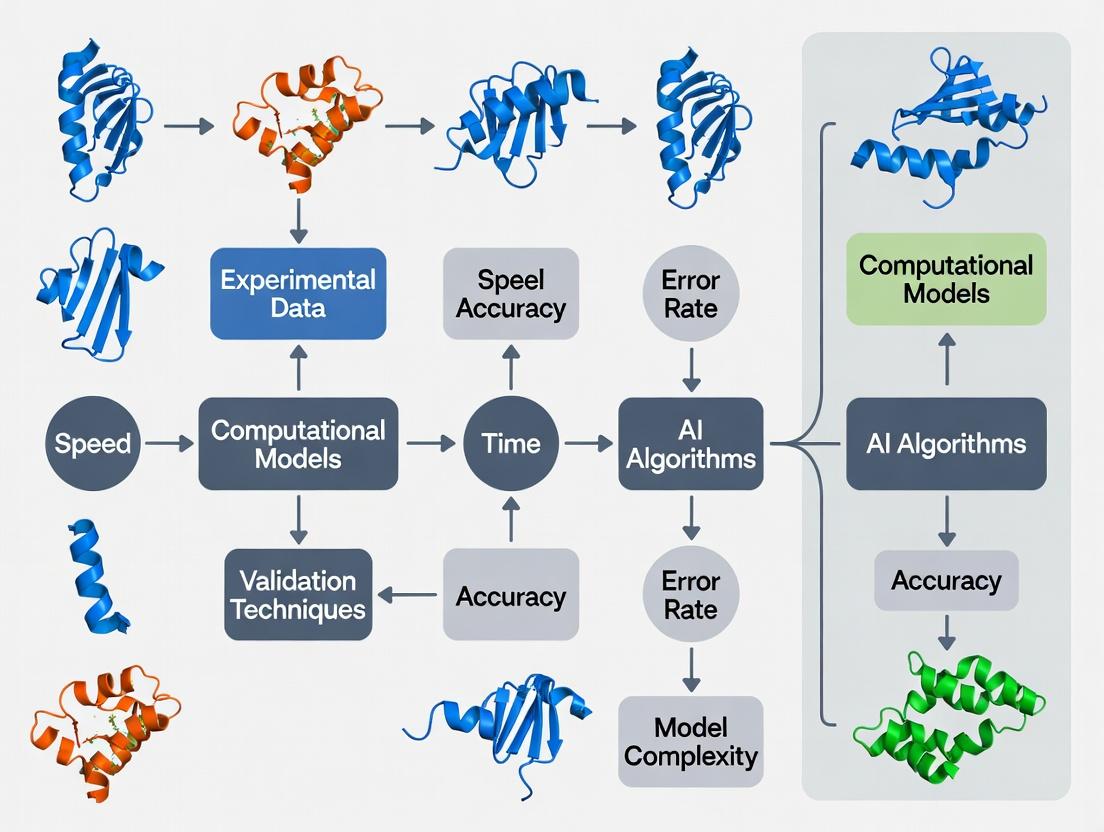
This article provides a comprehensive analysis of the critical trade-off between speed and accuracy in computational structure prediction for biomedical research.
The Prediction Paradox: Strategies for Balancing Speed and Accuracy in Protein & Molecular Structure Prediction
Abstract
This article provides a comprehensive analysis of the critical trade-off between speed and accuracy in computational structure prediction for biomedical research. Targeting researchers and drug development professionals, we explore the fundamental principles of this dichotomy, survey cutting-edge methodologies like AI/ML integration and hybrid pipelines, offer practical troubleshooting and optimization strategies for real-world projects, and establish frameworks for rigorous validation and comparative analysis. The article synthesizes actionable insights to empower scientists in designing efficient, reliable, and scalable prediction workflows.
The Fundamental Trade-off: Understanding the Core Dilemma of Speed vs. Accuracy in Computational Biology
Technical Support Center: Troubleshooting Guides and FAQs
FAQ Section: Common Issues in Structure Prediction Workflows
Q1: During high-throughput virtual screening, my molecular docking results show an unusually high number of false-positive hits with excellent docking scores but poor experimental activity. What could be the cause and how can I address this?
A: This is a common issue tied to the inherent speed/accuracy trade-off. Potential causes and solutions include:
- Cause: Overly simplistic scoring functions optimized for speed over physical accuracy.
- Solution: Implement a multi-stage filtering protocol. Use a fast, less accurate scoring function for initial screening (e.g., Vina, PLP) followed by re-scoring top hits with more rigorous, computationally expensive methods (e.g., MM-PBSA/GBSA, FEP+).
- Protocol: 1) Primary screen with docking software (Glide SP, AutoDock Vina). 2) Cluster top 1000 poses. 3) Re-score top 100 poses using MM-GBSA. 4) Visually inspect top 50 complexes. 5) Select top 20 for experimental testing.
Q2: When refining a predicted protein structure with molecular dynamics (MD) simulation, the RMSD relative to the starting model plateaus but remains high (>4 Å). Does this indicate a failed refinement or a conformational change?
A: A high, stable RMSD requires investigation.
- Troubleshooting Steps:
- Check RMSF: Analyze the Root Mean Square Fluctuation (RMSF). If fluctuations are high only in loop regions, the core fold may be stable.
- Cluster Analysis: Perform clustering on the MD trajectory. A single dominant cluster suggests convergence to a stable, albeit different, conformation. Multiple clusters suggest the simulation hasn't converged.
- Experimental Validation Cross-Check: Compare the MD-refined model's pocket geometry or surface features with any available mutagenesis or biochemical data. Disagreement may suggest an incorrect initial model.
- Protocol for MD-Based Refinement: 1) Solvate the predicted model in a TIP3P water box. 2) Neutralize system with ions. 3) Minimize energy (5000 steps). 4) Heat system to 300K over 100 ps. 5) Equilibrate at 1 atm for 1 ns. 6) Production run (100 ns - 1 μs). 7) Analyze trajectory using RMSD, RMSF, and cluster analysis (e.g., with GROMACS and MDAnalysis).
Q3: My AlphaFold2 or RoseTTAFold prediction for a multi-domain protein has high per-residue confidence (pLDDT) scores but the inter-domain orientation clashes with known cross-linking data. Which model should I trust?
A: Trust the experimental data. AI predictions are statistical models of likely folds, not physical simulations.
- Actionable Guide: Use the experimental data as a restraint in subsequent refinement.
- Filter: Use the predicted aligned error (PAE) matrix from AlphaFold2 to see if low confidence is associated with the inter-domain region.
- Integrate: Convert cross-linking distance constraints (e.g., Cα-Cα < 30 Å for a specific lysine-lysine cross-linker) into harmonic restraints.
- Refine: Run a short, restrained MD simulation or use molecular modeling software (e.g., MODELLER, Rosetta) to satisfy the experimental constraints while maintaining high-confidence domain folds.
Quantitative Data Comparison: Speed vs. Accuracy in Common Methods
| Method | Typical Time per Structure | Typical Resolution/Accuracy | Best Use Case | Key Limitation |
|---|---|---|---|---|
| Virtual Screening (Docking) | 1-60 seconds | Ligand RMSD: 2-5 Å; Poor binding affinity prediction | Identifying hit compounds from million-scale libraries | Scoring function inaccuracy; Rigid receptor approximation |
| Homology Modeling | Minutes to Hours | ~1-5 Å Cα RMSD (vs. template) | When a >30% identity template exists | Template bias; Loop and side-chain errors |
| AlphaFold2 | Minutes to Hours | Median ~1 Å for single chains (CASP14) | De novo prediction of monomeric folds | Dynamics & multimeric states; Ligand binding sites |
| Molecular Dynamics (Refinement) | Days to Months | Can improve models by 0.5-2 Å RMSD | Refining models, studying dynamics & stability | Extreme computational cost; Force field accuracy |
| Cryo-EM Single Particle | Weeks to Months | 3-5 Å (routine), <2.5 Å (high-end) | Large complexes, membrane proteins | Sample preparation; Requires expensive instrumentation |
| X-ray Crystallography | Weeks to Years | <1.5 Å (Atomic) | Atomic detail, small molecules, well-diffracting crystals | Requires crystallization; Static snapshot |
Experimental Protocol: Integrated Workflow for Hit-to-Lead Optimization
Title: Integrated Protocol for Balancing Speed and Accuracy in Structure-Based Lead Optimization
Objective: To rapidly optimize a hit compound's potency using iterative computational prediction and experimental validation.
Materials: Docked hit-receptor complex, High-performance computing cluster, Molecular dynamics software (e.g., AMBER, GROMACS), Free energy perturbation software, Protein expression & purification system, Microscale thermophoresis/SPR/isothermal titration calorimetry.
Procedure:
- Initial Model Preparation: Prepare the protein-ligand complex from the HTS docking hit. Add hydrogens, assign partial charges (e.g., using antechamber), and parameterize the ligand.
- Fast Alanine Scanning: Perform a computational alanine scan on binding site residues using a method like FoldX (takes ~1 hour) to identify "hotspot" residues critical for binding.
- Focused Library Design: Based on the ligand's interaction with hotspots, generate a focused library of ~100-200 analog structures.
- Multi-Stage Docking & Scoring:
- Stage 1 (Speed): Dock all analogs using a fast scoring function (Vina). Select top 30 poses.
- Stage 2 (Accuracy): Re-score the top 30 poses using MM-GBSA. Select top 10 compounds.
- Binding Affinity Prediction: For the top 3-5 compounds, run absolute binding free energy calculations (e.g., FEP+) if resources allow (weeks of computation).
- Experimental Validation: Synthesize or purchase the top 2-3 predicted compounds. Measure binding affinity (Kd) using a biophysical method (e.g., MST). Iterate from Step 3 with new data.
Visualizations
Title: Workflow: Balancing Speed & Accuracy in Drug Discovery
Title: Method Spectrum: Speed vs. Accuracy Trade-off
The Scientist's Toolkit: Essential Research Reagents & Materials
| Item | Function in Structure Prediction Pipeline | Example Product/Category |
|---|---|---|
| Purified Target Protein | Essential for experimental validation (biophysics, crystallography) and binding assays. | Recombinant protein, >95% purity, validated activity. |
| Chemical Fragment Library | For initial experimental screening to inform computational modeling of the binding site. | 500-2000 compounds, high solubility, known 3D coordinates. |
| Crystallization Screen Kits | To obtain atomic-resolution experimental structures for validation and template-based modeling. | Sparse-matrix screens (e.g., Hampton Research, Molecular Dimensions). |
| Cross-linking Reagents | To obtain distance restraints for validating predicted multi-domain or complex structures. | DSSO, BS3 (for mass spectrometry analysis). |
| Thermal Shift Dye | For fast, low-cost experimental validation of ligand binding (thermal shift assay). | SYPRO Orange, NanoDSF-capable instruments. |
| High-Fidelity Polymerase | For gene amplification and cloning to produce mutant proteins for validating predicted interactions. | Phusion, Q5. |
| GPU Computing Cluster Access | To run deep learning (AlphaFold2) and molecular dynamics simulations in a feasible timeframe. | NVIDIA A100/V100 nodes, cloud computing credits. |
| Specialized Software Licenses | For docking, molecular dynamics, and free energy calculations. | Schrödinger Suite, AMBER, GROMACS, Rosetta. |
Troubleshooting & FAQs
Q1: My AlphaFold2/ColabFold job is running out of memory (OOM) on my local GPU. What are the most effective parameters to reduce resource use while maintaining acceptable accuracy for initial screening? A: OOM errors typically occur during the Evoformer and structure module execution. To mitigate:
- Reduce
max_msaandmax_extra_msa: These control the number of sequence clusters and extra sequences used. For a 500-residue protein, trymax_msa:128andmax_extra_msa:1024(defaults are 512 and 1024, respectively). This directly reduces the MSA attention computation. - Use
unpaired_pdbinstead ofpaired_pdbfor templates: Thepaired_pdbmode is more accurate but requires significantly more memory. For initial runs, theunpaired_pdbtemplate mode is less memory-intensive. - Enable
low_memorymode in ColabFold: While slower, this trades compute time for reduced peak memory usage via gradient checkpointing. - Quantitative Impact: The table below summarizes the trade-offs.
| Parameter Adjustment | Approx. Memory Reduction | Expected ΔpLDDT (Accuracy) | Use Case |
|---|---|---|---|
max_msa:128 |
~30-40% | -1 to -3 points | Large-protein screening |
unpaired_pdb templates |
~20% | -0.5 to -2 points | When templates are low-confidence |
| 3 vs. 5 recycling steps | ~15% per step | -0.5 to -1.5 points per step | Convergent predictions |
Experimental Protocol for Parameter Sweeping:
- Target Selection: Choose a well-characterized protein of similar size to your target (e.g., PDB: 1A3A).
- Baseline Run: Execute prediction with default parameters (
max_msa:512,paired_pdbtemplates, 3 recycles). Record final pLDDT, ptmDTM scores, and GPU memory (vianvidia-smi). - Variable Runs: Run identical jobs, systematically varying one parameter (e.g.,
max_msaat 256, 128, 64). - Analysis: Plot pLDDT vs. memory usage and inference time. Determine the "knee in the curve" where accuracy loss accelerates.
Q2: When using molecular dynamics (MD) for relaxation/refinement after a neural network prediction, how do I decide between a fast (implicit solvent, 1ns) and a rigorous (explicit solvent, 50+ ns) simulation protocol? A: The choice hinges on the prediction's initial confidence and the biological question.
| Protocol | Computational Cost (CPU-hours) | Recommended For | Not Recommended For |
|---|---|---|---|
| Fast Implicit Solvent | 50-200 | High-confidence regions (pLDDT > 85), rapid side-chain packing, large-scale mutational screening. | Low-confidence loops, binding free energy calculations, folding simulations. |
| Explicit Solvent Long MD | 5,000-50,000 | Refining low-confidence flexible regions (pLDDT < 70), preparing structures for docking, assessing conformational stability. | High-throughput tasks or when the initial model is very poor (requires fold-level sampling). |
Detailed Protocol for Fast Implicit Solvent Relaxation (using AMBER):
- System Preparation: Use
pdb4amberto clean the PDB. Add hydrogens withreduce. - Parameter Assignment: Apply the
ff19SBforce field. - Solvation & Minimization: Solvate in a Generalized Born (GB) implicit solvent model (e.g.,
OBC1). Perform 500 steps of steepest descent minimization. - Thermalization & Production: Heat system to 300K over 20ps. Run 1ns of production MD with a 2fs timestep.
- Analysis: Extract the lowest potential energy frame as the refined model. Calculate RMSD from the initial prediction.
Q3: For docking small molecules, when should I use ultra-high-throughput virtual screening (Vina, 1 minute/pose) versus more expensive, accuracy-focused methods (FEP, 1 day/compound)? A: This is a classic speed/accuracy trade-off. Use a tiered funnel approach.
- Tier 1 - Ultra-High-Throughput: Screen 1M+ compounds using AutoDock Vina or QuickVina 2. Use a large grid box and low exhaustiveness (e.g., 8). Goal: 99.5% enrichment, not precise ranking.
- Tier 2 - Accuracy-Focused: Take the top 1,000 hits from Tier 1. Re-dock using GNINA (CNN scoring) or Glide SP/XP with stricter parameters and explicit water handling.
- Tier 3 - Free Energy Calculations: For the top 50-100 compounds, run alchemical Free Energy Perturbation (FEP) using Schrödinger FEP+ or OpenMM. This provides quantitative binding affinity predictions (goal: ~1 kcal/mol error).
Experimental Protocol for Tiered Screening Validation:
- Positive/Negative Control: Use a known binder (positive control) and a decoy (negative control) from the Directory of Useful Decoys (DUD-E).
- Metric: Calculate the Enrichment Factor (EF) at 1% of your library size for each tier. EF = (% actives in your top 1%) / (% actives in full database).
- Cost-Benefit Table:
| Screening Tier | Avg. Time per Compound | Approx. Cost per 10k Cpds* | Expected Correlation (R²) to Experiment |
|---|---|---|---|
| Vina (Tier 1) | 0.5 - 2 min | $20 (Cloud) | 0.2 - 0.4 |
| GNINA/Glide (Tier 2) | 5 - 15 min | $150 (Cloud) | 0.4 - 0.6 |
| FEP (Tier 3) | 24 - 72 hrs | $5,000 (HPC Cluster) | 0.6 - 0.8 |
*Cost estimates are for cloud/on-prem compute resources, excluding software licensing.
The Scientist's Toolkit: Research Reagent Solutions
| Item | Function & Rationale |
|---|---|
| AlphaFold2 (Local) / ColabFold | Core prediction engine. ColabFold offers faster, less resource-intensive MSA generation via MMseqs2. |
| OpenMM | Open-source MD engine for running explicit solvent simulations and FEP calculations with GPUs. |
| ChimeraX | Visualization and analysis. Critical for comparing predicted models, measuring RMSD, and preparing figures. |
| PyMOL | Alternative for high-quality rendering and presentation of molecular structures. |
| Rosetta Relax Protocol | Alternative to MD for fast, in-silico refinement of protein structures using a scoring function. |
| PDBfixer | (From OpenMM suite) Corrects common issues in PDB files (missing atoms, residues) before simulation. |
| GNINA | Docking software that uses convolutional neural networks for improved pose prediction and scoring. |
| AMBER/GAFF Force Fields | Parameter sets for modeling proteins and small molecules in MD simulations. |
Visualizations
Title: AlphaFold2 Prediction & Refinement Workflow
Title: Tiered Virtual Screening Funnel
Troubleshooting Guide & FAQs for Structure Prediction Experiments
FAQ 1: Why does my AI-predicted protein structure show high per-residue confidence (pLDDT) but poor overall stereochemical quality when validated?
- Answer: This is a classic speed-accuracy trade-off symptom. High-throughput AlphaFold2 or RoseTTAFold runs often use reduced template or recycle settings for speed, which can yield globally plausible but locally strained structures. To resolve, increase the number of recycles (--num_recycle in AlphaFold2, typically from 3 to 12 or 20) and enable template mode. This increases computation time significantly but improves side-chain packing and backbone angles.
FAQ 2: My molecular dynamics (MD) simulation of a predicted protein-ligand complex becomes unstable within nanoseconds. What steps should I take?
- Answer: Fast, automated docking and short MD equilibration protocols, while time-efficient, often produce unstable complexes. Follow this protocol:
- Re-dock: Use a more accurate, slower docking program (e.g., GLIDE SP or XP mode vs. high-throughput virtual screening).
- Extended Equilibration: Before production MD, run a multi-step equilibration:
- 100 ps NVT with heavy restraints on protein and ligand.
- 100 ps NPT with restraints on protein backbone and ligand.
- 100 ps NPT with restraints on protein C-alpha only.
- Explicit Solvation & Ions: Ensure the system uses explicit water (e.g., TIP3P) and physiological ion concentration (0.15M NaCl).
FAQ 3: How do I decide between a faster ab initio method and a slower, template-based method for a novel fold?
- Answer: The decision tree depends on remote homology detection. Run a sensitive sequence profile (HHblits, JackHMMER) against the PDB. If no templates with E-value < 0.001 are found, ab initio (like AlphaFold2 without templates) is your only option. If weak templates exist (E-value 0.001-0.1), use a hybrid method: run both fast ab initio and slower template-based folding, then compare consensus using a metric like TM-score. Investing time in the template-based run often provides a more accurate starting model for drug docking.
Experimental Protocol: Validating a Predicted Protein-Ligand Binding Pose Objective: To determine the accuracy of a computationally docked pose using a biophysical assay. Methodology:
- Protein Expression & Purification: Clone gene into pET vector, express in E. coli BL21(DE3), purify via Ni-NTA affinity and size-exclusion chromatography.
- Ligand Preparation: Obtain compound (>95% purity). Prepare 10 mM stock in DMSO.
- Surface Plasmon Resonance (SPR):
- Immobilize purified protein on a CMS chip via amine coupling to ~5000 RU.
- Run a 2-fold dilution series of ligand (from 50 µM to 0.39 µM) in running buffer (PBS + 0.05% Tween20, 2% DMSO).
- Contact time: 60 s, dissociation time: 120 s, flow rate: 30 µL/min.
- Fit sensograms to a 1:1 binding model to calculate KD.
- Comparison: If the experimental KD is within 10-fold of the computational predicted binding affinity (ΔG), the pose is considered plausible for further optimization. Major discrepancies require re-docking with the experimental data as a constraint.
Quantitative Data Summary: Impact of Prediction Parameters on Output
Table 1: AlphaFold2 Performance vs. Computational Time on a Standard GPU (NVIDIA V100)
| Parameter Set | Avg. pLDDT (Model 1) | Avg. TM-score | Wall-clock Time | Recommended Use Case |
|---|---|---|---|---|
| Fast (no templates, 3 recycles) | 85.2 | 0.89 | ~30 min | High-throughput target screening |
| Standard (with templates, 3 recycles) | 88.7 | 0.92 | ~1.5 hours | Standard single-target prediction |
| High Accuracy (with templates, 12 recycles) | 91.5 | 0.94 | ~6 hours | Critical drug target for lead optimization |
| Full DB Search (max templates, 20 recycles) | 92.1 | 0.95 | ~48 hours* | Final validation for clinical candidate |
*Time scales with MSA depth and sequence length.
Table 2: Error Rates in Virtual Screening Campaigns (2020-2023 Meta-Analysis)
| Screening Method | Avg. False Positive Rate | Avg. Hit Rate (Experimental) | Avg. Project Timeline (to hit validation) |
|---|---|---|---|
| Ultra-Fast (2D similarity, single docking) | 40-60% | 1-2% | 2-3 months |
| Balanced (ensemble docking, MD filter) | 20-35% | 5-10% | 4-6 months |
| Stringent (free energy perturbation, extensive MD) | 10-15% | 15-25% | 8-12 months |
Visualizations
Title: Speed vs Accuracy Decision Path in Early Discovery
Title: Structure Prediction Workflow with Parameter Inputs
The Scientist's Toolkit: Key Research Reagent Solutions
Table 3: Essential Materials for Structure Prediction & Validation
| Item | Function & Rationale |
|---|---|
| pET-28a(+) Vector | Standard bacterial expression vector with N-terminal His-tag for high-yield protein purification required for experimental validation. |
| Ni-NTA Superflow Resin | For immobilised metal affinity chromatography (IMAC) to rapidly purify His-tagged recombinant protein. |
| SEC Column (HiLoad 16/600 Superdex 200 pg) | For size-exclusion chromatography to purify protein to homogeneity and assess monomeric state—critical for accurate biophysics. |
| Biacore T200/Cytiva Series S CM5 Chip | Gold-standard SPR sensor chip for label-free, kinetic analysis of protein-ligand interactions to validate computational poses. |
| Molecular Dynamics Software (e.g., GROMACS, AMBER) | Open-source/licensed packages for running MD simulations to assess predicted complex stability and refine models. |
| Cryo-EM Grids (Quantifoil R1.2/1.3, 300 mesh Au) | For high-resolution structure determination of difficult targets unsuitable for crystallography, providing "ground truth." |
Troubleshooting Guide & FAQs
Q1: My homology model built with MODELLER has poor stereochemical quality (e.g., high Ramachandran outliers). What are the primary troubleshooting steps? A: This is a classic accuracy vs. speed trade-off. High outliers often stem from a poor template or incorrect alignment.
- Check Alignment: Manually inspect and refine the target-template sequence alignment. Even a single misaligned residue in a loop or secondary structure element can cause major distortions. Use multiple alignment tools (ClustalΩ, MAFFT) for consensus.
- Template Selection: If possible, use a template with higher sequence identity (>30-35%) and a solved structure in a similar conformation (active vs. inactive state). Consider using multiple templates for different domains.
- Sampling: Increase the number of models generated (e.g., from 5 to 50). MODELLER's
automodelroutine samples conformational space; more models increase the chance of a near-native structure. - Refinement: Subject your final model to a short, restrained molecular dynamics simulation in explicit solvent to relax clashes and improve side-chain rotamers.
Q2: When using AlphaFold2 (ColabFold) locally or on a cluster, I encounter "CUDA Out of Memory" errors. How can I proceed without a larger GPU? A: This balances computational speed (batch size, model size) against hardware limits.
- Reduce Model Size: Use the
--amberand/or--templatesflags selectively. Running the relaxation (AMBER) stage separately after prediction can save memory. - Adjust Sampling: Reduce the number of
num-recycle. The default is 3; try 1 or 2 for an initial test. Also, decreasenum-modelsfrom 5 to 1 or 3. - Sequence Chunking: For very long sequences (>1500 aa), use the
--chunk-sizeparameter (e.g.,--chunk-size 256) to process the sequence in overlapping segments. - Use CPU Mode: As a last resort, run with
--cpuonly. This is significantly slower but bypasses GPU memory constraints entirely.
Q3: The predicted aligned error (PAE) plot from my AlphaFold2 run shows low confidence (high error) for a specific domain or loop. How should I interpret and address this? A: The PAE plot is a critical accuracy metric, quantifying the model's self-estimated confidence.
- Interpretation: High inter-domain PAE (>15-20 Å) suggests flexible linkage between domains. High intra-domain PAE indicates intrinsically disordered regions or regions with no evolutionary constraints (e.g., long surface loops).
- Action - Template Search: Use this low-confidence region to search for a direct homologous template (via HHsearch) and build a targeted hybrid model, grafting the template loop onto the AF2 model.
- Action - Sampling: For loops, run dedicated loop modeling protocols (like RosettaNGK or MODELLER loop refinement) which sample more conformations than AF2's recycling steps, trading speed for local accuracy.
- Biological Insight: This may be a genuine feature—functionally important flexible regions. Consider complementary experiments (SAXS, NMR) to probe dynamics.
Q4: For molecular replacement in crystallography, when should I use a pure AlphaFold2 model vs. a refined hybrid model? A: This is a direct application of the speed-accuracy balance.
- Use Pure AlphaFold2 Model: For initial, rapid phasing attempts, especially if the predicted pLDDT is high (>85) across the entire chain and the PAE shows a rigid fold. This is the fastest path.
- Build a Hybrid Model: If phasing with the pure model fails, and your PAE/alignment suggests a reliable template exists for a low-confidence region, create a hybrid. This increases accuracy at the cost of manual modeling time. Always remove predicted disordered N/C-termini before running MR.
Experimental Protocols & Methodologies
Protocol 1: Building a Hybrid Model Using a High-Confidence AlphaFold2 Core and a Templated Loop
Objective: Integrate the global accuracy of AF2 with local precision from a homologous template for a problematic loop region (residues 50-65). Materials: See "Research Reagent Solutions" table. Procedure:
- Run AlphaFold2 (via ColabFold) on your target sequence. Download the highest-ranked model (
*_rank_1_*.pdb) and the PAE JSON file. - Visualize the PAE plot. Identify the low-confidence loop (high intra-chain error for residues 50-65).
- Perform a HHsearch (via the HMMER web server) of the target sequence against the PDB. Identify a homologous structure containing a resolved loop for your target region.
- Structurally align the template loop (residues 50-65) to the AF2 model core (residues 1-49 and 66-end) using PyMOL's
alignorsupercommand, minimizing RMSD in the stem regions. - In PyMOL, create a hybrid model by combining (
save) the AF2 core (with the original loop deleted) and the newly aligned template loop. - Perform energy minimization on the loop and its immediate surroundings (10 Å) using UCSF Chimera's
Minimize Structuretool (AMBER ff14SB force field, 100 steps) to relieve steric clashes.
Protocol 2: Comparative Assessment of Model Accuracy Using CASP Metrics
Objective: Quantitatively evaluate a newly generated model against a recently released experimental structure.
Materials: Your model (.pdb), the experimental structure (.pdb), and Molprobity or SWISS-MODEL Assessment server.
Procedure:
- Prepare Structures: Remove all heteroatoms and water molecules from both files. Ensure both structures contain the same residue numbering for the region of interest.
- Global Accuracy - TM-score: Upload both files to the TM-score web server. A TM-score >0.5 suggests a correct fold; >0.8 indicates high accuracy.
- Local Accuracy - RMSD: Perform a structural alignment in PyMOL (
align your_model, experimental_structure). Note the Ca-RMSD value. Lower is better (<2 Å for core regions). - Stereochemical Quality: Upload your model to the Molprobity server. Analyze key outputs:
- Ramachandran outliers (%): Target <0.5%.
- Clashscore: Target <5.
- CaBLAM outliers: Target <2%.
- Documentation: Record all metrics in a comparative table (see below).
Data Presentation
Table 1: Comparative Analysis of Protein Structure Prediction Methods
| Method (Example Tool) | Typical Speed (per target) | Typical Accuracy (Ca-RMSD vs. Experimental) | Key Strength | Primary Limitation |
|---|---|---|---|---|
| Homology Modeling (MODELLER, SWISS-MODEL) | Minutes to Hours | 1-5 Å (highly template-dependent) | Fast, explains known structural relationships. | Requires a close template (>25% seq. identity). |
| Threading/Fold Recognition (I-TASSER, Phyre2) | Hours | 3-8 Å (for distant homology) | Can detect remote homology when sequence alignment fails. | Less reliable for novel folds; accuracy varies. |
| Ab Initio/Physics-Based (Rosetta) | Days to Weeks | 3-10 Å (for small proteins) | Theoretically can model any fold; no template needed. | Computationally prohibitive for large proteins; low success rate. |
| Deep Learning (AlphaFold2) | Minutes to Hours | 0.5-2 Å (for most single-domain proteins) | Exceptional accuracy, even without clear templates. | Can struggle with multimers, large conformational changes, and novel orphan folds. |
| Ensemble/Hybrid Methods (AlphaFold2 + Template) | Hours to a Day | Can improve local accuracy by 0.5-1.5 Å over single method | Leverages strengths of multiple approaches; customizable. | Requires manual intervention and expertise. |
Table 2: Key Metrics for Model Quality Assessment
| Metric | Tool/Source | Ideal Value | Interpretation for Model Reliability |
|---|---|---|---|
| pLDDT | AlphaFold2 Output | >90 (Very High) | High confidence in atomic-level accuracy. |
| 70-90 (Confident) | Good backbone, variable side-chain accuracy. | ||
| <50 (Low) | Region likely disordered or unpredictable. | ||
| Predicted Aligned Error (PAE) | AlphaFold2 Output | Low Error (Dark Blue) | Confident in relative position/distance between residues. |
| High Error (Yellow/Red) | Uncertain spatial relationship (flexibility or disorder). | ||
| TM-score | TM-score Algorithm | 0-1 (1=perfect) | >0.5: Correct topological fold. >0.8: High accuracy. |
| Ramachandran Outliers | Molprobity, PROCHECK | <0.5% | Indicates good stereochemical backbone quality. |
| Clashscore | Molprobity | <5 | Low number of severe atomic steric overlaps. |
Mandatory Visualizations
Title: Decision Workflow for Modern Structure Prediction
Title: AlphaFold2 Architecture & Output Workflow
The Scientist's Toolkit: Research Reagent Solutions
| Item | Function in Structure Prediction | Example/Note |
|---|---|---|
| Multiple Sequence Alignment (MSA) Database (UniRef, BFD, MGnify) | Provides evolutionary constraints essential for deep learning methods like AlphaFold2. Depth and diversity of MSA are critical for accuracy. | ColabFold default: UniRef30 (2022-03). |
| Template Structure Database (PDB) | Provides high-accuracy structural fragments for homology modeling and to guide deep learning models. | Always check release date; use latest. |
| Modeling Software Suite (PyMOL, ChimeraX, MODELLER) | For visualization, manual model building/editing, structural alignment, and hybrid model creation. | PyMOL is industry standard for visualization. |
| Validation Server (Molprobity, SWISS-MODEL Assessment) | Provides objective metrics on stereochemical quality, clash scores, and overall model plausibility. | Essential before publication or experimental use. |
| High-Performance Computing (HPC) Resources | Local GPU clusters or cloud computing credits (AWS, GCP) are necessary for running advanced models like AlphaFold2 on large proteins/complexes. | ColabFold provides free but limited access. |
| Specialized Modeling Tools (Rosetta, Amber, GROMACS) | For advanced refinement (molecular dynamics) and scoring of models, especially for docking or conformational sampling. | Used for post-prediction refinement. |
Advanced Methodologies: Cutting-Edge Tools and Hybrid Pipelines for Efficient & Accurate Predictions
Technical Support Center: Troubleshooting & FAQs for AI-Driven Protein Structure Prediction
This support center is designed within the thesis context of Balancing Speed and Accuracy in Structure Prediction Research. It addresses common issues encountered when using state-of-the-art AI models, helping researchers optimize their workflow for their specific need for rapid screening or high-accuracy analysis.
Frequently Asked Questions (FAQs)
Q1: My AlphaFold2/3 or ColabFold prediction for a monomeric protein has low pLDDT scores (<70) in specific regions. Does this always mean the structure is wrong? A: Not necessarily. Low confidence regions often correspond to intrinsically disordered regions (IDRs) or areas with high conformational flexibility. The model is accurately reporting its uncertainty. Cross-reference with disorder prediction tools like IUPred2A or check for coiled-coil predictions. For drug target sites, consider if the low-confidence region is in the binding pocket; if so, experimental validation is strongly recommended.
Q2: When using RoseTTAFold for a protein-protein complex, the predicted interface has high pae but the monomers look correct. What steps should I take? A: High interface PAE indicates uncertainty in the relative orientation. First, ensure your multiple sequence alignment (MSA) for the complex includes co-evolutionary signals (i.e., sequences where both partners are present). Try providing a weak constraint or distance hint based on known biological data (e.g., a known residue contact from mutagenesis studies). Alternatively, run the prediction with different random seeds to generate an ensemble and see if a consistent interface emerges.
Q3: ESMFold is incredibly fast but sometimes yields topologies different from AlphaFold. Which result should I trust? A: ESMFold's speed comes from bypassing the MSA, relying solely on the language model. This can be advantageous for orphan proteins or de novo designs but may lack evolutionary constraints. Use ESMFold for high-throughput scanning or when MSAs are poor/non-existent. For final, high-confidence predictions, prioritize AlphaFold2/3 or RoseTTAFold results, which integrate co-evolutionary information. The discrepancy itself is a valuable hypothesis generator about protein evolution and fold uniqueness.
Q4: How do I handle the prediction of large protein complexes (>1500 residues) that exceed the default memory limits? A: All major models now support "chunking" or tiling strategies.
- AlphaFold/ColabFold: Use the
--max-template-dateand--is-prokaryoteflags correctly to limit unnecessary database searches. For ColabFold, enable the "sequential" mode for the complex. - RoseTTAFold: The standalone version allows for explicit control of MSA depth (
-max_msa) to reduce memory. Use the-num 1flag to generate fewer models initially. - General Protocol: Consider breaking the complex into stable subdomains or pairs, predicting them individually, and then using a docking program like HADDOCK or ClusPro with the AI predictions as inputs, guided by the interface predictions from the full-complex low-resolution run.
Q5: The predicted structure has a stereochemical outlier (e.g., twisted peptide bond). How can I fix this? A: AI models prioritize global fold accuracy and may tolerate minor local violations. Do not use raw AI outputs for molecular dynamics or detailed mechanistic studies without refinement.
- Perform a short energy minimization using a tool like
AMBERorGROMACSwith restraints on the backbone (CA atoms) to preserve the overall fold while fixing clashes and angles. - Use dedicated refinement tools like
Rosetta relaxorModRefiner, which are designed to correct these issues while staying near the initial prediction. - Always validate the final refined model with
MolProbityorWHAT-IFto check geometry.
Comparative Performance Data (Summarized)
Table 1: Key Quantitative Metrics for Major Structure Prediction AI Models (Approximate Benchmarks)
| Model | Typical Runtime (Single Protein) | Key Accuracy Metric (Avg. on CASP14) | Primary Input | Ideal Use Case |
|---|---|---|---|---|
| AlphaFold2/3 | Minutes to Hours (varies) | GDT_TS ~92 (CASP14) | MSA + Templates | High-accuracy, definitive prediction; complexes. |
| ColabFold | <10-30 mins (GPU) | GDT_TS ~91 (CASP14) | MMseqs2 MSA (fast) | Rapid, near-AlphaFold2 accuracy without full DB setup. |
| RoseTTAFold | ~20-60 mins (GPU) | GDT_TS ~87 (CASP14) | MSA + Templates | Protein complexes, flexible with user constraints. |
| ESMFold | <1 second to seconds (GPU) | GDT_TS ~65-75 (orphan proteins) | Single Sequence Only | Ultra-high-throughput screening, metagenomics, poor MSA targets. |
Table 2: Troubleshooting Decision Guide: Speed vs. Accuracy Trade-off
| Your Research Goal | Recommended Primary Tool | Supporting Action for Accuracy | Expected Speed Gain |
|---|---|---|---|
| Screen 10,000 sequences for fold family | ESMFold | Cluster results; run top candidates via AlphaFold. | 1000x faster than full MSA methods |
| Predict a single, important drug target | AlphaFold2/3 or ColabFold | Generate multiple models; use alphafold-msa for deep MSA. |
Baseline for high accuracy |
| Model a complex with known site mutation data | RoseTTAFold | Incorporate distance restraints from experiments. | Faster complex modeling than AF2 |
| Get a reliable structure in under 10 minutes | ColabFold (with Amber off) | Use --num-recycle 3 to balance time/quality. |
3-10x faster than full AlphaFold2 pipeline |
Experimental Protocol: Validating AI Predictions with Cross-Linking Mass Spectrometry (XL-MS)
This protocol is a key methodology for experimentally testing the accuracy of predicted protein complexes, directly addressing the speed-accuracy balance by providing empirical constraints.
Title: XL-MS Validation of Predicted Complex Structures Objective: To obtain distance constraints for validating or refining AI-predicted quaternary structures. Materials: Purified protein complex, DSSO or BS3 crosslinker, trypsin/Lys-C, LC-MS/MS system, data analysis software (e.g., XlinkX, plink 2.0). Procedure:
- Cross-linking: Incubate 50 µg of purified protein complex with 1 mM DSSO crosslinker in PBS, pH 7.5, for 30 min at 25°C. Quench with 50 mM Tris-HCl, pH 7.5, for 15 min.
- Digestion: Denature with 2 M urea, reduce with 5 mM DTT, alkylate with 15 mM iodoacetamide. Digest with trypsin/Lys-C mix overnight at 37°C.
- LC-MS/MS Analysis: Desalt peptides. Analyze using a Q-Exactive HF mass spectrometer coupled to an Easy-nLC 1200. Use a data-dependent acquisition method with stepped HCD collision energies to capture cross-link fragments.
- Data Analysis: Identify cross-linked peptides using dedicated software (XlinkX, plink 2.0). Filter for high-confidence identifications (FDR < 1%).
- Validation/Refinement: Map identified cross-links (Cα-Cα distance typically < 30 Å) onto the AI-predicted complex structure. Use consistent cross-links as validation. Use inconsistent cross-links with high confidence to guide iterative refinement in HADDOCK or using Rosetta's constraint protocol.
The Scientist's Toolkit: Key Research Reagent Solutions
Table 3: Essential Materials for AI-Driven Structure Prediction Workflow
| Item | Function / Example | Role in Balancing Speed/Accuracy |
|---|---|---|
| MMseqs2 Software Suite | Rapid, sensitive sequence searching and MSA generation. | Drastically reduces MSA generation time from hours to minutes for ColabFold, with minimal accuracy loss. |
| AlphaFold DB | Repository of pre-computed predictions for the proteome. | Ultimate speed (instant access) for known structures; accuracy is fixed at time of DB generation. |
| PyMOL / ChimeraX | Molecular visualization software. | Critical for qualitative accuracy assessment (visual inspection of folds, pockets, interfaces). |
| pLDDT & PAE Plots | Built-in per-residue and pairwise confidence metrics from models. | Quantitative, model-generated accuracy estimates. Guide where to trust the prediction. |
| HADDOCK / ClusPro | Integrative docking platforms. | Refine low-confidence multimer predictions by incorporating AI outputs as starting models and experimental data as constraints. |
| MolProbity Server | All-atom structure validation tool. | Provides independent, geometric accuracy scoring to identify local errors in AI models post-prediction. |
Visualization: Experimental Workflows
Title: AI Structure Prediction Decision Workflow
Title: Core Architectural Logic of AI Prediction Models
This technical support center provides guidance for implementing hybrid structure prediction strategies. Framed within the thesis of balancing speed and accuracy, these resources address practical challenges researchers face when integrating rapid template-based modeling with high-precision refinement methods like ab initio folding or molecular dynamics (MD).
Troubleshooting Guides & FAQs
Q1: My template-based model has a high overall RMSD but excellent local geometry in the core. Should I refine the entire structure or just loop regions? A: Prioritize targeted refinement. Use the core as a fixed anchor and perform ab initio or MD refinement only on the low-confidence loop regions and termini. This preserves accurate domains while improving problematic segments.
Q2: During MD refinement, my protein backbone drifts excessively (>3 Å RMSD) from the initial template model, losing potentially correct features. How can I constrain this? A: Apply restrained MD. Use harmonic positional restraints on the backbone atoms of secondary structure elements identified in the template model with high confidence (e.g., pLDDT > 80). Gradually release these restraints over the simulation course.
Q3: After ab initio refinement of a template-derived fragment, the refined region clashes with the stable core. What's the optimal protocol? A: Implement a multi-stage protocol: 1) Isolate the fragment and refine it in vacuo using ab initio. 2) Use rigid-body docking to reposition it against the core. 3) Run a short, all-atom MD simulation with explicit solvent to relax the interface and resolve clashes.
Q4: How do I decide whether to use ab initio or MD for refinement post-template modeling? A: Base the decision on time resources and target size. See the quantitative comparison below.
Table 1: Refinement Method Decision Matrix
| Criterion | Ab Initio Refinement | MD Refinement |
|---|---|---|
| Best For | Large insertions (>25 aa), no homologous folds, high de novo content | Improving side-chain packing, resolving local clashes, refining dynamics |
| Typical Time Scale | Hours to Days (GPU-accelerated) | Days to Weeks (depending on system size & sampling) |
| System Size Limit | Up to ~250 residues (efficiently) | Up to ~500 residues (explicit solvent, conventional MD) |
| Key Output Metric | Lowest energy structure's RMSD & MolProbity score | RMSD plateau, stable energy, & improved Ramachandran outliers |
| Computational Cost | Moderate-High (sampling-intensive) | Very High (explicit solvent, long time-steps) |
Q5: My hybrid pipeline results are inconsistent; sometimes refinement improves the model, sometimes it worsens it. How can I stabilize the process? A: Implement a consensus scoring approach. Generate multiple refined decoys (e.g., 5-10 from ab initio, 3-5 MD trajectories). Select the final model not by a single score but by consensus across multiple metrics (e.g., Rosetta energy, DOPE score, MolProbity, ProSA-web Z-score).
Experimental Protocols
Protocol 1: Targeted Hybrid Refinement for a Single Domain Protein (150-300 residues)
- Input: Template-based model (e.g., from AlphaFold2, MODELLER, or SWISS-MODEL).
- Region Identification: Use per-residue confidence scores (e.g., pLDDT) or visual inspection to identify low-confidence regions (typically <70).
- Segmentation: Separate the protein into a stable core (high-confidence regions) and target regions (low-confidence loops/termini).
- Decoy Generation for Target Regions:
- For each target region, run a focused ab initio fragment assembly (using Rosetta or similar) with harmonic distance restraints to the anchor residues at the junction with the stable core.
- Generate 1000-5000 decoys.
- Selection and Integration:
- Cluster decoys by RMSD and select the center of the largest cluster.
- Graft the selected refined fragment onto the stable core using SCWRL4 or RosettaFixBB for side-chain repacking.
- Global Relaxation: Perform a final all-atom energy minimization or a short (5-10 ns) restrained MD simulation in explicit solvent to relax the entire composite structure.
Protocol 2: MD-Based Refinement of a Template-Based Complex
- Input: Template-based protein-ligand or protein-protein complex model.
- System Preparation: Use CHARMM-GUI or
tleapto solvate the complex in a cubic water box, add ions to neutralize, and set ionic concentration to 0.15 M. - Equilibration: Run a multi-stage NVT/NPT equilibration with positional restraints on protein heavy atoms (force constant starting at 5.0 kcal/mol/Ų, reduced to 0 over 1 ns).
- Production MD: Run unrestrained production MD for a timeframe dependent on system size (e.g., 100-500 ns). Use a thermostat (e.g., Langevin at 300 K) and barostat (Berendsen or Monte Carlo).
- Analysis & Model Extraction:
- Monitor RMSD, radius of gyration, and interaction energies.
- After RMSD plateaus, cluster the trajectory frames (backbone RMSD cutoff 2.0 Å).
- Select the centroid of the most populated cluster as the refined model.
- Validate using H-bond networks, binding interface complementarity, and computational mutagenesis.
Visualizations
Diagram Title: Hybrid Structure Prediction Workflow
Diagram Title: Logical Relationship: Thesis to Hybrid Solution
The Scientist's Toolkit: Key Research Reagent Solutions
Table 2: Essential Materials & Software for Hybrid Strategy Experiments
| Item Name / Software | Category | Primary Function in Hybrid Strategy |
|---|---|---|
| AlphaFold2 (ColabFold) | Modeling Software | Provides fast, high-accuracy template-based (or template-free) starting models with per-residue pLDDT confidence metrics. |
| Rosetta Suite | Modeling Software | Workhorse for ab initio fragment assembly and refinement; used for targeted loop rebuilding and side-chain optimization. |
| GROMACS / AMBER | MD Software | Performs all-atom, explicit-solvent molecular dynamics simulations for high-precision refinement and stability assessment. |
| MODELLER | Modeling Software | Traditional tool for homology modeling; useful for generating alternative template alignments. |
| ChimeraX / PyMOL | Visualization | Critical for visual inspection of models, identifying clashes, and analyzing refinement results. |
| MolProbity / PHENIX | Validation Server | Provides comprehensive structure validation (steric clashes, rotamer outliers, Ramachandran plots) pre- and post-refinement. |
| CHARMM36 / AMBER ff19SB | Force Field | Provides the physical parameters for MD simulations, critical for accurate energy calculations and dynamics. |
| TIP3P / OPC Water Model | Solvent Model | Explicit water models used in MD simulations to solvate the protein and provide a realistic environment. |
| GPUs (NVIDIA A100/V100) | Hardware | Accelerates both deep learning-based template prediction (AlphaFold) and MD simulations dramatically. |
| High-Throughput Cluster | Hardware | Enables parallel generation of multiple refinement decoys and long-timescale MD replicates for consensus. |
Technical Support Center: Troubleshooting & FAQs
Frequently Asked Questions
Q1: During the initial fast filtering (Tier 1), my high-recall model is flagging over 95% of candidates, negating its speed benefit. What are the primary tuning knobs? A: This indicates a recall/specificity imbalance. Adjust the following in order:
- Classification Threshold: Lowering the probability threshold for inclusion increases recall but decreases precision. Start by raising it incrementally.
- Feature Set: Review features for relevance. Correlated or noisy features can degrade model discrimination. Use feature importance scores to prune.
- Model Choice: If using a simplistic model (e.g., Linear SVM), consider one with non-linear decision boundaries (e.g., Gradient Boosted Trees) while monitoring inference speed.
Q2: My high-accuracy Tier 2 (e.g., AlphaFold2) predictions are accurate but the pipeline throughput is too slow. How can I optimize? A: Optimize at the system and model level:
- Batch Processing: Ensure jobs are batched to maximize GPU utilization, not run serially.
- Template Restriction: For homologous targets, restrict the MSA/template search depth. This is the primary speed bottleneck.
- Hardware Check: Verify you are using a GPU with sufficient VRAM (>=16GB recommended). Monitor GPU utilization during runs; low utilization may indicate I/O or CPU bottlenecks.
- Early Stopping: Some systems allow prediction confidence estimation. Implement logic to abort low-confidence predictions early to save resources.
Q3: I encounter inconsistent results between pipeline runs with identical input data. What could cause this? A: Non-determinism is a common issue. Isolate the source:
- Tier 1 (ML Models): Set random seeds for all stochastic algorithms (e.g.,
random_statein scikit-learn,seedin TensorFlow/PyTorch). - Tier 2 (Structure Prediction): Check if your version of the prediction software uses stochastic sampling (e.g., in relaxation steps). Some tools have a deterministic mode flag.
- Concurrency: Race conditions in file I/O or database access in distributed workflows can cause inconsistencies. Implement proper job isolation and locking mechanisms.
Q4: How do I validate that the tiered system is providing a net benefit over a single-model approach? A: Conduct a cost-accuracy analysis. Measure:
- Compute Time: Record total wall-clock time for the full pipeline vs. running Tier 2 on all candidates.
- Accuracy Retention: Compare the accuracy (e.g., RMSD, GDT_TS) of final selected candidates from the tiered system vs. a Top-N selection from a hypothetical full Tier 2 run.
Validation Results Table
| Metric | Tiered System | Single-Tier (Tier 2 Only) | Benefit |
|---|---|---|---|
| Avg. Time per 1000 Candidates | 42 hours | 310 hours | 86% reduction |
| Mean RMSD of Top 50 Targets | 1.8 Å | 1.7 Å | 0.1 Å degradation |
| Cost per Candidate | $0.85 | $6.20 | 86% savings |
Q5: The handoff between my Tier 1 and Tier 2 systems is failing due to data format mismatches. What's the best practice? A: Implement a canonical data schema and validation layer. Use a structured format (e.g., JSON, Protocol Buffers) with a strict schema. The handoff service should validate all required fields (e.g., target sequence ID, pre-computed features, prior probability score) before Tier 2 execution. A lightweight Docker container can encapsulate this logic.
Experimental Protocols
Protocol 1: Establishing the Tier 1 High-Recall Filter Objective: Rapidly filter a large candidate pool (e.g., 100k proteins) to a manageable subset (~5-10%) with minimal false negatives. Methodology:
- Feature Engineering: Compute sequence-based features (e.g., length, amino acid composition, predicted disorder from
pyHCA, simple homology scores fromHMMER). - Model Training: Train a Gradient Boosting Classifier (e.g.,
XGBoost) on historical data labeled with "high-value" vs. "low-value" targets. - Calibration: Use Platt Scaling or Isotonic Regression to calibrate the model's output probabilities, ensuring they are meaningful for thresholding.
- Threshold Selection: On a validation set, identify the probability threshold that yields >98% recall while maximizing precision.
Protocol 2: Executing Tier 2 High-Accuracy Prediction Objective: Generate precise 3D structures for the Tier 1 output subset. Methodology:
- Input Preparation: Format the canonical JSON input containing target sequence and Tier 1 metadata.
- MSA Generation: Run
MMseqs2against the UniRef and environmental databases (configured for speed:--max-seqs 100 --num-iterations 2). - Structure Prediction: Execute
AlphaFold2orRoseTTAFoldin no-template (--notemp) mode for de novo targets, or with templates if homology is high. - Confidence Scoring: Extract the predicted local distance difference test (pLDDT) score. Structures with mean pLDDT < 70 are flagged for review or rejection.
Protocol 3: Cost-Benefit Analysis of Tiered System Objective: Quantify the trade-off between speed and accuracy. Methodology:
- Baseline: Run Tier 2 prediction on a representative, random sample of 500 candidates from the original pool. Record time and accuracy.
- Tiered Run: Execute the full tiered pipeline on the same 500 candidates.
- Comparison: Compare the top 50 candidates (by pLDDT) from both runs using structural alignment tools (
TM-score). Compute aggregate time and cloud compute cost.
Visualizations
Title: Tiered Prediction Workflow
Title: Speed vs Accuracy Trade-off Matrix
The Scientist's Toolkit: Research Reagent Solutions
| Item | Function in Tiered Systems | Key Consideration |
|---|---|---|
XGBoost / LightGBM |
Tier 1 ML model. Provides fast inference, good accuracy on structured features, and built-in feature importance. | Tune max_depth and n_estimators to balance speed and recall. |
MMseqs2 |
Ultra-fast protein sequence searching for MSA generation in Tier 2. Critical for speed. | Use pre-clustered target databases (e.g., UniClust30) to further accelerate searches. |
AlphaFold2 (ColabFold) |
High-accuracy Tier 2 prediction. ColabFold offers faster, optimized pipelines. | Manage GPU memory; use --amber flag only for final models to save time. |
Nextflow / Snakemake |
Workflow orchestrators. Manage dependencies, execution, and scaling of multi-tier pipelines across compute clusters. | Implement robust error-handling and checkpointing for long runs. |
pLDDT Score |
Per-residue and global confidence metric from AlphaFold2. Primary criterion for final prioritization. | Aggregate (mean) pLDDT is a reliable proxy for model accuracy. Use for ranking. |
Redis / RabbitMQ |
Message broker / queue. Manages the handoff between Tiers 1 and 2, enabling asynchronous, decoupled processing. | Essential for maintaining pipeline reliability and scalability under load. |
Docker / Singularity |
Containerization. Ensures consistency of software environments (e.g., specific AlphaFold2 version) across all pipeline stages. | Guarantees reproducibility and simplifies deployment on HPC/cloud. |
Technical Support Center
Troubleshooting Guides & FAQs
Q1: My molecular dynamics simulation on my local HPC cluster is failing with an "Out of Memory (OOM)" error during the minimization step. What are my immediate options? A: This is common when system size exceeds node memory. Options:
- Check Partitioning: Request a high-memory node if your cluster has them (e.g.,
#SBATCH --mem=512G). - Optimize Input: Reduce
cutoffdistances or use a implicit solvent model if accuracy permits. - Scale to Cloud: Package the job and run it on a cloud instance with large, contiguous memory (e.g., AWS x2gd.16xlarge with 1024 GiB RAM). This offers immediate scale without queue wait.
Q2: When running AlphaFold2 on cloud VMs, my job is slow and I see high "Steal Time" in htop. What does this mean and how do I fix it?
A: High "Steal Time" indicates your VM is competing for physical CPU resources on the host server, a common issue on shared public cloud tenancy. This directly impacts prediction speed.
- Solution: Migrate to a dedicated host or bare metal instance (e.g., Google Cloud C2, AWS m5d.metal). This guarantees full hardware access, eliminating performance variability and optimizing for accurate benchmarking.
Q3: My ensemble docking campaign on a cloud batch service is costing more than projected. How can I control costs without sacrificing scale? A: This points to inefficient resource configuration or job management.
- Apply Spot/Preemptible Instances: Use low-cost, interruptible instances for fault-tolerant batch jobs. Can reduce costs by 60-80%.
- Right-size Instances: Match instance type to task. Use compute-optimized (C-series) for docking, not general-purpose.
- Implement Auto-scaling: Configure clusters to scale down to zero when idle. Use object storage (S3, GCS) for results, not keeping VMs running.
Q4: File I/O is a major bottleneck in my HPC workflow for analyzing thousands of prediction trajectories. How can I improve this? A: HPC parallel filesystems (like Lustre, GPFS) can become congested.
- Use Local Scratch: Stage data on a compute node's local NVMe SSD (
/tmp,$TMPDIR), process, then write final results back. - Optimize Pattern: Use MPI-IO or HDF5 for parallel reads/writes instead of thousands of small files.
- Cloud Alternative: Consider a cloud-based HPC cache (e.g., AWS FSx for Lustre) that can elastically scale I/O bandwidth with your bursty workload.
Q5: I need to compare the accuracy of my refined protein structures predicted on different infrastructures. What's a standardized protocol? A: Use the following methodology to ensure consistent, comparable accuracy metrics:
Protocol: Comparative Accuracy Assessment for Predicted Structures
- Baseline Generation: Run identical prediction jobs (same input sequence, model parameters) on both HPC (local cluster) and Cloud (dedicated VM) infrastructures.
- Output Collection: Collect the top 5 ranked PDB files from each run.
- Validation Metrics Calculation:
- pLDDT: Use AlphaFold's built-in per-residue confidence score. Calculate average for each model.
- MolProbity Score: Use
phenix.molprobityto assess steric clashes, rotamer outliers, and Ramachandran outliers. - RMSD: If a known reference structure exists, compute global and core RMSD using
USalign.
- Statistical Analysis: Perform a paired t-test on the per-model metric sets (e.g., pLDDT from HPC-run models vs. Cloud-run models) to determine if observed differences are statistically significant (p < 0.05).
Table 1: Representative Performance & Cost Comparison for a 400-Residue Protein Fold Prediction Data sourced from recent benchmark studies and public cloud pricing calculators (2024).
| Infrastructure Type | Instance / Node Type | Approx. Wall-clock Time (AlphaFold2) | Est. Cost per Run | Key Infrastructure Limitation |
|---|---|---|---|---|
| On-Premises HPC | 4x NVIDIA V100, 16 CPU cores | 45 minutes | (Capital/Operational Overhead) | Fixed queue times; limited GPU availability. |
| Public Cloud (On-Demand) | AWS g4dn.12xlarge (4x T4) | 68 minutes | ~$8.50 | Lower-performance GPUs; shared tenancy variability. |
| Public Cloud (High-Perf) | Azure ND A100 v4 (4x A100) | 22 minutes | ~$25.00 | Highest raw speed, but premium cost. |
| Public Cloud (Spot/Preempt) | Google Cloud a2-highgpu-4g (4x A100) | 22 minutes | ~$7.50 | Can be interrupted; not suitable for time-critical jobs. |
Table 2: Decision Matrix: Cloud vs. HPC for Common Scenarios
| Research Scenario | Recommended Infrastructure | Rationale |
|---|---|---|
| High-throughput virtual screening (>1M compounds) | Cloud Batch (with Spot Instances) | Elastic scale avoids queue; cost-effective with interruptible instances. |
| Long-timescale MD (µs-ms simulation) | On-Premises HPC (dedicated cluster) | Sustained, expensive compute favors owned infrastructure; data gravity. |
| Rapid prototyping of new prediction tools | Cloud (Dev/Test Workstation) | Fast provisioning, no IT ticket wait; tear down after use. |
| Reproducing a competitor's published result | Cloud (Identical instance type) | Guarantees hardware/software parity, removing a variable. |
Workflow Visualizations
Title: Infrastructure Decision Workflow for Researchers
Title: Structure Prediction Compute Pathways: HPC vs Cloud
The Scientist's Toolkit: Research Reagent Solutions
Table 3: Essential Digital Research Reagents for Structure Prediction
| Item / Solution | Primary Function | Example / Source |
|---|---|---|
| Prediction Software Suite | Core engine for generating 3D models from sequence. | AlphaFold2, RoseTTAFold, OpenFold, ESMFold. |
| Molecular Dynamics Engine | Refines and validates predictions via physics simulation. | GROMACS, AMBER, NAMD, OpenMM. |
| Container Image | Reproducible, portable software environment. | Docker/Singularity containers from NGC, BioContainers. |
| Parameter/Topology Files | Defines force field and residue properties for simulation. | CHARMM36, AMBER ff19SB, Rosetta's talaris2014. |
| Reference Databases | Provide evolutionary and structural context for prediction. | UniRef90, BFD, PDB, AlphaFold DB. |
| Validation Metrics Scripts | Quantifies prediction accuracy and quality. | MolProbity, PROCHECK, pLDDT calculators, USalign. |
| Job Definition Template | Standardizes compute job submission across infrastructures. | SLURM batch script, AWS Batch job spec, CWL/WDL workflow. |
FAQ Section: Core Concepts & Problem Diagnosis
Q1: Our rapid virtual screening (VS) campaign against a kinase target yielded no hits in validation assays. What went wrong? A: This is a common issue in balancing speed and accuracy. The most likely cause is an inaccurate or low-resolution protein structure used for screening. Rapid VS protocols often use homology models or unrefined AlphaFold2 predictions. If the binding site conformation, especially in flexible loops (like the DFG-loop in kinases), is incorrect, the screening will fail.
- Troubleshooting Steps:
- Perform a binding site analysis: Use a high-fidelity tool like Schrodinger's SiteMap, FTMap, or P2Rank to analyze the predicted binding pocket's druggability and compare it to a known crystal structure.
- Check model confidence: For AlphaFold2 models, examine the per-residue pLDDT score. Regions with scores below 70, especially in the binding site, are unreliable.
- Apply molecular dynamics (MD): Run a short, unbiased MD simulation (100 ns) of the apo protein to assess binding site stability and sample conformations.
Q2: During high-fidelity binding site analysis with MD, the ligand drifts out of the pocket. How do I stabilize the simulation? A: Ligand drift indicates insufficient system preparation or inadequate sampling.
- Troubleshooting Protocol:
- System Preparation: Ensure proper protonation states of binding site residues (use H++ or PropKa). Use a force field parameterization tool (e.g., CGenFF, ACPYPE) specifically for the ligand.
- Apply Restraints: Implement weak positional restraints (force constant of 1-5 kcal/mol·Å²) on the ligand's heavy atoms for the first 10-20 ns of equilibration, then release them for production runs.
- Use Enhanced Sampling: If drift persists, employ Gaussian Accelerated MD (GaMD) or metadynamics to more efficiently sample binding/unbinding events without losing the ligand.
Q3: How do we reconcile conflicting results between a high-throughput VS (millions of compounds) and a focused, high-fidelity analysis (hundreds of compounds)? A: This conflict is central to the speed-accuracy trade-off. The table below summarizes key differences.
Table 1: Conflict Resolution Matrix: Rapid VS vs. High-Fidelity Analysis
| Aspect | Rapid Virtual Screening | High-Fidelity Binding Site Analysis | Resolution Strategy |
|---|---|---|---|
| Primary Goal | Enrichment of hit candidates from vast libraries. | Accurate characterization of binding affinity & mode. | Use VS as a filter; apply high-fidelity methods only to top 500-1000 VS hits. |
| Typical Throughput | 1,000,000+ compounds/day. | 100-500 compounds/week. | Implement a tiered workflow (see Diagram 1). |
| Structure Source | Static crystal structure or AlphaFold2 model. | MD-refined ensemble of structures. | Generate a consensus pharmacophore from the MD ensemble to re-score VS hits. |
| Scoring Function | Fast, empirical (e.g., Vina, Glide SP). | Slow, physics-based (MM/GBSA, FEP+). | Use MM/GBSA as a secondary screen on VS hits before experimental testing. |
| False Positive Cause | Imprecise scoring, rigid receptor assumption. | Limited sampling, force field inaccuracies. | Consensus scoring from at least two different methods before proceeding. |
Experimental Protocols
Protocol 1: Hybrid Tiered Workflow for Balanced Screening
- Initial Filter: Use AlphaFold2 model with high confidence (pLDDT >80 in binding site) for ultra-fast rigid docking (using Vina or FRED) against a 10M compound library. Top 50,000 hits progress.
- Refinement: Re-dock the 50,000 hits using induced-fit docking (IFD) or a flexible docking method against a crystal structure. Top 5,000 hits progress.
- Binding Site Analysis: Subject the top 5,000 hits to MD-based MM/GBSA binding free energy estimation (using AMBER or GROMACS). Use a cluster representative from a 100ns apo MD simulation.
- High-Fidelity Validation: Perform alchemical free energy perturbation (FEP+) calculations on the top 100-200 ranked compounds for quantitative affinity prediction.
Protocol 2: Generating a MD-Derived Pharmacophore for VS Post-Processing
- Run a 500ns explicit solvent MD simulation of the target protein.
- Cluster the trajectories based on binding site residue RMSD to identify dominant conformations.
- For each dominant cluster frame, use a tool like
pharmitor LigandScout to detect interaction features (H-bond donors/acceptors, hydrophobic areas). - Generate a consensus pharmacophore model combining features present in >60% of clusters.
- Use this pharmacophore to filter and re-rank the initial high-throughput VS hits, prioritizing compounds that match the dynamic features of the binding site.
Visualizations
Tiered Screening Workflow: Speed to Accuracy
Dynamic Pharmacophore Generation from MD
The Scientist's Toolkit: Essential Research Reagents & Software
Table 2: Key Reagent Solutions for Featured Experiments
| Item/Software | Category | Primary Function in Context |
|---|---|---|
| AlphaFold2 Protein Structure Database | Prediction Tool | Provides rapid, high-accuracy protein models for targets without crystal structures. Critical initial input for VS. |
| Schrodinger Maestro/Glide | Docking Suite | Enables high-throughput VS (Glide HT/SP) and high-accuracy induced-fit docking (IFD) refinement. |
| GROMACS/AMBER | MD Engine | Performs molecular dynamics simulations for binding site analysis, stability checks, and MM/GBSA calculations. |
| CHARMM36/GAFF2 | Force Field | Provides parameters for proteins and small molecules, essential for accurate MD and free energy calculations. |
| MM/GBSA Scripts (gmx_MMPBSA) | Analysis Tool | Calculates binding free energies from MD trajectories, offering a balance between speed and physics-based accuracy. |
| FEP+ (Schrodinger) | Free Energy Tool | Performs alchemical free energy perturbation calculations for high-fidelity binding affinity prediction on final candidates. |
| FTMap Server | Binding Site Analysis | Maps hot spots on protein surfaces to assess druggability and validate predicted binding sites. |
| PyMOL/Maestro Visualizer | Visualization | Critical for inspecting docking poses, MD trajectories, and binding site interactions at all stages. |
Practical Optimization: Troubleshooting Common Pitfalls and Fine-Tuning Your Prediction Workflow
Troubleshooting Guides & FAQs
Q1: My AlphaFold2 or RoseTTAFold run is taking days to complete. How do I know if the bottleneck is compute speed or model accuracy settings?
A: The primary bottleneck is often hardware-related for speed, and model parameter-related for accuracy. Follow this diagnostic protocol:
- Profile Hardware Utilization: Use
nvidia-smi(for GPU) or system monitoring tools (for CPU/RAM) during a short test run. Consistently high GPU utilization (>90%) indicates the compute is saturated and speed is likely limited by hardware. Low GPU usage suggests an I/O, memory, or software bottleneck. - Conduct a Scaling Test: Run the same prediction on a subset of your data (e.g., 25%, 50%) and time it. Plot runtime vs. input size.
- Modify Accuracy Parameters: Adjust key accuracy parameters in a controlled test (see Table 1).
Diagnostic Data Summary:
Table 1: Hardware vs. Accuracy Parameter Impact
| Component | Metric to Monitor | Typical Bottleneck Indicator | Potential Quick Fix |
|---|---|---|---|
| GPU | Utilization (%) | <70% during major model steps | Batch size adjustment, CUDA version check |
| CPU/RAM | CPU % / RAM Usage | CPU at 100% or RAM maxed out | Increase RAM, optimize data pipeline |
| I/O (Disk) | Read/Write Wait Times | High wait times during MSAs or template search | Use faster SSD, local storage |
| Model (Accuracy) | pLDDT/ipTM score | Low confidence scores on known structures | Increase MSA depth, enable template mode |
Q2: How can I quantitatively decide to trade pLDDT score for faster turnaround time?
A: This requires a calibration experiment specific to your target class. Experimental Protocol:
- Select a benchmark set of 5-10 proteins with known experimental structures from your area of interest (e.g., GPCRs, kinases).
- Run predictions with systematically varied speed/accuracy settings:
- Setting A: Max accuracy (full MSA, full ensemble, template mode).
- Setting B: Reduced MSA depth (e.g.,
max_msa_clusters:128). - Setting C: Single model, no templates, fast relaxation.
- Measure both (a) Runtime and (b) Accuracy (TM-score or RMSD to known structure).
- Plot results to find the "knee in the curve" where gains in accuracy diminish relative to increased compute time.
Q3: Are there specific stages in the prediction pipeline where bottlenecks most commonly occur?
A: Yes, the pipeline has distinct stages with different bottleneck profiles.
- Stage 1: Multiple Sequence Alignment (MSA) Generation: Often an I/O and memory bottleneck due to large database searches (BFD, MGnify). Slowness here points to network storage or insufficient CPU cores for HHblits/JackHMMER.
- Stage 2: Neural Network Inference: A pure GPU compute bottleneck. Speed scales directly with GPU memory and FLOPs.
- Stage 3: Relaxation/Miniaturization: Can be a CPU bottleneck, as it's often run on CPUs after GPU steps.
Pipeline Stages and Common Bottleneck Locations
Q4: What are the key reagent and software solutions for optimizing high-throughput structure prediction?
A: The Scientist's Toolkit
Table 2: Key Research Reagent & Software Solutions
| Item / Tool | Category | Primary Function | Impact on Speed/Accuracy |
|---|---|---|---|
| NVIDIA A100/A800 GPU | Hardware | Provides high VRAM and tensor cores for large model inference. | Speed: Major increase. Enables larger batch sizes and complex models. |
| AlphaFold2 (Local ColabFold) | Software | Integrated pipeline optimizing MSA generation and inference. | Speed: Faster than standard installs. Accuracy: Comparable with reduced DBs. |
| MMseqs2 Server | Software | Rapid, cloud-based MSA generation. | Speed: Dramatically reduces MSA time vs. local HHblits. Accuracy: Slightly lower for some targets. |
| UniRef90 & BFD Databases | Data | Curated protein sequence databases for MSA. | Accuracy: Critical for model confidence. Larger DBs increase accuracy but slow MSA. |
| PDB70 Database | Data | Database of known structures for template search. | Accuracy: Can significantly boost accuracy if good templates exist. Speed: Adds to search time. |
| Amber Force Field | Software | Used for the final relaxation step. | Accuracy: Improves stereochemical quality and physical plausibility. Speed: Adds CPU compute time. |
Diagnostic Decision Tree for Pipeline Bottlenecks
Troubleshooting Guides & FAQs
FAQ 1: My structure prediction experiment is taking an extremely long time to complete. How can I speed it up without a drastic loss in accuracy?
Answer: This is a core challenge in balancing speed and accuracy. Focus on tuning three key parameters: the conformational search space, the sampling algorithm, and the convergence criteria. First, consider refining your search space by applying biologically informed constraints (e.g., from homologous templates or NMR data) to reduce the number of degrees of freedom. Second, adjust sampling parameters. For Monte Carlo-based methods, increase the step size; for molecular dynamics, consider using enhanced sampling techniques like metadynamics which are more efficient. Third, loosen convergence criteria cautiously. For example, increase the convergence threshold for energy minimization from 0.001 kcal/mol to 0.01 kcal/mol. The table below summarizes the typical impact of these adjustments.
Table 1: Parameter Adjustments for Efficiency vs. Accuracy Trade-off
| Parameter | Adjustment for Speed | Potential Impact on Accuracy | Recommended Use Case |
|---|---|---|---|
| Search Space Radius | Reduce from 10Å to 6Å | May miss distant conformational minima | When strong template constraints are available |
| Monte Carlo Step Size | Increase from 0.5Å to 2.0Å | Lower resolution sampling | Preliminary screening phases |
| Energy Convergence Threshold | Loosen from 0.001 to 0.01 kcal/mol | Slightly less refined final structure | Large-scale virtual screening |
| Molecular Dynamics Time Step | Increase from 1 fs to 2 fs (with constraints) | Risk of integration instability | When using hydrogen mass repartitioning |
| Number of Genetic Algorithm Generations | Reduce from 50,000 to 10,000 | May not reach global minimum | Cluster-based pre-filtering |
Experimental Protocol for Tuning Sampling Rate:
- Baseline Run: Execute your prediction algorithm (e.g., Rosetta, AlphaFold2, GROMACS) with default "high-accuracy" settings. Record the final RMSD and computational time.
- Iterative Adjustment: Systematically adjust one parameter at a time (e.g., reduce the number of decoys from 50,000 to 5,000).
- Benchmarking: Run the modified protocol 3 times against a known benchmark set (e.g., CASP targets).
- Analysis: Calculate the average change in computational time and the change in accuracy (TM-score, RMSD). Plot these to identify the "knee in the curve" where speed gains outweigh accuracy losses.
FAQ 2: How do I know if my simulation has converged sufficiently, or if I'm stopping it too early?
Answer: Premature termination is a common source of irreproducible results. Implement quantitative, multi-metric convergence checks instead of relying solely on simulation time.
- Monitor Root Mean Square Deviation (RMSD) Plateau: Plot backbone RMSD over time. Convergence is suggested when the moving average fluctuates around a stable value.
- Observe Energy Stabilization: The total potential energy should reach a stable equilibrium.
- Use Cluster Analysis: Periodically cluster saved structures. Convergence is indicated when the population of the largest cluster exceeds 70-80% and stops growing.
- Check Observables: Monitor key distances or dihedral angles relevant to your biological question; they should become stationary.
Experimental Protocol for Defining Convergence:
- Define Metrics: Choose at least two convergence metrics (e.g., RMSD, cluster population, specific distance).
- Set Sliding Window: Analyze the last n nanoseconds (e.g., last 20% of simulation) for stability.
- Statistical Test: Apply a statistical test for stationarity (e.g., Wilcoxon signed-rank test) on the chosen metric within the sliding window. A p-value > 0.05 suggests no significant drift, indicating convergence.
- Implement Logic: In your workflow, script these checks to trigger automatic termination, ensuring consistency.
Title: Convergence Checking Workflow
FAQ 3: What are practical ways to define or constrain the initial search space for a novel protein target with no homologs?
Answer: For de novo targets, use a hierarchical approach that combines ab initio principles with sparse experimental data.
- Secondary Structure Prediction: Use tools like PSIPRED to define likely helical/strand regions and apply dihedral angle restraints.
- Contact Prediction: Utilize deep learning-based contact map predictors (e.g., from trRosetta, AlphaFold2) to generate distance restraints, dramatically narrowing the search space.
- SAXS Data: If available, use Small-Angle X-ray Scattering profiles to define overall shape and radius of gyration restraints.
- Sparse NMR: Use chemical shifts to define secondary structure and paramagnetic relaxation enhancement (PRE) data for long-range distance constraints.
Title: Defining Search Space for a Novel Target
The Scientist's Toolkit: Research Reagent Solutions
Table 2: Essential Tools for Efficient Structure Prediction Tuning
| Item | Function in Tuning for Efficiency |
|---|---|
| Molecular Dynamics Software (GROMACS, AMBER, NAMD) | Provides engines for sampling. Critical for adjusting timesteps, thermostat/barostat algorithms, and implementing enhanced sampling. |
| Enhanced Sampling Plugins (PLUMED) | Enables advanced techniques (metadynamics, umbrella sampling) to overcome energy barriers faster, improving sampling efficiency. |
| Structure Prediction Suites (Rosetta, MODELLER) | Allow direct control over search space size (e.g., fragment libraries), sampling cycles, and convergence score thresholds. |
| Clustering Algorithms (GROMOS, Daura) | Used to analyze convergence and assess the diversity and representativeness of sampled structures before stopping a run. |
| Bioinformatics Databases (PDB, UniProt) | Source of template structures and homologous sequences to inform and rationally limit the initial search space. |
| High-Performance Computing (HPC) Cluster with GPU Nodes | Essential infrastructure. GPU acceleration (e.g., for AlphaFold, MD) is the single largest factor for reducing wall-clock time. |
| Job Scheduling & Monitoring Scripts (Slurm, custom Python) | Automate parameter sweeps, collect performance metrics (time, energy), and manage large-scale tuning experiments. |
Technical Support Center
Troubleshooting Guide: Common Data Integrity Issues
Q1: My structure prediction model is producing highly variable results despite using the same algorithm. What could be the issue? A: This is a classic symptom of inconsistent input data preprocessing. Variability often stems from:
- Inconsistent Sequence Trimming: Input protein sequences must be trimmed to the region of interest using a standardized protocol. Manual, ad-hoc trimming introduces variance.
- Missing Value Handling: Different default behaviors in bioinformatics tools for handling gaps ('-') or ambiguous residues (e.g., 'X') can alter the feature space.
- Solution: Implement a version-controlled preprocessing pipeline. The protocol below ensures consistency.
Q2: After integrating a new public dataset, my model's accuracy dropped significantly. How do I diagnose the problem? A: This indicates a potential data quality mismatch or "concept drift." Follow this diagnostic checklist:
- Check for Label Inconsistency: Verify that the target variable (e.g., fold class, binding affinity) is defined and measured identically across your old and new data sources.
- Perform Statistical Distribution Analysis: Compare key features (e.g., sequence length, amino acid frequency, pI) between the old and new datasets. A significant shift often explains performance degradation.
- Solution: Create a data quality report for any new dataset using the comparative metrics table provided below.
Q3: I am encountering numerous errors during the feature extraction phase. What are the most common causes? A: Errors typically arise from malformed input data that violates the expectations of the extraction tool.
- Invalid Characters: Non-standard amino acid letters or whitespace within the sequence string.
- Header Format Mismatch: Incorrect FASTA header format for the specific parser being used.
- Abnormal Sequences: Sequences of unrealistic length (too short or too long) or composed of >50% ambiguous residues.
- Solution: Use a validation and sanitization script prior to feature extraction. See the "Preprocessing Protocol" below.
Frequently Asked Questions (FAQs)
Q: How much time should I allocate to data preparation versus model training in a typical structure prediction project? A: Based on recent surveys of ML-driven structural biology labs, the distribution is heavily skewed toward data preparation. Adhering to high-integrity standards is non-negotiable for accuracy.
Table 1: Project Phase Time Allocation
| Project Phase | Percentage of Total Time | Key Activities |
|---|---|---|
| Data Collection & Curation | 35-50% | Sourcing, validating, and labeling data from PDB, AlphaFold DB, etc. |
| Data Preprocessing & Cleaning | 25-35% | Standardization, error checking, feature engineering. |
| Model Training & Tuning | 15-25% | Algorithm selection, hyperparameter optimization. |
| Analysis & Validation | 10-15% | Assessing predictions against experimental or benchmark data. |
Q: What are the most critical checks for input data before running AlphaFold2 or similar ML-based predictors? A: The primary checks are for sequence quality and the relevance of template structures.
- Sequence Sanity: Ensure no non-canonical amino acids are present unless explicitly supported by the model. Check for contamination (e.g., vector sequences).
- Multiple Sequence Alignment (MSA) Depth: Assess the number of effective sequences in your generated MSA. A very shallow MSA (<10 effective sequences) will drastically reduce prediction confidence.
- Template Quality Control: If using template-based modes, verify the resolution and R-free value of proposed template structures from the PDB. Low-quality templates can misguide the model.
Q: How can I balance the need for rapid prototyping with the rigorous demands of data quality? A: Implement a tiered data quality system.
- Tier 1 (Gold Standard): Curated, high-confidence datasets (e.g., high-resolution X-ray structures) for final model training and validation.
- Tier 2 (Silver Standard): Larger, noisier datasets (e.g., cryo-EM models with medium resolution, homologs) used for exploratory analysis and initial model development.
- Protocol: Use Tier 2 data for speed during initial algorithm development. Transition to Tier 1 data for all accuracy-critical steps and final reporting. This balances iterative speed with ultimate reliability.
Detailed Experimental Protocols
Protocol 1: Standardized Protein Sequence Preprocessing for Machine Learning Objective: To transform raw protein sequence data from diverse sources into a consistent, clean, and machine-readable format. Materials: Raw FASTA files, computing environment with Python/Biopython. Methodology:
- Validation: Read each FASTA file. Reject files with non-standard characters (except 'A', 'C', 'D', ... 'Y', '-', 'X').
- Sanitization: Remove all whitespace within the sequence. Convert all letters to uppercase.
- Trimming: If a specific domain (e.g., kinase domain) is the target, use a predefined profile (e.g., from PFAM) and hmmsearch to extract the precise region from each full-length sequence. Avoid manual sequence editors.
- Length Filtering: Discard sequences shorter than 25 residues or longer than 2000 residues unless the study specifically targets extreme lengths.
- Redundancy Reduction: Use CD-HIT at a 90% sequence identity threshold to create a non-redundant set, preventing model bias.
- Output: Save the final curated set in a new FASTA file, with headers containing a consistent identifier and original source.
Protocol 2: Generating a Data Quality Profile Report Objective: To quantitatively compare a new dataset against a trusted benchmark, identifying shifts that may impact model performance. Materials: New dataset (FASTA or CSV), benchmark dataset, Python with Pandas/NumPy. Methodology:
- Calculate Descriptive Statistics: For both datasets, compute the metrics listed in Table 2.
- Comparative Analysis: Populate Table 2. Calculate the percentage difference for each metric.
- Threshold Check: Flag any metric where the percentage difference exceeds an acceptable threshold (e.g., >15% for average length, >10% for charge distribution).
- Report: The flagged metrics indicate areas where the new dataset may require transformation, additional filtering, or where model retraining may be necessary.
Table 2: Dataset Quality Comparison Metrics
| Metric | Benchmark Dataset Value | New Dataset Value | % Difference | Within Tolerance? |
|---|---|---|---|---|
| Number of Sequences | 10,000 | 12,500 | +25% | |
| Average Length (residues) | 350 | 420 | +20% | |
| Std Dev of Length | 120 | 115 | -4% | |
| % Charged Residues (D,E,K,R,H) | 24.5% | 28.1% | +14.7% | |
| % Ambiguous Residues ('X') | 0.1% | 2.3% | +2200% | |
| Isoelectric Point (pI) - Mean | 7.2 | 6.8 | -5.6% |
Visualization: Data Quality Workflow
Data Integrity Pipeline for Speed/Accuracy Balance
The Scientist's Toolkit: Research Reagent Solutions
Table 3: Essential Tools for Data Preparation in Computational Structure Prediction
| Tool / Reagent | Primary Function | Role in Ensuring Data Integrity |
|---|---|---|
| Biopython | Python library for computational biology. | Automates parsing, validation, and sequence manipulation, eliminating manual error-prone steps. |
| CD-HIT | Tool for clustering biological sequences. | Reduces sequence redundancy to prevent over-represented sequences from biasing the model. |
| HMMER (hmmsearch) | Tool for profiling protein domains. | Precisely identifies and extracts domains of interest, ensuring consistent input sequence boundaries. |
| Pandas / NumPy | Python data analysis libraries. | Enables calculation of quality metrics (Table 2) and efficient filtering/transformation of large datasets. |
| SQL / MongoDB | Database management systems. | Provides version control, provenance tracking, and secure storage for curated datasets. |
| Jupyter / Git | Notebook & version control systems. | Documents the exact preprocessing workflow, ensuring reproducibility and collaboration. |
Technical Support Center: Troubleshooting Guides & FAQs
FAQs & Troubleshooting for Structure Prediction Experiments
Q1: My Alphafold2/3 prediction has high confidence (pLDDT > 90) but contradicts known biochemical data. Should I trust the model or the wet-lab data? A: This is a classic speed-vs-accuracy compromise. In Exploratory phases, prioritize speed: use the high-confidence model to generate new hypotheses for testing, but flag the discrepancy. In Pre-Clinical phases, prioritize accuracy: trust the empirical biochemical data. The computational model may lack context (e.g., post-translational modifications, allosteric regulators). Perform a structural alignment with known homologs and consider molecular dynamics simulation to assess stability.
Q2: During virtual screening, I am getting too many false positives (high docking scores but no activity in assay). How do I adjust my protocol? A: This often stems from over-optimizing for scoring function agreement at the expense of physicochemical reality.
- Exploratory Phase Compromise: Favor speed and broad sampling. Use a faster, less accurate docking algorithm to screen ultra-large libraries. Accept a higher false positive rate to ensure no false negatives. Filter results with simple PAINS (Pan Assay Interference Compounds) filters.
- Pre-Clinical Phase Compromise: Favor accuracy. Implement a multi-stage workflow:
- Step 1: Initial fast docking.
- Step 2: Re-dock top hits with a more rigorous, physics-based method (e.g., Free Energy Perturbation).
- Step 3: Apply stringent, context-aware filters (e.g., for membrane permeability if target is intracellular).
- Step 4: Visually inspect top-ranking poses for sensible interactions.
Q3: My molecular dynamics simulation shows a potentially interesting binding pocket opening, but the event is rare and the simulation is computationally expensive. How long should I simulate? A: This decision is phase-dependent.
- Exploratory: Compromise on exhaustive sampling. Run 3-5 replicates of 100-500 ns simulations. Use enhanced sampling techniques (e.g., metadynamics) to accelerate the observation of the rare event, accepting that the free energy landscape may be quantitatively approximate. The goal is a qualitative "yes/no" on pocket existence.
- Pre-Clinical: Compromise on speed for statistical rigor. To characterize the pocket for drug design, perform microseconds of aggregate sampling using high-performance computing or specialized hardware. Use multiple force fields to assess robustness. Quantify the pocket's thermodynamic and kinetic properties.
Key Experimental Protocols
Protocol 1: Validating a Novel Predicted Protein-Protein Interface Method: Mutagenesis Coupled with Surface Plasmon Resonance (SPR) or Bio-Layer Interferometry (BLI)
- Design: Based on the predicted interface, generate point mutations (e.g., Ala-scan) for key residues on both Partner A and Partner B.
- Expression & Purification: Express wild-type and mutant proteins in a suitable system (e.g., E. coli, HEK293).
- Immobilization: Immobilize Partner A on an SPR chip or BLI sensor.
- Binding Kinetics: Flow Partner B (wild-type and mutants) over the surface. Measure association (
k_on) and dissociation (k_off) rates. - Analysis: Calculate dissociation constant (
K_D). A >10-fold increase inK_Dfor a mutant compared to wild-type supports the predicted interface.
Protocol 2: Benchmarking Structure Prediction Tools for a Membrane Protein Target Method: Comparative Prediction with Experimental Cross-Validation
- Input Preparation: Generate a high-quality multiple sequence alignment (MSA) for the target.
- Parallel Prediction: Run the target through:
- AlphaFold2/3 (ColabFold)
- RoseTTAFold
- A specialized tool (e.g., AlphaFold-Multimer for complexes, D-I-T-T for transporters).
- Model Assessment: Rank models by predicted confidence metrics (pLDDT, ipTM).
- Experimental Check: Compare top-ranked models to:
- Low-resolution data (e.g., cryo-EM density map at >4Å).
- Site-directed mutagenesis data mapping functional residues.
- Cross-linking mass spectrometry distance constraints.
- Decision: Select the model that best satisfies experimental constraints, even if its internal confidence score is not the highest.
Table 1: Compromise Guidelines by Research Phase
| Decision Point | Exploratory Phase Compromise (Speed-Oriented) | Pre-Clinical Phase Compromise (Accuracy-Oriented) |
|---|---|---|
| Model Selection | Use the highest confidence score (pLDDT/pTM). | Use the model that best fits all available experimental data. |
| Virtual Screening | Use faster scoring functions; larger library; higher false-positive tolerance. | Use rigorous, slower scoring; smaller, curated library; prioritize false-negative minimization. |
| Simulation Length | 100-500 ns; use enhanced sampling. | Microsecond aggregate sampling; multiple replicates/force fields. |
| Validation Priority | Computational validation (e.g., consistency across algorithms). | Experimental validation (e.g., mutagenesis, biophysics). |
Table 2: Common Structure Prediction Tools & Typical Runtime
| Tool | Typical Use Case | Approx. Runtime (CPU/GPU) | Best For Phase |
|---|---|---|---|
| ColabFold (AF2/3) | Single chain, complexes | 10 min - 2 hrs (GPU) | Exploratory, Initial Pre-Clinical |
| Local Alphafold2 | Large batches, custom MSAs | 1-12 hrs (GPU) | Pre-Clinical |
| RoseTTAFold | Quick initial fold, nucleic acids | ~1 hr (GPU) | Exploratory |
| Molecular Dynamics (GROMACS) | Flexibility, binding kinetics | Days-Weeks (HPC Cluster) | Pre-Clinical (Targeted) |
Diagrams
Title: Exploratory Phase Fast-Track Workflow
Title: Pre-Clinical Phase Validation-Centric Workflow
The Scientist's Toolkit: Research Reagent Solutions
| Item / Solution | Function in Structure-Guided Research |
|---|---|
| SPR/BLI Chips (e.g., Series S CMS) | Immobilize protein targets to measure real-time binding kinetics and affinity (K_D) of predicted interactions. |
| Site-Directed Mutagenesis Kit | Generate point mutations to test the functional role of specific residues identified in computational models. |
| Cross-Linking Reagents (e.g., BS3, DSS) | Capture proximal residues in protein complexes, providing distance constraints to validate predicted interfaces. |
| Cryo-EM Grids (e.g., Quantifoil R1.2/1.3) | Support vitrified protein samples for high-resolution imaging, the gold standard for validating de novo predictions. |
| Stable Isotope-Labeled Media (e.g., ^15N, ^13C) | For NMR studies to validate protein dynamics and ligand binding poses suggested by simulations. |
| Thermal Shift Dye (e.g., SYPRO Orange) | Quickly assess protein stability and ligand binding in high-throughput, a low-cost validation step. |
Technical Support & Troubleshooting Center
This support center addresses common resource allocation challenges in structure prediction research, framed within the core thesis of balancing computational speed with prediction accuracy.
Frequently Asked Questions (FAQs) & Troubleshooting
Q1: My molecular dynamics (MD) simulation is running extremely slowly on my local server. What hardware component should I prioritize for an upgrade to improve speed without building an entirely new system?
A: For classical MD simulations (e.g., using GROMACS, AMBER), the primary bottleneck is often the CPU, specifically sustained floating-point performance and core count. However, you must first diagnose the bottleneck. Monitor system resources (using htop, nvidia-smi). If GPU utilization is low (<80%) and CPU cores are saturated, upgrading the CPU (to a model with higher core count and AVX-512 support) or adding more CPU cores will yield the most immediate speed gain. If a supported GPU is already near full utilization, adding a second identical GPU (for multi-GPU runs) or upgrading to a newer GPU with more VRAM and CUDA cores is the better investment.
Q2: When using AlphaFold2 or RoseTTAFold, I get "CUDA out of memory" errors. How can I resolve this to complete my prediction? A: This error indicates your GPU's VRAM is insufficient for the model size (number of residues). You have several software and hardware strategies:
- Software/Parameter Optimization: Reduce the
max_template_dateto limit template search, use a smaller multiple sequence alignment (MSA) generation tool (e.g., MMseqs2 over jackhmmer), or decrease the number of recycles. For very long sequences, use the built-in AlphaFold2 chunking option (--db_preset=reduced_dbswith--model_preset=multimerfor complexes). - Hardware Allocation: If optimization is insufficient, you must allocate hardware with more VRAM. This may mean switching to a cloud instance with a GPU boasting 24GB+ VRAM (e.g., NVIDIA A10, RTX 4090, A100) or using a CPU-only mode (significantly slower).
Q3: How do I choose between a cloud computing instance and an on-premise cluster for my high-throughput virtual screening project? A: The choice hinges on scale, duration, and data sensitivity. Use this decision workflow:
Decision Workflow for Compute Sourcing
Q4: What is the practical accuracy vs. speed trade-off when choosing between different protein-ligand docking software (e.g., AutoDock Vina vs. Glide vs. FRED)? A: The trade-off is significant. Faster tools enable broader screening; slower, more rigorous tools provide higher accuracy for lead optimization.
| Software Tool | Typical Speed (ligands/core/day) | Typical Accuracy (RMSD/ enrichment factor) | Best Use Case | Recommended Hardware Focus |
|---|---|---|---|---|
| AutoDock Vina | 10,000 - 50,000 | Moderate (Good for pose prediction, ~2Å RMSD) | Large library virtual screening, initial hits | Multi-core CPU cluster |
| FRED (OEDocking) | 50,000 - 200,000 | Moderate to Good (Fast consensus scoring) | Ultra-high-throughput screening | High-frequency CPU or GPU |
| Glide (SP Mode) | 1,000 - 5,000 | High (Excellent enrichment) | Focused library docking, pose refinement | Mixed CPU/GPU infrastructure |
| Glide (XP Mode) | 100 - 500 | Very High (Gold standard for accuracy) | Lead optimization, final candidate selection | High-performance CPU servers |
Comparative Analysis of Docking Tools
Experimental Protocols for Benchmarking
Protocol: Benchmarking Hardware for AlphaFold2 Inference Objective: To determine the optimal hardware configuration for your throughput and accuracy requirements.
- Select Test Set: Choose 5-10 protein targets of varying lengths (e.g., 100, 300, 500, 800 residues).
- Define Configurations: Test on: a) Local CPU-only, b) Local single GPU, c) Cloud high-memory GPU (e.g., A100), d) Cloud multi-GPU.
- Standardize Software: Use the same AlphaFold2 version and database (e.g., fulldbs for accuracy, reduceddbs for speed).
- Metrics: Record a) Total wall-clock time, b) pLDDT score (average), c) Hardware cost (cloud cost or amortized local cost).
- Analysis: Plot time vs. length for each config. Plot pLDDT vs. time. The optimal config minimizes the curve for your required accuracy threshold.
Protocol: Optimizing MD Simulation Parameters for Speed/Accuracy Balance Objective: To adjust simulation parameters to achieve needed sampling without wasted computation.
- System Preparation: Prepare a solvated, neutralized protein-ligand system.
- Parameter Sweep: Run short (1ns) simulations varying:
- Integration time step (1fs vs. 2fs vs. 4fs, with hydrogen mass repartitioning).
- Electrostatic methods (Particle Mesh Ewald vs. cut-off).
- Parallelization scheme (CPU-only vs. GPU-accelerated).
- Validation: For each run, calculate the drift of the backbone RMSD and the conserved energy (total, potential). Compare to a 1fs, PME, CPU reference.
- Decision: Select the fastest parameter set where energy conservation and RMSD drift remain within acceptable limits (<5% deviation from reference).
The Scientist's Toolkit: Research Reagent Solutions
| Item / Resource | Function in Resource Allocation Context |
|---|---|
| Slurm / Altair PBS Pro | Workload manager for on-premise clusters. Essential for queueing, scheduling, and efficiently allocating CPU/GPU jobs across a shared researcher pool. |
| NVIDIA NGC Containers | Pre-optimized, performance-tuned containerized software (e.g., for GROMACS, PyTorch, AlphaFold). Ensures reproducible, high-performance execution across different hardware environments. |
| AWS ParallelCluster / Azure CycleCloud | Cloud-based tool to deploy and manage HPC clusters in the cloud. Enables "bursting" from on-premise limits to cloud resources for peak demand. |
| Conda / Bioconda | Package and environment manager. Crucial for maintaining isolated, conflict-free software environments for different prediction tools (e.g., separate envs for Rosetta vs. OpenMM). |
| KNIME / Nextflow | Workflow orchestration platforms. Automate multi-step prediction pipelines (MSA -> folding -> refinement), ensuring efficient resource usage and reproducibility across hardware. |
| Molecular Dynamics GPU (MDGPU) Nodes | Specialized servers with 4-8 NVIDIA GPUs and high-core-count CPUs. The optimal physical hardware allocation for accelerated MD and AI/ML inference tasks. |
Visualization: Resource Allocation Decision Pathway
Resource Optimization Workflow for Researchers
Benchmarking and Validation: Rigorous Frameworks for Evaluating Predictive Performance and Reliability
Technical Support Center: Troubleshooting Guides & FAQs
Frequently Asked Questions
Q1: My predicted protein model has a favorable RMSD (<2Å) but a poor lDDT score (<0.5). What does this indicate, and how should I proceed? A: This discrepancy suggests a global alignment success (captured by RMSD) but critical local structural inaccuracies (revealed by lDDT). RMSD can be minimized by aligning correct secondary structure elements while loops or active sites are misfolded. Prioritize inspecting regions with low per-residue lDDT confidence. In drug discovery, this model may be unreliable for binding site analysis despite its global appearance.
Q2: When comparing two models of the same target, TM-Score is 0.8 and CAD-Score is 0.7 for Model A, while Model B has TM-Score 0.75 and CAD-Score 0.9. Which model is better for functional annotation? A: Model B is likely superior for functional annotation. TM-Score >0.5 indicates both are correct folds. CAD-Score specifically measures local atomic contact accuracy, which is more relevant for inferring function, active site geometry, and potential ligand interactions. The higher CAD-Score suggests Model B's residue-residue interactions more closely resemble the native structure.
Q3: CAD-Score analysis shows a specific domain has low accuracy, but the rest of the multi-domain protein is well-predicted. Is this a common issue, and can I still use part of the model? A: Yes, this is common in multi-domain proteins, especially if domain interfaces or flexible linkers are challenging. A holistic assessment allows for segmental evaluation. You can use the well-predicted domains (CAD-Score >0.8, lDDT >0.7) for analyses like docking, but must exclude or flag the low-accuracy domain. Consider using flexible docking protocols if the inaccurate domain is near your site of interest.
Q4: How do I interpret a high TM-Score (>0.8) coupled with a low GDTTS score (<0.6)? A: This unusual combination may indicate a correctly folded core (high TM-Score) but significant errors in the precise positioning of many Cα atoms, particularly in loop regions or termini, which GDTTS penalizes more heavily. It warns that while the overall topology is correct, the model may lack the precision required for detailed mechanistic studies or high-confidence mutation planning.
Troubleshooting Guides
Issue: Inconsistent Metric Rankings Between Validation Tools Symptoms: Different validation servers (e.g., PDBeval, MolProbity, SAVES) report conflicting rankings for the same set of models. Diagnosis & Resolution:
- Check Input & Reference: Ensure all servers use the identical predicted model file and, critically, the same native/reference structure (same PDB ID and chain).
- Parameter Alignment: Confirm if tools use global or local alignment. RMSD is sensitive to this; TM-Score and lDDT are less so. Standardize by pre-aligning models to the reference using a consistent method (e.g., PyMOL
align). - Metric Purpose: Recognize inherent differences. Use the table below to select the metric aligning with your goal.
Issue: CAD-Score Fails or Produces Outlier Values Symptoms: CAD-Score server returns an error or a value (e.g., <0.2) contradicting other favorable metrics. Diagnosis & Resolution:
- Structure Integrity: Verify your model and reference are valid, complete structures without chain breaks or unnatural clashes. Use a tool like
PDBfixerto add missing atoms. - Chain Matching: CAD-Score requires a residue-by-residue correspondence. Ensure the sequences of your model and reference are identical in length and order for the region being scored. Use sequence alignment to map residues if necessary.
- Contact Threshold: The default contact distance is 4Å. If your protein has unusual packing, this may need adjustment. Re-run with a clarified cutoff (e.g., 5Å) if supported by the server.
Data Presentation: Quantitative Metric Comparison
Table 1: Core Validation Metrics for Protein Structure Assessment
| Metric | Full Name | Score Range | Interpretation (Typical) | Sensitivity | Key Strength | Limitation |
|---|---|---|---|---|---|---|
| RMSD | Root-Mean-Square Deviation | 0Å to ∞ | <2Å (Good), >4Å (Poor) | Global Cα positions | Simple, intuitive | Sensitive to outliers & alignment; poor for different sizes. |
| TM-Score | Template Modeling Score | 0 to 1 | <0.17 (Random), >0.5 (Correct fold) | Global topology & length | Size-independent; fold-level assessment. | Less sensitive to local details. |
| GDT_TS | Global Distance Test Total Score | 0 to 100 | >50 (Good), >80 (High-Quality) | Percentage of Cα within cutoff | Represents "precision" of modeling. | Depends on chosen distance thresholds. |
| lDDT | Local Distance Difference Test | 0 to 1 | <0.5 (Poor), >0.7 (Good), >0.9 (High) | Local atomic interactions | Model quality without a native; robust. | Requires all-heavy-atom model. |
| CAD-Score | Contact Area Difference Score | 0 to 1 | <0.6 (Poor), >0.8 (Good) | Residue-residue interface accuracy | Direct functional relevance for interactions. | Requires a reliable reference structure. |
Table 2: Metric Recommendations for Specific Research Goals (Balancing Speed & Accuracy)
| Research Goal | Priority Metrics | Recommended Threshold | Rationale & Trade-off |
|---|---|---|---|
| Rapid Fold Identification | TM-Score, lDDT-pLDDT | TM > 0.5, pLDDT > 70 | Fast, global confidence from AI predictors; suitable for large-scale genomic annotation. |
| Ligand Docking / Drug Design | CAD-Score, lDDT (per-residue) | CAD > 0.75, Active site lDDT > 80 | Prioritizes accurate local chemistry and binding site geometry over global topology. |
| Mutation Impact Analysis | CAD-Score, RMSD (local) | Local CAD change > 0.1 | Precisely assesses changes in residue contact networks due to mutation. |
| High-Accuracy Refinement | GDT_TS, RMSD, MolProbity | GDT_TS > 80, RMSD < 1Å, Clashscore < 5 | Demands atomic-level precision across the entire structure; computationally expensive. |
Experimental Protocols
Protocol 1: Holistic Model Validation Workflow Objective: To comprehensively assess a predicted protein structure using multiple complementary metrics. Materials: Predicted model file (.pdb), known reference/native structure (.pdb), computing workstation with internet access. Procedure:
- Pre-alignment: Align the predicted model to the reference structure using a robust sequence-dependent method (e.g.,
TMalignorCE-align). Save the aligned model. - Global Metric Calculation:
a. Calculate RMSD on the aligned Cα atoms using PyMOL (
align model, reference). b. Submit aligned model and reference to the TM-Score webserver. Record the normalized score. - Local Metric Calculation:
a. Submit the original (unaligned) model and reference to the CAD-Score webserver. Record the global score and analyze per-domain scores if applicable.
b. Submit the predicted model alone to the PDBeval server or use
locallddtfrom theOpenStructuretoolkit to compute the lDDT score against its own built-in reference. - Integrative Analysis: Tabulate results as in Table 1. A high-quality model should consistently score well across all metrics. Use the decision logic in Diagram 1 to interpret discrepancies.
Protocol 2: Rapid Pre-Screening for High-Throughput Prediction Objective: To quickly filter plausible models from thousands of decoys generated by fast ab initio or folding algorithms. Materials: Dataset of decoy structures (.pdb), known reference structure (optional for some steps). Procedure:
- lDDT Filtering: Compute lDDT or its predicted variant (pLDDT) for all decoys without a reference. Discard all models with a global score < 0.6.
- TM-Score Clustering: For the remaining models (~100s), compute pairwise TM-Scores using a tool like
US-align. Cluster models (TM-Score > 0.8) to identify the largest conformational family. - Representative Selection: Select the centroid model from the largest cluster (highest average TM-Score to cluster members).
- Final Validation: Apply the full Holistic Validation Workflow (Protocol 1) only to this representative subset (1-5 models), balancing speed with accurate final selection.
Mandatory Visualization
Title: Decision Logic for Interpreting Multiple Validation Metrics
Title: Workflow for Balancing Speed & Accuracy in Structure Prediction
The Scientist's Toolkit: Research Reagent Solutions
Table 3: Essential Resources for Structure Validation & Analysis
| Item Name | Type (Software/Server/Database) | Primary Function | Key Consideration for Speed/Accuracy |
|---|---|---|---|
| PyMOL | Molecular Visualization Software | Manual inspection, alignment, basic RMSD calculation. | Essential for quick visual checks; scripting enables batch processing for speed. |
| TM-align / US-align | Standalone Algorithm & Web Server | Structural alignment & TM-Score calculation. | Fast, robust for comparing folds. Critical for initial accuracy assessment. |
| CAD-Score Server | Web Server (or local executable) | Calculates residue-residue contact accuracy. | Provides functional insight but requires a reliable reference structure. |
| PDBeval / MolProbity | Validation Web Suite | Comprehensive quality scores (lDDT, clash score, rotamers). | Integrates multiple metrics; MolProbity's CaBLAM helps diagnose local errors quickly. |
| AlphaFold DB / ModelArchive | Database of Pre-computed Models | Source of predicted models with per-residue pLDDT confidence. | Drastically increases speed by providing instant, often accurate, starting models. |
| OpenStructure Toolkit | Programming Library (Python) | Programmatic calculation of lDDT, RMSD, and other metrics. | Enables automated, high-throughput validation pipelines for large-scale studies. |
| SWISS-MODEL | Homology Modeling Server | Integrated modeling and QMEAN scoring (composite metric). | Provides a balanced, automated workflow from sequence to validated model. |
Technical Support & Troubleshooting Center
FAQs & Common Issues
Q1: AlphaFold3 server returns a "Low pLDDT confidence" warning for my target protein. What steps should I take? A: A low per-residue confidence score (pLDDT) indicates low prediction reliability for specific regions. This is common for intrinsically disordered regions (IDRs), proteins with few homologous sequences, or novel folds.
- Troubleshooting Steps:
- Check Input Alignment: Use the provided MSAs or generate your own with diverse databases (UniRef, BFD). Poor or shallow MSAs are the primary cause of low confidence.
- Inspect Predicted Aligned Error (PAE): The PAE plot shows inter-domain confidence. Well-defined, low-error blocks indicate confident relative positioning. High error between domains suggests flexibility.
- Consider Truncation/Construct Design: If low confidence is localized to terminal regions or long loops, consider predicting a truncated construct matching a known experimental construct.
- Use as a Starting Model: For low-confidence targets, use the AlphaFold3 prediction as an initial model for refinement with molecular dynamics (MD) simulation.
Q2: My Rosetta comparative model has severe steric clashes and poor Ramachandran statistics. How do I refine it? A: This indicates issues in the loop modeling or side-chain packing steps.
- Troubleshooting Protocol:
- Run FastRelax: Execute the
FastRelaxprotocol in Rosetta to minimize energy and resolve clashes.
- Run FastRelax: Execute the
Q3: MODELLER fails with a "Segmentation Fault" during model building. What is the cause? A: This is typically due to an error in the alignment file or an issue with the template structure.
- Troubleshooting Guide:
- Validate Alignment Format: Ensure your target-template alignment in PIR format is perfectly formatted. Check for missing
*at the end of sequences, correct sequence lengths, and matching residue numbering from the template PDB. - Sanitize Template PDB: Run the template PDB through a cleaner (e.g.,
pdb_selmodel,pdb_delhetatmin MODELLER) to remove altloc atoms, multiple models, and non-standard residues not recognized by MODELLER. - Reduce Model Sampling: Decrease the number of models (
MODELLER.ending_modelin script) and optimization steps as a test to see if the fault is memory-related.
- Validate Alignment Format: Ensure your target-template alignment in PIR format is perfectly formatted. Check for missing
Q4: My Molecular Dynamics simulation "blows up" (crashes) within the first few picoseconds. What are the critical checks? A: An early crash is almost always due to bad initial sterics, incorrect system setup, or a misparameterized residue/ligand.
- Step-by-Step Debugging Protocol:
- Minimization Verification: Ensure energy minimization converged successfully (steepest descent followed by conjugate gradient). Check the log file for the final potential energy.
- Check for VDW Overlaps: Visually inspect the minimized structure (e.g., in VMD/Chimera) for any remaining severe clashes, especially in added solvent or ions.
- Validate Parameters: For non-standard molecules (cofactors, drugs), confirm all force field parameters (bonds, angles, charges) are correctly assigned using tools like
tleap(Amber) orpdb2gmx(GROMACS) with appropriate force field libraries. - Restart with Slow Heating: If crashes persist, implement a much slower heating protocol (e.g., from 0K to 300K over 500ps instead of 100ps) with heavy positional restraints on the protein backbone, gradually releasing them.
Table 1: Speed-Accuracy Benchmarking Summary (Typical Use Cases)
| Tool | Primary Method | Typical Time per Model* | Accuracy Metric (Typical Range) | Best Use Case |
|---|---|---|---|---|
| AlphaFold3 | Deep Learning (DL) | 1-10 minutes | pLDDT: 70-95 (High), GDT_TS: 75-90 | De novo prediction, complexes, high-accuracy template. |
| Rosetta (AbInitio) | Fragment Assembly + Physics | 10-100 CPU-hours | RMSD: 2-10Å (varies widely) | Small proteins (<150aa) with no clear template, de novo design. |
| Rosetta (Comparative) | Template-Based + Relax | 1-5 CPU-hours | RMSD: 1-3Å (on good template) | High-quality template available, protein-protein docking. |
| MODELLER | Comparative Modeling | 5-30 CPU-minutes | RMSD: 1-5Å (template-dependent) | Routine homology modeling with clear template (>30% seq identity). |
| MD Refinement | Explicit Solvent MD | 100-10,000 GPU-hours | RMSD Improvement: 0.1-0.5Å | Refinement of models, assessing stability, studying dynamics. |
*Time varies massively with system size, hardware, and sampling. DL: GPU. Others primarily CPU.
Table 2: Key Research Reagent Solutions & Computational Materials
| Item / Software | Function / Purpose | Example / Version |
|---|---|---|
| AlphaFold3 Server/Colab | DL-based structure & complex prediction. | Google DeepMind server, Colab notebook. |
| Rosetta Suite | Suite for de novo design, docking, & modeling. | Rosetta 2024 weekly build (license required). |
| MODELLER | Homology/comparative modeling by satisfaction of spatial restraints. | MODELLER 10.5. |
| GROMACS/Amber/NAMD | Molecular Dynamics simulation engines for refinement & dynamics. | GROMACS 2024, Amber22, NAMD 3.0. |
| Phenix.Refine/REFMAC5 | Experimental model refinement & validation tools. | Phenix 1.21, CCP-EM/CCP4 suite. |
| ChimeraX/PyMOL | Visualization, analysis, and figure generation. | UCSF ChimeraX 1.8, PyMOL 3.0. |
| PDB Databank | Primary source of experimental template structures. | RCSB Protein Data Bank. |
| UniRef Database | Source for generating Multiple Sequence Alignments (MSAs). | UniRef100/90/50 clusters. |
Experimental Workflow & Protocol Diagrams
Diagram 1: Tool Selection Workflow for Structure Prediction
Diagram 2: Integrated Refinement & Validation Pipeline
Detailed Experimental Protocols
Protocol 1: Benchmarking RMSD & pLDDT for AlphaFold3 vs. MODELLER
- Target Selection: Choose 5-10 proteins with solved crystal structures (from PDB) and varying sequence identity (30%-90%) to a suitable template.
- Model Generation:
- AlphaFold3: Input target sequence alone (for de novo) or with template(s) via the official server. Download top-ranked model.
- MODELLER: Generate a target-template alignment using
align2d. Build 5 models per target usingmodeler.build_model().
- Analysis:
- Superimpose all models to the experimental structure using
TM-alignorPyMOL align. - Calculate all-atom RMSD for the structured regions.
- For AlphaFold3, record the average pLDDT score.
- Plot RMSD vs. template sequence identity for both tools.
- Superimpose all models to the experimental structure using
Protocol 2: Rosetta AbInitio Folding for a Small Protein
- Fragment Preparation: Use the Robetta server or
nnmakeapplication with the target sequence to generate fragment files (3-mer and 9-mer). - Generate Decoys: Run the
AbinitioRelaxapplication.
- Cluster & Select: Extract lowest-scoring models, cluster based on RMSD using
cluster.info_silent, and select the centroid of the largest cluster as the final prediction.
Protocol 3: MD-Based Refinement of a Comparative Model
- System Preparation: Solvate the initial model in a TIP3P water box (≥10Å padding). Add ions to neutralize charge (e.g., using
gmx pdb2gmx,solvate,genionin GROMACS). - Minimization & Equilibration:
- Minimization: 5000 steps steepest descent.
- NVT Equilibration: Heat system to 300K over 100ps using Berendsen thermostat.
- NPT Equilibration: Apply Parrinello-Rahman barostat for 100ps to reach 1 bar.
- Production MD: Run unrestrained simulation for 50-100ns (time-dependent on goal). Use a 2fs timestep, PME for electrostatics.
- Analysis: Calculate backbone RMSD over time. Cluster frames from the last 10ns and select the centroid as the refined model.
Technical Support Center
Troubleshooting Guides & FAQs
Q1: Why do I get high pLDDT scores (>90) but the predicted structure shows an improbable backbone topology? A: High pLDDT indicates per-residue confidence in the local atomic structure but does not assess global fold correctness. This discrepancy often occurs due to:
- Template Contamination: The target sequence may have been in the training data, leading to high-confidence memorization of an incorrect fold.
- Distillation Artifacts: In some earlier AlphaFold2 models, high-confidence but incorrect "hallucinated" structures were generated during the distillation process.
- Protocol Step: Always run a pTM or ipTM score check for multimeric models, and examine the Predicted Aligned Error (PAE) matrix. A correct fold should show low error (blue) across structured domains.
Q2: How should I interpret a model with a bimodal pLDDT distribution (e.g., high in domains, very low in loops)? A: This is common for proteins with intrinsically disordered regions (IDRs) or flexible linkers.
- Actionable Protocol: Treat high pLDDT regions (>70) as reliable for core domain analysis. For low pLDDT regions (<50):
- Use the "pLDDT mask" in molecular dynamics (MD) simulations, applying flexible restraints.
- Generate multiple models (e.g., with different random seeds) to see if the disordered region samples different conformations.
- Consider complementary experimental techniques (SAXS, NMR) for those regions.
Q3: What does a PAE matrix with a clear, strong block pattern indicate? A: A strong off-diagonal block pattern suggests a confident prediction of relative orientation and placement between two or more domains, even if the individual domains are predicted with high confidence (high pLDDT). This is strong evidence for a multi-domain architecture or a potential domain swap.
Q4: My predicted model has low overall pLDDT (<50). Is it unusable? A: Not necessarily, but it requires cautious interpretation. This indicates low-confidence across the entire chain, often due to a lack of evolutionary information or a novel fold.
- Troubleshooting Steps:
- Verify your input sequence (check for non-standard residues or errors).
- Re-run the prediction using a multiple sequence alignment (MSA) generation tool with different parameters (increase depth, use metagenomic data).
- The structure's overall topology (fold) may still be roughly correct even if side-chain placements are unreliable. Focus on conserved core regions if any have higher pLDDT.
- Flag this target as a high priority for experimental structure determination.
Q5: How do I choose between a faster, less accurate prediction tool and a slower, more accurate one for my high-throughput study? A: This decision hinges on the trade-off between speed and accuracy central to modern structure prediction research. Use the following tiered protocol:
- First Pass (Speed-Optimized): Use ultra-fast tools (e.g., ESMFold, OmegaFold) to screen thousands of sequences. Filter for targets with pLDDT > 70.
- Validation Pass (Accuracy-Optimized): Take the high-confidence hits from step 1 and a subset of low-confidence hits, and run them through a more accurate, MSA-dependent method (e.g., AlphaFold2, ColabFold with MMseqs2).
- Analysis: Compare the confidence metrics (see Table 1) between the two runs. Correlate differences with the biological question.
Table 1: Comparison of Key Confidence Metrics in Structure Prediction
| Metric | Full Name | Range | Interpretation | Best For |
|---|---|---|---|---|
| pLDDT | Predicted Local Distance Difference Test | 0-100 | Per-residue confidence. <50: Very low, 50-70: Low, 70-90: Confident, >90: Very high. | Judging local backbone and side-chain atom reliability. |
| PAE | Predicted Aligned Error | 0-30+ Å | Expected distance error in Ångströms between residue pairs after optimal alignment. Lower is better. | Assessing relative domain orientation, folding correctness, and inter-residue trust. |
| pTM | Predicted TM-score | 0-1 | Estimates global fold similarity to a hypothetical true structure. >0.5 suggests correct fold. | Gauging overall model topology accuracy, especially for monomers. |
| ipTM | Interface pTM | 0-1 | Estimates TM-score for interfaces in a complex. | Evaluating confidence in quaternary structure assembly (multimers). |
| Model Confidence (ColabFold) | -- | 0-1 (or 0-100) | Composite score (often pLDDT & pTM). | Quick ranking of multiple model versions (e.g., from different templates). |
Detailed Experimental Protocols
Protocol 1: Validating a Novel Protein Fold Prediction Using Confidence Metrics
Objective: To determine the reliability of a de novo predicted protein structure with no homologous templates.
Materials: See "The Scientist's Toolkit" below. Method:
- Prediction: Generate five models using ColabFold (AlphaFold2 backend) with
num_recycles=12,num_models=5, andamber_relaxation=True. - Primary Metric Analysis:
- Plot the pLDDT per residue. Identify any stable domains (sustained pLDDT > 70).
- Visually inspect the PAE matrix. A confident novel fold should show a large, single block of low error (dark blue), indicating all parts of the structure are confidently placed relative to each other.
- Convergence Test: Superimpose all five models. Calculate the RMSD within the high pLDDT regions. Low RMSD (<2Å) suggests model convergence and higher trust.
- Alternative Method Check: Run the same sequence through ESMFold.
- If the topologies from AlphaFold2 and ESMFold are similar (TM-score > 0.7) and both assign high confidence to that fold, reliability is greatly increased.
- Note any major differences and correlate them with low-pLDDT regions.
Protocol 2: Troubleshooting a Low-Confidence Protein Complex (Heterodimer)
Objective: To diagnose and potentially improve the confidence of a predicted protein-protein complex.
Method:
- Baseline Prediction: Run AlphaFold-Multimer (via ColabFold) with default settings. Record the ipTM and pTM scores.
- Component Analysis:
- Run each monomer subunit individually as a control. Compare their monomeric pLDDT to their pLDDT in the complex. A significant drop often indicates an ambiguous interface.
- Examine the inter-chain PAE block. High error (yellow/red) suggests low confidence in the interface geometry.
- MSA Depth Investigation:
- Check the depth and diversity of the MSAs used for each chain and the paired MSA. A shallow paired MSA is a primary cause of low ipTM.
- Re-run with
pair_mode=unpaired+pairedand increasedmax_msaclusters to enrich the paired MSA.
- Result: If ipTM remains low (<0.5) after MSA optimization, the predicted interface should be considered speculative. Prioritize mutagenesis or cross-linking experiments to test it.
Mandatory Visualizations
Title: AlphaFold2 Confidence Score Generation Workflow
Title: Decision Flow: Speed vs Accuracy in Structure Prediction
The Scientist's Toolkit: Research Reagent Solutions
| Item | Function in Confidence Estimation & Validation |
|---|---|
| ColabFold | A streamlined, serverless pipeline combining AlphaFold2/AlphaFold-Multimer with fast MMseqs2 MSA generation. Essential for running multiple models with different parameters to assess confidence. |
| PyMOL/ChimeraX | Molecular visualization software. Critical for visually inspecting models colored by pLDDT and for superposing alternative predictions to assess convergence. |
| pLDDT Mask Script | A custom script (often in Python) to apply B-factor or occupancy values based on pLDDT scores to the model PDB file, enabling visual color-coding. |
| PAE Plotting Script | A script (e.g., from ColabFold or AlphaFold output) to generate the Predicted Aligned Error matrix plot, which is key for assessing domain packing and fold correctness. |
| Local Alphafold2 Installation | Allows for extensive custom MSA generation and control over recycling steps, which is crucial for troubleshooting low-confidence targets in a secure environment. |
| ESMFold Model | A language model-based fold predictor. Used as an orthogonal, MSA-free method to check for fold convergence, increasing confidence if predictions agree. |
| DALI/Foldseek Server | Structural similarity search tools. Used to scan the PDB for potential structural neighbors of a predicted model, providing external validation of the fold. |
Technical Support Center: Troubleshooting & FAQs
Context: This support center is designed to aid researchers in the iterative refinement of structural models, where speed must be balanced with high accuracy for effective structure prediction and drug development.
Frequently Asked Questions (FAQs)
Q1: During Cryo-EM processing, my 3D reconstruction shows strong directional anisotropy (preferential orientation). What are the primary causes and solutions? A: This is often caused by sample preparation issues or inherent particle properties.
- Cause: Air-water interface interactions during vitrification.
- Troubleshooting:
- Use Grid Modifiers: Add graphene oxide, continuous carbon, or ultrathin gold supports to the grid.
- Adjust Buffer/Additives: Include surfactants (e.g., 0.01% CHAPSO) or glycerol (3-5%) to reduce surface tension.
- Blotting Optimization: Reduce blot time and force; consider using a self-blotting or trehalose-based protocol.
- Data Processing: Use algorithms like
relion_pose_predictorcryoSPARC 3D variabilityto identify and down-weight views from preferred orientations.
Q2: My XRD dataset has a high Rmerge/Rsym but a decent Rfactor. Should I be concerned, and what does this indicate? A: Yes. This combination suggests significant non-statistical errors (systematic errors) in the data, not poor model fit.
- Interpretation: High Rmerge indicates poor agreement between symmetry-related intensity measurements (possible crystal decay, scaling issues). A decent Rfactor shows the model explains the averaged data reasonably well.
- Action:
- Check for radiation damage; use lower dose or smaller crystals.
- Re-integrate diffraction images using multiple software (XDS, DIALS, HKL-3000) to compare.
- Examine scaling and absorption correction parameters.
- Cross-validate with SAXS to ensure the solution conformation matches the crystalline model.
Q3: When integrating SAXS data with high-resolution models, my χ² value is poor despite a good visual fit at low resolution. What are common pitfalls? A: This often stems from incorrect handling of the hydration shell or flexible regions.
- Troubleshooting Guide:
- Buffer Subtraction: Ensure perfect volumetric matching between sample and buffer. Re-measure buffer both before and after the sample.
- Excluded Volume: Use
CRYSOLorFoXSwith adjustable hydration shell electron density and atomic group radius (∆ρ, Vr). - Flexibility: If the high-res model is rigid, use ensemble methods (
EOM,BUNCH,MultiFoXS) to account for flexible termini or linkers. - Check for Aggregation: Inspect the Guinier region; a downward curve at very low q indicates aggregation invalidating the data.
Q4: How do I resolve major discrepancies between my Cryo-EM map (4Å) and my XRD model (1.8Å) for the same protein?
A: Follow this iterative discrepancy-resolution protocol:
1. Real-Space Refinement: Refit the XRD model into the Cryo-EM density using Coot and PHENIX real-space_refine, allowing only side-chain rotamer adjustments initially.
2. Check for Conformational States: The Cryo-EM map may capture a different functional state. Use flexible fitting (MDFF, DireX) to explore large-scale transitions.
3. Validate with SAXS: Compute the SAXS profile from both models. The model whose profile best fits the experimental SAXS data is more likely correct in solution.
4. Re-examine Model Bias: In XRD, rebuild the questionable region with omit maps. In Cryo-EM, check the local resolution and map sharpening.
Quantitative Data Comparison Table
Table 1: Comparative Metrics for Structural Validation Techniques
| Technique | Typical Resolution Range | Key Validation Metric(s) | Optimal Use Case for Integration | Common Software for Integration |
|---|---|---|---|---|
| X-ray Diffraction (XRD) | 0.8 Å – 3.2 Å | Rwork/Rfree, Clashscore, Ramachandran outliers | Provides atomic-level detail for rigid regions; reference for model building. | PHENIX, Refmac, BUSTER, Rosetta |
| Cryo-Electron Microscopy (Cryo-EM) | 1.8 Å – 6+ Å | Global & Local Resolution, FSC 0.143/0.5, Map-to-Model CC | Captures large complexes & flexible structures; validates quaternary assembly. | ChimeraX, ISOLDE, RosettaES, Phenix |
| Small-Angle X-ray Scattering (SAXS) | 20 Å – 100+ Å (Dmax) | χ², Rg, Porod Volume, NSD (for ensembles) | Validates solution conformation and overall shape; detects oligomeric state. | CRYSOL, FoXS, DAMMIF, EOM |
Table 2: Troubleshooting Metrics and Target Values
| Issue | Diagnostic Metric | Acceptable Range | Corrective Action |
|---|---|---|---|
| Cryo-EM: Over-sharpening | Map vs. Model FSC Curve | Should not cross 0.5 before reported resolution | Adjust B-factor in relion_postprocess or phenix.auto_sharpen. |
| XRD: Over-fitting | Rfree – Rwork Difference | < 0.05 | Reduce number of refinement parameters; use stricter restraints. |
| SAXS: Concentration Error | Guinier I(0) vs. Concentration | Linearly proportional | Measure at multiple concentrations; extrapolate to zero concentration. |
| Cross-Validation: Model Discrepancy | RMSD (Core Residues) | < 2.0 Å | Use the SAXS profile to select the most accurate solution-state model. |
Detailed Experimental Protocols
Protocol 1: Iterative Cryo-EM to XRD Model Refinement Objective: To improve an XRD model using density from a medium-resolution Cryo-EM map.
- Initial Fit: Load the XRD PDB file and the half-maps into UCSF ChimeraX. Use the
fit in mapcommand. - Real-Space Refinement: Open the fitted model in
Coot. Run real-space refine zones for regions with clear density mismatch. - Geometry Restraints: Use
PHENIX real_space_refinewith secondary structure and reference model restraints (from the original XRD model) to prevent over-fitting. - Validation: Calculate a Fourier Shell Correlation (FSC) between the model-modified map and the experimental map. Aim for increased correlation, especially at medium-to-low resolution (5-10Å).
- Cross-Check: Validate the refined model’s geometry with
MolProbity.
Protocol 2: SAXS-Guided Ensemble Selection for Flexible Proteins Objective: To select a conformational ensemble that satisfies both high-resolution data and solution scattering.
- Data Collection: Collect SAXS data at multiple concentrations (1, 2, 5 mg/mL) to check for interparticle effects.
- Generate Pool: Using a high-res structure (XRD/Cryo-EM), generate a pool of 10,000+ conformers using
RosettaorFRODANby sampling flexible loop/domain movements. - Compute Profiles: Calculate theoretical SAXS profiles for each conformer using
FoXS. - Select Ensemble: Use
EOM(Ensemble Optimization Method) to select a sub-ensemble (typically 20-50 structures) whose averaged profile minimizes the χ² against the experimental SAXS data. - Validate: Check if the selected ensemble’s average properties (Dmax, Rg) match those derived from the SAXS data via
GNOM.
Visualizations
Title: Iterative Refinement and Cross-Validation Workflow
Title: Resolving Inter-Technique Discrepancies
The Scientist's Toolkit: Research Reagent Solutions
Table 3: Essential Materials for Integrated Structural Biology
| Item | Function & Rationale | Example Product/Type |
|---|---|---|
| Gold UltraFoil/Graphene Oxide Grids | Provides a continuous, hydrophobic support for Cryo-EM to reduce preferred orientation and particle adhesion. | Quantifoil R1.2/1.3 Au, Graphene Oxide on 300-mesh Cu. |
| SEC-SAXS Column | In-line Size Exclusion Chromatography for SAXS ensures a monodisperse sample and accurate buffer subtraction. | BioSEC-3 (Agilent) or Superdex 200 Increase. |
| Crystallization Additive Screens | Identifies compounds that promote crystal growth or improve diffraction quality for XRD. | Hampton Additive Screen, Silver Bullets. |
| Crosslinking Reagents | Mild chemical crosslinkers (e.g., GraFix, BS3) stabilize flexible complexes for Cryo-EM or crystallography. | Glutaraldehyde (0.1-0.5%), Disuccinimidyl suberate (DSS). |
| Deuterated Buffer Salts | Reduces background scattering in SAXS experiments, improving signal-to-noise for low-concentration samples. | Deuterated HEPES, NaCl in D2O. |
| Cryo-Protectants | Prevents ice crystal formation in Cryo-EM and protects crystals during XRD cryo-cooling. | Ethylene glycol, Paratone-N, 2-Methyl-2,4-pentanediol (MPD). |
| Software Suite License | Enables integrated refinement and validation across multiple data types. | PHENIX, CCP-EM, ScÅtter, BioXTAS RAW. |
Conclusion
Balancing speed and accuracy is not a one-time setting but a dynamic, context-dependent strategy integral to modern computational structural biology. The key takeaway is that the optimal balance shifts across the drug discovery pipeline—from blindingly fast AI-based screening for target identification to meticulously accurate hybrid methods for lead optimization. Future advancements in explainable AI, federated learning, and quantum computing promise to further compress the trade-off curve, moving towards a paradigm where high-speed predictions are inherently high-fidelity. For researchers, the imperative is to adopt a flexible, multi-method toolkit, apply rigorous validation frameworks, and consciously align their speed-accuracy strategy with the specific biological question and translational goal at hand, thereby accelerating the path from structural insight to clinical impact.