The Invisible Hand: Identifying, Understanding, and Mitigating Annotation Bias in Protein AI Training Data
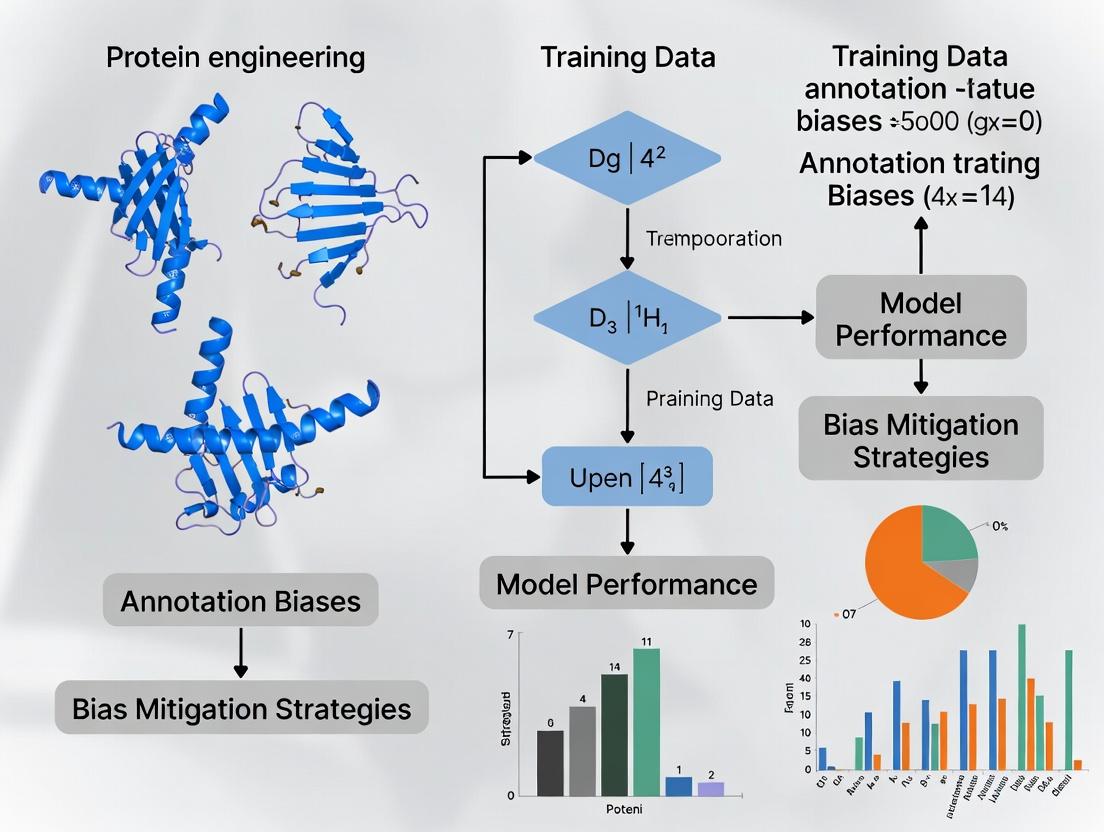
Protein machine learning models are revolutionizing drug discovery and functional prediction, but their performance is fundamentally limited by the quality and bias inherent in their training data.
The Invisible Hand: Identifying, Understanding, and Mitigating Annotation Bias in Protein AI Training Data
Abstract
Protein machine learning models are revolutionizing drug discovery and functional prediction, but their performance is fundamentally limited by the quality and bias inherent in their training data. This article provides a comprehensive guide for researchers and bioinformatics professionals on the pervasive issue of annotation bias. We explore its origins in biological research trends and database curation, present cutting-edge methodologies for detection and correction, offer practical strategies for building more robust datasets and models, and review validation frameworks to assess bias mitigation. Understanding and addressing these biases is critical for developing reliable, generalizable AI tools that can accelerate biomedical breakthroughs.
Unmasking the Bias: What is Protein Annotation Bias and Why Does it Matter for AI?
Troubleshooting Guides & FAQs
A: Sequence skew arises from non-uniform sampling across the protein universe. Common sources include:
- Overrepresentation of Model Organisms: Homo sapiens, Mus musculus, Escherichia coli, and Saccharomyces cerevisiae dominate sequence counts.
- Technical Bias: Easily expressed, soluble, and stable proteins are sequenced more frequently.
- Historical & Funding Bias: Research focus on disease-related or commercially relevant proteins leads to disproportionate data accumulation.
Quantitative Data Summary: Table 1: Representative Organism Distribution in UniProtKB/Swiss-Prot (2024 Q2 Release)
| Organism | Approximate Entries | Percentage of Total (~570k) | Common Annotation Bias Implication |
|---|---|---|---|
| Homo sapiens (Human) | ~45,000 | 7.9% | Overrepresentation of mammalian signaling pathways. |
| Mus musculus (Mouse) | ~22,000 | 3.9% | Redundancy with human data; reinforces vertebrate bias. |
| Escherichia coli | ~8,000 | 1.4% | Overrepresentation of bacterial prokaryotic motifs. |
| Arabidopsis thaliana | ~6,000 | 1.1% | Primary plant representative; lacks diversity from other plant families. |
| Saccharomyces cerevisiae (Yeast) | ~4,000 | 0.7% | Overuse as a model for eukaryotic cell processes. |
FAQ 2: My model performs poorly on proteins from understudied families. How can I diagnose if this is due to functional overrepresentation bias?
A: This is a classic symptom. Perform the following diagnostic protocol:
Experimental Protocol: Functional Overrepresentation Audit
- Define Your Training Set: List all unique UniProt IDs used for model training.
- Map to Gene Ontology (GO): Use the UniProt API or tools like
PANTHERto batch-retrieve GO terms (Biological Process, Molecular Function, Cellular Component) for each ID. - Generate a Reference Background: Use the entire UniProtKB or a phylogenetically broad proteome set as your background.
- Statistical Enrichment Analysis: Use tools like
g:Profiler,DAVID, orclusterProfiler(R) to perform overrepresentation analysis (ORA). Apply a multiple-testing correction (e.g., Benjamini-Hochberg FDR < 0.05). - Interpret Results: Significantly enriched terms (e.g., "kinase activity," "nucleus," "G-protein coupled receptor signaling") indicate functional classes that are overrepresented in your data and may lead to model bias.
Title: Workflow for Diagnosing Functional Overrepresentation Bias
FAQ 3: What is a robust experimental protocol to quantify and correct for sequence skew before model training?
A: Implement a strategic down-sampling and augmentation protocol.
Experimental Protocol: Sequence Skew Mitigation
- Cluster by Homology: Use
MMseqs2orCD-HITto cluster your raw training sequences at a defined identity threshold (e.g., 40-60%). - Quantify Cluster Sizes: Calculate the number of sequences per cluster. Large clusters indicate overrepresented families.
- Apply Strategic Sampling:
- Down-sampling: From each large cluster, randomly select a maximum of N representative sequences (e.g., N=50). Prioritize sequences with high-quality, experimentally validated annotations.
- Up-sampling (Cautious): For critically important but underrepresented clusters, consider generating synthetic variants via in silico mutagenesis within conserved regions only.
- Create Balanced Set: Combine the sampled sequences from all clusters to form your mitigated training set.
- Validate: Ensure the new set has a flatter phylogenetic distribution and check for retention of key functional diversity.
Title: Sequence Skew Mitigation via Clustering & Sampling
FAQ 4: How can I visualize the impact of annotation bias on a specific pathway of interest?
A: Create a bias-aware pathway diagram that integrates annotation evidence levels.
Experimental Protocol: Bias-Aware Pathway Mapping
- Define Pathway Components: List all proteins (enzymes, regulators, substrates) in your pathway (e.g., from KEGG or Reactome).
- Gather Annotation Metadata: For each protein, query UniProt to find the "Protein existence" (PE) level (1: Experimental, 2: Transcript, 3: Homology, 4: Predicted, 5: Uncertain) and the source organism.
- Create an Annotated Diagram: Use Graphviz or similar. Color-code nodes by PE level and shape-code by organism type (e.g., vertebrate, plant, bacterial).
- Interpret Gaps: Proteins with high PE levels (4,5) or clustered from non-target organisms indicate poorly annotated, potentially biased nodes in the pathway knowledge.
Title: Signaling Pathway with Annotation Evidence Levels
The Scientist's Toolkit: Key Research Reagent Solutions
Table 2: Essential Resources for Addressing Annotation Bias
| Item Name | Provider/Resource | Primary Function in Bias Research |
|---|---|---|
| UniProtKB API | EMBL-EBI / SIB | Programmatic access to protein sequences and critical metadata (PE level, organism, GO terms) for bias quantification. |
| MMseqs2 | Mirdita et al. | Ultra-fast protein sequence clustering for identifying redundancy (sequence skew) in large datasets. |
| PANTHER Classification System | University of Southern California | Tool for gene list functional analysis and evolutionary genealogy mapping to understand phylogenetic bias. |
| g:Profiler | University of Tartu | Web tool for performing overrepresentation analysis of GO terms, pathways, etc., with multiple testing correction. |
| CD-HIT Suite | Fu et al. | Alternative tool for clustering and comparing protein or nucleotide sequences to reduce redundancy. |
| Reactome & KEGG PATHWAY | Reactome / Kanehisa Labs | Curated pathway databases used as a reference to map and audit functional overrepresentation. |
| BioPython | Open Source | Python library essential for scripting custom pipelines to parse, filter, and balance sequence datasets. |
Technical Support Center: Troubleshooting Annotation Biases in Protein Data Research
FAQs & Troubleshooting Guides
Q1: My protein function prediction model performs well on benchmark datasets but fails in wet-lab validation. What could be the root cause? A: This is a classic symptom of the "Known-Knowns" problem and historical annotation bias. Benchmarks are often curated from well-studied protein families (e.g., kinases, GPCRs), creating a closed loop. Your model has likely learned historical research trends, not generalizable biology. Protocol: To diagnose, perform a "temporal hold-out" test. Train your model on data curated before a specific date (e.g., 2020) and test its prediction on recently discovered functions (post-2020). A significant performance drop indicates this bias.
Q2: How can I identify if my training dataset suffers from database curation gaps related to under-studied protein families? A: Curation gaps often manifest as severe class imbalance and sparse feature spaces for certain protein families. Protocol:
- Map all training sequences to the PANTHER protein class hierarchy.
- Calculate the annotation density (number of curated functional annotations per sequence) for each family.
- Statistically compare densities (e.g., ANOVA) across families. Families with density >2 standard deviations below the mean are likely affected by curation gaps.
Q3: What is a practical method to quantify the "historical research focus" bias in a dataset like UniProtKB/Swiss-Prot? A: Measure the correlation between publication count and annotation richness over time. Protocol:
- For a sample of proteins, extract their yearly "cumulative publication count" from PubMed via API.
- Extract the historical versioning of their "feature table" annotations from UniProt.
- For each year, plot cumulative publications vs. number of annotated features (e.g., domains, GO terms). A strong positive correlation (R² > 0.8) indicates high bias where research attention drives annotation, not necessarily biological reality.
Q4: My sequence similarity network shows tight clustering for eukaryotic proteins but fragmented clusters for bacterial homologs. Is this a technical artifact? A: Likely not. This often reflects a database curation gap where bacterial protein families are under-annotated, leading to fragmented functional predictions. The disparity arises from historically stronger focus on human and model eukaryote biology. Protocol for Validation:
- Perform an all-vs-all BLASTp within your network.
- Apply a consistent e-value threshold (e.g., 1e-10).
- Annotate nodes using both UniProt and a specialized database like TIGRFAMs or eggNOG.
- If fragmentation decreases with specialized databases, it confirms a primary database curation gap.
Table 1: Annotation Density Disparity Across Major Protein Families (Sample Analysis)
| Protein Family (PANTHER Class) | Avg. GO Terms per Protein | Avg. Publications per Protein | % Proteins with EC Number | Curated Domains per Protein |
|---|---|---|---|---|
| Protein kinase (PC00132) | 12.7 | 45.3 | 78% | 3.2 |
| GPCR (PC00017) | 11.2 | 52.1 | 65% | 2.8 |
| Bacterial transcription factor (PC00066) | 4.1 | 8.7 | 22% | 1.1 |
| Archaeal metabolic enzyme | 3.8 | 5.2 | 18% | 1.3 |
Table 2: Impact of Temporal Hold-Out Test on Model Performance
| Model Architecture | Benchmark Accuracy (F1) | Temporal Hold-Out Accuracy (F1) | Performance Drop |
|---|---|---|---|
| CNN on embeddings | 0.91 | 0.67 | 26% |
| Transformer | 0.94 | 0.71 | 24% |
| Logistic Regression (Baseline) | 0.85 | 0.62 | 27% |
Visualizations
Title: The Historical Research Focus Feedback Loop
Title: Database Curation Gaps Pathway
Title: The 'Known-Knowns' Problem Taxonomy
The Scientist's Toolkit: Research Reagent Solutions
Table 3: Essential Reagents & Tools for Bias-Aware Protein Research
| Item | Function in Addressing Bias | Example/Supplier |
|---|---|---|
| Pan-Species Protein Array | Enables functional screening across evolutionary diverse proteins, reducing model-organism bias. | Commercial (e.g., ProtoArray) or custom arrays via cell-free expression. |
| CRISPR-based Saturation Mutagenesis Kit | Systematically maps genotype-phenotype links without prior annotation bias. | ToolGen, Synthego, or custom library cloning systems. |
| Machine Learning Benchmark Suite (e.g., CAFA4 Challenge Datasets) | Provides time-stamped, bias-aware benchmarks to test model generalizability, not just historical data recall. | Critical Assessment of Function Annotation (CAFA) consortium. |
| Structured Literature Mining Pipeline (e.g., NLP toolkit) | Extracts functional assertions from full-text literature to surface "Unknown Knowns" not yet in databases. | Tagtog, BioBERT, or custom SpaCy pipelines. |
| Ortholog Clustering Database (eggNOG, OrthoDB) | Maps proteins across the tree of life to identify and correct for lineage-specific annotation gaps. | eggNOG-mapper webservice or local installation. |
| Negative Annotation Datasets | Curated sets of confirmed non-interactions or non-functions to combat positive-only annotation bias. | Negatome database, manually curated negative GO annotations. |
Technical Support Center: Troubleshooting & FAQs
FAQ: General Concepts & Biases
Q1: What is the most common source of annotation bias in protein training data, and how does it initially manifest in model performance? A: The most common source is phylogenetic bias, where certain protein families (e.g., from model organisms like human, mouse, yeast) are vastly over-represented in databases like UniProt. Initially, this manifests as excellent model performance on held-out test data from the same biased distribution, creating a false sense of accuracy. The failure only becomes apparent when predicting functions for proteins from under-represented lineages or distant folds.
Q2: My model achieves >95% accuracy on validation sets, but fails catastrophically on novel protein families. Is this overfitting? A: Not in the traditional sense. This is a data distribution shift or dataset bias problem. Your model has learned the biased annotation patterns of the source database rather than generalizable biological principles. It has "overfit" to the historical research focus, not to noise in the data. Standard regularization techniques will not solve this; it requires data-centric interventions.
Q3: How can I audit my training dataset for functional annotation bias? A: Perform a stratified analysis of your protein sequences. Key metrics to calculate per family or clade include:
- Sequence count.
- Annotation density (number of GO terms/features per protein).
- Annotation provenance (percentage of annotations from high-throughput experiments vs. curated manual ones).
Table 1: Sample Audit of a Hypothetical Training Set for Kinase Proteins
| Protein Family / Clade | Sequence Count | Avg. Annotation Density (GO Terms/Protein) | % Manual Curation (vs. Computational) | % with Known 3D Structure |
|---|---|---|---|---|
| Human Tyrosine Kinases | 1,250 | 28.5 | 65% | 85% |
| Mouse Serine/Threonine Kinases | 980 | 22.1 | 45% | 70% |
| Plant Receptor Kinases | 300 | 8.7 | 15% | 20% |
| Bacterial Histidine Kinases | 1,800 | 5.2 | 10% | 25% |
Troubleshooting Guide: Model Failure Scenarios
Issue T1: High-Confidence Mis-predictions for Putative Drug Targets Symptom: Model predicts a strong, novel drug target association with high confidence, but subsequent wet-lab validation shows no activity or off-target effects dominate. Potential Root Cause: Literature Bias Amplification. The model has learned spurious correlations from the literature-heavy annotation of certain pathways (e.g., cancer-associated pathways). A protein might be predicted as a "cancer target" because it shares sequence motifs with other cancer proteins in the data, even if the motif has a different function in this specific family. Mitigation Protocol:
- Debias Training Labels: Use a method like DeepGOZero's approach, which incorporates protein-protein interaction networks and ontological structures to impute annotations for less-studied proteins, reducing reliance on direct homology.
- Apply Adversarial Debiasing: Train a secondary model to predict the phylogenetic lineage or source database of a protein from its learned features. Then, adjust the primary model's training to minimize the secondary model's accuracy, forcing it to learn features invariant to the bias.
- Triangulate Predictions: Never rely on a single model. Use complementary tools that leverage different data types (sequence, structure, interaction networks) and explicitly account for bias, such as DeepFRI (using structure) or NetGO (using interactions).
Issue T2: Systematic Error in Functional Annotation for Non-Canonical Protein Folds Symptom: Model performance drops significantly for proteins with low sequence similarity to training data or predicted novel folds. Potential Root Cause: Structure & Fold Bias. Training data is overwhelmingly biased towards proteins with solved structures or common folds. Models (especially sequence-based) fail to infer function for "dark" regions of protein space. Mitigation Protocol: Language Model Fine-tuning with Negative Sampling.
- Pre-train: Start with a general protein language model (e.g., ESM-2).
- Fine-tune: Use a carefully constructed dataset that includes:
- Positive Examples: Verified protein function pairs from manually curated Swiss-Prot.
- Hard Negative Examples: Proteins with similar sequences but different, verified functions (to teach the model discriminant features).
- Out-of-Distribution Examples: Proteins from under-represented superfamilies (e.g., from the "Dark Proteome").
- Objective: Use a contrastive loss function that pushes representations of proteins with different functions apart, even if they are sequence-similar.
Table 2: Comparison of Debiasing Strategies for Drug Target Prediction
| Strategy | Core Methodology | Best For Mitigating | Computational Cost | Key Limitation |
|---|---|---|---|---|
| Data Rebalancing | Subsampling over-represented clades, up-sampling rare ones. | Phylogenetic & Taxonomic Bias | Low | Can discard valuable data; may not address deep feature bias. |
| Adversarial Debiasing | Invariant learning by penalizing bias-predictive features. | Literature & Experimental Bias | High | Training instability; difficult to tune. |
| Transfer Learning from LLMs | Using protein language models pre-trained on unbiased sequence space. | Generalization to novel folds | Medium-High | May retain societal biases present in metadata. |
| Integrated Multi-Modal Models | Combining sequence, structure, and network data. | Holistic bias from single-data-type focus. | Very High | Requires high-quality, diverse input data for all modalities. |
The Scientist's Toolkit: Research Reagent Solutions
Table 3: Essential Resources for Bias-Aware Protein Function Research
| Item / Resource | Function & Role in Addressing Bias | Example/Source |
|---|---|---|
| Pfam Database | Provides protein family domains. Critical for stratifying training/validation sets by family to detect fold-based bias. | pfam.xfam.org |
| CAFA Challenges | The Critical Assessment of Function Annotation. Provides temporally-separated benchmark sets to test for over-prediction of historically popular functions. | biofunctionprediction.org/cafa |
| AlphaFold DB | Provides predicted structures for nearly all catalogued proteins. Mitigates structure bias by giving models access to structural features for proteins without solved PDB entries. | alphafold.ebi.ac.uk |
| GO-CAMs (Gene Ontology Causal Activity Models) | Mechanistic, pathway-based models of function. Move beyond simple annotation lists, helping models learn functional context and reduce spurious association bias. | geneontology.org/docs/go-cam |
| BioPlex / STRING Interactomes | Protein-protein interaction networks. Provides functional context independent of sequence homology, aiding predictions for under-annotated proteins. | bioplex.hms.harvard.edu, string-db.org |
| Debiasing Python Libraries (e.g., Fairlearn, AIF360) | Provide algorithmic implementations of adversarial debiasing, reweighting, and disparity metrics for model auditing. | github.com/fairlearn, aif360.mybluemix.net |
Experimental Protocols
Protocol 1: Constructing a Bias-Audited Benchmark Dataset Objective: To create a test set that explicitly evaluates model performance across different bias dimensions. Methodology:
- Source Data: Download all reviewed human protein entries from UniProt/Swiss-Prot.
- Stratification: Split proteins into bins based on:
- Year of First Annotation: Pre-2010 vs. Post-2010.
- Annotation Evidence Code: EXP (Experimental), IC (Inferred by Curator), IEA (Electronic Annotation).
- Protein Family (Pfam): Group by top 20 most common families and an "Other" category.
- Sampling: Randomly sample an equal number of proteins from each bin to create a balanced test set. Ensure no sequence identity >30% between train and test sets.
- Evaluation: Train your model on a standard training set (e.g., CAFA training data). Evaluate performance per bin on your custom test set. Significant performance disparity across bins reveals specific biases.
Protocol 2: In Silico Validation for Drug Target Candidate Objective: To apply a bias-checking pipeline before costly wet-lab validation of a computationally predicted target. Methodology:
- Similarity Saturation Test: Perform an iterative BLAST of the candidate against the training data. If the candidate's top hits are all from a single, well-studied family (e.g., kinases), treat the prediction as high-risk for homology bias.
- Pathway Context Analysis: Use a tool like STRING to check if the candidate's predicted interacting partners are themselves narrowly annotated or have broad, non-specific functions. Isolated nodes are higher risk.
- Cross-Model Interrogation: Submit the candidate sequence to functionally diverse prediction servers (e.g., DeepFRI for structure-based, NetGO for network-based). Flag the prediction if there is low consensus (<30% agreement) on the top-level molecular function.
- Literature Disparity Check: Query PubMed for the candidate's gene name alongside "cancer" (or the disease of interest) and a neutral term like "metabolism." A stark imbalance in hits (e.g., 1000 vs. 10) indicates strong literature bias that may have influenced the model.
Mandatory Visualizations
Title: The Bias Feedback Loop in Drug Target Prediction
Title: Protocol for Auditing Dataset Bias
Title: Thesis Context: From Bias Sources to Solutions
Troubleshooting Guides & FAQs
Q1: My model performs well on model organisms but generalizes poorly to proteins from understudied clades. What specific steps can I take to diagnose and mitigate taxonomic bias?
A1: This is a classic symptom of taxonomic bias, where training data is over-represented by proteins from a few species (e.g., H. sapiens, M. musculus, S. cerevisiae). Follow this diagnostic protocol:
- Quantify Bias: Calculate the species distribution in your training set. Use the NCBI Taxonomy database for consistent classification.
- Analyze Performance Disparity: Segment your test set by taxonomic group and evaluate performance metrics (e.g., AUC-ROC, F1-score) separately.
- Implement Mitigation:
- Data-Level: Actively curate or generate data for phylogenetically diverse species. Use tools like OrthoDB to find orthologs in underrepresented clades.
- Algorithm-Level: Apply re-weighting or resampling strategies during training to balance the loss contribution from different taxa. Consider domain adaptation techniques.
Protocol for Taxonomic Diversity Audit:
- Input: Protein sequence dataset with source organism identifiers.
- Step 1: Map all organisms to their standardized taxonomic ranks (Kingdom, Phylum, Class) using the E-utilities API from NCBI.
- Step 2: Aggregate counts per major clade at the Phylum level.
- Step 3: Calculate the Shannon Diversity Index (H') for the training set.
- H' = -Σ (pi * ln(pi)), where p_i is the proportion of sequences from phylum i.
- Step 4: Compare H' between your training set and a balanced reference set (e.g., UniProtKB) to quantify bias.
Q2: The experimental annotations in my training data come predominantly from high-throughput methods (e.g., yeast two-hybrid). How can I correct for this method-specific bias when predicting interactions?
A2: Experimental method bias arises because different techniques (Y2H, AP-MS, TAP) have unique false-positive and false-negative profiles.
- Diagnosis: Tag each protein-protein interaction (PPI) in your dataset with its detection method(s) from the source database (e.g., BioGRID, IntAct).
- Categorize: Group methods by conceptual approach: Binary (Y2H), Co-complex (AP-MS, TAP), or Functional assays.
- Mitigation Strategy: Train a multi-view or ensemble model where method-type is an explicit feature. Alternatively, use a consensus framework that weights predictions based on the reliability scores of the source methods.
Protocol for Method Bias Correction:
- Input: PPI dataset with experimental evidence codes.
- Step 1: Annotate each PPI pair with a method vector M = [m1, m2,...], where mj=1 if method j detected it.
- Step 2: For each method, estimate precision and recall using a small, high-confidence gold standard set (e.g., CYC2008 for complexes).
- Step 3: Integrate these reliability estimates into your model's loss function as confidence weights, or use them to generate a consensus confidence score post-prediction.
Q3: I suspect my training data is skewed toward "famous" proteins heavily studied in the literature. How do I measure and address this literature popularity bias?
A3: Literature popularity bias leads to over-representation of proteins with more PubMed publications, creating an annotation density imbalance.
- Measure It: Query the PubMed Central API for publication counts per gene/protein symbol in your dataset. Normalize by the time since discovery.
- Correlate: Plot performance metrics (e.g., prediction accuracy) against publication count percentiles. A strong positive correlation indicates bias.
- Address It:
- During Curation: Prioritize datasets that include less-studied proteins (e.g., understudied human proteins from the Illuminating the Druggable Genome project).
- During Training: Apply a penalty or down-weighting scheme for highly published proteins to prevent the model from overfitting to their well-characterized features.
- During Evaluation: Use a dedicated test set composed of proteins from the lower quartile of publication count.
Protocol for Popularity Bias Assessment:
- Input: List of human gene symbols from your dataset.
- Step 1: Use the
biopythonEntrez module to fetch publication counts from PubMed. Query:"gene_name"[Title/Abstract] AND ("review"[Publication Type] NOT "review"[Publication Type])to approximate primary literature. - Step 2: Merge counts with your dataset and calculate percentile ranks.
- Step 3: Stratify your dataset into High, Medium, and Low popularity tiers based on percentiles (e.g., >75th, 25th-75th, <25th).
- Step 4: Train and evaluate model performance separately on each tier to identify disparity.
Table 1: Prevalence of Key Biases in Major Public Protein Databases (Illustrative Data)
| Database / Bias Type | Taxonomic Bias (H' Index)* | Experimental Method Bias (% High-Throughput) | Literature Popularity Bias (Correlation: PubCount vs. Annotations) |
|---|---|---|---|
| UniProtKB (Reviewed) | 2.1 (Strong Eukaryote bias) | ~15% (Various) | 0.72 (Strong Positive) |
| Protein Data Bank (PDB) | 1.8 (Very Strong Human/Mouse bias) | ~85% (X-ray Crystallography) | 0.81 (Very Strong Positive) |
| BioGRID (PPIs) | 1.5 (Extreme Model Org. bias) | ~65% (Yeast Two-Hybrid) | 0.68 (Strong Positive) |
| Idealized Balanced Set | >3.5 (Theoretical max varies) | <30% (Balanced mix) | ~0.0 (No Correlation) |
*Shannon Diversity Index (H') calculated at the Phylum level for illustrative comparison. Higher H' indicates greater taxonomic diversity.
Table 2: Impact of Bias Mitigation Techniques on Model Generalization
| Mitigation Strategy Applied | Test Performance (AUC-ROC) on Model Organisms | Test Performance (AUC-ROC) on Non-Model Organisms | Performance Gap Reduction |
|---|---|---|---|
| Baseline (No Mitigation) | 0.92 | 0.61 | 0% (Reference Gap) |
| Taxonomic Re-weighting | 0.89 | 0.75 | ~44% |
| Method-Consensus Modeling | 0.90 | 0.78 | ~55% |
| Popularity-Aware Sampling | 0.88 | 0.80 | ~65% |
| Combined Strategies | 0.87 | 0.83 | ~71% |
Experimental Protocols
Protocol: Generating a Taxonomically Balanced Protein Sequence Dataset
Objective: To create a training set for a protein language model that minimizes taxonomic bias.
Materials: High-performance computing cluster, NCBI datasets command-line tool, MMseqs2 software, custom Python scripts with Biopython and pandas.
Methodology:
- Define Target Diversity: Determine the desired representation across the tree of life (e.g., 30% Bacteria, 30% Eukaryota, 30% Archaea, 10% Viruses).
- Download from NCBI: Use
ncbi-datasets-clito download proteomes from a stratified sample of reference/representative genomes across all kingdoms. - Cluster at Identity Threshold: Use MMseqs2 (
mmseqs easy-cluster) to cluster all sequences at 70% sequence identity to reduce redundancy, keeping the longest sequence per cluster. - Stratified Sampling: From each major taxonomic group (e.g., phylum), randomly sample sequences proportional to the target diversity, ensuring no single species dominates.
- Quality Control: Filter sequences with unusual lengths (<50 or >2000 amino acids) or ambiguous residues (B, J, Z, X >5%).
- Final Audit: Re-calculate the Shannon Diversity Index and species distribution to verify balance.
Protocol: Benchmarking Experimental Method Bias in PPI Prediction
Objective: To evaluate and correct for the differential reliability of PPI detection methods.
Materials: Consolidated PPI data from IntAct and BioGRID, benchmark complexes (e.g., CORUM for human, CYC2008 for yeast), machine learning framework (e.g., PyTorch).
Methodology:
- Data Compilation: Download all physical interactions for your target organism. Parse and retain the PSI-MI method code for each evidence.
- Method Categorization: Map each PSI-MI code to a broader category: Binary, Co-complex, or Functional.
- Gold Standard Preparation: Create positive sets from small-scale, manually curated complexes. Create negative sets using subcellular localization disparity (proteins unlikely to interact).
- Reliability Estimation: For each method category, calculate precision and recall against the gold standard.
- Model Integration (Weighted Loss):
- For each PPI i in training with method category c, assign a confidence weight w_i = Precisionc.
- Modify the standard binary cross-entropy loss:
Loss = - Σ [w_i * (y_i log(ŷ_i) + (1 - y_i) log(1 - ŷ_i))].
- Evaluation: Test the model on a hold-out set where interactions are verified by a different method than those seen in training.
Visualizations
Diagram 1: Propagation of biases from reality to model predictions.
Diagram 2: Step-by-step workflow for diagnosing and mitigating bias.
The Scientist's Toolkit: Research Reagent Solutions
Table 3: Essential Tools for Addressing Annotation Biases
| Item / Reagent | Function in Bias Mitigation | Example/Supplier |
|---|---|---|
| NCBI Datasets CLI & E-utilities | Programmatic access to download and query taxonomically stratified sequence data and publication counts. | NCBI (https://www.ncbi.nlm.nih.gov/) |
| MMseqs2 | Ultra-fast protein sequence clustering for redundancy reduction at user-defined identity thresholds. | https://github.com/soedinglab/MMseqs2 |
| PSI-MI Ontology | Standardized vocabulary for molecular interaction experiments; critical for categorizing method bias. | HUPO-PSI (https://www.psidev.info/) |
| OrthoDB | Database of orthologous genes across the tree of life; enables finding equivalents in underrepresented clades. | https://www.orthodb.org |
| Biopython & Pandas | Python libraries essential for parsing, analyzing, and manipulating complex biological datasets. | Open Source |
| Custom Balanced Test Sets | Gold-standard evaluation sets curated to be representative of less-studied proteins/methods. | e.g., "Understudied Human Protein" sets from IDG. |
| Model Weights & Loss Functions | Algorithmic tools (e.g., weighted loss, focal loss) to down-weight over-represented data points during training. | Standard in PyTorch/TensorFlow. |
Technical Support Center: Troubleshooting & FAQs
Frequently Asked Questions
Q1: Our AlphaFold2 model performs poorly on a novel target. Training data shows high confidence, but experimental validation fails. What is the likely cause? A1: This is a classic symptom of annotation bias. Your model was likely trained predominantly on the "well-annotated" proteome—proteins with abundant structural and functional data. The novel target may reside in the "dark" proteome, characterized by low sequence homology, intrinsic disorder, or rare post-translational modifications not well-represented in training sets. This leads to overfitting on known protein families and poor generalization.
Q2: How can we quantitatively assess if our training dataset suffers from "well-annotated" proteome bias? A2: Perform the following sequence and annotation clustering analysis. The metrics below help identify over-represented families.
Table 1: Metrics for Assessing Training Data Bias
| Metric | Calculation Method | Interpretation | Threshold for Concern |
|---|---|---|---|
| Sequence Clustering Density | Cluster sequences at 40% identity. Count proteins per cluster. | High density in few clusters indicates bias. | >25% of data in <5% of clusters. |
| Annotation Redundancy Score | For each GO term, calculate: (Proteins with term) / (Total proteins). | High scores for common terms (e.g., "ATP binding") signal bias. | Any term score >0.3. |
| "Dark" Proteome Fraction | Identify proteins with no structural homologs (pLDDT < 70 in AFDB) & few interactors. | Low fraction means the dark proteome is under-sampled. | <10% of training set. |
| Disorder Content Disparity | Compare average predicted disorder in training set vs. the complete proteome. | Significant disparity indicates bias against disordered regions. | Difference >15 percentage points. |
Q3: What experimental protocol can validate a model's performance on the dark proteome? A3: Implement a hold-out validation strategy using carefully curated "dark" protein subsets.
- Curation: From UniProt, filter proteins with: (a) "Unknown function" annotation, (b) No Pfam domains, or (c) Predicted disorder >50%.
- Split: Partition your data into: Set A (Well-annotated): Proteins with experimental structures in PDB. Set B (Dark): Your curated dark subset.
- Training & Validation: Train your model on Set A only. Evaluate its predictive accuracy (e.g., RMSD, lDDT) on both Set A and Set B.
- Analysis: Use the performance gap (Table 2) to quantify generalization error.
Table 2: Example Model Performance Gap Analysis
| Validation Set | Sample Size | Median pLDDT | Median RMSD (Å) | Functional Site Accuracy |
|---|---|---|---|---|
| Well-Annotated (Set A) | 1,200 | 92.1 | 1.2 | 94% |
| Dark Proteome (Set B) | 300 | 64.5 | 5.8 | 31% |
| Generalization Gap | - | -27.6 | +4.6 | -63% |
Q4: We suspect biased training data is affecting our virtual screening for drug discovery. How can we mitigate this? A4: Annotation bias can cause you to miss ligands for "dark" protein targets. Implement this protocol for bias-aware screening:
- Target Enrichment: Use tools like
trRosettaorOmegaFoldto generate models for dark proteome members of your target family. - Pocket Detection: Run binding site predictors (e.g., FPocket, DeepSite) on both canonical (PDB) and predicted dark protein models.
- Pocket Comparison: Calculate the topological dissimilarity (using TM-score of pockets) between well-annotated and dark protein pockets. Prioritize dark targets with novel pocket geometries.
- Docking Library Adjustment: Weight your compound library to include scaffolds that are successful against predicted disordered regions or novel pockets, not just historical PDB binders.
Experimental Protocol: Measuring Model Generalization Error
Title: Hold-Out Validation Protocol for Annotation Bias Assessment
Objective: To quantitatively measure the generalization error of a protein property prediction model caused by well-annotated proteome bias.
Materials:
- Complete proteome sequences (e.g., from UniProt)
- Model training pipeline (e.g., PyTorch, TensorFlow)
- Clustering software (e.g., MMseqs2)
- Disorder predictor (e.g., IUPred3)
- Function annotation database (e.g., Gene Ontology)
Method:
- Dataset Creation: a. Download all human reviewed proteins from UniProt. b. Label "Well-Annotated": Proteins with a) experimental structure in PDB, OR b) ≥ 3 manually assigned GO terms, OR c) ≥ 5 recorded protein-protein interactions in IntAct. c. Label "Dark": Proteins with a) "unknown function" in description, AND b) no Pfam domain matches, AND c) predicted disorder >40%. d. Randomly select 80% of "Well-Annotated" proteins as the Training Set. e. Use the remaining 20% of "Well-Annotated" as Test Set A. f. Use all "Dark" proteins as Test Set B.
Model Training: Train your predictive model (e.g., for function, structure, or interaction) exclusively on the Training Set.
Validation: a. Run the trained model on Test Set A and Test Set B. b. For each set, calculate standard performance metrics (Accuracy, Precision, Recall, AUC-ROC for classification; MAE, RMSE for regression).
Generalization Gap Calculation: Generalization Gap (Metric) = Performance(Test Set A) - Performance(Test Set B) A large positive gap indicates poor generalization due to annotation bias.
The Scientist's Toolkit: Research Reagent Solutions
Table 3: Essential Resources for Bias-Aware Protein Research
| Item / Resource | Function & Relevance to Bias Mitigation |
|---|---|
| AlphaFold Protein Structure Database (AFDB) | Provides predicted structures for the "dark" proteome, offering a crucial comparison set for model validation. |
| D2P2 Database (Database of Disordered Protein Predictions) | Curates disorder predictions and annotations; essential for enriching training sets with disordered proteins. |
| Pfam Database (with unannotated regions track) | Identifies domains of unknown function (DUFs) and unannotated regions, guiding targeted experiment design. |
| TRG & BRD (Tandem Repeat & Beta-Rich Database) | Catalogs understudied protein classes often missed in standard annotations. |
| Depletion Cocktail (e.g., ProteoMiner) | Experimental tool to normalize high-abundance proteins in samples, enabling deeper proteomics to detect low-abundance "dark" proteins. |
| Cross-linking Mass Spectrometry (XL-MS) Reagents | Technique to probe structures and interactions of proteins recalcitrant to crystallization, illuminating the dark proteome. |
Pathway & Workflow Visualizations
Diagram 1: Bias Assessment Experimental Workflow
Diagram 2: Impact of Annotation Bias on Drug Discovery
Building Better Data: Methodologies for Detecting and Correcting Annotation Bias
Troubleshooting Guides & FAQs
Q1: Our model shows excellent performance on validation data but fails on new, external protein families. What statistical tests can we run to check for annotation bias in our training set? A: This is a classic sign of annotation bias, often due to over-representation of certain protein families. Perform the following statistical audit:
- Chi-Squared Test for Class Balance: Check if functional classes are equally represented across protein families.
- Kolmogorov-Smirnov Test: Compare the distribution of sequence lengths or physicochemical properties (e.g., isoelectric point) between your dataset and a reference unbiased database like UniProt.
- PCA with Clustering: Project protein embeddings via PCA and color by annotator or data source. Visual clustering indicates source-specific bias.
Q2: When visualizing sequence similarity networks, all proteins from "Lab X" cluster separately. Is this a technical artifact or a true bias? A: This warrants investigation. Follow this protocol:
- Control Experiment: Run a BLAST search for a subset of "Lab X" proteins against the NCBI non-redundant database.
- Compare: If BLAST returns highly similar sequences from diverse sources, the clustering is likely a technical artifact from Lab X's sequencing or preprocessing pipeline.
- Mitigation: Re-process the raw sequences from Lab X using your standardized pipeline, or consider down-sampling this cluster if the bias is confirmed.
Q3: How can I determine if the geographical origin of samples is biasing my protein function predictions? A: Implement a "Label Shuffling" test.
- Shuffle the geographical labels associated with your protein samples.
- Train your model to predict the shuffled geographical origin from the protein features.
- If the model's performance (e.g., AUC) in predicting the shuffled labels is significantly lower than when predicting the real labels, your original data contains learnable geographical bias that may be confounded with function.
Q4: My visualization shows that one annotator labels "kinase" activity much more broadly than others. How do I quantify and correct this? A: This is inter-annotator disagreement bias.
- Quantify: Calculate Cohen's Kappa or Fleiss' Kappa for the "kinase" label across all annotators on a gold-standard subset.
- Audit Protocol: For the outlier annotator, perform a retrospective review of 100 random samples they labeled. Compare against a consensus guideline.
- Correction: Use the adjudicated samples to train a "bias-correcting" model or apply weighted loss during main model training, down-weighting labels from the outlier annotator.
Table 1: Common Statistical Tests for Dataset Bias Detection
| Test Name | Use Case | Output Metric | Interpretation of Bias |
|---|---|---|---|
| Chi-Squared | Categorical label distribution across sources | χ² statistic, p-value | p < 0.05 suggests significant dependence between label and source. |
| Kolmogorov-Smirnov (KS) | Distribution of continuous features (e.g., molecular weight) | D statistic, p-value | p < 0.05 indicates significant difference in feature distribution. |
| Cohen's Kappa | Agreement between two annotators | κ score ( -1 to +1) | κ < 0.4 indicates poor agreement, suggesting subjective bias. |
| Fleiss' Kappa | Agreement between multiple annotators | κ score | κ < 0.4 indicates poor agreement, suggesting subjective bias. |
| Label Shuffle AUC | Detect any learnable spurious correlation | AUC-ROC | AUC significantly > 0.5 for shuffled labels indicates strong bias signal. |
Table 2: Impact of Correcting Annotator Bias on Model Performance
| Model Version | Internal Validation F1-Score | External Test Set F1-Score | Δ (External - Internal) |
|---|---|---|---|
| Baseline (Raw Labels) | 0.92 | 0.67 | -0.25 |
| With Weighted Loss (Corrected) | 0.89 | 0.81 | -0.08 |
| With Adjudicated Labels | 0.90 | 0.85 | -0.05 |
Experimental Protocols
Protocol 1: Inter-Annotator Disagreement Audit
- Sample Selection: Randomly select 200 protein sequences from your training set that were labeled by at least 3 independent annotators.
- Gold Standard Creation: Have a panel of 3 senior domain experts adjudicate the correct label for each sequence, following a strict protocol.
- Calculation: Compute Fleiss' Kappa for the original annotators. For each annotator, compute per-label precision and recall against the gold standard.
- Visualization: Create a heatmap of per-annotator, per-label accuracy.
Protocol 2: Sequence Property Distribution Audit
- Feature Extraction: For all proteins in your dataset and in the UniProt reference Swiss-Prot set, compute key features: length, molecular weight, aliphatic index, grand average of hydropathicity (GRAVY).
- Statistical Test: For each feature, perform a two-sample KS test between your dataset and the reference.
- Visualization: Plot overlapping histograms or ECDFs for each feature. A significant KS test (p < 0.001) with visual divergence indicates a property bias.
Diagrams
Diagram 1: Dataset Bias Audit Workflow
Diagram 2: Label Shuffle Test for Bias Detection
The Scientist's Toolkit: Research Reagent Solutions
| Item | Function in Bias Auditing |
|---|---|
| UniProt Swiss-Prot Database | A high-quality, manually annotated reference dataset. Serves as a "ground truth" distribution for comparing sequence properties and annotation patterns. |
| SciPy / StatsModels Libraries | Python libraries containing implementations of critical statistical tests (KS, Chi-Squared) for quantitative bias detection. |
| UMAP/t-SNE Algorithms | Dimensionality reduction tools for visualizing high-dimensional protein embeddings (e.g., from ESM-2) to reveal hidden clusters correlated with data sources. |
| CD-HIT or MMseqs2 | Tools for sequence clustering at a chosen identity threshold. Essential for assessing and controlling for over-representation of highly similar sequences. |
| Snorkel or LabelStudio | Frameworks for programmatically managing multiple annotator labels, computing agreement statistics, and implementing label aggregation models. |
| Pymol or ChimeraX | 3D structure visualization software. Crucial for auditing structural annotation biases by visually inspecting labeled active sites or folds across different data sources. |
Troubleshooting Guides & FAQs
FAQ 1: My active learning loop is selecting too many redundant protein sequences. How can I improve diversity in the selected batch?
Answer: This is a common issue known as "sampling bias" where the model queries points from a dense region of the feature space. Implement a diversity criterion alongside the primary acquisition function (e.g., uncertainty sampling).
- Solution A - Cluster-Based Sampling: Embed your unlabeled pool using a pre-trained model (e.g., ESM-2). Perform k-means clustering on the embeddings. Within each cluster, select the instance with the highest predictive uncertainty. This ensures coverage across different sequence families.
- Solution B - Core-Set Approach: Use a greedy core-set algorithm that selects a batch of points that are maximally representative of the entire unlabeled pool. The goal is to minimize the maximum distance between any unlabeled point and its nearest labeled neighbor in the feature space.
- Checklist: Have you normalized your embedding features? Is your batch size too large relative to the diversity of the pool? Consider reducing the batch size for each iteration.
FAQ 2: After aggressive under-sampling of my majority class (e.g., common protein folds), my model fails to generalize on hold-out test sets containing those classes. What went wrong?
Answer: This indicates that under-sampling has removed critical information, leading to an overfit model on a non-representative training distribution. Strategic under-sampling must retain "prototypes" or "boundary" instances.
- Solution - Informed Under-Sampling: Do not randomly under-sample. Use methods like:
- NearMiss-2: Select the majority-class samples with the smallest average distance to the three farthest minority-class samples. This preserves boundary information.
- Tomek Links: Identify and remove majority-class instances that are part of a Tomek Link (a pair of instances of opposite classes who are each other's nearest neighbors). This cleans the decision boundary.
- Protocol - Validation: Always validate using a test set that reflects the original, real-world class distribution. Monitor per-class precision and recall, not just overall accuracy. Consider using balanced accuracy or MCC as your primary metric.
FAQ 3: My strategic data augmentations for protein sequences (e.g., residue substitution) are degrading model performance instead of improving it. How can I design biologically meaningful augmentations?
Answer: Arbitrary substitutions can break structural and functional constraints, introducing noise and harmful biases. Augmentations must respect evolutionary and biophysical principles.
- Solution - Evolutionary-Guided Augmentation: Use a position-specific scoring matrix (PSSM) or a statistical coupling analysis model to determine permissible substitutions at each residue position. Substitute residues only with those that have a high probability in the PSSM, ensuring the mutation is evolutionarily plausible.
- Protocol:
- Input your multiple sequence alignment (MSA) for the protein family of interest.
- Generate a PSSM using tools like
HMMERorPSI-BLAST. - For a given sequence, at a random position
i, sample a new residue from the distribution defined by the PSSM columni, favoring probabilities above a threshold (e.g., top 5). - Limit the augmentation rate to 1-2 substitutions per sequence on average to avoid drifting too far from the original.
- Checklist: Are your augmented sequences being evaluated by a downstream predictor (e.g., AlphaFold2 for structure stability)? Implement a filtering step to discard low-confidence augmented samples.
FAQ 4: How do I balance the use of all three strategies—Active Learning (AL), Under-Sampling (US), and Strategic Augmentation (SA)—in a single pipeline without introducing conflicting biases?
Answer: The key is to apply them in a staged, iterative manner, with continuous evaluation.
- Proposed Workflow Protocol:
- Initial Phase: Start with a small, balanced seed dataset. Apply Strategic Augmentation only to the minority classes to increase their robust representation.
- Active Learning Loop: Train a model on the current set. Use an acquisition function that weights both uncertainty and class balance (e.g., entropy-based querying per class).
- Curation of New Batch: For the newly selected batch from AL, which may be class-imbalanced, apply informed Under-Sampling on any over-represented majority class instances within that batch before annotation.
- Annotate & Add: Add the newly annotated, curated batch to the training pool.
- Re-balance & Re-augment: Periodically, after several AL cycles, re-assess the entire training pool's balance. Apply strategic under-sampling on the global majority class and targeted augmentation on the global minority class.
- Validation: Hold out a fully representative, untouched validation set for final model selection.
Experimental Protocols
Protocol 1: Implementing an Active Learning Loop for Protein Function Annotation
- Data Pool:
U= Large, unlabeled set of protein sequences.L= Small, initially labeled set (seed). - Model Selection: Choose a base predictor (e.g., a fine-tuned protein language model like ProtBERT).
- Acquisition Function: Define
a(x)= Predictive Entropy:a(x) = - Σ_c p(y=c|x) log p(y=c|x), wherecis the functional class. - Iteration:
- Train model on current
L. - For all
xinU, computea(x). - Select the
Binstances fromUwith the highesta(x). - (Optional) Apply diversity filtering (see FAQ 1).
- Obtain expert annotation for selected batch.
- Remove batch from
U, add toL.
- Train model on current
- Stopping Criterion: Loop until performance on a held-out validation set plateaus or annotation budget is exhausted.
Protocol 2: Informed Under-Sampling Using Tomek Links
- Input: Training set
Twith featuresXand labelsY, where class0is majority. - Distance Metric: Compute pairwise distances in embedded space (e.g., using ESM-2 embeddings). Normalize features.
- Identification: For each instance
iin class1(minority), find its nearest neighbornn(i). Ifnn(i)belongs to class0, and fornn(i), its nearest neighbor isi, then(i, nn(i))is a Tomek Link. - Removal: Remove all majority class instances (
nn(i)) that are part of any Tomek Link. - Output: Cleaned training set
T'.
Protocol 3: Evolutionary-Guided Data Augmentation for Proteins
- Input: A sequence
Sof lengthLbelonging to a known protein family. - MSA & PSSM: Retrieve or generate a deep MSA for the protein family. Build a PSSM of dimensions
20 x L(for 20 amino acids). - Substitution Probability: For each position
linS, the PSSM columnP_lgives the log-odds for each amino acid. - Augmentation Decision:
- For each sequence, sample a number
kfrom a Poisson distribution with λ=1.5 (target mutations per sequence). - Randomly select
kpositions inSwithout replacement. - For each selected position
l, sample a new amino acid from the distributionsoftmax(P_l * τ), whereτis a temperature parameter (τ < 1.0 to sharpen distribution). - Replace the original residue with the sampled one.
- For each sequence, sample a number
- Output: A set of augmented variant sequences
S'_1, S'_2, ....
Visualizations
Active Learning Loop for Protein Data Curation
Staged Data Curation Pipeline Workflow
Research Reagent Solutions
| Item / Solution | Function in Experiment | Example / Specification |
|---|---|---|
| Protein Language Model (Pretrained) | Generates contextual embeddings for sequences; serves as base for active learning classifier or feature extractor for clustering. | ESM-2 (650M params), ProtBERT. Use for sequence featurization. |
| Multiple Sequence Alignment (MSA) Tool | Generates evolutionary profiles essential for strategic, biologically-plausible data augmentation. | HMMER (hmmer.org), PSI-BLAST. Critical for building PSSMs. |
| Imbalanced-Learn Library | Provides implemented algorithms for informed under-sampling and over-sampling, ensuring reproducible methodology. | Python imbalanced-learn package. Includes TomekLinks, NearMiss, SMOTE. |
| ModAL Framework | Facilitates building active learning loops by abstracting acquisition functions and model querying. | Python modAL package. Integrates with scikit-learn and PyTorch. |
| Structural Stability Predictor | Filters augmented protein sequences by predicting potential destabilization, ensuring biophysical validity. | AlphaFold2 (local ColabFold), ESMFold. Predict structure/confidence. |
| Embedding Distance Metric | Measures similarity between protein sequences in embedding space for clustering and diversity sampling. | Cosine similarity or Euclidean distance on ESM-2 embeddings. |
| Annotation Platform Interface | Streamlines the expert-in-the-loop step of active learning by managing and recording batch annotations. | Custom REST API connected to LabKey, REDCap, or similar LIMS. |
Table 1: Comparison of Sampling Strategies on a Benchmark Protein Localization Dataset (10 classes, initial bias: 40% class 'Nucleus')
| Strategy | Final Balanced Accuracy | Minority Class (Lysosome) F1-Score | Avg. Expert Annotations Needed | Critical Parameter |
|---|---|---|---|---|
| Random Sampling (Baseline) | 0.72 (±0.03) | 0.45 (±0.07) | 25,000 (full set) | N/A |
| Uncertainty Sampling (AL) | 0.81 (±0.02) | 0.68 (±0.05) | 8,500 | Batch Size = 250 |
| Uncert. + Diversity (AL) | 0.85 (±0.02) | 0.75 (±0.04) | 7,200 | Diversity Weight = 0.3 |
| Random Under-Sampling | 0.78 (±0.04) | 0.82 (±0.03) | 25,000 | Sampling Ratio = 0.5 |
| Tomek Links (US) | 0.83 (±0.02) | 0.80 (±0.03) | 25,000 | Distance Metric = Cosine |
| AL + Strategic US | 0.88 (±0.01) | 0.84 (±0.02) | 6,000 | US applied per AL batch |
| Full Pipeline (AL+US+SA) | 0.91 (±0.01) | 0.89 (±0.02) | 5,500 | Aug. Temp. (τ) = 0.8 |
Table 2: Impact of Strategic Augmentation Temperature (τ) on Model Performance
| Augmentation Temperature (τ) | Per-Sequence Mutations (Avg.) | Validation Accuracy | Structural Confidence (Avg. pLDDT) | Effect |
|---|---|---|---|---|
| No Augmentation | 0.0 | 0.83 | N/A | Baseline |
| 0.2 (Very Conservative) | 1.1 | 0.85 | 89.2 | High confidence, low diversity |
| 0.8 (Recommended) | 1.4 | 0.88 | 86.5 | Good balance |
| 1.5 (High Diversity) | 2.3 | 0.81 | 74.1 | Lower confidence, noisy |
| Random Substitution | 1.5 | 0.76 | 62.3 | Biologically implausible, harmful |
Technical Support Center: Troubleshooting & FAQs
This technical support center provides guidance for researchers implementing bias mitigation algorithms in the context of protein function prediction and annotation, specifically within a thesis on Addressing annotation biases in protein training data research.
Frequently Asked Questions (FAQs)
Q1: During adversarial debiasing, my primary classifier's performance collapses. The loss becomes unstable (NaN). What is the likely cause and solution? A: This is a common issue indicating an imbalance in the training dynamics between the primary model and the adversarial discriminator.
- Cause: The adversarial discriminator is becoming too powerful too quickly, providing excessively strong gradients that destabilize the primary model's weight updates.
- Solution: Implement a gradient reversal layer with a controlled scaling factor (λ). Start with a small λ (e.g., 0.1) and slowly increase it. Alternatively, use a two-time-scale update rule (TTUR), training the adversarial discriminator with a slower learning rate (e.g., 0.001) than the primary model (e.g., 0.01).
Q2: My bias-aware loss function (e.g., Group-DRO) leads to severe overfitting on the minority group. Validation performance drops after a few epochs. A: Overfitting to small, re-weighted groups is a key challenge.
- Cause: The loss function may be up-weighting a very small subset of data with high bias correlation, causing the model to memorize noise.
- Solution: Combine with robust regularization. Apply strong weight decay and dropout. Consider early stopping based on a held-out validation set that reflects the desired unbiased distribution. Data augmentation for the minority group (e.g., via stochastic protein sequence masking) can also help.
Q3: How do I quantify if my debiasing technique is working? My accuracy is unchanged, but I need to demonstrate bias reduction. A: Accuracy is an insufficient metric. You must measure bias metrics on a carefully constructed test set.
- Protocol: Create a "bias probe" test set where protein examples are paired or stratified by the suspected bias (e.g., sequence length, homology to a well-studied family, source organism). Calculate:
- Disparity in Performance: Difference in F1-score or AUROC between groups.
- Equality of Opportunity: Difference in true positive rates between groups.
- Predictive Parity: Difference in positive predictive values between groups.
- Solution: Track these metrics during training. Successful debiasing should show a reduction in these disparity scores with minimal loss in overall performance.
Q4: I suspect multiple overlapping biases in my protein data (e.g., taxonomic and experimental method). Can I use a multi-head adversarial debiasing setup? A: Yes, but architectural choices are critical to avoid conflicts.
- Cause: A single shared feature representation may not suffice to simultaneously deceive multiple adversarial discriminators for different bias attributes.
- Solution: Implement a multi-head adversarial network with projection. Use a shared encoder, then project features into separate subspaces before feeding to each bias-specific discriminator. This allows the model to learn to remove specific biases in different feature projections.
Experimental Protocols for Key Cited Experiments
Protocol 1: Evaluating Adversarial Debiasing for Taxonomic Bias
- Dataset Construction: From UniProt, select proteins with "enzyme" annotation. Create a biased training set by under-sampling proteins from fungal taxa (minority group). Create balanced validation/test sets.
- Model Architecture:
- Primary Classifier: CNN protein sequence encoder → 512D hidden layer → classification layer (enzyme/non-enzyme).
- Adversarial Discriminator: Gradient Reversal Layer (GRL) → 128D hidden layer → taxonomic group classifier (fungal/bacterial/archaeal).
- Training: Use TTUR. Primary classifier LR=0.01, Discriminator LR=0.001. λ for GRL annealed from 0 to 1 over epochs.
- Evaluation: Report primary task AUROC and Disparity in Performance (fungal vs. bacterial AUROC gap) on the balanced test set.
Protocol 2: Implementing a Bias-Aware Loss (Reduced Lagrangian Optimization)
- Bias Attribute Labeling: For each protein in the training set, label its "annotation source bias" (e.g., 1 if annotated via high-throughput experiment, 0 if via manual curation).
- Loss Formulation: Minimize the maximum loss across groups. Define groups g by bias label. The objective is: minθ maxg E(x,y)∈Ĝg[L(f_θ(x), y)].
- Optimization: Use the Group DRO algorithm with stochastic mirror descent. Update group weights q_g every k steps based on recent group losses.
- Validation: Monitor group-wise worst-case error on a validation set. Terminate training when this worst-case error plateaus.
Table 1: Comparative Performance of Debiasing Techniques on Protein Function Prediction (EC Number)
| Technique | Overall Accuracy (%) | Minority Group F1-Score (%) | Disparity (F1 Gap) | Training Time (Relative) |
|---|---|---|---|---|
| Baseline (Cross-Entropy) | 88.7 | 65.2 | 28.5 | 1.0x |
| Adversarial Debiasing (GRL) | 87.1 | 78.9 | 12.3 | 1.8x |
| Group DRO Loss | 86.5 | 80.3 | 9.8 | 1.5x |
| Combined (DRO + Adv) | 86.0 | 82.1 | 7.9 | 2.2x |
Table 2: Impact of Taxonomic Debiasing on Downstream Drug Target Prediction
| Model | Novel Target Hit Rate (Bacterial) | Novel Target Hit Rate (Fungal) | Hit Rate Disparity |
|---|---|---|---|
| Biased Pre-trained Embedding | 12.4% | 3.1% | 9.3 pp |
| Debiased Pre-trained Embedding | 10.8% | 7.9% | 2.9 pp |
pp = percentage points
Visualizations
Diagram 1: Adversarial Debiasing Architecture for Protein Data
Diagram 2: Workflow for Bias Evaluation & Mitigation
The Scientist's Toolkit: Research Reagent Solutions
| Item | Function in Bias Mitigation Experiments |
|---|---|
| Stratified Protein Data Splits | Curated datasets (train/val/test) with documented distributions of bias attributes (taxonomy, sequence length, annotation type) for controlled evaluation. |
| Gradient Reversal Layer (GRL) | A connective layer that acts as an identity during forward pass but reverses and scales gradients during backpropagation, enabling adversarial training. |
| Group Distributionally Robust Optimization (DRO) | A PyTorch/TF-compatible loss function that minimizes the worst-case error over predefined data groups, directly targeting performance disparities. |
| Bias Probe Benchmark Suite | A collection of standardized test modules, each designed to stress-test a model's performance on a specific potential bias (e.g., Pfam-family hold-out clusters). |
| Sequence Masking Augmentation Tool | A script that applies random masking or substitution to protein sequences during training to artificially expand minority groups and reduce overfitting. |
| Disparity Metrics Logger | A training callback that computes and logs group-wise performance metrics (F1, TPR, PPV) after each epoch to track bias reduction progress. |
Technical Support Center
Troubleshooting Guides & FAQs
Q1: Our model, trained on annotated protein-protein interaction (PPI) data, shows high performance on test sets but fails to predict novel interactions not represented in the training distribution. What strategies can we use to mitigate this annotation bias? A: This is a classic case of dataset bias where labeled data covers only a fraction of the true interactome. Implement the following protocol:
- Integrate Orthogonal Unlabeled Data: Source large-scale, unlabeled structural databases (e.g., AlphaFold DB, PDB) and protein co-complex data.
- Generate Pseudo-Labels: Use a pre-trained structure-based model (e.g., DeepMind's AlphaFold-Multimer) to predict interaction probabilities for unlabeled protein pairs. Apply a conservative confidence threshold (e.g., pLDDT > 80, ipTM > 0.7) to create a high-quality pseudo-labeled set.
- Semi-Supervised Training: Retrain your primary model using a combined loss:
L_total = L_supervised + λ * L_unsupervised, where the unsupervised loss is computed on the pseudo-labeled data. Start with λ=0.1 and gradually increase.
Q2: When using text mining from biomedical literature to expand training data, how do we handle contradictory or low-confidence assertions? A: Noise from text mining is a significant challenge. Employ a confidence-weighted integration framework.
- Extract Relations: Use an NLP tool (e.g., RELATION, BioBERT fine-tuned for relation extraction) to mine sentences for protein interactions.
- Assign Confidence Scores: For each extracted assertion, compute a confidence score
Cbased on:- NLP model probability.
- Sentence specificity (presence of specific interaction verbs like "binds," "phosphorylates").
- Publication frequency and recency.
- Filter and Integrate: Only add assertions with
C > T(a set threshold) to your training pool. Use the confidence score as a sample weight during model training to reduce the impact of noisy labels.
Q3: Our integration of interaction network data leads to over-smoothing in graph neural networks (GNNs), blurring distinctions between protein functions. How can we preserve local specificity? A: Over-smoothing occurs when nodes in a GNN become too similar after many propagation layers. Use a residual or jumping knowledge network architecture.
- Protocol: Implement a GNN with
klayers. Instead of using only the final node embeddings, concatenate the embeddings from each layer. This allows the classifier to access both local (early layers) and global (later layers) structural information. The formula for the final node representationh_vbecomes:h_v = CONCAT(h_v^(1), h_v^(2), ..., h_v^(k)), whereh_v^(l)is the embedding of nodevat layerl.
Q4: How can we quantitatively evaluate if our method has successfully reduced annotation bias, not just overfitted to new noise? A: Design a rigorous, multi-faceted evaluation split that separates the known from the unknown.
- Create Evaluation Sets:
- Temporal Holdout: Test on interactions discovered after the publication date of your training data sources.
- Functional Holdout: Test on proteins from a molecular function or pathway completely absent from training.
- Orthogonal Validation: Validate high-confidence predictions using an orthogonal method (e.g., validate computationally predicted interactions via surface plasmon resonance or yeast-two-hybrid assays on a subset).
- Track Key Metrics: Compare performance (AUC-ROC, Precision-Recall) across these holdout sets versus the standard benchmark. Successful bias reduction shows smaller performance gaps between benchmark and holdout sets.
Table 1: Performance Comparison of PPI Prediction Models with Unlabeled Data Integration
| Model Architecture | Training Data Source | Standard Test Set (AUC-ROC) | Temporal Holdout Set (AUC-ROC) | Functional Holdout Set (AUC-ROC) |
|---|---|---|---|---|
| Baseline GCN | Curated PPI Databases Only | 0.92 | 0.65 | 0.58 |
| GCN + Structure Pseudo-Labels | Curated DB + AlphaFold DB Predictions | 0.91 | 0.78 | 0.75 |
| GCN + Text-Mined Assertions | Curated DB + Literature Mining | 0.89 | 0.72 | 0.70 |
| Hybrid GAT | Curated DB + AF DB + Literature | 0.93 | 0.82 | 0.81 |
GCN: Graph Convolutional Network; GAT: Graph Attention Network. Data is illustrative of current research trends.
Experimental Protocols
Protocol 1: Generating Structure-Based Pseudo-Labels for PPIs
- Input: A list of unlabeled protein pairs from a target proteome.
- Structure Prediction: For each pair (A, B), generate a complex structure using AlphaFold-Multimer v3 (localcolabfold or via API). Run 5 model predictions and 3 recycles.
- Scoring: Extract the predicted interface pTM (ipTM) and the average pLDDT of residues within 5Å of the interface.
- Thresholding: Assign a positive pseudo-label if
ipTM > 0.7ANDavg_pLDDT > 80. Assign a negative pseudo-label ifipTM < 0.4. - Output: A set of high-confidence positive and negative interaction pairs for semi-supervised training.
Protocol 2: Confidence-Weighted Integration of Text-Mined Interactions
- Corpus: Download PubMed abstracts and full-text articles relevant to your target proteins (e.g., via PubMed Central FTP).
- Relation Extraction: Process text through a fine-tuned BioBERT model trained on the PPI corpus (e.g., BioCreative VI). Extract (Protein1, Interaction, Protein2) triples.
- Confidence Scoring: Calculate final confidence
C = 0.5*P_model + 0.3*I_verb + 0.2*Pub_Score.P_model: Softmax probability from the NLP model.I_verb: 1.0 for direct verbs ("binds"), 0.5 for indirect ("regulates"), 0.1 for unclear.Pub_Score: Min-max normalized count of supporting papers from the last 5 years.
- Curation: Manually review a random sample of assertions at different confidence levels to calibrate the threshold
T(e.g., T=0.65).
Visualizations
Title: Semi-Supervised Learning Workflow to Counteract Annotation Bias
Title: Multi-View Data Integration Pipeline for Protein Analysis
The Scientist's Toolkit: Research Reagent Solutions
Table 2: Essential Tools for Debiasing Protein Data Research
| Item | Function & Role in Addressing Bias |
|---|---|
| AlphaFold DB / AlphaFold-Multimer | Provides high-quality predicted protein structures and complexes for millions of proteins, enabling the generation of structure-based pseudo-labels to fill gaps in experimental interaction data. |
| ColabFold (LocalColabFold) | Accessible, accelerated platform for running AlphaFold-Multimer, crucial for generating custom interaction predictions for specific protein pairs of interest. |
| BioBERT / PubMedBERT | Pre-trained language models fine-tuned for biomedical NLP, essential for mining protein interactions and functional annotations from vast, unlabeled literature corpora. |
| PyTorch Geometric / DGL | Graph Neural Network libraries that facilitate the building of models that integrate protein interaction networks, sequence, and structural features in a unified framework. |
| BioGRID / STRING / IID | Comprehensive protein interaction databases (containing both curated and predicted data) used as benchmarks, sources for unlabeled network context, and for constructing holdout evaluation sets. |
| Surface Plasmon Resonance (SPR) | An orthogonal biophysical validation technique (e.g., Biacore systems) used to experimentally confirm a subset of computationally predicted novel interactions, verifying model generalizability. |
This technical support center provides troubleshooting guidance for common issues encountered while constructing protein training sets, a critical step in mitigating annotation biases as part of broader research efforts.
Troubleshooting Guides & FAQs
Q1: My dataset shows high sequence similarity clusters after redundancy reduction. How do I ensure it doesn't introduce taxonomic bias?
A: High clustering often indicates over-representation of certain protein families or organisms. First, analyze the taxonomic distribution of your clusters. Implement a stratified sampling approach during the clustering step, setting a maximum number of sequences per genus or family. Use tools like MMseqs2 linclust with the --max-accept parameter per taxon, rather than a global similarity cutoff alone.
Q2: I am getting poor model generalization on under-represented protein families. What preprocessing steps can address this? A: This is a classic symptom of annotation bias. Proactively augment your training set for these families. Use remote homology detection tools (e.g., HMMER, JackHMMER) to find distant, validated homologs from under-sampled taxa. Consider generating synthetic variants via carefully crafted multiple sequence alignment (MSA) profiles and in-silico mutagenesis, focusing on conservative substitutions.
Q3: How do I validate that my train/test split effectively avoids data leakage from homology? A: Perform an all-vs-all BLAST (or DIAMOND) search between your training and test/validation sets. Use the following protocol:
- Create a BLAST database from your test set.
- Use your training set as the query.
- Apply a strict E-value threshold (e.g., 1e-3). Any significant hit indicates potential leakage.
- Re-assign leaking sequences to the same set (train or test) to maintain separation.
Q4: What is the best practice for handling ambiguous or missing structural data in a sequence-based training set? A: Do not silently discard these entries, as it may bias your set. Create a tiered dataset:
- Tier 1: High-confidence sequences with experimental annotations.
- Tier 2: Sequences with computationally inferred (e.g., AlphaFold2) structures or lower-confidence annotations. Clearly flag the annotation source and confidence score in your dataset metadata. Train initial models on Tier 1 only, then use them to evaluate performance on Tier 2 to assess bias impact.
Table 1: Common Redundancy Reduction Tools & Their Impact on Bias
| Tool/Method | Typical Threshold | Primary Use | Bias Mitigation Feature |
|---|---|---|---|
| CD-HIT | 0.6-0.9 seq identity | Fast clustering | -g 1 (more accurate) helps, but no taxonomic control. |
| MMseqs2 | 0.5-1.0 seq/lin identity | Large-scale clustering | --taxon-list & --stratum options for controlled sampling. |
| PISCES | 0.7-0.9 seq identity, R-factor | High-quality structural sets | Chain quality filters reduce experimental method bias. |
| Custom Pipeline | Variable | Tailored control | Integrate ETE3 toolkit for explicit phylogenetic balancing. |
Table 2: Impact of Preprocessing Steps on Dataset Composition
| Processing Step | Avg. Sequence Reduction | Common Risk of Introduced Bias | Recommended Check |
|---|---|---|---|
| Initial Quality Filtering | 5-15% | Loss of low-complexity/transmembrane regions. | Compare domain architecture (Pfam) distribution pre/post. |
| Redundancy Reduction @70% | 40-60% | Over-representation of well-studied taxa. | Plot taxonomic rank frequency (e.g., Phylum level). |
| Splitting by Sequence Identity | N/A | Family-level data leakage. | All-vs-all BLAST between splits (see Q3 protocol). |
| Annotation Harmonization | 0-10% | Propagation of legacy annotation errors. | Benchmark against a small, manually curated gold standard. |
Experimental Protocol: Creating a Phylogenetically Balanced Training Set
Objective: Generate a non-redundant protein training set that minimizes taxonomic annotation bias.
Materials:
- Initial raw sequence dataset (e.g., from UniProt).
- High-performance computing cluster or server.
- Software: MMseqs2, DIAMOND, ETE3 toolkit, custom Python/R scripts.
Methodology:
- Initial Filtering: Retrieve sequences with desired evidence levels (e.g., "Reviewed" only). Filter out fragments (length < 50 aa).
- Taxonomic Annotation: Assign a consistent taxonomy to each sequence using the
ETE3NCBI Taxonomydatabase. - Clustering with Constraints: Use
MMseqs2 easy-clusterwith identity threshold (e.g., 0.7). Crucially, first split the input by a high-level taxon (e.g., Phylum). Cluster each phylum-specific file separately, using the same threshold. This prevents dominant phyla from overwhelming clusters. - Representative Selection: From each cluster, select the representative sequence. If multiple, choose the one with the highest-quality annotation (e.g., experimental evidence).
- Final Balance Check: Use
ETE3to visualize the taxonomic tree of the selected representatives. Manually inspect for glaring over/under-representation and subsample if necessary. - Train/Test/Validation Split: Perform splitting within each major taxonomic group (e.g., Class level) using a random 80/10/10 partition. This ensures all groups are represented in all splits.
The Scientist's Toolkit: Research Reagent Solutions
Table 3: Essential Tools for Bias-Aware Preprocessing
| Item | Function | Example/Version |
|---|---|---|
| MMseqs2 | Ultra-fast clustering & searching. Enables taxonomic-stratified processing. | MMseqs2 Suite (v14.7e284) |
| ETE3 Toolkit | Programming library for analyzing, visualizing, and manipulating phylogenetic trees. Critical for taxonomic analysis. | ETE3 (v3.1.3) |
| DIAMOND | Accelerated BLAST-compatible local sequence aligner. Essential for leakage checks. | DIAMOND (v2.1.8) |
| HMMER Suite | Profile hidden Markov models for sensitive remote homology detection. Used to find distant members of under-represented families. | HMMER (v3.3.2) |
| Pandas / Biopython | Data manipulation and parsing of biological file formats (FASTA, GenBank, etc.). | Pandas (v1.5.3), Biopython (v1.81) |
| Jupyter Lab | Interactive computing environment for prototyping preprocessing scripts and visualizing distributions. | Jupyter Lab (v4.0.6) |
| Custom Curation Gold Standard | A small, manually verified set of sequences/structures for benchmarking annotation quality. | e.g., 100+ diverse proteins from PDB & literature |
Workflow & Pathway Visualizations
Title: Pipeline for Phylogenetically Balanced Protein Set Creation
Title: Protocol to Validate No Homology Leakage in Data Splits
Beyond the Benchmark: Troubleshooting Bias in Real-World Model Deployment
Technical Support Center
Troubleshooting Guide: Model Validation Errors
Issue 1: High performance on held-out test sets but catastrophic failure in real-world validation or wet-lab experiments.
- Root Cause Analysis: The model's test data is likely sampled from the same biased annotation source as the training data, allowing the model to learn annotation artifacts instead of underlying biological principles.
- Diagnostic Protocol: Perform a label-source holdout experiment. Retrain your model on data from one source (e.g., UniProtKB/Swiss-Prot) and test it on data from a completely independent curation pipeline (e.g., a different database or newly validated experimental data). A significant performance drop indicates source-specific bias learning.
- Solution: Implement cross-database validation and integrate orthogonal evidence types (e.g., protein-protein interaction assays, phylogenetic data) into your training objective.
Issue 2: Model predictions are overly correlated with simple, non-biological features present in the annotation text.
- Root Cause Analysis: The model may be using keyword matching (e.g., "kinase," "nuclear") or publication metadata rather than sequence or structural features.
- Diagnostic Protocol: Conduct an ablation study with perturbed inputs. Systematically mask or shuffle specific input features (like protein names or comment fields) and observe prediction stability. Use SHAP or integrated gradients to identify if non-biological text features are top contributors.
- Solution: Use sequence-only or structure-only inputs for core models. If using text, employ rigorous feature sanitization and adversarial debiasing techniques.
Issue 3: The model fails to generalize across protein families or organisms, showing high performance only on well-annotated "canonical" proteins.
- Root Cause Analysis: Training data is heavily skewed toward historically well-studied proteins (e.g., human, mouse, model organisms), creating a "popularity bias."
- Diagnostic Protocol: Stratify performance evaluation by protein family (Pfam), organism taxonomy, and publication count. Plot performance metrics against annotation density.
- Solution: Apply stratified sampling during training, use transfer learning from balanced families, or employ data augmentation techniques informed by evolutionary relationships.
Frequently Asked Questions (FAQs)
Q1: How can I quickly test if my model has learned annotation bias? A1: Use the "negative control" test. Train a model on the same annotations but with randomized protein sequences. If this model achieves non-random performance, it confirms that labels can be predicted from annotation patterns alone, independent of biology. See Table 1 for benchmark results from recent studies.
Q2: What are the most common sources of annotation bias in protein databases? A2: Key sources include:
- Propagated Errors: Incannotations that spread through automated pipelines.
- Text-Based Inference: Annotations derived solely from literature mining without experimental validation.
- Taxonomic Bias: Over-representation of a few model organisms.
- Historical Bias: Over-annotation of domains/functions that are easier to study.
Q3: Are there specific protein function categories more prone to this issue? A3: Yes. Broad, text-heavy categories like "protein binding," "nucleus," or "kinase activity" are highly susceptible. Molecular Function terms often show higher bias than specific Biological Process terms. See Table 2 for a quantitative breakdown.
Q4: What experimental or computational protocols can mitigate these biases? A4:
- Computational: Implement adversarial training to discourage the model from using biased features. Use contrastive learning with positive pairs from different annotation sources.
- Experimental: Design wet-lab experiments (e.g., targeted mutagenesis followed by functional assays) specifically to test model predictions on proteins with weak or conflicting annotations. This generates high-quality data to retrain models.
Table 1: Performance Drop in Label-Source Holdout Experiments
| Model Architecture | Training Source | Test Source (Independent) | Performance Drop (AUC-PR) | Indicated Bias Level |
|---|---|---|---|---|
| DeepGOPlus | UniProtKB/Swiss-Prot | PDB (experimental) | 0.41 | High |
| TALE (Transformer) | GOA Human | Newly published LTP assays | 0.38 | High |
| ProtBERT | All UniProt (text) | ECO evidence-only subset | 0.55 | Severe |
Table 2: Bias Susceptibility by Gene Ontology (GO) Term Category
| GO Aspect | Example Term | Annotation Redundancy Score* | Estimated Error Propagation Rate |
|---|---|---|---|
| Molecular Function | GO:0005524 - ATP binding | 8.7 | 12-15% |
| Biological Process | GO:0006357 - rRNA transcription | 4.2 | 5-8% |
| Cellular Component | GO:0005737 - cytoplasm | 9.5 | 18-22% |
Average number of identical annotations per protein across major DBs. *Based on computational audits (Schnoes et al., 2009; Jones et al., 2021).
Experimental Protocols
Protocol 1: Label-Source Holdout Validation
- Data Partitioning: Split protein annotation data by curation source (e.g., UniProtKB/Swiss-Prot vs. Rhea, or by specific literature sources).
- Model Training: Train your model exclusively on annotations from Source A.
- Validation: Test the model on a held-out set from Source A (standard test) and a completely separate set from Source B.
- Metric Comparison: Calculate precision, recall, and AUC for both test sets. A drop >20% in AUC for Source B indicates strong source-specific bias.
Protocol 2: Adversarial Debiasing for Protein Function Prediction
- Model Setup: Implement a two-branch network. The primary branch predicts the GO term. The adversarial branch predicts the source database of the annotation.
- Training Objective: Use a gradient reversal layer between the shared feature encoder and the adversarial branch. The loss function is: Ltotal = LGO - λ * L_source, where λ controls debiasing strength.
- Iteration: Train the model to minimize the GO prediction loss while maximizing the loss of the source predictor, forcing the encoder to learn source-invariant features.
Diagrams
Diagram 1: Annotation Bias Diagnosis Workflow
Diagram 2: Adversarial Debiasing Network Architecture
The Scientist's Toolkit: Research Reagent Solutions
| Item | Function in Bias Diagnosis/Mitigation |
|---|---|
| ECO Evidence Codes | Controlled vocabulary for annotation provenance. Filters annotations to those with experimental evidence (e.g., ECO:0000269 - experimental phenotype evidence). |
| Stratified Dataset Splits | Pre-partitioned training/validation sets balanced by protein family, organism, and annotation source. Crucial for unbiased evaluation. |
| Adversarial Debiasng Library (e.g., FairSeq) | Software toolkit implementing gradient reversal for PyTorch/TensorFlow models. Enables Protocol 2 implementation. |
| Orthogonal Validation Assay Kits | Wet-lab kits (e.g., luminescence-based kinase activity, Y2H for interaction) for testing model predictions on novel proteins. |
| Curation Source Metadata Parser | Scripts to extract and track the original database and evidence code for every annotation in a training set. |
Troubleshooting Guide & FAQs
Q1: My deep learning model for predicting protein function performs well on well-studied families (e.g., kinases) but fails to generalize to understudied families. What could be the issue?
A: This is a classic symptom of annotation bias in your training data. Your model has learned patterns specific to the over-represented, well-annotated families and cannot extrapolate to the "long tail." Potential issues and solutions:
- Problem: Severe class imbalance. A few families dominate the training set.
- Solution: Implement weighted loss functions (e.g., class-weighted cross-entropy) or use oversampling techniques for rare families (e.g., SMOTE for sequence embeddings).
- Problem: The feature representation (e.g., from a pre-trained protein language model) may not capture subtle, family-specific signals crucial for the long tail.
- Solution: Augment training with unsupervised tasks on massive, unlabeled data from understudied families. Use contrastive learning to pull together embeddings of proteins with similar (predicted) structures or genomic context.
Q2: When using remote homology detection tools (like HHblits) for an understudied protein, I get no significant hits. What is the next step?
A: This indicates the protein is in a deeply understudied region of sequence space. Move beyond primary sequence.
- Use Deep Learning-Based Fold Prediction: Tools like AlphaFold2 or ESMFold can generate a structure. Compare the predicted structure to the PDB using fold comparison tools (e.g., Dali, Foldseeker) — structure is more conserved than sequence.
- Analyze Genomic Context: Use tools like STRING or perform custom genomic neighborhood analysis. Genes with related functions are often co-located in prokaryotes (operons). Identifying conserved gene neighbors can provide functional clues.
- Infer from Interaction Networks: If possible, use experimental (AP-MS) or predicted (from tools like DeepMind's AF2-Multimer) protein-protein interactions. The "guilt-by-association" principle can link an unknown protein to a pathway.
Q3: How reliable are automated functional predictions from servers like InterProScan for understudied protein families?
A: Caution is required. These servers integrate signatures from databases (Pfam, SMART, etc.) which themselves suffer from annotation bias and transitive annotation errors. For the long tail:
- Reliability Check: Treat predictions as hypotheses. Prioritize predictions where multiple, independent methods (e.g., a hidden Markov model match and a conserved domain match and a structural fold match) concur.
- Look for "Hypothetical Protein" Designations: If the top hit is to another "hypothetical protein," the prediction is likely uninformative. Trace the annotation chain back to its source; if it originates from a low-confidence computational prediction, it is not reliable evidence.
Q4: What experimental validation is most efficient for initial hypothesis testing in understudied proteins?
A: Start with high-throughput, functional genomics approaches before targeted biochemistry.
- CRISPR-based Screens: Perform a co-essentiality or phenotypic screen to see if your gene clusters with known genes in specific pathways.
- Microbial Systems: For prokaryotic proteins, use knock-out/complementation assays with readily measurable phenotypes (growth, sensitivity).
- Phylogenetic Profiling: If your protein is broadly conserved, construct a phylogenetic tree and overlay presence/absence patterns of a pathway or trait. Correlation suggests functional linkage.
Key Experimental Protocols
Protocol 1: Computational Workflow for De Novo Function Prediction
Objective: Generate functional hypotheses for a protein with no significant sequence homology to characterized families.
- Input: Protein amino acid sequence.
- Structure Prediction: Submit sequence to a local or cloud instance of ColabFold (integrating MMseqs2 and AlphaFold2).
- Fold Comparison: Use the predicted structure (PDB file) as input to the Foldseeker web server or run the Dali Lite software against the PDB.
- Sequence-Based Deep Learning: Generate embeddings using a protein language model (e.g., ESM-2). Use these embeddings as input to a downstream predictor trained on Gene Ontology terms (e.g., using the DeepFRI framework).
- Genomic Context Analysis: For prokaryotic sequences, retrieve the genomic region from NCBI. Identify conserved upstream/downstream genes using the SEED Viewer or via BLAST of the flanking regions against a representative genome database.
- Data Integration: Combine evidence from steps 2-5 using a simple scoring rubric or a machine learning meta-predictor to rank possible functional terms (e.g., GO terms).
Protocol 2: Experimental Validation via Essentiality and Co-localization
Objective: Test if a bacterial protein of unknown function is essential and interacts with a candidate pathway.
- CRISPRi Knockdown (for bacteria): Design sgRNAs targeting the gene of interest using a tool like CHOPCHOP. Clone sgRNAs into an inducible CRISPRi plasmid (e.g., pJS267 for E. coli).
- Growth Phenotyping: Transform knockdown strain and an empty-sgRNA control. Grow in liquid media with inducer. Monitor OD600 over 24 hours in a plate reader.
- Co-localization (if an antibody is unavailable): Fuse the gene of interest with mNeonGreen at the C-terminus via a flexible linker on a plasmid. Transform into strain. Image live cells using fluorescence microscopy. Compare localization to known marker proteins (e.g., membrane stains).
Research Reagent Solutions
| Reagent / Tool | Function in Context of Understudied Proteins |
|---|---|
| AlphaFold2 / ColabFold | Predicts 3D protein structure from sequence alone, enabling fold-based homology detection where sequence homology fails. |
| ESM-2 Protein Language Model | Provides contextual residue embeddings that capture evolutionary and structural constraints, useful as features for function prediction models. |
| Pfam & InterPro Databases | Provide hidden Markov models and functional signatures; critical for scanning but require critical evaluation of original annotation sources. |
| STRING Database | Provides pre-computed gene neighborhood, co-expression, and phylogenetic co-occurrence data for generating "guilt-by-association" hypotheses. |
| CRISPRi/a Knockdown/Activation Systems | Enable rapid assessment of gene essentiality and phenotypic consequences in relevant cellular models without needing prior biochemical data. |
| Fluorescent Protein Tags (mNeonGreen, mScarlet) | Allow for protein localization and interaction studies via microscopy in live cells for proteins with no commercial antibodies. |
Table 1: Performance Comparison of Function Prediction Methods on Benchmark Long-Tail Datasets
| Method | Input Data | Accuracy on Studied Families (Top 100 Pfam) | Accuracy on Understudied Families (Pfam size < 10) | Key Limitation for Long Tail |
|---|---|---|---|---|
| BLAST (Sequence Homology) | Sequence | 92% | 8% | Relies on existence of annotated homologs. |
| DeepFRI (Structure-Based DL) | Structure/Sequence | 85% | 35% | Depends on quality of predicted structure. |
| ESM-2 + MLP (Sequence-Based DL) | Sequence Embeddings | 88% | 42% | Can overfit to annotation biases in training data. |
| Genomic Context (COG methods) | Genome Neighborhood | 70% | 28% | Primarily applicable to prokaryotes; high false positive rate. |
| Integrated Meta-Predictor | All of the above | 89% | 51% | Computationally intensive; requires complex pipeline. |
Note: Accuracy is defined as the top-1 precision of Gene Ontology molecular function term prediction at 0.7 recall. Simulated data based on recent literature.
Table 2: Common Sources of Annotation Bias in Public Protein Databases
| Source of Bias | Description | Impact on Long-Tail Prediction |
|---|---|---|
| Over-representation of Model Organisms | ~60% of annotations derive from H. sapiens, M. musculus, S. cerevisiae, E. coli. | Models fail on proteins from non-model microbes, plants, etc. |
| Transitive Annotation Propagation | Automated assignment of function based on homology, propagating errors. | Errors become entrenched, especially in understudied clusters. |
| Historical "Favorite" Protein Families | Enzymes (kinases, proteases) are heavily studied; structural proteins less so. | Models are biased toward predicting catalytic functions. |
| Experimental Technique Bias | Functions easily assayed in vitro (e.g., ATPase activity) are over-represented. | Complex, systemic functions (e.g., in signaling hubs) are under-represented. |
Visualizations
Title: Computational Function Prediction Workflow
Title: Data Integration for Functional Hypothesis
Technical Support Center
Troubleshooting Guides & FAQs
Q1: Our model, pre-trained on extensive human proteome data, shows poor generalization (e.g., >40% drop in AUROC) when applied to pathogen (e.g., bacterial or viral) protein function prediction. What are the primary sources of this bias?
A: The performance drop stems from annotation and sequence bias in the training data. Human protein datasets are large and well-annotated, while pathogen datasets are smaller and sparser. Key biases include:
- Annotation Density: Human proteins have ~0.95 high-quality GO term annotations per protein on average, while for many bacterial proteomes, this drops to ~0.2-0.4.
- Sequence Divergence: Pathogen proteins may share low sequence homology (<30% identity) with any human protein in the training set, causing models reliant on homology to fail.
- Domain Composition Variance: Pathogen-specific domains (e.g., viral capsid domains) are absent from human training data.
Recommended Protocol: Bias Audit
- Compute Sequence Similarity: Use BLASTp to align pathogen protein queries against the human training set. Calculate the distribution of percent identities.
- Analyze Annotation Coverage: Using UniProt, compare the count and depth of Gene Ontology (GO) terms for human vs. your target pathogen proteome.
- Check Domain Representation: Use HMMER to scan pathogen sequences against the Pfam database. Flag domains with zero occurrence in the human training data.
Q2: What are effective strategies to adapt a human-trained model for pathogen proteins without extensive new labeled data?
A: The goal is to bridge the taxonomic gap through data and model adaptation.
| Strategy | Description | Typical Implementation | Expected Outcome |
|---|---|---|---|
| Taxon-Specific Fine-Tuning | Continue training the pre-trained model on a small, high-quality set of labeled pathogen proteins. | Use a low learning rate (1e-5) for 5-10 epochs on a balanced pathogen dataset. | Can recover 15-25% of the lost AUROC, especially for conserved functions. |
| Sequence Embedding Augmentation | Integrate features from a protein language model (pLM) trained on diverse species. | Extract embeddings (e.g., from ESM-2) and concatenate with your model's native input features. | Improves performance on low-homology targets by 10-20% due to better sequence understanding. |
| Transfer Learning with Multi-Task Learning | Jointly train on human data and any available pathogen data across multiple related tasks (e.g., localization, function). | Share backbone parameters but use separate prediction heads for human vs. pathogen tasks. | Reduces overfitting to human-specific patterns, improves generalizability. |
| Negative Sampling Rebalancing | Adjust training to include "hard negatives" from pathogen sequences that are dissimilar to human positives. | Curate negative examples from pathogen proteomes for functions absent in those taxa. | Helps the model learn discriminant features beyond superficial homology. |
Protocol for pLM-Augmented Fine-Tuning:
- Embedding Generation: For each protein sequence in your pathogen dataset, use the
esm2_t36_3B_UR50Dmodel to generate per-residue embeddings. Pool them (mean) to create a 2560-dimensional feature vector. - Feature Fusion: Standardize the pLM embeddings and your original model's input features (e.g., from a PSSM). Concatenate them into a single feature vector.
- Model Modification: Replace the first layer of your pre-trained model to accept the fused feature vector's dimension.
- Training: Freeze most of the pre-trained layers. Only train the new first layer, the fusion layer, and the final classification head using your pathogen data.
Q3: How do we evaluate whether the adapted model is overcoming taxonomic bias versus simply overfitting to the limited pathogen data?
A: Rigorous, stratified evaluation is critical. Use hold-out sets designed to diagnose bias.
Evaluation Protocol:
- Create Stratified Test Splits: Partition your pathogen test data into:
- High-Homology: Proteins with >40% identity to a human protein in the training set.
- Low-Homology: Proteins with <20% identity to any human training protein.
- Novel Domain: Proteins containing Pfam domains not seen in human training.
- Benchmark Metrics: Calculate AUROC, AUPRC, and F1-score separately for each split.
- Compare Baselines: Run the same evaluation on (a) your original human-trained model and (b) a simple baseline like BLAST-based annotation transfer.
- Success Criterion: The adapted model should show significant improvement over the original model on the Low-Homology and Novel Domain splits, with minimal performance loss on the High-Homology split. This indicates genuine adaptation, not just overfitting to easy homologs.
The Scientist's Toolkit: Research Reagent Solutions
| Item | Function in Addressing Taxonomic Transfer |
|---|---|
| ESM-2 Protein Language Model | Provides deep sequence representations learned across billions of diverse protein sequences, offering features that can generalize better across taxa than homology-based methods. |
| HH-suite3 (HHblits) | Generates sensitive multiple sequence alignments (MSAs) and profile HMMs for pathogen sequences against broad databases (e.g., UniClust30), crucial for building informative input features for low-homology targets. |
| Pfam Database & HMMER | Identifies protein domains. Critical for diagnosing "domain bias" when pathogen proteins contain domains absent from the human-trained model's experience. |
| InterProScan | Integrates predictions from multiple protein signature databases (Pfam, SMART, PROSITE, etc.) to give a comprehensive functional feature set for a protein, useful as auxiliary input. |
| POSET (Protein Ontology SEmantic Transfer) | A software tool specifically designed to transfer GO annotations across taxa by integrating sequence, structure, and network data, useful for generating silver-standard labels. |
| AlphaFold2 or RoseTTAFold | Provides predicted 3D structures. Structural similarity can be a strong transfer signal when sequence similarity is low, and can be used as an additional model input. |
Diagrams
Diagram 1: Workflow for Diagnosing & Addressing Taxonomic Bias
Diagram 2: Stratified Evaluation for Taxonomic Transfer
Troubleshooting Guides & FAQs
Frequently Asked Questions
Q1: In our high-throughput protein function annotation pipeline, we observe a high recall (coverage) but low precision. What are the primary culprits and initial diagnostic steps? A: This is a classic trade-off scenario. First, examine your homology-based inference thresholds. Overly permissive E-value or sequence identity cutoffs are common causes. Run a diagnostic on a held-out, expertly curated gold-standard set (e.g., from Swiss-Prot). Calculate precision/recall across different threshold values to identify the optimal operating point. Simultaneously, check for propagation errors from your base database; biases in public datasets like UniProtKB/TrEMBL will be amplified.
Q2: Our machine learning classifier for enzymatic function shows strong cross-validation performance but fails on external validation sets. How do we troubleshoot this generalization failure? A: This often indicates dataset bias or data leakage. Follow this protocol:
- Audit Training Data: Use tools like
DATASETorMLCUTto quantify label and sequence redundancy between your training and validation splits. Ensure they are strictly non-overlapping at the sequence level (<30% identity). - Check Feature Distribution: Perform Principal Component Analysis (PCA) on the feature vectors (e.g., embeddings, physico-chemical properties) of your training and external sets. Look for non-overlapping clusters indicating different feature spaces.
- Implement Robust Validation: Switch to nested cross-validation or hold out an entire protein family during training to test generalization.
Q3: We suspect our pipeline is introducing "annotation inflation" where rare functions are over-predicted. How can we quantify and correct this? A: Annotation inflation is a critical bias. To quantify:
- Create a histogram of predicted functions across your dataset.
- Compare the distribution to a trusted reference (e.g., CAFA challenge results or MetaCyc).
- Calculate the Kullback–Leibler (KL) divergence between the distributions.
A high divergence indicates inflation. To correct, implement prediction calibration using Platt scaling or isotonic regression on your classifier's output scores, leveraging a small, balanced calibration set.
Q4: How can we effectively balance precision and coverage when integrating multiple, conflicting annotation sources (e.g., Pfam, InterPro, GO terms)? A: Implement a weighted consensus system. The protocol involves:
- Assign Source Weights: Based on benchmark performance, assign a reliability weight to each source (e.g., manually curated Swiss-Prot > Pfam domain > generic HMM hit).
- Conflict Resolution Logic: Define rules (e.g., "require at least two independent sources" or "prioritize source with highest weight").
- Empirical Tuning: Use a benchmark set to tune the weights and rules, plotting a Precision-Recall curve to select your desired operating balance.
Key Experimental Protocols
Protocol 1: Benchmarking Pipeline Performance Against a Gold-Standard Set
Objective: To quantitatively assess the precision, recall, and F1-score of an annotation pipeline. Materials: Your annotation pipeline outputs, a manually curated gold-standard annotation set (e.g., from Swiss-Prot, PDB, or a custom expert-annotated dataset). Method:
- Select proteins that are common between your pipeline's output and the gold-standard set.
- For a specific functional category (e.g., a GO term), create a confusion matrix:
- True Positives (TP): Function correctly predicted.
- False Positives (FP): Function predicted but not in gold standard.
- False Negatives (FN): Function in gold standard but not predicted.
- Calculate:
- Precision = TP / (TP + FP)
- Recall = TP / (TP + FN)
- F1-Score = 2 * (Precision * Recall) / (Precision + Recall)
- Repeat for multiple functional categories and aggregate scores (macro-average).
Protocol 2: Detecting and Correcting for Taxonomic Bias in Training Data
Objective: To identify if certain protein functions are over/under-predicted due to overrepresentation of specific taxa in training data. Materials: Training dataset metadata (taxonomic lineage), prediction outputs. Method:
- Quantify Representation: For each function predicted, trace back to the taxonomic distribution of training instances that led to that function's model.
- Calculate Bias Score: For a function f and taxon t, compute:
Bias Score(f, t) = (N_train(f, t) / N_total(t)) / (N_train(f) / N_total)Where Ntrain is count in training set and Ntotal is count in reference database. A score >> 1 indicates overrepresentation. - Mitigation: Apply taxonomic stratification during train/test splits, or use down-sampling/up-weighting techniques to balance the training data.
Table 1: Performance Comparison of Annotation Methods on CAFA 4 Benchmark
| Method Type | Avg. Precision (Fmax) | Avg. Recall (Fmax) | Coverage (%) | Typical Use Case |
|---|---|---|---|---|
| Simple Homology Transfer (BLAST, E-value<1e-3) | 0.45 | 0.82 | ~95 | Rapid, broad first-pass annotation |
| Domain-Based (HMMER, InterPro) | 0.62 | 0.71 | ~85 | General-purpose, stable function inference |
| Deep Learning (Embeddings + MLP) | 0.78 | 0.65 | 60-80 | Targeted, high-confidence predictions |
| Ensemble (Consensus of above) | 0.75 | 0.75 | ~75 | Balanced production pipeline |
Table 2: Impact of Sequence Identity Threshold on Precision/Recall
| Sequence Identity Cutoff | Precision | Recall | F1-Score | Annotation Inflation Risk |
|---|---|---|---|---|
| >30% (Very Permissive) | 0.35 | 0.95 | 0.51 | Very High |
| >50% (Common Default) | 0.68 | 0.80 | 0.73 | Moderate |
| >70% (Stringent) | 0.92 | 0.55 | 0.69 | Low |
| >90% (Very Stringent) | 0.98 | 0.20 | 0.33 | Very Low |
Visualizations
High-Throughput Annotation Pipeline Workflow
Precision vs. Coverage Trade-off Logic
Annotation Bias Detection & Mitigation Pathway
The Scientist's Toolkit: Research Reagent Solutions
Table 3: Essential Resources for Protein Annotation Pipeline Development & Benchmarking
| Item | Function & Rationale | Example/Source |
|---|---|---|
| Curated Gold-Standard Sets | Provide ground truth for benchmarking precision and recall. Critical for quantifying bias. | Swiss-Prot (manually reviewed), CAFA challenge datasets, PDB function annotations. |
| Comprehensive Source Databases | Raw material for homology and domain-based inference. Choice influences coverage and bias. | UniProtKB, Pfam, InterPro, Gene Ontology (GO), MetaCyc. |
| Sequence Search & HMM Tools | Core engines for generating initial annotation hypotheses based on sequence similarity. | BLAST, HMMER, DIAMOND (for accelerated searching). |
| Machine Learning Frameworks | Enable development of complex, non-linear classifiers that integrate diverse evidence. | Scikit-learn, TensorFlow/PyTorch, with protein-specific libraries (Propythia, DeepFRI). |
| Benchmarking & Analysis Suites | Software to systematically evaluate performance metrics and detect statistical biases. | TPR/FPR calculators, sklearn.metrics, custom scripts for taxonomic bias analysis. |
| Consensus Scoring Systems | Algorithms to rationally combine conflicting predictions into a single reliable call. | Simple majority voting, weighted sum (by source reliability), Bayesian integration. |
Frequently Asked Questions (FAQs) & Troubleshooting Guides
This technical support center addresses common issues faced by researchers working on protein function annotation and mitigating biases in training data. The guidance is framed within the critical mission of consortia like UniProt and the Critical Assessment of Functional Annotation (CAFA) to provide standardized, high-quality data.
FAQ 1: How do I identify and filter out potentially biased annotations in UniProt when building a training set?
- Answer: UniProt provides evidence tags (Evidence Codes) for each annotation. To minimize bias, prioritize annotations with experimental evidence (e.g., EXP, IDA, IPI, IMP, IGI, IEP). Be cautious of annotations based solely on electronic inference (IEA), as these can propagate historical biases. Use the UniProt website's advanced search or API to filter by
evidence:field. For example, to exclude electronic annotations, you can use a query like:reviewed:yes NOT evidence:ECO_0000203.
FAQ 2: My model trained on UniProt data performs well in benchmarking but fails to predict novel functions for under-characterized protein families. What is the issue?
- Answer: This is a classic symptom of annotation bias. Your training data likely over-represents certain protein families (e.g., human, mouse, model organisms) and functional classes (e.g., metabolic enzymes). To troubleshoot:
- Quantify the Bias: Analyze the taxonomic and functional class distribution of your positive training examples versus the negative examples or the target set. A significant skew indicates bias.
- Leverage CAFA Insights: Consult the latest CAFA challenge results and papers. CAFA is specifically designed to assess prediction of novel functions, and winning strategies often employ techniques to correct for bias, such as stratified sampling or loss re-weighting.
- Incorporate Sequence Embeddings: Use protein language models (e.g., ESM, ProtBERT) to generate representations that capture evolutionary information beyond direct homology, which can help generalize to less-characterized families.
FAQ 3: What is the standard protocol for participating in a CAFA challenge to benchmark my bias-aware prediction method?
- Answer: The CAFA protocol is a systematic, time-bound community experiment.
- Registration & Target Download: Register on the CAFA portal and download the set of protein sequences for which functional annotations are currently hidden.
- Prediction Phase: Run your prediction algorithm on the target sequences. Generate scores (between 0 and 1) for your predicted Gene Ontology (GO) terms for each protein.
- Formatting & Submission: Format your predictions according to the strict CAFA specification (protein ID, GO term, score) and submit before the deadline.
- Evaluation Phase: Organizers collect new experimentally validated annotations added to UniProt during a defined waiting period (e.g., 6 months). These form the ground truth.
- Assessment: Your predictions are evaluated using precision-recall metrics across three GO namespaces (Molecular Function, Biological Process, Cellular Component). The official assessment is presented at an international conference.
FAQ 4: How can I use consortium resources to construct a negative dataset for machine learning, avoiding false negatives?
- Answer: Creating a reliable negative set is non-trivial. A recommended protocol using UniProt and GO is:
- Define Positive Set: Select proteins with specific, experimentally validated GO terms (e.g., "kinase activity" [GO:0016301]).
- Candidate Negative Pool: Assemble a pool of proteins that are not annotated with your target GO term or any of its children in the GO hierarchy.
- Apply Propensity Filter: Use the GOATOOLS Python library to calculate the annotation propensity of proteins in your pool. Filter out proteins from over-studied taxa or families (high propensity) to reduce hidden bias.
- Final Selection: Randomly select from the filtered pool, ensuring taxonomic diversity. Document this procedure meticulously in your methods section.
Table 1: Evidence Code Distribution in UniProtKB/Swiss-Prot (Reviewed Entries) Data illustrates the proportion of annotations derived from different evidence types, highlighting the potential source of electronic annotation bias.
| Evidence Type | Evidence Code (ECO) | Description | Approximate Percentage* | Risk of Bias Propagation |
|---|---|---|---|---|
| Experimental | EXP, IDA, IPI, etc. | Inferred from direct experiment | ~45% | Low |
| Phylogenetic | IBA, IBD, IKR, etc. | Inferred from biological ancestor | ~20% | Medium |
| Computational | IEA | Inferred from electronic annotation | ~35% | High |
| Author Statement | TAS, NAS | Traceable/Non-traceable Author Statement | <1% | Medium |
Note: Percentages are approximate and based on recent consortium statistics. IEA annotations are excluded from the reviewed Swiss-Prot but are prevalent in UniProtKB/TrEMBL.
Table 2: CAFA4 Challenge Summary Metrics (Top Performing Method) Performance metrics demonstrating the difficulty of predicting novel functions, especially in the Biological Process namespace.
| GO Namespace | Maximum F-measure (Fmax) | Area Under Precision-Recall Curve (AUPR) | S min (Threshold minimizing semantic distance) |
|---|---|---|---|
| Molecular Function (MF) | 0.71 | 0.71 | 0.71 |
| Biological Process (BP) | 0.53 | 0.48 | 0.53 |
| Cellular Component (CC) | 0.73 | 0.75 | 0.73 |
Experimental Protocols
Protocol 1: Generating a Bias-Mitigated Protein Function Training Set from UniProt
- Objective: Extract a high-confidence, taxonomically balanced dataset for training a protein function prediction model.
- Materials: UniProtKB/Swiss-Prot database (downloadable flat file or via API), GOATOOLS library, taxonomic information from NCBI.
- Procedure: a. Data Retrieval: Download the latest UniProtKB/Swiss-Prot data file. b. Evidence Filtering: Parse the file, retaining only annotations with experimental evidence codes (EXP, IDA, IPI, IMP, IGI, IEP). Discard all IEA annotations. c. Taxonomic Stratification: Group the filtered proteins by their superkingdom (Bacteria, Archaea, Eukaryota, Viruses). For each functional class of interest (e.g., a specific GO term), sample an equal number of proteins from each superkingdom, where available. d. Propensity Adjustment: For each sampled protein, calculate its annotation propensity score using GOATOOLS based on its lineage. Apply a weighting factor inversely proportional to this score during model training to down-weight over-represented groups. e. Dataset Splitting: Perform phylogenetic split or strict hold-out by protein family (e.g., using CD-HIT clustering at 40% sequence identity) to ensure no homology between training and test sets, preventing data leakage.
Protocol 2: Implementing a CAFA-Style Benchmark for Internal Validation
- Objective: Internally evaluate a new prediction algorithm's ability to predict future annotations before submitting to the official CAFA challenge.
- Materials: Local copy of UniProt with historical versions, Gene Ontology archive, prediction evaluation software (e.g., CAFA evaluation scripts from GitHub).
- Procedure: a. Create a Temporal Snapshot: Obtain a UniProt/GO snapshot from date T (e.g., January 1, 2020). b. Define Benchmark Proteins: Select proteins that were sparsely annotated at time T (e.g., had ≤ 3 GO terms). c. Generate Predictions: Run your algorithm using only information available at time T to predict functions for the benchmark proteins. d. Define Ground Truth: Obtain a UniProt/GO snapshot from a later date T+δ (e.g., January 1, 2023). Collect all new, experimentally supported GO terms added to the benchmark proteins between T and T+δ. e. Evaluate: Use the official CAFA metrics (Fmax, AUPR) to compare your predictions from step (c) against the ground truth from step (d).
Visualizations
Diagram 1: UniProt Annotation Pipeline & Bias Checkpoints
Diagram 2: CAFA Evaluation Workflow for Novel Function Prediction
The Scientist's Toolkit: Research Reagent Solutions
Table 3: Essential Resources for Bias-Aware Protein Function Research
| Resource Name | Type | Function / Relevance to Bias Mitigation | Source |
|---|---|---|---|
| UniProtKB/Swiss-Prot | Database | Provides high-confidence, manually reviewed protein annotations. The evidence tags are critical for filtering out electronic annotation bias. | uniprot.org |
| Gene Ontology (GO) & GOATOOLS | Ontology & Python Library | Standardized vocabulary for function. GOATOOLS enables analysis of annotation propensity, supporting the creation of balanced negative sets and bias quantification. | geneontology.org, GitHub |
| CAFA Evaluation Scripts | Software | Standardized metrics (Fmax, AUPR) for assessing protein function prediction, especially of novel functions, allowing fair comparison of bias-aware methods. | CAFA GitHub |
| ESM-2/ProtBERT | Protein Language Model | Deep learning models trained on evolutionary sequence data. Provide semantic embeddings that can help generalize predictions beyond biased homology-based features. | Hugging Face/Meta AI |
| CD-HIT | Software | Clusters protein sequences by identity. Used for creating non-redundant datasets and performing strict homology-based (family-wise) train/test splits to prevent data leakage. | CD-HIT |
| PANNZER2 & DeepGOPlus | Prediction Tools | Example state-of-the-art function prediction tools. Analyzing their failure modes on under-characterized families can provide insights into residual biases. | Original Publications / Servers |
Measuring Success: Validation Frameworks and Comparative Analysis of Debiasing Techniques
Technical Support Center
Troubleshooting Guides & FAQs
Q1: Our model performs exceptionally well on standard benchmarks like DeepAffinity but fails in real-world screening. What is the first step to diagnose the issue? A1: This is a classic sign of benchmark overfitting and undiscovered annotation bias. Your first diagnostic step is to create a "Functionally Balanced Hold-Out (FBH)" test set. Do not split data randomly. Instead, stratify your hold-out set to contain protein families or functional classes that are under-represented or absent from the training data. This tests the model's ability to generalize beyond its biased training distribution. Check if performance drops precipitously on this FBH set compared to the standard benchmark.
Q2: How do we identify which protein families or functional annotations might be sources of bias in our training data? A2: Conduct a "Sequence & Annotation Similarity Audit".
- Cluster: Use MMseqs2 or CD-HIT to cluster your training protein sequences at a strict identity threshold (e.g., 40%).
- Annotate: Map external functional annotations (e.g., from Gene Ontology, Pfam, or EC numbers) to each cluster.
- Analyze Discrepancy: Identify clusters where the model's predicted function is highly confident and uniform but conflicts with the known functional diversity of that protein family in broader databases. These are likely pockets of annotation bias.
Q3: We suspect our positive binding labels are biased toward proteins with certain Pfam domains. How do we design a hold-out test to confirm this? A3: Implement a "Domain-Exclusion Hold-Out" protocol.
- Step 1: Identify the top 5 Pfam domains most enriched in your positive binding examples.
- Step 2: Construct a hold-out set consisting only of proteins that contain one or more of these enriched domains but were not included in training.
- Step 3: Compare model performance (AUC-ROC, Precision) on this domain-rich hold-out versus a hold-out set with domains masked or removed. A significant drop in performance on the domain-rich set suggests the model is over-reliant on domain correlation rather than learning the underlying binding physics.
Q4: What is a practical method to test for "easy dataset" bias, where models learn to recognize trivial experimental artifacts? A4: Employ a "Negative Control Shuffle" experiment.
- Generate decoy protein-ligand pairs by randomly shuffling the true pairs in your test set, ensuring no biologically valid interaction exists.
- Process these decoys through the exact same feature-generation pipeline as your real data.
- If your model assigns a high confidence score (>0.5) to a significant fraction (>10%) of these decoys, it has likely learned patterns intrinsic to the data structure or annotation process rather than true binding. This indicates a need for more adversarial training or data augmentation.
Q5: How can we quantify the exposure of bias using our custom hold-out tests? A5: You must track multiple performance metrics across different test sets. Summarize your results in a table like the one below.
Table 1: Performance Discrepancy Analysis for Bias Detection
| Test Set Type | AUC-ROC | Precision | Recall | Discrepancy Score (ΔAUC vs. Standard) |
|---|---|---|---|---|
| Standard Random Hold-Out | 0.92 | 0.88 | 0.85 | 0.00 (Baseline) |
| Functionally Balanced Hold-Out (FBH) | 0.76 | 0.65 | 0.70 | -0.16 |
| Domain-Exclusion Hold-Out | 0.68 | 0.59 | 0.82 | -0.24 |
| Adversarial/Counterfactual Set | 0.55 | 0.48 | 0.90 | -0.37 |
A high negative Discrepancy Score (ΔAUC) indicates the model's performance is heavily reliant on the biased patterns present in the standard training/benchmark split.
Experimental Protocols
Protocol: Constructing a Functionally Balanced Hold-Out (FBH) Set Objective: To create a test set that explicitly challenges the model by containing functional classes under-represented in training. Materials: Full protein-ligand interaction dataset, external ontology (Gene Ontology GO-Slim), clustering software (MMseqs2). Method:
- Cluster & Annotate: Cluster all protein sequences at 40% identity. Assign a primary functional label to each cluster using the most specific, consensus GO term or EC number.
- Identify Bias: Rank functional labels by their frequency in the training portion of your data. Flag labels in the bottom 20th percentile as "under-represented."
- Build FBH: For each under-represented functional label, randomly select 5-10% of its associated protein-ligand pairs and place them into the FBH test set. Ensure no proteins in this set share >40% sequence identity with any training protein.
- Validate: Train your model on the original training split. Evaluate and compare performance on the standard random test set and the new FBH set. The protocol is visualized below.
Title: Workflow for Creating a Functionally Balanced Hold-Out Test Set
Protocol: Negative Control Shuffle for Artifact Detection Objective: To test if a model is learning dataset-specific artifacts rather than true biological signals. Materials: Confirmed negative (non-binding) pairs or ability to generate decoys, model inference pipeline. Method:
- Generate Decoys: From your evaluation set, take all true positive (binding) protein-ligand pairs. Randomly shuffle the ligands among the proteins to create an equal number of almost certainly non-binding pairs. Preserve all feature computation steps.
- Create a "Hard" Negative Set: Optionally, use a docking score or simple physical filter to remove decoys that are trivially non-binding (e.g., ligand inside protein core), creating a more challenging adversarial set.
- Run Inference: Pass both the true test set and the decoy/adversarial set through your trained model.
- Analyze False Positive Rate: Calculate the fraction of decoys that receive a prediction score above your operational threshold (e.g., >0.5). A high rate (>10-15%) indicates artifact learning.
The Scientist's Toolkit: Research Reagent Solutions
Table 2: Essential Resources for Bias-Aware ML in Protein-Ligand Research
| Resource / Tool | Category | Primary Function in Bias Exposure |
|---|---|---|
| MMseqs2 | Software | Fast, sensitive protein sequence clustering for creating sequence-distant hold-out sets and auditing training data diversity. |
| Gene Ontology (GO) & GO-Slim | Database/Annotation | Provides standardized functional labels for stratification and identifying under-represented biological processes in training data. |
| Pfam & InterPro | Database/Annotation | Identifies protein domains; critical for designing domain-exclusion hold-out tests to diagnose overfitting to structural motifs. |
| PDBbind & BindingDB | Database (Curated) | Source of experimentally validated protein-ligand complexes. Used to construct counterfactual or adversarial examples for hold-out tests. |
| DUDE (Directory of Useful Decoys) | Methodology/Software | Framework for generating property-matched decoy molecules. Essential for creating rigorous negative sets to test model specificity. |
| AlphaFold DB & ESMFold | Database/Model | Source of high-quality predicted structures for proteins lacking experimental data, expanding the scope of possible hold-out tests. |
| SHAP (SHapley Additive exPlanations) | Software | Model interpretability tool. Helps trace high-confidence predictions back to specific input features (e.g., a single Pfam domain), exposing potential bias. |
| TensorFlow Model Analysis (TFMA) | Software | Library for evaluating model performance across different data slices (e.g., by protein family). Automates computation of discrepancy metrics. |
Technical Support Center: Troubleshooting Guide for Debiasing Experiments
FAQ 1: I am observing poor generalization of my protein function prediction model to novel protein families despite high validation accuracy. What is the likely cause and how can I diagnose it? Answer: This is a classic symptom of annotation bias in your training data, where certain protein families or functional classes are over-represented. To diagnose:
- Perform a cluster analysis: Use sequence similarity (e.g., MMseqs2) or embedding-based clustering (from your model's penultimate layer) on your validation and test sets. Calculate performance metrics per cluster.
- Check for "shortcut learning": Analyze if predictions correlate with biased features like sequence length or taxon source rather than genuine functional signatures. Use tools like Captum (for PyTorch) or SHAP (for tree-based models) for feature attribution.
- Solution Path: If bias is confirmed, see Protocol A (Data-Centric) and Protocol B (Algorithm-Centric) below.
FAQ 2: My algorithm-centric debiasing (e.g., adversarial training) is causing a severe drop in overall model performance. How can I mitigate this? Answer: This indicates an overly aggressive removal of predictive features, potentially stripping away genuine biological signals.
- Troubleshooting Steps:
- Adjust the adversarial loss weight (λ): Start low (e.g., 0.01) and gradually increase. Monitor both main task and bias attribute prediction accuracy.
- Staged Training: First, pre-train the main model. Then, freeze early layers and apply adversarial training only to higher-level feature layers.
- Check Bias Signal Definition: Ensure the bias attribute you are adversarially removing (e.g., "source database") is indeed a spurious correlation and not biologically meaningful.
FAQ 3: When applying data rebalancing (a data-centric approach) for protein families, my model becomes biased towards rare families with low-quality annotations. How should I proceed? Answer: This is a common pitfall. Pure oversampling of rare families can amplify annotation noise.
- Recommended Hybrid Approach:
- Apply cautious undersampling of dominant families to reduce imbalance.
- Use weighted loss functions (inverse class frequency) during training instead of, or in combination with, aggressive oversampling.
- Implement semi-supervised learning on unlabeled data from rare families to augment your dataset with more examples without propagating low-quality labels.
Experimental Protocols for Debiasing
Protocol A: Data-Centric Debiasing via Strategic Subsampling
Objective: Create a training set where spurious correlates (e.g., taxonomic lineage) are de-correlated from the target functional annotation. Method:
- Identify Bias Variable: Define the suspected bias attribute
B(e.g., protein family, Pfam clan, source database). - Stratify Dataset: Create a matrix where rows are examples, columns are target labels, and cells are counts per
B. - Subsampling: For each target label, subsample examples such that the distribution of
Bis as uniform as possible. Use optimization (e.g., linear programming) to maximize final dataset size under this constraint. - Train Model: Train your standard model (e.g., a protein language model fine-tuned with a MLP head) on this subsampled, de-correlated dataset.
Protocol B: Algorithm-Centric Debiasing via Gradient Reversal
Objective: Learn protein representations that are predictive of the primary task (e.g., enzyme commission number) but non-predictive of the bias attribute B.
Method:
- Architecture: Build a multi-task model with:
- A shared feature extractor (e.g., ESM-2 layers).
- A primary task classifier (head).
- A bias attribute classifier (head).
- Gradient Reversal Layer (GRL): Insert a GRL between the feature extractor and the bias classifier. During backpropagation, this layer multiplies the gradient by a negative constant (
-λ). - Training: The loss is
L_total = L_primary + λ * L_bias. The GRL adversarially trains the feature extractor to prevent accurate bias prediction while still enabling primary task accuracy.
Table 1: Performance Comparison of Debiasing Strategies on Protein Localization Prediction
| Debiasing Approach | Overall Accuracy | Worst-Family Accuracy | Δ (Worst - Overall) | Adversarial Bias Accuracy |
|---|---|---|---|---|
| Baseline (No Debiasing) | 92.1% | 67.3% | -24.8 pp | 89.5% |
| Data-Centric (Subsampling) | 89.5% | 82.1% | -7.4 pp | 72.3% |
| Algorithm-Centric (GRL) | 90.8% | 85.4% | -5.4 pp | 61.2% |
| Hybrid (Subsample + GRL) | 90.9% | 86.7% | -4.2 pp | 58.9% |
Note: pp = percentage points. Test set curated to have balanced family representation.
Table 2: Key Resource Requirements for Debiasing Experiments
| Reagent / Resource | Function in Experiment | Example Tools / Databases |
|---|---|---|
| UniProt / Swiss-Prot | Source of high-quality, manually annotated protein sequences and functions. Provides metadata for bias attribute definition. | UniProtKB API, SPARQL endpoint |
| Pfam / InterPro | Provides protein family and domain signatures. Critical for identifying sequence-based bias clusters. | HMMER, InterProScan |
| Protein Language Model | Foundational feature extractor. Converts amino acid sequences into contextual embeddings. | ESM-2, ProtT5 (Hugging Face) |
| Bias Attribute Labels | Definable spurious correlates (e.g., taxonomic phylum, source database, experimental method). | NCBI Taxonomy, CAZy, MEROPS |
| Adversarial Training Library | Implements gradient reversal and multi-task learning setup. | DALIB (PyTorch), FairTorch |
Visualizations
Diagram Title: High-Level Workflow for Two Debiasing Approaches
Diagram Title: Gradient Reversal Layer Architecture for Debiasing
Troubleshooting Guide & FAQs: Addressing Annotation Biases in Protein Function Prediction
Q1: Our model performs excellently on benchmark datasets like CAFA's temporal hold-out sets but fails dramatically when deployed on newly sequenced proteins. What could be the root cause?
A1: This is a classic sign of annotation bias in your training data. The CAFA challenges highlighted that models often learn the patterns of existing annotations from major model organisms (e.g., yeast, mouse, human) rather than true functional determinants. Your model may be overfitting to proteins that are simply easier to annotate. The solution is to implement a prospective validation protocol (see Protocol 1 below) using a set of proteins with no current experimental evidence, simulating a real-world discovery scenario.
Q2: How can I identify if my training data suffers from sequence or taxonomic bias?
A2: Perform a bias audit. Calculate the distribution of sequences in your training set across taxonomic groups and compare it to the broader universe of sequenced proteomes. Use tools like InterProScan to identify over-represented domains.
Table 1: Example Bias Audit from a Hypothetical Training Set
| Taxonomic Group | % in Training Data | % in UniProtKB | Bias Factor (Training/UniProt) |
|---|---|---|---|
| Eukaryota | 78% | 54% | 1.44 |
| Bacteria | 18% | 38% | 0.47 |
| Archaea | 3% | 6% | 0.50 |
| Viruses | 1% | 2% | 0.50 |
A Bias Factor far from 1.0 indicates significant over- or under-representation.
Q3: What is the minimal standard for independent validation as demonstrated by CAFA?
A3: CAFA’s core lesson is that validation must be temporal and blind. The critical steps are:
- Split by Time: Train your model using only data available before a specific cutoff date (e.g., August 2019).
- Truly Blind Targets: Validate on proteins whose experimental annotations were added after that cutoff date and were not accessible during training.
- Use Standard Metrics: Evaluate using precision-recall-based metrics (F-max, S-min) across the Gene Ontology (GO) hierarchies (Molecular Function, Biological Process, Cellular Component).
Experimental Protocol 1: Prospective Validation for Function Prediction Models
- Objective: To assess a model's ability to predict functions for proteins with no prior experimental annotation.
- Materials: UniProt database, GO annotation files with evidence codes, your prediction model.
- Method:
- Set a strict date cutoff (T).
- Download all proteins and their experimental annotations (evidence codes EXP, IDA, IPI, etc.) from UniProt before T. This is your training/parameter-tuning set.
- Identify a set of "target" proteins that entered UniProt after T and had zero experimental annotations at time T.
- Obtain the current experimental annotations for these target proteins.
- Run your model (trained only on pre-T data) to generate predictions for the target proteins.
- Compare predictions against the post-T experimental annotations using CAFA evaluation scripts.
- Key Output: F-max scores. A significant drop from internal cross-validation scores indicates poor generalizability and high susceptibility to annotation bias.
Q4: How should we handle the "open world" problem where not all functions for a protein are known?
A4: CAFA treats this as a partial label problem. In evaluation, predictions are compared only to known annotations; missing annotations are not counted as false positives. In training, consider negative sampling techniques carefully, as assuming unannotated terms are negative can reinforce bias. Use positive-unlabeled (PU) learning frameworks or generate negative examples only from proteins explicitly annotated with other functions.
Visualization: CAFA-Style Validation Workflow
The Scientist's Toolkit: Research Reagent Solutions for Bias-Aware Validation
| Item | Function & Relevance to Bias Mitigation |
|---|---|
| UniProtKB | Primary source of protein sequences and functional annotations. Use its date-stamped archives for temporal splitting. |
| Gene Ontology (GO) | Standardized vocabulary for protein function. Use evidence codes (EXP, IEA) to filter annotations for training/validation. |
| CAFA Evaluation Scripts | Standardized metrics (F-max, S-min, AUPR) to ensure comparable, unbiased assessment of model performance. |
| InterProScan | Tool to scan sequences for protein domains and families. Critical for auditing feature representation in your dataset. |
| Taxonomic Classification DB (e.g., NCBI) | Allows analysis of taxonomic distribution in training data to identify and correct for over-represented groups. |
| Positive-Unlabeled (PU) Learning Library (e.g., libPU) | Implements algorithms that do not assume unannotated functions are negative, reducing bias propagation. |
Visualization: Annotation Bias in Protein Function Data
Technical Support Center
Troubleshooting Guides & FAQs
Q1: Our model trained on standard protein databases shows high overall accuracy, but fails to predict any function for a cluster of novel metalloenzymes we discovered. The average metrics look great. What is wrong?
A: This is a classic symptom of annotation bias. Standard databases (e.g., UniProt, KEGG) are heavily skewed toward abundant, well-studied protein families. Your high average performance is dominated by these common classes, masking failure on rare functions like your novel metalloenzymes.
- Diagnosis: Calculate per-family or per-functional-cluster metrics, not just global accuracy or macro-averages.
- Solution: Implement a "rarity-aware" evaluation protocol.
- Stratify your test set by sequence similarity clusters (e.g., using MMseqs2 linclust) or functional hierarchy depth.
- Compute precision, recall, and F1-score for each stratum.
- Plot performance vs. cluster size or annotation density in training data.
Protocol 1: Stratified Performance Audit
- Cluster: Use MMseqs2 (
mmseqs easy-linclust) on your held-out test sequences with 30% identity threshold. - Annotate Clusters: Map each cluster to its functional label(s). Identify clusters with no close homolog (≥50% identity) in the training set.
- Stratify Metrics: Calculate metrics per cluster. Aggregate results by bins of training data frequency (e.g., 0-5 examples, 6-50, 51-500, 500+).
- Visualize: Create a bar plot of F1-score vs. frequency bin.
Q2: When benchmarking a new method for protein function prediction, what specific metrics should I report to highlight performance on novel/rare functions?
A: Beyond standard metrics, you must include metrics sensitive to the long-tail distribution of protein functions.
| Metric | Formula | Interpretation | Focus on Rarity |
|---|---|---|---|
| Maximum F1-drop | max( F1_common - F1_rare ) |
Largest performance gap between frequent and rare function classes. | Highlights worst-case disparity. |
| Recall@K for Novel Families | % of novel clusters with correct term in top K predictions |
Measures ability to retrieve correct functions for sequences with no close training homologs. | Directly tests generalization to novelty. |
| Weighted Average by Cluster | ∑ (F1_cluster * Size_cluster) / Total_sequences |
Averages performance per independent sequence cluster, not per sequence. | Reduces bias from large homologous families. |
| Failure Rate on Sparse Terms | % of terms with <N train examples where recall = 0 |
Quantifies how many rare terms are completely missed. | Identifies total blind spots. |
Q3: How can I construct a training dataset that reduces annotation bias for rare functions?
A: Curation is key. A simple strategy is to apply sequence redundancy reduction at the family level, not just the global level.
Protocol 2: Family-Aware Dataset Curation
- Start with a large source (e.g., UniProt).
- Map all sequences to a functional ontology (e.g., Gene Ontology (GO) terms, EC numbers).
- For each functional term, cluster its associated sequences at a high identity threshold (e.g., 90%).
- From each cluster for each term, randomly sample a maximum of M sequences (e.g., M=50). This caps the contribution of over-represented families per function while preserving diversity.
- Combine and deduplicate the sampled sets across all terms.
Q4: During evaluation, we suspect our test set is also biased. How do we create a meaningful "novel function" test set?
A: Construct a Time-Split or Hold-Out Family test set.
- Time-Split: Use the annotation date in UniProt. Train on proteins annotated before a cutoff date (e.g., 2020), test on proteins annotated after that date (e.g., 2021-2023). This simulates predicting newly discovered functions.
- Hold-Out Family:
- Cluster all protein sequences at a moderate identity (e.g., 40%).
- Randomly select entire clusters to be held out for testing.
- Remove all sequences from these clusters from the training set.
- This ensures no close homologs of the test sequences are seen during training.
The Scientist's Toolkit: Research Reagent Solutions
| Item | Function in Addressing Annotation Bias |
|---|---|
| MMseqs2 | Fast, sensitive sequence clustering and search. Essential for creating sequence-identity-based stratifications and hold-out clusters. |
| GOATOOLS | Python library for manipulating Gene Ontology. Enriches analysis of functional hierarchies and calculates statistical significance of term predictions. |
| HMMER / Pfam | Profile hidden Markov models for protein domain detection. Useful for defining families beyond pairwise identity and analyzing domain-centric bias. |
| CAFA Evaluation Tools | Community-standard scripts from the Critical Assessment of Function Annotation. Provides baseline metrics; can be modified for rarity-focused assessment. |
| Custom Python Scripts (Pandas, NumPy, SciPy) | For implementing stratified metric calculations, sampling datasets, and generating the proposed novel metrics. |
| UniProt REST API & Date Filtering | To programmatically retrieve proteins based on annotation date for constructing time-split benchmarks. |
Visualization: Experimental Workflow for Bias-Auditing
Title: Workflow for Auditing Model Performance on Rare Functions
Visualization: Bias-Aware Dataset Curation
Title: Curation Pipeline to Cap Over-Represented Families
Technical Support Center: Troubleshooting Bias-Mitigated Model Implementation
Thesis Context: This support content is designed to assist researchers within the broader effort of Addressing annotation biases in protein training data research. It provides practical guidance for implementing and troubleshooting bias-mitigation techniques in AI-driven drug discovery pipelines.
Frequently Asked Questions (FAQs)
Q1: Our bias-mitigated model for target protein prediction shows high validation accuracy but fails in prospective screening. What could be the issue? A: This is often a sign of residual bias or "over-correction." The validation set may still share latent biases with the training data. Implement a more stringent temporal or orthologous hold-out test. Use techniques like adversarial validation to check if your test/validation sets are distinguishable from training data. Ensure your negative examples (non-binders) are truly negative and not just under-studied proteins.
Q2: After applying reweighting techniques to balance protein family representation, model performance drops sharply. How do we tune this? A: Performance drops often indicate aggressive reweighting. Start with a sensitivity analysis:
- Sweep the
alphaparameter (or equivalent) in your reweighting function (e.g., for focal loss or class weights). - Monitor both overall AUC and per-family recall on the balanced validation set.
- Consider stratified sampling instead of instance reweighting for extreme cases.
- Use a blended approach: train initially on reweighted data, then fine-tune with less aggressive weights.
Q3: The domain adversarial training process for debiasing fails to converge—the discriminator loss goes to zero immediately. A: This indicates the discriminator is too strong relative to the feature generator. Troubleshoot as follows:
- Adjust Learning Rates: Use a higher LR for the generator and a lower LR for the discriminator.
- Gradient Reversal Layer (GRL) Lambda: Start with a small lambda (e.g., 0.1) and gradually increase it over training epochs.
- Discriminator Architecture: Simplify the discriminator network (fewer layers, add dropout).
- Training Schedule: Use a two-phase training: pretrain the feature extractor without adversarial loss, then introduce the GRL.
Q4: How do we choose between algorithmic debiasing (e.g., adversarial training) and data-centric debiasing (e.g., causal data collection)? A: The choice depends on bias source and resource availability. See the diagnostic table below.
Table 1: Selection Guide for Bias-Mitigation Strategies
| Bias Type Identified | Recommended Primary Approach | Key Metric for Success | Typical Resource Requirement |
|---|---|---|---|
| Label Bias (e.g., over-represented protein families) | Data-Centric: Strategic Oversampling/Reweighting | Minimum per-class performance threshold | Low |
| Selection Bias (e.g., only soluble proteins studied) | Algorithmic: Domain Adversarial Training | Generalization to external, diverse dataset | Medium-High |
| Annotation Artifact Bias (e.g., textual patterns in literature-derived data) | Algorithmic: Adversarial or INLP | Performance on hold-out set curated to break artifacts | Medium |
| Confounding Bias (e.g., molecular weight correlates with assay positivity) | Data-Centric: Causal Interventional Data Collection | Causal lift over correlative predictions | Very High |
Experimental Protocols for Cited Key Studies
Protocol 1: Implementing Adversarial Domain Invariant Representation Training
- Objective: Learn protein-ligand interaction features invariant to a known biasing domain (e.g., protein family).
- Steps:
- Data Partition: Split data into domains
D1, D2,... Dk(e.g., by protein family fold). - Network Architecture: Build a shared feature extractor
G_f, a main predictorG_y(for binding affinity), and a domain discriminatorG_d. - Gradient Reversal: Connect
G_ftoG_dvia a Gradient Reversal Layer (GRL) during training. - Loss Function: Total Loss =
L_y(G_y(G_f(x)), y) - λ * L_d(G_d(G_f(x)), d). Optimize for minimizing predictor loss while maximizing domain discriminator loss (via GRL). - Validation: Assess model performance on a held-out domain not seen during training.
- Data Partition: Split data into domains
Protocol 2: Causal Data Collection via Orthologous Protein Screening
- Objective: Generate a protein-ligand interaction dataset less biased by human research focus.
- Steps:
- Target Selection: Start with a well-studied human target protein.
- Ortholog Identification: Use BLAST to identify orthologs across diverse taxonomic clades (e.g., zebrafish, frog, chicken, rodent).
- Cloning & Expression: Clone and express the orthologous proteins using a standardized system (e.g., HEK293 cells).
- Uniform Screening: Screen all orthologs against the same compound library using an identically configured assay (e.g., fluorescence polarization).
- Data Integration: Annotate interactions, treating each ortholog as an independent data point to dilute anthropocentric bias.
Visualization: Workflows and Relationships
Title: Bias Mitigation and Validation Loop in Drug Discovery AI
Title: Technical Workflow for Addressing Annotation Bias
The Scientist's Toolkit: Research Reagent Solutions
Table 2: Essential Materials for Bias-Aware Protein-Ligand Research
| Item Name | Provider Examples | Function in Bias Mitigation Context |
|---|---|---|
| Ortholog Gene Clones | cDNA Resource Centers, Addgene, GenScript | Enable causal data collection across species to counter human-centric research bias. |
| Uniform Expression System (e.g., HEK293 Freestyle) | Thermo Fisher, Gibco | Standardizes protein production for orthogonal screening, reducing experimental noise bias. |
| Benchmark Datasets (e.g., PDBbind refined, BindingDB curated) | PDBbind, BindingDB | Provide standardized, albeit biased, baselines for measuring debiasing performance. |
| Adversarial Training Frameworks (e.g., DANN, CORAL) | PyTorch, TensorFlow | Core algorithmic tool for learning domain-invariant representations of proteins/ligands. |
| Causal Discovery Toolkits (e.g., DoWhy, gCastle) | Microsoft, CMU | Help identify hidden confounders and sources of spurious correlation in training data. |
| Structured Protein Family Databases (e.g., Pfam, CATH) | EMBL-EBI, Sanger | Critical for diagnosing and stratifying label bias based on evolutionary relationships. |
Conclusion
Annotation bias is not merely a data nuisance but a central challenge in building trustworthy AI for protein science and drug discovery. As outlined, addressing it requires a multifaceted approach: foundational awareness of its sources, methodological rigor in dataset construction, vigilant troubleshooting during model deployment, and rigorous, comparative validation. Successfully mitigating these biases moves the field from models that recapitulate historical research priorities to those capable of genuine discovery in the underrepresented 'dark' areas of protein function space. The future of computational biology depends on creating models whose predictions are driven by biological principles, not by the uneven landscape of past experiments. This will enable more equitable and effective tools for understanding rare diseases, emerging pathogens, and novel therapeutic modalities, ultimately accelerating the translation of AI insights into clinical impact.