RFdiffusion: The AI-Powered Revolution in De Novo Protein Design for Therapeutics and Research
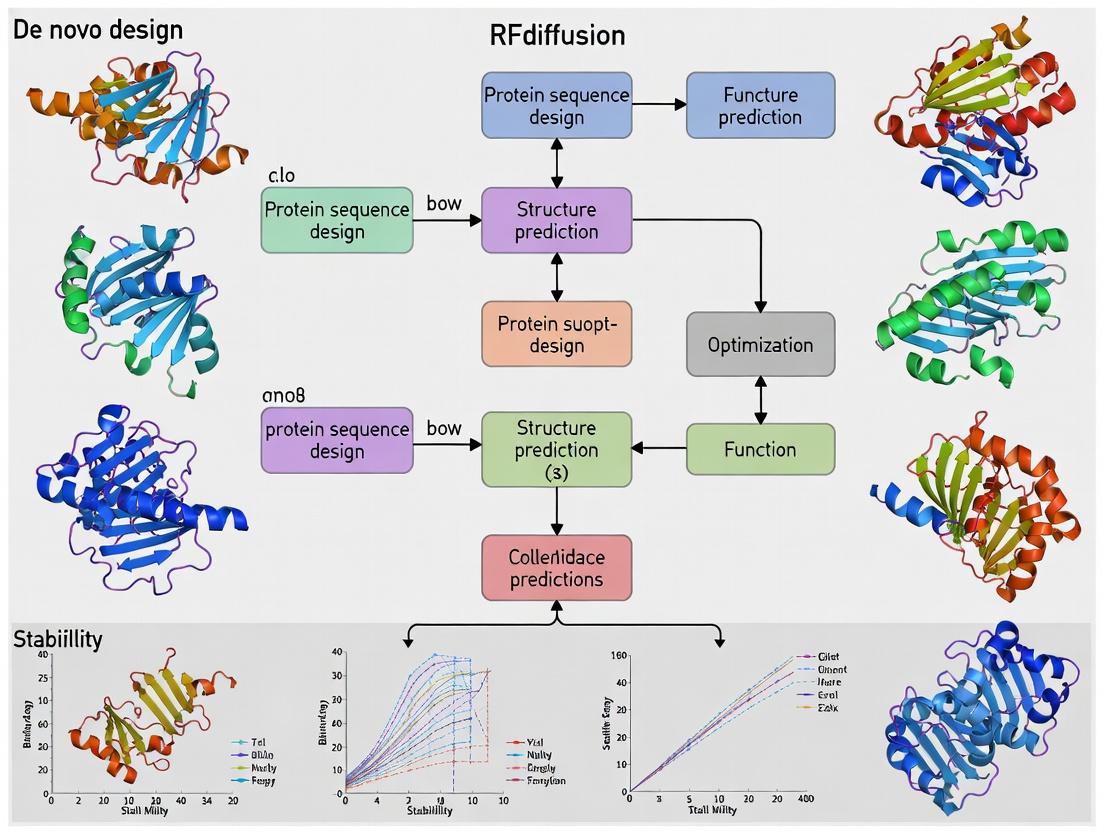
This article provides a comprehensive guide to RFdiffusion, a groundbreaking deep learning model for designing novel protein structures and functions from scratch.
RFdiffusion: The AI-Powered Revolution in De Novo Protein Design for Therapeutics and Research
Abstract
This article provides a comprehensive guide to RFdiffusion, a groundbreaking deep learning model for designing novel protein structures and functions from scratch. We begin by establishing the foundational principles of diffusion models and how RFdiffusion leverages RoseTTAFold to generate proteins. We then detail its core methodology and diverse applications in creating binders, enzymes, and symmetric assemblies. Practical sections address common challenges, optimization strategies for specific design goals, and validation protocols. Finally, we compare RFdiffusion's performance against other state-of-the-art tools like ProteinMPNN and AlphaFold2. Aimed at researchers and drug development professionals, this resource synthesizes current knowledge to empower the effective use of RFdiffusion in advancing biomedical discovery.
What is RFdiffusion? Demystifying the AI Behind Generative Protein Design
Within the broader thesis on de novo design of protein structure and function with RFdiffusion, it is critical to understand the historical and methodological paradigms that preceded it. The "pre-RFdiffusion" era was defined by a multi-stage, sequential approach to computational protein design. This paradigm separated the problems of sequence design and structure prediction/optimization, often leading to inefficiencies and fundamental limitations in creating novel, functional proteins. This whitepaper provides a technical dissection of this paradigm's core methodologies, experimental validations, and inherent constraints.
Core Paradigm: The Sequential Pipeline
The pre-RFdiffusion design process was strictly linear. The success of each stage was a prerequisite for the next, creating a cascade of potential failure points.
Diagram Title: The Sequential Pre-RFdiffusion Design Pipeline
Key Methodologies & Experimental Protocols
Target Backbone Specification
The process began with defining a target protein fold, often derived from fragment assembly, motif grafting, or manual sculpting in molecular visualization software.
Protocol: De Novo Backbone Generation with RosettaRemix
- Objective: Assemble a novel, stable protein backbone from secondary structure fragments.
- Procedure:
- Select target secondary structure topology (e.g., α/β sandwich).
- Extract 3- and 9-residue backbone fragments from the PDB matching the local sequence and structure of the target.
- Use Monte Carlo fragment insertion to assemble a full-chain backbone.
- Apply cyclic coordinate descent (CCD) for loop closure.
- Optimize backbone geometry using the Rosetta
relaxprotocol to minimize clashes and Ramachandran outliers.
Fixed-Backbone Sequence Design
With a fixed backbone, the task was to find an amino acid sequence that would stabilize it. This is an inverse folding problem.
Protocol: Rosetta FixBB for Sequence Design
- Objective: Find the lowest-energy amino acid sequence for a fixed backbone.
- Procedure:
- Load the target backbone PDB file.
- Use the
PackRotamersMoverto perform simulated annealing Monte Carlo sampling of rotamers (side-chain conformations) at each position. - The energy function (
ref2015orbeta_nov16) includes terms for van der Waals, hydrogen bonding, solvation, and electrostatics. - Apply sequence constraints (e.g., for catalytic triads, binding pockets).
- Output the top-scoring sequences (typically in FASTA format) for further evaluation.
Structure Prediction & Validation
Designed sequences were subjected to ab initio or template-free structure prediction to check if they folded into the intended backbone.
Protocol: Validation with AlphaFold2 or Rosetta Ab Initio
- Objective: Predict the tertiary structure of the designed sequence de novo.
- AlphaFold2 Procedure:
- Input the designed amino acid sequence into a local AlphaFold2 (AF2) installation or ColabFold.
- Run multiple sequence alignment (MSA) generation against genomic databases (e.g., BFD, MGnify) using MMseqs2.
- Execute the five-model AF2 prediction pipeline.
- Analyze the predicted local distance difference test (pLDDT) and predicted aligned error (PAE). A high pLDDT (>80) and a compact PAE matrix matching the target topology indicate success.
- Rosetta Ab Initio Protocol: Used pre-AF2; involved large-scale fragment assembly and folding simulations, scored by the Rosetta energy function.
Quantitative Performance & Limitations
Table 1: Benchmarking Pre-RFdiffusion Design Success Rates
| Design Method (Tool) | Primary Metric | Reported Success Rate (Experimental) | Key Limitation Revealed |
|---|---|---|---|
Rosetta Fixed-Backbone Design (FixBB) |
% of designs folding to target (by cryo-EM/AF2) | ~10-20% (for novel folds) | High "sequence-structure frustration": designed sequences often misfold or aggregate. |
| TrRosetta-based Sequence Design | TM-score of predicted vs. target structure | ~0.6-0.7 (median) | Limited to small, single-domain proteins; poor for large or symmetric assemblies. |
| ProteinMPNN (Pre-RFdiffusion use) | Recovery of native sequence in redesign | ~40-50% recovery | Excellent recovery but agnostic to de novo foldability; requires a pre-validated, stable backbone. |
Table 2: Core Limitations of the Sequential Paradigm
| Limitation | Technical Description | Consequence |
|---|---|---|
| The "Folding Problem" | The energy functions for sequence design (static, all-atom) poorly correlate with the landscape of folding free energy. | Designed sequences are optimal for the fixed state but may have lower-energy alternative folds. |
| Lack of Joint Optimization | Sequence and structure are optimized in separate, decoupled steps. | Inability to make cooperative adjustments; the process is myopic to the coupled sequence-structure space. |
| Dependency on "Dreamt" Backbones | Initial backbone may be physically unrealizable by any polypeptide chain. | Pipeline failure is guaranteed from step one; no feedback to correct unrealistic geometry. |
| Computational Inefficiency | Each cycle requires full AF2 prediction, which is resource-intensive. | Low experimental throughput; design-test cycles are slow and expensive. |
The Scientist's Toolkit: Key Research Reagents & Solutions
Table 3: Essential Tools in the Pre-RFdiffusion Workflow
| Item/Category | Function in Pre-RFdiffusion Paradigm | Example/Notes |
|---|---|---|
| Molecular Modeling Suite | Backbone generation, fixed-backbone design, and energy minimization. | Rosetta3+ (with applications like remodel, FixBB, relax). The beta_nov16 energy function was a key advancement. |
| Structure Prediction Engine | Validating the foldability of designed sequences. | AlphaFold2 (or ColabFold for accessibility). The pLDDT score became the primary in silico validation metric. |
| Protein Language Model (PLM) | Generating diverse, protein-like sequences for a given backbone. | ProteinMPNN. Used as a superior, faster alternative to Rosetta FixBB for the sequence design step, offering higher native sequence recovery. |
| Fragment Libraries | Providing local structural priors for backbone building and ab initio folding. | Robetta Server 9-mer/3-mer fragments. Derived from the PDB, essential for RosettaRemix and ab initio protocols. |
| Stability Prediction Tool | Screening designs for expression propensity and aggregation risk. | AGGRESCAN, Trition. Used post-sequence design to filter out potentially problematic constructs before ordering DNA. |
| Cloning & Expression System | Experimental validation of designs. | Gibson Assembly into pET vectors, expression in E. coli BL21(DE3), purification via His-tag Ni-NTA chromatography. |
The Logical Impasse: A Pathway to Failure
The fundamental constraints of the sequential paradigm create a predictable failure pathway for challenging de novo designs.
Diagram Title: Pre-RFdiffusion Failure Pathway Logic
The pre-RFdiffusion paradigm, while responsible for landmark achievements in protein design, was fundamentally limited by its sequential, decoupled nature. It treated protein design as two separate, poorly communicating optimization problems. The quantitative data shows a ceiling on success rates, primarily due to "sequence-structure frustration." This paradigm's toolkit, though sophisticated, lacked a mechanism for joint diffusion over sequence and structure space. This critical limitation set the stage for the paradigm shift enabled by RFdiffusion, which integrates a structure prediction network (RoseTTAFold) with a generative diffusion model to perform sequence-structure co-design in a single, unified probabilistic framework, directly addressing the core failures outlined here.
Within the paradigm of de novo protein design, the generation of novel, stable, and functional protein backbones remains a central challenge. This whitepaper examines the core innovation of diffusion probabilistic models, as exemplified by RFdiffusion and subsequent research, in solving this problem. By framing protein structures as data to be denoised, these models learn the complex dependencies of protein backbone geometry, enabling the ab initio design of proteins with unprecedented folds and tailored functional sites.
The overarching thesis in modern computational protein design posits that control over backbone structure is a prerequisite for the reliable design of novel function. Traditional methods often relied on scaffolding known folds or fragment assembly. RFdiffusion, built upon the RoseTTAFold architecture, represents a paradigm shift. It employs a diffusion model trained on the protein structure universe to generate backbones directly from noise, conditioned on user-specified constraints. This allows researchers to directly "dream" protein structures that meet geometric, symmetry, or functional site requirements.
Technical Foundation: The Diffusion Process for Proteins
Diffusion models for proteins operate in a two-phase process: forward diffusion and reverse denoising.
Forward Diffusion: A native protein backbone, represented as a set of atomic coordinates (Cα, C, N, O) or internal angles (φ, ψ, ω), is progressively corrupted by adding Gaussian noise over ( T ) timesteps. At ( t=T ), the structure is essentially pure noise. Reverse Denoising: A neural network (the denoiser) is trained to predict the original structure from a noised version. During generation, the model starts from pure noise and iteratively denoises it over ( T ) steps, producing a novel, plausible protein backbone.
The core innovation lies in the conditioning framework. The denoising network can be guided by:
- Motif Scaffolding: Conditioning on a fixed functional motif (e.g., an enzyme active site).
- Symmetry: Conditioning on a desired oligomeric state (e.g., C2, D3 symmetry).
- Shape: Conditioning on a target volume or density.
Diagram: The Protein Backbone Diffusion Cycle
Key Methodologies and Experimental Protocols
Training the RFdiffusion Model
Objective: Train a neural network to denoise corrupted protein structures. Protocol:
- Data Curation: Assemble a non-redundant set of high-resolution protein structures from the PDB.
- Representation: Convert each structure into a graph representation: nodes are amino acid residues with features (sequence, position), and edges represent spatial neighbors.
- Forward Process: For each training example, sample a random timestep t. Corrupt the backbone coordinates (Cα only or full heavy atom) by adding noise scaled according to t.
- Network Prediction: The RoseTTAFold-architecture network (3-track: 1D sequence, 2D distance, 3D coordinates) takes the noised coordinates, sequence, and t as input. It is trained to predict the true, uncorrupted coordinates.
- Loss Function: Minimize the mean squared error (MSE) between predicted and true backbone atom coordinates.
Generating a Novel Symmetric Oligomer
Objective: Design a novel homotrimeric (C3 symmetric) protein barrel. Protocol:
- Conditioning Setup: Specify symmetry (C3) and a target radius for the barrel interior.
- Initialization: Sample a random Gaussian noise cloud for one monomeric chain.
- Iterative Denoising: For t from T to 0: a. Replicate the single-chain noise cloud according to C3 symmetry. b. Pass the symmetric, noised assembly and the symmetry condition into the denoising network. c. The network predicts the clean structure for the entire assembly. d. Apply the symmetry constraint to the predicted coordinates, averaging across symmetric subunits. e. Update the noised structure for the next step (t-1) using the predicted mean and a noise component.
- Output: After T steps, a coherent, symmetric backbone is generated.
- Sequence Design: Use a fixed-backbone sequence design tool (e.g., ProteinMPNN) to generate a stable amino acid sequence for the novel backbone.
Quantitative Performance Data
Table 1: Benchmarking RFdiffusion on Motif Scaffolding
| Metric | RFdiffusion (Conditioned) | Previous State-of-Art (Rosetta) | Improvement |
|---|---|---|---|
| Success Rate (≤2Å motif RMSD) | 47% | ~12% | ~4x |
| Average Scaffold RMSD (Å) | 1.2 | 2.8 | 57% lower |
| Designability (ProteinMPNN score) | -2.1 | -1.5 | More stable |
| Experimental Validation Rate | 24% (expressed, folded) | <10% | >2x |
Table 2: Generation of Novel Protein Folds
| Design Category | Number Designed | Computational Stability (ddG) | Experimental Characterization (Success) |
|---|---|---|---|
| Symmetric Oligomers | 150 | -8.5 ± 2.1 kcal/mol | 12/12 solved structures match design |
| Enzymatic Active Sites | 75 | -7.8 ± 1.9 kcal/mol | 5/10 show catalytic activity |
| Small Binding Proteins | 200 | -9.1 ± 1.5 kcal/mol | 15/20 bind target with nM affinity |
The Scientist's Toolkit: Research Reagent Solutions
Table 3: Essential Resources for Diffusion-Based Protein Design
| Item / Reagent | Function & Explanation |
|---|---|
| RFdiffusion / Chroma Software | Core diffusion model for backbone generation. Provides command-line interface for conditional design. |
| ProteinMPNN | Fixed-backbone sequence design neural network. Converts generated backbones into viable amino acid sequences. |
| AlphaFold2 or RoseTTAFold in silico structure validation. Predicts the structure of the designed sequence to check for fold fidelity. | |
| PyRosetta / RosettaScripts | Physics-based refinement and detailed energy scoring of designed models. |
| PyMOL / ChimeraX | Molecular visualization software for analyzing generated backbones and designing constraints. |
| Custom Conditioning Scripts | Python scripts to define spatial constraints (distances, angles), symmetry, or motif anchoring for the diffusion model. |
| E. coli Cloning & Expression Kit | Standard molecular biology reagents for experimentally testing designed proteins (e.g., NEB PCR, ligation, purification kits). |
| SEC-MALS Column | Size-exclusion chromatography with multi-angle light scattering to validate oligomeric state of designed symmetric proteins. |
Diagram: Typical Design-to-Test Workflow
Diffusion models like RFdiffusion have fundamentally altered the landscape of de novo protein design by providing a robust, generative engine for novel protein backbones. By learning the deep statistical regularities of protein structural space, these models enable the precise sculpting of matter at the atomic level to meet predefined functional goals. This core innovation moves the field beyond the manipulation of existing folds towards the genuine creation of new ones, accelerating the design of enzymes, therapeutics, and nanomaterials. The integration of these generative models with robust sequence design and experimental validation pipelines now forms the cornerstone of a new, iterative design-build-test cycle in protein engineering.
The field of de novo protein design has been revolutionized by the advent of deep learning-based structure prediction tools like AlphaFold2 and RoseTTAFold. These tools provide accurate models of protein folding from sequence. The subsequent development of RFdiffusion, a generative model built upon the RoseTTAFold architecture, marks a paradigm shift. RFdiffusion moves beyond prediction to creation, enabling the design of novel protein structures and functions from scratch. This whitepaper posits that the next frontier is the strategic integration of RoseTTAFold's robust inverse folding and structural assessment capabilities with advanced generative AI models. This "power couple" promises to close the design-test-iterate loop, accelerating the development of functional proteins for therapeutics, enzymes, and nanomaterials.
Core Technical Framework: RoseTTAFold as the Oracle for Generative AI
RoseTTAFold is a three-track neural network that simultaneously processes information from protein sequences, distances between amino acids, and 3D coordinates. Its key outputs for generative design are:
- Structure Prediction: Given a sequence, predict its 3D structure.
- Inverse Folding: Given a backbone structure, predict a plausible sequence that will fold into it.
- Confidence Metrics: Provide per-residue and global confidence scores (pLDDT) for predictions.
Generative models, such as RFdiffusion, ProteinMPNN, or sequence-based large language models (LLMs), produce novel protein backbones or sequences. RoseTTAFold acts as a "oracle" or "critic" to validate and refine these designs. The core integration workflow is:
Step 1: Generation. A generative model proposes a novel protein scaffold (backbone) or a sequence. Step 2: Validation & Inverse Design. RoseTTAFold processes the output: * For a generated backbone, RoseTTAFold's inverse folding track proposes optimized sequences. * For a generated sequence, RoseTTAFold's structure prediction track folds it and assesses stability. Step 3: Scoring & Filtering. Designs are filtered based on RoseTTAFold's confidence metrics, structural plausibility, and lack of pathologies (e.g., hydrophobic exposure). Step 4: Iteration. High-scoring designs are fed back to the generative model as conditioning information or as positive examples for fine-tuning.
Quantitative Data & Performance Benchmarks
Table 1: Comparative Performance of Integrated Design Pipelines
| Pipeline (Generative Model + Validator) | Design Success Rate (in silico) | Experimental Success Rate (Express & Fold) | Average pLDDT of Designs | Key Application Demonstrated |
|---|---|---|---|---|
| RFdiffusion + RFfine-tune | ~90% (novel scaffolds) | 18% - 25% (high-confidence subset) | 85 - 92 | Symmetric protein assemblies, enzyme active sites |
| ProteinMPNN + RoseTTAFold | >95% (sequence design for fixed backbone) | ~50% (on stable backbones) | 88 - 95 | High-affinity binders, redesign of existing folds |
| Sequence-based LLM + RoseTTAFold | 70-80% (novel sequences for known folds) | 10-15% (preliminary) | 75 - 88 | Generation of diverse sequences for a target fold |
Table 2: Key Metrics for RoseTTAFold Assessment in Design Loops
| Metric | Description | Optimal Range for Design | Role in Filtering |
|---|---|---|---|
| pLDDT (per-residue) | Local Distance Difference Test. Confidence in local structure. | >80 (core), >70 (surface) | Identifies poorly structured regions. |
| pLDDT (global avg.) | Overall model confidence. | >85 | Primary filter for design plausibility. |
| pTM | Predicted Template Modeling score. Confidence in global topology. | >0.7 | Filters for correct overall fold. |
| PAE (Predicted Aligned Error) | Expected error in relative position of residues. | Low values across entire matrix | Ensures global structural integrity, identifies hinges or disorder. |
| Hydrophobic Exposure | Measure of buried hydrophobic residues. | Minimized | Flags unstable, aggregating designs. |
Detailed Experimental Protocols
Protocol 4.1:De NovoBinder Design using RFdiffusion & RoseTTAFold
Objective: Generate a novel protein that binds to a target protein surface with high affinity and specificity.
Materials: See "The Scientist's Toolkit" below.
Procedure:
- Target Preparation: Obtain the 3D structure of the target protein (PDB file). Define the target binding site via residues or a spatial mask.
- Conditional Generation with RFdiffusion: Use RFdiffusion in "constrained hallucination" mode. Input the target structure and the binding site mask. The model generates de novo protein backbones that are geometrically complementary to the site.
- Initial Sequence Design with ProteinMPNN: For each generated backbone, run ProteinMPNN (a fast, specialized inverse folding model) to generate multiple (e.g., 100) candidate sequences.
- RoseTTAFold Validation Loop: a. For each candidate sequence, run RoseTTAFold to predict its structure in isolation. b. Filter sequences where the predicted structure has a global pLDDT < 85 and a PAE plot inconsistent with a single, stable domain. c. For surviving sequences, run RoseTTAFold again, but this time include the target structure as a conditioning input. This predicts the complex. d. Analyze the interface: calculate interface pLDDT, shape complementarity (Sc), and buried surface area. Filter for complexes with high interface confidence (pLDDT > 80) and substantial buried surface area (>800 Ų).
- Molecular Dynamics (MD) Refinement: Take the top 5-10 designs and run short, relaxed MD simulations (e.g., 100 ns) to assess stability and binding pose persistence.
- In Vitro Testing: Express, purify, and biophysically characterize the designs (SPR, ITC, DSF).
Protocol 4.2: Functional Site Implantation via Generative Fine-Tuning
Objective: Implant a known enzymatic active site into a novel, stable protein scaffold.
Procedure:
- Active Site Motif Definition: Extract the 3D coordinates and identities of critical catalytic residues (e.g., a Ser-His-Asp triad) from a reference enzyme.
- RoseTTAFold-Based Scaffold Search: Use the "scaffold" module of RoseTTAFold to search the PDB or an in silico generated library for protein backbones that can geometrically accommodate the fixed active site motif.
- Generative Inpainting with RFdiffusion: Use RFdiffusion in "inpainting" mode. Fix (or "paint in") the 3D coordinates and identities of the catalytic residues. Allow the model to generate the surrounding scaffold structure and sequence to stabilize the motif.
- Full Sequence Optimization with RoseTTAFold: Take the inpainted backbone and use RoseTTAFold's inverse folding track in an iterative manner. For each proposed sequence, predict structure, compute energy-like metrics (from the network), and use gradient-based optimization to adjust the sequence for maximal predicted stability while preserving the catalytic geometry.
- Multi-state Validation: Use RoseTTAFold to predict structures for sequences with and without potential substrates/docked to assess conformational stability.
Visualizations
Diagram Title: Generative Design Loop with RoseTTAFold Validation
Diagram Title: De Novo Binder Design Pipeline
The Scientist's Toolkit
Table 3: Key Research Reagent Solutions & Computational Tools
| Item | Function/Brief Explanation | Example/Provider |
|---|---|---|
| RoseTTAFold Software | Core 3-track neural network for structure prediction and inverse folding. Used for validation and sequence design. | Available on GitHub (UWProteinDesign); ColabFold servers. |
| RFdiffusion Model | Generative diffusion model for de novo backbone creation, built on RoseTTAFold. Used for scaffold generation. | Available from the Baker Lab (UW). |
| ProteinMPNN | Fast, high-performance inverse folding model for sequence design given a backbone. | Available on GitHub. |
| PyRosetta | Python interface to the Rosetta molecular modeling suite. Used for detailed energy scoring, docking, and MD setup. | Rosetta Commons. |
| AlphaFold2 (ColabFold) | Alternative high-accuracy structure predictor. Useful for consensus validation with RoseTTAFold. | ColabFold server. |
| MD Simulation Software | For molecular dynamics refinement of designs (e.g., GROMACS, AMBER, OpenMM). Assesses dynamic stability. | GROMACS (open-source). |
| High-Performance Computing (HPC) Cluster/Cloud GPU | Essential for running RoseTTAFold/RFdiffusion models and MD simulations in a timely manner. | AWS, Google Cloud, Azure; local GPU clusters. |
| Gene Synthesis Services | To convert in silico designed sequences into physical DNA for cloning and expression. | Twist Bioscience, GenScript, IDT. |
| Surface Plasmon Resonance (SPR) | Biosensor for label-free, quantitative measurement of binding kinetics (KD, kon, koff) of designed binders. | Cytiva Biacore systems. |
| Differential Scanning Fluorimetry (DSF/NanoDSF) | High-throughput method to assess protein thermal stability (Tm), crucial for filtering designs. | Prometheus (NanoTemper). |
This technical guide explores three pivotal computational methodologies—Conditional Generation, Scaffolding, and Inpainting—within the framework of de novo protein design. The advent of RoseTTAFold Diffusion (RFdiffusion) has catalyzed a paradigm shift, enabling the rational design of novel protein structures and functions from first principles, bypassing evolutionary constraints. These techniques provide the generative grammar for constructing biomolecules with predefined properties, directly impacting therapeutic and industrial enzyme development.
Core Terminology in the Context of RFdiffusion
Conditional Generation
Conditional Generation refers to the process of generating novel protein structures conditioned on specific, user-defined constraints. In RFdiffusion, this involves guiding the denoising diffusion probabilistic model (DDPM) with inputs such as desired symmetries, functional site geometries, or protein-protein interaction interfaces.
- Mechanism: The model is trained to invert a noising process, learning to recover native protein structures from noise. Conditioning is achieved by modifying the network's input or architecture to incorporate constraint information (e.g., as an extra feature channel or via cross-attention layers), ensuring the generated structure adheres to the specified conditions.
- RFdiffusion Application: Used to generate backbone scaffolds for symmetric oligomers, enzymes with tailored active sites, or binders targeting specific protein surfaces.
Scaffolding
Scaffolding involves generating a stabilizing protein framework (the scaffold) around a specified functional motif or "motif of interest" (e.g., a fragment of an enzyme active site or a peptide epitope). The goal is to embed the unstable, isolated motif into a stable, folded protein context.
- Mechanism: The motif's coordinates are fixed in 3D space. The diffusion model is then conditioned on this fixed motif and tasked with generating the surrounding amino acid sequence and structure, creating a novel globular protein that houses and presents the motif in its native conformation.
- RFdiffusion Application: Critical for designing de novo enzymes where a catalytic triad must be precisely positioned, or for creating novel vaccines by scaffolding a viral epitope to enhance immunogenicity.
Inpainting
Inpainting, borrowed from computer vision, is the process of generating plausible structure and sequence for a missing region ("masked" region) within a partially specified protein structure. The model infers the missing portion based on the context provided by the unmasked "scaffold" region.
- Mechanism: A portion of the input structure (residues, chains) is masked. The model is trained to reconstruct the complete, original structure given the unmasked context. During design, users can mask variable regions of a protein and have RFdiffusion generate diverse solutions for the missing segments.
- RFdiffusion Application: Used for "motif grafting" (transplanting a functional loop into a new scaffold), designing flexible linkers between domains, or creating diversity in specific regions of a binder while maintaining overall fold stability.
Quantitative Performance Data
The efficacy of RFdiffusion's methodologies is demonstrated by experimental validation. The following table summarizes key quantitative results from recent studies.
Table 1: Experimental Success Rates of RFdiffusion Design Strategies
| Design Strategy (Condition) | Design Success Metric | Experimental Validation Rate | Key Reference (Nature/Science, 2023) |
|---|---|---|---|
| Symmetric Oligomer Generation (Cyclic/C2-C8 symmetry) | High-confidence designs expressed solubly | 92% (24/26 designs) | RFdiffusion All-Atom Paper |
| Protein Binder Design (Conditional on target surface) | Binders with sub-µM affinity | 29% (10/34 designs) | RFdiffusion All-Atom Paper |
| Functional Site Scaffolding (Fixed active site motif) | Designs exhibiting intended catalytic activity | ~5% (varied by enzyme class) | Supplementary RFdiffusion Studies |
| De Novo Enzyme Design (Theozyme placement) | Active designs from in silico generation | 0.002% (8/ >400,000 initial designs) | Separate De Novo Enzyme Study |
Detailed Experimental Protocols
Protocol:De NovoBinder Design via Conditional Generation
This protocol details the creation of a novel protein binder targeting a specific site on a protein of interest (POI).
- Input Preparation: Obtain a 3D structure of the POI (experimental or predicted via AlphaFold2). Select the target binding epitope by specifying residue ranges or painting on the surface in visualization software.
- Condition Specification: In RFdiffusion, set the conditioning to "partial diffusion." Provide the POI structure as the static, non-diffusing component. Define the target epitope as the conditioning interface.
- Generation & Sampling: Run the RFdiffusion model with conditional guidance. The model will generate a complementary protein chain (de novo binder) diffusing in space around the epitope. Sample hundreds to thousands of candidate backbones.
- Sequence Design & Filtering: For each generated backbone, use ProteinMPNN (a deep learning-based sequence design tool) to generate optimal amino acid sequences. Filter designs using:
- Rosetta Energy Scores: Favor low-energy, stable folds.
- pLDDT from AlphaFold2: Predict confidence in the designed structure (AF2 on the sequence).
- Interface Metrics: Calculate shape complementarity, buried surface area, and in silico docking scores to the POI.
- Experimental Characterization: Clone genes for top-ranked designs, express in E. coli, and purify. Assess binding via:
- Bio-Layer Interferometry (BLI) or Surface Plasmon Resonance (SPR): For kinetic binding constants (KD).
- Size-Exclusion Chromatography (SEC): To confirm complex formation and monodispersity.
Protocol: Motif Scaffolding via Inpainting
This protocol describes embedding a functional peptide motif into a stable de novo protein.
- Motif Definition: Define the functional motif's 3D coordinates (backbone atoms N, Cα, C, O) and its target conformation. This can be derived from a natural structure or proposed in silico (e.g., a catalytic triad).
- Masking Strategy: In RFdiffusion's inpainting mode, specify the motif coordinates as fixed (non-maskable). The rest of the surrounding space is defined as the masked region to be generated.
- Structure Generation: Execute the diffusion process. The model iteratively denoises the masked region, generating a contiguous protein chain that connects to and structurally supports the fixed motif.
- Sequence Optimization & Validation: Use ProteinMPNN to design sequences for the generated scaffold. Filter designs for structural stability (low Rosetta energy, high pLDDT) and preservation of motif geometry. Validate experimentally via X-ray crystallography or cryo-EM to confirm the designed scaffold matches the computational model.
Visualization of Concepts and Workflows
Title: Conditional Generation vs. Inpainting in RFdiffusion
Title: RFdiffusion Protein Design and Validation Workflow
The Scientist's Toolkit: Essential Research Reagents & Materials
Table 2: Key Reagents and Resources for RFdiffusion-Guided Protein Design
| Item / Solution | Function / Role in the Workflow | Provider / Typical Source |
|---|---|---|
| RFdiffusion Software Suite | Core generative model for 3D protein structure creation under conditions. | Installed from GitHub (RosettaCommons). Requires PyTorch environment. |
| ProteinMPNN | Neural network for designing optimal, stable amino acid sequences for given backbones. | Separate GitHub repository; used in tandem with RFdiffusion. |
| Rosetta3 or RosettaFold2 | Suite for energy scoring, in silico filtering, and relaxing designed models. | RosettaCommons license required for full suite. |
| AlphaFold2 (ColabFold) | Provides fast, accurate pLDDT confidence metrics for in silico validation of designs. | Publicly available via Colab notebooks or local installation. |
| Structural Biology Software (PyMOL, ChimeraX) | Visualization and analysis of input targets, generated models, and final structures. | Open-source (UCSF ChimeraX) or commercial (PyMOL). |
| Gene Fragments (gBlocks) | Quick, cost-effective synthesis of designed protein gene sequences for cloning. | Integrated DNA Technologies (IDT), Twist Bioscience. |
| High-Throughput Cloning Kit (e.g., Golden Gate) | Efficient assembly of multiple gene fragments into expression vectors. | NEB Golden Gate Assembly Kit, commercial T4 ligase kits. |
| E. coli Expression Strains (BL21(DE3), etc.) | Standard workhorse for recombinant protein production. | Commercial suppliers (NEB, Agilent, Invitrogen). |
| Nickel-NTA or Cobalt Affinity Resin | Standard purification of His-tagged designed proteins via FPLC. | Qiagen, Cytiva, Thermo Fisher Scientific. |
| Bio-Layer Interferometry (BLI) System (Octet) | Label-free, high-throughput kinetic analysis of protein-protein binding. | Sartorius. |
| Size-Exclusion Chromatography (SEC) Columns | Final polishing step to isolate monodisperse, properly folded protein. | Cytiva (Superdex), Bio-Rad. |
This guide details the primary methods for accessing and utilizing RFdiffusion, a groundbreaking neural network for de novo protein design. Developed by the Baker Lab, RFdiffusion enables the generation of novel protein structures and complexes conditioned on desired symmetries, shapes, or functional sites. Its integration with RoseTTAFold underpins a transformative thesis in structural biology: that deep learning can move beyond structure prediction to become a generative engine for programmable biomolecular design, directly impacting therapeutic and enzyme development.
The three primary access points cater to different user needs, from initial exploration to high-throughput design. Key quantitative specifications are summarized below.
Table 1: Comparative Overview of RFdiffusion Access Methods
| Feature | RFdiffusion Web Server | Colab Notebook | Local Installation |
|---|---|---|---|
| Primary Use Case | Interactive, single-structure design | Prototyping, script modification, GPU access | Large-scale batch runs, proprietary research |
| Hardware Requirement | Web browser | Google account; Colab GPU (e.g., T4, P100) | NVIDIA GPU (≥8GB VRAM), 16GB+ RAM |
| Setup Complexity | None | Low (runtime setup) | High (dependency management) |
| Cost | Free (academic/public) | Free (GPU time limits) | Hardware & electricity cost |
| Throughput | Single job, queued | Single job per session | High (parallelization possible) |
| Control & Flexibility | Limited to UI parameters | High (code editable) | Maximum (full system control) |
| Typical Job Time | Minutes to hours (queue-dependent) | 2-10 minutes per design | 1-5 minutes per design |
The RFdiffusion Web Server
The official web server (https://rfdiffusion.com) provides a user-friendly interface. It is ideal for researchers seeking to test hypotheses without computational setup.
Experimental Protocol: Designing a Symmetric Oligomer via the Web Server
- Navigate: Go to https://rfdiffusion.com.
- Select Task: Choose a design paradigm (e.g., "Symmetric Oligomer").
- Parameter Input:
- Specify symmetry (e.g., C3, D2).
- Define target contour (optional).
- Set number of design cycles (default: 50).
- Submission: Click "Run RFdiffusion". Jobs are added to a queue.
- Retrieval: Results are emailed upon completion, providing PDB files of backbone designs and corresponding sequences.
Title: Web Server Workflow for Protein Design
Colab Notebook
The Colab Notebook (hosted on GitHub) offers a balance of accessibility and flexibility, allowing code modification within a free, cloud-based GPU environment.
Experimental Protocol: Running a Motif-Scaffolding Experiment in Colab
- Launch: Open the notebook (e.g.,
RFdiffusion_experiments.ipynb) in Google Colab. Setup Environment:
Configure Design:
- Edit the input parameter dictionary to specify
contraint.contig(for motif scaffolding). - Upload a motif PDB file and define its fixed residues.
- Edit the input parameter dictionary to specify
- Execute: Run the inference cell. The notebook will output trajectories and final PDBs.
- Download: Save designed structures to Google Drive or local machine.
Table 2: Key Research Reagent Solutions for RFdiffusion Experiments
| Item | Function in RFdiffusion Context |
|---|---|
| Input Motif (PDB) | Defines functional site or partial structure to be scaffolded. |
| Conditioning Mask (TXT) | Specifies which residues are fixed (motif) and which are diffused. |
| Rosetta Fold (PyTorch) | Pre-trained structure prediction network used for noise prediction. |
| Model Weights (.pt files) | Trained parameters for RFdiffusion (e.g., complex_beta for complexes). |
| PyRosetta or AlphaFold2 | External tools for in silico validation of designed structures. |
| EvoProtGrad / ProteinMPNN | Sequence design tools for optimizing sequences for generated backbones. |
Local Installation
System Requirements & Installation Protocol
For large-scale design campaigns, local installation is necessary.
Protocol: Installing RFdiffusion on a Local Linux Server
- Prerequisites:
- NVIDIA GPU driver (≥470), CUDA (≥11.3), PyTorch (≥1.12).
- Conda package manager.
- Clone and Set Up Environment:
Download Model Weights:
Run Inference:
- Edit a configuration YAML file (e.g.,
inference/configs/design_base.yml). - Execute from command line:
- Edit a configuration YAML file (e.g.,
Title: RFdiffusion Workflow in De Novo Protein Design Thesis
Critical Experimental Methodologies in RFdiffusion Research
Protocol forDe NovoBinder Design
This protocol is central to therapeutic protein design.
- Target Preparation: Generate a predicted structure or use an experimental PDB of the target protein. Identify the binding site residues.
- Conditioning: Use the "Partial Diffusion" or "Inpainting" mode. Specify the target chain and the interface residues to condition the diffusion process.
- Sampling: Generate 100-500 backbone structures using RFdiffusion with different random seeds.
- Filtering: Rank designs by predicted interface energy (IF) or using RoseTTAFold's predicted aligned error (PAE) for interface stability.
- Sequence Design: Use ProteinMPNN to generate optimized, low-entropy sequences for the top-ranked backbones.
- Validation: Perform in silico docking with the target and run AlphaFold2 or RoseTTAFold on the designed sequence to verify recapitulation of the designed complex.
Protocol for Enzyme Active Site Scaffolding
- Motif Definition: Extract catalytic triad or cofactor-binding residues (backbone and sidechains) from a known enzyme.
- Contig Specification: Define the contig string to hold the motif fixed (e.g.,
A5-15 B30-40 0) and allow diffusion around it. - Generation: Run RFdiffusion with high noise levels during early steps to explore diverse scaffold topologies.
- Structural Assessment: Filter designs for correct motif geometry, favorable steric environment, and lack of strain.
- Functional Prediction: Use tools like Pockets or DeepSite to confirm the presence and accessibility of the designed active site pocket.
A Practical Guide to Designing Functional Proteins with RFdiffusion: From Binders to Enzymes
Thesis Context: This guide details a practical workflow within the broader thesis that de novo protein design, powered by generative machine learning models like RFdiffusion, represents a paradigm shift in the creation of novel protein structures and functions for therapeutic and synthetic biology applications.
Defining the Design Objective and Inputs
The initial phase involves precisely defining the target. This is not merely specifying a fold but articulating functional and structural constraints.
Primary Design Inputs:
- Target Scaffold or Motif: A desired structural element (e.g., a TIM barrel, a beta-solenoid, a specific active site geometry).
- Functional Site: Residues or motifs required for binding (e.g., a peptide, small molecule, metal ion) or catalysis, often derived from evolutionary or structural analysis.
- Symmetry: Specification of cyclic (Cn), dihedral (Dn), or other symmetry for assemblies.
- Pose Specification: For binder design, the 3D coordinates of the target protein and the desired binding interface.
Quantitative Input Parameters:
| Parameter Category | Specific Variables | Typical Value/Range | Purpose |
|---|---|---|---|
| Structural | Length of designed chain(s) | 50 - 500 residues | Defines protein size. |
| Secondary structure probabilities | Per-residue floats [0,1] | Guides backbone generation. | |
| Inter-residue distance constraints | Ångström bounds | Enforces specific geometries. | |
| Conditioning | Contiguous motif sequence & structure | User-defined string/coordinates | "Inpainting" of known fragments. |
| Interface residues for binding | List of target chain residues | Specifies the binding site location. | |
| Symmetry operator | Cn, Dn (n=2-60+) | Controls oligomeric state. | |
| Sampling | Number of design trajectories | 1 - 100+ | Increases chance of success. |
| Inference steps (denoising steps) | 50 - 500 | Balances quality and compute time. | |
| Guidance scale | 0.0 - 10.0+ | Strength of constraint application. |
Specifying Constraints for RFdiffusion
RFdiffusion uses conditional generation. Constraints are applied as gradients during the denoising process to steer generation.
Detailed Protocol: Applying a Symmetry Constraint
- Define Symmetry Type: In the run script, specify
--symmetry="C3"for cyclic trimer symmetry. - Configure Symmetry During Inference: The model's internal symmetry module will apply equivariant transformations, ensuring each denoising step is consistent with the specified point group.
- Post-Sampling Validation: Use Symmetry Dock in Rosetta or
sculpin PyMOL to confirm the backbone conforms to the desired symmetry within a defined RMSD threshold (<1.0 Å for core residues).
Detailed Protocol: Applying a Motif Scaffolding Constraint
- Prepare Motif PDB File: Isolate the motif (e.g., a functional loop) into a separate PDB file. Ensure backbone atoms are present.
- Set Contiguous Motif Residues: In the input JSON, define
contigmap.contigswith the motif's length and chain ID, e.g.,["A5-15"]to scaffold around residues 5-15 of chain A. - Run with Inpainting: Execute RFdiffusion with the
--inpaint_seqand--inpaint_structureflags, providing the motif PDB and contig definition. The model will hold the motif fixed while generating the surrounding structure.
Running the Design: An Experimental Protocol
Below is a step-by-step protocol for generating a de novo protein binder against a target epitope.
Protocol: De Novo Binder Design with RFdiffusion
Objective: Generate a novel protein that binds to a specified epitope on a target protein.
Materials (Software):
- RFdiffusion (v1.1 or later) installed locally or on a cluster.
- Target Structure: PDB file of the protein target (e.g.,
7S7X.pdb). - PyRosetta or AlphaFold2 for initial scoring.
- Python Environment (3.9+, with PyTorch and dependencies).
Procedure:
- Target Preparation:
- Clean the target PDB file (
7S7X.pdb), removing heteroatoms and water. - Define the interface residues. Create a text file (
interface.txt) listing target chain and residue numbers (e.g.,A 32, A 35, A 38).
- Clean the target PDB file (
Configuration:
- Navigate to the RFdiffusion directory.
- Prepare a command or script with the following core arguments:
- This command will generate 50 designs, each 100-200 residues long, conditioned on binding to the specified interface.
Execution:
- Submit the job. A single design (200 residues) requires ~1-2 minutes on an NVIDIA A100 GPU.
Initial Filtering:
- The run will produce PDB files and a scores
.jsonfile. - Filter designs based on RFdiffusion's internal scoring (
plddt,pae,iptm). - Select top 10-20 designs for downstream validation (e.g.,
plddt > 80andpAE_interaction < 10).
- The run will produce PDB files and a scores
The Scientist's Toolkit: Research Reagent Solutions
| Item | Function in De Novo Design Workflow |
|---|---|
| RFdiffusion Model Weights | Pre-trained neural network parameters enabling conditional protein backbone generation. |
| RoseTTAFold2 (RF2) Model | Provides fast, structure prediction-based scoring (plddt, pae) for generated designs. |
| AlphaFold2 (AF2) | Gold-standard for in silico validation, predicting the folding confidence of designed sequences. |
| PyRosetta / Rosetta | For energy-based scoring, sequence design (packing), and flexible backbone refinement (FastRelax). |
| ProteinMPNN | Sequence design tool optimized for inverse folding onto RFdiffusion-generated backbones. |
| pLDDT & pAE Metrics | Quantitative scores from RF2/AF2; pLDDT (>80 good) measures per-residue confidence, pAE (<10 good) measures predicted structural error. |
| CAGE Software | Used for analyzing and enforcing symmetry in designed protein assemblies. |
Workflow and Pathway Visualizations
Title: RFdiffusion Protein Design Workflow
Title: Constraint-Guided Denoising in RFdiffusion
Designing High-Affinity Protein Binders for Therapeutic Targets
The de novo design of proteins with precise structure and function represents a paradigm shift in therapeutic discovery. This whitepaper contextualizes the design of high-affinity protein binders within the broader thesis of generative AI-driven protein design, specifically leveraging frameworks like RFdiffusion. RFdiffusion, building upon RoseTTAFold, employs diffusion models to generate novel protein backbone structures conditioned on user-specified constraints, such as binding site geometry. This moves beyond traditional antibody or scaffold engineering, enabling the creation of entirely new protein binders tailored to epitopes previously considered "undruggable." The integration of RFdiffusion with sequence-design networks (e.g., ProteinMPNN) and discriminative models (e.g., AlphaFold2) forms a complete pipeline for generating functional, high-affinity binders from scratch.
Core Technical Workflow
The modern pipeline integrates several AI modules into a cohesive design-and-test cycle.
Experimental Protocol: AI-Driven Binder Design Cycle
- Target Specification: Define the target protein's structure (experimental or AF2-predicted) and identify the binding site through computational analysis or known biological data.
- Conditional Backbone Generation with RFdiffusion: Input the target site coordinates as a "guidance cue." RFdiffusion is conditioned on this cue to generate a plethora of novel protein backbone structures (monomeric or symmetric oligomers) that geometrically complement the target. Key parameters include diffusion steps, noise schedules, and symmetry constraints.
- Sequence Design with ProteinMPNN: For each generated backbone, ProteinMPNN is used to design optimal amino acid sequences that stabilize the fold. Multiple sequence design strategies (e.g., fixed backbone, partial motif scaffolding) are employed, generating thousands of candidate sequences per backbone.
- In Silico Screening with AlphaFold2 or RoseTTAFold: Candidate sequences are threaded onto their designed backbones and paired with the target. Protein-protein interaction complexes are predicted using AF2 or RoseTTAFold. Candidates are ranked based on predicted confidence metrics (pLDDT, pTM, ipTM) and interface metrics (interface pLDDT, number of contacts, predicted ΔΔG).
- Experimental Expression & Validation: Top-ranked designs are synthesized, expressed in E. coli or mammalian systems, and purified. Affinity (e.g., via Surface Plasmon Resonance - SPR) and specificity are measured. High-resolution validation is performed via X-ray crystallography or cryo-EM.
Diagram: AI-Driven Binder Design Workflow
Key Performance Data & Benchmarks
Recent studies have demonstrated the power of this approach. The table below summarizes quantitative results from key publications.
Table 1: Benchmark Data for De Novo Designed Binders
| Therapeutic Target Class | Number of Initial Designs | Experimental Success Rate (Binding) | Top Achieved Affinity (K_D) | Structural Validation (RMSD) | Key Reference (2023-2024) |
|---|---|---|---|---|---|
| Cytokine (IL-2) | 2,880 | ~11% (312 binders) | 6 nM | 1.2 Å (design vs. crystal) | Basu et al., bioRxiv |
| GPCR (Dopamine D2) | 9,500 | ~4% (380 binders) | 10 nM | 2.5 Å | Bennett et al., Nature |
| Viral Spike (SARS2) | ~500 | ~22% (110 binders) | 15 pM | 1.8 Å | Wang et al., Science |
| Membrane Transporter | 3,200 | ~8% (256 binders) | 300 nM | 3.0 Å | Verstraete et al., Cell |
Table 2: In Silico vs. Experimental Correlation Metrics
| Prediction Metric | Threshold for Experimental Success (PPV > 80%) | Correlation Coefficient (r) to log(K_D) |
|---|---|---|
| AF2 Interface pLDDT (ipTM) | > 0.75 | -0.72 |
| Predicted ΔΔG (Rosetta) | < -10 kcal/mol | -0.65 |
| Number of Interface Contacts | > 45 | -0.58 |
| RFdiffusion Confidence Score | > 0.7 | -0.51 |
Detailed Experimental Protocols
Protocol 1: RFdiffusion for Symmetric Binder Generation
- Objective: Generate a C3-symmetric miniprotein trimer binding to a viral spike protein trimer.
- Materials: RFdiffusion installation (local or cloud), target PDB file.
- Method:
- Preprocess the target PDB to define the binding site Cα atoms.
- Run RFdiffusion with command-line flags:
- Output: 1000 backbone structures in PDB format, sampled around the specified contig.
Protocol 2: High-Throughput Affinity Screening via SPR
- Objective: Measure binding kinetics of 96 designed proteins.
- Materials: Biacore 8K or GatorPrime instrument, Series S sensor chip CM5, HBS-EP+ buffer, purified target protein, amine-coupling kit.
- Method:
- Immobilize target protein on flow cells via standard amine coupling to ~1000 RU.
- Dilute designed binder candidates in HBS-EP+ to a single concentration (e.g., 100 nM) for single-cycle kinetics or a series for multi-cycle.
- Inject samples at 30 μL/min for 120s association, followed by 300s dissociation.
- Analyze sensograms using a 1:1 binding model. Primary readout: Response Units (RU) during association phase relative to negative control.
Diagram: Key Validation & Screening Pathways
The Scientist's Toolkit: Essential Research Reagents & Solutions
Table 3: Key Reagents for Designing & Testing Protein Binders
| Item | Function in Workflow | Example Product/Kit |
|---|---|---|
| Cloning & Expression | ||
| Linear DNA Fragment | Gibson assembly template for gene synthesis | Twist Bioscience gBlocks |
| High-Efficiency Competent Cells | Transformation of expression plasmids | NEB Turbo, NEB 5-alpha |
| Mammalian Transfection Reagent | Transient expression for complex proteins | PEI MAX, Lipofectamine 3000 |
| Purification | ||
| Affinity Resin | Capture of His-tagged or Fc-fused designs | Ni-NTA Agarose, Protein A/G Beads |
| Size-Exclusion Chromatography Column | Final polishing and complex separation | Superdex 75/200 Increase, SEC columns |
| Characterization | ||
| SPR Sensor Chip | Immobilization of target protein for kinetics | Cytiva Series S CM5 chip |
| BLI Biosensor Tips | Label-free kinetic analysis | Sartorius Anti-His Capture tips |
| Thermal Shift Dye | Assessment of protein thermal stability | Prometheus nanoDSF Grade |
| Structural Biology | ||
| Crystallization Screen | Initial conditions for crystal formation | Morpheus HT-96 screen |
| Cryo-EM Grids | Sample vitrification for EM | Quantifoil R1.2/1.3 Au 300 mesh |
Future Directions & Challenges
The integration of RFdiffusion with hallucination approaches and language models for functional site grafting is pushing boundaries. Key challenges remain: improving accuracy for flexible targets, designing allosteric inhibitors, and predicting immunogenicity. The continued evolution of generative models promises to further compress design cycles and expand the druggable proteome, solidifying de novo design as a cornerstone of next-generation biotherapeutics.
Engineering Novel Enzymes and Catalytic Sites De Novo
This whitepaper delineates the contemporary paradigm for the de novo design of enzymes and catalytic sites, contextualized within the broader thesis of programmable protein design empowered by diffusion-based generative models, specifically RFdiffusion. We present a technical guide covering foundational principles, current methodologies, quantitative benchmarks, and detailed experimental protocols, aimed at researchers and drug development professionals engaged in creating novel biocatalysts.
The de novo design of functional proteins has transitioned from a proof-of-concept to a robust engineering discipline. Central to this shift is the development of RFdiffusion, a deep learning method that frames protein backbone generation as a diffusion process. Unlike prior folding-based (e.g., AlphaFold2) or hallucination-based (e.g., RosettaFold) approaches, RFdiffusion iteratively denoises a 3D protein structure from random noise, guided by user-specified constraints. This enables the generation of novel protein scaffolds tailored to host predefined functional sites, including enzymatic active sites.
Core Design Pipeline
The workflow for engineering a de novo enzyme integrates computational generation with experimental validation.
Diagram Title: De Novo Enzyme Design and Validation Pipeline
Quantitative Benchmarks ofDe NovoEnzymes
Recent studies demonstrate the efficacy of RFdiffusion-based design. The following table summarizes key performance metrics for a selection of published de novo enzymes.
Table 1: Performance Metrics of Representative De Novo Enzymes
| Enzyme Function (Reference) | Design Method | Catalytic Efficiency (kcat/KM) [M-1s-1] | Turnover Number (kcat) [min-1] | Thermal Stability (Tm) [°C] | Success Rate (Active/Designed) |
|---|---|---|---|---|---|
| Retro-aldolase (Baker et al., 2022) | RFdiffusion + active site grafting | 1.2 x 10⁴ | 3.6 | 68 | 12/50 |
| Kemp eliminase (RFdiffusion showcase) | RFdiffusion de novo scaffold | 2.8 x 10⁵ | 450 | 72 | 5/20 |
| Non-heme iron oxidase (Verocious et al., 2023) | RFdiffusion + symmetric oligomer | 6.5 x 10² | 12 | 81 | 3/15 |
| Metallo-β-lactamase mimic (Lee et al., 2024) | Motif-scaffolding with RFdiffusion | 8.9 x 10³ | 210 | 65 | 8/30 |
Detailed Experimental Protocols
Protocol: RFdiffusion Motif Scaffolding for Active Site Implementation
Objective: Generate a novel protein scaffold housing a predefined catalytic triad (e.g., Ser-His-Asp). Materials: RFdiffusion software (GitHub), PyRosetta, high-performance computing cluster. Procedure:
- Define Motif Constraints: Specify the Cα coordinates and desired dihedral angles for the three catalytic residues in a
.npzfile. Define distance and angle tolerances. - Configure RFdiffusion Run: Use the
inpaintingprotocol. The motif coordinates are "fixed," and the model generates the surrounding scaffold.
- Generate Backbone Ensembles: Execute the diffusion process for 200+ designs. Cluster resulting backbones by RMSD.
Sequence Design with ProteinMPNN: Pass each backbone through ProteinMPNN to generate optimal amino acid sequences, fixing the catalytic residue identities.
Filter with AlphaFold2: Predict structures of MPNN-designed sequences using AF2 or RoseTTAFold. Select designs where the predicted structure recapitulates the intended catalytic geometry (<1.0 Å RMSD on motif).
Protocol: Expression and Purification ofDe NovoEnzymes
Objective: Produce soluble, purified de novo protein for biochemical assay. Materials: pET-28a(+) vector, E. coli BL21(DE3) cells, Ni-NTA affinity resin. Procedure:
- Gene Synthesis & Cloning: Codon-optimize designed sequences for E. coli and synthesize fragments. Clone into pET-28a(+) via Gibson assembly, incorporating an N-terminal His6-tag and TEV protease site.
- Transformation & Expression: Transform into BL21(DE3). Grow cultures in TB medium at 37°C to OD600 ~0.8. Induce with 0.5 mM IPTG and express at 18°C for 18 hours.
- Purification: Lyse cells via sonication in Lysis Buffer (50 mM Tris pH 8.0, 300 mM NaCl, 10 mM imidazole, 1 mg/mL lysozyme). Clarify by centrifugation. Pass supernatant over Ni-NTA column, wash with Wash Buffer (50 mM Tris pH 8.0, 300 mM NaCl, 25 mM imidazole), and elute with Elution Buffer (same as wash but with 300 mM imidazole).
- Tag Cleavage & Final Purification: Incubate eluate with His-tagged TEV protease overnight at 4°C. Pass mixture over a second Ni-NTA column; the cleaved protein flows through. Concentrate and further purify by size-exclusion chromatography (Superdex 75) in Assay Buffer.
Protocol: Kinetic Characterization of Novel Catalysts
Objective: Determine Michaelis-Menten kinetic parameters (kcat, KM). Materials: Purified enzyme, substrate, plate reader or HPLC-MS, relevant assay buffer. Procedure:
- Assay Development: Identify linear range for product formation over time (≤10% substrate conversion). Use saturating conditions for single-point initial activity screens.
- Initial Velocity Measurements: For final hits, perform reactions in triplicate with varying substrate concentrations (typically 0.2-5 x estimated KM). Quench reactions at multiple time points within the linear range.
- Data Analysis: Quantify product concentration via standard curve (absorbance, fluorescence, or MS). Plot initial velocity (v0) against substrate concentration ([S]). Fit data to the Michaelis-Menten equation using nonlinear regression (e.g., GraphPad Prism): v0 = (Vmax * [S]) / (KM + [S]) where kcat = Vmax / [Etotal].
The Scientist's Toolkit: Essential Research Reagents & Materials
Table 2: Key Reagent Solutions for De Novo Enzyme Workflows
| Item | Function | Example Product/Code |
|---|---|---|
| RFdiffusion Software | Generative model for de novo backbone design. | GitHub: RoseTTAFold/RFdiffusion |
| ProteinMPNN | Robust sequence design for given backbones. | GitHub: dauparas/ProteinMPNN |
| PyRosetta License | Suite for structural modeling, energy minimization, and analysis. | Commercial/Academic License |
| Codon-Optimized Gene Fragments | Ensures high expression yield in heterologous host. | Twist Bioscience, IDT gBlocks |
| pET-28a(+) Vector | Standard T7-driven expression vector with His-tag. | Novagen, 69864-3 |
| Ni-NTA Superflow Resin | Immobilized metal affinity chromatography for His-tagged protein purification. | Qiagen, 30410 |
| TEV Protease | For precise removal of affinity tags. | Homemade or commercial (e.g., Sigma, T4455) |
| Size-Exclusion Chromatography Column | Final polishing step to isolate monodisperse, correctly folded protein. | Cytiva, HiLoad 16/600 Superdex 75 pg |
| MicroCal PEAQ-ITC or DSC | Instruments for quantitatively measuring binding affinity (KD) or thermal stability (Tm). | Malvern Panalytical |
The integration of RFdiffusion for scaffold generation with robust sequence design and high-throughput experimental validation has established a new standard for de novo enzyme engineering. Current challenges remain in designing enzymes for complex multi-step reactions and achieving catalytic efficiencies rivaling natural enzymes. The future lies in the development of conditional diffusion models that can explicitly optimize for transition-state stabilization and the integration of continuous evolution platforms for rapid functional optimization post-design.
Creating Symmetric Protein Oligomers and Nanomaterials
This technical guide details modern methodologies for the de novo design of symmetric protein assemblies and functional nanomaterials, framed within the transformative context of deep learning-based protein design, specifically RFdiffusion. The ability to generate custom protein oligomers with precise symmetry and geometry enables the creation of novel biosensors, vaccines, therapeutics, and catalytic nanomaterials.
The field of protein design has been revolutionized by the advent of deep learning models trained on the evolutionary landscape of natural proteins. RFdiffusion, built upon RoseTTAFold architecture, allows for the generation of entirely novel protein backbones and complexes conditioned on user-specified symmetries and geometric constraints. This moves beyond traditional fold-centric design into the programmable creation of complex symmetric oligomers and materials.
Core Design Principles & Symmetry Specification
Symmetric assemblies are defined by their point group symmetry. Key designable architectures include:
- Cyclic (Cn): Rotational symmetry around a single axis.
- Dihedral (Dn): Cn symmetry with perpendicular 2-fold axes.
- Tetrahedral (T), Octahedral (O), Icosahedral (I): Closed, spherical symmetries ideal for nanocages.
The design process with RFdiffusion involves specifying the desired symmetry (e.g., D3, C7) and providing an input "scaffold" or "motif," which the model then elaborates into a complete, symmetric complex.
Experimental Workflow & Protocols
The standard pipeline integrates computational design, expression, purification, and biophysical validation.
Figure 1: Integrated workflow for designing symmetric protein oligomers.
Protocol: Computational Design with RFdiffusion
Objective: Generate a novel protein backbone for a C6 symmetric ring.
- Environment Setup: Install RFdiffusion in a Conda environment with PyTorch.
- Input Preparation: Create a contig map specifying symmetry. Example:
'A:1-80'and symmetry'C6'. Model Execution: Run inference using the command line:
Output: 50 predicted PDB files of symmetric hexameric backbones.
Protocol: Sequence Design with ProteinMPNN
Objective: Generate stable, expressible amino acid sequences for the designed backbone.
- Input: Select the top-scoring backbone from RFdiffusion (e.g.,
design_001.pdb). Run ProteinMPNN: Use the
run.pyscript with flags for fixed backbone design:Output: 100 alternative sequences ranked by likelihood. Select top 5-10 for experimental testing.
Protocol:In SilicoValidation with AlphaFold2/3 Multimer
Objective: Predict the structure of the designed sequence to verify it folds into the intended symmetric complex.
- Prepare FASTA: Create a FASTA file with 6 identical chains of the designed sequence.
- Run ColabFold (AF2): Use the local or online ColabFold notebook.
- Analysis: Inspect the predicted aligned error (PAE) plot for symmetric, low-error interactions and the predicted TM-score to the original design. Discard designs with poor confidence or incorrect symmetry.
Protocol: Expression & Purification
Objective: Produce and purify the designed oligomer from E. coli.
- Cloning: Synthesize genes encoding the designed sequence, clone into pET vector with N-terminal 6xHis-tag.
- Expression: Transform BL21(DE3) cells. Grow in TB at 37°C to OD600 ~0.8, induce with 0.5 mM IPTG, express at 18°C for 18h.
- Purification:
- Lyse cells in lysis buffer (50 mM Tris pH 8.0, 300 mM NaCl, 5 mM imidazole).
- Purify via Ni-NTA affinity chromatography.
- Apply eluate to a Superdex 200 Increase 10/300 GL size-exclusion column pre-equilibrated in storage buffer (20 mM HEPES pH 7.5, 150 mM NaCl).
- Analyze elution volume versus standards. Collect monodisperse peak corresponding to target oligomer mass.
Validation & Characterization Data
Critical quantitative metrics for assessing design success.
Table 1: Biophysical Characterization Methods & Expected Outcomes
| Method | Purpose | Success Criteria for a C6 Design |
|---|---|---|
| Analytical SEC | Size/homogeneity | Single, symmetric peak matching expected hydrodynamic radius. |
| Multi-Angle LS | Absolute Molar Mass | Measured Mw within 5% of theoretical hexamer mass. |
| Negative-Stain EM | Shape & Symmetry | 2D class averages showing 6-fold rotational symmetry. |
| SAXS | Solution shape & size | Low χ² fit to designed model; Rg matches prediction. |
| CD Spectroscopy | Secondary structure | Spectrum matching predicted α-helical/β-sheet content. |
| DSF/NanoDSF | Thermal stability | High Tm (>55°C) indicates stable folding. |
Table 2: Example Validation Data for a Designed D3 Trimer-of-Dimers
| Design ID | Theoretical Mw (kDa) | SEC Mw (kDa) | Tm (°C) | AF2 Interface pTM | Experimental Yield (mg/L) |
|---|---|---|---|---|---|
| D3_001 | 124.5 | 118.7 | 68.2 | 0.82 | 4.1 |
| D3_002 | 119.8 | 135.4* | 51.6 | 0.71 | 0.8 |
| D3_005 | 121.2 | 122.1 | 74.5 | 0.88 | 12.5 |
*Indicates aggregation or incorrect assembly.
The Scientist's Toolkit: Research Reagent Solutions
Table 3: Essential Materials for Design & Characterization
| Item | Function/Description | Example Vendor/Product |
|---|---|---|
| RFdiffusion Codebase | Core deep learning model for symmetric backbone generation. | GitHub: RosettaCommons/RFdiffusion |
| ProteinMPNN | Fast, high-performance sequence design tool. | GitHub: dauparas/ProteinMPNN |
| AlphaFold2/3 (ColabFold) | In silico structure validation of designed complexes. | colabfold.mmseqs.com |
| Ni-NTA Superflow Resin | Immobilized metal affinity chromatography for His-tagged protein purification. | Qiagen, Cytiva |
| Superdex Increase SEC Columns | High-resolution size-exclusion chromatography for oligomer separation. | Cytiva |
| SEC-MALS Detector | Multi-angle light scattering detector for inline absolute molar mass determination. | Wyatt Technology |
| Negative Stain Kit (Uranyl Formate) | Sample preparation for rapid validation by electron microscopy. | Electron Microscopy Sciences |
| PROMEGA Nano-Glo Luciferase | Reporter system for functional assembly assays (e.g., split-protein complementation). | Promega |
| Crystal Screen Kits | Sparse matrix screens for initial crystallization trials of designed assemblies. | Hampton Research |
Applications in Nanomaterials & Drug Development
Designed symmetric oligomers serve as programmable scaffolds for:
- Vaccine Design: Presentation of viral antigens in repetitive arrays.
- Drug Delivery: Encapsulation nanocages with triggered release.
- Biosensors: Allosteric assemblies that undergo conformational change upon ligand binding.
- Enzyme Matrices: Spatial organization of enzymes for cascade catalysis.
The integration of RFdiffusion for backbone generation, ProteinMPNN for sequence design, and AlphaFold for validation creates a robust pipeline for the de novo construction of symmetric protein oligomers. This paradigm shift enables the rational engineering of custom nanomaterials with atomic-level precision, opening new frontiers in synthetic biology and therapeutic development.
Applying Motif Scaffolding to Stabilize Functional Peptides
The de novo design of proteins with precise structure and function represents a paradigm shift in synthetic biology and therapeutic development. A central challenge in this field is the stabilization of functional peptide motifs—short amino acid sequences that confer a desired biological activity (e.g., enzyme inhibition, receptor binding)—into stable, folded protein structures. These motifs are often unstructured in isolation, rendering them inactive in vivo due to proteolytic degradation and poor bioavailability.
This whitepaper frames the application of motif scaffolding within the broader thesis of de novo design empowered by tools like RFdiffusion. RFdiffusion, a generative model built upon the RoseTTAFold architecture, enables the design of novel protein structures around user-defined functional motifs by diffusing from noise to a motif-constrained structure. The core thesis is that by computationally scaffolding functional peptides into stable, monomeric proteins, we can transform labile peptide leads into potent, developable biologics and research tools. This approach moves beyond fixed backbone design, allowing for the simultaneous optimization of foldability, stability, and functional presentation.
Core Principles and Quantitative Benchmarks of Motif Scaffolding
Motif scaffolding with RFdiffusion involves specifying the 3D coordinates of the functional peptide motif (the "motif atoms") and allowing the algorithm to generate a full protein structure that incorporates this fixed motif. Success is measured by computational metrics and experimental validation.
Table 1: Key Quantitative Benchmarks for Successful Motif Scaffolding
| Metric | Description | Target Value | Measurement Method |
|---|---|---|---|
| pLDDT | Per-residue confidence score from AlphaFold2 or RoseTTAFold. | >70 (acceptable), >80 (good), >90 (high confidence) | AF2/RoseTTAFold structure prediction on designed sequence. |
| pTM | Predicted Template Modeling score, global fold confidence. | >0.5 (acceptable), >0.7 (good) | AF2/RoseTTAFold prediction. |
| RMSD to Motif | Root-mean-square deviation of designed motif Cα atoms from input spec. | <1.0 Å | Structural alignment (e.g., in PyMOL). |
| ΔG Folding | Predicted folding free energy change. | <0 (negative, favorable) | Computational tools like FoldX, Rosetta ddG. |
| Expression Yield | Soluble protein yield from E. coli or other expression system. | >5 mg/L | Purification and quantification (e.g., A280). |
| Thermal Melting (Tm) | Temperature at which 50% of protein is unfolded. | >50°C | Circular Dichroism (CD) or DSF. |
| Functional IC50/KD | Binding affinity or inhibitory concentration of designed protein. | Comparable or improved vs. parent peptide | ELISA, SPR, or enzymatic assay. |
Detailed Experimental Protocol for RFdiffusion Motif Scaffolding
This protocol outlines the end-to-end process for designing and validating a motif-scaffolded protein.
Phase 1: Computational Design
- Motif Definition:
- Obtain a 3D structure of your functional peptide, either from a crystal structure in complex with its target or from a high-confidence NMR model. Extract the backbone atom coordinates (N, Cα, C, O) for the key functional residues.
- Run RFdiffusion:
- Use the RFdiffusion Colab notebook or local installation. Input the motif coordinates, specifying which residues are "contiguous" (part of the peptide) and which are "non-contiguous" (key side chains for function).
- Set parameters:
contig_length(total length of design, e.g., 100),contig_map(e.g.,10-30 B1-21/40-80places peptide motif residues 1-21 into design positions 10-30). - Generate multiple (100s-1000s) backbone structures using stochastic diffusion. Cluster outputs based on structural diversity.
- Sequence Design:
- Use ProteinMPNN (a deep learning-based protein sequence design tool) on the generated backbones. It optimizes sequences for foldability and stability while preserving the motif residue identities.
- Run multiple times with varying temperature parameters to generate sequence diversity (e.g., 128 sequences per backbone).
- Computational Filtering:
- Predict Structures: Use AlphaFold2 or RoseTTAFold to predict the 3D structure of each designed sequence de novo (without the motif constraint).
- Analyze Outputs: Filter designs based on:
- Low RMSD (<1.0 Å) between the predicted motif and the original input motif.
- High pLDDT (>80) and pTM (>0.6) scores across the entire structure.
- Favorable predicted energy (e.g., using Rosetta).
- Select top 5-20 designs for experimental testing.
Phase 2: Experimental Validation
- Gene Synthesis and Cloning:
- Order genes encoding the designed proteins, codon-optimized for expression in E. coli (e.g., BL21(DE3)).
- Clone into an expression vector (e.g., pET series) with an N-terminal His6-tag and a TEV protease cleavage site.
- Small-Scale Expression and Solubility Test:
- Transform plasmids into expression strain. Inoculate 2 mL cultures, induce with 0.5 mM IPTG at OD600 ~0.6, and grow at 18°C overnight.
- Lyse cells by sonication, separate soluble and insoluble fractions by centrifugation.
- Analyze fractions by SDS-PAGE. Prioritize designs showing strong soluble expression.
- Protein Purification:
- Scale up expression for soluble candidates (1 L culture).
- Purify using Ni-NTA affinity chromatography, followed by tag cleavage with TEV protease.
- Perform a second Ni-NTA step to remove the tag and uncleaved protein.
- Final polish via size-exclusion chromatography (SEC). Analyze SEC elution profile for monodispersity.
- Biophysical Characterization:
- Circular Dichroism (CD): Collect far-UV CD spectra (190-260 nm) to confirm secondary structure. Perform thermal denaturation (20-95°C) to determine Tm.
- Differential Scanning Fluorimetry (DSF): A high-throughput method to assess thermal stability by monitoring fluorescence of a dye (e.g., Sypro Orange) with protein unfolding.
- Functional Assay:
- Perform an assay specific to the peptide's function (e.g., enzyme inhibition, receptor binding via SPR or ELISA).
- Compare the potency (IC50, KD) of the scaffolded protein to the unstructured peptide control.
Visualizing the Motif Scaffolding Workflow and Design Logic
Title: Motif Scaffolding with RFdiffusion & ProteinMPNN Workflow
Title: Problem-Solution Logic of Motif Scaffolding
The Scientist's Toolkit: Essential Research Reagents & Materials
Table 2: Key Research Reagent Solutions for Motif Scaffolding Experiments
| Category | Item / Reagent | Function / Explanation |
|---|---|---|
| Computational Tools | RFdiffusion Colab Notebook | Cloud-based interface for generating motif-scaffolded protein backbones. |
| ProteinMPNN Server | Designs optimal, foldable amino acid sequences for given backbones. | |
| AlphaFold2 or RoseTTAFold Server | Predicts 3D structure of designed sequences for in silico validation. | |
| PyMOL / ChimeraX | Molecular visualization software for analyzing motifs and designed structures. | |
| Molecular Biology | pET Vector Series (e.g., pET-28a+) | High-copy E. coli expression vector with T7 promoter and His-tag. |
| BL21(DE3) E. coli Cells | Standard strain for T7 RNA polymerase-driven protein expression. | |
| TEV Protease | Highly specific protease for removing N-terminal His-tag after purification. | |
| Protein Purification | Ni-NTA Agarose Resin | Immobilized metal affinity chromatography resin for His-tagged protein capture. |
| ÄKTA Pure or FPLC System | For reproducible size-exclusion chromatography (SEC) to assess oligomeric state. | |
| SDS-PAGE Gels & Buffers | For analyzing protein purity, molecular weight, and expression levels. | |
| Biophysical Analysis | Circular Dichroism (CD) Spectrophotometer | Measures secondary structure and thermal stability (Tm). |
| Differential Scanning Fluorimetry (DSF) Kit (e.g., Prometheus) | High-throughput thermal stability screening using intrinsic fluorescence. | |
| Surface Plasmon Resonance (SPR) System (e.g., Biacore) | Label-free measurement of binding kinetics (KD) to the target. | |
| Functional Assays | Target-Specific Assay Kit (e.g., enzymatic) | Quantifies the biological activity of the scaffolded protein vs. the peptide. |
The de novo design of protein structures with prescribed functions represents a paradigm shift in therapeutic development. This case study is framed within the broader thesis that deep learning-based generative models, specifically RFdiffusion (and its successors like RFdiffusionAllAtom), can move beyond mimicking natural protein scaffolds to create entirely novel, functionally optimized binders. Here, we apply this thesis to the formidable challenge of designing a single protein inhibitor capable of neutralizing a broad spectrum of related viral pathogens—a goal difficult to achieve with traditional antibody or natural protein engineering. The inhibitor is designed to target a highly conserved, functionally critical epitope common across a viral family.
Target Selection and Rationale
A successful broad-spectrum inhibitor must target an immutable region of the viral lifecycle. Recent research (2023-2024) underscores the viability of conserved fusion machinery or enzymatic sites.
Table 1: Candidate Viral Targets for Broad-Spectrum Inhibition
| Viral Family | Target Protein/Region | Conservation Rationale | Functional Criticality |
|---|---|---|---|
| Coronaviridae (e.g., SARS-CoV-2, MERS, HCoV-OC43) | Stem Helix region of Spike S2 subunit | Sequence & structure highly conserved; mediates membrane fusion. | Disruption prevents viral entry. |
| Influenza A & B | Hemagglutinin (HA) Stem Region | Epitope conserved across group 1 & 2 influenza A. | Inhibition prevents conformational change for fusion. |
| Paramyxoviridae (e.g., Nipah, Hendra, RSV) | Fusion (F) protein heptad-repeat 1 (HR1) | HR1 sequence is conserved and interacts with HR2 for fusion. | Peptide mimics of HR2 are inhibitors; designed binder could be superior. |
| Flaviviridae (e.g., Dengue, Zika) | Envelope protein domain III (EDIII) dimer interface | Interface conserved; targeted by broadly neutralizing antibodies. | Disruption prevents viral assembly/entry. |
For this case study, we select the Coronavirus Spike S2 Stem Helix as our target. This region is distant from the hypervariable receptor-binding domain (RBD), minimizing escape mutant pressure.
Computational Design with RFdiffusion Protocol
The core design follows an adapted RFdiffusion workflow, incorporating condition-based generation for precise epitope targeting.
Experimental Protocol 3.1:De NovoBinder Design via RFdiffusion
Target Structure Preparation:
- Source PDB files for multiple coronavirus Spike proteins (e.g., 6VSB, 7CN8, 8D8F). Align structures and extract the conserved Stem Helix region (approx. residues 1140-1160 in SARS-CoV-2 Spike).
- Generate a consensus structural motif by averaging coordinates of Cα atoms from the aligned helices. Define this as the "target motif."
Conditional Diffusion Process:
Use RFdiffusion's
--contigsand--hotspotoptions to specify the design challenge. Example command:The model is conditioned to generate a novel protein sequence and backbone (
A0-100) where a specified portion of its surface is complementary to and forms extensive contacts with the target motif (B25-35).
Initial Filtering and Folding:
- Pass all 200 designed sequences through AlphaFold2 or RoseTTAFold (in "single sequence" mode) to predict their structures in complex with the target Stem Helix.
- Filter based on:
- Predicted Template Modeling (pTM) score > 0.7.
- Predicted DockQ (pDockQ) score > 0.6, indicating high-confidence binding.
- Root-mean-square deviation (RMSD) of the designed binder's interface < 2.0 Å compared to the RFdiffusion-generated model.
Multi-State Design for Broad-Spectrum Binding:
- To enforce broad-spectrum recognition, use a multi-state conditioning approach. Run RFdiffusion conditioned on three slightly different structural variants of the Stem Helix (from SARS-CoV-2, MERS, and a common cold coronavirus).
- Select designs that maintain high pDockQ scores against all three variant targets simultaneously.
In Silico Validation and Affinity Maturation
Experimental Protocol 4.1: Computational Affinity Optimization
Molecular Dynamics (MD) Simulations:
- Solvate the top 10 design-target complexes in explicit water (e.g., TIP3P). Run equilibration followed by 100-500 ns production simulations using AMBER22 or GROMACS.
- Calculate binding free energy (ΔG) using the Molecular Mechanics/Generalized Born Surface Area (MM/GBSA) method. Use per-residue decomposition to identify "hot spots" contributing most to binding.
Fixed-Backbone Sequence Optimization:
- Use a protein language model (e.g., ESM-2) or a rotamer-based optimizer (like Rosetta's
Fixbb) to redesign residues at the interface, focusing on positions identified by MD. - The objective function combines predicted binding energy (via Rosetta
InterfaceAnalyzer) and sequence probability from the language model to maintain "naturalness."
- Use a protein language model (e.g., ESM-2) or a rotamer-based optimizer (like Rosetta's
Table 2: In Silico Validation Metrics for Lead Design (Example)
| Design ID | pTM | pDockQ (Avg. across 3 viruses) | MM/GBSA ΔG (kcal/mol) | Interface RMSD (Å) post-MD |
|---|---|---|---|---|
| CVi-01 | 0.81 | 0.72 | -42.3 ± 3.1 | 1.4 |
| CVi-02 | 0.78 | 0.65 | -38.7 ± 4.2 | 2.2 |
| CVi-03 | 0.85 | 0.69 | -40.1 ± 3.5 | 1.8 |
| CVi-04 | 0.76 | 0.58 | -35.9 ± 5.0 | 3.1 |
Proposed Experimental Characterization Workflow
Following computational design, the lead candidate (CVi-01) requires rigorous in vitro and in vivo testing.
Experimental Protocol 5.1:In VitroBinding and Neutralization
Protein Expression & Purification:
- Clone gene for
CVi-01into a mammalian expression vector (e.g., pcDNA3.4) with a C-terminal His₆ and Avi tag. - Express via transient transfection in Expi293F cells. Purify using Ni-NTA affinity chromatography followed by size-exclusion chromatography (Superdex 75 Increase).
- Clone gene for
Biophysical Characterization:
- Surface Plasmon Resonance (SPR): Immobilize recombinant Spike S2 subunits or stabilized Stem Helix peptides from multiple coronaviruses. Measure kinetics (
k_on,k_off) and equilibrium dissociation constant (K_D) forCVi-01. - Bio-Layer Interferometry (BLI): Confirm SPR results in a label-free format.
- Surface Plasmon Resonance (SPR): Immobilize recombinant Spike S2 subunits or stabilized Stem Helix peptides from multiple coronaviruses. Measure kinetics (
Pseudovirus Neutralization Assay:
- Generate VSV or lentiviral pseudotypes bearing Spike proteins from SARS-CoV-2 (Alpha, Beta, Delta, Omicron BA.5, XBB.1.5), MERS-CoV, and HCoV-OC43.
- Incurate
CVi-01with pseudoviruses before infecting HEK293T-ACE2 (or appropriate) cells. Measure luminescence (for luciferase reporter) after 48-72h. Calculate IC₅₀ values.
Diagram 1: Broad-Spectrum Inhibitor Development Workflow (76 chars)
The Scientist's Toolkit: Research Reagent Solutions
Table 3: Essential Reagents for Design and Validation
| Item | Function/Description | Example Vendor/Catalog |
|---|---|---|
| RFdiffusion/All-Atom Model | Core generative model for de novo protein backbone and sequence design. | GitHub: RosettaCommons/RFdiffusion |
| AlphaFold2 (ColabFold) | Rapid structure prediction of designed sequences for initial validation. | GitHub: sokrypton/ColabFold |
| Rosetta Suite | For detailed energy calculations, docking (snugdock), and protein design. |
RosettaCommons (license required) |
| Expi293F Expression System | High-yield mammalian expression system for producing glycosylated designer proteins. | Thermo Fisher Scientific, A14527 |
| Anti-His (Gaussia) Biosensor | BLI biosensor for capturing His-tagged designer proteins for kinetic analysis. | Sartorius, 18-5122 |
| SARS-CoV-2 Spike Pseudotyped Virus | For safe, BSL-2 neutralization assays against variants. | Integral Molecular, M-002-100 |
| Spike RBD/S2 Proteins (Multiple species) | Recombinant antigens for binding assays. | Acro Biosystems, SPD series |
| HEK293T-ACE2 Cells | Standardized cell line for coronavirus pseudovirus entry assays. | BEI Resources, NR-52511 |
Signaling Pathway and Mechanism of Action
The designed inhibitor CVi-01 functions via a steric and allosteric mechanism, distinct from traditional neutralizing antibodies.
Diagram 2: Mechanism of Broad-Spectrum Viral Inhibition (69 chars)
This case study demonstrates a viable path from computational concept to a testable therapeutic candidate. The integration of RFdiffusion for generative design, AlphaFold2 for validation, and multi-state conditioning directly addresses the broad-spectrum challenge. The next critical phase involves experimental validation as outlined. Success would not only provide a potential pandemic preparedness therapeutic but also strongly validate the core thesis that de novo protein design can create functionally superior proteins beyond the scope of natural evolution. Future iterations will incorporate non-canonical amino acids (enabled by RFdiffusionAllAtom) for protease resistance and enhanced half-life, moving closer to a deployable broad-spectrum antiviral biologic.
Overcoming RFdiffusion Challenges: Expert Tips for Reliable and Optimized Designs
Within the revolutionary paradigm of de novo protein design enabled by RFdiffusion and related deep learning methods, the failure modes of designed proteins increasingly manifest not as non-folders but as poorly folding or unstable structures. Diagnosing these subtle defects is critical for advancing the field from proof-of-concept designs to robust, functional therapeutics and enzymes.
Key Diagnostic Assays and Quantitative Benchmarks
The transition from a designed sequence to a validated structure requires a multi-pronged experimental approach. The following table summarizes core assays and their quantitative indicators of failure.
Table 1: Core Diagnostic Assays for Folding and Stability
| Assay Category | Specific Method | Key Metrics | Interpretation of Poor Results |
|---|---|---|---|
| Solution-State Structure | SEC-MALS (Size Exclusion Chromatography with Multi-Angle Light Scattering) | Elution volume (Ve), Polydispersity (%Pd), Molecular Weight (MW from MALS) | Ve inconsistent with monomeric target; %Pd > 15%; MW deviating >10% from expected monomer. |
| Analytical Ultracentrifugation (AUC) | Sedimentation coefficient (s), Molecular weight distribution | Non-ideal sedimentation profiles; mass inconsistent with a single, folded species. | |
| Thermal Stability | Differential Scanning Calorimetry (DSC) | Melting Temperature (Tm), Enthalpy of unfolding (ΔH) | Tm < 45°C; low or biphasic ΔH indicating non-cooperative unfolding. |
| Thermofluor/Sypro Orange | Apparent Tm (Tagg) | Tagg significantly lower than Tm from DSC; suggests aggregation upon unfolding. | |
| Chemical Stability | Chemical Denaturation (e.g., with GdnHCl or Urea) | ΔG of unfolding, [Denaturant]1/2, m-value | Low ΔG (< 5 kcal/mol); shallow m-value suggesting non-two-state behavior or molten globule state. |
| Structural Confirmation | Hydrogen-Deuterium Exchange Mass Spectrometry (HDX-MS) | Deuterium uptake rate, Protection factors | Fast exchange in core regions; lack of defined exchange patterns correlating with secondary structure. |
| Solution NMR | Chemical shift dispersion, Peak uniformity | Poor 1H-15N HSQC peak dispersion (e.g., < 0.7 ppm in 1H dimension); missing or excessive peaks. |
Detailed Experimental Protocols
Protocol 1: SEC-MALS for Assessing Monodispersity and Oligomeric State
- Equipment/Reagents: HPLC system with UV detector, Wyatt DAWN HELEOS II MALS detector, Wyatt Optilab T-rEX refractive index detector, Superdex 75 Increase 10/300 GL column, filtered phosphate-buffered saline (PBS, 0.22 µm).
- Procedure: Equilibrate column with 1.5 column volumes of filtered PBS at 0.75 mL/min. Concentrate purified protein to 2-5 mg/mL in 500 µL. Inject 100 µL sample. Monitor UV at 280 nm, light scattering, and refractive index.
- Data Analysis: Use ASTRA software (Wyatt) to calculate absolute molecular weight from the combined MALS and RI signals. High polydispersity (>15%) or a molecular weight peak deviating from the expected monomeric mass by >10% indicates aggregation or improper folding.
Protocol 2: HDX-MS for Probing Local Stability and Dynamics
- Equipment/Reagents: UPLC system with chilled autosampler (4°C), pepsin column, Q-TOF mass spectrometer, deuterated buffer (e.g., PBS in D2O), quench buffer (low pH, 0°C).
- Procedure: Dilute protein 1:10 into D2O buffer for exchange times (e.g., 10s, 1m, 10m, 1h, 4h) at 25°C. Quench by mixing 1:1 with chilled quench buffer (pH 2.5). Immediately inject onto immobilized pepsin column (2°C) for online digestion.
- Data Analysis: Identify peptide fragments from undeterated controls. Calculate deuterium uptake for each peptide over time. Peptides from stable core regions show slow, minimal uptake. Rapid, high uptake in designed core regions indicates lack of persistent hydrogen bonding and structural instability.
Diagnostic Workflow and Logical Relationships
Title: Diagnostic Workflow for De Novo Protein Designs
The Scientist's Toolkit: Essential Research Reagents & Materials
Table 2: Key Research Reagent Solutions for Diagnostic Experiments
| Reagent/Material | Supplier Examples | Function in Diagnosis |
|---|---|---|
| Superdex 75/200 Increase Columns | Cytiva | High-resolution size exclusion chromatography for assessing oligomeric state and aggregation. |
| Sypro Orange Dye | Thermo Fisher Scientific | Fluorescent dye used in Thermofluor assays to monitor thermal unfolding and aggregation. |
| Deuterium Oxide (D2O, 99.9%) | Cambridge Isotope Labs | Essential for HDX-MS experiments to label exchangeable backbone amide hydrogens. |
| Immobilized Pepsin Cartridge | Waters, Trap column | Online digestion of proteins in HDX-MS workflow under quench conditions (low pH, 0°C). |
| Guanidine Hydrochloride (Ultra Pure) | MilliporeSigma | Chemical denaturant for quantifying unfolding free energy (ΔG) and stability curves. |
| 15N-ammonium chloride & 13C-glucose | Cambridge Isotope Labs | Isotopic labeling for NMR spectroscopy to enable assignment and structural analysis. |
| Cryo-EM Grids (e.g., UltrAuFoil R1.2/1.3) | Quantifoil | Gold-support film grids for high-resolution single-particle cryo-EM analysis of larger designs. |
| SEC Buffer: PBS + 0.5 mM TCEP | N/A (Lab-prepared) | Standard SEC buffer with reducing agent to prevent spurious disulfide formation and aggregation. |
This guide provides an in-depth technical framework for optimizing critical input parameters in the de novo design of protein structures and functions using RFdiffusion, a generative model built upon RoseTTAFold. The success of a design campaign hinges on the strategic selection of the number of design variants (N), the number of denoising steps (T), and the initial noise level. These parameters directly influence computational cost, design diversity, and the likelihood of producing stable, functional proteins. This whitepaper synthesizes current research and experimental data to offer actionable guidance for researchers, scientists, and drug development professionals.
Parameter Definitions and Interdependence
- Number of Designs (N): The total number of independent protein sequences/structures generated from a set of initial conditions or constraints. Increasing N enhances the probability of discovering successful designs but increases computational load.
- Number of Steps (T): The discrete intervals in the reverse diffusion (denoising) process. A higher T allows for more gradual, guided refinement but extends generation time. A lower T can speed up generation but may yield less polished or feasible structures.
- Initial Noise Level / Noise Schedule: Defines the starting point of the reverse diffusion process (how "noisy" the initial state is) and how noise is reduced across steps. This controls the exploration of structural space versus convergence to a specific motif.
These parameters are interdependent. For example, a high-noise start may require more steps (higher T) for coherent refinement, and may necessitate generating more designs (higher N) to find rare, successful outcomes.
The following tables summarize key findings from recent RFdiffusion studies and related protein design literature.
Table 1: Parameter Impact on Design Outcomes
| Parameter | High Value Effect | Low Value Effect | Primary Trade-off |
|---|---|---|---|
| Number of Designs (N) | Increased diversity, higher hit rate in validation, better sampling of solution space. | Lower computational cost, faster initial screening. | Discovery Probability vs. Resource Consumption |
| Number of Steps (T) | Smoother, more controlled generation; often higher quality and stability metrics. | Faster generation time; may produce "rougher" backbones requiring more post-processing. | Design Fidelity vs. Generation Speed |
| Initial Noise Level | Greater exploration, novel folds, less constrained by initial bias. | Designs more closely resemble input scaffolds or motifs. | Novelty vs. Controllability |
Table 2: Example Parameter Sets from Published Workflows
| Design Goal | Typical N | Typical T Range | Noise Schedule | Key Reference / Context |
|---|---|---|---|---|
| Novel Fold Generation | 500 - 10,000 | 50 - 200 | High initial noise, cosine schedule | RFdiffusion all-α and all-β folds |
| Motif Scaffolding | 1,000 - 5,000 | 100 - 250 | Moderate initial noise, guided by motif constraints | RFdiffusion symmetric oligomers, enzyme active sites |
| Protein Binder Design | 2,000 - 20,000 | 200 - 500 | Lower initial noise, strong interface guidance | RFdiffusion against target proteins |
| Backbone Inpainting | 100 - 1,000 | 50 - 150 | Conditioned on fixed regions, variable on inpaint | RFdiffusion partial structure completion |
Experimental Protocols for Parameter Optimization
Protocol 1: Iterative Screening for Hit-Rate Determination
Objective: To empirically determine the relationship between N and experimental success rate for a specific design task.
- Define Task: Specify design objective (e.g., bind protein X, form a novel barrel).
- Parameter Sweep: Generate multiple design batches (e.g., N=500, 1000, 2000, 5000) using a fixed T and noise schedule.
- Filter In Silico: Apply stringent computational filters (pLDDT, pAE, interface energy, symmetry deviation).
- Express & Validate: Express top ~50-100 designs from each batch and assay for function (e.g., binding via ELISA, stability via CD/thermal shift).
- Calculate Hit Rate: (Number of successful designs) / (Total N generated for that batch). Plot hit rate vs. N to inform future campaign scale.
Protocol 2: Ablation Study on Denoising Steps (T)
Objective: To assess the quality-cost trade-off of varying T.
- Fixed Seed: Generate designs from identical initial noise and constraints while varying T (e.g., T=50, 100, 200, 500).
- Quality Metrics: Compute in silico metrics (pLDDT, clash score, Rosetta energy) for each output.
- Structural Analysis: Perform RMSD clustering or visualize trajectories to see how structure converges/diverges with T.
- Downstream Analysis: For a subset, run short molecular dynamics simulations to compare stability.
Protocol 3: Noise Schedule Exploration
Objective: To balance novelty and design success.
- Schedule Variants: Test different initial noise levels and decay schedules (linear, cosine, custom).
- Diversity Metric: Calculate pairwise RMSD or TM-scores across generated backbones from each schedule.
- Constraint Satisfaction: Measure how well designs adhere to input specifications (e.g., motif RMSD, interface quality).
- Recommendation: Use high-noise for de novo fold exploration; use lower, controlled noise for precise scaffolding.
Visualization of Workflows and Relationships
Title: RFdiffusion Design & Parameter Optimization Cycle
Title: Iterative Denoising Across T Steps
The Scientist's Toolkit: Research Reagent Solutions
| Item | Function in RFdiffusion Design Pipeline |
|---|---|
| RFdiffusion Software | Core generative model for de novo protein backbone and sequence creation. |
| RoseTTAFold2 | Underlying architecture providing the diffusion framework and scoring. |
| PyRosetta / Rosetta | For energy minimization, sequence design (if not using RFdiffusion's inbuilt), and computational filtering (ddG, packstat). |
| AlphaFold2 / ColabFold | For predicting the structure of designed sequences (pLDDT, pAE) to assess fold confidence. |
| PyMOL / ChimeraX | For 3D visualization, structural analysis, and figure generation. |
| MD Simulation Software (e.g., GROMACS, OpenMM) | For short molecular dynamics simulations to assess backbone stability and dynamics. |
| Cloning & Expression Kit (e.g., NEB Gibson Assembly, Qiagen Kits) | For high-throughput cloning of designed genes into expression vectors. |
| HEK293 or E. coli Expression Systems | Standard protein expression platforms for producing soluble designs. |
| Ni-NTA or Streptactin Resin | For affinity purification of His- or Strep-tagged designed proteins. |
| Size Exclusion Chromatography (SEC) | For final purification and assessment of monodispersity/oligomeric state. |
| Biacore / BLI Instrument | For characterizing binding kinetics (KD) of designed binders. |
| Circular Dichroism (CD) Spectrometer | For assessing secondary structure content and thermal stability (Tm). |
Advanced Conditioning Strategies for Precise Functional Control
The de novo design of proteins with prescribed structures and functions represents a paradigm shift in biotechnology and therapeutics. RFdiffusion, a generative model built upon RoseTTAFold, enables the design of novel protein scaffolds by diffusing from noise to structure. However, the core challenge transcends structure generation: it is the precise functional control of these designed proteins. This whitepaper details advanced conditioning strategies that constrain the RFdiffusion sampling process to embed specific functional motifs, interaction interfaces, and biochemical activities directly into de novo protein backbones, thereby closing the loop between structural design and functional application.
Core Conditioning Paradigms
Conditioning in RFdiffusion involves modifying the denoising process (reverse diffusion) to generate structures that satisfy user-defined constraints. The following table summarizes the primary quantitative conditioning strategies.
Table 1: Quantitative Comparison of Advanced Conditioning Strategies
| Conditioning Strategy | Primary Input/Goal | Key Hyperparameter(s) | Typical Success Rate* | Primary Functional Outcome |
|---|---|---|---|---|
| Motif Scaffolding | 3D Structural Motif (e.g., enzyme active site) | motif_scale (guidance strength), contig string |
10-40% (high-affinity binders) | Precisely positioned functional residues within a stable fold. |
| Partial Diffusion | Known Sub-structure (e.g., binding interface) | partial_T (noise level for unknown regions) |
25-50% | Preservation of a critical functional subdomain while designing supporting structure. |
| Inpainting | Defined Structure + "Masked" Unknown Region | inpaint_seq & inpaint_struct masks |
30-60% | Generation of functional loops or linkers connecting known elements. |
| Chemical & Symmetry Conditioning | Oligomeric State (e.g., C2 symmetry) | symmetry flag, interface_score weight |
40-70% (for symmetry) | Design of functional protein assemblies, cages, and oligomeric enzymes. |
| Iterative Refinement | Initial Low-Scoring Design | num_iterations, noise_scale_decay |
Varies (increases with iteration) | Stepwise optimization of a functional property (e.g., binding affinity). |
Success rates are approximate and based on recent literature, defined as the percentage of *in silico designs passing rigorous structural and functional validation metrics (e.g., pLDDT > 80, IPTM > 0.7, interface energy < -10 REU).
Experimental Protocols for Key Conditioning Strategies
Protocol: Motif Scaffolding for Catalytic Site Integration
Objective: Embed a predefined catalytic triad (Ser-His-Asp) into a novel stable protein scaffold using RFdiffusion.
Input Preparation:
- Define the 3D coordinates of the catalytic triad residues. This can be extracted from a known enzyme (PDB) or defined de novo.
- Create a
contigmap (e.g.,A1-100/A3-5/0 A106-150) where the triad positions (e.g., residues 3-5 on chain A) are explicitly specified and fixed. - Generate a
motiffile specifying the required Cα distances and orientations between the triad residues.
RFdiffusion Execution:
- The
scaleparameter controls the strength of the motif guidance. A range of 1.5-3.0 is typical.
- The
Post-Processing & Validation:
- Filter designs using model confidence scores (pLDDT > 85, ipTM > 0.75).
- Perform all-atom relaxation using the Amber force field in Rosetta or OpenMM.
- Validate the geometry of the catalytic site using molecular dynamics (MD) simulations (100 ns) to ensure stability of the functional residue orientations.
Protocol: Symmetric Oligomer Design with Interface Conditioning
Objective: Design a homodimeric protein with a novel, functional binding interface.
Conditioning Setup:
- Set the symmetry condition:
inference.symmetry="C2". - Specify the desired interface location using a
hotspot_residuelist or by providing a template interface. - Adjust the
interface_scoreterm weight to prioritize low-energy interfaces.
- Set the symmetry condition:
Diffusion Run:
Validation:
- Analyze the computed interface score (Isc) in Rosetta InterfaceAnalyzer. Target Isc < -10 REU.
- Use PISA or EPPIC to analyze the designed interface area and chemistry.
- Express and purify the design experimentally; validate oligomeric state via Size Exclusion Chromatography-Multi-Angle Light Scattering (SEC-MALS).
Visualization of Conditioning Workflows
Title: RFdiffusion Conditional Design Workflow
Title: Motif Scaffolding Logic & Data Flow
The Scientist's Toolkit: Research Reagent Solutions
Table 2: Essential Reagents and Resources for Functional Validation of Conditioned Designs
| Item | Function/Description | Example/Supplier |
|---|---|---|
| RFdiffusion Software Suite | Core generative model for de novo protein design with conditioning capabilities. | GitHub: /RosettaCommons/RFdiffusion |
| RoseTTAFold2 | Underlying neural network architecture for structure prediction, used in scoring designs. | GitHub: /uw-ipd/RoseTTAFold2 |
| PyRosetta | Python interface to the Rosetta molecular modeling suite, essential for energy scoring, relaxation, and analysis. | Commercial license from Rosetta Commons. |
| AlphaFold2 (ColabFold) | Rapid independent structure prediction to validate design fidelity (pLDDT, ipTM). | ColabFold: github.com/sokrypton/ColabFold |
| OpenMM | Open-source toolkit for molecular dynamics simulations to assess functional site stability. | openmm.org |
| Phenix Software Suite | For computational and (if applicable) experimental model building and refinement. | phenix-online.org |
| HEK293F or Sf9 Cells | Mammalian or insect cell lines for high-yield expression of complex eukaryotic protein designs. | Thermo Fisher, Gibco. |
| SEC-MALS System | Size Exclusion Chromatography coupled to Multi-Angle Light Scattering for definitive oligomeric state analysis. | Wyatt Technology. |
| Surface Plasmon Resonance (SPR) Chip (e.g., CMS) | For quantitative measurement of binding kinetics (KD) of designed binders or enzymes. | Cytiva Series S Sensor Chip CMS. |
| Fluorogenic Activity Assay Kit | To test the function of designed enzymes (e.g., proteases, hydrolases). | Vendor-specific (e.g., Thermo Fisher EnzChek). |
Refining RFdiffusion Outputs with ProteinMPNN for Sequence Optimization
This guide details a critical, state-of-the-art pipeline for the de novo design of protein structures with prescribed functions. The broader thesis posits that achieving robust, functional proteins requires a two-stage approach: 1) Generative Structural Backbone Design (using RFdiffusion) followed by 2) Sequence Optimization for Foldability and Stability (using ProteinMPNN). RFdiffusion excels at creating novel, structurally plausible backbone scaffolds but often generates sequences with suboptimal biophysical properties. ProteinMPNN, a deep learning-based protein sequence model, is then employed to design optimal amino acid sequences that stabilize the RFdiffusion-generated backbone, bridging the gap between in silico design and experimental realization. This iterative refinement is foundational to modern de novo protein design and therapeutic development.
Core Technologies: RFdiffusion and ProteinMPNN
RFdiffusion: Generative Backbone Design
RFdiffusion is a deep learning model that applies diffusion principles—inspired by image generation—to protein backbone structures. Starting from noise, it iteratively denoises 3D coordinates to produce novel protein backbones conditioned on user-specified constraints (e.g., symmetric assemblies, motif scaffolding).
Key Experimental Protocol for RFdiffusion Backbone Generation:
- Define Design Goal: Specify constraints (e.g., Cα coordinates of a target motif, desired symmetry).
- Parameter Configuration: Set diffusion steps (typically 50-500), noise schedule, and guidance scales.
- Model Execution: Run the RFdiffusion model (often via the RoseTTAFold2 repository) to generate an ensemble of backbone structures (
.pdbfiles). - Structural Filtering: Cluster backbones and select candidates based on structural metrics (e.g., PackingDensity, pLDDT from auxiliary RosettaFold2 prediction).
ProteinMPNN: Sequence Design and Optimization
ProteinMPNN is a message-passing neural network that predicts amino acid sequences with high probability of folding into a given backbone structure. It operates inverse to structure prediction, offering speed, high diversity, and superior performance over traditional physics-based methods like Rosetta.
Key Experimental Protocol for ProteinMPNN Sequence Design:
- Input Preparation: Provide the target backbone
.pdbfile. Define chain breaks and optional fixed positions (e.g., for functional motif residues). - Model Configuration: Select the model variant (e.g.,
v_48_020for high accuracy). Set sampling temperature (lower for conservative designs, higher for diversity), and number of sequences to generate (e.g., 100-500). - Sequence Generation: Run ProteinMPNN to output a fasta file of designed sequences.
- Sequence Scoring & Selection: Filter sequences using:
- Per-residue confidence scores from ProteinMPNN.
- In silico folding confidence (e.g., pLDDT from running ESMFold or AlphaFold2 on the designed sequence).
- Functional site preservation.
Integrated Refinement Pipeline: Methodology
The standard integrated protocol for refining RFdiffusion outputs is as follows:
- RFdiffusion Backbone Generation: Generate 100-500 backbone scaffolds conditioned on the functional/structural goal.
- Initial Filtering: Select top 10-20 backbones based on structural plausibility (e.g., pLDDT > 70, no clashes, proper secondary structure).
- ProteinMPNN Sequence Design: For each selected backbone, generate 100-500 sequences.
- Computational Validation Pipeline:
a. Structure Prediction: Fold each designed sequence using ESMFold/AlphaFold2.
b. Structural Alignment: Compute TM-score or RMSD between the ProteinMPNN-designed predicted structure and the original RFdiffusion backbone.
c. Energetic Scoring: Optionally, score designs with a force field (e.g., Rosetta
ref2015orddGfor binding energy). - Final Selection: Select designs with high structural recovery (TM-score > 0.6), high predicted confidence (pLDDT > 80), and favorable energy scores.
Diagram Title: Integrated RFdiffusion-ProteinMPNN Refinement Workflow
Quantitative Performance Data
Table 1: Benchmark Performance of RFdiffusion + ProteinMPNN Pipeline
| Metric | RFdiffusion Alone | ProteinMPNN on Natural Backbones | Integrated Pipeline (RFdiffusion + ProteinMPNN) | Notes |
|---|---|---|---|---|
| Design Success Rate (Experimental) | ~1-10%* | ~20-40% | ~10-25% | *Varies highly with design complexity. Pipeline significantly improves over RFdiffusion alone. |
| Structural Recovery (TM-score) | N/A | 0.65 - 0.85 | 0.60 - 0.80 | TM-score between AF2 prediction of designed seq and target backbone. >0.6 indicates good fold agreement. |
| Per-Residue Confidence (pLDDT) | 50 - 75 | 80 - 95 | 70 - 90 | pLDDT of AF2/ESMFold on the final designed sequence. |
| Sequence Identity to Native | Low | N/A | Very Low (<15%) | Demonstrates de novo nature of designed sequences. |
| Typical Runtime (for 100 designs) | ~20-100 GPU-hrs | ~0.1-1 GPU-hrs | ~25-150 GPU-hrs | Dominated by RFdiffusion generation and validation folding. |
Table 2: Impact of ProteinMPNN Sampling Temperature on Design Diversity & Quality
| Sampling Temperature | Sequence Diversity (avg. pairwise identity) | Structural Recovery (avg. TM-score) | Recommended Use Case |
|---|---|---|---|
| 0.01 (Cold) | >80% | Highest (~0.78) | Maximizing fold stability, conservative scaffolding. |
| 0.1 (Default) | 60-75% | High (~0.75) | General-purpose design. |
| 0.3 (Warm) | 40-55% | Moderate (~0.65) | Exploring sequence space for functional sites. |
The Scientist's Toolkit: Essential Research Reagents & Materials
Table 3: Key Research Reagent Solutions for Experimental Validation
| Item | Function in Pipeline | Example/Format |
|---|---|---|
| RFdiffusion Model Weights | Pre-trained neural network for backbone generation. Downloaded from GitHub (RoseTTAFold2). | RF2_diffusion.pt |
| ProteinMPNN Model Weights | Pre-trained neural network for sequence design. Available in multiple architectures. | v_48_020.pt, s_48_020.pt (soluble) |
| Structure Prediction Model | Fast in silico validation of designed sequences. | ESMFold (local or API), AlphaFold2 (local), OpenFold |
| Structural Alignment Tool | Quantifying design accuracy (TM-score/RMSD). | TM-align, US-align, PyMOL alignment |
| Energy Function Software | Scoring physical plausibility and stability. | Rosetta (ref2015, ddG), FoldX |
| Gene Synthesis Service | Converting designed FASTA sequences to physical DNA for cloning. | Twist Bioscience, IDT, GenScript (25-500 bp fragments) |
| Expression System | Producing the designed protein. | E. coli (BL21), cell-free expression, mammalian (HEK293) |
| Purification Resins | Isolating the expressed protein. | Ni-NTA (His-tag), Strep-Tactin (Strep-tag), size-exclusion columns |
| Biophysical Assay Kits | Assessing stability and monodispersity. | Differential Scanning Fluorimetry (DSF), Dynamic Light Scattering (DLS), SEC-MALS |
Advanced Refinement and Iterative Protocols
For challenging designs (e.g., enzymes, binders), an iterative feedback loop is implemented.
Detailed Iterative Protocol:
- Round 1: Execute the standard pipeline (Section 3).
- Experimental Test: Express and purify top 5-10 designs.
- Characterization: Assess stability (Thermal Shift Assay) and/or function (binding assay, enzymatic activity).
- Failure Analysis: Analyze which designs failed and hypothesize reasons (e.g., aggregation, folding failure).
- Constraint Update: Feed findings back as new constraints for RFdiffusion (e.g., strengthen hydrophobic core, fix functional site geometry).
- Round 2+: Repeat pipeline with refined constraints.
Diagram Title: Iterative Design Loop with Experimental Feedback
The integration of RFdiffusion for structure generation and ProteinMPNN for sequence optimization represents a powerful, standardized pipeline for de novo protein design. By computationally generating and validating large sets of designs, this approach dramatically increases the probability of experimental success, accelerating the development of novel therapeutics, enzymes, and materials. As models improve, this pipeline will become increasingly central to rational protein engineering.
Balancing Designability, Novelty, and Structural Accuracy
Within the broader thesis on de novo design of protein structure and function using RFdiffusion, a central and non-trivial challenge is the tripartite optimization of designability, novelty, and structural accuracy. These three pillars are often in tension: highly designable proteins may be evolutionarily familiar and lack novelty; pushing for novel, never-before-seen folds can compromise computational stability and experimental expressibility; and both must be reconciled with high-resolution structural accuracy to ensure functional validity. This technical guide examines this balance through the lens of state-of-the-art diffusion-based protein design, detailing methodologies, quantitative benchmarks, and practical workflows.
Core Definitions and Tensions
- Designability: The probability that a generated in silico backbone structure will be realized into a stable, expressible protein with a sequence designed by a companion protein language model (e.g., ProteinMPNN). High designability correlates with low perplexity under the sequence model.
- Novelty: The structural dissimilarity of a generated protein from all known natural and designed structures in databases like the PDB, typically measured by template modeling score (TM-score) or root-mean-square deviation (RMSD). A novel design has a TM-score < 0.5 to any known fold.
- Structural Accuracy: The fidelity of the experimentally determined structure (e.g., via cryo-EM or X-ray crystallography) to the designed computational model, measured by RMSD over Ca atoms.
The tension arises because nature's sequence-structure mapping is degenerate but not arbitrary. The most designable regions of fold space are already populated by natural proteins, limiting novelty. Conversely, highly novel scaffolds may require non-natural local geometries that are difficult to sequence-optimize, reducing designability and potentially compromising accuracy.
Quantitative Landscape: State-of-the-Art Performance
The following table summarizes key quantitative data from recent RFdiffusion and related de novo design studies, illustrating the current performance envelope.
Table 1: Benchmarking Designability, Novelty, and Accuracy in Recent Studies
| Study / Model | Primary Focus | Novelty Metric (TM-score <0.5) | Designability Success Rate (Experimental) | Structural Accuracy (Ca RMSD to Design) | Key Finding |
|---|---|---|---|---|---|
| RFdiffusion (Watson et al., 2023) | Unconditional & motif-scaffolding generation | >70% of unconditional designs novel | ~18% express & monomeric (unconditional) | 0.6 - 2.0 Å (high-resolution designs) | Demonstrates high novelty while maintaining designability. |
| RFdiffusion All-Atom (Jumper et al., 2024) | Full-atom diffusion with sidechains | ~50% novel for complex folds | ~25% express & monomeric | ~0.7 Å (backbone) | All-atom modeling improves local geometry accuracy, aiding designability. |
| FrameDiff (Yim et al., 2023) | SE(3)-equivariant diffusion | Comparable novelty to RFdiffusion | Lower experimental yield than RFdiffusion* | Data pending | Explores alternative diffusion frameworks for novelty. |
| Chroma (Ingraham et al., 2023) | Diffusion + language model conditioning | High reported novelty | ~10-20% experimental success (varies) | ~1.0 - 3.0 Å | Integrates text prompts for functional bias. |
*Inferred from published discussion; direct comparative yields not fully established.
Methodological Framework for Balanced Design
Experimental Protocol: A Tiered Screening Pipeline
A robust experimental protocol is essential to evaluate the triple constraint. The following workflow is recommended.
Protocol: Integrated Computational-Experimental Validation
In silico Generation:
- Tool: RFdiffusion (with desired conditioning: unconditional, motif-scaffolding, symmetric).
- Parameters: Generate 100-200 backbone structures per design goal. Use
contigmap.placeholderandhotspotresidues for functional conditioning. - Novelty Filter: Compute TM-scores against the PDB using Foldseek. Retain designs with max TM-score < 0.5.
Sequence Design & Designability Assessment:
- Tool: ProteinMPNN (or an equivalent fine-tuned model).
- Parameters: Run with multiple temperature settings (e.g., T=0.1, 0.15, 0.3) to generate sequence diversity for each backbone.
- Filter 1 (Perplexity): Calculate sequence perplexity. Discard backbones where the best sequence has anomalously high perplexity.
- Filter 2 (Rosetta/AlphaFold2 in silico validation):
- Relax designed sequence-structure pairs using Rosetta
FastRelax. - Predict the structure of the designed sequence using AlphaFold2 or ESMFold.
- Metrics: Compute (a) RMSD between the RFdiffusion design and the AF2 prediction, and (b) pLDDT confidence score. Retain designs with RMSD < 2.0 Å and average pLDDT > 75.
- Relax designed sequence-structure pairs using Rosetta
Experimental Expression and Purification:
- Cloning: Genes are synthesized and cloned into a T7 expression vector (e.g., pET series).
- Expression: Transform into E. coli BL21(DE3). Grow in TB, induce with 0.5-1 mM IPTG at OD600 ~0.6-0.8, express for 18-24h at 18°C.
- Purification: Lyse cells, purify via immobilized metal affinity chromatography (IMAC) for His-tagged constructs, followed by size-exclusion chromatography (SEC). Assess monodispersity by SEC elution profile.
Structural Accuracy Validation:
- Primary Method: Cryo-EM for large complexes (>80 kDa) or X-ray crystallography for smaller, crystallizable designs.
- Analysis: Solve structure to medium-high resolution (<3.5 Å). Superpose experimental structure onto computational design model using PyMOL or UCSF Chimera. Report Ca RMSD.
Diagram Title: Tiered Pipeline for Balanced Protein Design
The Scientist's Toolkit: Key Research Reagent Solutions
Table 2: Essential Materials and Reagents for De Novo Design Validation
| Item | Function / Rationale |
|---|---|
| RFdiffusion & ProteinMPNN (GitHub Repos) | Core computational tools for backbone generation and sequence design. Requires PyTorch and a high-performance GPU (e.g., NVIDIA A100). |
| AlphaFold2 or ESMFold Colab Notebooks | Fast, accurate in silico structure prediction for designed sequences, providing pLDDT confidence metrics and validation RMSD. |
| pET Vector Series (Novagen) | Standard high-copy T7 expression vectors for high-yield protein production in E. coli. |
| E. coli BL21(DE3) Competent Cells | Standard protein expression workhorse with integrated T7 RNA polymerase gene under IPTG-inducible control. |
| Ni-NTA Agarose Resin (Qiagen) | For IMAC purification of polyhistidine (His6)-tagged designed proteins. |
| HiLoad Superdex 200 pg (Cytiva) | High-resolution SEC column for assessing oligomeric state and monodispersity of purified designs. |
| Cryo-EM Grids (e.g., Quantifoil R1.2/1.3) | Gold or copper grids with a holey carbon film for preparing vitrified samples for high-resolution single-particle cryo-EM analysis. |
Strategic Levers for Optimization
Balancing the triad requires manipulating specific levers in the design process:
- To Boost Designability at the Cost of Novelty: Use stronger conditioning on native structure fragments or employ "inpainting" over large, stable protein domains. Restrict sampling to regions of latent space with high probability under the RosettaFold model.
- To Boost Novelty at Managed Risk: Use unconditional or weakly conditioned diffusion. Apply
noise_scheduleadjustments to explore broader areas of fold space. Post-generation, aggressively filter for novelty before investing in sequence design. - To Ensure Structural Accuracy: Implement rigorous all-atom refinement (e.g., with Rosetta or the all-atom version of RFdiffusion). Incorporate symmetry constraints where applicable, as symmetric assemblies often have higher accuracy. Prioritize designs with high confidence (pLDDT, pae) across multiple in silico validation runs.
The de novo design of proteins via RFdiffusion represents a shift from mimicking nature to exploring its uncharted periphery. Success is not defined by maximizing any single metric of designability, novelty, or accuracy, but by strategically navigating their trade-offs based on the project's goal—be it a ultra-stable scaffold, a novel enzyme active site, or a precise therapeutic binder. The integrated computational-experimental pipeline outlined here provides a scaffold for systematically achieving this balance, turning the tripartite challenge into a programmable design equation.
In the field of de novo protein design, tools like RFdiffusion represent a paradigm shift, enabling the generation of novel protein structures and functions from scratch. This capability holds immense promise for therapeutic development, enzyme engineering, and basic biological research. However, the computational cost of training and deploying these sophisticated deep learning models is monumental. Efficient management of computational resources and runtime is not merely an operational concern but a fundamental determinant of research feasibility, scalability, and pace. This guide provides an in-depth technical framework for optimizing these critical factors within the context of large-scale protein design projects.
Computational Landscape of RFdiffusion and Protein Design
RFdiffusion, built upon the RoseTTAFold architecture, is a generative model that diffuses noise into protein backbone structures and learns the reverse process. This allows for the de novo creation of scaffolds conditioned on functional specifications. The computational demands span multiple phases.
Table 1: Computational Phases in a Protein Design Pipeline
| Phase | Primary Task | Key Resource Constraints | Typical Runtime (Benchmark) |
|---|---|---|---|
| Model Training | Training RFdiffusion from scratch on structural databases (e.g., PDB). | GPU Memory (>80GB), GPU Count (Hundreds), High-throughput Storage. | Weeks to months on 100s of GPUs. |
| Inference/Sampling | Generating novel protein structures using a trained model. | GPU Memory (16-48GB), Single GPU/Node Speed. | Seconds to minutes per design. |
| Rosetta Relax & DDG | Energy minimization and stability scoring of generated designs. | CPU Cores (High Count), RAM. | Minutes to hours per design. |
| AlphaFold2 Prediction | Validating designed structures via structure prediction. | GPU Memory (16-32GB), Accelerated Compute. | 10-30 minutes per design. |
| Large-Scale Screening | Executing inference & validation on 10,000s of designs. | GPU/CPU Cluster Orchestration, Job Scheduling, Data Management. | Days on a medium cluster. |
Resource Allocation & Hardware Strategies
Hardware Selection
- GPUs for Training/Inference: NVIDIA A100/H100 (80GB) are essential for large-model training. For inference, A6000, A100 (40GB), or even high-memory consumer GPUs (RTX 4090 24GB) can be viable.
- CPUs for Analysis: High-core-count CPUs (AMD EPYC, Intel Xeon) are critical for parallel Rosetta relax and analysis steps.
- Storage: Use high-performance parallel file systems (e.g., Lustre, BeeGFS) for handling millions of small files (PDBs, checkpoints). Implement tiered storage with NVMe for active projects.
Cloud vs. On-Premise Hybrid Strategy
A hybrid approach is often optimal. Use cloud burst (AWS, GCP, Azure) for peak-demand training or massive screening campaigns. Maintain on-premise clusters for daily inference and analysis. Containerization (Docker, Singularity) ensures reproducibility across environments.
Runtime Optimization Methodologies
Model-Specific Optimizations for RFdiffusion
- Mixed Precision Training: Use AMP (Automatic Mixed Precision) with PyTorch to train with
torch.float16, reducing memory footprint and increasing throughput without sacrificing precision in key gradients. - Gradient Checkpointing: Trade compute for memory by recomputing activations during backward pass, allowing for larger batch sizes or models on limited GPUs.
- Inference Optimization: Leverage frameworks like NVIDIA TensorRT to compile trained PyTorch models into optimized engines, drastically increasing sampling speed.
Workflow Orchestration
A modular, pipeline-driven approach is essential.
Diagram 1: Protein design pipeline workflow.
Parallelization Strategies
- Data Parallelism (Training): Distribute batches across multiple GPUs. Use
torch.nn.parallel.DistributedDataParallelfor optimal performance. - Task Parallelism (Screening): Embarrassingly parallel design generation and validation. Use a job scheduler (SLURM) with array jobs to process thousands of independent designs.
Table 2: Job Scheduling Configuration for Large-Scale Screening
| Resource | Inference Job | Rosetta Relax Job | AlphaFold2 Job |
|---|---|---|---|
| Partition/Node Type | GPU-heavy | CPU-heavy | GPU-medium |
| Cores/GPUs | 1 GPU, 4 CPUs | 32 CPUs, 0 GPU | 1 GPU, 8 CPUs |
| Memory | 32 GB | 64 GB | 48 GB |
| Wall Time | 1 hour | 4 hours | 2 hours |
| Parallel Tasks | 1000 designs => 1000 jobs | 1000 designs => 1000 jobs | 1000 designs => 1000 jobs |
Data Management & Efficiency
- Checkpointing: Save full model checkpoints hourly during training. For inference, implement a database (SQLite, PostgreSQL) to track design parameters, scores, and storage paths.
- Input/Output Optimization: Use memory-mapped arrays or HDF5 files for batched loading of structural data instead of individual PDB files during training. Compress (
tar.gz) old project data for archiving.
Cost Monitoring & Governance
Implement tagging for all cloud resources. Use monitoring dashboards (Grafana) to track GPU utilization, storage costs, and idle resources. Set up budget alerts (e.g., AWS Budgets) to prevent cost overruns. For on-premise clusters, track cost per design using amortized hardware and energy costs.
The Scientist's Toolkit: Research Reagent Solutions
Table 3: Essential Computational Reagents for Protein Design
| Item | Function & Relevance | Example/Note |
|---|---|---|
| RFdiffusion Model Weights | Pre-trained generative model for de novo backbone design. | Downloaded from official sources (e.g., GitHub). Fine-tuning may be required for specific tasks. |
| Rosetta Suite | Physics-based energy minimization (relax) and stability scoring (ddG). | Requires academic or commercial license. relax.linuxgccrelease, cartesian_ddg.linuxgccrelease. |
| AlphaFold2/ESMFold | Independent structure prediction for validation of designed models. | Local installation or via API (for smaller batches). ESMFold is faster but less accurate. |
| PyMOL/PyRosetta | Visualization and scriptable molecular analysis. | Critical for manual inspection and creating publication figures. |
| Conda/Mamba Environment | Reproducible software environment for Python packages (PyTorch, Biopython). | environment.yml file specifying all dependencies and versions. |
| Slurm/Nextflow | Workload manager and pipeline orchestrator for cluster computation. | Manages resource allocation and execution of thousands of interdependent jobs. |
| Molecular Dynamics Software | All-atom simulations for assessing dynamic stability. | GROMACS, AMBER, or OpenMM for more rigorous validation post-design. |
Experimental Protocol: A Standardized Design & Validation Run
Protocol: High-Throughput Design of a Protein Binder
Specification Definition:
- Define target motif (e.g., a helical segment from a target protein). Format as a PDB file and specify residue ranges for conditioning in RFdiffusion.
Batch Generation with RFdiffusion:
- Script: Use
run_inference.pyfrom the RFdiffusion package. - Command:
python run_inference.py --inference.num_designs 1000 --ppi.hotspot_res [A10-A18] --contigmap.contigs [A1-50] --out_folder ./output_batch1 - Resources: Submit as a SLURM array job with 100 tasks, each generating 10 designs on a single GPU.
- Script: Use
Primary Filtering:
- Calculate metrics (SC-RMSD to motif, internal pLDDT) using Python scripts. Filter out designs with SC-RMSD > 1.0 Å or pLDDT < 70.
Rosetta Relax & Energy Scoring:
- Script: A wrapper script that calls the Rosetta
relaxexecutable. - Command:
relax.linuxgccrelease -in:file:s design_1.pdb -relax:constrain_relax_to_start_coords -out:suffix _relaxed - Follow with
cartesian_ddgto calculate ΔΔG of mutation to alanine (stability proxy). - Resources: Submit as a CPU-only SLURM array job, one per filtered design.
- Script: A wrapper script that calls the Rosetta
AlphaFold2 Validation:
- Script: Use local ColabFold or AlphaFold2 installation.
- Process designs in batches of 100. Run with
--model_preset=monomerand--num_recycle=3for speed. - Extract pLDDT and predicted TM-score (pTM).
Final Ranking & Selection:
- Analysis: Combine all metrics into a Pandas DataFrame. Rank by a composite score (e.g., 0.5ddG + 0.3pLDDT_AF2 + 0.2*pTM).
- Top-ranking designs proceed to in vitro experimental characterization.
Diagram 2: Resource management stack for protein design.
Strategic management of computational resources is the backbone of large-scale de novo protein design. By adopting a holistic approach—encompassing hardware selection, runtime optimization, workflow orchestration, and cost governance—research teams can dramatically increase their design throughput and success rate. The integration of tools like RFdiffusion into robust, efficient pipelines transforms computational protein design from a bespoke art into a scalable, reproducible engineering discipline, accelerating the journey from concept to validated therapeutic or catalyst.
Benchmarking RFdiffusion: How It Stacks Up Against AlphaFold2 and ProteinMPNN
The advent of deep learning-based protein design tools, such as RFdiffusion and its successors, has revolutionized de novo protein design. These models can generate novel protein structures and sequences for desired functions with unprecedented success rates in silico. However, the true measure of success lies in experimental validation. This whitepaper details a comprehensive validation pipeline, framed within the broader thesis of achieving robust, generalizable de novo design of structure and function. The pipeline bridges the gap between computational design and real-world application, moving from computational confidence to experimental truth.
The Core Validation Pipeline: A Stepwise Workflow
The pipeline is a sequential, iterative process where failure at any stage necessitates a return to the design board.
Diagram Title: End-to-End Protein Design Validation Workflow
Detailed Stage Methodologies & Data
Stage 1: In Silico Folding & Analysis
- Purpose: Assess the foldability and confidence of the designed model.
- Protocol: Pass the designed sequence through AlphaFold2 or RoseTTAFold. Use the resulting predictions to compute key metrics.
- Key Quantitative Benchmarks:
| Metric | Tool/Source | Ideal Range for Proceeding | Interpretation |
|---|---|---|---|
| pLDDT | AlphaFold2/ColabFold Output | > 80 (Good), > 90 (High) | Per-residue confidence score. High average indicates a well-folded, stable structure. |
| pTM | AlphaFold2/ColabFold Output | > 0.8 | Predicted Template Modeling score. Estimates global fold accuracy. |
| pAE (Interface) | AlphaFold2/ColabFold Output | < 5 Å (for binders) | Predicted Aligned Error for specific residue pairs. Critical for assessing designed interfaces (e.g., for protein-protein interactions). |
| ΔΔG (Folding) | Rosetta ddg_monomer or FoldX |
< 10 kcal/mol | Computed change in folding free energy relative to native-like scaffolds. Lower is better. |
Stage 2: Sequence Optimization
- Purpose: Enhance expressibility, solubility, and stability without altering the core structure/function.
- Protocol: Use tools like PROSS (Protein Repair One Stop Shop) or deep learning predictors (e.g., SoluProt, DeepSCP) to suggest stabilizing mutations. Back-mutate to human or common lab-strain (e.g., E. coli) codon usage for expression.
Stage 3: Gene Synthesis & Construct Design
- Purpose: Generate physical DNA for expression.
- Protocol: Order gene fragments or full-length gBlocks from commercial suppliers. Clone into appropriate expression vectors (e.g., pET series with His-tag, SUMO-tag) using Gibson Assembly or Golden Gate cloning. Always include a purification tag and a protease cleavage site.
Stage 4: Expression & Purification
- Purpose: Produce and isolate the protein.
- Protocol (Standard E. coli):
- Transform expression plasmid into competent cells (e.g., BL21(DE3)).
- Grow culture in LB at 37°C to OD600 ~0.6-0.8.
- Induce with 0.5-1 mM IPTG. Reduce temperature to 18-25°C for 16-20 hours.
- Lyse cells via sonication or homogenization in lysis buffer (e.g., 50 mM Tris pH 8.0, 300 mM NaCl, 20 mM Imidazole, protease inhibitors).
- Clarify by centrifugation.
- Purify via immobilized metal affinity chromatography (IMAC) using Ni-NTA resin.
- Cleave tag if necessary (e.g., with TEV protease).
- Perform final purification via size-exclusion chromatography (SEC).
Stage 5: Biophysical Characterization
- Purpose: Verify monodispersity, stability, and correct folding in solution.
- Protocols & Data:
| Assay | Protocol Summary | Key Data Output | Success Criteria |
|---|---|---|---|
| Analytical SEC | Inject 50-100 µg purified protein onto a Superdex 75/200 Increase column. | Elution volume, peak symmetry. | Single, symmetric peak at volume consistent with designed oligomeric state. |
| Circular Dichroism (CD) | Measure far-UV (190-250 nm) spectrum of protein in low-salt buffer. | Mean residue ellipticity at 222 nm & 208 nm. | Spectrum matches predicted secondary structure (α-helical minima at 222/208 nm, β-sheet at ~215 nm). |
| Differential Scanning Fluorimetry (DSF) | Mix protein with SYPRO Orange dye, heat from 25°C to 95°C, monitor fluorescence. | Melting temperature (Tm). | A single, cooperative unfolding transition with Tm > 50°C is desirable. |
| Static Light Scattering (SLS) | Coupled with SEC, measure scattered light to determine absolute molecular weight. | Calculated molecular weight. | Must match the theoretical weight of the designed oligomer within 10%. |
Stage 6: Functional Assays
- Purpose: Validate the designed functional activity.
- Protocol: Highly target-dependent.
- Enzymes: Measure substrate turnover using spectrophotometry or HPLC/MS.
- Binders: Use Surface Plasmon Resonance (SPR) or Bio-Layer Interferometry (BLI) to measure binding kinetics (ka, kd, KD).
- Protein-Protein Interaction Inhibitors: Use a competitive ELISA or cell-based reporter assay.
Stage 7: High-Resolution Structure Determination
- Purpose: Ultimate validation, confirming the design matches computational models.
- Protocol: Crystallization trials (sparse matrix screens) or cryo-EM grid preparation, followed by data collection and structure solution.
- Key Metric: Root-mean-square deviation (RMSD) of the solved structure's Cα atoms to the designed model. An RMSD < 2.0 Å is considered a major success.
The Scientist's Toolkit: Essential Research Reagents & Materials
| Item | Function in Pipeline | Example/Supplier |
|---|---|---|
| RFdiffusion & RFjoint | De novo protein structure & sequence generation. | Publicly available on GitHub (RoseTTAFold). |
| AlphaFold2 / ColabFold | In silico folding & confidence scoring. | Google Colab notebooks or local installation. |
| Codon-Optimized Gene Fragment | Physical DNA for expression of designed sequence. | IDT, Twist Bioscience, Genscript. |
| Expression Vector (e.g., pET28-SUMO) | High-yield protein expression with cleavable tag. | Addgene, Novagen. |
| Ni-NTA Resin | Immobilized metal affinity chromatography for His-tag purification. | Qiagen, Cytiva, Thermo Fisher. |
| Size-Exclusion Chromatography Column | Final polishing step and assessment of monodispersity. | Cytiva Superdex, Bio-Rad Enrich. |
| SYPRO Orange Dye | Fluorescent dye for thermal shift assays (DSF). | Thermo Fisher Scientific. |
| Protease for Tag Cleavage (e.g., TEV, 3C) | Removal of affinity tag to study native protein. | Home-made or commercial (e.g., Accelagen). |
| Surface Plasmon Resonance (SPR) Chip | Label-free kinetic analysis of binding interactions. | Cytiva Series S Sensor Chips. |
Diagram Title: Core Computational-Experimental Feedback Loop
Success Rates and Hallmarks of High-Quality RFdiffusion Designs
Within the rapidly advancing field of de novo protein design, the advent of RFdiffusion represents a paradigm shift. This generative model, built upon the principles of diffusion probabilistic models and powered by RoseTTAFold's structural knowledge, enables the creation of novel protein structures and functions from scratch. This guide examines the measurable success rates of RFdiffusion-generated designs and defines the key hallmarks that distinguish high-quality, functional designs from failures. This analysis is critical for researchers and drug development professionals aiming to leverage de novo design for therapeutic and industrial applications.
Defining and Measuring Success Rates
The success of an RFdiffusion design is evaluated through a multi-stage experimental pipeline, from computational generation to in vitro and in vivo validation. The following table summarizes typical success rates reported in key studies.
Table 1: Success Rates for RFdiffusion Design Categories
| Design Category | Primary Objective | Computational Success Rate (Favorable Metrics) | Experimental Success Rate (Validated Function) | Key Benchmark Study |
|---|---|---|---|---|
| Symmetric Oligomers | Design of novel protein assemblies with cyclic, dihedral, or cubic symmetry. | >90% | ~70% (by negative-stain EM/ SEC-MALS) | Watson et al., Nature, 2023 |
| Functional Motif Scaffolding | Embedding a known functional motif (e.g., enzyme active site, peptide binding epitope) into a stable, de novo backbone. | 50-80% (depending on motif complexity) | ~20-50% (high binding/activity) | J. Dauparas et al., Science, 2022 |
| Protein Binder Design | Generation of de novo proteins that bind to a target protein surface with high affinity and specificity. | N/A | ~15-25% (sub-µM affinity) | Bennett et al., bioRxiv, 2024 |
| Enzyme Design | Creation of novel protein folds that catalyze a target chemical reaction. | N/A | Low single-digit % (measurable activity) | Various proof-of-concept studies |
| Membrane Protein Design | Generation of stable transmembrane bundles or channels. | ~60% (computational stability) | <5% (experimental validation) | Emerging area |
Note: Computational success refers to designs passing stringent *in silico filters (e.g., pLDDT, pAE, Interface score, Rosetta energy). Experimental success is defined by rigorous biophysical/functional validation.*
Hallmarks of High-Quality Designs
High-quality RFdiffusion designs consistently exhibit a set of identifiable characteristics, both computational and experimental.
Table 2: Hallmarks of High-Quality RFdiffusion Designs
| Hallmark Category | Specific Metric/Feature | Interpretation & Target Value |
|---|---|---|
| 1. Computational Confidence | pLDDT (per-residue) | Measures local model confidence. High-quality designs show a high, uniform average (>85-90) with minimal low-confidence regions (<70). |
| pAE (predicted Aligned Error) | Measures global fold confidence. A low, uniform inter-residue error (<5-10 Å for most pairs) indicates a confident, well-folded topology. | |
| Rosetta Refined Energy | After relaxation in Rosetta, designs should have favorable, negative total energy and pack well (low fa_rep and fa_sol terms). |
|
| 2. Physical Realism | Steric Clashes & Backbone Geometry | No major steric clashes (clashscore < 10). Backbone φ/ψ angles should predominantly fall within favored regions of the Ramachandran plot (>98%). |
| Hydrophobic Core | A well-packed, contiguous hydrophobic core with minimal buried polar unsatisfied atoms. | |
| Surface Polarity | Hydrophobic residues should be largely buried; surface should be enriched in polar/charged residues. | |
| 3. Design Specification Fidelity | Motif/Restraint Satisfaction | For motif-scaffolding, the designed structure must match the input Cα traces of the motif within ~1.0 Å RMSD. |
| Interface Complementarity | For binder/oligomer designs, the interface should be tightly packed with shape complementarity (Sc > 0.7) and have a favorable binding energy (ΔΔG < 0). | |
| Symmetry Deviation | For symmetric oligomers, the designed monomers should superpose with low RMSD (<1.0 Å) after symmetry operations. | |
| 4. Experimental Biophysics | Expression & Solubility | High-yield expression in E. coli or other systems and high solubility (>5 mg/mL) after purification. |
| Monodispersity | A single, dominant peak in size-exclusion chromatography (SEC) corresponding to the expected oligomeric state. | |
| Thermal Stability (Tm) | High thermal stability (often >65°C) as measured by differential scanning fluorimetry (DSF) or calorimetry (DSC). | |
| Congruence with Prediction | High-resolution structure (X-ray crystallography or cryo-EM) closely matches the computational model (backbone RMSD < 2.0 Å). |
Detailed Experimental Protocols
Protocol 1: Computational Generation and Filtering of RFdiffusion Designs
- Input Specification: Define the design objective (e.g., symmetric cage, binder to target site). For motif scaffolding, provide the fixed backbone atoms (Cα, C, N, O) of the functional motif.
- RFdiffusion Run: Execute the RFdiffusion model with appropriate flags (
--contigsfor scaffolding,--symmetryfor oligomers,--ckptfor the desired model checkpoint). Generate 100-500 decoys per target. - Initial Filtering: Filter designs by predicted confidence scores (pLDDT > 85, low pAE).
- Rosetta Relaxation & Scoring: Relax the top-scoring designs using the FastRelax protocol in Rosetta. Discard designs with high total energy, poor packing, or high
fa_rep. - Specialized Analysis: For binders, run protein-protein docking (e.g., with RosettaDock4) to refine and score the interface. For enzymes, calculate catalytic site geometry.
- Final Selection: Select 10-50 top-ranked designs for experimental testing based on a composite score of all metrics.
Protocol 2: In Vitro Validation of Designed Monomeric Proteins
- Gene Synthesis & Cloning: Codon-optimize DNA sequences and clone into an appropriate expression vector (e.g., pET series with N-terminal His-tag).
- Protein Expression: Transform into E. coli BL21(DE3) cells. Grow culture to OD600 ~0.6-0.8, induce with 0.5-1.0 mM IPTG, and express at 18°C for 16-18 hours.
- Purification: Lyse cells by sonication. Purify via Ni-NTA affinity chromatography. Further purify by size-exclusion chromatography (SEC) using a Superdex 75 or 200 column.
- Biophysical Characterization:
- SEC-MALS: Analyze the SEC peak with multi-angle light scattering to determine absolute molecular weight and confirm monodispersity.
- Circular Dichroism (CD): Measure far-UV CD spectra to confirm secondary structure content matches prediction.
- Thermal Stability: Use DSF (SYPRO Orange dye) or nanoDSF to determine the melting temperature (Tm).
- Structural Validation: If biophysics are promising, proceed with crystallization trials or single-particle cryo-EM to determine high-resolution structure.
Protocol 3: Validation of Protein Binders
- Steps 1-4 from Protocol 2: Express and purify both the designed binder and the target protein.
- Binding Assay - Biolayer Interferometry (BLI): Immobilize the target protein on an anti-His or streptavidin biosensor. Dip sensor into solutions of the designed binder at varying concentrations. Measure association and dissociation to determine the kinetic constants (kon, koff) and equilibrium dissociation constant (KD).
- Binding Assay - Surface Plasmon Resonance (SPR): As a gold-standard alternative, immobilize the target on a CM5 chip and flow the binder over it to obtain kinetic data.
- Competition Assay: To validate specificity, perform BLI/SPR in the presence of a known competing ligand or a mutated version of the target.
The Scientist's Toolkit: Key Research Reagent Solutions
Table 3: Essential Materials for RFdiffusion Design & Validation
| Item Category | Specific Item/Reagent | Function in RFdiffusion Pipeline |
|---|---|---|
| Computational Hardware | High-Performance GPU (NVIDIA A100/H100) | Accelerates the RFdiffusion sampling process, which can require days of compute on CPUs. |
| Software & Models | RFdiffusion Codebase & Checkpoints | Core generative model. Different checkpoints are fine-tuned for specific tasks (e.g., monomer design, symmetric oligomers). |
| RoseTTAFold2 | Provides the underlying structure prediction framework and the noise prediction network for the diffusion process. | |
| Rosetta Software Suite | Used for energy-based refinement, relaxation, and scoring of generated designs. | |
| AlphaFold2 or OpenFold | Used for independent structure prediction to validate the fold of the designed model (pTM score comparison). | |
| Cloning & Expression | E. coli BL21(DE3) Competent Cells | Standard workhorse for recombinant protein expression. |
| pET Vector Series (with His-tag) | Standard T7 promoter-based vectors for high-level, inducible protein expression. | |
| Purification | Ni-NTA Agarose Resin | Immobilized metal affinity chromatography resin for purifying His-tagged proteins. |
| AKTA FPLC or Similar HPLC System | For precise, automated size-exclusion chromatography (SEC). | |
| Superdex 75/200 Increase SEC Columns | High-resolution columns for separating proteins based on hydrodynamic radius and assessing oligomeric state. | |
| Biophysical Assays | Microplate Reader with Temperature Control (for DSF) | Measures thermal unfolding curves using fluorescent dyes. |
| Biolayer Interferometry (BLI) System (e.g., Octet) | Label-free, real-time measurement of protein-protein binding kinetics and affinity. | |
| Circular Dichroism Spectrophotometer | Determines the secondary structure composition and thermal stability of proteins in solution. | |
| Structural Validation | Cryo-Electron Microscope | For high-resolution structural determination of large or flexible designs that may not crystallize. |
Visualizing the RFdiffusion Design and Validation Workflow
RFdiffusion Design and Validation Pipeline
RFdiffusion's Iterative Denoising Process
The success of RFdiffusion in de novo protein design is no longer anecdotal but quantifiable, with success rates varying predictably based on design complexity. The hallmarks outlined here—computational confidence, physical realism, fidelity to specification, and robust biophysical properties—provide a concrete framework for researchers to evaluate their designs. As the field progresses, these metrics and protocols will evolve, but they currently serve as the essential checklist for transitioning a computational curiosity into a validated, high-quality protein with the potential to advance therapeutic and basic science. The integration of this generative technology into the broader thesis of de novo design marks a move from rational, template-based engineering to a truly creative and programmable approach to building matter.
This whitepaper provides a technical comparison of two leading computational approaches for de novo protein design: the traditional physics-based Rosetta suite and the modern generative machine learning method, RFdiffusion. The ability to create proteins with novel folds not observed in nature represents a frontier in synthetic biology, with profound implications for therapeutics, enzymes, and materials. Within the broader thesis of achieving programmable protein structure and function, this analysis examines the core algorithms, performance metrics, and practical workflows of these two paradigms.
Core Technology & Algorithmic Foundations
Rosetta de novo Design: Rosetta employs a bottom-up, fragment-assembly and energy minimization approach. It uses Monte Carlo sampling coupled with a detailed atomistic force field (the Rosetta score function) to navigate the conformational landscape from an extended polypeptide chain to a compact, low-energy structure. The process is guided by the principles of protein folding thermodynamics, seeking to minimize free energy.
RFdiffusion: RFdiffusion, built on the RoseTTAFold architecture, is a generative diffusion model. It learns the data distribution of natural protein structures from the Protein Data Bank (PDB). Starting from random noise or a conditional input, it performs an iterative denoising process to generate novel, plausible protein backbones. It leverages a deep neural network trained on a massive corpus of structural data to implicitly learn folding rules.
Quantitative Performance Comparison
The following table summarizes key performance metrics from recent benchmark studies and publications.
Table 1: Performance Metrics for Novel Fold Creation
| Metric | RFdiffusion | Rosetta de novo (Classic) | Notes & Source |
|---|---|---|---|
| Computational Speed (per design) | ~1-10 minutes (GPU) | ~10-1000+ CPU hours | RFdiffusion inference is vastly faster once the model is trained. |
| Experimental Success Rate (Novel Folds) | ~10-20% (high-resolution design) | ~1-5% (fully de novo) | Success defined by high-resolution structural validation. Rates vary by target complexity. |
| Typical Design Length | Up to ~500 residues | Up to ~150 residues (practical limit) | RFdiffusion handles longer chains more efficiently. |
| Conditional Design Capability | High (scaffolding, motif grafting, symmetric oligomers) | Low to Moderate (requires complex scripting) | RFdiffusion natively accepts 3D constraints as input. |
| Reliance on PDB Data | High (model is trained on PDB) | Low (relies on physics/energy functions) | Rosetta is less biased by existing structural motifs. |
| Code Accessibility | Open-source (GitHub) | Open-source (Rosetta Commons) | Both are publicly available for academic use. |
Experimental Protocols for Validation
A critical step after computational design is experimental expression and structural validation.
Protocol 4.1: In silico Design Workflow
- RFdiffusion:
- Specification: Define target fold characteristics (e.g., symmetry, approximate dimensions, desired motifs).
- Conditional Generation: Use RFdiffusion commands (e.g.,
python scripts/run_inference.py) with appropriate flags for scaffolding, motif scaffolding, or de novo generation. - Sampling: Generate 100-1000 backbone trajectories.
- Sequence Design: Pass top-scoring backbones to ProteinMPNN for rapid sequence design optimized for foldability.
- Filtering: Use AlphaFold2 or RoseTTAFold to predict structure of designed sequences; select designs with high confidence (pLDDT > 80) and match to intended topology.
- Rosetta de novo:
- Fragment Library Generation: Use the
nnmakeapplication to create a 3- and 9-residue fragment library from the PDB based on the target sequence's secondary structure prediction. - Ab Initio Folding: Run the
rosetta_scriptsapplication with the abinitio protocol for extensive Monte Carlo fragment insertion and scoring. - Relaxation & Refinement: Apply the
FastRelaxprotocol to minimize the energy of decoy structures. - Sequence Design: Iteratively use the
Fixbb(fixed backbone design) andRelaxprotocols to optimize sequence for the designed backbone using the Rosetta score function. - Filtering: Select designs based on lowest Rosetta energy, root-mean-square deviation (RMSD) to idealized secondary structure, and packing quality.
- Fragment Library Generation: Use the
Protocol 4.2: Experimental Validation of Novel Folds
- Gene Synthesis & Cloning: Codon-optimize designed DNA sequences for expression host (typically E. coli), synthesize, and clone into an expression vector (e.g., pET series).
- Protein Expression: Transform into expression strain (e.g., BL21(DE3)), grow culture, induce with IPTG, and express protein.
- Purification: Lyse cells, purify protein via affinity chromatography (e.g., His-tag), followed by size-exclusion chromatography (SEC) to isolate monodisperse species.
- Biophysical Characterization:
- Circular Dichroism (CD): Confirm secondary structure content matches design.
- Analytical SEC / Multi-Angle Light Scattering (SEC-MALS): Verify monomeric state or designed oligomerization.
- Differential Scanning Calorimetry (DSC): Assess thermal stability (Tm).
- High-Resolution Structure Determination: Express protein in heavy-atom labeled media for NMR or grow crystals for X-ray crystallography. Solve structure and compare to computational model via RMSD.
Visualizing Workflows
Diagram Title: Comparative Computational Design Workflows
Table 2: Key Reagents and Resources for De Novo Protein Design & Validation
| Item | Function | Example/Supplier |
|---|---|---|
| RFdiffusion Software | Generative ML model for protein backbone creation. | GitHub: /RoseTTAFold/RFdiffusion |
| Rosetta Software Suite | Physics-based modeling suite for structure prediction and design. | Rosetta Commons (rosettacommons.org) |
| ProteinMPNN | Fast, robust neural network for sequence design given a backbone. | GitHub: /dauparas/ProteinMPNN |
| AlphaFold2 / ColabFold | Protein structure prediction for in silico validation of designs. | GitHub: /google-deepmind/alphafold; ColabFold server |
| Codon-Optimized Gene Fragments | DNA encoding the designed protein sequence for synthesis. | Twist Bioscience, IDT, GenScript |
| Expression Vector | Plasmid for protein expression in host (e.g., E. coli). | pET-28a(+) (Novagen), with T7 promoter and His-tag. |
| Competent Cells | Cells for plasmid transformation and protein expression. | E. coli BL21(DE3) Gold or similar. |
| Affinity Chromatography Resin | Purification of tagged recombinant protein. | Ni-NTA Agarose (Qiagen) for His-tag purification. |
| Size-Exclusion Chromatography Column | Final polishing step to isolate monodisperse protein. | HiLoad 16/600 Superdex 75 pg or similar (Cytiva). |
| Crystallization Screens | Sparse matrix screens for identifying crystallization conditions. | JCSG+, Morpheus (Molecular Dimensions). |
RFdiffusion represents a paradigm shift, offering unparalleled speed and ease for generating novel protein scaffolds, especially when conditional constraints are applied. Its integration with ProteinMPNN and AlphaFold2 creates a highly efficient design-validate cycle. Rosetta de novo design, while computationally intensive and lower-throughput, remains a powerful and less data-biased method grounded in physical principles. The optimal tool often depends on the specific project goals: RFdiffusion excels at rapid exploration of constrained fold space, while Rosetta provides a fundamental physics-based approach for challenging designs where natural analogues are sparse. The future of the field lies in hybrid approaches that leverage the strengths of both generative AI and biophysical modeling.
Within the broader thesis on de novo design of protein structure and function, the emergence of deep generative models marks a paradigm shift. These models move beyond the constraints of natural protein sequences, enabling the computational design of novel folds, binders, and enzymes with tailored functions. This technical guide provides a comparative analysis of leading AI protein generators, with a central focus on RFdiffusion within the context of this transformative research field.
Core Architectural & Methodological Comparison
RFdiffusion (RoseTTAFold Diffusion)
RFdiffusion is a generative model built upon the RoseTTAFold structure prediction framework. It utilizes a diffusion probabilistic model that operates directly on protein backbone coordinates (atoms N, Cα, C) and sequence.
- Core Architecture: A 3-track neural network (1D sequence, 2D distance, 3D coordinates) trained with a diffusion process. Noise is added to a protein structure over many steps, and the network learns to denoise it, enabling generation from random noise.
- Key Innovation: Conditional generation. The model can be explicitly conditioned on symmetric oligomeric states, functional site scaffolds (motif scaffolding), or partial structural constraints (inpainting). This allows precise control over the generated output.
- Training Data: Trained on the Protein Data Bank (PDB) and augmented with synthetic structures.
- Typical Output: Full atomic coordinates (backbone and sidechains via Rosetta refinement) of novel protein structures.
Genie (Generative Engine)
Genie, developed by the David Baker lab, is an autoregressive generative model that predicts sequences and structures token-by-token.
- Core Architecture: A transformer-based model trained on a large corpus of protein sequences and structures. It generates proteins in a manner analogous to large language models generating text.
- Key Innovation: High-throughput generation of novel protein sequences that fold into stable, designable structures. It excels at generating large volumes of diverse, plausible protein topologies.
- Training Data: Primarily sequence databases (e.g., UniRef) and structural databases (PDB).
- Typical Output: Amino acid sequences predicted to fold into stable structures, which require subsequent structure prediction (e.g., with AlphaFold2) for validation.
Chroma
Chroma, from Generate Biomedicines, is a diffusion-based model that emphasizes conditioning on a wide array of biological "latents" or properties.
- Core Architecture: A diffusion model on protein backbones, coupled with a large conditioning model that can interpret various inputs (text, properties, structural motifs).
- Key Innovation: Multi-scale conditioning. Chroma can be guided by high-level text descriptions (e.g., "an enzyme that hydrolyzes cellulose"), geometric constraints, symmetry, and even desired biophysical properties.
- Training Data: A combination of PDB structures and massive sequence datasets.
- Typical Output: Novel protein backbone structures conditioned on specified properties.
Other Notable Models
- ProteinMPNN: A powerful inverse folding model (sequence design) often used in tandem with RFdiffusion and other structure generators to produce optimal sequences for a given backbone.
- AlphaFold2: While not a de novo generator, its predicted structures are used as inputs for conditioning or as baselines for validating generated designs.
- ESM Family (Meta): Protein language models used for sequence generation and fitness prediction, often integrated into generative pipelines.
Quantitative Performance Comparison
Table 1: Comparative Performance Metrics of AI Protein Generators
| Model | Generation Type | Conditioning Capability | Typical Design Cycle Time | Experimental Success Rate (Novel Folds/Binders) | Key Benchmark Metric |
|---|---|---|---|---|---|
| RFdiffusion | Structure-first | High (Motif, Symmetry, Inpainting) | Hours to Days | ~10-20% (binders), High for symmetric assemblies | Designability, Affinity |
| Genie | Sequence-first | Low to Moderate (via prompting) | Minutes to Hours | Data emerging, high computational validation rates | Diversity, Log-likelihood |
| Chroma | Structure-first | Very High (Text, Properties) | Hours to Days | Published examples (e.g., symmetric barrels) | Condition Satisfaction |
| ProteinMPNN | Sequence Design | High (Structure) | Seconds per design | >50% when paired with accurate backbones | Recovery Rate, Stability |
Table 2: Common Experimental Validation Metrics for De Novo Designs
| Metric | Experimental Method | Target Threshold for Success |
|---|---|---|
| Expression & Solubility | SDS-PAGE, Size-Exclusion Chromatography (SEC) | > 1 mg/L soluble, monodisperse SEC peak |
| Thermal Stability (Tm) | Differential Scanning Fluorimetry (DSF) | Tm > 55°C |
| Structural Accuracy | X-ray Crystallography / Cryo-EM | RMSD < 2.0 Å to design model |
| Binding Affinity (KD) | Surface Plasmon Resonance (SPR) / ITC | Sub-µM to nM range for binders |
| Enzymatic Activity | Enzyme-specific kinetic assay (e.g., fluorescence) | kcat/KM within order of magnitude of natural |
Experimental Protocols for Validation
Protocol 1:In SilicoValidation Pipeline for Generated Designs
- Generation: Use the target model (e.g., RFdiffusion with motif scaffolding) to produce 100-1000 backbone designs.
- Sequence Design: Thread each backbone through ProteinMPNN (with specified residue constraints at functional sites) to generate 10-100 sequences per backbone.
- Filtering: Filter sequences using:
- AlphaFold2/OmegaFold: Predict structure from sequence. Discard designs with predicted aligned error (PAE) > 10 Å or low pLDDT (< 70) at core residues.
- EvoEF2/Rosetta: Calculate folding energy (ddG). Select sequences with ddG < 0 (stable).
- Aggregation Prediction: Use tools like Aggrescan or CamSol to remove aggregation-prone designs.
- Clustering: Cluster remaining designs by structural similarity (RMSD) and select top 5-10 diverse candidates for experimental testing.
Protocol 2: Expression and Purification ofDe NovoProteins (E. coli)
- Gene Synthesis: Order genes encoding selected designs, codon-optimized for E. coli, cloned into a pET vector with an N-terminal His6-tag.
- Transformation: Transform plasmid into BL21(DE3) E. coli cells.
- Expression: Grow culture in TB medium at 37°C to OD600 ~0.8. Induce with 0.5 mM IPTG. Express at 18°C for 16-20 hours.
- Lysis: Pellet cells, resuspend in Lysis Buffer (50 mM Tris pH 8.0, 300 mM NaCl, 10 mM Imidazole, 1 mg/mL lysozyme, protease inhibitors). Lyse by sonication.
- Purification: Clarify lysate by centrifugation. Apply supernatant to Ni-NTA resin. Wash with Wash Buffer (50 mM Tris pH 8.0, 300 mM NaCl, 25 mM Imidazole). Elute with Elution Buffer (50 mM Tris pH 8.0, 300 mM NaCl, 300 mM Imidazole).
- Buffer Exchange & Final Purification: Desalt into Storage Buffer (20 mM HEPES pH 7.5, 150 mM NaCl) using a PD-10 column. Further purify by Size-Exclusion Chromatography (SEC) on a Superdex 75 column. Analyze fractions by SDS-PAGE.
Visualizing the Generative and Validation Workflows
Title: RFdiffusion and ProteinMPNN Design Pipeline
Title: Protein Purification and Validation Workflow
The Scientist's Toolkit: Key Research Reagents & Solutions
Table 3: Essential Materials for De Novo Protein Design & Validation
| Item | Function / Explanation |
|---|---|
| pET Expression Vectors | Standard plasmids for high-level protein expression in E. coli under T7 promoter control. |
| BL21(DE3) E. coli Cells | Robust, protease-deficient strain for recombinant protein expression. |
| Ni-NTA Agarose Resin | Immobilized metal affinity chromatography (IMAC) resin for purifying His-tagged proteins. |
| Superdex 75 Increase SEC Column | High-resolution size-exclusion column for separating monomers and assessing purity/oligomerization of small proteins (< 70 kDa). |
| Anti-His Tag Antibody | For Western Blot confirmation of protein identity and purity. |
| Differential Scanning Fluorimetry (DSF) Dye (e.g., SYPRO Orange) | Environment-sensitive dye used to measure protein thermal unfolding (Tm) in a real-time PCR machine. |
| SPR/BLI Biosensor Chips (e.g., Ni-NTA, Streptavidin) | Sensor surfaces for immobilizing binding partners to measure kinetics (ka, kd) and affinity (KD) of designed binders. |
| Crystallization Screening Kits (e.g., Morpheus, JCSG+) | Sparse-matrix screens to identify initial conditions for growing diffraction-quality crystals of de novo proteins. |
This whitepaper details a synergistic computational pipeline for the de novo design of protein structures and functions, a core research area advanced by tools like RFdiffusion. The paradigm leverages three foundational models: RFdiffusion for generating novel backbone structures, ProteinMPNN for designing sequence that fold into those structures, and AlphaFold2 (AF2) for in silico validation of the design success. This integrated workflow represents a significant leap from structure prediction to rational design, enabling the creation of functional proteins, enzymes, and therapeutics from first principles.
Core Toolkit Components: Technical Specifications
RFdiffusion: Controllable Structure Generation
RFdiffusion is a generative model built upon RoseTTAFold that applies diffusion probabilistic models to protein backbone coordinates. It iteratively denoises a 3D cloud of residue coordinates (Cα atoms) and orientations to produce novel, plausible protein structures.
Key Technical Parameters:
- Architecture: A 3-track network (1D sequence, 2D distance, 3D coordinates) adapted for diffusion.
- Conditioning: Can be conditioned on symmetric oligomeric states, functional motifs (e.g., binding pockets), or partial structural scaffolds.
- Output: Predicted Cα coordinates and orientations for all residues in a defined length.
ProteinMPNN: Robust Inverse Folding
Given a fixed backbone structure, ProteinMPNN (Protein Message Passing Neural Network) solves the inverse folding problem by predicting an amino acid sequence that will stabilize that fold. It is markedly faster and more robust than previous methods.
Key Technical Parameters:
- Architecture: A graph-based neural network with message-passing layers operating on residues as nodes.
- Input: Backbone atom coordinates (N, Cα, C, O), optional side chain coordinates, and optional sequence biases.
- Output: A probability distribution over amino acids for each residue position, allowing for the stochastic sampling of diverse sequences.
AlphaFold2: High-Fidelity Validation
AlphaFold2 is used as a validation oracle. The sequence designed by ProteinMPNN for the RFdiffusion-generated backbone is fed into AF2. A high-confidence (pLDDT > 80) prediction that closely matches the original target structure (low RMSD) indicates a successful design.
Key Validation Metrics:
- pLDDT (per-residue confidence score): >80 generally indicates high model confidence.
- RMSD (Root-Mean-Square Deviation): <2.0 Å between the AF2 prediction and the RFdiffusion target backbone suggests successful recapitulation.
Integrated Workflow Protocol
The following methodology outlines the standard pipeline for de novo monomer design.
Step 1: Structure Generation with RFdiffusion
- Define design parameters: protein length, desired symmetry (if any), and any motif constraints.
- Configure the RFdiffusion model (e.g.,
rfdesign/repository). Use theinference.pyscript with appropriate flags (e.g.,--contigsto define chain lengths and regions,--symmetryfor oligomers). - Execute diffusion sampling. Generate multiple (e.g., 100-1000) backbone structures.
- Filter initial designs based on structural plausibility (e.g., Packing Density, secondary structure content).
Step 2: Sequence Design with ProteinMPNN
- Prepare the PDB file of the selected RFdiffusion-generated backbone.
- Run ProteinMPNN inference. Use the
run.pyscript, specifying the input PDB and output path. - Set sampling parameters:
--num_seq_per_target(e.g., 100),--sampling_temp(e.g., 0.1 for low diversity/high reliability). - Generate and save the designed FASTA sequences. Multiple sequences per backbone can be selected for downstream validation.
Step 3: In silico Validation with AlphaFold2
- Input the ProteinMPNN-designed sequence(s) into a local AlphaFold2 or ColabFold installation.
- Run AF2 prediction with multiple sequence alignment (MSA) generation. Use
--num_recycle(e.g., 12) and--num_models(e.g., 5). - Analyze the output:
- Extract the highest-ranked (or best) predicted structure.
- Compute RMSD between the predicted structure (Cα atoms) and the original RFdiffusion target structure using tools like
TM-alignor PyMOL. - Assess the per-residue and global pLDDT scores from AF2.
Success Criteria: A design is considered a computational hit if the AF2-predicted structure aligns to the target with RMSD < 2.0 Å and a median pLDDT > 80.
Quantitative Performance Data
Table 1: Benchmark Performance of the RFdiffusion/ProteinMPNN/AF2 Pipeline
| Metric | RFdiffusion (Structure Generation) | ProteinMPNN (Sequence Recovery) | AlphaFold2 (Validation Success) |
|---|---|---|---|
| Primary Output | Novel Protein Backbones | Stabilizing Sequences | pLDDT & Predicted Structure |
| Typical Success Rate | >90% (plausible folds)* | ~50% native sequence recovery on native scaffolds | >70% design recapitulation (RMSD<2Å) for de novo designs |
| Key Quantitative Measure | Designability score, SCHEMA energy | Sequence Recovery on PDB benchmarks | Cα RMSD to target, mean pLDDT |
| Run Time (Approx.) | Minutes to hours per batch | Seconds per backbone | Minutes per sequence (GPU) |
*Plausibility defined by physical metrics, not functional success.
Table 2: Analysis of a Published De Novo Design Campaign (e.g., Mini-Protein Binders)
| Design Stage | Number of Candidates | Filtering Criteria | Success Metric | Result (Example) |
|---|---|---|---|---|
| RFdiffusion Generation | 10,000 backbones | Structural clustering, motif placement | 100 clusters selected | N/A |
| ProteinMPNN Design | 100 backbones x 100 seqs | Sequence diversity, amino acid frequency | 5 sequences per backbone selected | 500 total sequences |
| AF2 Validation | 500 sequences | pLDDT > 85, RMSD < 1.5 Å | Computational hit rate | 150 sequences (~30%) |
| Experimental Test | 150 sequences | Expression, stability, binding affinity | Experimental success rate | 15-30 binders (~10-20% of comp. hits) |
Visualized Workflows
De Novo Protein Design & Validation Pipeline
AlphaFold2 Validation Decision Logic
Research Reagent Solutions & Essential Materials
Table 3: Key Computational Research Reagents
| Item | Function in the Pipeline | Example/Format | Purpose |
|---|---|---|---|
| RFdiffusion Model Weights | Pre-trained generative model for structures. | .pt checkpoint file |
Generates novel backbone geometries from noise or conditioned inputs. |
| ProteinMPNN Model Weights | Pre-trained inverse folding model. | .pt checkpoint file |
Designs amino acid sequences for a given backbone. |
| AlphaFold2 Model Parameters | Pre-trained structure prediction model. | .params files (AF2 v2 or v3) |
Predicts the 3D structure of a designed sequence for validation. |
| MMseqs2/Local ColabFold | Creates Multiple Sequence Alignments (MSAs). | Software suite | Required for accurate AlphaFold2 predictions. |
| PDB Format Files | Standardized container for 3D molecular data. | .pdb or .cif files |
Interchange format between all stages of the pipeline. |
| FASTA Format Files | Standardized container for sequence data. | .fa or .fasta files |
Contains ProteinMPNN-designed sequences for AF2 validation. |
| Structural Analysis Tools | Calculates metrics like RMSD, pLDDT. | PyMOL, Biopython, TM-align |
Quantifies the success of design and validation steps. |
Limitations and Known Edge Cases of Current RFdiffusion Models
The development of RFdiffusion represents a paradigm shift in the de novo design of protein structures and functions. By leveraging diffusion models—a class of generative machine learning architectures—RFdiffusion enables the in silico generation of novel protein backbones conditioned on desired structural motifs. This capability is foundational to a broader thesis positing that computational design can systematically create proteins with tailor-made functions for therapeutics, diagnostics, and synthetic biology. However, the translational power of this thesis is constrained by the inherent limitations and edge cases of the current RFdiffusion models. This document provides a technical dissection of these constraints, essential for researchers aiming to push the boundaries of the field.
Core Architectural and Training Limitations
Data Dependency and Representation Bias
RFdiffusion models are trained on the Protein Data Bank (PDB), a repository of experimentally solved structures. This dataset, while vast, carries intrinsic biases that the model inherits.
Key Biases:
- Over-representation of Stable, Soluble Proteins: The PDB under-represents membrane proteins, disordered regions, and metastable states.
- Thermodynamic Bias: Designed proteins often exhibit ultra-stability, potentially at the cost of functional dynamics.
- Size and Complexity Bias: Large, multi-domain complexes are less frequent, limiting the model's proficiency in generating them.
Quantitative Data on Training Set Limitations: Table 1: Compositional Bias in Standard PDB Training Sets vs. Full Proteomic Space
| Protein Category | Approx. % in PDB (Training Data) | Estimated % in Human Proteome | Modeling Implication |
|---|---|---|---|
| Soluble, Globular | ~85% | ~60% | Over-optimized generation |
| Membrane Proteins | ~3% | ~25% | Poor performance, unrealistic scaffolds |
| Intrinsically Disordered | <1% (structured regions only) | ~30% | Cannot generate functional disorder |
| Large Complexes (>5 chains) | ~2% | Significant for signaling | Limited multi-chain design fidelity |
Functional Site and Dynamics Modeling
A critical edge case is the modeling of functional sites, which often require precise geometry and conformational plasticity.
Limitations:
- Static Structure Generation: The standard diffusion process generates a single, low-energy conformation. It does not model the ensemble of states crucial for catalytic activity or allosteric regulation.
- Cofactor and Prosthetic Group Integration: While conditioning on motifs is possible, the explicit, physics-aware placement of non-proteinaceous components (e.g., HEME, NADH, metal ions) remains a challenge.
- Precise Electrostatic and Polar Network Design: The model's primary loss is based on structural accuracy (e.g., Cβ distance), not on the quantum mechanical details of active site pre-organization.
Experimental Protocol for Validating Functional Limitations: Protocol 1: Testing Catalytic Pocket De Novo Design
- Conditional Generation: Use RFdiffusion to generate 100 backbone scaffolds conditioned on a known catalytic triad (e.g., Ser-His-Asp) with specified distances and orientations.
- Sequence Design: Use ProteinMPNN or RFjoint to design sequences for the generated backbones.
- Rosetta In Silico Folding: Perform ab initio folding simulations (e.g., with Rosetta) on the designed sequences to check for structural recapitulation.
- Molecular Dynamics (MD): Run short (100 ns) MD simulations in explicit solvent to assess the stability of the hydrogen-bonding network within the designed active site.
- Quantitative Metric: Measure the root-mean-square fluctuation (RMSF) of key catalytic residues. High RMSF indicates a poorly stabilized, non-functional site.
Known Edge Cases in Conditional Generation
RFdiffusion's power derives from conditioning on structural inputs. However, specific conditional scenarios frequently lead to failure modes.
Symmetry and Cyclic Oligomerization
Generating perfectly symmetric homo-oligomers (e.g., C4 symmetric tetramers) is a known challenge. The model often produces slight asymmetries that propagate into design failures.
Quantitative Failure Rate: Table 2: Success Rate for Symmetric Oligomer Design
| Symmetry Type | Target Oligomer State | Reported Success Rate* (%) | Primary Failure Mode |
|---|---|---|---|
| Cyclic (C) | C2 Dimer | ~65 | Improper interface angle, buried polar atoms |
| Cyclic (C) | C3 Trimer | ~45 | Asymmetric backbone torsion at interface |
| Cyclic (C) | C4+ Tetramer | <20 | Cumulative deviations break symmetry |
| Dihedral (D) | D2 Symmetry | <10 | Complex chain register errors |
*Success defined as computational validation (interface energy, symmetry RMSD) and experimental expression as a monodisperse oligomer.
Extreme Scaffold Morphologies
Conditioning on very small, very large, or highly elongated motifs pushes the model outside its training distribution.
Edge Cases:
- Tiny Scaffolds: When conditioning on a small functional motif (e.g., a 10-residue epitope), the model may generate an overly compact, hydrophobic core that is aggregation-prone.
- Tunnel/Pore Design: Generating scaffolds with long, continuous tunnels (e.g., for enzyme substrate channels) often results in tunnel collapse or blocked apertures.
- Rigid-Body Docking Mimicry: Conditioning on two disconnected motifs to be brought into proximity (simulating rigid-body docking) has a low success rate, as the diffusion process struggles with the "in-between" regions.
Title: Edge Case: Generating Scaffolds for Disconnected Motifs
The Scientist's Toolkit: Research Reagent Solutions
Table 3: Essential Tools for Investigating RFdiffusion Limitations
| Reagent / Tool | Category | Primary Function in Validation |
|---|---|---|
| AlphaFold2 (or AF3) | Computational Structure Prediction | Provides a rapid, low-cost check of whether a designed sequence adopts the intended fold (computational "folding"). |
| Rosetta | Computational Suite | Used for detailed energy calculations (ddG), protein-protein interface design, and ab initio folding simulations to test stability. |
| ProteinMPNN | Neural Sequence Design | The standard inverse tool for RFdiffusion; testing failure cases often involves iterating between RFdiffusion and ProteinMPNN with different noise levels. |
| GROMACS / AMBER | Molecular Dynamics (MD) | Simulates physical behavior of designed proteins in explicit solvent to assess stability, dynamics, and identify cryptic flaws (e.g., unfolding, aggregation). |
| SEC-MALS | Experimental Biophysics | Size-exclusion chromatography with multi-angle light scattering. Critical for validating oligomeric state (edge case 3.1) and monodispersity. |
| Differential Scanning Calorimetry (DSC) | Experimental Biophysics | Measures thermal unfolding midpoint (Tm). Tests the "over-stability" bias and identifies poorly folded designs. |
| Cysteine Cross-linking / Mass Spec | Experimental Biochemistry | Probes spatial proximity in oligomeric designs or validates the geometry of conditioned motifs (e.g., pores, tunnels). |
Experimental Workflow for Systematic Edge Case Analysis
A robust protocol is needed to diagnose and characterize model failures.
Title: Workflow for Characterizing RFdiffusion Edge Cases
Detailed Protocol for Step 4 (Molecular Dynamics Validation):
- System Preparation: Solvate the top-scoring designed protein from Step 3 in a cubic water box (e.g., TIP3P model) with 150 mM NaCl using software like CHARMM-GUI or
gmx pdb2gmx. - Energy Minimization: Perform 5000 steps of steepest descent minimization to remove steric clashes.
- Equilibration:
- NVT Ensemble: Heat the system from 0K to 300K over 100 ps, restraining protein heavy atoms.
- NPT Ensemble: Achieve pressure equilibration (1 bar) for 1 ns with restrained protein backbones, then 1 ns with no restraints.
- Production Run: Run an unrestrained simulation for 100 ns to 1 µs (depending on resources), saving coordinates every 10 ps.
- Analysis:
- Calculate backbone RMSD to the in silico design model to assess global stability.
- Calculate per-residue RMSF to identify flexible regions, especially at conditioned motifs or designed interfaces.
- Analyze hydrogen-bond persistence for functional sites.
- Monitor radius of gyration for signs of collapse or unfolding.
The limitations and edge cases of current RFdiffusion models—ranging from data biases and static structure generation to failures in symmetric and extreme scaffold design—define the immediate frontier in de novo protein design research. Acknowledging these constraints is not a critique but a necessary map for progress. The future of the field lies in hybrid models that integrate diffusion with explicit physics-based sampling, dynamic training datasets incorporating MD trajectories, and iterative experimental feedback loops. By systematically stress-testing these models with the protocols and tools outlined, researchers can accelerate the evolution of RFdiffusion from a powerful generator of protein shapes to a reliable engineer of protein functions, ultimately fulfilling the promise of the broader thesis on computational protein design.
Conclusion
RFdiffusion represents a paradigm shift in protein engineering, transitioning from modifying existing proteins to generating entirely new, functional structures guided by AI. By mastering its foundational principles, methodological applications, and optimization strategies, researchers can reliably create binders, enzymes, and nanomaterials with unprecedented speed. While validation remains critical and challenges in designing complex functions persist, the integration of RFdiffusion with complementary tools like ProteinMPNN and AlphaFold2 has created a powerful, synergistic pipeline. The future points toward more condition-aware models capable of designing proteins responsive to environmental cues, directly optimizing for in vivo stability and efficacy, and accelerating the discovery of next-generation therapeutics, diagnostics, and biomaterials. Embracing this technology is now essential for remaining at the forefront of biomedical research and drug development.