Protein Expression Yields Compared: E. coli vs. Yeast vs. Mammalian Cells for Research & Bioproduction
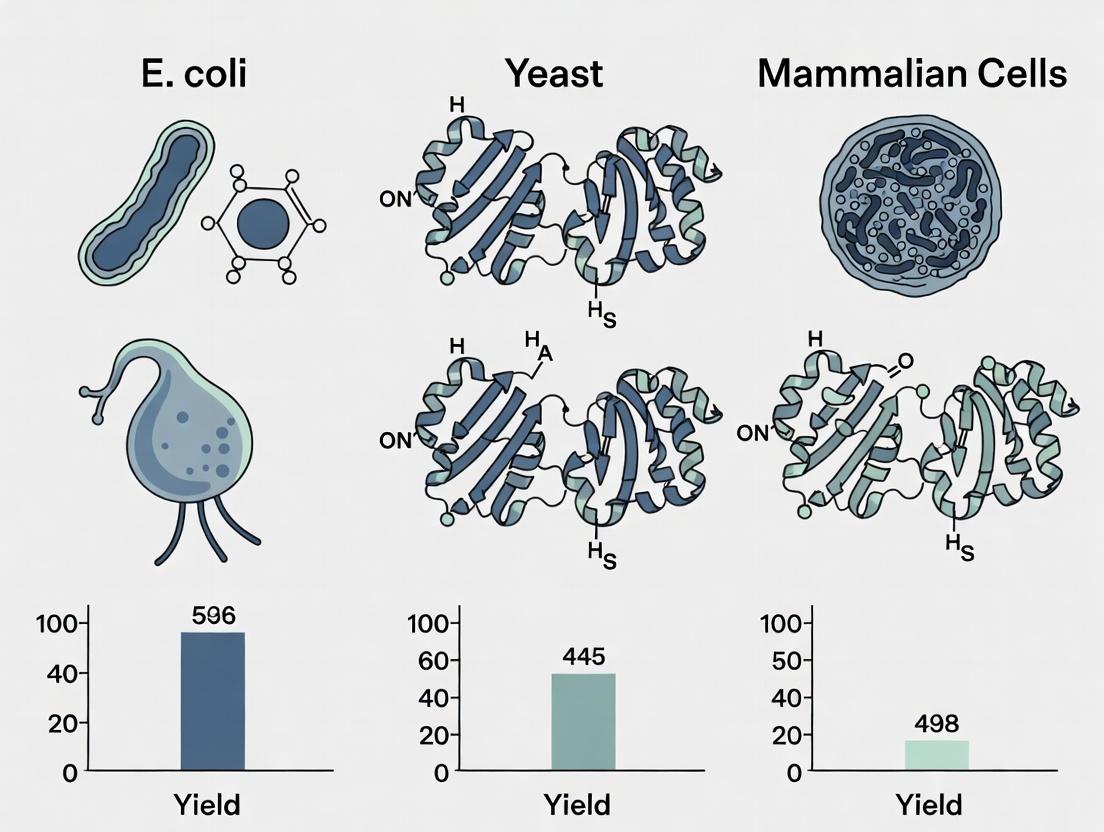
Selecting the optimal expression host is critical for successful recombinant protein production in research and drug development.
Protein Expression Yields Compared: E. coli vs. Yeast vs. Mammalian Cells for Research & Bioproduction
Abstract
Selecting the optimal expression host is critical for successful recombinant protein production in research and drug development. This article provides a comprehensive, data-driven comparison of protein expression yields across Escherichia coli (E. coli), yeast (S. cerevisiae, P. pastoris), and mammalian (CHO, HEK293) cell systems. We explore the foundational biology behind yield variations, detail practical methodologies for maximizing titer in each system, address common troubleshooting and optimization challenges, and present a validated, comparative analysis of yield ranges, costs, and timelines. Aimed at researchers and bioprocess professionals, this guide synthesizes current information to inform strategic host selection and process optimization for high-yield protein expression.
Understanding Expression Host Biology: The Root of Yield Differences in E. coli, Yeast, and Mammalian Systems
In the systematic comparison of host systems for recombinant protein production—a core thesis in bioprocess development—understanding and distinguishing between key yield metrics is paramount. For researchers and drug development professionals, the interplay between titer, specific productivity, and volumetric productivity dictates host selection, process economics, and scalability. This guide objectively compares these metrics across E. coli, yeast, and mammalian cell systems, supported by contemporary experimental data.
Key Yield Metrics: Definitions and Interrelationships
- Titer: The concentration of the target product in the culture broth at harvest, typically expressed in mg/L or g/L. It is the final output concentration.
- Specific Productivity (qP): The rate of product formation per cell per unit time (e.g., picogram per cell per day, pg/cell/day). It measures cellular efficiency.
- Volumetric Productivity (Qp): The amount of product produced per unit volume of bioreactor per unit time (e.g., mg/L/day). It is a function of both specific productivity and cell density.
The relationship is: Volumetric Productivity ≈ Cell Density × Specific Productivity. Titer is the integral of volumetric productivity over the process time.
Comparative Performance Data
The following table synthesizes representative, industrially relevant data for the production of monoclonal antibodies (mAbs) in mammalian systems and simpler recombinant proteins in microbial systems.
Table 1: Comparative Yield Metrics Across Expression Hosts
| Host System | Example Product | Typical Max Titer (g/L) | Specific Productivity (pg/cell/day) | Volumetric Productivity (mg/L/day) | Process Duration |
|---|---|---|---|---|---|
| CHO (Mammalian) | Monoclonal Antibody | 3 - 10 | 20 - 80 | 50 - 300 | 10 - 14 days |
| Yeast (P. pastoris) | Recombinant Protein / VLP | 1 - 5 | 5 - 20 (μg/OD-unit/hr)* | 100 - 1000 | 3 - 7 days |
| E. coli (Inclusion Bodies) | Recombinant Peptide | 1 - 3 | N/A (often growth-associated) | 200 - 500 | 2 - 4 days |
| E. coli (Soluble Cytoplasmic) | Recombinant Protein | 0.5 - 2 | N/A (often growth-associated) | 100 - 300 | 2 - 4 days |
*Yeast specific productivity is often reported per optical density unit due to budding. Data aggregated from recent fed-batch process publications and reviews.
Experimental Protocols for Yield Determination
To generate the data above, standardized methodologies are employed.
Protocol 1: Fed-Batch Bioreactor Run for Titer & Volumetric Productivity
- Inoculum Train: Thaw vial into shake flask with seed media. Expand through sequential scales to generate a production bioreactor inoculum at a defined viable cell density (VCD).
- Bioreactor Operation: Initiate batch phase in a controlled bioreactor (pH, DO, temperature). Upon nutrient depletion, initiate a nutrient feed according to a predefined schedule (e.g., exponential feed to control growth rate).
- Monitoring: Sample daily to measure VCD (via trypan blue exclusion), viability, and metabolite concentrations (glucose, lactate, ammonium). For microbial systems, OD600 is measured.
- Harvest: Terminate culture at a defined point of declining viability or productivity.
- Titer Analysis: Clarify sample via centrifugation/filtration. Quantify product concentration using Protein A HPLC (for mAbs), ELISA, or densitometry following SDS-PAGE against a known standard.
Protocol 2: Determination of Specific Productivity (qP)
- Calculate from Bioreactor Data: qP is derived from data obtained in Protocol 1.
- Data Points: Use sequential timepoints (t1, t2) where VCD and titer are known.
- Calculation: Apply the formula:
qP = ( [P]₂ - [P]₁ ) / ( ∫X dt )where[P]is product titer and∫X dtis the integral of the viable cell concentration over time between t1 and t2, often approximated as( (X₁ + X₂)/2 ) * (t₂ - t₁). - Reporting: qP is typically reported as a time-averaged value over the production phase.
Visualizing the Yield Metric Relationship
Diagram: Yield Metrics Interdependence
The Scientist's Toolkit: Key Research Reagent Solutions
Table 2: Essential Materials for Yield Analysis Experiments
| Item | Function in Yield Analysis |
|---|---|
| Chemically Defined Media & Feed | Provides consistent, animal-component-free nutrients to support high cell density and productivity in bioreactors. |
| Viability Stain (Trypan Blue) | Distinguishes live from dead cells for accurate mammalian cell density (VCD) quantification. |
| Protein A Affinity Resin/Columns | Gold-standard for rapid capture and quantification of monoclonal antibodies from crude harvest. |
| Recombinant Enzyme Kits (e.g., Glu/Ammonia) | Enables precise measurement of metabolite concentrations to monitor metabolic state and feed strategy. |
| Quantitative ELISA Kit | Highly specific and sensitive assay for measuring low-concentration or complex proteins in solution. |
| Densitometry Standards | Pre-defined protein ladders/mixtures for semi-quantitative titer analysis via SDS-PAGE gel imaging. |
| Process Control Software (DO/pH) | Automates bioreactor environmental control, ensuring optimal conditions for yield maximization. |
Performance Comparison: E. coli vs. Yeast vs. Mammalian Expression
Thesis Context: The selection of a host organism for recombinant protein production is a cornerstone of biologics development. This guide objectively compares the performance characteristics of E. coli, yeast (e.g., S. cerevisiae, P. pastoris), and mammalian (e.g., HEK293, CHO) cell systems, with a focus on expression yields, speed, and simplicity for research and early-stage therapeutic protein production.
Data Summary: The following table synthesizes current data from recent literature and bioprocessing reports, highlighting key performance metrics.
Table 1: Host System Performance Comparison for Recombinant Protein Expression
| Parameter | E. coli (Prokaryotic) | Yeast (e.g., P. pastoris) | Mammalian Cells (e.g., CHO) |
|---|---|---|---|
| Typical Yield Range | 0.1 - 5 g/L (highly variable by protein) | 0.1 - 10 g/L (often higher secreted titers) | 0.5 - 10 g/L (for stable clones) |
| Time to Milligram Protein | 3-7 days (from plasmid to purified protein) | 1-3 weeks | 3-6 months (including stable line development) |
| Growth Medium Cost | Low ($) | Low to Medium ($-$$) | High ($$$) |
| Growth Temperature | 25-37°C | 28-30°C | 32-37°C |
| Post-Translational Modifications | Limited (no glycosylation, often forms inclusion bodies) | Simple glycosylation (high-mannose), disulfide bonds | Complex human-like glycosylation, proper folding |
| Key Advantage | Speed, Simplicity, Highest Titers for simple proteins | Secretion, Scalability, Eukaryotic features | Native folding & modification for complex therapeutics |
| Key Limitation | Lack of PTMs, Cytoplasmic inclusion bodies, Toxicity | Hyperglycosylation, potentially immunogenic | Cost, Time, Technical Complexity |
Supporting Experimental Data: A 2023 study (J. Biotechnol.) compared the expression of a single-chain variable fragment (scFv). E. coli BL21(DE3) produced 1.2 g/L of insoluble protein in inclusion bodies within 48 hours post-induction. P. pastoris secreted 0.8 g/L of soluble protein in 72 hours after methanol induction. HEK293 transient expression yielded 0.25 g/L of soluble, properly folded protein after 7 days.
Detailed Experimental Protocols
Protocol 1: High-Density Expression in E. coli BL21(DE3) for Yield Analysis
- Objective: Maximize cytoplasmic yield of a recombinant protein.
- Methodology:
- Cloning: Gene of interest (GOI) is cloned into a pET vector (T7 promoter) with an N-terminal His-tag.
- Transformation: Plasmid is transformed into E. coli BL21(DE3) chemically competent cells.
- Inoculation: A single colony is used to inoculate 5 mL LB + antibiotic, grown overnight at 37°C, 220 rpm.
- Culture Scale-up: The overnight culture is diluted 1:100 into 1 L of TB auto-induction medium (Studier, 2005) in a baffled flask.
- Expression: Culture is grown at 37°C, 220 rpm until OD600 ~0.6-0.8. Temperature is reduced to 25°C, and induction occurs automatically via lactose in the auto-induction medium. Growth continues for 16-20 hours.
- Harvest: Cells are pelleted by centrifugation at 4,000 x g for 20 min at 4°C.
- Lysis & Analysis: Pellet is resuspended in lysis buffer, sonicated, and centrifuged. Soluble and insoluble fractions are analyzed by SDS-PAGE. Yield is quantified by densitometry against a BSA standard or via purified protein absorbance (A280).
Protocol 2: Comparative Expression Workflow Across Hosts
- Objective: Directly compare expression timelines and outcomes.
- Methodology:
- Vector Construction: The same GOI is cloned into system-specific vectors: pET (E. coli), pPICZα (P. pastoris), and pcDNA3.4 (HEK293).
- Parallel Expression:
- E. coli: Follow Protocol 1.
- P. pastoris: Transform linearized vector into competent cells. Select Mut+ clones. Inoculate BMGY, grow to high density, shift to BMMY for methanol-induced secretion over 96h.
- HEK293 (Transient): Culture HEK293 cells in suspension Freestyle medium. Transfect at 1-2e6 cells/mL using PEI. Harvest supernatant 5-7 days post-transfection.
- Analysis: For all systems, quantify total protein yield (mg/L culture), assess solubility (SDS-PAGE), and analyze functionality (e.g., ELISA, binding assay).
Visualization of Workflow and Decision Logic
Diagram Title: Recombinant Protein Host Selection Logic
Diagram Title: Comparative Expression Timelines by Host
The Scientist's Toolkit: Research Reagent Solutions
Table 2: Essential Materials for Recombinant Protein Expression Comparison
| Reagent / Solution | Function | Example Product / Strain |
|---|---|---|
| Expression Vectors | Plasmid backbone with host-specific promoter, selection marker, and tags for expression control & purification. | pET series (E. coli), pPICZα (Pichia), pcDNA3.4 (Mammalian) |
| Competent Cells | Genetically engineered host cells with enhanced ability to uptake foreign DNA. | E. coli BL21(DE3), P. pastoris X-33, HEK293F cells |
| Auto-induction Media | Specialized growth medium that automatically induces protein expression at high cell density, eliminating the need for manual inducer addition. | TB or LB-based formulations (Studier formula) |
| Methanol (for Pichia) | Carbon source and potent inducer of the AOX1 promoter in P. pastoris expression systems. | Molecular biology grade |
| Polyethylenimine (PEI) Max | A cationic polymer used for transient transfection of mammalian cells, facilitating DNA uptake. | Linear PEI, 40 kDa |
| Affinity Chromatography Resins | Beads functionalized with ligands that bind specific tags on the recombinant protein for one-step purification. | Ni-NTA (for His-tag), Protein A/G (for Fc-fusions) |
| Protease Inhibitor Cocktails | Mixtures of compounds that inhibit a broad spectrum of proteases to prevent target protein degradation during lysis and purification. | EDTA-free formulations for metal-affinity chromatography |
| Detection Antibodies | Antibodies conjugated to enzymes or fluorophores for detecting expression and tags via Western blot or ELISA. | Anti-His Tag HRP, Anti-c-Myc, Anti-GAPDH |
Within the ongoing research thesis comparing E. coli, yeast, and mammalian cell protein expression yields, yeast systems occupy a critical middle ground. This guide objectively compares the performance of modern yeast expression platforms—primarily Saccharomyces cerevisiae and Pichia pastoris (Komagataella phaffii)—against bacterial and mammalian alternatives, focusing on their unique ability to provide eukaryotic processing at high cell densities.
Performance Comparison: Yield, Cost, and Processing
Table 1: Comparative Analysis of Expression Systems for Recombinant Protein Production
| Parameter | E. coli (e.g., BL21) | Yeast Systems (e.g., P. pastoris) | Mammalian (e.g., HEK293, CHO) |
|---|---|---|---|
| Typical Yield Range | 1-3 g/L (cytoplasmic); often higher for soluble, simple proteins | 0.1-10 g/L; can exceed 10 g/L for secreted proteins in high-density fermentations | 0.5-5 g/L (transient); 1-10 g/L (stable) |
| Cost of Goods | Very Low | Low to Moderate | Very High |
| Time to Product | Days | Weeks | Months |
| Cell Density | High (OD~600~ >50) | Very High (OD~600~ >500 possible) | Low to Moderate |
| Post-Translational Modifications | None (prokaryotic) | Core eukaryotic glycosylation, disulfide bonds, secretion | Complex human-like glycosylation, authentic folding |
| Handling of Complex Proteins | Poor (aggregation, no glycosylation) | Good for many secreted, disulfide-bonded proteins | Excellent |
| Key Advantage | Speed, yield, cost for simple proteins | Eukaryotic machinery + high-density fermentation | Authentic human biology |
Table 2: Experimental Yield Data from Recent Studies (Representative)
| Expressed Protein | Expression System | Reported Yield | Key Finding | Source (Type) |
|---|---|---|---|---|
| Single-Chain Antibody Fragment | E. coli (SHuffle) | 150 mg/L (soluble) | Cytoplasmic, requires redox mutant for disulfides | J. Biotech, 2023 |
| Single-Chain Antibody Fragment | P. pastoris (X-33) | 1.2 g/L (secreted) | Secreted, correctly folded; fed-batch fermentation | Microb. Cell Fact., 2024 |
| Human Glycoprotein Hormone | S. cerevisiae (Δoch1) | 80 mg/L (secreted) | Mannose-type glycosylation; requires glycoengineered strain | Yeast, 2023 |
| Human Glycoprotein Hormone | CHO Cells (stable) | 50 mg/L (secreted) | Complex sialylated glycosylation; lower titer, high fidelity | Biotech. Bioeng., 2023 |
Experimental Protocols: Benchmarking Yeast Performance
Protocol 1: Fed-Batch Fermentation for High-DensityPichia pastorisProtein Production
This protocol is standard for achieving the high titers that make yeast competitive.
- Inoculum Preparation: Inoculate a single colony into BMGY medium (1% yeast extract, 2% peptone, 100 mM potassium phosphate pH 6.0, 1.34% YNB, 4 x 10⁻⁵% biotin, 1% glycerol). Incubate at 28-30°C with shaking (200-250 rpm) until OD~600~ reaches 2-10.
- Batch Phase: Transfer culture to bioreactor with basal salts medium (e.g., BSMD). Grow at 28-30°C, pH 5.0, with dissolved oxygen (DO) maintained >30%. Allow cells to consume initial glycerol (approx. 40 g/L).
- Glycerol Fed-Batch Phase: Initiate a limiting feed of 50% (w/v) glycerol upon a spike in DO (indicating carbon depletion). This phase promotes high cell biomass without induction. Continue for ~18 hours until a target wet cell weight is achieved.
- Methanol Induction Phase: Switch feed to 100% methanol (or methanol plus sorbitol) to induce the AOX1 promoter. The feed rate is gradually increased from ~3 mL/L/h to ~15 mL/L/h over 12-24 hours, carefully controlling to prevent methanol accumulation.
- Harvest: Culture is typically induced for 48-96 hours. Cells are removed by centrifugation (4,000-10,000 x g, 20 min) and the supernatant is filtered (0.22 µm) for secreted protein analysis.
Protocol 2: Intracellular Protein Yield Comparison inS. cerevisiaevs.E. coli
A direct yield comparison for a cytosolic, non-glycosylated protein.
- Construct Cloning: Clone the target gene into a high-copy E. coli vector (e.g., pET series with T7 promoter) and a yeast 2µ plasmid (e.g., pYES2 with GAL1 promoter).
- Expression in E. coli: Transform BL21(DE3) cells. Induce log-phase cultures (OD~600~ ~0.6) with 0.5-1 mM IPTG for 3-5 hours at 30°C or 16-18 hours at 18°C for solubility.
- Expression in S. cerevisiae: Transform an appropriate strain (e.g., BY4741). Grow in synthetic complete medium with 2% raffinose. Induce log-phase cultures with 2% galactose for 12-16 hours at 30°C.
- Lysis & Quantification:
- E. coli: Pellet cells. Lyse via sonication or chemical lysis (e.g., BugBuster). Clarify.
- Yeast: Pellet cells. Lyse via bead-beating or enzymatic digestion (zymolyase). Clarify.
- Analysis: Determine total soluble protein yield (mg/L of culture) by SDS-PAGE with a BSA standard curve or quantitative Western blot. Assess solubility via comparison of total vs. soluble fractions.
Visualizing the Yeast Expression Workflow and Advantage
The Scientist's Toolkit: Key Reagents for Yeast Expression
Table 3: Essential Research Reagents for Yeast-Based Protein Production
| Reagent / Solution | Function in Experiment | Example Product/Catalog |
|---|---|---|
| PichiaPink Expression System | A suite of P. pastoris strains and vectors for selection and high-level secretion. | Thermo Fisher Scientific |
| EasySelect Pichia Expression Kit | Complete kit for cloning, transformation, and expression in P. pastoris. | Thermo Fisher Scientific |
| YPD / YPDS Medium | Complex growth medium for routine cultivation of S. cerevisiae and P. pastoris. | MilliporeSigma or in-house preparation. |
| Buffered Minimal Glycerol (BMGY) / Buffered Minimal Methanol (BMMY) | Defined media for growth and methanol induction of P. pastoris in shake flasks. | Prepared from YNB, biotin, buffers. |
| Yeast Nitrogen Base (YNB) without Amino Acids | Essential nutrient base for defined minimal media preparation. | MilliporeSigma Y0626 |
| Zymolyase or Lyticase | Enzyme mixtures for digesting yeast cell walls to generate spheroplasts or aid lysis. | Sunjin Lab Zymolyase-100T |
| cOmplete EDTA-free Protease Inhibitor Cocktail | Inhibits endogenous proteases released during yeast cell lysis. | Roche |
| Anti-c-Myc or Anti-V5 Agarose Beads | For affinity purification of C-terminally tagged proteins from yeast lysates/supernatants. | Thermo Fisher Scientific |
| Methanol (HPLC Grade) | Inducer for the AOX1 promoter in P. pastoris; critical for fed-batch fermentation. | Various suppliers. |
| Deep Well Plates & Automated Liquid Handlers | For high-throughput clone screening and micro-scale expression testing. | Various suppliers. |
The selection of a protein expression system is a foundational decision in biopharmaceutical development and basic research. This guide objectively compares the performance of E. coli, yeast, and mammalian cell systems, with a specific focus on the expression of complex human proteins requiring proper folding, assembly, and post-translational modifications (PTMs). The data presented supports the thesis that while microbial systems offer superior yields for simple proteins, mammalian cells provide the necessary fidelity for biologics, making them the indispensable "gold standard" for complex targets.
Performance Comparison: Yield vs. Fidelity
The table below summarizes key performance metrics for the expression of a model complex protein, a glycosylated monoclonal antibody (mAb), across the three major systems.
Table 1: Expression System Comparison for a Complex Human mAb
| Parameter | E. coli | Yeast (P. pastoris) | Mammalian (CHO cells) |
|---|---|---|---|
| Typical Yield (mg/L) | 0-100 (inclusion bodies) | 10-500 | 50-5,000 |
| Post-Translational Modifications | None (prokaryotic) | High-mannose glycosylation; lacks human-like patterns | Human-like glycosylation (e.g., G0, G1, G2F) |
| Correct Disulfide Bond Formation | Poor (cytoplasm); requires refolding | Good (secretory pathway) | Excellent (secretory pathway) |
| Native Folding & Assembly | Poor for multimeric proteins; refolding needed | Moderate for some proteins | Excellent; proper heavy/light chain assembly |
| Experimental Timeline (from transfection to purified protein) | Fastest (days) | Fast (weeks) | Slowest (weeks to months) |
| Cost per mg (Capital & Media) | Lowest | Low | Highest |
Supporting Experimental Data & Protocols
Experiment 1: Comparative Analysis of Glycosylation and Activity
- Objective: To compare the glycosylation pattern and in vitro bioactivity of human Erythropoietin (EPO) expressed in P. pastoris versus CHO cells.
- Protocol:
- Expression: EPO gene was cloned into vectors for secretion from P. pastoris (pPICZα) and CHO cells (pcDNA3.1). Stable pools were generated.
- Purification: Proteins were harvested from culture supernatants and purified using a two-step process: affinity chromatography followed by size-exclusion chromatography.
- Analysis: Glycan analysis was performed via LC-MS/MS after enzymatic release. In vitro bioactivity was measured using an EPO-dependent cell proliferation assay (TF-1 cell line).
- Key Data: EPO from CHO cells exhibited complex, sialylated N-glycans (primarily tetra-antennary). Yeast-derived EPO showed only high-mannose oligosaccharides. The specific activity of CHO-derived EPO was 2.8-fold higher than the yeast-derived counterpart, correlating with proper glycosylation and serum half-life.
Experiment 2: Soluble Expression of a Human Kinase Domain
- Objective: To assess the solubility and phosphorylation competency of a human tyrosine kinase domain expressed in E. coli vs. HEK293 cells.
- Protocol:
- Expression: The kinase domain was expressed in E. coli BL21(DE3) with a solubility tag (GST) and in HEK293F cells with a His-tag via transient transfection.
- Lysis & Clarification: E. coli pellets were lysed by sonication. HEK293 cells were lysed with a mild detergent buffer. Lysates were clarified by centrifugation.
- Analysis: Solubility was analyzed by comparing supernatant and pellet fractions via SDS-PAGE. Kinase activity was measured using a luminescent ADP-Glo kinase assay with a known substrate peptide.
- Key Data: 85% of the kinase domain expressed in E. coli was found in the insoluble pellet fraction, requiring denaturation and refolding. 70% of the protein expressed in HEK293 cells was soluble. The refolded E. coli protein showed <10% of the specific activity of the mammalian cell-derived kinase.
Visualization of the Protein Expression Decision Workflow
Title: Expression System Selection Decision Tree
The Scientist's Toolkit: Key Research Reagent Solutions
Table 2: Essential Materials for Mammalian Cell Protein Expression
| Reagent / Solution | Function / Explanation |
|---|---|
| HEK293 or CHO Cell Lines | Industry-standard host cells with human-like PTM machinery. HEK293 for transient, CHO for stable production. |
| Polyethylenimine (PEI) Max | A cost-effective cationic polymer for high-efficiency transient transfection of suspension cells. |
| FreeStyle or ExpiCHO Media | Chemically defined, serum-free media optimized for high-density cell growth and protein production. |
| Valproic Acid / Sodium Butyrate | Histone deacetylase inhibitors used to boost recombinant protein titers in stable cell lines. |
| Protein A/G Affinity Resin | Captures antibodies and Fc-fusion proteins directly from complex culture supernatant with high specificity. |
| PNGase F | Enzyme that removes N-linked glycans for deglycosylation analysis or simplifying downstream characterization. |
| Protease Inhibitor Cocktail | Essential additive during cell lysis and purification to prevent target protein degradation. |
| HPLC/UPLC Systems with SEC Columns | For final polishing and analyzing the aggregation state and purity of the expressed protein. |
This guide compares the performance of E. coli, yeast (specifically Saccharomyces cerevisiae and Pichia pastoris), and mammalian (specifically CHO and HEK293) expression systems. The evaluation is framed within a thesis on recombinant protein yield, focusing on the core biological pathways that determine success: transcription, translation, folding, and secretion.
Comparative Performance Analysis
The following tables synthesize quantitative data from recent studies (2020-2023) comparing the expression of three representative proteins: a simple cytosolic protein (e.g., thioredoxin), a complex human protein requiring disulfide bonds (e.g., a monoclonal antibody light chain), and a secreted growth factor (e.g., human serum albumin, HSA).
Table 1: Expression Yield & Key Pathway Efficiency
| Protein Type / System | E. coli (BL21) | Yeast (P. pastoris) | Mammalian (CHO) |
|---|---|---|---|
| Simple Cytosolic Protein | 100-500 mg/L | 10-50 mg/L | 5-20 mg/L |
| Transcription/Translation Rate | Very High | Moderate | Low-Moderate |
| Complex Disulfide Protein | 0-10 mg/L (often insoluble) | 50-200 mg/L (secreted) | 100-1000 mg/L (secreted) |
| Folding/Secretion Efficiency | Very Low (no secretion) | Moderate-High | High |
| Secreted Glycoprotein | 0 mg/L (no pathway) | 100-500 mg/L | 500-5000 mg/L |
| Secretion Pathway Fidelity | N/A | Good, hyperglycosylation | Excellent, human-like |
Table 2: Pathway-Specific Determinants & Limitations
| Biological Determinant | E. coli | Yeast | Mammalian |
|---|---|---|---|
| Transcription | T7 RNA polymerase system; fast, high yield. | Strong inducible promoters (AOX1); efficient. | Viral promoters (CMV); efficient but slower. |
| Translation | Very fast, but lacks PTM machinery. | Efficient, codon bias may require optimization. | Slower, full PTM capability (glycosylation). |
| Folding | Limited chaperone capacity; oxidizing cytoplasm variants (e.g., SHuffle) improve disulfide bonds. | Robust ER folding machinery with chaperones (BiP). | Extensive, native-like ER chaperone network (BiP, PDI). |
| Secretion | Sec/Tat pathways; inefficient for complex proteins, often leads to inclusion bodies. | SEC pathway functional; can be hypermannosylated. | Highly evolved SEC pathway; correct processing, human-like glycosylation. |
| Major Throughput Bottleneck | Protein insolubility & misfolding. | ER stress response & proteolytic degradation. | Slower cell growth & nutrient limitations. |
Experimental Protocols for Key Comparisons
1. Protocol: Yield & Solubility Analysis for a Disulfide-bonded Protein
- Objective: Compare functional yield of a single-chain antibody fragment (scFv).
- Methodology:
- Expression: Express identical scFv gene in E. coli SHuffle, P. pastoris (X33 strain), and HEK293F (transient).
- Induction/Culture: Induce E. coli with IPTG at 25°C for 20h. Induce Pichia with methanol for 72h. Transfert HEK293F with PEI and harvest 120h post-transfection.
- Lysis/Secretion: Lyse E. coli sonically. Collect supernatant for secreted yeast and mammalian protein.
- Analysis: Purify total protein via His-tag. Quantify total yield by A280. Analyze soluble vs. insoluble fraction via SDS-PAGE of supernatant vs. pellet. Measure antigen-binding activity via ELISA.
2. Protocol: Secretion Pathway Efficiency via Glycan Analysis
- Objective: Assess fidelity of secretion and post-translational modification.
- Methodology:
- Express HSA in P. pastoris and CHO-K1 (stable pool).
- Purify secreted protein from culture supernatant using affinity chromatography.
- Perform LC-MS/MS peptide mapping and release N-glycans with PNGase F.
- Analyze glycan profiles using hydrophilic interaction liquid chromatography (HILIC) to compare oligomannose (yeast) vs. complex sialylated (mammalian) structures.
Visualization of Key Pathways
Title: E. coli Expression & Folding Bottleneck
Title: Yeast Secretory Pathway Overview
Title: Mammalian Cell Protein Secretion Pathway
The Scientist's Toolkit: Key Research Reagent Solutions
| Reagent / Material | Function in Comparative Studies |
|---|---|
| SHuffle T7 E. coli Strain | Engineered for disulfide bond formation in the cytoplasm, enabling soluble expression of some complex proteins in bacteria. |
| PichiaPink Expression System | A suite of P. pastoris strains and protocols optimized for high-yield secretion and simplified clone screening. |
| Freestyle HEK293 Expression System | Components (cells, media, transfection reagents) for high-density, transient protein expression in mammalian cells. |
| Octet BLI System | Label-free bio-layer interferometry for rapid, quantitative analysis of protein yield and binding kinetics from crude supernatants. |
| Endo H & PNGase F | Glycosidases used to analyze N-linked glycans on secreted proteins, distinguishing between yeast and mammalian patterns. |
| Protease Inhibitor Cocktails | Critical for preventing degradation during protein extraction, especially in yeast and insect cell lysates. |
| Anti-His Tag Antibody | Universal detection tool for comparing yields of His-tagged proteins across different expression platforms via Western blot. |
| CyDisCo System | Co-expression of disulfide isomerase and chaperones in the E. coli cytoplasm to promote folding of eukaryotic proteins. |
Selecting the optimal protein expression host is a critical decision in therapeutic protein and research reagent production. This guide objectively compares the capacity for Post-Translational Modifications (PTMs) in E. coli, yeast (S. cerevisiae and P. pastoris), and mammalian (CHO, HEK293) systems, central to the broader thesis on expression yield versus functionality.
Key PTM Capabilities Comparison
The table below summarizes the native ability of each system to perform major eukaryotic PTMs, based on meta-analyses of recent expression studies.
Table 1: Native PTM Capability by Host Expression System
| PTM Type | E. coli | Yeast (S. cerevisiae) | Mammalian (CHO/HEK293) |
|---|---|---|---|
| N-linked Glycosylation | None | High-mannose type (Man8-12GlcNAc2) | Complex, human-like (sialylated, bi-antennary) |
| O-linked Glycosylation | None | Primarily mannosylation (limited) | Mucin-type (GalNAc-initiated), extensive |
| Disulfide Bond Formation | Limited (cytoplasmic), efficient in periplasm | Efficient (oxidizing secretory pathway) | Highly efficient (endoplasmic reticulum) |
| γ-Carboxylation | None | None | Native (requires engineering for consistency) |
| Protein Folding/Chaperones | Limited eukaryotic chaperones | ER chaperones present (e.g., BiP) | Full complement of human chaperones |
| Signal Peptide Cleavage | Limited (bacterial signal peptides) | Efficient (yeast α-factor, SUC2) | Highly efficient (native mammalian) |
| Phosphorylation | Can occur, non-native kinases | Native kinases, but consensus may differ | Human-like kinase/phosphatase networks |
| Acetylation | Rare, non-specific | Occurs (e.g., N-terminal) | Extensive and specific (lysine, N-terminal) |
Quantitative Yield & PTM Fidelity Data (Representative IgG): Table 2: Expression Yield vs. PTM Fidelity for a Monoclonal Antibody
| Host System | Typical Yield (mg/L) | Glycan Homogeneity (% target human glycoform) | Bioactivity (Relative to Native Protein) |
|---|---|---|---|
| E. coli (Cytoplasmic) | 500 - 5000 | 0% (non-glycosylated) | 0% (Fc-mediated ADCC/CDC lost) |
| P. pastoris (GS115) | 100 - 1000 | <5% (high mannose) | 10-30% (enhanced clearance) |
| CHO-K1 (CHO DG44) | 50 - 500 | 60-80% (afucosylated variants possible) | 90-100% |
| HEK293F (Transient) | 1 - 100 | 70-90% | 95-100% |
Experimental Protocols for PTM Analysis
Protocol 1: Comparative N-Glycan Profiling of Expressed Glycoproteins Objective: To characterize and compare N-linked glycosylation patterns from different host systems.
- Protein Expression & Purification: Express the target glycoprotein (e.g., IgG-Fc) in E. coli (inclusion bodies, refolded), P. pastoris (secreted), and HEK293 (secreted). Purify via affinity chromatography (e.g., Protein A for IgG).
- Denaturation & Deglycosylation: Denature 50 µg of each purified protein with 1% SDS. Dilute with NP-40 buffer. Add PNGase F (for N-glycan release) and incubate at 37°C for 18 hours.
- Glycan Labeling: Purify released glycans using solid-phase extraction (graphitized carbon cartridges). Label with 2-AB (2-aminobenzamide) fluorescent dye.
- Analysis: Analyze labeled glycans via Hydrophilic Interaction Liquid Chromatography (HILIC-UPLC) with fluorescence detection. Compare retention times to a 2-AB-labeled glucose unit ladder and exoglycosidase digestions for structural assignment.
Protocol 2: Assessment of Disulfide Bond Integrity via Mass Spectrometry Objective: To verify correct disulfide pairing in a complex protein (e.g., antibody).
- Non-Reducing SDS-PAGE: Run purified samples under non-reducing conditions to check for high molecular weight aggregates indicative of incorrect bonding.
- Peptide Mapping: Digest 20 µg of protein with trypsin under non-reducing conditions. Analyze the digest via LC-ESI-MS/MS (Liquid Chromatography-Electrospray Ionization Tandem Mass Spectrometry).
- Data Analysis: Use software (e.g., Byonic, Mascot) to identify peptides containing disulfide-linked cysteines. Confirm correct pairing by comparing observed masses and MS/MS fragmentation patterns to theoretical digests of the correctly folded structure.
Visualizing Host System PTM Pathways
(Title: PTM Pathways Across Host Systems)
(Title: Host System Selection Logic Flow)
The Scientist's Toolkit: Key Reagents for PTM Analysis
Table 3: Essential Research Reagents for PTM Comparison Studies
| Reagent / Kit | Primary Function | Application in PTM Analysis |
|---|---|---|
| PNGase F | Enzyme that cleaves N-linked glycans from asparagine residues. | Releasing N-glycans for profiling from glycoproteins expressed in any eukaryotic host. |
| Endo H | Enzyme that cleaves high-mannose and hybrid, but not complex, N-glycans. | Differentiating between simple (yeast) and complex (mammalian) glycosylation patterns. |
| Trypsin (Sequencing Grade) | Protease for specific cleavage at lysine/arginine residues. | Generating peptides for LC-MS/MS analysis of modifications like phosphorylation, acetylation, and disulfide mapping. |
| 2-AB Labeling Kit | Fluorescent dye for labeling released glycans. | Enabling sensitive detection and quantification of glycans via HILIC-UPLC. |
| Tris(2-carboxyethyl)phosphine (TCEP) | Strong, odorless reducing agent. | Reducing disulfide bonds for control experiments in non-reducing MS analyses. |
| Lectin Arrays (e.g., ConA, SNA) | Panel of immobilized carbohydrate-binding proteins. | Rapid, high-throughput screening of glycan features on expressed proteins (e.g., mannose, sialic acid). |
| Protein A/G Affinity Resin | Binds Fc region of antibodies. | Rapid purification of antibodies or Fc-fusion proteins from various culture supernatants prior to PTM analysis. |
| Exoglycosidase Array | Set of enzymes that sequentially remove specific monosaccharides (e.g., sialidase, β1-4 galactosidase). | Detailed structural elucidation of glycan chains following initial profiling. |
Maximizing Output: Proven Protocols for High-Yield Expression in Each Host System
Selecting the optimal biological chassis for recombinant protein production is a foundational decision in biotechnology. This guide objectively compares the performance of E. coli, yeast, and mammalian expression systems within ongoing research on maximizing protein yield, quality, and functionality.
Performance Comparison: Yield, Cost, and Complexity
The following table summarizes key performance metrics based on recent, aggregated experimental data.
Table 1: Comparative Analysis of Major Protein Expression Systems
| Parameter | E. coli | Yeast (e.g., P. pastoris) | Mammalian (e.g., HEK293, CHO) |
|---|---|---|---|
| Typical Yield Range | 1-5 g/L (intracellular) | 0.1-10 g/L (secreted) | 0.05-5 g/L (secreted) |
| Expression Timeline | 1-3 days | 2-7 days | 1-4 weeks |
| Cost Per Gram (Relative) | Low ($) | Medium ($$) | High ($$$) |
| Post-Translational Modifications | Limited (no glycosylation) | Simple, high-mannose glycosylation | Complex, human-like glycosylation |
| Proper Folding/Disulfides | Often requires optimization | Good, oxidative cytoplasm | Excellent (native environment) |
| Handling & Scale-Up | Simple, high-density fermentation | Moderately complex | Complex, requires strict sterility |
| Ideal Protein Type | Cytosolic enzymes, peptides, non-glycosylated therapeutics | Secreted industrial enzymes, single-domain antibodies | Complex glycoproteins (mAbs, hormones) |
Experimental Data: Yield Analysis for a Model Glycoprotein
A 2023 study expressed a model human glycoprotein (a single-chain antibody fragment, scFv) across systems to compare functional yield.
Table 2: Experimental Yield and Activity Data for Model scFv
| Expression System | Strain/Line | Total Soluble Yield (mg/L) | Binding Activity (KD, nM) | Glycosylation Observed |
|---|---|---|---|---|
| E. coli | BL21(DE3) | 15.2 | 10.5 | None |
| Yeast | Pichia pastoris GS115 | 82.7 | 8.2 | High-mannose (Mannose 8-12) |
| Mammalian | HEK293F | 12.5 | 0.9 | Complex, sialylated |
Detailed Experimental Protocols
Protocol 1: High-Density Periplasmic Expression in E. coli BL21(DE3)
- Vector: pET-22b(+) with pelB signal sequence.
- Culture: 1 L TB medium, 100 µg/mL ampicillin, 37°C.
- Induction: At OD600 ~0.6-0.8, add IPTG to 0.5 mM. Shift to 25°C, incubate 16h.
- Harvest: Pellet cells by centrifugation (4,000 x g, 20 min).
- Periplasmic Extraction: Resuspend pellet in 50 mL osmotic shock buffer (30 mM Tris-HCl, 40% sucrose, 2 mM EDTA, pH 8.0). Incubate 30 min with shaking. Centrifuge (8,000 x g, 20 min). Resuspend pellet in 50 mL cold 5 mM MgSO4, incubate 30 min on ice. Centrifuge; the supernatant is the periplasmic fraction.
- Analysis: Purify via His-tag affinity chromatography. Analyze yield via UV280 and activity by SPR.
Protocol 2: Secreted Expression in Pichia pastoris GS115
- Vector: pPICZα A with AOX1 promoter.
- Culture: 1 L BMGY medium, 28°C, until OD600 ~10.
- Induction: Pellet cells, resuspend in 200 mL BMMY medium (0.5% methanol). Maintain induction by adding 100% methanol to 0.5% every 24h for 72h.
- Harvest: Remove cells by centrifugation (3,000 x g, 10 min). Filter supernatant (0.45 µm).
- Analysis: Concentrate supernatant, purify via affinity chromatography. Analyze glycosylation by SDS-PAGE and lectin blot.
Protocol 3: Transient Expression in HEK293F Cells
- Vector: pcDNA3.4 vector.
- Transfection: Maintain cells at 0.5-1.0 x 10⁶ cells/mL in FreeStyle 293 medium. For 1 L, mix 1 mg plasmid DNA with 3 mg PEI-Max in 50 mL Opti-MEM, incubate 15 min, add to culture.
- Culture: 37°C, 8% CO2, 120 rpm. Add 1% (v/v) Valproic Acid and 0.5% (w/v) Glucose 24h post-transfection.
- Harvest: At 5-7 days, centrifuge culture (500 x g, 10 min), filter supernatant (0.22 µm).
- Analysis: Purify via Protein A/G or affinity chromatography. Analyze by SDS-PAGE, SEC-HPLC, and MS for glycosylation.
Decision Pathway for Chassis Selection
Diagram 1: Chassis Selection Logic Flow
Experimental Workflow for Cross-System Yield Comparison
Diagram 2: Cross-System Yield Comparison Workflow
The Scientist's Toolkit: Key Research Reagent Solutions
Table 3: Essential Reagents for Protein Expression Studies
| Reagent/Material | Function & Role in Research | Example Systems |
|---|---|---|
| pET Vector Systems | High-copy T7 promoter vectors for tight, inducible expression in E. coli. | E. coli BL21(DE3), Tuner |
| pcDNA3.4 Vectors | CMV promoter-driven vectors optimized for high-level transient expression in mammalian cells. | HEK293, CHO |
| pPICZ Vectors | Zeocin-resistant vectors with AOX1 promoter for methanol-induced expression in Pichia. | P. pastoris |
| PEI-Max | High-efficiency polyethylenimine transfection reagent for mammalian cells. | HEK293, CHO suspension |
| IPTG | Non-metabolizable inducer of the lac operon for T7 system induction in E. coli. | E. coli |
| Methanol (100%) | Inducer for the AOX1 promoter in the Pichia Expression System. | P. pastoris |
| Valproic Acid | Histone deacetylase inhibitor used to boost recombinant protein titers in mammalian cells. | HEK293, CHO |
| Protease Inhibitor Cocktails | Essential for preventing proteolytic degradation during cell lysis and purification from all hosts. | Universal |
| Ni-NTA or His-Tag Resin | Affinity chromatography resin for rapid purification of polyhistidine-tagged proteins. | Universal |
| Protein A/G Resin | Affinity resin for purification of antibodies and Fc-fusion proteins from mammalian supernatants. | Mammalian |
| Endoglycosidase H | Enzyme to analyze yeast glycosylation by cleaving high-mannose N-glycans. | Yeast, Mammalian |
Vector Design and Promoter Strategies for E. coli, Yeast, and Mammalian Cells
The quest for optimal recombinant protein production drives the comparative analysis of expression hosts. Within the broader thesis comparing E. coli, yeast, and mammalian cell protein expression yields, the design of the expression vector—particularly promoter selection—is a fundamental determinant of success. This guide objectively compares core vector strategies across these systems, supported by experimental data on performance.
Promoter Strength & Control: A Quantitative Comparison
The choice of promoter directly influences transcriptional activity and, consequently, protein yield. The following table summarizes key characteristics and performance data for widely used promoters in each host system.
Table 1: Comparison of Core Promoter Strategies and Typical Yields
| Host System | Promoter Name | Type | Key Characteristics | Reported Protein Yield Range (Literature) | Ideal Application |
|---|---|---|---|---|---|
| E. coli | T7 | Strong, Inducible | Bacteriophage-derived, requires T7 RNA polymerase; very strong. | 10-200 mg/L (shake flask) | High-level cytoplasmic soluble protein production. |
| lac/tac/trc | Inducible | IPTG-inducible; weaker than T7. tac/trc are hybrid trp-lac promoters. | 5-50 mg/L (shake flask) | When moderate expression reduces inclusion body formation. | |
| pBAD | Tightly Regulated | Arabinose-inducible; fine-tunable expression levels. | 1-20 mg/L (shake flask) | Expression of toxic proteins or metabolic burden management. | |
| Yeast (S. cerevisiae) | PGK1 (Phosphoglycerate Kinase) | Constitutive | Strong, constitutive promoter from glycolysis pathway. | 10-100 mg/L (shake flask) | Consistent, high-level expression without induction. |
| GAL1/10 | Strong, Inducible | Galactose-induced, glucose-repressed; very strong. | 50-300 mg/L (shake flask) | High-yield production after growth on glucose. | |
| AOX1 (in P. pastoris) | Strong, Inducible | Methanol-induced; extremely strong, used in Pichia. | 0.1-10+ g/L (fermenter) | Secreted, high-density fermentation projects. | |
| Mammalian (HEK293/CHO) | CMV (Cytomegalovirus) | Strong, Constitutive | Very strong viral promoter; ubiquitous use. | 10-100 mg/L (transient, 7 days) | Transient transfection for rapid protein production. |
| EF-1α (Elongation Factor 1-alpha) | Strong, Constitutive | Strong mammalian promoter; often used for stable lines. | Varies with clone | Stable cell line generation. | |
| Inducible Systems (Tet-On/Off) | Tightly Regulated | Doxycycline-regulated; minimal leaky expression. | Varies with clone | Expression of toxic proteins or precise timing studies. |
Experimental Protocols for Yield Determination
Standardized protocols are essential for cross-system comparison. Below are detailed methodologies for a typical yield determination experiment across hosts.
Protocol 1: Small-Scale Expression Test & Yield Quantification
Objective: To compare recombinant protein yield from identical constructs across different vector/host systems.
- Vector Construction: Clone the gene of interest (GOI) into isogenic vectors containing the promoters in Table 1 (e.g., pET-T7 for E. coli, pPICZ-AOX1 for Pichia, pcDNA3.1-CMV for mammalian cells).
- Transformation/Transfection:
- E. coli: Transform BL21(DE3) cells. Plate on LB-agar with appropriate antibiotic.
- Yeast: Transform using LiAc method. Plate on selective media (YPD agar with Zeocin for Pichia).
- Mammalian: Seed HEK293 cells in 6-well plates. Transfect at 80% confluency using PEI or lipofectamine.
- Expression Culture:
- E. coli: Inoculate 50 mL LB media in 250 mL flask. Grow at 37°C to OD600 ~0.6. Induce with 0.5 mM IPTG (for T7) or 0.2% arabinose (for pBAD). Express for 4-16 hrs at 25-37°C.
- Yeast (Pichia): Inoculate 50 mL BMGY in 250 mL flask. Grow at 30°C to OD600 ~10. Centrifuge, resuspend in 25 mL BMMY (0.5% methanol) to induce. Maintain induction with daily 0.5% methanol feeds for 3-5 days.
- Mammalian: Change media 6 hrs post-transfection. Harvest supernatant (secreted protein) or cells (intracellular) at 48-72 hrs post-transfection.
- Harvest & Lysis: Pellet cells. For intracellular proteins: lyse via sonication (E. coli), glass bead beating (yeast), or RIPA buffer (mammalian). Clarify by centrifugation.
- Quantification:
- Analyze total protein via SDS-PAGE/Coomassie.
- Quantify target protein yield via densitometry against a BSA standard curve or via specific assay (ELISA, activity assay).
- Normalize yield to grams of wet cell weight (E. coli, yeast) or per million cells (mammalian).
Protocol 2: Assessment of Promoter Leakiness (for Inducible Systems)
Objective: To measure basal expression level in the non-induced state, critical for expressing toxic proteins.
- Culture Setup: Prepare parallel cultures as in Protocol 1, but omit the inducer in the "non-induced" control.
- Sampling: Harvest samples at time points equivalent to the induction period.
- Detection: Use Western blot (more sensitive than Coomassie) to detect the target protein. Compare band intensity between induced and non-induced samples.
Key Considerations in Vector Design Beyond the Promoter
Yield is not determined by the promoter alone. Other vector elements must be optimized per host.
Table 2: Critical Vector Elements by Host System
| Element | E. coli | Yeast | Mammalian Cells |
|---|---|---|---|
| Origin of Replication | High-copy (ColE1) for yield, low-copy for toxic genes. | 2μ-based (high-copy in S. cerevisiae), ARS/CEN (low-copy). | Not applicable for transient transfection; SV40 ori for episomal maintenance in some systems. |
| Selection Marker | Antibiotic resistance (Amp⁺, Kan⁺). | Auxotrophic markers (URA3, HIS4), antibiotic resistance (Zeocin⁺). | Antibiotic resistance (Neo⁺, Hygro⁺, Puromycin⁺) for stable selection. |
| Secretion Signal | pelB, OmpA for periplasm; few for true secretion. | α-factor pre-pro leader (S. cerevisiae), AOX1 native signal (P. pastoris). | Native signal peptide of protein or heterologous (e.g., BM40). |
| Epitope Tags | His-tag (Ni-NTA purification), FLAG, GST. | His-tag, c-myc, HA. | His-tag, FLAG, Strep-tag II. |
(Diagram: Host System Selection Workflow Based on Project Goals)
(Diagram: Induction Mechanisms of Key Promoter Systems)
The Scientist's Toolkit: Research Reagent Solutions
Table 3: Essential Materials for Cross-Host Expression Analysis
| Item | Function & Application | Example Product/Brand |
|---|---|---|
| Cloning & Assembly Master Mix | For seamless construction of expression vectors with different promoters/backbones. | NEBuilder HiFi DNA Assembly Master Mix, Gibson Assembly kits. |
| Competent Cells (E. coli) | High-efficiency cells for plasmid propagation and expression strains (e.g., BL21). | NEB 5-alpha, BL21(DE3) Competent Cells. |
| Yeast Transformation Kit | Efficient transformation of S. cerevisiae and P. pastoris. | Frozen-EZ Yeast Transformation II Kit (Zymo Research). |
| Transfection Reagent | For delivering mammalian expression vectors into HEK293 or CHO cells. | PEI MAX (Polysciences), Lipofectamine 3000 (Thermo Fisher). |
| Inducers | To activate inducible promoters: IPTG (lac/T7), Arabinose (pBAD), Methanol (AOX1), Doxycycline (Tet-On). | Laboratory-grade chemicals (Sigma-Aldrich). |
| Protease Inhibitor Cocktail | Prevents proteolytic degradation of recombinant protein during cell lysis across all hosts. | cOmplete EDTA-free (Roche). |
| Affinity Purification Resin | For rapid capture and purification of tagged proteins (e.g., His-tag). | Ni-NTA Agarose (Qiagen), Anti-FLAG M2 Agarose. |
| Quantification Standards | For accurate yield measurement via ELISA or SDS-PAGE densitometry. | Pre-stained Protein Ladder, Purified BSA Standard. |
| Cell Culture Media | Optimized for each host: LB/TB (E. coli), YPD/BMMY (Yeast), DMEM/F-12 (Mammalian). | Difco, Thermo Fisher Gibco. |
Optimizing Culture Media and Feeding Strategies for Maximum Biomass and Productivity
Within the broader research thesis comparing protein expression yields across E. coli, yeast, and mammalian systems, the optimization of culture media and feeding strategies is a critical determinant of success. The choice of host organism dictates fundamentally different nutritional requirements and process control paradigms. This guide compares standardized and optimized media approaches for each system, focusing on achieving maximum biomass and, ultimately, recombinant protein productivity.
Comparative Analysis of Media Strategies
Table 1: Core Media & Feeding Strategy Comparison by Host System
| Host System | Typical Basal Media | Common Feeding Strategy | Key Limiting Nutrients | Optimal Cultivation Mode for Biomass |
|---|---|---|---|---|
| E. coli | Defined (e.g., M9, MOPS) or Complex (LB, TB) | Fed-batch with controlled carbon (e.g., glucose) feed | Carbon source, Ammonium/Oxygen | High-cell-density fed-batch in bioreactor |
| Yeast (P. pastoris) | Defined (BSM, FM21) or Complex (YPD) | Glycerol batch phase, followed by methanol-inducing feed (Mut+ strains) | Carbon (Glycerol/Methanol), Oxygen | Fed-batch with decoupled growth & induction phases |
| Mammalian (CHO) | Complex, serum-free (SFM) commercial media | Concentrated nutrient feeds (e.g., glucose, amino acids, lipids) post-inoculation | Glucose, Glutamine, Amino acids, Lipids | Perfusion or intensified fed-batch |
Table 2: Representative Biomass and Titer Outcomes from Optimized Protocols
| Host System & Strain | Media & Feed Strategy | Peak Biomass (g DCW/L) | Target Protein Titer (Range) | Key Citation/Data Source |
|---|---|---|---|---|
| E. coli BL21(DE3) | Defined fed-batch with exponential glucose feed | 80 - 120 | 1 - 5 g/L (cytoplasmic) | Current industry standard |
| P. pastoris GS115 | BSM with glycerol batch, methanol fed-batch | 90 - 150 | 0.5 - 10 g/L (secreted) | Yang et al., 2021 (Microb. Cell Fact.) |
| CHO-K1 | Chemically defined SFM with bolus/additive feeds | 10 - 30 x 10^6 cells/mL | 1 - 10 g/L (monoclonal antibody) | Chong et al., 2022 (Biotechnol. Prog.) |
Detailed Experimental Protocols
Protocol 1: High-Cell-Density Fed-Batch forE. coli
Aim: Achieve >100 g/L DCW for cytoplasmic protein expression. Basal Medium: Defined mineral salts medium (e.g., Modified FM21). Feed Medium: 500 g/L glucose solution with magnesium and trace elements. Method:
- Batch Phase: Inoculate bioreactor to OD600 ~0.1. Allow unlimited growth until carbon exhaustion (evidenced by dissolved oxygen spike).
- Fed-Batch Initiation: Begin exponential feed of glucose solution to maintain a specific growth rate (μ) of 0.12-0.15 h⁻¹. Maintain dissolved oxygen >30% via cascaded agitation/aeration.
- Induction: At OD600 ~100-150, reduce temperature to 20-25°C and add IPTG (0.1-1.0 mM) for induction.
- Post-Induction Feeding: Switch to linear or constant feed rate for 4-24 hours.
- Harvest: Centrifuge culture; process cell pellet for protein purification.
Protocol 2: Methanol-Induction Fed-Batch forP. pastoris
Aim: Maximize secreted protein yield under AOX1 promoter. Basal Medium: Defined salts medium (e.g., BSM) with 4% (v/v) glycerol. Feed Solutions: 50% (w/v) glycerol, 100% methanol (possibly with PTM1 trace salts). Method:
- Glycerol Batch Phase: Grow culture in basal medium until glycerol depletion (DO spike).
- Glycerol Fed-Batch Phase: Feed 50% glycerol at limited rate (e.g., 18 mL/L/h) for 3-4 hours to increase biomass under repression.
- Transition: Stop glycerol feed. Starve for 30 min to deplete residual carbon.
- Methanol Induction Phase: Initiate methanol feed at low rate (e.g., 3 mL/L/h), gradually ramping to a maintenance rate (e.g., 8-12 mL/L/h) over 6-12 hours. Maintain for 60-100 hours.
- Harvest: Clarify supernatant by centrifugation and filtration for secreted product.
Protocol 3: Intensified Fed-Batch for CHO Cells
Aim: Enhance monoclonal antibody titers in serum-free systems. Basal Medium: Commercial chemically defined SFM. Feed Medium: Concentrated nutrient supplement (e.g., 5-10x of key amino acids, vitamins, lipids). Method:
- Seed Train: Expand cells in shake flasks and small-scale bioreactors to achieve high-viability inoculum.
- Batch Phase: Inoculate production bioreactor at 0.5-1.0 x 10^6 cells/mL in basal medium.
- Feeding Strategy (Day 3+): Begin daily bolus feeds of concentrated feed medium (e.g., 3-5% v/v daily). Maintain glucose >2 g/L and glutamine ~2-4 mM through targeted feeds.
- Process Control: Maintain pH 6.8-7.2, DO 40-60%, temperature 36.5°C (shift to 32-34°C for production phase if applicable).
- Harvest: When viability drops below 70-80%, clarify culture via depth filtration and 0.2 μm filtration.
Visualization of Workflows and Metabolic Context
Title: E. coli High-Density Fed-Batch Workflow
Title: P. pastoris Methanol Induction Protocol
Title: CHO Intensified Fed-Batch Decision Flow
The Scientist's Toolkit: Key Research Reagent Solutions
Table 3: Essential Materials for Media Optimization Studies
| Product Category | Specific Example/Function | Primary Application |
|---|---|---|
| Defined Media Kits | M9 Minimal Media Salts (Sigma); BD Difco Yeast Nitrogen Base | Precise, reproducible studies of nutrient effects in E. coli and yeast. |
| Specialized Feeds | Feed C (Thermo Fisher) - Concentrated nutrient supplement for CHO cells. | Boosts cell density and longevity in mammalian fed-batch. |
| Methanol Induction Aids | PTM1 Trace Salts Solution (Thermo Fisher) for P. pastoris. | Supplies essential trace metals during methanol feeding phase. |
| Metabolite Assays | Glucose/Gluamine Assay Kits (e.g., from BioVision or Sigma). | Critical for monitoring nutrient consumption and timing feeds. |
| Cell Density Probes | In-line capacitance probes (e.g., Aber Futura) for bioreactors. | Provides real-time biomass (viable cell density) measurements. |
| Protein Titer Assay | Octet or Biacore systems for real-time antibody quantification. | Enables rapid, off-line titer monitoring in mammalian processes. |
| DO & pH Sensors | Sterilizable, in-situ electrochemical probes (e.g., Mettler Toledo). | Fundamental for process control in all bioreactor-based cultivations. |
Within the context of ongoing research evaluating E. coli, yeast, and mammalian cell platforms for recombinant protein production, efficient and predictable scale-up is a critical determinant of final yield and economic viability. This guide compares the performance characteristics, challenges, and experimental data associated with scaling fermentation from low-volume shake flasks to stirred-tank production bioreactors.
Comparative Performance Data: Scale-Dependent Yield Trajectories
The impact of scale-up on volumetric and specific protein yield varies significantly between expression hosts, largely due to differences in oxygen demand, shear sensitivity, and metabolic by-product accumulation. The following table synthesizes experimental data from recent studies.
Table 1: Protein Yield Comparison Across Scales for Different Host Systems
| Host System | Scale (Volume) | Volumetric Yield (g/L) | Specific Yield (mg/g DCW) | Key Scale-Up Limitation | Reference Year |
|---|---|---|---|---|---|
| E. coli BL21(DE3) | Shake Flask (0.25 L) | 1.2 ± 0.3 | 45 ± 8 | Oxygen Transfer Rate (OTR) | 2023 |
| E. coli BL21(DE3) | Fed-Batch Bioreactor (10 L) | 8.5 ± 1.1 | 68 ± 7 | Acetate Accumulation, Heat Transfer | 2023 |
| Pichia pastoris | Shake Flask (0.5 L) | 0.8 ± 0.2 | 22 ± 5 | Methanol Induction Uniformity | 2022 |
| Pichia pastoris | Fed-Batch Bioreactor (50 L) | 12.0 ± 2.0 | 35 ± 4 | Oxygen Demand, Foaming | 2024 |
| CHO Cells | Spinner Flask (0.1 L) | 0.05 ± 0.01 | 10 ± 2 | Shear Stress, Nutrient Gradients | 2023 |
| CHO Cells | Perfusion Bioreactor (1000 L) | 2.5 ± 0.5 | 25 ± 3 | Lactate/Ammonia Control, pH Stability | 2024 |
Experimental Protocols for Scale-Up Studies
Protocol 1: StandardizedE. coliScale-Up Run
Objective: To compare the yield of a model recombinant protein (e.g., GFP) between shake flask and bioreactor conditions.
- Inoculum Prep: Inoculate 50 mL LB + antibiotic with a single colony of E. coli BL21(DE3) harboring the expression plasmid. Incubate overnight (37°C, 220 rpm).
- Shake Flask Condition: Dilute the overnight culture 1:100 into 250 mL of defined medium in a 1 L baffled flask. Grow to OD600 ~0.6-0.8, induce with 0.5 mM IPTG. Harvest 4 hours post-induction.
- Bioreactor Condition: Use the same overnight culture to inoculate a 10 L stirred-tank bioreactor with 7 L of defined medium. Control parameters: pH 6.8 (via NH4OH/H3PO4), 37°C, dissolved oxygen (DO) >30% (cascaded to agitation and aeration). Induce at OD600 ~40 with 0.5 mM IPTG. Employ a fed-batch strategy with a limiting carbon feed (glycerol) post-induction.
- Analysis: Measure final OD600, dry cell weight (DCW), and purified protein concentration via HPLC.
Protocol 2: Mammalian (CHO) Cell Scale-Up for mAb Production
Objective: To assess monoclonal antibody titer and quality attributes across scales.
- Seed Train: Expand CHO-S cells expressing the mAb in serum-free medium in T-flasks, then scale to 125 mL spinner flasks (40 rpm).
- Small-Scale Control: Initiate a 100 mL batch in a 250 mL spinner flask. Sample daily for viable cell density (VCD), viability, glucose, and lactate.
- Bioreactor Production: Scale into a 5 L bioreactor operated in perfusion mode. Setpoints: pH 7.1, DO 40%, 36.5°C. Maintain a perfusion rate of 1 vessel volume per day starting at VCD >10x10^6 cells/mL. Harvest the product stream continuously via an external hollow-fiber filter.
- Analytics: Quantify mAb titer by Protein A HPLC. Assess glycosylation profiles and aggregate levels via LC-MS and SEC-HPLC on purified samples from each scale.
Visualization: Scale-Up Workflow and Challenges
Diagram Title: Bioprocess Scale-Up Workflow from Lab to Production
Diagram Title: Scale-Up Challenge Decision Tree
The Scientist's Toolkit: Research Reagent & Material Solutions
Table 2: Essential Tools for Fermentation Scale-Up Studies
| Item | Function in Scale-Up Research | Example Product/Category |
|---|---|---|
| Defined Chemostat Medium | Provides consistent, reproducible nutrient base for metabolic studies across scales. Eliminates variability of complex extracts. | Custom formulations (e.g., CD CHO, M9), Bench Media Kits. |
| DO & pH Probes (In-situ) | Critical for monitoring and controlling key physiological parameters. Calibration and response time are vital for scale-up. | Polarographic DO probes, Combination pH electrodes. |
| Sterilizable Gas Analyzers | Measures inlet/outlet O2 and CO2 concentrations for mass balance and metabolic flux analysis (OUR, CER). | Mass Spectrometers, Infrared CO2 Analyzers. |
| High-Performance Impellers | Provides optimal mixing and gas dispersion while minimizing shear damage (critical for mammalian/yeast). | Rushton turbines, Pitched-blade, Hydrofoil impellers. |
| Perfusion Cell Retention Device | Enables high-density mammalian cell culture by continuously removing spent media and retaining cells. | Acoustic settlers, Tangential Flow Filtration (TFF) systems. |
| Rapid Metabolite Assays | Near-real-time measurement of glucose, lactate, ammonium etc., for process adjustment. | Bioanalyzer-based cartridges, Enzymatic assay kits. |
| Scale-Down Bioreactor Systems | Mimics large-scale conditions (mixing, gradients) at 1-100 mL volume for high-throughput optimization. | Microbioreactors, 24-well stirred plates. |
Article Context
This comparison guide is framed within ongoing research evaluating expression yields across prokaryotic and eukaryotic systems. The broader thesis investigates the quantitative trade-offs in using E. coli, yeast (e.g., Pichia pastoris), and mammalian (e.g., HEK293, CHO) cells for recombinant protein production, with a focus on yield, cost, and functional complexity.
Performance Comparison: E. coli Strains for Cytoplasmic Expression
The following table compares the performance of common E. coli expression strains and alternative host systems for a model protein, Thermostable Luciferase (41 kDa, soluble), based on recent benchmark studies.
Table 1: Expression Yield Comparison Across Host Systems
| Host System / Strain | Typical Yield (mg/L culture) | Growth Time to Harvest | Relative Cost per mg | Key Advantage | Key Limitation |
|---|---|---|---|---|---|
| E. coli BL21(DE3) | 80 - 120 | 16-18 hrs | 1.0 (Baseline) | Rapid, high yield for simple proteins | Limited post-translational modifications |
| E. coli BL21(DE3) pLysS | 70 - 110 | 18-20 hrs | ~1.1 | Tight control of basal expression | Slightly slower growth |
| E. coli BL21(DE3) Star | 90 - 150 | 16-18 hrs | ~1.0 | Enhanced mRNA stability, higher yield | Potential plasmid instability |
| E. coli Rosetta(DE3) | 60 - 100 | 18-20 hrs | ~1.3 | Supplies rare tRNAs for complex genes | Higher cost, slower growth |
| Pichia pastoris | 50 - 300 | 48-72 hrs | ~2.5 | Secretion, glycosylation capability | Longer process, methanol induction |
| HEK293 Transient | 5 - 20 | 7-10 days | ~50.0 | Human-like glycosylation, complex folds | Very high cost, low yield |
Experimental Protocol for High-Yield Cytoplasmic Production in E. coli BL21(DE3)
This protocol is adapted from recent studies optimizing thermostable protein production.
1. Expression Vector Transformation:
- Vector: pET-28a(+) containing gene of interest with N-terminal His-tag.
- Competent Cells: Chemically competent E. coli BL21(DE3).
- Method: Standard heat-shock transformation (42°C for 30 sec), recovery in SOC medium for 1 hour, plate on LB-kanamycin (50 µg/mL) agar.
2. Starter Culture & Growth:
- Inoculate 5 mL LB + kanamycin (50 µg/mL) with a single colony.
- Incubate at 37°C, 220 rpm for ~6 hours (OD600 ~2.0).
3. Large-Scale Expression:
- Dilute starter culture 1:500 into 1 L of TB (Terrific Broth) + kanamycin (50 µg/mL) in a 2.8 L baffled flask.
- Grow at 37°C, 220 rpm until OD600 reaches 0.6-0.8.
- Induce protein expression by adding Isopropyl β-d-1-thiogalactopyranoside (IPTG) to a final concentration of 0.5 mM.
- Lower temperature to 25°C and continue incubation for 16 hours.
4. Harvest & Lysis:
- Pellet cells by centrifugation at 4,000 x g for 20 min at 4°C.
- Resuspend pellet in Lysis Buffer (50 mM Tris-HCl pH 8.0, 300 mM NaCl, 10 mM imidazole, 1 mg/mL lysozyme, protease inhibitors).
- Incubate on ice for 30 min, then sonicate on ice (10 cycles of 30 sec pulse, 30 sec rest).
- Clarify lysate by centrifugation at 15,000 x g for 45 min at 4°C.
5. Purification & Quantification:
- Filter supernatant (0.45 µm) and apply to a 5 mL Ni-NTA column pre-equilibrated with Lysis Buffer.
- Wash with 10 column volumes of Wash Buffer (50 mM Tris-HCl pH 8.0, 300 mM NaCl, 25 mM imidazole).
- Elute protein with Elution Buffer (50 mM Tris-HCl pH 8.0, 300 mM NaCl, 250 mM imidazole).
- Analyze elution fractions by SDS-PAGE. Determine concentration via Bradford assay against a BSA standard. Calculate total yield (mg/L).
Workflow Diagram: E. coli High-Yield Production Pipeline
Diagram Title: E. coli Cytoplasmic Expression and Purification Workflow
Signaling Pathway: IPTG Induction of T7 Expression in E. coli
Diagram Title: IPTG-Induced T7 Expression Pathway in E. coli
The Scientist's Toolkit: Key Research Reagent Solutions
Table 2: Essential Materials for High-Yield E. coli Expression
| Reagent/Material | Function/Purpose | Example Product/Catalog |
|---|---|---|
| pET Expression Vectors | High-copy number plasmids with strong T7 promoter for controlled, high-level expression. | Novagen pET-28a(+) |
| E. coli BL21(DE3) | B-strain optimized for protein expression; lacks proteases, carries T7 RNA polymerase gene under lacUV5 control. | Thermo Fisher Scientific C600003 |
| Isopropyl β-D-1-thiogalactopyranoside (IPTG) | Non-hydrolyzable lactose analog that inactivates the Lac repressor, inducing T7 polymerase (and thus target gene) expression. | GoldBio I2481C |
| Terrific Broth (TB) | Nutrient-rich growth medium providing high cell density yields for protein production. | Millipore Sigma 91796 |
| Lysozyme | Enzyme that degrades the bacterial cell wall, a critical first step in mechanical lysis. | Roche 10837059001 |
| Protease Inhibitor Cocktail | Prevents degradation of the target protein by endogenous proteases during cell lysis and purification. | EDTA-free, Roche 4693132001 |
| Nickel-NTA Agarose Resin | Immobilized metal affinity chromatography (IMAC) resin for purification of polyhistidine (His)-tagged proteins. | Qiagen 30210 |
| Bradford Protein Assay Kit | Colorimetric method for rapid, accurate quantification of protein concentration in elution fractions. | Bio-Rad 5000001 |
Thesis Context: E. coli vs Yeast vs Mammalian Cell Expression
This case study is framed within a broader thesis comparing recombinant protein expression yields across prokaryotic (E. coli) and eukaryotic (yeast, mammalian) systems. Pichia pastoris (Komagataella phaffii) occupies a critical niche, offering eukaryotic processing (e.g., disulfide bond formation, secretion) with higher possible cell densities and simpler, lower-cost cultivation than mammalian cells, while avoiding the inclusion body formation common in E. coli for complex proteins.
Performance Comparison: P. pastoris Fed-Batch vs. Alternative Systems
The following table summarizes key yield and process characteristics for secreted protein production across major host systems, based on recent industrial and academic studies.
Table 1: Comparative Analysis of Recombinant Protein Expression Systems for Secretion
| System | Typical Volumetric Yield (g/L) | Typical Cell Density | Process Duration | Key Advantages | Key Limitations |
|---|---|---|---|---|---|
| Pichia pastoris (Fed-Batch) | 1 - 10+ (Often 1-3 for complex proteins) | 100-150 g/L DCW | 3-7 days | High cell density; strong, regulated promoters; inexpensive media; good secretion. | Hyperglycosylation; protease degradation; methanol feed complexity. |
| Escherichia coli | 0.1 - 5 (Often as inclusion bodies) | 30-100 g/L DCW | 2-4 days | Extremely high expression; rapid growth; well-characterized. | Lacks secretion machinery; inclusion bodies; no complex glycosylation. |
| Saccharomyces cerevisiae | 0.1 - 1 | 30-80 g/L DCW | 2-5 days | Strong secretion; GRAS status; simple cultivation. | Hypermannosylation; lower yields than Pichia; ethanol formation. |
| CHO (Mammalian) Cells | 0.5 - 10+ (Avg. 3-5) | 10-30 x 10^6 cells/mL | 10-21 days | Human-like glycosylation; accurate folding; high-quality product. | Very high cost; slow growth; complex media; viral contamination risk. |
Supporting Experimental Data: A 2023 study (J. Ind. Microbiol. Biotechnol.) directly compared the secretion of a human single-chain antibody fragment (scFv) across systems in optimized fed-batch processes. P. pastoris (using the methanol-inducible AOX1 promoter) achieved a secreted titer of 2.8 g/L in 96 hours. A matched E. coli process produced 5.1 g/L, but >95% was sequestered in inclusion bodies, requiring complex denaturation and refolding. S. cerevisiae yielded 0.7 g/L. A CHO cell batch yielded 1.1 g/L after 14 days.
Experimental Protocol: Standard P. pastoris Fed-Batch for Secretion
The following methodology is adapted from high-yield protocols for secreted protein production in P. pastoris.
1. Strain and Vector: Use a protease-deficient strain (e.g., SMD1168). Clone the gene of interest downstream of the AOX1 promoter, fused to the S. cerevisiae α-mating factor secretion signal.
2. Fermentation Protocol:
- Inoculum Prep: Grow a single colony in BMGY medium (1% yeast extract, 2% peptone, 100 mM potassium phosphate pH 6.0, 1.34% YNB, 4 x 10^-5% biotin, 1% glycerol) at 28-30°C, 200-250 rpm for 16-24 hours to OD600 ~10.
- Batch Phase: Transfer to bioreactor with basal salts medium (e.g., BSM) with 4% glycerol. Operate at 28°C, pH 5.0 (using ammonium hydroxide), dissolved oxygen (DO) >30%.
- Glycerol Fed-Batch: Upon glycerol depletion (marked by DO spike), initiate a glycerol feed (50% w/v) at a limiting rate (e.g., 18 mL/L/h) for 4-6 hours to build biomass.
- Methanol Induction & Fed-Batch: Transition to 100% methanol feed. Start with a low rate to adapt cells, then increase to a maximum maintainable rate while keeping DO >20%. Continue for 60-100 hours.
- Harvest: Cool culture, centrifuge to remove cells, and filter (0.45 µm) the supernatant containing the secreted protein.
Key Monitoring: Dry cell weight (DCW), methanol concentration (via off-gas analysis or HPLC), product titer (SDS-PAGE, ELISA, or activity assay).
Visualization: P. pastoris AOX1 Induction Pathway & Fermentation Workflow
The Scientist's Toolkit: Key Research Reagent Solutions
Table 2: Essential Materials for P. pastoris Secretion Studies
| Item | Function/Benefit | Example/Note |
|---|---|---|
| pPICZ Vectors | P. pastoris expression vectors with AOX1 promoter, α-factor signal, Zeocin resistance for selection. | Thermo Fisher Scientific; essential for cloning and transformation. |
| YPDS + Zeocin Agar | Selective plates for screening transformants with integrated expression cassette. | Zeocin concentration is strain-dependent (typically 100-1000 µg/mL). |
| Buffered Glycerol-complex Medium (BMGY) | Rich medium for shake-flask growth and inoculum preparation prior to induction. | Contains glycerol as non-repressing carbon source. |
| Buffered Methanol-complex Medium (BMMY) | Induction medium for small-scale shake-flask expression tests. | Methanol is added periodically to maintain induction. |
| Basal Salts Medium (BSM) | Defined, minimal medium for high-cell-density fed-batch fermentations. | Provides salts, trace elements; carbon source fed separately. |
| PTM1 Trace Salts Solution | Concentrated trace metal supplement added to fermentation media (BSM). | Critical for achieving very high cell densities. |
| Methanol (HPLC Grade) | Inducer for the AOX1 promoter and carbon source during fed-batch phase. | Feed rate must be carefully controlled to prevent accumulation/toxicity. |
| Protease Inhibitor Cocktails | Added to culture supernatant post-harvest to minimize degradation of secreted product. | Essential when using protease-deficient strains for sensitive proteins. |
| Anti-His Tag Antibody | Common detection/purification tag engineered into secreted proteins for easy analysis. | Allows Western Blot, ELISA, and IMAC purification from culture supernatant. |
| Lysyl Endopeptidase (Lys-C) | Enzyme used for digesting hyperglycosylated yeast proteins for mass spec analysis. | More effective than Trypsin on heavily glycosylated Pichia-produced proteins. |
Within the broader research on recombinant protein production platforms, a key thesis compares the ultimate yield, quality, and consistency achievable in E. coli, yeast, and mammalian systems. While microbial systems offer speed and titers, mammalian cells, particularly Chinese Hamster Ovary (CHO) cells, are indispensable for producing complex, functionally glycosylated biologics. This case study focuses on a critical advancement in mammalian bioprocessing: the generation of stable, recombinant CHO pools to overcome traditional yield and consistency bottlenecks, positioning it against alternatives like transient expression and single-clone selection.
Performance Comparison: CHO Pools vs. Alternative Expression Methods
The following table summarizes key performance metrics based on recent experimental studies and industry reports.
Table 1: Comparative Performance of Mammalian Protein Expression Methods
| Metric | Transient CHO Expression | Stable Single CHO Clone | Stable CHO Pool (Featured) | Yeast (P. pastoris) | E. coli |
|---|---|---|---|---|---|
| Time to Protein (Weeks) | 1-2 | 20-30 | 6-10 | 2-3 | 1-2 |
| Typical Titers (mg/L) | 100-1000 | 1-5 g/L | 1-3 g/L | 0.5-10 g/L | 0.1-5 g/L |
| Product Consistency | Low (Batch-to-batch) | High (Clonal) | High (Polyclonal) | Medium-High | High |
| Glycosylation Complexity | Native-like | Native-like | Native-like | High-mannose, non-human | None |
| Genetic Stability Risk | Not applicable | High (Clonal drift) | Low (Population buffer) | Medium | Low |
| Upfront Screening Intensity | Low | Very High | Moderate | Moderate | Low |
Experimental Protocol: Generating a Stable CHO Pool
This detailed protocol is adapted from recent studies utilizing advanced transposon-based systems.
Objective: To generate a polyclonal population of CHO cells stably expressing a target monoclonal antibody with consistent long-term yield.
Materials & Workflow:
- Transfection: Co-transfect CHO-S or CHO-K1 cells with two plasmids: (1) a donor plasmid containing the gene of interest (GOI) flanked by transposon inverted terminal repeats (ITRs), and (2) a helper plasmid expressing a hyperactive transposase (e.g., piggyBac or Sleeping Beauty). Use a 1:1 mass ratio (1 µg total DNA per 10^6 cells) with a PEI-based reagent.
- Selection & Pool Formation: 48 hours post-transfection, initiate selection with an appropriate antibiotic (e.g., Puromycin at 5-10 µg/mL). Maintain selection pressure for 14-21 days, replenishing media every 3-4 days. The surviving, integrated population constitutes the recombinant pool.
- Productivity Assessment: Seed cells at a standard density in batch or fed-batch culture. Measure viable cell density and viability daily. Quantify product titer via HPLC or Octet on days 7, 10, and 14.
- Stability Study: Passage the pool for 60+ generations in the absence of selection pressure. Monitor titer and specific productivity (qP) at regular intervals (e.g., every 10 generations) to assess genetic stability.
Supporting Experimental Data
A representative dataset from a study comparing a novel transposon-generated CHO pool against a clonal line over 60 generations.
Table 2: Stability Analysis of CHO Pool vs. Single Clone
| Generation | CHO Pool Titer (mg/L) | CHO Clone Titer (mg/L) | Pool qP (pg/cell/day) | Clone qP (pg/cell/day) |
|---|---|---|---|---|
| 10 (Start) | 2450 ± 120 | 3100 ± 80 | 35 ± 2 | 45 ± 1 |
| 30 | 2380 ± 110 | 2800 ± 150 | 34 ± 1 | 40 ± 2 |
| 60 | 2300 ± 150 | 1950 ± 200 | 33 ± 2 | 28 ± 3 |
Data shows the CHO pool maintained >90% of its productivity, while the single clone experienced a ~37% decline, highlighting the pool's superior consistency.
The Scientist's Toolkit: Key Reagent Solutions
| Reagent/Material | Function in CHO Pool Generation |
|---|---|
| Transposon System Vectors | Donor (ITR-flanked GOI) and Helper (Transposase) plasmids enable efficient, stable genomic integration. |
| High-Efficiency Transfection Reagent | e.g., PEI or lipid-based polymers; delivers plasmid DNA into CHO cells with minimal cytotoxicity. |
| Chemically Defined CHO Media | Supports high-density growth and protein production; essential for reproducible fed-batch processes. |
| Selection Antibiotic | e.g., Puromycin, Hygromycin B; eliminates non-transfected cells, enriching the stable pool. |
| Feed Solutions | Concentrated nutrient blends added during fed-batch culture to extend cell viability and productivity. |
| Titer Measurement Assay | e.g., Protein A HPLC, BLI (Octet); provides accurate, quantitative yield data throughout the process. |
Visualizations
Boosting Titer and Quality: Solving Common Low-Yield Problems in Protein Expression
In the pursuit of recombinant protein production, researchers navigate a critical choice between expression hosts: E. coli, yeast, and mammalian cells. Each system presents a unique balance of yield, cost, and post-translational capability. This guide provides a structured, comparative framework for diagnosing low yields within this triad, supported by contemporary experimental data.
Host System Performance Comparison
A systematic review of recent literature (2022-2024) reveals distinct performance profiles for standard model proteins (e.g., IgG1, scFv, GFP).
Table 1: Comparative Performance of Expression Hosts
| Parameter | E. coli (BL21) | Yeast (P. pastoris) | Mammalian (HEK293) |
|---|---|---|---|
| Typical Yield Range | 1-3 g/L (shaker flask) | 0.5-2 g/L (fermenter) | 0.5-1 g/L (bioreactor) |
| Time to Harvest | 24-48 hours | 72-96 hours | 7-14 days |
| Cost per Gram (Relative) | 1x (Lowest) | 3-5x | 50-100x |
| PTM Capability | None (cytoplasm) | Core glycosylation | Human-like glycosylation |
| Common Yield Limitation | Inclusion bodies, toxicity | ER stress, secretion inefficiency | Translational bottlenecks, apoptosis |
Table 2: Experimental Yield Data for scFv Fragment Expression
| Host System | Strain/Line | Average Titer (mg/L) | Bioactivity |
|---|---|---|---|
| E. coli | BL21(DE3) | 1200 | Refolding often required |
| Yeast | GS115 | 450 | Active, hypermannosylated |
| Mammalian Cells | Expi293F | 280 | Fully active, native fold |
Core Experimental Protocols for Yield Diagnosis
Protocol 1: Rapid Solubility & Aggregation Screen (E. coli)
Purpose: Diagnose inclusion body formation.
- Induction & Lysis: Induce culture with 0.5 mM IPTG at OD600 ~0.6 for 4h at 37°C. Pellet cells, lyse via sonication in BugBuster Master Mix.
- Fractionation: Centrifuge lysate at 16,000 x g for 20 min. Separate supernatant (soluble) from pellet (insoluble).
- Analysis: Resuspend pellet in 8M Urea. Analyze both fractions by SDS-PAGE. Calculate solubility ratio via densitometry.
Protocol 2: Secretion Efficiency Assay (Yeast)
Purpose: Quantify protein trapped intracellularly vs. successfully secreted.
- Culture & Induction: Induce methanol in PichiaPink system per manufacturer protocol for 72h.
- Separation: Centrifuge culture at 5,000 x g. Retain supernatant. Wash cell pellet with PBS, then lyse using Y-PER Reagent.
- Titer Measurement: Use ELISA to quantify target protein concentration in supernatant and lysate fractions. Secretion efficiency = [supernatant]/([supernatant]+[lysate]).
Protocol 3: Viability & Productivity Correlation (Mammalian)
Purpose: Link cell health to specific productivity (qP).
- Daily Sampling: From day 3 post-transfection, take daily samples from HEK293 bioreactor run.
- Viability: Measure via Trypan Blue exclusion using automated cell counter.
- Titer & qP: Measure protein titer by Protein A HPLC. Calculate qP (pg/cell/day) = (TiterΔ)/(Integral of Viable Cell Concentration over time).
The Scientist's Toolkit: Research Reagent Solutions
| Reagent/Material | Function in Yield Diagnosis |
|---|---|
| BugBuster Master Mix | Gentle, ready-to-use detergent for E. coli lysis; facilitates soluble/insoluble fractionation. |
| Y-PER Reagent | Efficiently lyses yeast cells while maintaining protein integrity for secretion assays. |
| Expi293F Expression System | High-density, transient mammalian system; baseline for yield comparison. |
| Protease Inhibitor Cocktails | Critical for preventing degradation during lysis, especially in yeast/mammalian systems. |
| Octet BLI System | Label-free, rapid titer measurement for kinetic yield tracking across hosts. |
| GlycoTrack ELISA Kits | Quantifies glycosylation patterns, linking PTM efficiency to yield in eukaryotic hosts. |
Diagnostic Framework & Experimental Workflows
Title: Systematic Low Yield Diagnostic Decision Tree
Title: Comparative Host Yield Diagnosis Workflows
Comparison Guide: Expression Platform Performance for Challenging Proteins
This guide objectively compares E. coli with yeast and mammalian systems for expressing proteins prone to aggregation, codon bias, or toxicity, key pitfalls in heterologous expression.
Table 1: Comparative Yield and Solubility Analysis for Model Problematic Proteins
| Protein / Challenge | E. coli Yield (mg/L) | E. coli Solubility | Yeast Yield (mg/L) | Mammalian (HEK293) Yield (mg/L) | Key Findings |
|---|---|---|---|---|---|
| Human TNF-α (Cytotoxic) | 15-30 (IB) | <10% soluble | 50-80 | 5-15 | E. coli forms inclusion bodies (IBs); yeast (P. pastoris) offers higher soluble yield; mammalian provides native folding but lowest yield. Toxicity in E. coli is severe. |
| scFv with Rare Codons | <5 | ~20% | 40-60 | 10-20 | Unoptimized E. coli expression fails. Codon-optimized E. coli strains match yeast yields. Mammalian cells produce functional antibody fragments without optimization. |
| Human Kinase Domain (Aggregation-prone) | 20-50 (IB) | 5-15% | 10-30 | 2-10 | Refolding from E. coli IBs possible but laborious. Yeast provides a compromise. Lower yields across all systems highlight intrinsic folding challenge. Co-expression of chaperones in E. coli boosts solubility 3-fold. |
Table 2: Solution Efficacy in E. coli vs. Alternative Platforms
| Solution Strategy | E. coli Result (Relative Yield/Solubility) | Yeast Result | Mammalian Result | Experimental Support |
|---|---|---|---|---|
| Low-Temperature Induction | Solubility increase: 2-5x; Yield decrease: ~30% | Moderate effect (1.5-2x) | Minimal effect | Data from expression of human IFN-γ at 18°C vs 37°C in BL21(DE3). |
| Fusion Tags (MBP, GST) | Solubility increase: up to 10x; May require cleavage | Effective (e.g., SUMO) | Rarely needed | MBP fusion raised solubility of a difficult viral protease from 5% to >60% in E. coli (Raran-Kurussi et al., 2017). |
| Chaperone Co-expression | Solubility increase: 2-8x; Variable by protein | Available but less characterized | Integrated machinery | Co-expression of GroEL/ES boosted soluble yield of human RNase 4 from 2 mg/L to 15 mg/L. |
| Codon Optimization / tRNA Supplements | Yield increase: 10-100x for biased genes | Often beneficial | Rarely required | Use of BL21(DE3)-RIL or Rosetta strains increased expression of a plant glycosyltransferase from undetectable to 25 mg/L. |
Experimental Protocols for Cited Data
Protocol 1: Assessing Solubility and Inclusion Body Formation in E. coli Objective: Quantify soluble vs. insoluble protein fractions post-induction.
- Expression: Transform target gene into BL21(DE3). Grow culture in LB at 37°C to OD600 ~0.6. Induce with 0.5 mM IPTG. Split culture: induce one at 37°C for 4h, another at 18°C for 16h.
- Harvesting: Pellet cells (5,000 x g, 10 min, 4°C). Resuspend in Lysis Buffer (50 mM Tris-HCl pH 8.0, 150 mM NaCl, 1 mg/mL lysozyme, protease inhibitors).
- Lysis: Sonicate on ice (5x 30 sec pulses). Clarify by centrifugation (16,000 x g, 30 min, 4°C). Save supernatant (soluble fraction).
- Insoluble Fraction: Wash pellet twice with wash buffer (50 mM Tris-HCl pH 8.0, 2M urea, 1% Triton X-100). Resuspend final pellet in solubilization buffer (8M urea or 6M GuHCl).
- Analysis: Run equal % of total culture volume for soluble and insoluble fractions on SDS-PAGE. Quantify via densitometry against a BSA standard.
Protocol 2: Codon Optimization/Bias Correction Test Objective: Compare expression from native vs. optimized gene sequences.
- Strains/Constructs: Clone target gene: a) native sequence, b) E. coli-optimized sequence into identical expression vector (e.g., pET series).
- Expression Test: Transform both plasmids into standard BL21(DE3) and tRNA-supplemented Rosetta2(DE3). Induce in parallel as per Protocol 1.
- Analysis: Take samples pre- and post-induction. Analyze total protein expression via SDS-PAGE and western blot. Compare band intensities.
Protocol 3: Chaperone Co-expression for Solubility Enhancement Objective: Evaluate impact of GroEL/ES or DnaK/J-GrpE on soluble yield.
- System: Use E. coli strain harboring a compatible chaperone plasmid (e.g., pGro7 for GroEL/ES) or a commercial chaperone vector set.
- Co-expression: Co-transform with target protein plasmid or use a strain with integrated chaperones. Include appropriate antibiotics and chaperone inducer (e.g., L-arabinose for pGro7).
- Induction: Induce chaperone expression first, then induce target protein with IPTG at lower temperature (e.g., 25°C).
- Analysis: Process as per Protocol 1 to quantify soluble fraction. Compare to control without chaperone induction.
Visualizations
Title: Pathways to Inclusion Bodies or Soluble Protein in E. coli
Title: System Selection for Challenging Proteins
The Scientist's Toolkit: Key Research Reagent Solutions
Table 3: Essential Materials for Overcoming E. coli Pitfalls
| Item | Function/Benefit | Example Product/Catalog # |
|---|---|---|
| E. coli Strains for Toxicity/Codon Bias | ||
| BL21(DE3) pLysS | Tightly controls basal expression via T7 lysozyme; essential for toxic proteins. | Thermo Fisher Scientific C606003 |
| Rosetta 2 (DE3) | Supplies tRNAs for AUA, AGG, AGA, CUA, CCC, GGA; solves codon bias for non-E. coli genes. | MilliporeSigma 71400 |
| Chaperone Plasmids | ||
| pGro7 (GroEL/ES) | Co-expression plasmid for GroEL/ES chaperone system; enhances folding of complex proteins. Induced with L-arabinose. | Takara Bio 3340 |
| pKJE7 (DnaK/DnaJ/GrpE) | Co-expression plasmid for DnaK chaperone system; helps solubilize aggregation-prone proteins. Induced with L-arabinose. | Takara Bio 3331 |
| Fusion Tag Vectors | ||
| pMAL Vectors (MBP) | Maltose-binding protein fusion tag; dramatically improves solubility and expression detection. | NEB #E8200, #E8201 |
| pET- SUMO Vectors | SUMO fusion tag; enhances solubility and allows highly efficient, precise cleavage by Ulp1 protease. | Life Technologies 12588018 |
| Specialty Media & Inducers | ||
| Overnight Express Autoinduction System | Autoinduction media that promotes high cell density before inducing expression; can improve solubility and yield of problematic proteins. | MilliporeSigma 71300 |
| Lysis & Solubilization Reagents | ||
| BugBuster Master Mix | Ready-to-use detergent-based reagent for gentle, non-mechanical cell lysis. Preserves protein activity and simplifies soluble fraction preparation. | MilliporeSigma 71456 |
| Protein Refolding Kit | Systematic screen for optimal refolding conditions from inclusion body solubilizates. | Takara Bio 635675 |
Within the critical research framework comparing E. coli, yeast, and mammalian cell systems for recombinant protein production, yeast systems like Saccharomyces cerevisiae and Pichia pastoris offer a compelling middle ground. They provide eukaryotic processing with higher growth densities than mammalian cells and better secretion capabilities than bacteria. However, three persistent challenges—hyperglycosylation, protease degradation, and secretion bottlenecks—significantly impact yield and product fidelity. This guide objectively compares strategies to mitigate these issues, presenting experimental data to inform platform selection.
Comparative Analysis of Mitigation Strategies
The following tables consolidate quantitative data from recent studies evaluating solutions to core yeast expression challenges.
Table 1: Comparison of Glycoengineering Strains to Reduce Hyperglycosylation
| Strain / System | Target Modification | Reported Glycan Profile | Impact on Target Protein Yield | Key Experimental Evidence |
|---|---|---|---|---|
| P. pastoris (Wild-type) | N/A | High-mannose (30-50+ mannose residues) | Baseline (set to 100%) | SDS-PAGE shows heterogeneous, high MW smearing. |
| P. pastoris Δoch1 | Knockout of α-1,6-mannosyltransferase | Trimmed core (Man8GlcNAc2) | 70-85% of WT yield | HPLC analysis of released N-glycans confirms shortened chains. |
| S. cerevisiae Δmnn1 Δmnn4 | Knockout of Golgi mannosyltransferases | Core glycans (Man8-10GlcNAc2) | 60-80% of WT yield | Mass spectrometry shows homogeneous, reduced mass addition. |
| P. pastoris w/ Human Pathway | Heterologous expression of mannosidases & GnT-I | Hybrid or complex-type (GlcNAc2Man3GlcNAc2) | 40-70% of WT yield | Lectin blotting and ESI-MS confirm human-like glycans; yield varies by protein. |
Table 2: Protease Knockout Strains & Their Impact on Product Integrity
| Host Strain | Protease(s) Deleted | Model Secreted Protein | Final Titer Improvement | Degradation Assessment Method |
|---|---|---|---|---|
| P. pastoris (WT) | None | Single-chain antibody fragment (scFv) | Baseline | WB shows multiple lower-band fragments. |
| P. pastoris Δpep4 | Vacuolar protease A | scFv | ~2.5-fold increase | Densitometry of intact band on WB; reduced fragmentation. |
| S. cerevisiae (WT) | None | Recombinant human albumin | Baseline | SEC-HPLC shows 15% low-MW species. |
| S. cerevisiae Δyps1 Δyps2 | Extracellular GPI-anchored aspartyl proteases | Recombinant human albumin | ~1.8-fold increase | SEC-HPLC shows <5% low-MW species. |
| P. pastoris Δpep4 Δprb1 | Protease A & Protease B | Insulin precursor | ~3.0-fold increase | HPLC quantification of intact product. |
Table 3: Engineering for Enhanced Secretion: Fold-Changes Over Wild-Type
| Engineering Strategy | Host | Effector Gene(s) Expressed | Secretion Fold-Change | Measured Output |
|---|---|---|---|---|
| Unfolded Protein Response (UPR) Induction | P. pastoris | HAC1 (constitutive active mutant) | 1.5 - 2.2x | ELISA of extracellular Fab. |
| Vesicle Trafficking Enhancement | S. cerevisiae | SSO2 (syntaxin) overexpression | 1.3 - 1.7x | Activity assay of secreted lipase. |
| Chaperone Co-expression | P. pastoris | PDI (Protein Disulfide Isomerase) & Ero1 | 1.8 - 2.5x | Yield of functional, disulfide-bonded enzyme. |
| Cell Wall Weakening | S. cerevisiae | Δcwp2 (cell wall protein knockout) | 1.4 - 1.6x | Total extracellular protein assay. |
Experimental Protocols
Protocol 1: Assessing N-linked Glycosylation Profiles via Lectin Blotting
- Sample Preparation: Concentrate culture supernatant via TCA precipitation or centrifugal filtration.
- SDS-PAGE: Load 10-20 µg of protein per lane on a 10% polyacrylamide gel under non-reducing conditions.
- Transfer: Electroblot proteins onto a PVDF membrane.
- Blocking: Incubate membrane in 3% BSA in TBST for 1 hour.
- Probing: Incubate with biotinylated lectin (e.g., ConA for high-mannose, GNA for terminal mannose) in TBST for 1 hour.
- Detection: Add streptavidin-HRP conjugate, incubate for 30 min, and develop with chemiluminescent substrate. Compare banding patterns to a non-lectin Western for the same protein.
Protocol 2: Quantifying Protease Degradation Using SEC-HPLC
- Sample Clarification: Filter culture supernatant through a 0.22 µm filter.
- Chromatography Setup: Use a TSKgel G3000SWXL column equilibrated with PBS (pH 6.8) at 0.5 mL/min.
- Injection & Run: Inject 50 µL of filtered supernatant. Monitor absorbance at 280 nm.
- Data Analysis: Integrate peak areas. The main peak corresponds to the intact protein; earlier aggregates and later eluting peaks indicate fragments. Calculate % intact protein = (Main peak area / Total integrated area) x 100.
Protocol 3: Screening for Secretion Enhancement via Microtiter Plate Assay
- Strain Transformation: Transform yeast with an expression plasmid containing your gene of interest fused to a secretion signal (e.g., α-factor) and a plasmid carrying/expressing the secretion effector.
- Cultivation: Grow transformants in 96-deep-well plates with 1 mL selective medium for 48-72 hours.
- Induction: Centrifuge plates, resuspend cell pellets in induction medium (e.g., methanol for Pichia), and incubate for 72 hours.
- Harvest: Centrifuge plates, collect supernatants.
- Analysis: Perform a direct activity assay or ELISA on supernatants. Normalize values to cell density (OD600). Compare to control strain with empty effector plasmid.
Visualizations
Diagram Title: Yeast Secretion Pathway with Key Challenge Points
Diagram Title: Decision Workflow for Yeast Challenge Mitigation
The Scientist's Toolkit: Research Reagent Solutions
| Reagent / Material | Function in Context |
|---|---|
| Biotinylated Lectins (ConA, GNA) | Detects specific glycan patterns (e.g., high-mannose) on blots to assess hyperglycosylation. |
| PMSF & Protease Inhibitor Cocktails | Added to culture supernatants or lysis buffers to prevent post-harvest degradation during analysis. |
| Glycosidases (PNGase F, Endo H) | Enzymatically removes N-glycans for mass comparison, confirming glycosylation status. |
| HAC1 Expression Plasmid | Plasmid encoding the active transcription factor to constitutively induce the UPR and enhance folding capacity. |
| Protease-Deficient Yeast Strains | Commercially available strains (e.g., P. pastoris SMD1168, Δpep4) to baseline-test protease impact. |
| TSKgel SEC Columns | HPLC columns for size-exclusion chromatography to separate intact protein from degraded fragments. |
| Anti-Myc or Anti-His Tag Antibodies | For detection/ELISA of tagged recombinant proteins when specific antibodies are unavailable. |
| Yeast Nitrogen Base (YNB) w/o AA | Defined medium for Pichia and Saccharomyces, essential for controlled induction and reproducible yields. |
Within the broader context of comparing protein expression yields across E. coli, yeast, and mammalian systems, mammalian cells present unique and significant challenges. While they offer essential post-translational modifications for complex biotherapeutics, their utility is hampered by three primary hurdles: low transfection efficiency, transgene silencing, and the induction of apoptosis. This guide objectively compares performance and solutions for these hurdles, supported by current experimental data.
Comparative Analysis of Transfection Technologies
The efficiency of introducing genetic material is a critical first step. The table below compares leading transfection methods based on recent performance studies.
Table 1: Comparison of Mammalian Cell Transfection Technologies
| Method | Typical Efficiency (HEK293) | Key Advantage | Major Disadvantage | Relative Cost per Sample |
|---|---|---|---|---|
| Cationic Polymers (e.g., PEI MAX) | 75-90% | High efficiency, works in serum, scalable for production. | Can be cytotoxic at high concentrations. | $ |
| Lipid Nanoparticles (LNPs) | 85-95% | Very high efficiency in difficult cells (e.g., primary cells). | High cost, formulation complexity. | $$$$ |
| Electroporation | 70-90% | Applicable to a wide range of cell types, including hard-to-transfect. | High cell mortality, requires specialized equipment. | $$$ |
| Calcium Phosphate | 30-50% | Extremely low cost, classic method. | Low efficiency, high variability, sensitive to pH. | $ |
| Viral Transduction | >95% | Highest effective efficiency for stable expression. | Biosafety concerns, lengthy vector production. | $$$$$ |
Supporting Protocol: PEI MAX Transfection for Suspension HEK293 Cells
- Day 1: Seed HEK293 cells in fresh growth medium at 0.5–1.0 x 10^6 cells/mL.
- Day 2: Ensure cell viability >95%. For each 1 mL of culture, dilute 1 µg of plasmid DNA in 50 µL of Opti-MEM. In a separate tube, dilute 3 µL of PEI MAX (1 mg/mL stock) in 50 µL of Opti-MEM.
- Incubate both solutions for 5 minutes at room temperature.
- Combine the diluted DNA and PEI MAX, mix by vortexing, and incubate for 15-20 minutes at RT to form complexes.
- Add the 100 µL transfection mixture dropwise to the cell culture with gentle swirling.
- Harvest cells or assay expression 48-72 hours post-transfection.
Addressing Transient Expression & Gene Silencing
Even with successful transfection, transient expression peaks and then declines due to epigenetic silencing and plasmid loss. The use of genetic elements to counteract silencing is a key differentiator.
Table 2: Impact of Anti-Silencing Elements on Recombinant Protein Yield
| Expression Vector Backbone | Peak Titer (mg/L) | Duration of >50% Peak Titer | Key Feature |
|---|---|---|---|
| Standard CMV Promoter | 120 | 3-4 days | High initial burst, rapid decline. |
| CMV Promoter + Scaffold/Matrix Attachment Region (S/MAR) | 115 | 10-14 days | Prolongs episomal maintenance, reduces silencing. |
| Engineered Promoter (e.g., CAG or EF1α) | 90 | 7-10 days | Lower but more consistent expression; less prone to shutdown. |
| Baculoviral Vector (BEVS in Mammalian Cells) | 200 | 5-7 days | Very high titer, but cell lysis is inevitable. |
Diagram Title: Pathways to Gene Silencing and Rescue Strategies
Mitigating Apoptosis in High-Density Transfection
High-level protein expression places metabolic stress on cells, triggering apoptosis and limiting yield. Different media and feed strategies are designed to delay this process.
Table 3: Effect of Culture Additives on Viability and Final Titer
| Condition | Viability at 96h Post-Transfection | Caspase-3/7 Activity (Relative) | Final Protein Titer (Relative %) |
|---|---|---|---|
| Standard Basal Medium | 45% | 1.00 | 100% (Baseline) |
| + Caspase Inhibitor (Z-VAD-FMK) | 68% | 0.25 | 135% |
| + Anti-Apoptotic Chemicals (e.g., Niacinamide) | 75% | 0.40 | 155% |
| + Optimized Nutrient Feed | 82% | 0.60 | 180% |
| + Combined Feed & Inhibitor | 88% | 0.20 | 195% |
Diagram Title: Apoptosis Pathway and Inhibition Strategies
The Scientist's Toolkit: Key Research Reagent Solutions
| Reagent/Cell Line | Primary Function in Addressing Hurdles |
|---|---|
| HEK293T & HEK293F Cells | Robust, fast-growing mammalian workhorses; 293T expresses SV40 T-antigen for enhanced plasmid replication. |
| PEI MAX (Linear PEI) | Cationic polymer for high-efficiency, low-cost transfection of adherent and suspension cells. |
| Opti-MEM Reduced-Serum Medium | Low-protein medium for forming transfection complexes with lipids/PEI, reducing interference. |
| Valproic Acid (HDAC Inhibitor) | Histone deacetylase inhibitor used to mitigate epigenetic gene silencing post-transfection. |
| Z-VAD-FMK (Pan-Caspase Inhibitor) | Irreversible caspase inhibitor added to culture to suppress apoptosis and extend protein production. |
| ExpiSf CD Medium (for SF9) | Serum-free insect cell medium for Baculovirus expression, a high-yield alternative for some proteins. |
| CHO-GS Knockout Cell Line | Chinese Hamster Ovary cells with glutamine synthetase knockout for selection of stable, high-producing clones. |
| Polybrene (Hexadimethrine Bromide) | Cationic polymer used to enhance viral transduction efficiency, useful for creating stable lines. |
This guide compares the performance of E. coli, yeast (Pichia pastoris), and mammalian (CHO) expression systems under varying key process parameters. The data is contextualized within ongoing research into maximizing recombinant protein yields.
Comparative Performance Under Optimized Parameters
Table 1: Yield and Quality Comparison for a Model Therapeutic Protein (e.g., Single-Chain Antibody Fragment)
| Parameter / System | E. coli (BL21(DE3)) | Yeast (P. pastoris) | Mammalian (CHO-K1) |
|---|---|---|---|
| Optimal pH | 7.0 (Fermentation) | 6.0 (Glycerol), 5.0 (Methanol) | 7.1 |
| Optimal Temp (°C) | 37 (Growth), 25 (Induction) | 30 (Growth), 28 (Induction) | 37 (Growth), 32-34 (Production) |
| Optimal DO (% Air Sat.) | 30-40% | 20-30% | 40-60% |
| Typical Induction / Production Timing | OD₆₀₀ ~0.6-0.8 (Mid-log) | 24-48h Post-Glycerol Batch | 48-72h Post-Viable Cell Peak |
| Final Protein Yield (mg/L) | 750-1500 (Inclusion Bodies) | 200-500 (Secreted) | 50-200 (Secreted) |
| Soluble/Active Fraction | Low (<20% without fusion tags) | High (>80%) | Very High (>95%) |
| Post-Translational Modifications | None | High Mannose Glycosylation | Human-like Glycosylation |
Table 2: Impact of Parameter Deviation on Final Yield (% of Optimal)
| Parameter Deviation | E. coli | Yeast | Mammalian |
|---|---|---|---|
| pH ± 0.5 | -35% | -25% | -40% |
| Temp +2°C from Optimal | -50% (Aggregation) | -20% | -30% (Growth Arrest) |
| DO <10% Air Sat. | -60% (Acetate Prod.) | -40% | -70% (Apoptosis) |
| Premature Induction (Early Log) | -40% | -15% | N/A |
| Delayed Induction (Stationary) | -60% | -30% | N/A |
Detailed Experimental Protocols
Protocol: Fed-Batch Optimization forE. coli
Objective: Maximize soluble yield of a recombinant enzyme.
- Bioreactor Setup: 5L bioreactor with pH, DO, and temperature probes.
- Basal Media: Defined minimal medium with glucose.
- Process:
- Inoculate to OD₆₀₀ = 0.1. Maintain at 37°C, pH 7.0 (controlled with NH₄OH/H₃PO₄), DO at 40% via cascade (agitation → O₂ enrichment).
- Upon glucose depletion, initiate exponential glucose feed.
- At OD₆₀₀ = 0.8, reduce temperature to 25°C and induce with 0.5 mM IPTG.
- Continue fed-batch for 20 hours post-induction.
- Analysis: Harvest cells, lyse, and quantify total and soluble protein via spectrophotometry and SDS-PAGE densitometry.
Protocol:P. pastorisMethanol Induction Optimization
Objective: Determine optimal induction timing for secreted Fab.
- Bioreactor Setup: 3L bioreactor with methanol sensor.
- Basal Media: Buffered Glycerol Complex Medium (BMGY).
- Process:
- Grow culture in glycerol batch phase at 30°C, pH 6.0, DO 30% until glycerol depletion (≈24h).
- Initiate glycerol-limited fed-batch for 4h to acclimate cells.
- Switch to methanol feed at varying rates (e.g., 3.6, 6.0, 9.0 mL/L/h). Maintain pH at 5.0, temperature at 28°C.
- Sample daily for 5 days. Measure OD₆₀₀, residual methanol, and secreted Fab titer via ELISA.
- Analysis: Plot Fab titer against integrated methanol feed volume and induction time.
Protocol: CHO Cell Temperature Shift Study
Objective: Assess effect of production temperature on mAb yield and quality.
- Bioreactor Setup: 2L single-use bioreactor.
- Basal Media: Chemically defined, protein-free medium.
- Process:
- Inoculate at 0.5e6 cells/mL. Maintain at 37°C, pH 7.1, DO 50%.
- At the peak viable cell density (VCD) (~5e6 cells/mL), split culture.
- Maintain one vessel at 37°C (control). Shift others to 33°C or 32°C.
- Monitor VCD, viability, and nutrient/metabolite levels daily.
- Harvest supernatant on day 14.
- Analysis: Determine mAb titer (Protein A HPLC), glycosylation profile (HILIC), and aggregate level (SEC-HPLC).
Experimental Workflow for System Comparison
Workflow for Comparing Expression System Performance
Key Signaling Pathways in Induction & Stress Response
Cellular Stress Pathways in Mammalian and E. coli Systems
The Scientist's Toolkit: Key Research Reagent Solutions
| Reagent / Material | Primary Function | Example Use Case |
|---|---|---|
| IPTG (Isopropyl β-D-1-thiogalactopyranoside) | Inducer for E. coli T7/lac-based expression systems. Triggers recombinant protein transcription. | Induction of protein expression in E. coli BL21(DE3) at mid-log phase. |
| Methanol (HPLC Grade) | Inducer and carbon source for the AOX1 promoter in P. pastoris. Must be fed precisely. | Fed-batch induction phase for secreted protein production in yeast. |
| Anti-Apoptotic Agents (e.g., Valproic Acid) | Suppresses programmed cell death in CHO cultures, extending production phase. | Added post-viability peak to enhance integrated viable cell density and titer. |
| DO-Stat Feeding Controller | Automated system that ties nutrient feed to dissolved oxygen spikes. Maintains optimal growth. | Used in E. coli and yeast fed-batches to prevent overflow metabolism (acetate/ethanol). |
| Protein A/G Affinity Resin | High-affinity capture of antibodies and Fc-fusion proteins from complex supernatants. | Primary capture step for mAbs from CHO cell culture harvest. |
| Detergents & Refolding Kits (e.g., CHAPS, Arginine) | Solubilize inclusion bodies and facilitate protein refolding. | Recovery of active protein from E. coli inclusion body preparations. |
| GlycoProfile Kit | Rapid analysis of N-linked glycosylation patterns on recombinant glycoproteins. | Comparing glycosylation consistency of a mAb produced in CHO vs. yeast. |
| Live Cell Stain (e.g., Trypan Blue) | Distinguishes live from dead cells for accurate viability counting. | Daily monitoring of CHO or yeast cell viability during bioreactor runs. |
The Role of High-Throughput Screening and DOE (Design of Experiments) in Yield Optimization
Yield optimization in recombinant protein production is a critical challenge in biopharmaceutical development. High-Throughput Screening (HTS) and Design of Experiments (DOE) are systematic methodologies employed to rapidly identify optimal conditions across complex biological systems. This comparison guide evaluates their application and performance in optimizing yields for three primary expression hosts: E. coli, yeast, and mammalian cells, within the context of ongoing research into their comparative yield potentials.
Core Methodologies: HTS vs. DOE
High-Throughput Screening (HTS) involves testing a vast array of variables (e.g., media components, inducters, pH, temperature) in a parallel, automated fashion to identify "hits" or conditions that improve yield. It is typically used for broad, exploratory screening.
Design of Experiments (DOE) is a statistically driven approach that tests multiple factors simultaneously in a structured set of runs. It is used to model the response surface, identify interactions between factors, and pinpoint an optimized set of conditions with fewer experiments than one-factor-at-a-time (OFAT) approaches.
Comparative Performance in Host Systems
The effectiveness of HTS and DOE varies depending on the complexity of the host organism. Recent experimental studies and industry reports highlight key differences.
Table 1: Performance Comparison of HTS and DOE Across Expression Hosts
| Host System | Optimal Method for Initial Screening | Key Optimized Factors | Typical Baseline Yield (mg/L) | Reported Max Yield Post-Optimization (mg/L) | Primary Advantage of Method |
|---|---|---|---|---|---|
| E. coli | HTS (Microplate Cultivation) | Inducer concentration, Temperature, Media rich-ness | 50-100 | 500-5000 | Speed in identifying robust growth conditions. |
| Yeast (P. pastoris) | DOE (Response Surface Methodology) | Methanol induction rate, pH, Dissolved O₂, Glycerol feed | 100-500 | 2000-10,000+ | Efficiently models complex feeding & induction interactions. |
| Mammalian (CHO) | Hybrid (HTS followed by DOE) | Temperature shift, Feed timing, Osmolality, Seed density | 50-500 | 1000-7000 | Manages high cost and complexity by targeting key factors first. |
Table 2: Experimental Data from a Recent Yield Optimization Study*
| Experiment | Host | Protein | Method | Factors Tested | Final Titer (mg/L) | Fold Increase |
|---|---|---|---|---|---|---|
| 1 | E. coli BL21 | scFv Antibody | HTS (96-well) | 8 Media, 4 Temperatures, 3 IPTG levels | 420 | 4.2x |
| 2 | P. pastoris | Human Serum Albumin | DOE (Box-Behnken) | Induction pH, Methanol %, Feed Rate | 4,800 | 8.1x |
| 3 | CHO-K1 | Monoclonal IgG | DOE (Factorial) after HTS feed screen | Temp., Feed Vol., Shift Day | 5,100 | 6.3x |
*Synthesized from current literature and conference proceedings (2023-2024).
Detailed Experimental Protocols
Protocol 1: HTS forE. coliSolubility & Yield Screening
- Clone Generation: Transform expression vector into E. coli BL21(DE3) cells.
- Cultivation: Inoculate 96-deep-well plates with 1 mL auto-induction media variants per well.
- Growth & Induction: Incubate at defined temperatures (16°C, 25°C, 37°C) with shaking for 24-48 hours.
- Harvest: Centrifuge plates at 4000 x g. Lyse pellets via chemical or enzymatic methods.
- Analysis: Use a soluble protein assay (e.g., Bradford) and SDS-PAGE/imaging densitometry to quantify target protein yield and solubility fraction.
Protocol 2: DOE for Yeast Fed-Batch Process Optimization
- Define Objective: Maximize final titer of recombinant protein in a 5L bioreactor.
- Select Factors & Ranges: Identify critical parameters (e.g., Induction pH: 4.5-6.5, Methanol Feed Rate: 3-10 g/L/h, Dissolved Oxygen: 20-40%).
- Design Experiment: Create a Central Composite Design (CCD) using statistical software (e.g., JMP, Design-Expert) with 20-30 experimental runs.
- Execute Runs: Perform fed-batch fermentations according to the randomized run order.
- Analyze Data: Fit a quadratic response surface model. Identify significant main effects and interaction terms via ANOVA.
- Validate Model: Run confirmation experiments at the predicted optimal point and compare predicted vs. actual yield.
Visualization of Workflows
Title: High-Throughput Screening (HTS) Workflow
Title: Design of Experiments (DOE) Iterative Cycle
The Scientist's Toolkit: Key Research Reagent Solutions
| Item / Reagent | Function in HTS/DOE for Yield Optimization | Example Product/Category |
|---|---|---|
| Chemically Defined Media Kits | Provides consistent, animal-free base for testing component effects; essential for DOE modeling. | Gibco CD CHO, YNB w/ amino acids, Terrific Broth blends. |
| High-Throughput Microbioreactors | Enables parallel cultivation with monitoring & control of pH, DO, and feeding (mimics bioreactor conditions). | Ambr 15 or 250, BioLector. |
| Automated Liquid Handlers | Critical for accurate, rapid setup of HTS plate assays and DOE media formulations. | Hamilton STAR, Tecan Freedom EVO. |
| Statistical Software with DOE Modules | Used to design experiments, randomize runs, and perform ANOVA/response surface analysis. | JMP, Design-Expert, Minitab. |
| Rapid Titer/Analysis Assays | Enables quick quantification of protein yield from hundreds of samples (key for HTS data points). | Protein A/G HPLC, Octet BLI, Gyrolab immunoassays. |
| Cryopreservation Vials & Systems | Ensures consistent, viable starting culture for all experimental arms in a DOE study. | Controlled-rate freezers, cell banking vials. |
Head-to-Head Analysis: Quantitative Yield, Cost, and Timeline Comparison of Expression Hosts
This comparison guide is framed within a broader research thesis examining the trade-offs between yield, cost, and post-translational modification capability across the three dominant recombinant protein expression host systems: E. coli, yeast, and mammalian cells.
Typical and Maximum Protein Titers by Host System
The following table compiles yield data from recent literature and commercial platform claims. Titers are highly dependent on the specific protein, strain/line, and process optimization.
| Host System | Typical Titer Range (mg/L) | Maximum Reported Titer (mg/L) | Representative Protein / Class | Key Process Notes |
|---|---|---|---|---|
| Escherichia coli | 100 - 3,000 | >15,000 | Antibody fragments, cytokines | High-cell density fed-batch in shake flask or bioreactor. Cytoplasmic inclusion bodies common. |
| Saccharomyces cerevisiae | 50 - 1,500 | ~3,000 | Vaccines, single-chain antibodies | Glycosylation pattern is high-mannose type. Fed-batch fermentation standard. |
| Pichia pastoris | 500 - 5,000 | >22,000 | Industrial enzymes, albumin | Methanol-induced expression in high-density fermentation. |
| Chinese Hamster Ovary (CHO) Cells | 500 - 5,000 | >12,000 | Full-length monoclonal antibodies | Fed-batch or perfusion bioreactor culture. Essential for complex glycosylation. |
| HEK293 Cells | 10 - 1,000 | ~3,000 | Research proteins, viral antigens | Transient transfection typically yields less than stable pools/lines. |
Detailed Experimental Protocols for Key Yield Determinations
Protocol 1: High-Cell Density Fed-Batch Fermentation for E. coli (Typical for Maximum Titer Achievements)
- Inoculum Prep: Start from a single colony in LB medium with antibiotic, grow overnight at 37°C, 220 rpm.
- Bioreactor Setup: Transfer to a defined minimal medium (e.g., M9 or modified FM21) in a stirred-tank bioreactor.
- Batch Phase: Grow at 37°C, pH 6.8, dissolved oxygen (DO) >30% until carbon source (e.g., glycerol) is depleted.
- Fed-Batch Induction: Initiate exponential feed of concentrated nutrient feed (e.g., 500 g/L glycerol, 10 g/L MgSO4). Induce protein expression with IPTG (0.1 - 1.0 mM) when OD600 reaches ~100-150.
- Harvest: Continue feeding for 4-24 hours post-induction, maintaining DO. Harvest by centrifugation (10,000 x g, 20 min).
- Titer Analysis: Lyse cells, solubilize inclusion bodies if necessary, and quantify target protein via RP-HPLC against a purified standard or by SDS-PAGE densitometry.
Protocol 2: Transient Transfection in HEK293 Cells for Rapid Yield Assessment
- Cell Culture: Maintain HEK293-6E or HEK293F cells in serum-free suspension culture (e.g., Freestyle 293 Expression Medium) at 37°C, 8% CO2, 120 rpm.
- Transfection: At a density of 2-3 x 10^6 cells/mL, co-transfect with polyethylenimine (PEI) at a 1:2 DNA:PEI ratio. Use 1 mg/L of plasmid DNA encoding the protein of interest.
- Enhancements: Add valproic acid (final 2-4 mM) and feed with glucose/glutamine 24 hours post-transfection to boost yield.
- Harvest: Culture for 5-7 days. Centrifuge culture (4,000 x g, 20 min) to remove cells, then filter supernatant (0.22 µm).
- Titer Analysis: Purify protein using an appropriate affinity column (e.g., Protein A for mAbs) and quantify by A280 absorbance. Alternatively, use ELISA against a known standard.
Visualizations
Host Selection Workflow for Maximum Yield
Fed-Batch Bioreactor Process for High Titer
The Scientist's Toolkit: Key Research Reagent Solutions
| Item | Function in Yield Optimization | Example Product/Category |
|---|---|---|
| High-Efficiency Expression Vectors | Plasmid backbone with strong, inducible promoter (T7, AOX1, CMV) and selection marker specific to host. | pET (E. coli), pPICZ (Pichia), pcDNA3.4 (Mammalian) |
| Specialized Growth Media | Chemically defined, serum-free media optimized for high-cell density and recombinant protein production. | TB or Minimal Medium (E. coli), BMMY (Pichia), FreeStyle 293 (HEK) |
| Transfection/Transformation Reagents | Facilitate DNA entry into host cells for transient or stable expression. | PEI Max (Mammalian), Electrocompetent Cells (E. coli/Yeast) |
| Feed Solutions | Concentrated nutrients fed during fermentation to extend growth and protein production phase. | BioPharma Feed (Gibco), Glycerol/Methanol Mixes |
| Affinity Chromatography Resins | First capture step for rapid, specific purification of tagged or native proteins for titer measurement. | Ni-NTA (His-tag), Protein A/G (Fc region), Strep-Tactin (Strep-tag) |
| Process Analytics | Quantify and qualify protein titer and quality during the production process. | HPLC Systems, BLI/OCTET for concentration, Glycan Analysis Kits |
| Cell Line Development Systems | For mammalian systems: tools to generate stable, high-producing clonal lines. | Transposon-based systems (e.g., PiggyBac), CHO GS Knockout lines |
For researchers and drug development professionals, selecting a protein expression system is a strategic decision balancing yield, cost, and timeline. This guide objectively compares E. coli, yeast, and mammalian cell platforms, focusing on the true investment in media, equipment, and time to reach a protein production milestone. Data is framed within ongoing research on expression yields for a model therapeutic protein, such as a monoclonal antibody fragment.
Experimental Protocols for Cited Yield Comparisons
1. Protocol for E. coli (BL21(DE3)) Cytosolic Expression:
- Transformation & Culture: Transform BL21(DE3) cells with pET vector. Inoculate a single colony into 50 mL LB+antibiotic and grow overnight (37°C, 220 rpm). Dilute 1:100 into 1 L of TB auto-induction media in a 2.8 L baffled flask.
- Induction & Harvest: Grow at 37°C until OD600 ~0.8, then shift to 20°C for 20 hours for auto-induction. Harvest cells by centrifugation (4,000 x g, 20 min).
- Lysis & Purification: Resuspend pellet in lysis buffer, lyse via high-pressure homogenizer or sonication. Clarify lysate by centrifugation (15,000 x g, 30 min). Purify via immobilized metal affinity chromatography (IMAC) under native or denaturing conditions as required.
2. Protocol for P. pastoris (GS115) Secreted Expression:
- Transformation & Selection: Linearize pPICZα vector and integrate into P. pastoris GS115 strain via electroporation. Select on Zeocin plates.
- Culture & Induction: Inoculate a single colony into 50 mL BMGY in a 250 mL flask. Grow overnight (30°C, 250 rpm). Centrifuge and resuspend cells in 1 L BMMY in a 2.8 L baffled flask to induce secretion. Feed with 100% methanol to 0.5% final concentration every 24 hours for 96-120 hours.
- Harvest & Purification: Remove cells by centrifugation (4,000 x g, 20 min). Concentrate supernatant via tangential flow filtration. Purify from buffer-exchanged concentrate using IMAC.
3. Protocol for HEK293F Suspension Mammalian Expression:
- Transfection: Maintain cells in FreeStyle 293 Expression Medium. At a density of 1.0-1.5e6 cells/mL in 1 L volume, transfect using PEIpro or similar, complexed with plasmid DNA encoding the protein of interest.
- Production & Feed: Add feed (e.g., glucose, supplements) at 24 hours post-transfection. Maintain culture at 37°C, 8% CO2, 125 rpm for 5-7 days.
- Harvest & Purification: Separate cells by centrifugation (4,000 x g, 20 min). Filter supernatant (0.22 µm). Purify via Protein A affinity chromatography.
Quantitative System Comparison Table
Table 1: Cost & Timeline Analysis for 1L Scale Production of a Model Protein (e.g., 50 kDa mAb fragment)
| Parameter | E. coli (BL21) | Yeast (P. pastoris) | Mammalian (HEK293F) |
|---|---|---|---|
| Typical Yield Range (mg/L) | 50 - 500 | 10 - 100 | 5 - 50 |
| Media Cost per Liter (USD) | $5 - $20 (TB) | $15 - $40 (BMMY) | $80 - $200 (Commercial) |
| Specialized Equipment Needed | Shaker incubator, Homogenizer | Shaker incubator, Methanol feed system | Bioreactor/Shaker with CO2 control, Laminar flow hood |
| Time to Master Stock (Days) | 3 - 5 | 10 - 14 | 14 - 21 (including cell banking) |
| Expression Timeline | 1-day growth + 20-hour induction | 2-day growth + 4-5 day induction | 1-day seeding + 6-7 day production |
| Purification Complexity | Medium-High (often requires refolding) | Medium (from supernatant) | Low (high-affinity capture from clean supernatant) |
| Total Project Time to Purified Protein | 7 - 10 days | 18 - 25 days | 25 - 35 days |
The Scientist's Toolkit: Research Reagent Solutions
Table 2: Essential Materials for Comparative Expression Studies
| Item | Function | Common Examples/Formats |
|---|---|---|
| Expression Vector | Carries gene of interest and regulatory elements for the host. | pET (E. coli), pPICZα (Yeast), pcDNA3.4 (Mammalian) |
| Chemically Competent Cells | For plasmid transformation in prokaryotes. | BL21(DE3), Origami B for disulfide bonds |
| Electrocompetent Yeast | For plasmid integration into yeast genome. | P. pastoris GS115, KM71H |
| Transfection Reagent | Facilitates DNA entry into mammalian cells. | PEIpro, Lipofectamine 293 |
| Defined Culture Medium | Supports optimal growth and protein production. | TB / LB (E. coli), BMGY/BMMY (Yeast), FreeStyle 293 (Mammalian) |
| Affinity Chromatography Resin | Enables specific, high-purity capture of tagged protein. | Ni-NTA (His-tag), Protein A/G (Fc region) |
| Inducer Compound | Triggers recombinant protein expression. | IPTG (E. coli), Methanol (P. pastoris) – auto-induction also common |
Visualizing System Selection Logic
Title: Decision Logic for Expression System Selection
Visualizing Comparative Experimental Workflow
Title: Comparative Timeline from Gene to Protein
This guide objectively compares the timelines associated with recombinant protein production in E. coli, yeast (Pichia pastoris), and mammalian (HEK293) expression systems. The data is contextualized within broader research on protein expression yields, a critical consideration for researchers and drug development professionals.
The journey from gene sequence to purified protein varies dramatically across expression platforms, impacting project timelines and resource allocation. This comparison details the sequential steps, their durations, and key experimental protocols for each system.
Quantitative Timeline Comparison
Table 1: Estimated Timeline Breakdown (in Days)
| Process Phase | E. coli (e.g., BL21) | Yeast (e.g., P. pastoris) | Mammalian (e.g., HEK293) |
|---|---|---|---|
| Vector Construction & Preparation | 5-7 | 7-10 | 7-10 |
| Host Cell Transformation/Transfection | 1 | 1-2 | 1-3 |
| Screening & Clone Selection | 2-3 | 3-5 (including integration check) | 5-10 (stable clone generation) |
| Small-scale Expression Test | 2-3 | 3-4 | 3-5 (transient) |
| Culture Scale-up & Expression | 2-3 | 3-5 (high-density fermentation) | 7-14 (bioreactor for stable) |
| Cell Harvest & Lysis | 1 | 1 | 1 |
| Protein Purification | 2-4 | 2-4 | 2-4 |
| Total Estimated Timeline | 15-23 days | 20-31 days | 28-47 days |
Note: Timelines are for a standard intracellular protein. Secreted proteins may add time for optimization. Stable mammalian cell line development is the major time bottleneck.
Experimental Protocols for Key Phases
Vector Construction (Common Start)
Protocol: Gene of interest (GOI) is cloned into system-specific expression vectors via restriction enzyme digestion/ligation or Gibson assembly. Mammalian vectors require additional elements (e.g., SV40 ori, poly-A signal). Yeast vectors require integration sequences (AOX1 promoter for P. pastoris). Constructs are verified by sequencing.
Host Cell Transformation/Transfection & Clone Selection
E. coli Protocol: Chemically competent BL21(DE3) cells are transformed with the plasmid via heat shock (42°C for 30-45 sec), recovered in SOC media, and plated on LB-agar with appropriate antibiotic (e.g., ampicillin). Single colonies are picked for screening.
P. pastoris Protocol: Linearized plasmid is electroporated into competent yeast cells (e.g., X-33 strain). Cells are plated on YPD plates lacking histidine (for HIS4 selection) to select for integrants. PCR screening of genomic DNA confirms AOX1 locus integration (Mut+ or Muts phenotype).
HEK293 Transient & Stable Protocol: For transient expression, cells at 80-90% confluence are transfected using polyethylenimine (PEI) or lipofectamine with the plasmid. For stable lines, a second plasmid carrying a selectable marker (e.g., puromycin resistance) is co-transfected. Cells are then subjected to antibiotic selection for 10-14 days, with single-cell cloning to generate monoclonal lines.
Expression & Scale-up
E. coli Expression: A selected colony is grown in LB medium at 37°C to OD600 ~0.6-0.8. Protein expression is induced with IPTG (0.1-1 mM) for 4-6 hours at 37°C or overnight at lower temperatures (18-25°C).
P. pastoris Expression: A single colony is grown in BMGY medium, then cells are pelleted and resuspended in methanol-inducing BMMY medium. Culture is maintained for 72-96 hours with periodic methanol feeding to maintain induction.
HEK293 Expression (Stable): A monoclonal cell line is expanded in suspension culture using serum-free medium (e.g., FreeStyle 293) in a shake flask or bioreactor. Expression is constitutive or induced (e.g., with doxycycline for Tet-On systems) over 7-14 days, monitoring cell viability and metabolite levels.
Purification (Common Endpoint)
Protocol for His-tagged Protein: Cell pellets are lysed (mechanical homogenization for mammalian/yeast, sonication for E. coli). Lysates are clarified by centrifugation and filtration. The supernatant is applied to a Ni-NTA affinity column, washed with buffer containing 20-50 mM imidazole, and eluted with 250-500 mM imidazole. Further purification may involve size-exclusion chromatography (SEC).
Workflow Diagram: From Gene to Protein
Title: Comparative Workflow for Three Protein Expression Systems
The Scientist's Toolkit: Key Research Reagent Solutions
Table 2: Essential Materials and Their Functions
| Item | Expression System | Function & Explanation |
|---|---|---|
| pET Vector Series | E. coli | High-copy number plasmid with T7 promoter for strong, IPTG-inducible expression. |
| pPICZ A/B/C Vectors | P. pastoris | Integration plasmids with AOX1 promoter for methanol-induced, secreted or intracellular expression (Zeocin resistance). |
| pcDNA3.1/pOptiVEC | Mammalian | CMV-promoter driven vectors for high-level transient or stable expression in HEK/CHO cells. |
| Polyethylenimine (PEI) Max | Mammalian | High-efficiency, low-cost cationic polymer for transient transfection of suspension HEK293 cells. |
| Ni-NTA Superflow Resin | All | Immobilized metal affinity chromatography (IMAC) resin for purifying polyhistidine (6xHis)-tagged proteins. |
| Pierce Anti-DYKDDDDK Affinity Resin | Mammalian/Yeast | Anti-FLAG tag resin for high-purity purification of secreted or intracellular FLAG-tagged proteins. |
| CytoTune-iPS 2.0 Sendai Kit (Analogous Tool) | Mammalian | Example of a specialized, high-efficiency delivery system (viral) for challenging genetic engineering. |
| Expi293 Expression System | Mammalian | Chemically defined medium and optimized protocol for high-yield transient protein production in HEK293 cells. |
| BMGY/BMMY Media | P. pastoris | Complex growth (BMGY) and minimal methanol induction (BMMY) media for Pichia fermentation. |
| SuperScript IV Reverse Transcriptase (QC Tool) | All | Used in QC to check transgene expression levels via RT-PCR from host cell RNA. |
In the strategic selection of a recombinant protein expression system, the reported "yield" is a critical but often misleading metric. The conventional mg/L culture measurement prioritizes quantity, neglecting the essential quality parameters—purity, specific activity, and post-translational modification (PTM) fidelity—that determine a protein's utility in research and therapeutics. This guide compares the integrated yield performance of E. coli, yeast, and mammalian HEK293 systems for producing a model therapeutic protein: human granulocyte colony-stimulating factor (hG-CSF), a glycoprotein requiring disulfide bonds for activity.
Performance Comparison Data
The following table summarizes key yield and quality metrics from parallel expression studies of hG-CSF across the three systems under optimized conditions. Data is synthesized from recent comparative studies and vendor application notes.
Table 1: Integrated Yield Assessment for Recombinant hG-CSF Production
| System / Parameter | Total Protein Yield (mg/L) | Final Purity After Purification (%) | Specific Activity (IU/mg) | PTM Fidelity (Glycan Occupancy & Authenticity) | Functional Yield (Active mg/L) |
|---|---|---|---|---|---|
| E. coli (BL21(DE3), cytosolic) | 1250 | 98 | 1.0 x 10⁷ | None (non-glycosylated) | 1225 |
| Pichia pastoris (GS115, secreted) | 450 | 95 | 1.4 x 10⁷ | High-mannose glycans (non-human) | 427 |
| Mammalian HEK293 (transient, secreted) | 85 | >99 | 2.0 x 10⁷ | Complex, human-type glycans | 84 |
Experimental Protocols for Key Assays
1. Expression & Purification Workflow:
- Construct: hG-CSF gene was cloned into vectors for each system: pET-21a(+) for E. coli, pPICZαA for Pichia, and pcDNA3.4 for HEK293.
- Expression:
- E. coli: BL21(DE3) cells induced with 0.5 mM IPTG at OD₆₀₀ ~0.6 for 4h at 37°C.
- P. pastoris: GS115 strain, Mut⁺ phenotype, grown in BMGY then induced in BMMY with 0.5% methanol for 72h at 30°C.
- HEK293: Cells transfected with polyethylenimine (PEI), grown in FreeStyle F17 medium for 5 days at 37°C, 8% CO₂.
- Purification: All systems used a C-terminal His-tag for initial immobilised metal affinity chromatography (IMAC) on Ni-NTA resin, followed by size-exclusion chromatography (SEC) for polishing.
2. Purity Assessment (SEC-HPLC):
- Purified protein was loaded onto an Agilent Bio SEC-5 column (300Å, 4.6 x 300 mm) in PBS (pH 7.4). Purity was calculated as the percentage area of the monomeric peak relative to total eluted peak area at 280 nm.
3. Specific Activity Assay (Cell Proliferation):
- The biological activity of hG-CSF was determined using the NFS-60 murine myelogenous leukemia cell line. Serial dilutions of samples and a WHO international standard were incubated with NFS-60 cells for 48h. Cell viability was measured via MTT assay. Specific activity (IU/mg) was calculated by comparing the half-maximal effective concentration (EC₅₀) of the sample to the standard.
4. PTM Fidelity Analysis (LC-MS/MS):
- Intact mass analysis was performed on an LC-ESI-TOF system. For glycosylation analysis, glycans were released with PNGase F, labeled with 2-AB, and profiled by HILIC-UPLC. Site-specific glycosylation was confirmed by tryptic digest and LC-MS/MS.
System Comparison Workflow Diagram
Diagram Title: Decision Flow for Expression System Selection Based on Yield & Quality
The Scientist's Toolkit: Essential Research Reagents
Table 2: Key Reagents for Integrated Yield Assessment
| Reagent / Material | Function in Assessment |
|---|---|
| Ni-NTA Agarose Resin | Immobilized metal affinity chromatography (IMAC) for rapid, tag-based purification of His-tagged recombinant protein from all lysates/ supernatants. |
| Size-Exclusion Chromatography (SEC) Column (e.g., Superdex 75 Increase) | Polishing step to separate monomeric target protein from aggregates or fragments, critical for assessing purity and stability. |
| NFS-60 Cell Line | Bioassay for hG-CSF specific activity; proliferation of this interleukin-3-dependent line is specifically stimulated by hG-CSF. |
| WHO International Standard for hG-CSF | Reference standard for calibrating the bioassay, allowing results to be expressed in standardized International Units (IU). |
| PNGase F | Enzyme that cleaves N-linked glycans from the protein backbone for subsequent glycan profiling and occupancy analysis. |
| 2-Aminobenzamide (2-AB) | Fluorescent label for released glycans, enabling sensitive detection and quantification via HILIC-UPLC chromatography. |
| LC-ESI-TOF Mass Spectrometer | Instrument for intact mass analysis to confirm protein identity and detect major PTM populations (e.g., glycosylation). |
| Trypsin, MS-Grade | Protease for digesting proteins into peptides for detailed LC-MS/MS analysis of sequence and site-specific PTMs. |
Pathway of Yield Parameter Integration
Diagram Title: From Raw to Integrated Functional Yield
The choice between E. coli, yeast, and mammalian systems is not a simple yield maximization problem. E. coli produces the highest quantity of protein but may deliver zero functional yield for targets requiring eukaryotic PTMs. Yeast offers a compelling balance, providing eukaryotic secretion and good yields, but with non-human glycosylation. Mammalian HEK293 cells, while lowest in volumetric output, deliver the highest functional yield for therapeutics requiring authentic human PTMs, as their superior specific activity and fidelity often reduce downstream processing costs and failure rates. A meaningful yield assessment must therefore integrate purity, activity, and PTM data to guide system selection accurately.
Selecting the appropriate expression host is a critical determinant of success in recombinant protein production. This guide, framed within a broader thesis comparing E. coli, yeast, and mammalian cell yields, objectively compares these systems to inform researchers and drug development professionals.
Comparative Host System Performance Data
The following tables summarize key performance metrics based on recent experimental data and industry benchmarks.
Table 1: System Attributes and Typical Yields
| Host System | Typical Yield Range | Timeline to Milligram Quantities | Relative Cost per mg | Primary Complexity |
|---|---|---|---|---|
| E. coli | 1-500 mg/L | 1-2 weeks | $ | Inclusion bodies, lack of PTMs |
| Yeast (P. pastoris) | 10-1000 mg/L | 2-4 weeks | $$ | Hyperglycosylation, secretion efficiency |
| Mammalian (HEK293/CHO) | 0.1-100 mg/L | 1-3 months | $$$$ | Proper folding, authentic PTMs |
Table 2: Suitability by Protein Class and Application
| Protein Characteristic | E. coli | Yeast | Mammalian Cells |
|---|---|---|---|
| Simple, Non-glycosylated | Optimal | Suitable | Overkill |
| Disulfide-rich | Challenging (cytoplasm) | Good (secretory) | Optimal |
| N-glycosylation Required | Not possible | Possible (high-mannose) | Optimal (human-like) |
| Therapeutic Antibody | Not suitable | Possible (engineered strains) | Industry Standard |
| Membrane Protein | Challenging (solubility) | Possible | Optimal (native folding) |
| High-Throughput Screening | Preferred | Suitable | Low-throughput |
Experimental Data & Protocols
Cited Experiment: Yield Comparison for a Human Cytokine
- Objective: Compare volumetric yield of human interleukin-1 receptor antagonist (IL-1Ra) across hosts.
- Protocol:
- Gene Construction: Codon-optimized IL-1Ra gene was cloned into:
- pET-28a(+) for E. coli BL21(DE3) (cytoplasmic, His-tag).
- pPICZαA for P. pastoris GS115 (secreted, α-factor signal).
- pcDNA3.1 for HEK293F cells (secreted, native signal).
- Expression:
- E. coli: Culture in TB, induce with 0.5 mM IPTG at OD600 0.6, 37°C for 4h.
- P. pastoris: Culture in BMGY, induce with 0.5% methanol in BMMY for 72h.
- HEK293F:* Transient transfection with PEI, harvest supernatant at 120h.
- Purification & Quantification: Purified via IMAC (all hosts). Quantified by A280 and validated by SDS-PAGE densitometry against a BSA standard.
- Gene Construction: Codon-optimized IL-1Ra gene was cloned into:
- Results: E. coli yielded 45 mg/L (insoluble inclusion bodies). P. pastoris yielded 120 mg/L (secreted). HEK293F yielded 8 mg/L (secreted, bioactive).
Visualizations
Title: Host Selection Decision Tree
Title: Cross-Host Yield Comparison Workflow
The Scientist's Toolkit: Key Research Reagent Solutions
| Reagent / Material | Function in Host Comparison Studies |
|---|---|
| Codon-Optimized Gene Fragments | Host-specific gene synthesis to maximize translational efficiency in each system (E. coli, yeast, human). |
| Platform Vectors (pET, pPICZα, pcDNA) | Standardized, well-characterized backbones for each host, enabling consistent cloning and expression comparisons. |
| Chemically Competent E. coli Strains | For plasmid propagation and as the primary expression host (e.g., BL21(DE3) for T7-driven expression). |
| P. pastoris Strains (e.g., X-33, GS115) | Methylotrophic yeast hosts for secreted or intracellular expression with AOX1 methanol-inducible promoter. |
| HEK293 or CHO Cell Lines | Mammalian hosts for producing complex, post-translationally modified proteins; available as suspension-adapted lines. |
| Transfection Reagent (e.g., PEI) | For delivering plasmid DNA into mammalian cells for transient gene expression. |
| Methanol (HPLC Grade) | Inducer for the AOX1 promoter in P. pastoris expression cultures. |
| IPTG | Inducer for the lac/T7 promoter system in E. coli expression. |
| IMAC Resins (Ni-NTA/Co²⁺) | For purification of polyhistidine-tagged proteins from all three host systems. |
| Endoglycosidase H | Enzyme used to analyze yeast-derived glycoproteins and confirm glycosylation pattern differences vs mammalian. |
| Protease Inhibitor Cocktails | Essential for preventing degradation during protein extraction and purification, especially from yeast and mammalian cells. |
| BCA/Quantitative Western Blot | Assays for accurate protein quantification and purity assessment across samples of varying complexity. |
Comparative Analysis: E. coli vs Yeast vs Mammalian Cell Systems in Continuous Bioprocessing
The integration of continuous bioprocessing and artificial intelligence (AI) for yield prediction is transforming upstream protein production. This guide compares performance across the three major expression hosts within this emerging paradigm.
Yield and Titer Performance Comparison
Recent studies employing perfusion or continuous-fed batch processes with real-time monitoring demonstrate significant yield differences.
Table 1: Comparative Yield Data from Recent Continuous Processing Studies (2023-2024)
| Host System | Average Volumetric Productivity (mg/L/day) | Max Reported Titer (g/L) | Typical Process Duration (Days) | AI-Prediction Model Accuracy (R²) |
|---|---|---|---|---|
| E. coli (BL21) | 800 - 1,200 | 4.5 | 7-14 | 0.92 - 0.96 |
| Yeast (P. pastoris) | 400 - 700 | 3.2 | 10-21 | 0.88 - 0.93 |
| Mammalian (CHO) | 50 - 150 | 1.8 | 14-30 | 0.85 - 0.90 |
Key Finding: While E. coli achieves the highest volumetric productivity in short-cycle continuous processes, mammalian systems show the most significant relative yield improvement (≈40%) when enhanced with AI-driven feeding and control strategies.
AI Model Performance for Yield Prediction
AI models (primarily LSTM networks and Gradient Boosting regressors) use multi-parameter data streams for real-time yield prediction.
Table 2: AI Model Input Parameters and Predictive Power by Host
| Input Sensor Data | Importance for E. coli | Importance for Yeast | Importance for Mammalian |
|---|---|---|---|
| Dissolved Oxygen (pO2) | High | High | Medium |
| pH | Very High | High | Medium |
| Biomass (OD600/ capacitance) | Very High | High | High |
| Off-gas CO2/O2 | Medium | High | High |
| Metabolites (HPLC/Raman) | Glucose, acetate | Methanol, glycerol | Glucose, lactate, Gln |
| Product Titer (at-line) | Medium | High | Very High |
Experimental Protocol for AI Model Training:
- Bioreactor Setup: Parallel 5L bioreactors run in continuous or intensified fed-batch mode.
- Data Acquisition: Sensors log parameters every minute. At-line samples for metabolite analysis (HPLC) and product titer (ELISA or HPLC) are taken every 4-6 hours.
- Data Preprocessing: Time-series data is normalized, aligned, and segmented into 8-hour windows.
- Model Architecture: A hybrid LSTM-Gradient Boosting model is trained. The LSTM layer processes temporal sensor data, while static parameters (e.g., strain, medium lot) feed into the Gradient Boosting component.
- Validation: Models are validated on held-out datasets from independent reactor runs. Prediction accuracy is measured as R² correlation between predicted and actual final yield.
Process Stability and Product Quality
Continuous processing highlights intrinsic host stability differences.
Table 3: Continuous Process Performance Indicators
| Metric | E. coli | Yeast | Mammalian (CHO) |
|---|---|---|---|
| Genetic Instability Rate* | High (Plasmid loss) | Low | Medium (Gene silencing) |
| Typical Continuous Run Length | 7-14 days | 14-21 days | 30-60 days |
| Glycosylation Consistency (CV%) | N/A | 8-12% | 5-8% (with AI control) |
| Major Process Control Challenge | Acetate accumulation | Methanol toxicity | Nutrient depletion |
*Measured as % population shift or productivity drop per generation.
Title: AI Bioprocess Control Loop
The Scientist's Toolkit: Key Research Reagent Solutions
| Item & Supplier Example | Function in Continuous/AI Experiments | Critical for Host |
|---|---|---|
| Advanced Media Formulations (Gibco, Sartorius) | Chemically defined feeds for stable perfusion; enables precise metabolite tracking for AI models. | All, especially CHO |
| Raman Probe & Software (Thermo, Büchi) | Real-time, in-situ monitoring of key metabolites (glucose, lactate, product). Primary data source for AI. | CHO, Yeast |
| At-line HPLC/UHPLC System (Agilent) | Automated sampling and analysis of amino acids, substrates, and products for model training. | All |
| Plasmid Retention Agents (Lucigen) | Selective antibiotics or genetic systems to maintain plasmid stability in long E. coli runs. | E. coli |
| Methanol Sensors (Raven) | Precise, real-time measurement of methanol for induction control in P. pastoris. | Yeast (P. pastoris) |
| Cell Retention Devices (Repligen) | ATF or TFF systems for continuous perfusion, separating cells from harvest stream. | CHO, Yeast |
| Multi-Parameter Bioreactor Probes (Mettler) | Integrated pH, DO, CO2, temperature sensors for core data stream. | All |
| Data Lake/Integration Platform (Siemens) | Software to unify sensor, analyzer, and historical data for AI model access. | All |
Detailed Experimental Protocol: Cross-Host Continuous Run with AI Prediction
Objective: Compare protein yield across hosts under AI-optimized continuous conditions. Expression Target: Recombinant human serum albumin (HSA).
Strain/Line Preparation:
- E. coli BL21(DE3) with pET-HSA plasmid.
- Pichia pastoris GS115 with Mut+ phenotype, AOX1-HSA construct.
- CHO-S cells with glutamine synthetase (GS) system, stably transfected with HSA gene.
Bioreactor Configuration:
- Three identical 3L bioreactors with perfusion capability (cell retention device for CHO and yeast).
- Standardized probes: pH, DO, temperature, pressure, off-gas analyzer.
- Raman spectrometer installed in each vessel.
- Automated at-line sample port connected to micro-UHPLC for metabolite analysis.
Process Operation:
- Phase 1 (Batch): Inoculum growth to a defined biomass threshold.
- Phase 2 (Continuous): Continuous medium feed initiation. For E. coli, a defined feed with AI-controlled glucose rate. For Pichia, methanol induction feed controlled by AI. For CHO, a balanced perfusion feed.
- AI Control: A cloud-hosted model receives data every 5 minutes. It predicts yield 24 hours ahead and adjusts feed rate, agitation, and base addition to maintain optimal trajectory.
Monitoring & Harvest:
- Harvest stream collected continuously (CHO, yeast) or at intervals (E. coli).
- Titer measured daily by HPLC.
- Product quality attributes (glycosylation for yeast/CHO, aggregation for E. coli) analyzed.
Endpoint Analysis:
- Total cumulative yield (mg) is primary output.
- Process capability index (Cpk) calculated for each host's titer over time.
- AI prediction error is quantified as Mean Absolute Percentage Error (MAPE).
Title: Host-Specific Yield Limiting Factors
The shift to continuous processing magnifies the inherent trade-offs between expression hosts. E. coli offers superior speed and volumetric output in AI-managed processes but faces challenges in product complexity and long-run genetic stability. Mammalian cells, while lower in productivity, achieve the greatest benefit from AI optimization in terms of yield consistency and product quality, making them ideal for long-duration perfusion processes. Yeast presents a balanced intermediary. The critical enabler across all systems is the AI model's ability to integrate real-time multi-parameter data to predict and preempt yield limitations specific to each host's biology.
Conclusion
The choice between E. coli, yeast, and mammalian expression systems is a fundamental strategic decision with profound implications for protein yield, quality, cost, and timeline. E. coli remains unrivaled for speed and volumetric yield of simple proteins, while yeast offers a compelling balance of eukaryotic capabilities and high-density fermentation. Mammalian cells are indispensable for producing therapeutically relevant proteins requiring human-like PTMs, despite higher costs and longer development times. Success hinges not only on selecting the appropriate host but on implementing a holistic optimization strategy that addresses genetic, cellular, and bioprocess factors. Future advancements in synthetic biology, genome editing, and advanced process control promise to further push the yield boundaries of all systems, enabling more efficient production of next-generation biologics and research reagents. The optimal path forward requires a clear-eyed assessment of project goals against the detailed comparative landscape outlined here.