From Sequence to Structure: A 2024 Review of AI-Driven De Novo Protein Design
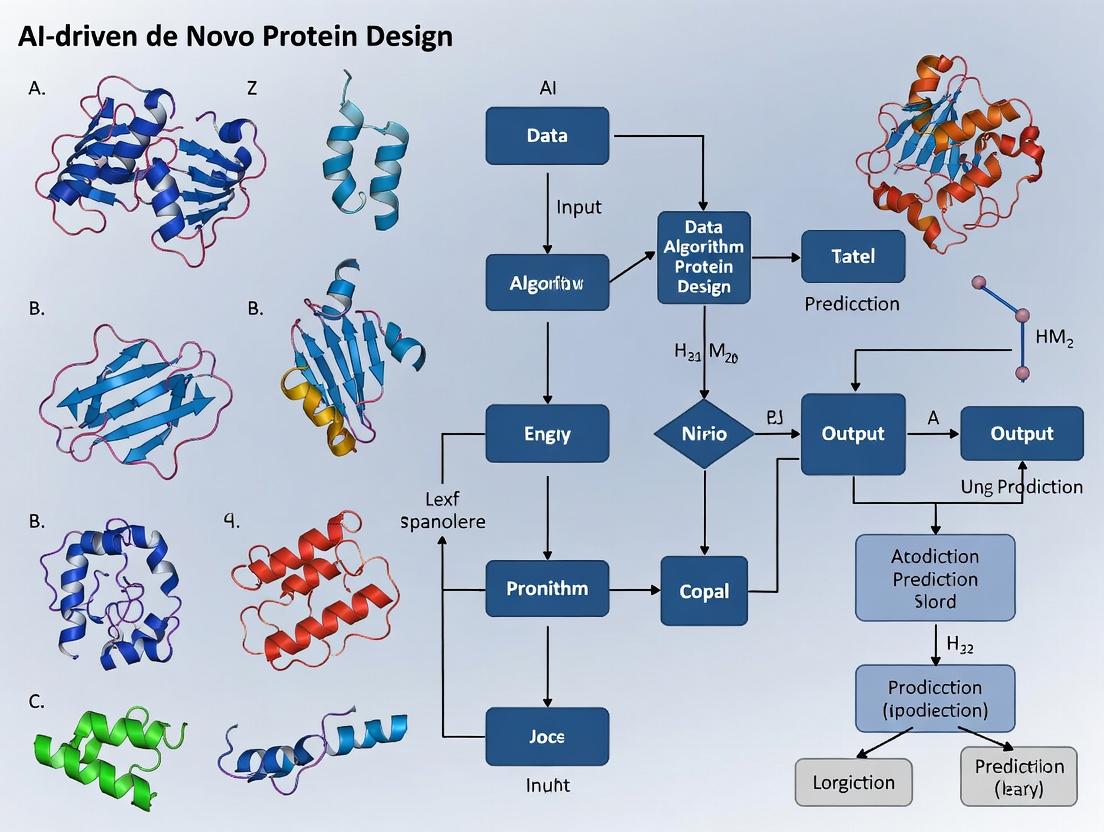
This comprehensive review explores the transformative impact of artificial intelligence on de novo protein design, a field moving beyond natural evolution to create novel proteins with customized functions.
From Sequence to Structure: A 2024 Review of AI-Driven De Novo Protein Design
Abstract
This comprehensive review explores the transformative impact of artificial intelligence on de novo protein design, a field moving beyond natural evolution to create novel proteins with customized functions. We trace the foundational shift from physics-based to AI-driven paradigms, detailing key methodologies like generative models and diffusion techniques. The article addresses practical challenges in design optimization and experimental validation, compares leading tools such as RFdiffusion and ProteinMPNN, and analyzes successful applications in therapeutics, diagnostics, and materials science. Aimed at researchers and drug development professionals, this review synthesizes current capabilities, limitations, and the future trajectory of computational protein engineering for biomedical innovation.
The AI Revolution in Protein Design: From Physics-Based Rules to Generative Intelligence
This whitepaper serves as a core technical guide within a broader thesis reviewing AI-driven de novo protein design. The field's paradigm has shifted from mimicking nature to computationally generating novel protein structures and functions without direct evolutionary templates. This approach, powered by deep learning, is revolutionizing therapeutic, enzymatic, and material science by creating proteins tailored for specific, predefined tasks.
Foundational Principles and Quantitative Landscape
De novo protein design integrates principles from structural biology, biophysics, and machine learning. The process typically follows a "fold-first" or "function-first" strategy, where a desired backbone fold is designed and then optimized for sequence compatibility and function.
Table 1: Key Performance Metrics in Recent AI-Driven De Novo Design (2023-2024)
| Metric / Study | Design Success Rate (Experimental) | Novel Scaffold Topologies Generated | Thermostability (Tm, °C) | Application Demonstrated |
|---|---|---|---|---|
| RFdiffusion/ProteinMPNN (2023) | ~20% (High-res structures) | 100+ | 55-110+ | Binders, Enzymes |
| Chroma (Generate Biomes, 2024) | N/A (in silico) | 1000s | N/A (in silico) | Scaffold Generation |
| AlphaFold2 for Validation | >90% (Structure Prediction Accuracy) | N/A | N/A | In silico Filtering |
| EMBER3D (2024) | ~15% (NMR validation) | Dozens | 40-75 | Symmetric Assemblies |
Core AI-Driven Methodological Pipeline: A Detailed Protocol
Protocol: AI-Based Protein Backbone Generation with RFdiffusion
Objective: Generate novel, stable protein backbones conforming to specified structural motifs.
- Specification: Define constraints (e.g., symmetry, pocket presence, fragment incorporation).
- Noise Addition: Start from a random or seed structure. Apply a diffusion process that iteratively adds noise to atomic coordinates.
- Conditional Denoising: Employ a trained RoseTTAFold architecture (RFdiffusion) to reverse the diffusion process. The network is conditioned on the user's constraints, guiding the denoising trajectory towards desired features.
- Backbone Sampling: Output an ensemble of all-atom backbone structures (Cα, C, N, O atoms).
- Clustering & Filtering: Cluster generated backbones by RMSD. Filter using physics-based metrics (packing, voids) and AlphaFold2/OmegaFold prediction to assess foldability confidence.
Protocol: Sequence Design with ProteinMPNN
Objective: Fix the amino acid sequence onto a generated backbone for stable folding.
- Input: Selected backbone structure (from 3.1).
- Graph Encoding: Represent the backbone as a graph (nodes: residues, edges: spatial relationships).
- Neural Message Passing: Use the ProteinMPNN neural network to compute a probability distribution over amino acids for each residue position, optimizing for global energy minima.
- Sequence Sampling: Decode multiple high-probability sequences from the network output.
- Ranking: Rank sequences by predicted confidence score (pseudo-perplexity).
Protocol: In Silico Validation Workflow
Objective: Prioritize designs for experimental testing.
- Folding Prediction: Process each designed sequence through AlphaFold2 or ESMFold. Calculate the predicted TM-score (Template Modeling Score) between the design model and the AF2 prediction. Accept designs with TM-score >0.7.
- Stability Assessment: Run short molecular dynamics (MD) simulations (10-100 ns) using GROMACS or OpenMM. Analyze root-mean-square fluctuation (RMSF) and secondary structure persistence.
- Function Check: If designing binders, dock the protein to the target using RosettaDock or AlphaFold Multimer. For enzymes, perform quantum mechanics/molecular mechanics (QM/MM) calculations on the active site.
Visualization of Core Workflows
Diagram Title: AI-Driven De Novo Protein Design Pipeline
Diagram Title: Diffusion Model for Protein Backbone Generation
The Scientist's Toolkit: Essential Research Reagent Solutions
Table 2: Key Reagents and Materials for Experimental Validation of De Novo Proteins
| Item | Function/Description |
|---|---|
| Cloning & Expression | |
| pET Series Vectors (e.g., pET-28a(+)) | High-copy number E. coli expression vectors with T7 promoter and optional N-/C-terminal His-tag for purification. |
| BL21(DE3) Competent E. coli | Standard expression host for T7 RNA polymerase-driven protein production. |
| Gibson Assembly or Golden Gate Mix | For seamless, scarless assembly of synthetic DNA fragments into expression vectors. |
| Purification | |
| Ni-NTA or Co-TALON Resin | Immobilized metal affinity chromatography (IMAC) resin for purifying His-tagged proteins. |
| Size Exclusion Chromatography (SEC) Column (e.g., HiLoad 16/600 Superdex 75 pg) | For final polishing step to obtain monodisperse, correctly folded protein samples. |
| Characterization | |
| SYPRO Orange Dye | Fluorescent dye used in thermal shift assays (TSA) to measure protein thermal stability (Tm). |
| SEC-MALS Detectors (Multi-Angle Light Scattering) | Coupled with SEC to determine absolute molecular weight and oligomeric state in solution. |
| Lipids or Target Antigen | For functional assays (e.g., testing enzyme substrates or protein-protein/binding interactions). |
| Structural Analysis | |
| Crystallization Screens (e.g., JC SG, Morpheus) | Sparse matrix screens to identify initial conditions for protein crystallization. |
| Cryo-EM Grids (e.g., Quantifoil R1.2/1.3 Au 300 mesh) | Holey carbon grids for flash-freezing protein samples for single-particle cryo-electron microscopy. |
For two decades, computational protein design was dominated by the principles of physical energy minimization and fragment assembly, exemplified by the Rosetta software suite. The paradigm involved sampling a vast conformational space guided by a physics-based force field, supplemented by libraries of structural fragments from known proteins. While revolutionary, this approach was computationally expensive, limited by the accuracy of the force field, and struggled with the vastness of sequence space.
The contemporary paradigm shift is driven by deep learning models that learn the complex mapping between protein sequence, structure, and function directly from the expanding universe of known protein structures in databases like the Protein Data Bank (PDB) and AlphaFold Protein Structure Database. Framed within a broader thesis on AI-driven de novo design, this shift moves from calculating what a sequence might fold into, to generating sequences that will fold into a desired structure or perform a target function, with unprecedented speed and success rates.
Core Technical Comparison: Fragment Assembly vs. Deep Learning
Table 1: Paradigm Comparison: Rosetta/Fragment Assembly vs. AI-Driven Design
| Aspect | Rosetta/Fragment Assembly Paradigm | AI/Deep Learning Paradigm |
|---|---|---|
| Core Principle | Physics-based energy minimization & structural fragment assembly. | Statistical learning from known protein sequence-structure relationships. |
| Primary Input | Target backbone scaffold or functional site description. | Target backbone (structure-based) or functional constraint (function-based). |
| Sequence Search Method | Monte Carlo sampling with side-chain rotamer replacement. | Neural network inference (forward pass) or latent space sampling. |
| "Knowledge" Source | Physical chemistry principles (Van der Waals, electrostatics, etc.) + fragment libraries. | Patterns extracted from millions of evolutionary-related sequences and structures. |
| Computational Cost | High (thousands to millions of CPU/GPU hours per design). | Low once trained (seconds to minutes per design on GPU). |
| Key Limitation | Force field inaccuracies, limited conformational sampling. | Dependency on training data quality and coverage; "black box" interpretability. |
| Representative Tools | RosettaDesign, FRAGFOLD, TOPOLOG. | RFdiffusion, ProteinMPNN, AlphaFold2 (for validation), ESMFold. |
Experimental Protocols for AI-Driven Design
Protocol 1: Structure-Based De Novo Design Using RFdiffusion & ProteinMPNN Objective: Generate a novel protein sequence that folds into a specified 3D structure.
- Target Structure Definition: Define the desired backbone topology (e.g., a symmetrical barrel, a specific binding cavity) as a 3D coordinate set or a textual description for a conditional diffusion model.
- Backbone Generation (RFdiffusion):
- Input the target specification into the RFdiffusion model.
- Run the diffusion process in reverse, starting from noise and iteratively refining to produce a plausible, novel protein backbone that meets the constraints.
- Output: A set of candidate backbone structures (PDB format).
- Sequence Design (ProteinMPNN):
- Input the generated backbone(s) from Step 2 into ProteinMPNN.
- Run the protein language model to predict optimal amino acid sequences that stabilize the given backbone. Multiple sequence variants with predicted high scores are generated.
- Output: Designed protein sequences (FASTA format) for each backbone.
- In Silico Validation:
- Use AlphaFold2 or ESMFold to perform structure prediction on each designed sequence.
- Calculate the root-mean-square deviation (RMSD) between the predicted structure and the intended (RFdiffusion-generated) backbone.
- Select designs with low RMSD (<~2.0 Å) for experimental testing.
Protocol 2: Function-First Design Using a Language Model (e.g., ESM-2) Objective: Generate novel protein sequences that possess a desired functional motif or property.
- Functional Conditioning: Encode the functional constraint (e.g., a specific enzyme active site motif "DxSxG", a transmembrane helix pattern, or a binding peptide sequence) as a positional mask or a prompt for the language model.
- Sequence Generation:
- Use a fine-tuned or conditioned protein language model (e.g., ESM-2).
- Sample from the model's output distribution to generate full-length protein sequences that incorporate the constrained functional motif within a coherent global sequence context.
- Output: Hundreds to thousands of candidate sequences (FASTA).
- Structure & Function Prediction:
- Pass all candidates through a fast folding network (like ESMFold) for structural assessment.
- Use complementary tools (e.g., docking with AF2, or conservation analysis) to rank candidates by structural integrity and plausibility of the desired function.
- Downstream Screening: Clone top-ranking sequences into expression vectors for high-throughput experimental characterization of stability and function.
Key Signaling Pathways and Workflows
Diagram Title: Paradigm Shift in Protein Design Workflow
Diagram Title: AI Design & Validation Feedback Loop
The Scientist's Toolkit: Research Reagent Solutions
Table 2: Essential Toolkit for AI-Driven Protein Design & Validation
| Item | Function in AI-Driven Workflow | Example/Note |
|---|---|---|
| Generative Models | Create novel protein backbones or sequences from constraints. | RFdiffusion (backbones), ProteinMPNN (sequences), fine-tuned ESM-2 (function-first). |
| Structure Prediction Models | Validate designs in silico; predict structure of generated sequences. | AlphaFold2 (high accuracy), ESMFold (high speed for screening). |
| High-Performance Computing (HPC) | Provides GPU clusters necessary for training and running large AI models. | NVIDIA A100/H100 GPUs; Cloud platforms (AWS, GCP). |
| Protein Structure Database | Source of training data for AI models and for structural analysis. | PDB, AlphaFold DB (provides vast expanded dataset). |
| Cloning & Expression Suite | For experimental validation of AI-generated designs. | Gibson Assembly kits, high-efficiency competent cells (NEB Turbo), cell-free expression systems for rapid testing. |
| High-Throughput Characterization | Rapidly assess stability and function of dozens of designs. | Differential Scanning Fluorimetry (nanoDSF), Surface Plasmon Resonance (Biacore), Mass Photometry. |
| Structural Validation | Confirm designed protein matches AI-predicted structure. | X-ray Crystallography, Cryo-Electron Microscopy. |
Within the accelerating field of AI-driven de novo protein design, the selection and implementation of core AI architectures are foundational to research progress. This whitepaper provides an in-depth technical overview of three pivotal architectures—Neural Networks, Variational Autoencoders (VAEs), and Transformers—detailing their application, comparative performance, and experimental protocols in protein science. Framed within a broader thesis on advancing de novo design, this document serves as a technical reference for researchers and development professionals pushing the boundaries of therapeutic and enzymatic protein creation.
Architectural Foundations and Applications in Protein Science
Deep Neural Networks (DNNs)
DNNs, particularly Convolutional Neural Networks (CNNs) and Recurrent Neural Networks (RNNs), serve as workhorses for protein structure and function prediction. CNNs excel at extracting spatial hierarchies from structural data (e.g., voxelized 3D density maps or 2D contact maps), while RNNs model sequential dependencies in amino acid chains.
- Primary Application: Secondary structure prediction, residue-residue contact prediction, and quantitative structure-activity relationship (QSAR) modeling for protein-ligand binding.
Variational Autoencoders (VAEs)
VAEs are generative models that learn a compressed, continuous latent representation of protein sequences or structures. By sampling from this latent space, VAEs can generate novel, plausible protein sequences that fulfill specific design criteria, such as folding into a target structure or exhibiting a desired function.
- Primary Application: De novo generation of protein sequences, scaffold design, and exploring the "dark matter" of protein sequence space.
Transformers
Originally developed for natural language processing (NLP), Transformers, with their self-attention mechanisms, have revolutionized protein modeling by treating amino acid sequences as "sentences" and protein properties as "context." Large-scale pre-trained models (e.g., AlphaFold2, ESM-2, ProteinBERT) learn evolutionary and biophysical patterns from massive sequence databases.
- Primary Application: State-of-the-art protein structure prediction (AlphaFold2), protein language modeling for function prediction, and zero-shot fitness prediction for mutations.
Quantitative Performance Comparison
Table 1: Comparative performance metrics of core AI architectures on key protein science tasks. Data synthesized from recent literature (2023-2024).
| Architecture | Exemplary Model | Primary Task | Key Metric | Reported Performance | Computational Cost (GPU hrs) |
|---|---|---|---|---|---|
| CNN | DeepContact | Residue Contact Prediction | Precision@L/5 (CASP12) | 69% | ~500 |
| Vae | ProteinVAE | Sequence Generation | Recovery of Native Motifs | >40% | ~200 |
| Transformer | AlphaFold2 (AF2) | Structure Prediction | TM-score (CASP14) | Median >0.90 | ~16,000* |
| Transformer | ESM-2 (15B params) | Mutation Effect Prediction | Spearman's ρ (Fluorescence) | 0.71 | ~25,000 (Pre-training) |
| Hybrid (Vae+CNN) | trRosetta | Structure Prediction | GDT_TS (CASP13) | Median 73.0 | ~1,000 |
*Per model inference. Pre-training cost is substantially higher.
Detailed Experimental Protocols
Protocol: Training a VAE forDe NovoProtein Sequence Design
Objective: To generate novel protein sequences predicted to fold into a target topology. Materials: UniRef50 database, PyTorch/TensorFlow, VAE architecture code (e.g., ProteinVAE), Adam optimizer. Procedure:
- Data Preparation: Curate a multiple sequence alignment (MSA) for a target protein family. One-hot encode sequences as a [Batch Size, Sequence Length, 20] tensor.
- Model Initialization: Define encoder (3 CNN layers → dense → μ & σ layers) and decoder (dense → 3 transposed CNN layers) networks. Latent space dimension (z) typically 50-200.
- Training Loop: For each batch:
a. Encode input
xto latent parametersμandσ. b. Sample latent vectorzusing the reparameterization trick:z = μ + ε * σ, whereε ~ N(0,1). c. Decodezto reconstructx'. d. Compute loss:Loss = BCE(x, x') + β * KL_div(N(μ, σ) || N(0,1)). (β-term for controlled disentanglement). e. Update weights via backpropagation. - Generation: After training, sample random vectors
zfrom the priorN(0,1)and decode to generate novel sequences. - Validation: Filter generated sequences using a pre-trained structure predictor (e.g., AlphaFold2 or RosettaFold) to assess fold fidelity.
Protocol: Fine-Tuning a Protein Language Transformer (ESM-2)
Objective: Predict the functional effect of single-point mutations. Materials: Pre-trained ESM-2 model (esm2t363B_UR50D), dataset of protein variants with measured fitness scores (e.g., fluorescence, stability), GPU cluster. Procedure:
- Setup: Install the
fair-esmlibrary. Load the pre-trained model and its tokenizer. - Input Representation: For each variant (e.g., "M1A"), tokenize the full wild-type sequence. The model generates a per-residue embedding for each position.
- Feature Extraction: Extract the hidden-state embedding (from the final layer) for the mutated position (
pos=1). This 2560-dimensional vector is the input feature. - Add Regression Head: Attach a simple Multi-Layer Perceptron (MLP: Linear(2560, 256) → ReLU → Linear(256, 1)) on top of the frozen base model.
- Fine-Tuning: Unfreeze the last n layers (e.g., last 6) of the transformer along with the MLP head. Train using Mean Squared Error (MSE) loss on the fitness scores.
- Evaluation: Perform k-fold cross-validation. Report Spearman's rank correlation coefficient (ρ) between predicted and experimental fitness scores on the held-out test set.
Architecture and Workflow Visualizations
Title: VAE Training & Generation Workflow in Protein Design
Title: Fine-tuning a Transformer for Mutation Effect Prediction
The Scientist's Toolkit: Research Reagent Solutions
Table 2: Essential computational tools and resources for AI-driven protein design research.
| Item | Category | Function / Application | Example / Provider |
|---|---|---|---|
| Pre-trained Models | Software | Foundation models for transfer learning, saving immense compute time. | ESM-2 (Meta), ProtT5 ( RostLab), AlphaFold2 (DeepMind) |
| Structure Prediction Servers | Web Service | Rapid in silico validation of generated protein sequences. | ColabFold (Google), Robetta (Baker Lab), trRosetta |
| Protein Sequence Databases | Data | Primary source for training and MSAs. | UniProt, UniRef, Pfam (EMBL-EBI) |
| Fitness/Stability Datasets | Data | Curated experimental data for supervised learning & benchmarking. | ProteinGym (EPFL), ThermoMutDB, FireProtDB |
| Molecular Dynamics Engines | Software | Physics-based simulation for refining AI-generated designs. | GROMACS, AMBER, OpenMM |
| Differentiable Physics | Software Library | Integration of physical laws into neural network training loops. | JAX, TorchMD (Doerr et al.) |
| Protein Design Suites | Software Platform | Integrated environments combining AI and biophysical methods. | Rosetta (with PyRosetta), RFdiffusion (Baker Lab) |
Within the broader thesis on AI-driven de novo protein design, the availability, quality, and structure of training data are fundamental limiting factors. This technical guide examines the core datasets and benchmarks—specifically the Protein Data Bank (PDB) and AlphaFold DB—that serve as the primary fuel and validation instruments for modern machine learning models in structural biology. The performance and generalizability of design algorithms are directly contingent upon the characteristics of these underlying data resources.
Core Datasets: Characteristics and Access
The Protein Data Bank (PDB)
The PDB is the foundational, experimentally determined repository of 3D structural data for biological macromolecules, established in 1971. It is managed by the Worldwide Protein Data Bank partnership (wwPDB). As of the latest data, it contains over 220,000 entries, with growth trends and content detailed below.
Table 1: Protein Data Bank (PDB) Current Statistics and Composition
| Metric | Count/Percentage | Notes |
|---|---|---|
| Total Entries | ~223,000 | As of April 2024. |
| Proteins, Peptides, Viruses | ~91% | Includes complexes with other molecules. |
| Nucleic Acids | ~8% | DNA and RNA structures. |
| Other/Complexes | ~1% | Carbohydrates, theoretical models, etc. |
| Determined by X-ray Crystallography | ~89% | Dominant experimental method. |
| Determined by NMR Spectroscopy | ~7% | Solution-state structures. |
| Determined by 3D Electron Microscopy | ~4% | Rapidly growing method, especially for large complexes. |
| Experimental Method: Other | <0.5% | Includes neutron diffraction, hybrid methods. |
| Deposition Growth Rate | ~15,000 new entries/year | Steady annual increase. |
| Public Access | Fully open via RCSB.org, PDBe.org, PDBj.org | No restrictions for most data. |
Protocol 2.1: Accessing and Processing PDB Data for Machine Learning
- Bulk Download: Use the RCSB PDB search API (
search.rcsb.org) or FTP server (ftp.wwpdb.org) to download metadata and structure files in mmCIF or PDB format. - Filtering: Apply filters for resolution (e.g., ≤ 2.5 Å for X-ray), experimental method, and absence of severe deposition errors. Remove highly homologous sequences (>30% identity) to reduce redundancy using tools like CD-HIT.
- Preprocessing: Convert structures to standardized formats. Extract atomic coordinates, compute per-residue features (secondary structure, solvent accessibility, dihedral angles), and generate distance/contact maps.
- Splitting: Partition data into training/validation/test sets using time-based splits (older entries for training, newer for testing) or rigorous sequence/cluster splits to prevent data leakage and benchmark generalization.
Title: PDB Data Curation and Splitting Workflow for ML
AlphaFold DB
AlphaFold DB, hosted by the European Molecular Biology Laboratory's European Bioinformatics Institute (EMBL-EBI), is a repository of over 200 million protein structure predictions generated by DeepMind's AlphaFold2 and AlphaFold3 models. It provides high-accuracy predictions for nearly the entire UniProt proteome.
Table 2: AlphaFold DB Content and Model Performance Metrics
| Metric | Value / Specification | Interpretation |
|---|---|---|
| Total Predictions | >200 million | Covers UniProt reference proteomes. |
| Model Versions | AlphaFold2 (v2.3.1), AlphaFold3 (v3.0) | AF3 extends to nucleic acids, ligands. |
| Key Accuracy Metric | Predicted Local Distance Difference Test (pLDDT) | Per-residue confidence score (0-100). |
| High Confidence (pLDDT) | >90 | Very high accuracy, backbone reliable. |
| Low Confidence (pLDDT) | <50 | Unreliable, likely disordered. |
| Predicted Aligned Error (PAE) | Reported for all models | Estimates positional error between residues. |
| Coverage (Human Proteome) | ~98% | Vastly expands structural coverage. |
| Access | Open via https://alphafold.ebi.ac.uk/ | Bulk download available. |
Protocol 2.2: Utilizing AlphaFold DB Predictions for Training and Analysis
- Target Selection: Identify protein families or organisms of interest via UniProt IDs or sequence search on the AlphaFold DB website.
- Data Retrieval: Download predicted structure files (PDB format), confidence scores (pLDDT as B-factor field), and PAE matrices (JSON format) via the website or programmatically using the AlphaFold DB API.
- Confidence Filtering: Filter predictions or specific regions based on pLDDT scores. For training de novo design models, high-confidence (pLDDT > 70) regions are typically used as reliable structural templates.
- Integration with Experimental Data: Use predictions to fill gaps in experimental structural coverage (e.g., for missing loops or uncharacterized homologs). Cross-validate low-confidence regions against experimental data from the PDB or biochemical assays.
Title: AlphaFold DB Prediction Retrieval and Application Workflow
The Critical Role of Training Data in AI-Driven Protein Design
The performance of models like RoseTTAFold, ProteinMPNN, and RFdiffusion is not solely an architectural achievement but a direct consequence of their training data's scope and quality.
Table 3: Impact of Training Data Characteristics on Model Performance
| Training Data Attribute | Impact on De Novo Design Model | Example/Practical Consequence |
|---|---|---|
| Size & Diversity | Determines generalizability. Larger, more diverse sets improve coverage of fold space. | Models trained on the full PDB+AlphaFold DB generate more novel, stable folds than those trained on small, homogeneous sets. |
| Experimental Accuracy | Affects physical realism of generated structures. High-resolution data yields better energy landscapes. | Designs based on high-resolution PDB data (<2.0 Å) express and fold more reliably than those from low-resolution templates. |
| Sequence-Structure Mapping | Teaches the fundamental rules of protein folding. Redundant data reinforces patterns but may limit novelty. | Models learn conserved physical constraints (e.g., hydrophobic packing, hydrogen bonding networks). |
| Presence of Artifacts | Can lead to learned biases (crystal contacts, purification tags). | Early models sometimes generated "crystalline" packing interfaces not suitable for solution biology. |
| Temporal Splitting | True test of predictive power and generalization to new biology. | A model performing well on a random split may fail on a "future" protein discovered after its training data cutoff. |
Protocol 3.1: Benchmarking a De Novo Design Pipeline
- Dataset Construction: Create a benchmark set from high-quality PDB structures released after the training data cutoff date of the model being tested. Ensure no significant sequence homology (>25% identity) to the training set.
- Design Generation: Use the model to generate de novo sequences for the backbone scaffolds of the benchmark set's structures.
- In Silico Validation: Fold the designed sequences using AlphaFold2 or RosettaFold. Compute the Template Modeling Score (TM-score) between the predicted structure of the design and the original target scaffold. A TM-score >0.7 indicates successful recapitulation.
- Experimental Validation (Gold Standard): Cloning, expression in E. coli or other systems, purification via affinity chromatography (e.g., His-tag), and assessment of monodispersity via size-exclusion chromatography (SEC). Determine structure via X-ray crystallography or cryo-EM and compare to design model.
Title: Benchmarking Pipeline for De Novo Protein Design Models
The Scientist's Toolkit: Essential Research Reagents and Materials
Table 4: Key Reagents and Materials for Experimental Protein Design Validation
| Item | Function/Application | Example Vendor/Product |
|---|---|---|
| Cloning Vector (T7 Expression) | High-copy plasmid for inducible protein expression in E. coli. | pET series vectors (Novagen/Merck). |
| Competent E. coli Cells | Genetically engineered bacteria for plasmid transformation and protein production. | BL21(DE3) cells (NEB). |
| Affinity Chromatography Resin | Purifies recombinant proteins via a fused tag (e.g., His-tag, Strep-tag). | Ni-NTA Agarose (Qiagen). |
| Size-Exclusion Chromatography (SEC) Column | Separates proteins by size; assesses monodispersity and final polishing step. | HiLoad Superdex columns (Cytiva). |
| Crystallization Screening Kits | Sparse-matrix screens to identify conditions for protein crystal growth. | JC SG I/II, Morpheus (Molecular Dimensions). |
| Cryo-EM Grids | Ultrathin, perforated supports for flash-freezing protein samples for cryo-EM. | Quantifoil R 1.2/1.3 Au grids. |
| Synchrotron Beamline Access | High-intensity X-ray source for collecting diffraction data from protein crystals. | ESRF (Grenoble), APS (Argonne). |
| Sequence-Structure Prediction Server | Rapid in silico folding and confidence estimation of designed sequences. | ColabFold (AlphaFold2/3 accessible via cloud). |
| Molecular Visualization Software | Analyzes and visualizes 3D protein structures and models. | PyMOL (Schrödinger), ChimeraX (UCSF). |
This technical guide delineates the core design cycle for de novo protein design, framed within a broader thesis on AI-driven methodologies. The cycle represents a paradigm shift in biotechnology, enabling the creation of proteins with novel functions not found in nature. This paradigm is central to modern research in therapeutic development, enzyme engineering, and biomaterials.
The Tripartite Design Cycle
The AI-driven de novo protein design cycle is an iterative, three-phase process: In Silico Generation, Folding Prediction, and Functional Specification. Each phase feeds into the next, with validation data prompting refinement.
Phase 1:In SilicoGeneration
This phase involves the computational proposal of novel amino acid sequences intended to adopt a target structure or function.
Methodology:
- Objective: Generate a diverse library of protein sequences that are predicted to be stable and fold into a desired topology.
- Core Algorithms: Modern approaches use deep generative models.
- Protein Language Models (pLMs): Models like ESM-2 and ProtGPT2, trained on evolutionary sequence data, generate plausible, natural-like sequences by learning the "grammar" of proteins.
- Diffusion Models: Inspired by image generation, these models (e.g., RFdiffusion) gradually denoise a random coil into a structured protein backbone or sequence conditioned on a spatial constraint or functional site.
- Conditional Variational Autoencoders (cVAEs): Encode known structural motifs into a latent space, allowing for sampling and recombination of features to create new designs.
Experimental Protocol (for a cVAE-based generation):
- Dataset Curation: Assemble a non-redundant set of protein structures (e.g., from the PDB) and their corresponding sequences.
- Feature Encoding: Convert each structure into a geometric tensor (e.g., distances, dihedral angles).
- Model Training: Train a VAE to compress the structural/sequence data into a latent distribution and reconstruct it accurately.
- Conditional Sampling: For a desired structural class (e.g., "beta-barrel"), sample points from the latent space conditioned on that class label.
- Sequence Decoding: Decode the sampled latent vectors into novel amino acid sequences.
- Initial Filtering: Apply basic filters (e.g., remove sequences with excessive hydrophobicity, poor amino acid distribution).
Phase 2: Folding Prediction
Generated sequences are subjected to rigorous structure prediction to verify they will adopt the intended fold.
Methodology:
- Objective: Accurately predict the 3D structure of the in silico generated sequences.
- Core Tools: AlphaFold2 and RoseTTAFold are state-of-the-art. For de novo designs, specialized pipelines like ProteinMPNN (for sequence design on a fixed backbone) coupled with AlphaFold2 or RosettaFold are standard.
- Metrics: Prediction confidence is measured by:
- pLDDT (per-residue confidence score): >90 indicates high confidence.
- pTM (predicted Template Modeling score): Estimates global fold accuracy.
- PAE (Predicted Aligned Error): A matrix assessing relative positional confidence between residues.
Experimental Protocol (for structure validation):
- Input Sequences: Use the filtered sequences from Phase 1.
- Structure Prediction: Run AlphaFold2 (using the ColabFold implementation for speed) with multiple sequence alignment (MSA) generation disabled or limited, as novel designs lack evolutionary homologs.
- Analysis:
- Calculate global metrics (average pLDDT, pTM).
- Visualize the predicted structure and overlay it with the intended design target using root-mean-square deviation (RMSD) calculations.
- Inspect the PAE plot for domain-level errors.
- Selection: Retain only sequences where the predicted structure has an RMSD < 2.0 Å to the target backbone and an average pLDDT > 80.
Table 1: Example Output Metrics from Folding Prediction of 5 De Novo Designs
| Design ID | Target Fold | Avg pLDDT | pTM Score | RMSD to Target (Å) | Pass/Fail |
|---|---|---|---|---|---|
| DN_001 | TIM Barrel | 92.4 | 0.89 | 1.2 | Pass |
| DN_002 | Beta-Sandwich | 85.1 | 0.78 | 2.5 | Fail (RMSD) |
| DN_003 | Alpha-Helical Bundle | 88.7 | 0.82 | 1.8 | Pass |
| DN_004 | TIM Barrel | 76.3 | 0.65 | 3.8 | Fail (pLDDT, RMSD) |
| DN_005 | Beta-Sandwich | 94.0 | 0.91 | 0.9 | Pass |
Phase 3: Functional Specification
The validated folds are engineered to perform specific biochemical functions.
Methodology:
- Objective: Introduce functional sites (e.g., enzyme active sites, protein-protein interaction interfaces, small-molecule binding pockets) onto the stable de novo scaffolds.
- Core Approaches:
- Rosetta-based Functional Site Grafting: Transplant the geometric arrangement of key catalytic or binding residues from a natural protein onto a compatible region of the de novo scaffold.
- Machine Learning-Guided Docking: Use tools like DiffDock to predict how a target ligand binds to the scaffold, then fix the pocket geometry through further sequence optimization (e.g., with ProteinMPNN).
- Evolutionary Coupling Analysis: For binding interfaces, use statistical methods to identify residue pairs that co-evolve in natural systems and impose similar constraints on the designed interface.
Experimental Protocol (for active site grafting):
- Functional Motif Definition: From a natural enzyme (e.g., a serine protease), extract the identities and relative 3D positions of the catalytic triad residues (His, Asp, Ser).
- Scaffold Mapping: Search the de novo scaffold (e.g., a TIM barrel) for a site where the backbone geometry can accommodate the functional motif with minimal distortion.
- Sequence Design: Using Rosetta or ProteinMPNN, redesign the amino acids in and around the grafted site to both stabilize the functional residue geometry and maintain overall scaffold stability.
- In Silico Functional Screening: Perform molecular dynamics (MD) simulations to assess the stability of the functional site and computational docking to assay binding affinity.
Integrated Workflow & Validation
(Diagram Title: AI-Driven Protein Design Cycle)
The Scientist's Toolkit: Research Reagent Solutions
Table 2: Essential Tools and Reagents for AI-Driven De Novo Protein Design
| Item | Category | Function & Application |
|---|---|---|
| Truncated Gene Fragments | Synthetic Biology | For cost-effective, high-throughput construction of novel DNA sequences encoding de novo protein designs via Gibson or Golden Gate assembly. |
| Cell-Free Protein Synthesis (CFPS) Systems (e.g., PURExpress) | Expression | Enables rapid, parallel expression of designed proteins without cellular constraints, ideal for screening unstable or potentially toxic designs. |
| Fast-Folding Biosensors | Assay | Engineered fluorescent or colorimetric reporter systems used in high-throughput screens to assess folding stability or enzymatic activity of designs in vivo. |
| Site-Specific Bioconjugation Kits (e.g., sortase, SpyTag/SpyCatcher) | Characterization | Allows for precise labeling of de novo proteins with fluorophores, immobilization tags, or other probes for functional assays. |
| Stable Isotope-Labeled Amino Acids (¹⁵N, ¹³C) | Biophysics | Essential for nuclear magnetic resonance (NMR) spectroscopy to validate the solution-state structure and dynamics of designed proteins. |
| Surface Plasmon Resonance (SPR) Chips (e.g., NTA for His-tagged proteins) | Biophysics | Enable quantitative measurement of binding kinetics (Ka, Kd) between designed proteins and their target ligands or partners. |
| Thermal Shift Dye (e.g., SYPRO Orange) | Biophysics | Used in differential scanning fluorimetry (DSF) to experimentally determine the melting temperature (Tm) and assess the thermal stability of designs. |
| Protease Cocktails | Assay | Used in limited proteolysis experiments to probe the rigidity and foldedness of designed protein scaffolds. |
The integration of in silico generation, robust folding prediction, and precise functional specification constitutes a mature pipeline for AI-driven de novo protein design. This cycle, continuously refined by experimental feedback, is accelerating the creation of novel therapeutics, catalysts, and materials, moving from computational abstraction to real-world function.
Tools of the Trade: How RFdiffusion, ProteinMPNN, and AlphaFold2 Enable Real-World Applications
This whitepaper, framed within a comprehensive review of AI-driven de novo protein design, examines the paradigm shift brought by diffusion probabilistic models for generating novel, diverse, and functional protein backbone structures. The core challenge in computational protein design is sampling from the high-dimensional, biophysically constrained space of plausible three-dimensional structures. Generative models, particularly diffusion models, have emerged as a dominant framework for learning this complex data distribution, enabling the conditional generation of backbones for specific functional or geometric requirements.
Core Technical Principles: Diffusion Models on Manifolds
Unlike image generation, protein backbones are represented as sequences of 3D coordinates (Cα, N, C, O) or internal torsion angles (φ, ψ, ω). Diffusion models operate by defining a forward process that gradually adds noise to a native structure ( x_0 ) over ( T ) timesteps, and a learned reverse process that denoises from a random Gaussian distribution to a coherent structure.
For protein backbones, this process is often defined on the SE(3) manifold (3D rotations and translations) to ensure roto-translational invariance. The forward process for atom coordinates can be defined as: ( q(xt | x{t-1}) = \mathcal{N}(xt; \sqrt{1-\betat} x{t-1}, \betat I) ) where ( \betat ) is a noise schedule. The model learns to predict the noise ( \epsilon ) or the clean structure ( x0 ) at each step, conditioned on timestep ( t ) and optional conditioning information ( c ).
Conditional generation is achieved by modifying the denoising process to be guided by a conditioning signal ( c ), such as a desired functional site, a target fold, a protein motif (e.g., helix, sheet), or a binding pocket shape. This is formalized by learning ( p\theta(x{t-1} | x_t, c) ).
Key Methodologies & Experimental Protocols
Model Training Protocol (Based on RFdiffusion & Chroma)
Data Curation: A non-redundant set of protein structures from the PDB is clustered (<30% sequence identity). Structures are processed into backbone frames (orientations of N, Cα, C atoms) and/or Cα coordinates only.
Representation & Featurization:
- Convert each residue to a local frame (3D rotation matrix) and translation (Cα coordinate).
- Compute internal torsion angles (φ, ψ) and backbone bond lengths/angles.
- Extract sequence features (amino acid type, position) and optional structural features (secondary structure, solvent accessibility).
Network Architecture (Denoiser):
- Input: Noisy backbone frames/coordinates at timestep
t, encoded timestept, conditioning vectorc. - Core: An SE(3)-equivariant graph neural network (GNN) or transformer. Nodes represent residues; edges represent spatial or sequence neighbors.
- Equivariance: Use Vector Neurons or SE(3)-transformers to ensure model output transforms consistently with 3D rotations/translations of input.
- Output: Predicted noise ( \epsilon ) or the clean structure at
t=0for the current noisy input.
- Input: Noisy backbone frames/coordinates at timestep
Loss Function: Mean Squared Error (MSE) on the predicted noise in the coordinate or frame space, often weighted per residue.
Conditioning Injection:
- Concatenation: Conditioning vector
cis concatenated with node features. - Cross-Attention: For complex conditions (e.g., partial motifs), a cross-attention layer allows the backbone generation to attend to the condition.
- Concatenation: Conditioning vector
Conditional Generation Protocol (Inference)
- Specify Condition: Define the conditioning input (e.g., target symmetry, scaffold identity for partial motif, desired secondary structure string).
- Sampling Loop:
- Sample initial noise ( x_T \sim \mathcal{N}(0, I) ).
- For
t = Tto1:- Input
x_t, timestept, and conditioncto the trained denoiser network. - Predict
x_0estimate or noiseϵ. - Use the reverse diffusion equation (DDPM or DDIM sampler) to compute
x_{t-1}.
- Input
- Output
x_0as the generated backbone.
- Structure Refinement: Pass the generated backbone through a fast relaxation (short MD simulation or Rosetta FastRelax) to fix minor geometric distortions.
Performance Data & Quantitative Comparison
The following table summarizes key quantitative results from recent state-of-the-art models. Metrics focus on designability (the ability of a generated structure to be realized by a plausible amino acid sequence) and diversity.
Table 1: Performance Comparison of Generative Models for Protein Backbones
| Model (Year) | Core Architecture | Conditional Capability | Key Metric & Result | Reference / Benchmark |
|---|---|---|---|---|
| RFdiffusion (2023) | Diffusion + RosettaFold | Symmetry, motif scaffolding, binder design | Design Success Rate: ~20% for high-accuracy binder design (vs. ~1% pre-2022). | Nature (2023) |
| Chroma (2023) | Diffusion (GNN) + Language Model | Text, structure, properties | Novel Fold Generation: >90% produce novel folds not in PDB. | bioRxiv (2023) |
| FrameDiff (2023) | SE(3) Diffusion on Frames | - | RMSD to Native: <2Å for short (<100aa) de novo designs. | ICML (2023) |
| ProteinMPNN + AlphaFold2 (Pipeline) | Autoregressive + Discriminative | Sequence recovery | Sequence Recovery: ~40% for fixed backbone design. | Science (2022) |
| AlphaFold2 (for hallucination) | Structure Module Recycling | - | pLDDT: Designs with pLDDT >80 often foldable. | Nature (2021) |
Table 2: Common Evaluation Metrics for Generated Protein Backbones
| Metric | Definition | Ideal Value | Tool/Method for Calculation |
|---|---|---|---|
| pLDDT (predicted) | Per-residue confidence score from AF2/ESMFold on designed sequence. | >80 (High confidence) | AlphaFold2, ESMFold |
| RMSD (to target/condition) | Root-mean-square deviation of Cα atoms. | <2.0 Å (close match) | PyMOL, Biopython |
| Designability | Percentage of generated backbones for which a stable, folding sequence can be found. | Higher is better | Rosetta FixBB, ProteinMPNN + AF2 |
| SCD (Self-Consistency Distance) | RMSD between the generated structure and the AF2 prediction of its designed sequence. | <2.0 Å (self-consistent) | AlphaFold2 |
| Novelty | TM-score < 0.5 to closest PDB entry. | TM-score < 0.5 | Foldseek, DALI |
The Scientist's Toolkit: Research Reagent Solutions
Table 3: Essential Tools & Resources for Protein Backbone Generation Research
| Item | Function | Example / Provider |
|---|---|---|
| Structure Prediction Network | Evaluates designability and structural confidence of generated backbones. | AlphaFold2 (ColabFold), ESMFold, RosettaFold (RFdiffusion) |
| Sequence Design Tool | Designs a protein sequence that folds into a given backbone structure. | ProteinMPNN, Rosetta FixBB protocol, ESM-IF1 |
| Molecular Dynamics Engine | Refines and validates physical plausibility and stability of designs. | GROMACS, AMBER, OpenMM, Rosetta FastRelax |
| Diffusion Model Codebase | Pre-trained models and training/inference pipelines. | RFdiffusion (GitHub), Chroma (GitHub), FrameDiff (GitHub) |
| Curated Protein Dataset | High-quality data for training and benchmarking. | PDB, PDB Reduced (clustered), CATH, ESM Atlas |
| Equivariant NN Library | Framework for building SE(3)-equivariant denoiser networks. | PyTorch Geometric, e3nn, SE(3)-Transformers |
| Structure Analysis Suite | Calculates metrics (RMSD, TM-score, angles). | Biopython, PyMOL, MDAnalysis |
| High-Performance Compute (HPC) | GPU clusters for training (weeks on 4-8 GPUs) and inference. | NVIDIA A100/H100, Cloud (AWS, GCP) |
Thesis Context: This whitepaper is situated within a comprehensive review of AI-driven de novo protein design. The objective is to evaluate and systematize computational methodologies for generating functional amino acid sequences conditioned on fixed, three-dimensional protein backbones—a critical subproblem for creating novel enzymes, therapeutics, and biomaterials.
The inverse protein folding problem—finding a sequence that folds into a given scaffold—is a cornerstone of de novo design. Fixed scaffolds provide structural constraints (secondary structure, topology, active site geometry) while sequence space is explored for stability and function. Recent AI approaches, primarily autoregressive and graph-based models, have dramatically advanced the feasibility and success rate of this task.
Core Methodological Approaches
Autoregressive Models
These models treat the protein sequence as an ordered chain and generate residues sequentially, typically from N- to C-terminus, conditioned on the scaffold structure.
- Architecture: Commonly based on Transformers or recurrent neural networks (RNNs).
- Conditioning: The fixed scaffold is represented as a contextual input at each generation step. This is often achieved by encoding the local structural environment of each residue position (e.g., distances, angles, solvent accessibility) into a feature vector that is provided as an additional input when predicting the amino acid for that position.
- Training: Maximizes the likelihood of observed sequences given their native structures in databases like the Protein Data Bank (PDB).
Graph-Based Models
These models represent the protein scaffold as a graph, where nodes are residues (or atoms) and edges represent spatial or chemical relationships.
- Architecture: Employ Graph Neural Networks (GNNs) or attention-based networks on graphs.
- Representation: Nodes are annotated with features (residue type, secondary structure, etc.). Edges are defined based on spatial proximity (e.g., Cα-Cα distance < 10Å) and may be labeled with distance and orientation.
- Generation: Can be performed in one-shot (predicting all residues simultaneously) or via iterative refinement. The graph structure allows for direct modeling of long-range, non-sequential interactions critical for folding.
Comparative Performance Analysis
The following table summarizes key quantitative benchmarks from recent literature, focusing on sequence recovery (identity to native sequence) and computational metrics.
Table 1: Performance Comparison of Representative Models
| Model Name | Approach | Key Architecture | Sequence Recovery (%) (Test Set) | Runtime per Protein (Seconds) | Key Benchmark |
|---|---|---|---|---|---|
| ProteinSolver | Graph-Based | Gated Graph Neural Network (GGNN) | 39.7 | ~120 | PDB, CATH subset |
| SPIN | Autoregressive | Transformer (Structure-Conditioned) | 51.2 | ~45 | TS50, TS500 |
| GVP-Transformer | Graph-Based | Geometric Vector Perceptrons + Transformer | 53.8 | ~90 | CATH 4.2 |
| AlphaFold2 (Inverse) | Graph-Based (Modified) | Structure Module (Evoformer not used) | 59.1 | ~300* | PDB100 |
| FrameDiff | SE(3)-Diffusion | Equivariant GNN | 48.5 (designed to scaffold) | ~600 | De novo backbone design |
Note: Runtime is hardware-dependent; values are approximate for a ~250 residue protein on a single GPU. Sequence recovery is not a perfect proxy for design quality but is a standard initial metric.
Detailed Experimental Protocol for Validation
A standard in silico and in vitro validation pipeline for designed sequences is outlined below.
Protocol: In Silico Folding and In Vitro Expression Validation
A. In Silico Folding with AlphaFold2 or RoseTTAFold
- Input: Generate 5-10 candidate sequences for a single target scaffold using the design model.
- Prediction: Submit each candidate sequence to AlphaFold2 (local ColabFold implementation recommended for batch processing) or the RoseTTAFold web server.
- Analysis: Compare the predicted structure (pLDDT > 70 generally acceptable, >80 high confidence) to the target scaffold using Root Mean Square Deviation (RMSD) of Cα atoms. A successful design typically achieves RMSD < 2.0Å for the core regions.
- Selection: Proceed with sequences showing high prediction confidence (pLDDT) and low RMSD to the target fold.
B. In Vitro Gene Synthesis, Expression, and Purification
- Gene Synthesis: Select 3-5 top designs for laboratory testing. Order codon-optimized genes for expression in E. coli from a commercial supplier, cloned into a pET vector with an N-terminal His-tag.
- Expression:
- Transform plasmid into BL21(DE3) E. coli cells.
- Grow culture in LB + antibiotic at 37°C to OD600 ~0.6.
- Induce with 0.5-1.0 mM Isopropyl β-d-1-thiogalactopyranoside (IPTG).
- Express protein at 18°C for 16-18 hours.
- Purification:
- Lyse cells via sonication in lysis buffer (e.g., 50 mM Tris-HCl pH 8.0, 300 mM NaCl, 10 mM imidazole).
- Clarify lysate by centrifugation.
- Purify soluble protein using Ni-NTA affinity chromatography.
- Elute with imidazole gradient (e.g., 250 mM imidazole).
- Perform buffer exchange into storage buffer using desalting columns.
- Characterization:
- Assess purity via SDS-PAGE.
- Confirm identity and mass via Liquid Chromatography-Mass Spectrometry (LC-MS).
- Assess folding and thermal stability via Circular Dichroism (CD) spectroscopy (melting temperature, Tm).
Visualizations
Diagram 1: Autoregressive sequence generation workflow.
Diagram 2: Graph-based protein representation and design.
The Scientist's Toolkit: Research Reagent Solutions
Table 2: Essential Materials for Experimental Validation
| Item | Function in Protocol | Example Product/Catalog # (Representative) |
|---|---|---|
| Codon-Optimized Gene Fragment | Synthetic DNA encoding the designed protein sequence, optimized for expression in the host organism. | Twist Bioscience Gene Fragments, IDT gBlocks. |
| Expression Vector | Plasmid for cloning and expressing the gene in cells; provides promoter, selectable marker, and purification tags. | pET-28a(+) Vector (Novagen, 69864-3). |
| Competent E. coli Cells | Genetically engineered bacteria for plasmid propagation and protein expression. | BL21(DE3) Competent Cells (NEB, C2527H). |
| Affinity Chromatography Resin | Matrix for purifying His-tagged proteins via metal ion affinity. | Ni-NTA Superflow (Qiagen, 30410). |
| Size-Exclusion Chromatography Column | For final polishing step to remove aggregates and exchange buffer. | HiLoad 16/600 Superdex 75 pg (Cytiva, 28989333). |
| Circular Dichroism Spectrophotometer | Measures secondary structure and thermal stability of purified protein. | J-1500 CD Spectrophotometer (JASCO). |
Functional motif scaffolding is a cutting-edge paradigm in computational protein design, situated within the broader thesis that AI-driven de novo design can systematically create novel proteins with prescribed functions. This field moves beyond designing stable folds to the precise spatial and chemical placement of functional motifs—short amino acid sequences critical for catalysis, binding, or signaling—within novel, stable protein scaffolds. The goal is to decouple functional site geometry from evolutionary constraints, enabling the creation of custom enzymes, biosensors, and therapeutics with tailored activities.
Core Methodological Framework
The design process integrates physics-based modeling with deep generative AI. A functional motif, defined by its 3D coordinates and required chemical environment, is treated as a rigid or partially flexible constraint. The algorithm then searches the vast conformational space of possible backbone scaffolds that can house this motif while maintaining foldability and stability.
Key Steps:
- Motif Definition: Specify the functional site's atomic coordinates, required residue identities, and geometric constraints (e.g., distances, angles for catalytic triads).
- Scaffold Generation: Use neural networks (e.g., ProteinMPNN, RFdiffusion) to generate backbone structures or sequences that are compatible with the motif.
- Sequence Design: Optimize the remaining scaffold amino acids to stabilize the fold and support the motif.
- In Silico Validation: Employ molecular dynamics and Rosetta folding simulations to assess stability and functional site integrity.
Quantitative Performance Landscape
Recent benchmark studies illustrate the capabilities of state-of-the-art methods.
Table 1: Performance Metrics of Key Scaffolding Methods (2023-2024)
| Method / Platform | Primary Approach | Success Rate (Experimental) | Design Success Criteria | Typical RMSD (Motif) |
|---|---|---|---|---|
| RFdiffusion + AF2 | Diffusion model + Inverse folding | ~20-30% | High expression, stable fold, correct motif geometry | <1.0 Å |
| RosettaFold2 | End-to-end deep learning | ~15-25% | High confidence pLDDT, motif compatibility | 0.5-1.5 Å |
| Chroma | Diffusion-based generative model | Preliminary data ~10-20%* | Stable in MD simulation, low design loss | N/A |
| Classic Rosetta | Monte Carlo + Fragment assembly | ~5-10% | Low Rosetta energy, negative ΔΔG folding | <2.0 Å |
Table 2: Experimentally Validated Functional Scaffolds (Select Examples)
| Functional Motif | Designed Scaffold | Validated Function | Expression Yield (mg/L) | Thermal Stability (Tm °C) |
|---|---|---|---|---|
| HIV Broadly Neutralizing Antibody Epitope | Novel 3-helix bundle | High-affinity binding to target | 15-30 | 68 |
| PDZ Domain Ligand | Novel β-sandwich | Sub-micromolar binding affinity | 50 | 72 |
| Caspase-3 Cleavage Site | Novel α/β fold | Specific proteolysis by caspase-3 | 20 | 65 |
| Metalloenzyme Site (Zn²⁺) | Novel TIM barrel | Zn²⁺ coordination, esterase activity | 5 | 60 |
Detailed Experimental Protocol: Validation of a Designed Enzyme
This protocol outlines the experimental validation pipeline following the computational design of a novel hydrolase scaffold containing a canonical Ser-His-Asp catalytic triad.
A. In Silico Design & Selection
- Input the catalytic triad motif (PDB ID reference geometry).
- Run RFdiffusion with motif scaffolding constraints to generate 10,000 backbone scaffolds.
- Design sequences for top 1,000 scaffolds using ProteinMPNN.
- Filter using AlphaFold2: select 50 models with pLDDT > 85 and pTM > 0.7, with motif RMSD < 1.0Å.
- Perform 100-ns molecular dynamics simulation on top 5 designs; select 2 with stable motif geometry.
B. Gene Synthesis & Cloning
- Codon-optimize genes for E. coli expression and synthesize.
- Clone into pET-29b(+) vector with a C-terminal 6xHis-tag using NdeI and XhoI restriction sites.
- Transform into BL21(DE3) E. coli cells. Plate on kanamycin (50 µg/mL) LB agar.
C. Protein Expression & Purification
- Inoculate 5 mL overnight culture. Dilute 1:100 into 1L TB medium with kanamycin.
- Grow at 37°C to OD600 ~0.6. Induce with 0.5 mM IPTG. Express at 18°C for 18h.
- Pellet cells by centrifugation (4,000 x g, 20 min). Resuspend in Lysis Buffer (50 mM Tris pH 8.0, 300 mM NaCl, 10 mM imidazole, 1 mM PMSF).
- Lyse by sonication (5 min, 50% duty cycle). Clarify by centrifugation (20,000 x g, 45 min).
- Load supernatant onto 5 mL Ni-NTA column. Wash with 10 column volumes of Wash Buffer (50 mM Tris pH 8.0, 300 mM NaCl, 25 mM imidazole).
- Elute with Elution Buffer (50 mM Tris pH 8.0, 300 mM NaCl, 250 mM imidazole).
- Dialyze into Storage Buffer (20 mM HEPES pH 7.5, 150 mM NaCl). Concentrate to 5 mg/mL. Assess purity by SDS-PAGE.
D. Functional & Biophysical Characterization
- Circular Dichroism (CD): Measure far-UV spectrum (190-260 nm). Estimate helical content. Perform thermal melt (20-95°C) to determine Tm.
- Size Exclusion Chromatography (SEC): Run on Superdex 75 10/300 column to confirm monodispersity and oligomeric state.
- Enzyme Kinetics: Use para-nitrophenyl acetate (pNPA) as substrate. Monitor release of p-nitrophenolate at 405 nm (ε405 = 12,800 M⁻¹cm⁻¹) for 5 min. Calculate kcat and KM from Michaelis-Menten fit.
Visualization of Workflows and Relationships
Title: AI-Driven Functional Scaffolding Computational Workflow
Title: Experimental Gene-to-Protein Pipeline
The Scientist's Toolkit: Essential Research Reagents & Materials
Table 3: Key Reagents for Functional Scaffolding Experiments
| Reagent / Material | Supplier Examples | Function in Protocol |
|---|---|---|
| RFdiffusion / ProteinMPNN (Software) | GitHub (RosettaCommons) | AI models for scaffold generation and sequence design. |
| AlphaFold2 (Colab) | DeepMind / Google Colab | High-accuracy structure prediction for in silico filtering. |
| Codon-Optimized Gene Fragments | Twist Bioscience, IDT | Provides DNA encoding the designed protein for synthesis. |
| pET-29b(+) Vector | MilliporeSigma | Prokaryotic expression vector with T7 promoter and His-tag. |
| BL21(DE3) Competent Cells | NEB, Thermo Fisher | E. coli strain for T7 polymerase-driven protein expression. |
| Ni-NTA Agarose Resin | Qiagen, Cytiva | Immobilized metal affinity chromatography for His-tagged protein purification. |
| Size Exclusion Column (Superdex 75) | Cytiva | High-resolution chromatography for assessing protein oligomeric state and purity. |
| Para-Nitrophenyl Acetate (pNPA) | MilliporeSigma | Chromogenic substrate for esterase/hydrolase activity assays. |
| Circular Dichroism Spectrophotometer | Applied Photophysics, JASCO | Measures secondary structure and thermal stability of purified designs. |
Functional motif scaffolding represents a mature application of AI in de novo protein design, successfully yielding novel proteins with precisely implanted active sites. Future research is directed towards designing more complex multi-motif systems (e.g., enzyme cascades), integrating allosteric control, and improving the computational prediction of catalytic efficiency. As generative AI models evolve, the success rate and complexity of designed functional proteins are expected to increase significantly, accelerating the development of new biocatalysts and targeted molecular therapeutics.
The advent of AI-driven de novo protein design represents a paradigm shift in therapeutic development. This field leverages deep learning models to generate novel protein sequences and structures from scratch, aiming to bind therapeutic targets with high affinity and specificity, bypassing traditional discovery limitations. This whitepaper details the core methodologies for creating high-affinity binder proteins within this revolutionary context.
Core AI/ML Frameworks and Performance Data
The following table summarizes key AI platforms and their demonstrated performance in generating novel protein binders.
Table 1: Performance of AI Platforms for De Novo Protein Binder Design
| AI Platform / Model | Core Methodology | Key Achievement (Affinity / Success Rate) | Representative Target | Year |
|---|---|---|---|---|
| RFdiffusion | Diffusion model on RoseTTAFold structure network | Designed binders to 12 distinct targets with experimental success rate of ~12% for high-affinity (nM) binding. | SARS-CoV-2 spike, PD-1 | 2023 |
| ProteinMPNN | Message Passing Neural Network for sequence design | >18x higher success rate for soluble expression and binding vs. previous methods when used with AF2 or RF. | Various symmetric protein assemblies | 2022 |
| AlphaFold 2 (for validation) | Evoformer & structure module | Not a design tool per se, but critical for validating designed binder structures (pLDDT > 80 considered reliable). | N/A | 2021 |
| Chroma | Diffusion model with SE(3) equivariance | Generated functional protein dyes (nanomolar affinity) and symmetric oligomers with <2 Å design accuracy. | Fluorescent protein mCherry, TIM barrels | 2023 |
| RFjoint | Joint sequence-structure diffusion | Designed high-affinity binders (KD < 10 nM) to multiple therapeutic targets, including a cancer-relevant cytokine. | CXCL12 | 2024 |
Experimental Workflow for AI-Designed Binder Development
A standardized pipeline integrates AI design with experimental characterization.
Title: AI-Driven Binder Design and Validation Workflow
Detailed Experimental Protocols
Protocol:In SilicoDesign Using RFdiffusion and ProteinMPNN
Objective: Generate and score candidate binder sequences for a specified target epitope.
- Target Preparation: Input a PDB file of the target protein. Define the epitope by selecting specific residue chains and numbers.
- Binder Scaffold Specification: Set parameters in RFdiffusion: binder length (e.g., 100-200 residues), symmetry (C1 or cyclic), and number of design trajectories (e.g., 1000).
- Conditional Diffusion: Run RFdiffusion in "inpainting" or "partial diffusion" mode, conditioning the generation process on the target epitope coordinates to create novel backbone structures.
- Sequence Design: Feed each designed backbone into ProteinMPNN. Run with
--num_seq 50to generate 50 optimal sequences per backbone, focusing on natural amino acid biases. - Filtering: Filter sequences by ProteinMPNN confidence score (per-residue likelihood > -1.0). Select top 100-200 candidates for in silico validation.
Protocol: Affinity Measurement via Surface Plasmon Resonance (SPR)
Objective: Quantitatively measure the binding kinetics (KD, kon, koff) of purified designed proteins.
- Sensor Chip Preparation: Use a Series S CM5 chip. Activate with EDC/NHS mixture for 7 minutes.
- Ligand Immobilization: Dilute target protein to 10-20 µg/mL in sodium acetate buffer (pH 4.5-5.5). Inject for 60-420 seconds to achieve a capture level of 50-100 Response Units (RU). Deactivate with 1M ethanolamine-HCl.
- Binding Kinetics: Dilute AI-designed binder proteins in HBS-EP+ buffer (pH 7.4). Inject a concentration series (e.g., 0.5 nM to 500 nM) at a flow rate of 30 µL/min for 120 seconds association, followed by 600 seconds dissociation.
- Data Analysis: Double-reference subtractions. Fit data to a 1:1 Langmuir binding model using Biacore Evaluation Software to calculate ka (kon), kd (koff), and KD (kd/ka).
Protocol: Structural Validation by Cryo-EM Single Particle Analysis
Objective: Determine the structure of the designed binder-target complex.
- Complex Formation & Vitrification: Incubate purified binder and target at 2:1 molar ratio. Apply 3.5 µL of complex (2-3 mg/mL) to a glow-discharged Quantifoil grid. Blot for 3-4 seconds and plunge-freeze in liquid ethane.
- Data Collection: Use a 300 keV cryo-TEM. Collect ~5,000 movies at a nominal magnification of 105,000x (pixel size 0.825 Å), with a total dose of 50 e-/Ų.
- Image Processing (Relion Workflow):
- Motion correction and CTF estimation (MotionCor2, Gctf).
- Automated particle picking (Topaz).
- Extract ~2 million particles. Perform 2D classification to remove junk.
- Generate an ab initio model in CryoSPARC, then perform multiple rounds of heterogeneous refinement.
- Take the best subset through non-uniform refinement and Bayesian polishing to achieve a final resolution of <3.5 Å.
- Model Building: Fit the AI-designed model into the cryo-EM map using Coot and refine with Phenix.realspacerefine.
Key Research Reagent Solutions
Table 2: Essential Toolkit for Binder Design and Characterization
| Reagent / Material | Vendor Examples | Function in Workflow |
|---|---|---|
| High-Fidelity DNA Synthesis | Twist Bioscience, IDT | Provides gene fragments for de novo designed protein sequences for cloning. |
| Expression Vectors (e.g., pET series) | Novagen, Addgene | Plasmid backbones for high-yield protein expression in E. coli or mammalian systems. |
| Affinity Purification Resins | Cytiva (Ni Sepharose), Thermo Fisher (Strepto-Tactin) | For purification of His-tagged or Strep-tagged designed binder proteins. |
| SPR Sensor Chips (CM5) | Cytiva | Gold sensor surface for immobilizing target proteins to measure binding kinetics. |
| Cryo-EM Grids (Quantifoil R1.2/1.3) | Electron Microscopy Sciences | Perforated carbon grids for vitrifying protein complexes for structural analysis. |
| Size-Exclusion Chromatography Columns (Superdex 75 Increase) | Cytiva | Final polishing step to isolate monodisperse, properly folded binder protein or complex. |
| Anti-His Tag Antibody (for Western/ELISA) | Abcam, GenScript | Detects and quantifies expressed His-tagged designed binders during development. |
Signaling Pathway for a Therapeutic Binder
The following diagram illustrates the mechanism of a designed high-affinity binder inhibiting a receptor-ligand signaling pathway relevant in oncology.
Title: AI-Designed Binder Inhibits Oncogenic Signaling
This whitepaper, framed within a broader review of AI-driven de novo protein design research, provides a technical guide to the core methodologies and experimental validation of computational designs. The convergence of deep learning, structural bioinformatics, and synthetic biology has enabled the creation of functional proteins and materials not found in nature.
Core AI Methodologies and Quantitative Performance
The field is driven by two primary paradigms: physics-based generative modeling (e.g., Rosetta) and deep learning (DL)-based generative modeling. Key DL architectures include ProteinMPNN for sequence design, RFdiffusion and Chroma for structure generation, and AlphaFold2/ESMFold for structure prediction. Their performance is benchmarked on success rates in experimental validation.
Table 1: Key AI Models and Their Benchmarked Performance (2023-2024)
| Model Name | Primary Function | Key Metric | Reported Success Rate | Reference |
|---|---|---|---|---|
| ProteinMPNN | Fixed-backbone sequence design | Sequence recovery in native-like backbones | ~50-60% (vs. ~35% for Rosetta) | Dauparas et al., Science 2022 |
| RFdiffusion | De novo structure generation | Experimental validation of designed binders | ~20% success for high-affinity binders | Watson et al., Nature 2023 |
| Chroma | Conditional protein design | Designability (AF2/ESMFold confidence) | >90% (in silico) | Ingraham et al., arXiv 2022 |
| AlphaFold2 | Structure prediction | Accuracy (GDT_TS on CASP14) | ~92 GDT_TS | Jumper et al., Nature 2021 |
| ESMFold | Structure from sequence | Prediction speed (vs. AF2) | ~60x faster than AF2 | Lin et al., Science 2023 |
Table 2: Experimental Outcomes for AI-Designed Functional Proteins (Representative Studies)
| Protein Class | Design Goal | Experimental Validation Method | Quantitative Outcome | Success Rate (Study) |
|---|---|---|---|---|
| Enzymes (De novo Kemp eliminase) | Catalytic efficiency | Kinetic assay (kcat/KM) | ~10⁶ catalytic proficiency over background | ~25% of designs active (Koga et al., Nature 2012) |
| Protein Binders | High-affinity binding to target | Surface Plasmon Resonance (SPR) | pM to nM binding affinity | ~1 in 5 designs successful (RFdiffusion) |
| Nanostructures (Symmetric cages) | Self-assembly, porosity | Negative-stain TEM, SEC-MALS | High-yield assembly, defined porosity | >90% assembly success (Hsia et al., Nature 2016) |
| Biomaterials (Amyloid-like filaments) | Tunable stiffness | Cryo-EM, rheology | Modulus range: 1 kPa to 10 GPa | N/A (Sawaya et al., Nature 2021) |
Detailed Experimental Protocol for Validating AI-Designed Enzymes/Binders
This protocol outlines the standard pipeline for moving from an AI-generated design to biophysical and functional characterization.
Protocol: Expression, Purification, and Characterization of De Novo Designed Proteins
I. Gene Synthesis and Cloning
- Input: AI-generated protein sequence.
- Gene Synthesis: Use commercial service (e.g., Twist Bioscience, IDT) for codon-optimized (for E. coli) double-stranded DNA fragment.
- Cloning: Insert fragment into a standard expression vector (e.g., pET series with N-terminal His₆-SUMO tag) via Gibson Assembly or restriction cloning.
- Verification: Sequence the entire insert.
II. Protein Expression in E. coli
- Transformation: Transform plasmid into BL21(DE3) E. coli competent cells.
- Culture: Grow 50 mL overnight pre-culture in LB + antibiotic. Inoculate 1 L of auto-induction media (e.g., ZYP-5052) in a 2 L baffled flask. Incubate at 37°C, 220 rpm until OD₆₀₀ ~0.6-0.8.
- Induction & Harvest: Lower temperature to 18°C, incubate for 16-20 hours. Harvest cells by centrifugation (4,000 x g, 20 min, 4°C). Pellet can be stored at -80°C.
III. Protein Purification via Immobilized Metal Affinity Chromatography (IMAC)
- Lysis: Resuspend pellet in 40 mL Lysis Buffer (50 mM Tris pH 8.0, 500 mM NaCl, 20 mM imidazole, 1 mM PMSF, 1 mg/mL lysozyme). Incubate on ice 30 min. Sonicate on ice (5 s pulse, 10 s rest, 3 min total).
- Clarification: Centrifuge lysate at 20,000 x g for 45 min at 4°C. Filter supernatant through a 0.45 μm filter.
- IMAC: Load supernatant onto a 5 mL HisTrap HP column pre-equilibrated with Binding Buffer (50 mM Tris pH 8.0, 500 mM NaCl, 20 mM imidazole). Wash with 10 column volumes (CV) of Binding Buffer.
- Elution: Elute protein with a linear gradient over 20 CV to Elution Buffer (50 mM Tris pH 8.0, 500 mM NaCl, 500 mM imidazole). Collect fractions.
- Tag Cleavage: Add His-tagged protease (e.g., SUMO protease, TEV protease) to pooled elution fractions. Dialyze overnight at 4°C against Dialysis Buffer (50 mM Tris pH 8.0, 150 mM NaCl, 1 mM DTT).
- Reverse IMAC: Pass dialyzed sample over a fresh HisTrap column. Collect the flow-through (containing purified, tag-free protein).
- Buffer Exchange & Concentration: Concentrate using an Amicon centrifugal filter (appropriate MWCO). Exchange into Final Storage Buffer (e.g., PBS or 20 mM HEPES pH 7.4, 150 mM NaCl). Determine concentration via A₂₈₀. Assess purity by SDS-PAGE.
IV. Biophysical Characterization (SEC-MALS & DSF)
- Size Exclusion Chromatography with Multi-Angle Light Scattering (SEC-MALS):
- Purpose: Determine absolute molecular weight and oligomeric state.
- Method: Inject 100 μL of 2 mg/mL sample onto a Superdex 200 Increase 10/300 GL column pre-equilibrated with storage buffer. Use inline DAWN HELEOS II MALS detector and Optilab T-rEX differential refractometer. Analyze data using ASTRA software.
- Differential Scanning Fluorimetry (DSF):
- Purpose: Assess thermal stability (Tm).
- Method: Mix protein (final 0.2 mg/mL) with SYPRO Orange dye in a 96-well qPCR plate. Perform a temperature ramp from 25°C to 95°C at 1°C/min in a real-time PCR machine. Analyze fluorescence curve to determine Tm.
V. Functional Assay (Example: Binding Affinity via SPR)
- Surface Preparation: Immobilize the target ligand on a CMS sensor chip via amine coupling to achieve ~50-100 Response Units (RU).
- Kinetics: Serially dilute purified designed protein (analyte) in running buffer (HBS-EP+). Inject analyte over ligand and reference surfaces at 30 μL/min for 120s association, followed by 300s dissociation.
- Analysis: Double-reference sensograms. Fit data to a 1:1 Langmuir binding model using Biacore Evaluation Software to derive association (kₐ), dissociation (k𝒹) rate constants, and equilibrium dissociation constant (K𝒹 = k𝒹/kₐ).
Visualizing the AI-Driven Protein Design Workflow
Title: AI-Driven de Novo Protein Design and Validation Cycle
The Scientist's Toolkit: Essential Research Reagents & Materials
Table 3: Key Reagent Solutions for AI-Protein Design Validation
| Reagent / Material | Supplier Examples | Function in Workflow |
|---|---|---|
| Codon-Optimized Gene Fragments | Twist Bioscience, IDT, GenScript | Provides the DNA template for expression of the designed protein sequence. |
| pET Vector Systems | Novagen (MilliporeSigma), Addgene | Standard, high-copy plasmids for strong, inducible expression in E. coli. |
| HisTrap HP Columns | Cytiva | Nickel-charged immobilized metal affinity chromatography (IMAC) for rapid purification of His-tagged proteins. |
| Superdex Increase SEC Columns | Cytiva | High-resolution size-exclusion chromatography for polishing and oligomeric state analysis. |
| SYPRO Orange Protein Gel Stain | Thermo Fisher Scientific | Fluorescent dye used in Differential Scanning Fluorimetry (DSF) to measure protein thermal stability. |
| Series S Sensor Chip CMS | Cytiva | Gold surface for covalent immobilization of ligands in Surface Plasmon Resonance (SPR) binding assays. |
| HBS-EP+ Buffer | Cytiva | Standard, low-nonspecific-binding running buffer for SPR kinetics experiments. |
| Amicon Ultra Centrifugal Filters | MilliporeSigma | Concentration and buffer exchange of protein samples via molecular weight cut-off (MWCO) membranes. |
| T7 Express Competent E. coli | NEB | High-efficiency, engineered E. coli strains for protein expression from T7/lac promoters. |
Overcoming Hallucination and Aggregation: Practical Challenges in AI Protein Design
The advent of AI-driven de novo protein design promises a revolution in biotechnology, therapeutics, and materials science. Models like AlphaFold2, RFdiffusion, and ProteinMPNN can generate novel protein folds and binders with astonishing speed in silico. However, a persistent and costly "reality gap" separates computational prediction from experimental validation. This whitepaper examines the multi-faceted technical origins of this gap, framed within the critical path of AI-driven design review research, and provides a detailed guide for bridging it.
Quantitative Analysis of the Reality Gap
The failure rates of de novo designed proteins upon experimental characterization are significant. The following table summarizes recent published data on success rates across key design categories.
Table 1: Experimental Success Rates for De Novo AI-Designed Proteins (2022-2024)
| Design Category | Primary Metric | In Silico Success Prediction | In Vitro / In Vivo Validation Rate | Key Reason for Discrepancy |
|---|---|---|---|---|
| Enzymes (Novel Catalysts) | Catalytic Efficiency (kcat/Km) | >90% (Docking Score, ΔΔG) | 0.1% - 5% | Transition state stabilization mis-modeled; quantum effects ignored. |
| Protein Binders (Therapeutic Targets) | Binding Affinity (KD) | < 10 nM (Predicted) | 1% - 20% (Achieving < 100 nM) | Epitope flexibility; solvation/entropy errors in ΔG calculation. |
| Symmetrical Oligomers | Structural Fidelity (Cryo-EM) | >0.8 TM-score | 30% - 60% | Interfacial side-chain packing defects in solution. |
| Membrane Proteins | Stable Expression & Folding | High (Sequence Recovery) | < 1% | Lipid bilayer interactions not modeled; trafficking failures. |
| Scaffold Proteins | Thermal Stability (Tm) | ΔTm > +20°C | 10% - 40% | Neglect of conformational entropy in unfolded state. |
Root Causes: Technical Origins of the Discrepancy
Force Field and Scoring Function Inaccuracies
Current molecular mechanics force fields (e.g., AMBER, CHARMM) and statistical potentials in AI models imperfectly capture key energetic terms:
- Solvation and Entropy: Poor estimation of hydrophobic effect, water-mediated interactions, and backbone/side-chain conformational entropy.
- Electrostatics: Inadequate modeling of pH-dependent protonation states, ion pairing, and dielectric effects in protein cores.
- Dynamic Flexibility: Training data (X-ray, cryo-EM) bias models toward single, low-energy states, missing functional conformational dynamics.
Oversimplified Biological Context
In silico designs are tested in isolation, ignoring the complex cellular environment:
- Cellular Fitness: Misfolded proteins trigger degradation (ubiquitin-proteasome system, autophagy).
- Co-Translational Folding: Ribosome exit tunnel constraints are not modeled.
- Post-Translational Modifications: Phosphorylation, glycosylation, disulfide bond formation can be critical for stability and function.
Experimental Noise and Conditions
Computational designs assume ideal conditions, but lab experiments introduce variables:
- Non-Native Buffers: Ionic strength, redox potential, and specific ions can alter folding.
- Aggregation: Designs may have exposed hydrophobic patches leading to off-pathway aggregation not predicted in silico.
Critical Experimental Protocols for Validation
To close the gap, a rigorous, multi-stage experimental pipeline is mandatory.
Protocol 1: High-Throughput Soluble Expression Screening (96-well format)
- Cloning: Clone designed gene sequences into a T7 promoter vector (e.g., pET series) with a C-terminal His-tag via Gibson assembly.
- Expression: Transform into E. coli BL21(DE3) cells. Grow in 0.5 mL deep-well plates at 37°C to OD600 ~0.6, induce with 0.5 mM IPTG, and express at 18°C for 18h.
- Lysis & Clarification: Pellet cells, lyse with BugBuster HT (MilliporeSigma), and clarify by centrifugation (3000 x g, 20 min).
- Analysis: Transfer supernatant to a His-tag binding plate. Detect soluble expression via anti-His ELISA. Success Criterion: >70% of designs show detectable soluble expression.
Protocol 2: Orthogonal Biophysical Characterization (Hit Validation)
- Purification: Scale-up positive hits for purification via Ni-NTA affinity chromatography followed by size-exclusion chromatography (SEC).
- SEC-MALS: Analyze SEC elution using inline Multi-Angle Light Scattering (MALS) to determine absolute molecular weight and detect aggregation.
- Differential Scanning Calorimetry (DSC): Measure thermal unfolding midpoint (Tm) at a scan rate of 1°C/min. Success Criterion: Monodisperse peak in SEC-MALS; Tm > 55°C for mesophilic designs.
- HDX-MS (Hydrogen-Deuterium Exchange Mass Spectrometry): Compare deuterium uptake of designed vs. native (if exists) protein to validate predicted stabilizing interactions and local dynamics.
The Scientist's Toolkit: Research Reagent Solutions
Table 2: Essential Reagents for Bridging the Reality Gap
| Item | Function & Rationale | Example Product |
|---|---|---|
| NEB Stable Competent E. coli | Expression of proteins with rare codons or toxic effects; reduces misfolding pressure during expression. | New England Biolabs #C3040 |
| BugBuster HT Protein Extraction Reagent | High-throughput, non-denaturing chemical lysis for soluble protein screening in microplates. | MilliporeSigma #70924 |
| Anti-6X His tag Monoclonal Antibody (HRP conjugate) | Essential for high-throughput ELISA-based detection of soluble His-tagged designs. | GenScript #A01852 |
| Superdex 75 Increase 10/300 GL column | High-resolution SEC for analyzing monomeric stability and purity of small proteins (< 70 kDa). | Cytiva #29148721 |
| UniProt Reagents (e.g., UGGT, Calnexin) | To test ER folding and quality control for eukaryotic/membrane protein designs. | Addgene purified proteins |
| Protease Cocktail (e.g., Thermolysin) | Limited proteolysis to experimentally probe rigidity and foldedness of designs. | Thermo Scientific #90050 |
Visualizing the Validation Workflow and Failure Modes
Title: AI Protein Design Validation Pipeline & Failure Points
Title: Factors Contributing to the In Silico vs. In Lab Gap
Bridging the "reality gap" requires a fundamental shift from viewing AI as a standalone designer to integrating it within an iterative, experimentally-grounded feedback loop. Future directions must include:
- Developing Physics-Augmented ML Models: Integrating explicit physical terms (electrostatics, solvation) into neural network training.
- Building "Digital Twins" of Experiments: Training models on not just structural data but also biophysical screening outcomes (expression yield, thermostability data).
- Embracing High-Throughput Experimental Cyclying: Rapid, automated characterization data must be fed back to retrain and condition design models. Closing the gap is not merely an engineering challenge but a central scientific objective for realizing the transformative potential of AI-driven de novo protein design.
Addressing Protein Aggregation and Solubility in AI-Generated Sequences
The integration of artificial intelligence into de novo protein design has revolutionized our ability to generate novel protein sequences with targeted functions. However, a persistent challenge in this field is the propensity of AI-generated sequences to form insoluble aggregates, which renders them non-functional and complicates experimental validation. This guide, situated within a broader thesis on AI-driven de novo protein design review research, addresses the computational and experimental strategies essential for predicting, mitigating, and validating the solubility of computationally generated proteins. This is a critical translational step for applications in therapeutic development, industrial enzymology, and synthetic biology.
The Molecular Basis of Aggregation inDe NovoProteins
Aggregation arises from the exposure of hydrophobic patches, low-complexity sequences, and specific amyloidogenic motifs that promote intermolecular interactions over proper folding. AI models trained primarily on sequence-structure databases may prioritize fold stability in silico while neglecting the complex physicochemical rules governing solubility in vivo.
Key Aggregation-Prone Features:
- Hydrophobic Surface Area: Excessive non-polar residue content.
- Low Net Charge: According to the Wilkinson-Harrison model, proteins with a net charge magnitude below a threshold are prone to aggregation.
- Aggregation-Prone Motifs: Short, sticky sequences (e.g., stretches of alanine, valine, isoleucine).
- Dynamic Fluctuations: Regions of intrinsic disorder that can act as nucleation sites.
Computational Pre-Screening and Design Strategies
Predictive Algorithms and Scores
A multi-tool approach is recommended for robust pre-screening.
Table 1: Key Computational Tools for Aggregation & Solubility Prediction
| Tool Name | Type | Principle/Input | Key Output Metric | Typical Threshold for "Soluble" |
|---|---|---|---|---|
| AGGRESCAN | Server | Amino acid sequence & aggregation-propensity scale | Average aggregation propensity (Aaₚ) | Aaₚ < 0 (lower is better) |
| TANGO | Algorithm | Statistical mechanics of secondary structure formation | % residues in aggregation-prone regions | <5-10% aggregation-prone |
| CamSol | Method | Physicochemical profile of intrinsic solubility | Intrinsic solubility score | Score > 0 (higher is more soluble) |
| DeepSol | Deep Learning | Sequence embeddings from protein language models | Binary classification (soluble/insoluble) & probability | Probability > 0.5 for soluble |
| SOLart | Machine Learning | Sequence features, predicted structure, language model embeddings | Solubility score (0-1) | >0.45 (context-dependent) |
Integrative Design Rules for Improved Solubility
- Charge Engineering: Optimize net charge and charge distribution via surface Glu/Asp/Arg/Lys substitutions to enhance electrostatic repulsion.
- Gatekeeper Residues: Introduce charged or polar residues (e.g., Arg, Glu, Lys) flanking hydrophobic stretches to shield them.
- Codon Optimization: Use host-specific (e.g., E. coli) codon optimization to avoid translational pauses that can co-translationally induce misfolding.
- Stability-Aggregation Trade-off: Use tools like Rosetta or AlphaFold2 (with proteinmpnn) in design cycles that explicitly penalize predicted aggregation motifs while maintaining fold stability.
Diagram Title: Computational Screening and Redesign Workflow
Experimental Validation Protocols
Heterologous Expression & Solubility Analysis
Objective: Rapidly assess the soluble yield of designed proteins in a model system (e.g., E. coli).
Protocol:
- Cloning: Clone the codon-optimized gene into an appropriate expression vector (e.g., pET series with a His₆-tag).
- Expression: Transform into expression strain (e.g., BL21(DE3)). Induce with IPTG at optimal temperature (often 18-25°C to slow folding and reduce aggregation).
- Lysis & Fractionation:
- Lyse cells via sonication in a suitable buffer.
- Centrifuge at high speed (e.g., 20,000 x g, 30 min, 4°C).
- Carefully separate the supernatant (soluble fraction) from the pellet (insoluble fraction).
- Analysis: Run equal relative volumes of total lysate (T), supernatant (S), and resuspended pellet (P) on SDS-PAGE.
- Quantification: Use densitometry of gel bands to calculate Soluble Fraction: Intensity(S) / [Intensity(S) + Intensity(P)].
Thermal Stability Assay via Differential Scanning Fluorimetry (DSF)
Objective: Determine protein melting temperature (Tₘ) as a proxy for proper folding and stability.
Protocol:
- Purify Protein: Use affinity chromatography (e.g., Ni-NTA) to purify soluble protein.
- Setup: Mix protein with a fluorescent dye (e.g., SYPRO Orange) that binds hydrophobic patches exposed upon denaturation.
- Run: Perform a thermal ramp (e.g., 25-95°C) in a real-time PCR machine, monitoring fluorescence.
- Analysis: Plot fluorescence vs. temperature. The Tₘ is the inflection point of the sigmoidal curve. A well-folded, soluble protein typically exhibits a single, cooperative unfolding transition.
Detection of Higher-Order Aggregates via Size-Exclusion Chromatography (SEC)
Objective: Evaluate the monodispersity of the purified protein and detect soluble oligomers/aggregates.
Protocol:
- Sample Preparation: Concentrate purified protein and centrifuge to remove any pre-existing large aggregates.
- Chromatography: Inject sample onto a calibrated SEC column (e.g., Superdex 75/200) equilibrated in a suitable buffer.
- Analysis: Monitor absorbance at 280 nm. A sharp, symmetric peak at the elution volume corresponding to the expected monomeric molecular weight indicates a monodisperse, soluble protein. Earlier eluting peaks suggest higher-order aggregates.
The Scientist's Toolkit: Essential Reagents & Materials
Table 2: Key Research Reagent Solutions for Solubility Assessment
| Item | Function in Context | Example/Details |
|---|---|---|
| pET Expression Vectors | High-level, inducible expression in E. coli. Facilitates purification. | pET-28a(+) for N- or C-terminal His₆-tag. |
| Codon-Optimized Gene Fragments | Ensures efficient translation in the host, reducing translational stress & misfolding. | Synthesized E. coli-optimized gBlocks or genes. |
| Affinity Resin | One-step purification of tagged proteins for downstream assays. | Ni-NTA Agarose for His-tagged proteins. |
| SYPRO Orange Dye | Binds hydrophobic regions exposed during thermal denaturation in DSF assays. | Commercial stock (5000X) diluted in assay buffer. |
| Size-Exclusion Columns | Separates protein species based on hydrodynamic radius to identify aggregates. | HiLoad Superdex 75/200 prep grade for purification; Superose 6 Increase for analysis. |
| Urea or Guanidine HCl | Chaotropic agents for denaturation and refolding studies or solubilizing inclusion bodies. | 6-8 M solutions for denaturation; used in refolding screens. |
| L-Arginine | Common additive in lysis and purification buffers to suppress aggregation & improve solubility. | Typically used at 0.1-0.5 M concentration. |
| Protease Inhibitor Cocktail | Prevents proteolytic degradation during expression and purification, which can confound solubility analysis. | EDTA-free cocktails recommended for metal-affinity purifications. |
Diagram Title: Experimental Validation Pipeline for Solubility
Addressing protein aggregation is not a secondary concern but a primary design criterion in AI-driven de novo protein generation. Success requires a tight, iterative feedback loop between predictive computation (using evolving tools from protein language models to physics-based models) and rigorous experimental validation. Integrating solubility constraints directly into the generative AI models themselves represents the next frontier. For researchers and drug developers, adopting the multi-faceted strategy outlined here—from in silico screening with defined thresholds to standardized experimental pipelines—is essential for translating promising AI-generated sequences into functional, usable proteins.
Within the burgeoning field of AI-driven de novo protein design, the generation of novel protein folds and functions has transitioned from proof-of-concept to a practical engineering discipline. The primary challenge is no longer the computational generation of plausible sequences but the in vivo realization of these designs with high expression yields and robust stability. This whitepaper positions the optimization of expression and stability, through the explicit incorporation of biophysical constraints, as the critical next step in translating AI-designed proteins into viable research tools and therapeutics. It argues that the design pipeline must evolve from a pure sequence-structure-function paradigm to one that integrates cellular expression logic and thermodynamic stability from the outset.
Core Biophysical Constraints Governing Expression and Stability
The successful translation of a designed protein sequence into a functional entity is governed by a hierarchy of biophysical constraints. These can be categorized as follows, with quantitative benchmarks derived from recent literature (2023-2024).
Table 1: Quantitative Benchmarks for Key Biophysical Parameters
| Parameter | Optimal Range for High Expression & Stability | Measurement Technique | Impact on Development |
|---|---|---|---|
| Thermodynamic Stability (ΔGfolding) | < -5 kcal/mol | Differential Scanning Fluorimetry (DSF), Isothermal Titration Calorimetry (ITC) | Dictates soluble yield, resistance to aggregation, and shelf-life. |
| Hydrophobic Surface Exposure | Minimized (Core: >85% buried) | Computational ΔGfold predictors (e.g., Rosetta, AlphaFold2) | Reduces non-specific aggregation during expression and purification. |
| Codon Adaptation Index (CAI) | > 0.8 for target host | Genomic codon frequency analysis | Maximizes translation speed and fidelity, directly correlating with yield. |
| mRNA Secondary Structure (ΔG) | > -5 kcal/mol around start codon | Tools like NUPACK, ViennaRNA | Prevents ribosomal stalling and ensures efficient translation initiation. |
| Isoelectric Point (pI) | >1 pH unit from host cytoplasm pI (~7.4) | Computational pI calculators | Reduces non-specific binding to host cell components during purification. |
| Aggregation Propensity (Zagg) | Score < 0 (negative is better) | TANGO, AGGRESCAN, CamSol | Predicts and mitigates inclusion body formation. |
Integrating Constraints into the AI Design Pipeline
The modern AI-driven pipeline must interleave generative models with biophysical filters.
Diagram: Integrated AI Protein Design Pipeline with Biophysical Constraints
Title: AI design pipeline with biophysical constraint filters
Experimental Protocols for Validation
High-Throughput Stability Screening via Differential Scanning Fluorimetry (DSF)
Purpose: To measure thermal stability (Tm) of hundreds of designed protein variants in a microplate format. Protocol:
- Sample Preparation: Purify protein variants via high-throughput Ni-NTA chromatography in a 96-well plate format. Dialyze into a standard buffer (e.g., 20 mM HEPES, 150 mM NaCl, pH 7.5). Adjust final protein concentration to 0.2 mg/mL in a 50 µL volume.
- Dye Addition: Add 5 µL of 50X SYPRO Orange dye (stock in DMSO) to each well. Include a buffer-only + dye control.
- Run Thermal Ramp: Using a real-time PCR instrument, heat samples from 25°C to 95°C at a rate of 1°C/min, with fluorescence measurements (excitation ~470-485 nm, emission ~560-580 nm) taken at each temperature step.
- Data Analysis: Plot fluorescence vs. temperature. Determine Tm as the inflection point of the sigmoidal unfolding curve (first derivative maximum). Normalize data to the buffer-only control.
2In VivoExpression Yield Assessment inE. coli
Purpose: Quantitatively compare soluble expression levels of designs. Protocol:
- Cloning & Transformation: Clone genes into a standard expression vector (e.g., pET series) using Golden Gate assembly. Transform into a suitable E. coli strain (e.g., BL21(DE3)).
- Expression Culture: Inoculate 1 mL deep-well blocks with auto-induction media (e.g., ZYP-5052). Grow at 37°C, 1000 rpm until OD600 ~0.6, then reduce temperature to 18°C and incubate for 18 hours.
- Lysis & Fractionation: Pellet cells and lyse via chemical (BugBuster) or enzymatic (lysozyme) method. Centrifuge at 15,000 x g for 20 min to separate soluble (supernatant) and insoluble (pellet) fractions.
- Quantification: Analyze 10 µL of each soluble fraction via SDS-PAGE. Stain with Coomassie Blue or use a fluorescence-compatible stain (e.g., InstantBlue). Quantify band intensity relative to a BSA standard curve using gel imaging software. Report yield as mg of soluble protein per liter of culture (mg/L).
The Scientist's Toolkit: Key Reagent Solutions
Table 2: Essential Research Reagents for Expression & Stability Optimization
| Reagent / Material | Function & Rationale | Example Product/Catalog |
|---|---|---|
| Golden Gate Assembly Mix | Enables rapid, seamless, and high-throughput cloning of designed gene variants into expression vectors. | NEB Golden Gate Assembly Kit (BsaI-HF v2) |
| Autoinduction Media | Simplifies expression screening by eliminating the need for IPTG monitoring; promotes high cell density before induction. | ZYP-5052, or commercial mixes (e.g., Formedium) |
| Lysis Reagent (Mild) | Efficiently releases soluble protein while minimizing denaturation, ideal for screening solubility. | MilliporeSigma BugBuster Master Mix |
| Fluorescent Dye for DSF | Binds to hydrophobic patches exposed upon protein unfolding, enabling high-throughput Tm determination. | Thermo Fisher SYPRO Orange Protein Gel Stain (5000X) |
| Nickel Sepharose 96-Well Plate | Enables parallel purification of His-tagged protein variants for downstream biophysical assays. | Cytiva His MultiTrap 96-well plates |
| Stabilization Screen Buffer Kit | A set of buffers with varying pH, salts, and additives to empirically identify optimal storage conditions. | Hampton Research Additive Screen HR2-428 |
| Protease-Deficient Cell Strain | Minimizes in vivo degradation of unstable designs, providing a more accurate read of intrinsic stability. | E. coli BL21(DE3) pLysS or E. coli SHuffle for disulfides |
Pathway: From AI Design to Validated Candidate
Diagram: Workflow from Computational Design to Stabilized Candidate
Title: Experimental validation and refinement workflow
The integration of biophysical constraints for expression and stability is not merely a final polishing step but a foundational component of a mature AI-driven protein design ecosystem. By embedding metrics for thermodynamic stability, solubility, and host compatibility directly into the generative and discriminative stages of the design process, the pipeline's success rate—measured by the yield of functional, expressible, and stable proteins—can be dramatically increased. This convergence of computational biophysics and machine learning is essential for accelerating the delivery of de novo proteins for therapeutic, diagnostic, and catalytic applications.
Within the broader thesis of AI-driven de novo protein design, the central challenge is the intelligent navigation of the vast, multidimensional sequence space. The objective is not merely to generate novel sequences but to identify those that robustly fold into stable, three-dimensional structures and execute precise biological functions. This whitepaper serves as a technical guide to the methodologies and metrics enabling this tripartite optimization of novelty, foldability, and function, which is foundational for advancing therapeutic and industrial applications.
Core AI Architectures and Training Data
Modern pipelines leverage generative deep learning models trained on evolutionary data from the Protein Data Bank (PDB) and AlphaFold DB.
- Protein Language Models (pLMs): Models like ESM-2 are trained on millions of natural sequences to learn evolutionary constraints and latent structural rules, enabling the generation of plausible, foldable sequences.
- Structure-Conditioned Generative Models: Networks such as RFdiffusion and Chroma are conditioned on 3D structural scaffolds (e.g., backbones, symmetry) to generate sequences that fulfill specific fold topologies.
- Inverse Folding Models: Tools like ProteinMPNN solve the inverse problem: given a target backbone, they predict optimal amino acid sequences likely to fold into that structure.
Table 1: Key AI Models for Sequence Space Navigation
| Model Name | Architecture Type | Primary Input | Primary Output | Key Utility |
|---|---|---|---|---|
| ESM-2 | Transformer pLM | Sequence | Sequence Logits/Embeddings | Learning evolutionary priors, scoring sequences |
| ProteinMPNN | Graph Neural Network | Backbone Coordinates (Cα, C, N, O) | Sequence & Per-Residue Logits | Fixed-backbone sequence design |
| RFdiffusion | Diffusion Model | Noisy Backbone + Conditions (Symmetry, Motif) | Denoised Backbone | De novo backbone generation |
| Chroma | Diffusion Model (Multiscale) | Conditions (Shape, Symmetry, Text) | All-Atom Structure | Conditional generation of structure & sequence |
Quantitative Metrics for Balancing Design Objectives
Design success is evaluated through a suite of computational metrics before experimental validation.
Table 2: Computational Metrics for Design Evaluation
| Objective | Metric Name | Calculation/Description | Target Range/Interpretation |
|---|---|---|---|
| Novelty | Sequence Identity | (Aligned Identical Residues) / (Alignment Length) | < 30-40% vs. natural homologs |
| Foldability | pLDDT (predicted) | Per-residue confidence score from AlphaFold2/3 | Mean > 80-90 indicates high confidence |
| Foldability | pae (predicted) | Predicted Aligned Error between residues | Low inter-domain error (< 10 Å) |
| Stability | ΔΔG (predicted) | Predicted change in folding free energy (e.g., via Rosetta, FoldX) | Negative value (more stable) |
| Function | In silico Docking Score | Binding affinity (kcal/mol) to target (e.g., via AutoDock Vina) | Lower (more negative) = stronger binding |
| Function | Motif Preservation | RMSD of key functional residues (e.g., catalytic triad) | < 1.0 Å from reference |
Experimental Protocols for Validation
Protocol for High-Throughput Expression & Solubility Screening
- Cloning: Designed genes are codon-optimized, synthesized, and cloned into a T7-driven expression vector (e.g., pET series) with a His-tag.
- Expression: Vectors are transformed into E. coli BL21(DE3) cells. Cultures are grown to OD600 ~0.6-0.8, induced with 0.5-1 mM IPTG, and expressed at 18°C for 16-18 hours.
- Lysis & Clarification: Cells are pelleted, resuspended in lysis buffer (50 mM Tris pH 8.0, 300 mM NaCl, 10 mM imidazole, lysozyme, benzonase), and lysed by sonication. Lysate is clarified by centrifugation (20,000 x g, 30 min).
- Analysis: Soluble fraction is separated from the insoluble pellet. Both fractions are analyzed by SDS-PAGE to determine expression yield and solubility ratio.
Protocol for Biophysical Characterization (SEC-MALS)
- Sample Preparation: Purified protein (via IMAC and SEC) is concentrated to ~2-5 mg/mL in a suitable storage buffer.
- Chromatography: 100 µL sample is injected onto a size-exclusion column (e.g., Superdex 75 Increase) equilibrated in 25 mM HEPES, 150 mM NaCl, pH 7.5, at 0.75 mL/min.
- Detection: The effluent passes through a multi-angle light scattering (MALS) detector followed by a refractive index (RI) detector.
- Data Analysis: Absolute molecular weight is calculated across the eluting peak using the ASTRA or equivalent software, confirming the monodispersity and oligomeric state.
Protocol for Functional Assay (SPR Binding Kinetics)
- Immobilization: Target ligand is covalently immobilized on a CM5 sensor chip via amine coupling to achieve ~50-100 Response Units (RU).
- Binding Experiment: Serially diluted designed protein (analyte) is flowed over the chip in HBS-EP buffer at 30 µL/min. Association is monitored for 120s, dissociation for 180s.
- Regeneration: Chip surface is regenerated with a mild pulse (e.g., 10 mM glycine pH 2.0).
- Data Fitting: Sensogram data is reference-subtracted and fit to a 1:1 binding model using the Biacore Evaluation Software to derive ka (association rate), kd (dissociation rate), and KD (equilibrium dissociation constant).
Diagrams of Key Workflows and Relationships
AI-Driven Protein Design Pipeline
The Tripartite Design Optimization Goal
The Scientist's Toolkit: Key Research Reagent Solutions
Table 3: Essential Materials for Experimental Validation
| Item | Function & Description |
|---|---|
| pET Expression Vectors | High-copy number plasmids with T7 promoter for controlled, high-yield protein expression in E. coli. |
| BL21(DE3) Competent Cells | E. coli strain deficient in proteases, containing the T7 RNA polymerase gene for inducible expression. |
| Ni-NTA Agarose Resin | Immobilized metal-affinity chromatography (IMAC) resin for purifying His-tagged proteins. |
| Superdex 75 Increase Column | Size-exclusion chromatography column optimized for high-resolution separation of proteins (3-70 kDa). |
| CM5 Sensor Chip (Biacore) | Gold surface with a carboxymethylated dextran matrix for covalent immobilization of ligands in SPR. |
| Anti-His Tag Antibody (HRP) | Conjugated antibody for detection and quantification of His-tagged proteins in Western blot or ELISA. |
Within the broader thesis of AI-driven de novo protein design, the closed-loop paradigm of iterative design-validate-refine cycles represents a critical advancement. This framework moves beyond static, one-shot AI predictions, integrating high-throughput experimental feedback directly into model training and inference. This guide details the technical implementation of such cycles, enabling the efficient exploration of the vast protein sequence-structure-function landscape.
Core Conceptual Framework
The cycle is a cybernetic system where AI models propose designs, wet-lab experiments validate them, and the resulting data refines the models for the next iteration. The key is the formalization of experimental data—especially negative or marginal results—into a format that algorithms can learn from, thereby progressively aligning the generative design space with empirical reality.
The Iterative Cycle: Technical Breakdown
Design Phase: AI-Driven Proposal Generation
Current state-of-the-art models (as of early 2025) combine sequence-based language models and structure-based diffusion models.
- Protein Language Models (pLMs): Models like ESM-3 and ProtGPT2 generate novel sequences by learning evolutionary patterns. In iterative cycles, they are conditioned on experimental fitness scores from previous rounds.
- Structure Diffusion Models: Tools like RFdiffusion and Chroma generate backbone structures or full atomistic details from noise, guided by specified constraints (symmetry, binding sites). Experimental validation data updates these constraints probabilistically.
- Hybrid Conditioning: The design phase integrates prior experimental feedback through learned reward models or Bayesian optimization surrogates that predict the likelihood of experimental success.
Validate Phase: High-Throughput Experimental Characterization
Rapid, quantitative experimental feedback is the linchpin of the cycle.
Key Experimental Methodologies:
A. Deep Mutational Scanning (DMS):
- Protocol: A library of designed protein variants is synthesized via oligo pooling. The library is cloned into an appropriate expression vector and transformed into a selection host (e.g., yeast, phage). The population undergoes a functional selection (e.g., binding to a fluorescently tagged target, antibiotic resistance, thermal challenge). Pre- and post-selection populations are sequenced via NGS to quantify variant enrichment.
- Data Output: A fitness score (often log₂( enrichment )) for each variant in the library.
B. Massively Parallel Reporter Assays (MPRA) for Stability/Expression:
- Protocol: Designed sequences are cloned upstream of a reporter gene (e.g., GFP, luciferase) in a standardized expression vector. The pooled library is transfected into cells, and reporter activity is measured via FACS or bulk luminescence, correlated with NGS counts.
- Data Output: Quantitative expression or stability metrics for thousands of designs in parallel.
C. High-Throughput Cryo-EM Screening:
- Emerging Protocol: Advances in automated specimen preparation and data collection enable screening of hundreds of designed protein complexes. While not yet fully quantitative for entire libraries, it provides crucial structural validation for top candidates from DMS rounds.
Refine Phase: Integrating Feedback into AI Models
This phase closes the loop by updating the AI models.
- Fine-Tuning: The experimentally characterized sequence-fitness pairs are used to fine-tune the foundational pLMs or diffusion models via transfer learning, biasing future generations toward validated regions of sequence space.
- Reward Model Training: A separate regression model (a "reward model") is trained to predict experimental fitness from sequence or structural features. This model then guides the generative process through reinforcement learning (e.g., PPO) or as a discriminator.
- Active Learning & Bayesian Optimization: The cumulative experimental dataset is used to train a surrogate model (e.g., Gaussian Process) that predicts fitness and uncertainty. The next design batch is selected by an acquisition function (e.g., Expected Improvement) to balance exploration and exploitation.
Table 1: Performance Metrics of Iterative Cycles in Recent De Novo Protein Design Studies
| Study (Year) | Cycle Rounds | Initial Library Size | Model Used (Design) | Assay (Validate) | Improvement Metric (Final vs. Initial) | Key Outcome |
|---|---|---|---|---|---|---|
| Tsuboyama et al. (2023) | 3 | ~1,000 designs | RFdiffusion/ProteinMPNN | Yeast Surface Display (Binding) | 15-fold increase in binding affinity | High-affinity binders for a therapeutic target. |
| Tischer et al. (2024) | 4 | 500-2,000 per round | pLM Fine-tuning | DMS for Stability | Median expression yield increased by 5x | Robust, expressible enzyme scaffolds. |
| Tjong et al. (2024) | 2 | ~800 designs | Chroma + BO | MPRA (Expression) | Success rate (>90%ile expression) from 2% to 40% | Reliable generation of well-expressed proteins. |
Table 2: Typical Data Throughput per Cycle for Key Validation Methods
| Experimental Method | Typical Variants Tested per Cycle | Turnaround Time (Wet-Lab) | Primary Data Type | Cost per Variant (Approx.) |
|---|---|---|---|---|
| Deep Mutational Scanning (DMS) | 10^4 - 10^6 | 3-5 weeks | Continuous Fitness Score | Very Low ($0.01 - $0.10) |
| Massively Parallel Reporter Assay | 10^3 - 10^5 | 2-3 weeks | Continuous Expression Metric | Low ($0.10 - $1.00) |
| High-Throughput SPR/BLI | 100 - 1,000 | 4-8 weeks | Kinetic Constants (kon, koff) | High ($10 - $100) |
| Cryo-EM Single Particle | 10 - 100 | 4-12 weeks | 3D Density Map | Very High ($1,000+) |
Visualization of Workflows and Relationships
Title: AI-Driven Protein Design Iterative Cycle
Title: Deep Mutational Scanning (DMS) Workflow
Title: Model Refinement Pathways from Experimental Data
The Scientist's Toolkit: Research Reagent Solutions
Table 3: Essential Reagents & Materials for Iterative Design-Validate-Refine Cycles
| Item | Function in the Cycle | Key Considerations & Examples |
|---|---|---|
| Combinatorial DNA Library | Encodes the AI-designed protein variants for physical testing. | Synthesis: Twist Bioscience, IDT. Format: Pooled oligos, array-synthesized. Length: Must cover full designed sequence with diversity. |
| Cloning System | Efficient insertion of variant library into expression vector. | Method: Golden Gate Assembly (modular, high efficiency), Gibson Assembly. Vector: Yeast display (pCTcon), bacterial (pET), mammalian (pcDNA) backbones. |
| Expression Host | Cellular machinery to produce and display/fold the protein variants. | Choice: S. cerevisiae (surface display), E. coli (soluble expression), HEK293T (mammalian folding). Depends on protein complexity. |
| Selection Mechanism | Physically links protein function to genetic encoding for sorting. | Binders: Fluorescently labeled target for FACS. Enzymes: Fluorescent substrate or survival selection. Stability: Thermal challenge with protease. |
| Next-Gen Sequencing (NGS) | Quantifies variant abundance pre- and post-selection to calculate fitness. | Platform: Illumina MiSeq/NovaSeq for read depth. Primers: Must include unique molecular identifiers (UMIs) to correct for PCR bias. |
| Analysis Pipeline | Transforms NGS counts into reliable fitness scores for model training. | Tools: Enrich2, dms_tools2. Critical Steps: UMI deduplication, count normalization, error correction. |
| AI/ML Training Stack | Infrastructure to run and refine the generative models. | Hardware: High-end GPUs (NVIDIA H100/A100). Software: PyTorch, JAX, model-specific code (e.g., RFdiffusion, ESM). Cloud: AWS/GCP instances with GPU accelerators. |
Benchmarking Success: Experimental Validation and Comparative Analysis of Leading AI Platforms
In the rapidly advancing field of AI-driven de novo protein design, the computational generation of novel protein folds and functions must be rigorously validated by experimental gold-standard techniques. This review details the core structural biology methods—X-ray crystallography and cryo-electron microscopy (cryo-EM)—and essential functional assays that constitute the definitive proof for any designed protein. The integration of high-resolution structural data with quantitative functional readouts is paramount for transforming in silico predictions into validated, biologically relevant molecules for therapeutic and industrial applications.
X-ray Crystallography: The Atomic Resolution Benchmark
Core Principle
X-ray crystallography determines the three-dimensional atomic structure of a protein by analyzing the diffraction pattern produced when a focused X-ray beam strikes a well-ordered crystalline sample. The resulting electron density map allows for the precise modeling of atomic coordinates.
Detailed Experimental Protocol for Designed Proteins
- Protein Expression & Purification: The de novo gene is cloned into an appropriate expression vector (e.g., pET series for E. coli). Protein is expressed, lysed, and purified via affinity (e.g., Ni-NTA for His-tag), ion-exchange, and size-exclusion chromatography to >95% homogeneity.
- Crystallization: Purified protein is concentrated to 5-20 mg/mL. Initial crystallization screens (commercial screens like Hampton Research) are set up using vapor diffusion (hanging or sitting drop) at controlled temperatures (4°C, 20°C). Optimize hits by grid screening around initial conditions.
- Data Collection: A single crystal is cryo-cooled in liquid nitrogen using a cryoprotectant solution. Data is collected at a synchrotron beamline (e.g., Diamond Light Source, APS) or with a home-source X-ray generator. A complete dataset consists of hundreds of images collected at different crystal orientations.
- Data Processing & Structure Solution:
- Indexing & Integration: Use XDS, DIALS, or HKL-2000 to process diffraction images, yielding intensity data and merging statistics (e.g., Rmerge, CC1/2, I/σI).
- Phasing: For de novo proteins, molecular replacement (MR) using a computational design model as a search template in Phaser is standard. Anomalous scattering (SAD/MAD) from incorporated Se-Met may be required for novel folds.
- Model Building & Refinement: The initial model is built into the electron density map using Coot and iteratively refined against the diffraction data using PHENIX.refine or Refmac5, minimizing the Rwork and Rfree factors.
Table 1: Key Validation Metrics from X-ray Crystallography
| Metric | Target Range for Validation | Interpretation |
|---|---|---|
| Resolution (Å) | < 2.5 Å (High-resolution) | Defines the clarity of the electron density map. Crucial for assessing side-chain rotamer accuracy in designs. |
| Rwork / Rfree | < 0.20 / < 0.25 | Measures agreement between the model and experimental data. Rfree is calculated on a withheld (~5%) test set. A gap >0.05 is a red flag. |
| Ramachandran Outliers | < 0.5% | Percentage of residues in disallowed dihedral angle regions. Validates backbone geometry. |
| RMSD (Bonds) | < 0.020 Å | Root-mean-square deviation of bond lengths from ideal values. Validates geometric correctness. |
| RMSD to Design Model | 0.5 - 2.0 Å (Cα) | Measures the similarity between the experimentally solved structure and the computational design model. Critical for validation. |
| Average B-factor | 30 - 60 Ų | Indicates atomic displacement and overall flexibility/order of the structure. |
X-ray Crystallography Workflow for De Novo Proteins
Cryo-Electron Microscopy: The High-Resolution Solution for Complexes
Core Principle
Cryo-EM visualizes the structure of proteins and complexes flash-frozen in a thin layer of vitreous ice. Single-particle analysis (SPA) reconstructs a 3D density map by aligning and averaging thousands of 2D particle images from an electron microscope.
Detailed Experimental Protocol (Single-Particle Analysis)
- Sample Preparation: The designed protein/complex is purified to homogeneity at ~0.5-2 mg/mL. 3-4 µL is applied to a glow-discharged EM grid, blotted, and plunge-frozen in liquid ethane using a vitrobot (controlled humidity and temperature).
- Data Acquisition: Grids are loaded into a 200-300 keV cryo-electron microscope (e.g., Titan Krios) equipped with a direct electron detector (e.g., Gatan K3). Movies (~30-50 frames) are automatically collected using software like SerialEM or EPU, with a total electron dose of 40-60 e⁻/Ų at a nominal magnification yielding a pixel size of ~0.8-1.2 Å.
- Data Processing Workflow:
- Motion Correction & CTF Estimation: Use MotionCor2 or RELION's implementation for beam-induced motion correction. CTFFIND4 or Gctf estimates the contrast transfer function.
- Particle Picking: Automated picking from micrographs using neural networks (Topaz, cryoSPARC Live).
- 2D Classification: Particles are aligned and classified into 2D averages to remove junk particles and conformational classes.
- Ab-initio Reconstruction & 3D Classification: Generate initial 3D models (cryoSPARC Ab-Initio, RELION 3D Classify) to separate structural heterogeneity.
- Homogeneous Refinement: Refine a selected homogeneous subset of particles to high resolution using Bayesian polishing and CTF refinement in RELION or cryoSPARC.
- Model Building: For de novo designs, the computational model can be rigid-body fit into the density map using UCSF ChimeraX. Coot and PHENIX are used for real-space refinement.
Table 2: Key Validation Metrics from Cryo-EM Single Particle Analysis
| Metric | Target Range for Validation | Interpretation |
|---|---|---|
| Global Resolution (Å) | < 3.5 Å (for atomic modeling) | Reported via Fourier Shell Correlation (FSC) at 0.143 criterion. Defines map interpretability. |
| Local Resolution Variation | Map should show core detail | Indicates flexible regions (loops, termini) may have lower resolution. |
| Map-to-Model FSC | Curve should follow global FSC | Validates the atomic model against the half-maps used for refinement. |
| Model-to-Map CC | > 0.7 | Real-space correlation coefficient measuring fit of model to density. |
| Particle Count (Final) | 50,000 - 1,000,000+ | Number of particles contributing to final reconstruction. Affects resolution and statistical power. |
| Angstrom Error (Rot./Trans.) | < 1.0° / < 1.0 Å | Estimates accuracy of particle alignment during refinement. |
Cryo-EM Single Particle Analysis Workflow
Functional Assays: Validating Biological Relevance
Structural validation must be complemented by functional assays that confirm the designed protein performs its intended biochemical activity.
Core Assay Types & Protocols
- Enzyme Kinetics (Michaelis-Menten):
- Protocol: Vary substrate concentration [S] in reaction buffer. Use continuous (spectrophotometric/fluorometric) or discontinuous (quenched, HPLC) assays to measure initial velocity (V0). Fit data to V0 = (Vmax [S]) / (Km + [S]) using GraphPad Prism or KaleidaGraph.
- Key Outputs: kcat (turnover number), Km (Michaelis constant), kcat/Km (catalytic efficiency). Compare to natural or design target values.
- Binding Affinity (Surface Plasmon Resonance - SPR):
- Protocol: Immobilize ligand on a sensor chip. Flow analyte (designed protein) at varying concentrations. Monitor the association/dissociation in real-time (sensogram). Fit data to a 1:1 binding model using Biacore Evaluation Software.
- Key Outputs: KD (equilibrium dissociation constant), ka (association rate), kd (dissociation rate). High-affinity binding validates interface design.
- Cellular Activity Assays (e.g., for designed therapeutics):
- Protocol: Treat relevant cell lines with the designed protein (e.g., a de novo cytokine). Measure downstream outputs via qPCR (gene expression), western blot (phosphorylation), or cell proliferation/viability assays (MTT, CellTiter-Glo).
Table 3: Key Metrics from Functional Assays for Validation
| Assay Type | Primary Metric | Secondary Metrics | Validation Benchmark |
|---|---|---|---|
| Enzyme Kinetics | kcat/Km (M⁻¹s⁻¹) | kcat, Km | Activity within 1-3 orders of magnitude of natural enzyme or meeting design goal. |
| SPR / Binding | KD (M) | ka (M⁻¹s⁻¹), kd (s⁻¹) | KD matching design target (e.g., nM range for tight binder). Fitting χ² value for model quality. |
| Cell-Based Reporter | EC50 (M) | Max Response (%) | Potency (EC50) and efficacy (Max Response) comparable to native ligand. |
| Thermal Stability | Tm (°C) | ΔTm vs. control | Increased Tm indicates improved stability from design. |
The Scientist's Toolkit: Essential Research Reagents & Materials
Table 4: Key Reagent Solutions for Gold-Standard Validation
| Item | Category | Function / Purpose |
|---|---|---|
| HisTrap HP Column | Protein Purification | Affinity chromatography for rapid capture of His-tagged de novo proteins. |
| Hampton Research Crystal Screen | Crystallization | Pre-formulated sparse matrix screen for initial crystallization condition identification. |
| Cryo-EM Grids (Quantifoil R1.2/1.3 Au 300 mesh) | Cryo-EM Sample Prep | Holey carbon film grids optimized for reproducible vitrification and imaging. |
| Ni-NTA Nanodiscs | Cryo-EM / Membrane Proteins | Solubilize and stabilize designed membrane proteins or complexes for structural study. |
| Superdex 200 Increase 10/300 GL | Biophysics | Size-exclusion chromatography for final polishing and buffer exchange into assay-ready condition. |
| Cytiva Series S Sensor Chip CM5 | Binding Assays (SPR) | Versatile chip for covalent immobilization of ligands for kinetic analysis. |
| CellTiter-Glo 2.0 Assay | Functional Assay | Luminescent assay to measure cellular viability/proliferation in response to designed proteins. |
| Se-Met Complete Medium | Crystallography | Used for expression of selenomethionine-labeled protein for experimental phasing. |
| Protease Inhibitor Cocktail (EDTA-free) | General Biochemistry | Protects designed proteins from degradation during purification and handling. |
The convergence of atomic-resolution structures from X-ray crystallography and cryo-EM with quantitative functional data forms the unassailable validation framework for AI-driven de novo protein design. As design algorithms grow more sophisticated, the demand for rigorous, gold-standard experimental confirmation only intensifies. These methodologies not only validate successes but, critically, provide the high-quality feedback necessary for iterative computational model improvement, closing the loop in the rational design pipeline and accelerating the development of novel biologic therapeutics, enzymes, and nanomaterials.
This whitepaper provides a comparative analysis of three leading AI-driven de novo protein design platforms: RFdiffusion, Chroma, and Genie. Framed within a broader thesis on the evolution of generative AI for protein engineering, this technical review evaluates the core architectures, experimental validations, and practical applications of each model. The analysis is intended to guide researchers and drug development professionals in selecting appropriate tools for specific design challenges.
The field of de novo protein design has been revolutionized by generative AI models that learn from the statistical patterns of natural protein structures. These models enable the in silico creation of novel proteins with tailored functions, accelerating therapeutic and enzyme development. This review focuses on three distinct paradigms: RFdiffusion (diffusion models), Chroma (energy-based models), and Genie (language models).
Core Architectural Comparison
RFdiffusion
Architecture: An inverse folding-augmented diffusion model built upon RoseTTAFold. It operates directly on 3D protein backbones (atoms or residues), gradually denoising from noise to a coherent structure conditioned on user-defined specifications (symmetry, shape, motif scaffolding).
Key Innovation: Leverages a pretrained protein structure prediction network (RoseTTAFold) as a strong prior, enabling high-fidelity generation of complex folds.
Chroma
Architecture: A layered, energy-based generative model. Chroma combines multiple "latent variables" to control global properties (symmetry, shape, function) and uses a gradient-based sampler (Langevin dynamics) to draw samples from a joint probability distribution defined by a learned energy function.
Key Innovation: Explicit disentanglement of global design aspects through latent variables, offering granular, interpretable control over the generative process.
Genie
Architecture: An autoregressive generative language model that treats protein sequences and structures as tokens in a unified sequence. It predicts the next "structural token" given a context, enabling sequence-structure co-design.
Key Innovation: Unified sequence-structure modeling in a single autoregressive framework, simplifying the design pipeline and enabling direct generation of both sequence and backbone.
Table 1: Core Architectural & Functional Comparison
| Feature | RFdiffusion | Chroma | Genie |
|---|---|---|---|
| Core Paradigm | Diffusion Model | Energy-based/Latent Variable Model | Autoregressive Language Model |
| Primary Input | 3D Coordinates (Cα atoms) | Latent Variables & Constraints | Sequence/Structure Tokens |
| Conditioning | Motifs, Symmetry, Shape | Symmetry, Shape, Function, Text | Sequence, Structure, Prompt |
| Output | Backbone Structure | Backbone Structure | Sequence & Backbone Structure |
| Design Control | High (geometric) | Very High (multifaceted) | High (sequential) |
| Generation Speed | Moderate (requires many denoising steps) | Slow (requires MCMC sampling) | Fast (single forward pass) |
| Open Source | Yes | Yes | No (API access) |
Experimental Validation & Performance
Experimental validation typically involves in silico metrics followed by in vitro expression, purification, and biophysical characterization.
Table 2: Key Performance Metrics (Representative Data)
| Metric | RFdiffusion | Chroma | Genie | Notes |
|---|---|---|---|---|
| Design Success Rate (in silico) | ~70-90% (scaffolding) | Reported high on complex tasks | High per reported benchmarks | Measured by pLDDT, scRMSD to design target |
| Experimental Success Rate | ~10-20% (expressed, stable) | Published examples show function | Limited public data | Highly dependent on target and protocol |
| Novel Fold Generation | Excellent | Excellent | Good | Demonstrated in publications |
| Motif Scaffolding | State-of-the-art | Capable | Capable | RFdiffusion widely cited for this |
| Computation Time (per design) | ~1-10 GPU-hours | ~10-30 GPU-hours | <1 GPU-hour | Varies significantly with complexity |
Example Experimental Protocol: Validation of a Novel Enzyme Design
This protocol is genericized from common validation workflows for AI-designed proteins.
A. In Silico Design & Selection:
- Specification: Define functional motif (active site residues), target fold (if any), and desired oligomeric state.
- Generation: Generate 500-1000 candidate structures using the chosen platform (RFdiffusion, Chroma, or Genie).
- Filtering: Filter candidates using:
- pLDDT/PAE: From AlphaFold2 or ESMFold prediction on the designed sequence.
- Rosetta Energy Units (REU): Assess folding energy.
- Motif Preservation: Calculate RMSD of key functional residues.
- Sequence Design: For backbone-only models (RFdiffusion, Chroma), use a fixed-backbone sequence design tool (e.g., ProteinMPNN) to generate stable, expressible sequences.
B. In Vitro Characterization:
- Gene Synthesis & Cloning: Genes are codon-optimized, synthesized, and cloned into an expression vector (e.g., pET series).
- Expression: Vectors are transformed into E. coli BL21(DE3) cells. Expression is induced with IPTG.
- Purification: Proteins are purified via affinity chromatography (e.g., His-tag on Ni-NTA resin).
- Biophysical Analysis:
- SEC: Check monodispersity and oligomeric state.
- CD Spectroscopy: Confirm secondary structure matches design.
- DSF/NanoDSF: Assess thermal stability (Tm).
- Functional Assay: Perform enzyme-specific kinetic assay (e.g., fluorescence, absorbance) to verify activity.
Diagram Title: AI Protein Design & Validation Workflow
The Scientist's Toolkit: Key Research Reagents & Materials
Table 3: Essential Reagents for Experimental Validation
| Item | Function in Protocol | Typical Example/Supplier |
|---|---|---|
| Codon-Optimized Gene Fragment | DNA template for protein expression. | Twist Bioscience, IDT, GenScript |
| Expression Vector | Plasmid for protein expression in host. | pET-21a(+) (Novagen) |
| Competent E. coli Cells | Host for plasmid propagation and protein expression. | BL21(DE3) (NEB) |
| Affinity Chromatography Resin | Purifies protein via engineered tag. | Ni-NTA Agarose (Qiagen) |
| Size Exclusion Chromatography Column | Assesses purity and oligomeric state. | Superdex 75 Increase (Cytiva) |
| Circular Dichroism (CD) Spectrophotometer | Measures secondary structure. | J-1500 (JASCO) |
| Differential Scanning Fluorimetry (DSF) Dye | Reports protein thermal unfolding. | SYPRO Orange (Thermo Fisher) |
| Microplate Reader | Measures absorbance/fluorescence for kinetic assays. | Spark (Tecan) |
Strengths and Weaknesses Analysis
Table 4: Qualitative Strengths and Weaknesses
| Model | Key Strengths | Key Weaknesses |
|---|---|---|
| RFdiffusion | 1. Exceptional for motif scaffolding & symmetric assemblies.2. Built on robust RoseTTAFold prior, high structure quality.3. Open source, highly extensible. | 1. Decoupled from sequence (requires ProteinMPNN step).2. Computationally intensive.3. Control is primarily geometric, not semantic. |
| Chroma | 1. Unparalleled, interpretable control via latent variables.2. Can integrate diverse constraints (text, function).3. Generates globally consistent, novel folds. | 1. Very computationally slow (MCMC sampling).2. Steeper learning curve for effective use.3. Sequence design is a separate step. |
| Genie | 1. Unifies sequence & structure generation in one step.2. Very fast generation via autoregressive sampling.3. Potentially easier conditioning via natural language. | 1. Not open source (black-box API).2. Less precise geometric control than diffusion models.3. Limited independent peer-reviewed validation. |
Diagram Title: Model Paradigm Trade-offs
Within the thesis of AI-driven de novo design evolution, RFdiffusion, Chroma, and Genie represent powerful but philosophically distinct approaches. RFdiffusion is the current workhorse for precise structural problems like scaffolding. Chroma offers a visionary, controllable framework for multi-objective design. Genie presents a streamlined, fast paradigm for co-design. The choice depends critically on the design problem: geometric precision (RFdiffusion), multifaceted control (Chroma), or speed and unification (Genie). The field's future lies in hybrid models that integrate the strengths of these paradigms, further closing the gap between in silico design and in vitro function.
This in-depth guide situates itself within a broader research thesis on AI-driven de novo protein design. The thesis posits that the convergence of deep learning architectures, exponentially growing biological data, and high-throughput experimental validation is transitioning protein design from an artisanal, structure-based discipline to a programmable engineering paradigm. This case study examines the pivotal transition point: the progression of AI-designed proteins from in silico validation into preclinical and clinical development, with a focus on the methodologies enabling this leap.
Core AI Design Platforms & Clinical Pipeline
The following table summarizes leading platforms and their most advanced candidates as of late 2024/early 2025.
Table 1: AI-Designed Protein Therapeutics in Development
| Developer / Platform | AI Platform Core | Clinical Candidate / Target | Stage (as of 2025) | Key Quantitative Result |
|---|---|---|---|---|
| Insilico Medicine | Chemistry42, AlphaFold 2, in-house generative AI | INS018_055 (Anti-fibrotic) | Phase II | 80% inhibition of key fibrotic markers in preclinical models; favorable PK in Phase I (NCT05154240). |
| Generate:Biomedicines | Generative Biology platform | GB-0669 (SARS-CoV-2 mAb) | Phase I | Potency 10-100x greater than traditional mAbs against XBB variants; designed de novo without immunization. |
| Absci | Generative AI + zero-shot screening | ABS-101 (Anti-TNFα) | Preclinical | >99% reduction in TNFα-induced cytotoxicity vs. standard-of-care in in vitro assays. |
| Cradle | Generative models guided by lab feedback | Novel enzyme for sustainable chemical production | Preclinical | 5x higher specific activity than natural benchmark after 10 design-generate-test cycles. |
| BigHat Biosciences | ML-guided antibody optimization | Multiple antibody programs | Preclinical | >100-fold improvement in binding affinity (to pM range) while maintaining stability in 3 design rounds. |
Experimental Protocols for Validation
The path from AI-generated sequence to clinically validated candidate requires a rigorous, multi-stage experimental cascade.
Protocol A:In SilicoBiophysical Characterization
Objective: To computationally assess the stability, solubility, and aggregation propensity of AI-designed protein sequences before synthesis.
Methodology:
- Structure Prediction: Submit FASTA sequence to AlphaFold2, RoseTTAFold, or ESMFold to generate 3D structural models. Generate multiple (e.g., 5) predictions.
- Molecular Dynamics (MD) Simulation: Solvate the best-ranked model in explicit solvent (e.g., TIP3P water). Run minimization, equilibration (NVT, NPT), and a production run (≥100 ns) using GROMACS or AMBER.
- Analysis:
- Stability: Calculate Root Mean Square Deviation (RMSD) of protein backbone over time. Stable proteins plateau.
- Aggregation: Use tools like AGGRESCAN3D or CamSol to predict "hotspots" of aggregation.
- Solubility: Predict intrinsic solubility from sequence using tools like SoluProt or DeepSol.
- Docking (if applicable): For binders/enzymes, perform rigid or flexible docking with the target (e.g., using HADDOCK, AutoDock Vina) to confirm designed interactions and estimate binding affinity (ΔG).
Protocol B: High-ThroughputIn VitroCharacterization
Objective: To experimentally validate expression, folding, and function in a parallelized manner.
Methodology:
- Gene Synthesis & Cloning: Use pooled oligo synthesis to generate genes for hundreds of designs. Clone into a suitable expression vector (e.g., pET for E. coli, or mammalian vectors).
- Microscale Expression & Purification: Express in 96-well deep-well plates. Lyse cells and perform high-throughput purification via His-tag using nickel-coated magnetic beads or automated FPLC.
- Stability Assay: Use Differential Scanning Fluorimetry (nanoDSF) in 384-well format. Monitor intrinsic tryptophan fluorescence (350/330 nm ratio) as temperature ramps (1°C/min) to determine melting temperature (Tm). Designs with Tm > 60°C are typically prioritized.
- Binding/Affinity Assay: For binders, use surface plasmon resonance (SPR, Biacore) or biolayer interferometry (BLI, Octet) in a high-throughput mode. Load target onto sensor, measure association/dissociation kinetics of designed proteins to derive KD. Aim for pM-nM range for therapeutics.
Protocol C:In VivoEfficacy & PK/PD
Objective: To validate therapeutic activity and pharmacokinetics in a relevant animal model.
Methodology:
- Animal Model: Use a disease-relevant model (e.g., murine model of pulmonary fibrosis for anti-fibrotics).
- Dosing: Administer AI-designed protein via the intended clinical route (e.g., subcutaneous injection). Include vehicle and standard-of-care control groups (n=8-10 per group).
- Pharmacokinetics (PK): Serial blood collection at defined timepoints (e.g., 5min, 1h, 6h, 24h, 72h). Quantify serum protein concentration via ELISA or LC-MS. Calculate AUC, Cmax, T1/2.
- Pharmacodynamics (PD)/Efficacy: Measure relevant biomarkers (e.g., collagen deposition in tissue, cytokine levels) at study endpoint. Perform histopathological scoring blinded.
- Immunogenicity Screen: Assess anti-drug antibody (ADA) formation at terminal timepoints.
Table 2: Key In Vivo Results for Leading Candidate INS018_055
| Parameter | Result (Preclinical) |
|---|---|
| Bioavailability (SC) | ~65% |
| Half-life (T1/2) | ~72 hours |
| Efficacy (Model) | 50-60% reduction in fibrosis score vs. vehicle control |
| Minimal Effective Dose | 1 mg/kg |
| ADA Incidence | Low (<5% of treated animals) |
Visualization of Workflows & Pathways
AI Protein Design and Validation Workflow
Title: AI Protein Design & Validation Pipeline
Therapeutic Mechanism: Anti-Fibrotic Ai Protein
Title: AI Protein Inhibits TGF-β Pro-Fibrotic Pathway
The Scientist's Toolkit: Research Reagent Solutions
Table 3: Essential Materials for AI Protein Development & Validation
| Reagent / Material | Function in Workflow | Example Vendor / Product |
|---|---|---|
| Nucleotide Pool for Gene Synthesis | Enables high-throughput, accurate synthesis of hundreds of AI-generated DNA sequences without template. | Twist Bioscience (Gene Fragments), IDT (Oligo Pools) |
| Magnetic His-Tag Purification Beads | Allows rapid, parallelized purification of His-tagged proteins from microscale expressions in 96-well plates for initial screening. | Thermo Fisher (Dynabeads), Cytiva (His Mag Sepharose) |
| NanoDSF Grade Capillaries | Required for high-sensitivity, low-volume thermal stability measurements (Tm) of proteins in solution. | NanoTemper (Prometheus PR Grade Capillaries) |
| Biosensor Tips for BLI | Coated with Ni-NTA, Streptavidin, or Anti-Human Fc for capturing tagged proteins or targets for high-throughput kinetic binding analysis. | Sartorius (Octet tips) |
| PK/PD-Relevant Animal Model | Provides a biologically relevant system to test efficacy, pharmacokinetics, and safety of the lead candidate. | Jackson Laboratory, Charles River Laboratories (Disease Models) |
| Anti-Drug Antibody (ADA) Assay Kit | Critical for immunogenicity assessment in preclinical and clinical studies to detect immune responses against the novel AI-designed protein. | Meso Scale Discovery (Immunogenicity Assay Kits), Gyros Protein Technologies |
This in-depth technical review, framed within a broader thesis on AI-driven de novo protein design, assesses the state-of-the-art in computational structure prediction against experimental reality. The advent of deep learning systems like AlphaFold2 and RoseTTAFold has revolutionized structural biology, but the critical question remains: how accurately do these predicted models represent the true, physical atomic structures? This review synthesizes current data, outlines validation protocols, and discusses implications for research and therapeutic development.
Core Performance Metrics & Quantitative Comparison
The accuracy of predicted protein structures is quantified by several key metrics. The most common is the root-mean-square deviation (RMSD) of atomic positions, typically measured in Ångströms (Å) for the backbone (Cα) atoms, comparing the predicted model to an experimental reference. Another critical metric is the Global Distance Test (GDT), particularly GDT_TS (Total Score), which measures the percentage of Cα atoms under a defined distance cutoff (e.g., 1, 2, 4, 8 Å). The template modeling score (TM-score) assesses topological similarity, where a score >0.5 suggests a generally correct fold, and >0.8 indicates a high degree of accuracy.
The table below summarizes benchmark performance data for leading structure prediction tools against experimental structures from the PDB. Data is aggregated from recent CASP (Critical Assessment of Structure Prediction) assessments and independent studies.
Table 1: Comparative Accuracy of Major Protein Structure Prediction Methods
| Method (Type) | Avg. Cα RMSD (Å) (Single-Chain) | Avg. GDT_TS (%) | Avg. TM-score | Notable Strengths |
|---|---|---|---|---|
| AlphaFold2 (DL) | ~1.0 | ~85-90 | ~0.88 | High accuracy on single-domain, well-covered targets. |
| RoseTTAFold (DL) | ~1.5 | ~80-85 | ~0.82 | Fast, good performance with less sequence data. |
| ESMFold (DL) | ~2.0 | ~75-80 | ~0.78 | Very fast, no MSA required, good for high-throughput. |
| ColabFold (DL Suite) | ~1.2 | ~83-88 | ~0.85 | Accessible, integrates AF2/RoseTTAFold with fast MMseqs2. |
| Rosetta (Physics-Based) | ~3.5-6.0 | ~50-70 | ~0.65 | Useful for de novo design, refinement, docking. |
| Experimental Uncertainty | 0.1-0.5 | ~99 | ~0.99 | Typical resolution-dependent variance in PDB structures. |
DL = Deep Learning; MSA = Multiple Sequence Alignment. Data is indicative for targets of moderate difficulty. Performance degrades for multi-chain complexes, orphan folds, and proteins with large intrinsically disordered regions.
Table 2: Accuracy by Protein Class and Complexity
| Protein Category | Typical AlphaFold2 GDT_TS Range | Key Experimental Challenges |
|---|---|---|
| Soluble Globular Domains | 85-95% | Minimal; high-resolution X-ray/cryo-EM validation. |
| Transmembrane Proteins | 70-85% | Experimental structure determination is difficult; lipid environment effects. |
| Large Multi-Protein Complexes | 65-80% (interface accuracy varies) | Capturing correct stoichiometry and conformational states. |
| Proteins with Long Disordered Regions | Low confidence per-residue pLDDT | Disordered regions are not structured in solution. |
| De Novo Designed Proteins | Highly variable (60-95%) | Lacks evolutionary constraints; accuracy depends on design success. |
Experimental Protocols for Validation
Validating a predicted structure requires comparison to experimentally determined data. The following are detailed protocols for key validation experiments.
High-Resolution X-ray Crystallography Validation Protocol
Objective: To obtain an experimental electron density map at atomic resolution (<2.0 Å) for direct comparison with the predicted model.
Workflow:
- Cloning & Expression: The gene of interest is cloned into an appropriate expression vector (e.g., pET series) and expressed in a host system (typically E. coli or insect cells).
- Purification: The protein is purified via affinity (e.g., Ni-NTA for His-tag), ion-exchange, and size-exclusion chromatography to homogeneity.
- Crystallization: Using robotic screens, the protein is mixed with precipitant solutions in sitting or hanging drops to identify crystallization conditions.
- Data Collection: A single crystal is cryo-cooled and exposed to synchrotron X-ray radiation. Diffraction images are collected.
- Structure Determination: The predicted model can be used as a molecular replacement search model in software like Phaser to solve the crystallographic phase problem.
- Refinement & Comparison: The model is iteratively refined against the electron density map (using Phenix or Refmac). The final experimental model is then superimposed on the predicted model using PyMOL or ChimeraX, and RMSD/GDT_TS are calculated.
Cryo-Electron Microscopy (Cryo-EM) Validation Protocol for Complexes
Objective: To determine the structure of large proteins or complexes that are unsuitable for crystallization.
Workflow:
- Sample Preparation: The purified complex is applied to an EM grid, blotted, and rapidly vitrified in liquid ethane to preserve native state.
- Microscopy: Grids are imaged in a high-end cryo-electron microscope (e.g., Titan Krios) at liquid nitrogen temperatures, collecting thousands of micrographs.
- Image Processing: Particles are picked, extracted, and subjected to 2D classification, 3D initial model generation, and high-resolution 3D reconstruction in software like RELION or cryoSPARC.
- Model Building & Fitting: An atomic model can be built de novo or, more commonly, the predicted model is flexibly fitted into the cryo-EM density map using tools like UCSF Chimera or ISOLDE.
- Validation: The fit is assessed by cross-correlation coefficients (CCC) and visual inspection. Local resolution variations highlight regions of disagreement.
Solution-State NMR Validation Protocol
Objective: To assess the accuracy of a predicted structure in solution and identify dynamic regions.
Workflow:
- Isotope Labeling: Protein is expressed in minimal media with (^{15})NH(_4)Cl and/or (^{13})C-glucose to produce (^{15})N, (^{13})C-labeled protein for NMR detection.
- Data Collection: A series of multi-dimensional NMR experiments (e.g., HSQC, HNCA, HNCACB, NOESY) are performed to assign backbone and sidechain resonances and obtain distance restraints (from NOEs).
- Structure Calculation: An ensemble of structures is calculated using distance and dihedral angle restraints in software like CYANA or XPLOR-NIH.
- Comparison: The predicted model is compared to the NMR ensemble. Agreement is measured by RMSD of backbone atoms to the ensemble's mean structure. Significant deviations in chemical shifts from predicted values can also highlight local inaccuracies.
Visualizing Workflows and Relationships
Structure Prediction Validation Workflow
(Diagram Title: Experimental Validation Pathways for AI-Predicted Structures)
AI-Driven Protein Design & Testing Cycle
(Diagram Title: AI Protein Design Feedback Loop)
The Scientist's Toolkit: Key Research Reagent Solutions
Table 3: Essential Materials & Reagents for Validation Experiments
| Item/Category | Example Product/System | Primary Function in Validation |
|---|---|---|
| Cloning & Expression | pET Expression Vectors (Novagen) | High-level, inducible protein expression in E. coli. |
| InsectSelect System (Thermo Fisher) | Baculovirus-mediated expression of complex proteins in insect cells. | |
| Purification | HisTrap HP columns (Cytiva) | Immobilized metal affinity chromatography (IMAC) for purification of His-tagged proteins. |
| Superdex Increase SEC columns (Cytiva) | High-resolution size-exclusion chromatography for polishing and complex analysis. | |
| Crystallization | JC SG I/II Crystallization Suites (Qiagen) | Sparse-matrix screens for identifying initial protein crystallization conditions. |
| Gryphon/LCP Crystallization Robot (Art Robbins) | Automated nanoliter-volume setup for crystallization trials. | |
| Cryo-EM Sample Prep | Quantifoil R1.2/1.3 Au Grids | Holey carbon films on gold grids for optimal ice thickness and particle distribution. |
| Vitrobot Mark IV (Thermo Fisher) | Automated instrument for reproducible plunge-freezing of cryo-EM samples. | |
| NMR Isotopes | (^{15})N-ammonium chloride, (^{13})C-glucose (Cambridge Isotope Labs) | Isotopic labeling for multi-dimensional NMR experiments. |
| Software | PyMOL, UCSF ChimeraX | Molecular visualization, superposition, and metric calculation (RMSD, etc.). |
| Phenix, Refmac | Crystallographic refinement and model building. | |
| RELION, cryoSPARC | Processing cryo-EM data to generate 3D reconstructions. |
The match between predicted and experimental protein structures has reached an unprecedented level of accuracy for single-domain proteins, largely due to AI systems like AlphaFold2. However, significant discrepancies remain for complexes, membrane proteins, and designed proteins. Rigorous validation using the experimental protocols outlined is non-negotiable for research and drug development. The continuous cycle of prediction, experimental testing, and model refinement, as visualized, is essential for advancing the field of AI-driven de novo protein design towards true predictive reliability.
This whitepaper examines a critical trade-off in AI-driven de novo protein design: the balance between computational resource expenditure and the experimental success rate of designed proteins. Within the broader thesis of "AI-driven de novo protein design review research," this analysis posits that tool selection is not merely a choice of algorithm but a strategic decision impacting project timelines, resource allocation, and ultimate success. We evaluate prominent tools—including RFdiffusion, ProteinMPNN, ESMFold, AlphaFold2, and RosettaFold—quantifying their computational demands against the experimentally validated success rates of their designs.
Key Tools & Quantitative Performance Metrics
Live search data (2024-2025) from published benchmarks and databases (e.g., PDB, preprints on bioRxiv) inform the following summary. Success rate is defined as the percentage of de novo designs that express, fold, and function as intended in in vitro or cellular assays.
Table 1: Computational Efficiency vs. Design Success Rate (Summary)
| Tool | Primary Role | Typical Hardware (Per Design) | Approx. Wall-clock Time (Per Design) | Reported Experimental Success Rate (Range) | Key Strength |
|---|---|---|---|---|---|
| RFdiffusion | Generation (Backbone) | 1-2 High-end GPUs (e.g., A100) | 10-60 minutes | 20% - 50%+ | High-fidelity, diverse backbone generation. |
| ProteinMPNN | Sequence Design | 1 GPU or CPU-only | Seconds to minutes | High (60%-90% when paired with good backbone) | Fast, robust sequence solution finder. |
| ESMFold | Structure Prediction | 1 High-end GPU | < 1 minute | N/A (Prediction Tool) | Ultra-fast inference for validation. |
| AlphaFold2 | Structure Prediction | 1-4 High-end GPUs | 3-10 minutes | N/A (Prediction Tool) | High-accuracy standard for validation. |
| Rosetta | Refinement/Design | High-CPU Cluster | Hours to Days | Variable (5%-30% for pure de novo) | Physically realistic refinement, flexible. |
Table 2: End-to-End Workflow Cost-Benefit Comparison
| Workflow Pattern | Typical Tools Used | Total Comp. Time | Aggregate Success Rate | Best For |
|---|---|---|---|---|
| Generative AI-Centric | RFdiffusion → ProteinMPNN → ESMFold | ~1-2 GPU-hours | High (Reported up to 50%) | High-throughput de novo motif scaffolding, binders. |
| Classical-Refinement Heavy | Rosetta (trRosetta) → RosettaDesign → AF2 | ~100-1000 CPU/GPU-hours | Moderate (Highly target-dependent) | High-precision functional sites, enzymes. |
| Validation-Rigorous | Any Generator → AF2/ESMFold (Multimer) → MD Simulation | ~Hours to Days | Potentially Highest (Pre-experiment filter) | Mission-critical designs where failure cost is extreme. |
Experimental Protocols for Benchmarking
To generate the data typifying Table 1, the following core methodologies are employed in the field.
Protocol 1: Measuring Computational Efficiency
- Tool Setup: Install tool in a containerized environment (Docker/Singularity).
- Hardware Profiling: Execute the tool on a standardized target (e.g., a 150-residue fold or design problem).
- Metrics Collection:
- Wall-clock Time: From job submission to completion.
- Peak Memory Usage: Using tools like
/usr/bin/time -v. - GPU Utilization: Monitored via
nvidia-smisampling.
- Averaging: Repeat process (n=10) for statistical significance.
Protocol 2: Measuring Experimental Success Rate
- Design Generation: Produce a minimum of 100 de novo protein designs per tool/workflow for a defined functional task (e.g., binding a specific antigen, catalyzing a reaction).
- In Silico Filtering: Predict structures of all designs using AF2 or ESMFold. Filter based on confidence metrics (pLDDT, pTM), structural similarity to design intent, and lack of aggregation propensity.
- Wet-Lab Validation:
- Gene Synthesis & Cloning: Genes are codon-optimized and synthesized for expression in E. coli or another chassis.
- Expression & Purification: Use His-tag affinity chromatography.
- Biophysical Characterization:
- SEC-MALS: Assess monodispersity and oligomeric state.
- CD Spectroscopy: Verify secondary structure matches prediction.
- DSF/NanoDSF: Measure thermal stability (Tm).
- Functional Assay: Perform assay specific to design goal (e.g., ELISA for binding, enzymatic activity assay).
- Success Calculation: A design is a success if it is expressible, soluble, folded, stable (Tm > specified threshold, e.g., 55°C), and shows measurable target function. Success Rate = (Successful Designs / Total Designs Tested) x 100.
Visualization of Core Workflows & Decision Pathways
Title: AI Protein Design Iterative Cycle
Title: Tool Selection Decision Tree
The Scientist's Toolkit: Research Reagent Solutions
Table 3: Essential Materials for Experimental Validation
| Item | Function/Benefit | Example/Supplier |
|---|---|---|
| Codon-Optimized Gene Fragments | Ensures high expression yield in chosen expression system (e.g., E. coli). | Twist Bioscience, IDT, Genscript. |
| High-Efficiency Cloning Kit | Rapid and reliable insertion of gene into expression vector. | NEBuilder HiFi DNA Assembly (NEB), Gibson Assembly. |
| Expression Vector with Cleavable His-tag | Facilitates purification via IMAC; cleavable tag allows for native protein studies. | pET series vectors with TEV protease site. |
| Nickel NTA Agarose Resin | Standard for Immobilized Metal Affinity Chromatography (IMAC) purification of His-tagged proteins. | Qiagen, Cytiva. |
| Size-Exclusion Chromatography Column | Critical for polishing and assessing monodispersity (part of SEC-MALS). | Superdex Increase (Cytiva). |
| Differential Scanning Fluorimetry (DSF) Dye | Measures protein thermal stability (Tm) in a high-throughput manner. | SYPRO Orange (Thermo Fisher). |
| Reference Protein Standards | For calibrating SEC columns and analytical ultracentrifugation runs. | Gel Filtration Markers (Bio-Rad). |
| Surface Plasmon Resonance (SPR) Chip | For kinetic characterization of binding affinity (KD) for designed binders. | Series S Sensor Chip (Cytiva). |
Conclusion
AI-driven de novo protein design has matured from a speculative concept into a powerful, practical engine for biomedical innovation. The foundational shift to generative AI has unlocked unprecedented control over protein structure and function, while methodological advances provide researchers with a versatile toolkit for applications ranging from next-generation therapeutics to advanced biomaterials. However, as highlighted in troubleshooting, bridging the in silico-to-wet-lab gap remains a critical challenge, necessitating robust validation and iterative optimization. The comparative landscape is dynamic, with tools specializing in different facets of the design process. Looking forward, the integration of multimodal AI, real-time lab data, and enhanced physics-based reasoning promises to further close the design-reality loop. This will accelerate the translation of computational blueprints into real-world solutions, fundamentally reshaping drug discovery, synthetic biology, and our approach to solving complex biological problems.