Computational Protein Design: Principles, Methods, and Clinical Applications
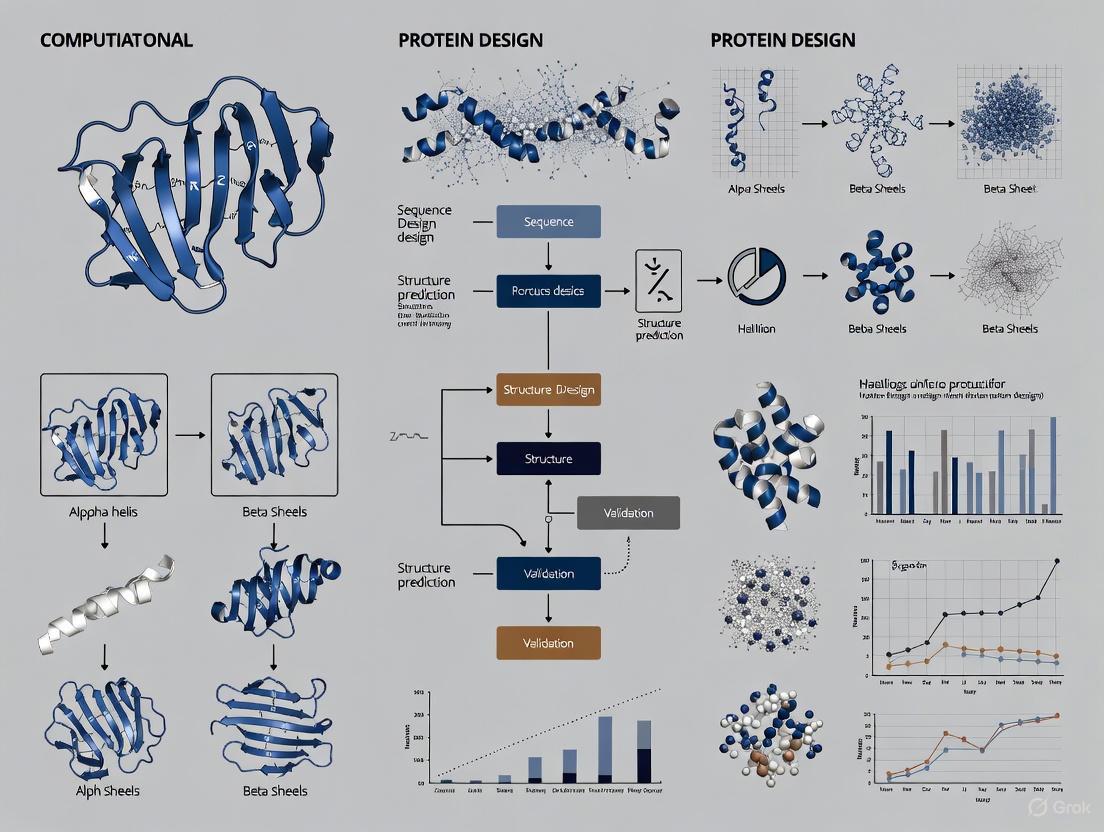
Computational protein design (CPD) has evolved from a theoretical concept into a powerful tool for creating novel proteins with tailored functions.
Computational Protein Design: Principles, Methods, and Clinical Applications
Abstract
Computational protein design (CPD) has evolved from a theoretical concept into a powerful tool for creating novel proteins with tailored functions. This article provides a comprehensive overview for researchers and drug development professionals, covering the foundational principles of CPD, including the 'inverse folding problem' and key energy functions. It explores cutting-edge methodologies, from Rosetta and OSPREY to machine learning tools like ProteinMPNN and RFDiffusion, and their application in designing therapeutic antibodies, enzymes, and stable vaccine immunogens. The review also addresses critical troubleshooting aspects, such as overcoming low designability and marginal stability, and examines the rigorous validation frameworks that confirm the success of computational designs in both silico and experimental settings, ultimately highlighting the transformative impact of CPD on biomedicine.
From Inverse Folding to De Novo Design: Core Principles of Computational Protein Design
Computational protein design represents a fundamental paradigm shift in biomedical research, enabling the creation of novel proteins with tailored functions for therapeutic, industrial, and research applications. At the core of this paradigm lies the inverse folding problem, a critical computational challenge that involves identifying amino acid sequences that will fold into a predetermined three-dimensional protein structure [1] [2]. This problem stands in direct contrast to the traditional protein folding problem, which predicts the native structure of a given amino acid sequence. The significance of inverse folding extends across multiple domains, from drug development to enzyme engineering, as it provides researchers with a systematic methodology for creating proteins that nature has not explored [3].
The computational complexity of inverse folding differs substantially from traditional folding problems. Unlike folding, which scales exponentially with chain length, advanced design strategies for inverse folding can scale linearly with chain length, making the design of even large proteins computationally tractable [1]. This scalability is crucial for exploring the vast landscape of possible protein sequences—a space so immense that the fraction sampled by nature is infinitesimally small, estimated to be less than 1×10⁻³⁰⁰ of all possible sequences [3]. Inverse folding models serve as sophisticated guides in this expansive sequence space, enabling researchers to navigate toward functional proteins with desired structural characteristics.
Recent advances in machine learning and artificial intelligence have dramatically accelerated progress in solving the inverse folding problem. Modern computational approaches now allow researchers to rapidly generate hundreds of candidate sequences that are predicted to fold into a target structure, significantly compressing the traditional "design, make, test, analyze" cycle that has historically constrained protein engineering efforts [2] [3]. These developments are transforming the field of computational protein design, opening new possibilities for addressing challenges in medicine, technology, and sustainability that were previously intractable through conventional approaches.
Core Principles and Computational Challenges
Fundamental Principles of Inverse Folding
The theoretical foundation of inverse folding rests on several key principles derived from protein biophysics and structural biology. Central to these principles is the understanding that structural stability requires not only the burial of hydrophobic residues in the protein core but also strategic placement of additional hydrophobic residues on the surface to optimize folding energetics [1]. This nuanced understanding represents a significant advancement over earlier simplistic models that strictly adhered to a "hydrophobic inside, polar outside" strategy. Research on self-avoiding hydrophobic/polar chains has demonstrated that to avoid unwanted conformational states, designed sequences must possess neither too many nor too few hydrophobic residues, highlighting the delicate balance required for successful protein design [1].
Another critical principle involves the relationship between sequence diversity and structural conservation. Inverse folding models operate on the fundamental assumption that proteins with divergent sequences can retain similar function as long as their structures remain reasonably conserved [2]. This principle enables the exploration of sequence spaces far beyond natural homologs while maintaining structural and functional integrity. The resulting sequence identities from inverse folding typically range between >0.4 and <0.75, allowing researchers to sample a much broader portion of the sequence landscape compared to traditional methods that rely on limited point mutations [2]. This expansive sampling capability is particularly valuable for enzyme design, where exploring diverse sequences can lead to discovering variants with enhanced properties such as improved stability or novel catalytic activity.
Key Computational Challenges
Despite significant advances, inverse folding methodologies face several substantial computational challenges. A primary challenge involves the multiplicity of solutions—the recognition that many different amino acid sequences can fold into structurally similar proteins, a phenomenon known as structural degeneracy [1]. This degeneracy complicates the identification of optimal sequences, as the computational model must select from numerous possible solutions while ensuring the resulting protein not only folds into the desired conformation but also avoids alternative low-energy states.
Functional preservation presents another significant challenge, particularly when redesigning natural enzymes and binding proteins. Traditional inverse folding models focused primarily on structural stability often produce functionally impaired proteins because they fail to preserve residues critical for catalytic activity or molecular recognition [4]. This limitation stems from the models' optimization for folding energetics without incorporating constraints for functional sites. Related to this is the challenge of conformational dynamics, as optimizing sequences for a single static structure may impair the protein's ability to undergo functionally essential conformational changes [4]. This is particularly problematic for enzymes and binding proteins that rely on structural flexibility for their biological activity.
More recently, the integration of evolutionary information has emerged as a crucial strategy for addressing these challenges. By incorporating multiple sequence alignments and other evolutionary constraints, next-generation inverse folding models can better distinguish between residues critical for function versus those primarily involved in structural stability [4]. This integration helps preserve functional sites while allowing extensive sequence variation in other regions, enabling the design of proteins that maintain biological activity despite significant sequence divergence from natural counterparts.
Computational Methodologies and Models
Traditional Physics-Based Approaches
Early computational approaches to inverse folding relied heavily on physics-based models and energy minimization strategies. These methods employed atomistic force fields and statistical potentials to evaluate the compatibility between amino acid sequences and target structures [1]. The primary objective was to identify sequences that minimized the free energy of the target conformation, thereby ensuring it would represent the lowest accessible free energy state. These physics-based approaches incorporated explicit modeling of molecular interactions, including van der Waals forces, electrostatics, solvation effects, and hydrogen bonding [1].
A key insight from these early studies was the importance of hydrogen bonding networks, particularly in β-sheet structures, for achieving mechanical stability and resistance to environmental extremes [5]. Research demonstrated that systematically maximizing hydrogen-bond networks within force-bearing β strands could produce proteins with exceptional stability, exhibiting unfolding forces exceeding 1,000 pN—approximately 400% stronger than natural titin immunoglobulin domains [5]. These designed proteins retained structural integrity even after exposure to extreme conditions such as 150°C, highlighting the potential of physics-based design principles for creating robust protein systems.
While valuable, these traditional approaches faced significant limitations in computational efficiency and accuracy. The complexity of accurately modeling all relevant molecular interactions often restricted applications to small proteins or required substantial computational resources. Additionally, these methods struggled with the vastness of sequence space and the subtle nature of protein folding energetics, particularly long-range interactions and cooperative effects that are challenging to capture with simplified energy functions.
Machine Learning and Deep Learning Models
The field of inverse folding has been transformed by the introduction of machine learning models, particularly deep learning approaches trained on large datasets of known protein structures and sequences. These models have dramatically improved both the efficiency and accuracy of protein design, enabling the rapid generation of diverse sequences for complex target structures.
Table 1: Key Machine Learning Models for Inverse Folding
| Model Name | Core Architecture | Key Features | Typical Applications |
|---|---|---|---|
| ProteinMPNN [2] | Autoregressive neural network | Fast sequence generation, confidence scores, soluble protein training | De novo protein design, enzyme engineering, therapeutic proteins |
| ABACUS-T [4] | Sequence-space denoising diffusion | Atomic sidechains, ligand interactions, multiple conformational states | Functional enzyme redesign, allosteric proteins, ligand-binding proteins |
| ESM-IF1 [2] | Transformer-based | Evolutionary scale modeling, masked structure prediction | Protein variant generation, stability optimization |
| RFdiffusion [2] | Diffusion model | Backbone structure generation, complex design | Protein binders, symmetric assemblies, novel folds |
These machine learning approaches operate on different principles than traditional physics-based methods. For example, ProteinMPNN uses an autoregressive architecture that predicts amino acids sequentially while conditioning on both the target structure and previously generated residues [2]. This approach allows for efficient sampling of sequence space and can generate hundreds of candidate sequences in minutes. The model is typically trained on massive datasets of masked protein structures, where it learns to predict original sequences from partially obscured structural information [2]. During inference, the model receives a protein backbone (often with masked side chains) and generates plausible sequences that would fold into that structure.
More advanced models like ABACUS-T employ a denoising diffusion probabilistic model (DDPM) in sequence space, which uses successive reverse diffusion steps to generate amino acid sequences from a fully "noised" starting sequence [4]. A distinctive feature of ABACUS-T is that at each denoising step, both residue types and sidechain conformations are decoded, and each step is self-conditioned with the output amino acid sequence from the previous step [4]. This approach, combined with integration of evolutionary information from multiple sequence alignments and pre-trained protein language models, enables more accurate inverse folding that better preserves functional sites.
Advanced Frameworks: ABACUS-T and Multimodal Integration
The ABACUS-T framework represents a significant advancement in inverse folding methodology through its multimodal approach that unifies several critical features into a single computational framework [4]. Unlike previous models that focused primarily on structural compatibility, ABACUS-T incorporates multiple sources of information to enhance both structural accuracy and functional preservation in designed proteins.
Core Architectural Innovations
ABACUS-T employs a sequence-space denoising diffusion probabilistic model (DDPM) that generates amino acid sequences through successive refinement steps [4]. The model begins with a fully "noised" sequence where residue types at all positions are undetermined, then progressively specifies these residues through a series of reverse diffusion steps. Key innovations include the simultaneous decoding of both residue types and sidechain conformations at each step, and a self-conditioning mechanism that incorporates the output from previous denoising steps [4]. This self-conditioning, implemented using a pre-trained Evolutionary Scale Modelling (ESM) sequence language model, significantly improves inference accuracy compared to earlier approaches.
The model can be further enhanced with three types of optional input beyond a single backbone structure: atomic structures of ligand molecules, multiple conformational states of the backbone, and evolutionary information from multiple sequence alignments (MSA) [4]. This multimodal integration addresses critical limitations of previous inverse folding methods, particularly their tendency to disrupt functional sites when optimizing for structural stability alone.
Experimental Validation and Performance
ABACUS-T has demonstrated remarkable experimental success across multiple protein engineering challenges. When applied to an allose binding protein, the model generated variants with 17-fold higher binding affinity while retaining conformational change functionality [4]. Redesigned versions of endo-1,4-β-xylanase and TEM β-lactamase maintained or surpassed wild-type activity while achieving substantial increases in thermostability (ΔTₘ ≥ 10°C) [4]. In the case of OXA β-lactamase, ABACUS-T enabled rational alteration of substrate specificity while simultaneously enhancing protein stability. Notably, these significant enhancements were achieved by testing only a few designed sequences, each containing dozens of simultaneously mutated residues relative to wild-type enzymes [4].
Table 2: Performance Metrics of Advanced Inverse Folding Models
| Model | Structural Accuracy | Functional Preservation | Thermostability Enhancement | Design Speed |
|---|---|---|---|---|
| ProteinMPNN [2] | High (TM-score >0.7) | Moderate (requires fixed positions) | Significant (ΔTₘ ~5-15°C) | Very Fast (100s of sequences/min) |
| ABACUS-T [4] | Very High (TM-score >0.8) | High (maintains activity) | Very Significant (ΔTₘ ≥10°C) | Moderate (requires more computation) |
| Traditional Methods [1] | Moderate | Low to Moderate | Variable | Slow (extensive sampling required) |
The performance advantages of ABACUS-T over ablated versions highlight the importance of its integrated features. Comparative analyses show that the full model outperforms versions with smaller ESM models, removed self-conditioning, or excluded ligand modeling [4]. These results confirm that the multimodal approach provides tangible benefits for designing functional proteins, particularly for enzymes and other proteins where specific molecular interactions are critical for biological activity.
Experimental Protocols and Validation
Computational Workflow and Implementation
The standard computational workflow for inverse folding begins with structure preparation, which involves obtaining or generating a target protein backbone structure. This structure may come from experimental sources (X-ray crystallography, NMR, cryo-EM) or computational prediction tools like AlphaFold2 [2]. For functional proteins, critical regions such as active sites or binding interfaces may be partially fixed to preserve functionality, though advanced models like ABACUS-T can automatically identify and preserve these regions through integrated evolutionary information [4].
The next step involves sequence generation using inverse folding models. For ProteinMPNN, this typically includes specifying fixed positions to guide the model away from nonsensical outputs and excluding problematic amino acids (e.g., cysteines to prevent unwanted disulfide bonds) [2]. The model can be run with different versions, such as the "soluble" model trained specifically on soluble proteins to enhance the likelihood of generating well-behaved variants. ABACUS-T employs a more complex process that can incorporate multiple backbone conformations and ligand coordinates to preserve functional dynamics and binding sites [4].
Following sequence generation, candidates are filtered based on confidence metrics (e.g., ProteinMPNN's score, where values closer to zero indicate better predictions) and structural validation using tools like AlphaFold2 to predict the structures of designed sequences [2]. The similarity between predicted and target structures is quantified using metrics like TM-align score, with higher scores indicating better structural matches. This computational validation helps prioritize candidates for experimental testing before moving to resource-intensive laboratory work.
Experimental Validation Techniques
Experimental validation of computationally designed proteins employs multiple complementary techniques to assess structural integrity, stability, and function. Structural validation typically involves biophysical methods such as circular dichroism (CD) spectroscopy to verify secondary structure content, nuclear magnetic resonance (NMR) spectroscopy to confirm tertiary structure, and X-ray crystallography for atomic-level structural determination [5] [4]. For the latter, the solution NMR structure of designed proteins (e.g., A339 in referenced studies) can be deposited in the Protein Data Bank (PDB) for public access and verification [5].
Thermal stability assessments measure the melting temperature (Tₘ) of designed proteins using techniques like differential scanning calorimetry (DSC) or thermal shift assays [4]. Successful designs typically show significant increases in Tₘ (ΔTₘ ≥ 10°C) compared to wild-type proteins, demonstrating the effectiveness of inverse folding in enhancing structural robustness [4]. For mechanostable proteins, single-molecule force spectroscopy techniques like atomic force microscopy (AFM) can quantify unfolding forces, with high-performance designs exhibiting resistance exceeding 1,000 pN [5].
Functional assays are crucial for validating that designed proteins maintain or enhance biological activity. For enzymes, these assays measure catalytic parameters (Kₘ, kₐₜₜ) against relevant substrates [4]. For binding proteins, surface plasmon resonance (SPR) or isothermal titration calorimetry (ITC) determine binding affinity and specificity [4]. In successful applications, designed proteins have shown substantially improved function, such as 17-fold higher binding affinity in redesigned allose binding proteins, while maintaining essential functional characteristics like ligand-induced conformational changes [4].
Research Reagent Solutions
The experimental implementation of inverse folding requires specialized reagents and computational resources for expressing, purifying, and characterizing designed proteins. The following table outlines essential research reagents and their applications in the protein design pipeline.
Table 3: Essential Research Reagents for Inverse Folding Implementation
| Reagent/Resource | Function | Application Examples |
|---|---|---|
| Expression Vectors | Protein production in host systems | Plasmid systems for E. coli, yeast, or mammalian expression |
| Chromatography Media | Protein purification | Ni-NTA for His-tagged proteins, ion-exchange, size exclusion |
| Stability Assays | Thermal stability measurement | Differential scanning calorimetry, thermal shift dyes |
| Structural Biology Tools | Structure verification | Crystallization screens, NMR isotopes, cryo-EM grids |
| Functional Assays | Activity assessment | Enzyme substrates, binding partners, cellular activity reporters |
| Computational Resources | Running design models | GPU clusters for deep learning, cloud computing platforms |
Specialized computational tools form another critical component of the inverse folding reagent toolkit. ProteinMPNN and ABACUS-T provide the core inverse folding capabilities, while AlphaFold2 serves as a crucial validation tool for predicting structures of designed sequences [2] [4]. Molecular dynamics software like GROMACS enables all-atom simulations to assess structural dynamics and stability [5]. For specialized applications, automated execution scripts for annealing simulations and steered molecular dynamics (SMD), available via GitHub repositories, provide standardized protocols for evaluating mechanical properties of designed proteins [5].
Access to curated protein databases represents another essential resource for inverse folding research. Databases such as MaxQB offer comprehensive collections of high-resolution mass spectrometry data that can inform design decisions and provide experimental validation benchmarks [6]. The Protein Data Bank (PDB) remains the primary source of structural templates for design projects, while specialized resources like the Global Proteome Machine and PeptideAtlas provide peptide identification data that can guide sequence selection [6].
Applications in Biotechnology and Medicine
The inverse folding paradigm has enabled groundbreaking applications across multiple domains of biotechnology and medicine. In therapeutic protein engineering, inverse folding has been used to design protein binders that target specific regions of disease-relevant proteins and receptors [2]. For example, small protein binders designed to inhibit Human PDCD1 have shown promise as cancer immunotherapies, with inverse folding enabling the creation of alternative versions with improved pharmacological properties [2]. The ability to rapidly generate diverse sequences for a target structure allows researchers to optimize therapeutic proteins for stability, specificity, and reduced immunogenicity while maintaining target recognition.
In enzyme engineering, inverse folding has proven particularly valuable for enhancing stability under industrial conditions while maintaining or improving catalytic activity. Successful applications include the redesign of endo-1,4-β-xylanase and TEM β-lactamase, which achieved substantial increases in thermostability (ΔTₘ ≥ 10°C) without compromising enzymatic function [4]. More advanced implementations have enabled the rational alteration of substrate specificity, as demonstrated with OXA β-lactamase, where inverse folding facilitated the creation of variants with altered antibiotic selectivity profiles [4]. These applications highlight how inverse folding can address dual objectives of stability enhancement and functional optimization simultaneously.
The technology has also enabled the creation of novel protein materials with exceptional properties. By maximizing hydrogen-bond networks within β-sheets, researchers have designed proteins with extreme mechanical stability, forming hydrogels that maintain structural integrity at high temperatures [5]. These materials showcase how inverse folding can produce proteins with properties exceeding those found in nature, opening possibilities for applications in biomaterials, drug delivery, and industrial biocatalysis where robustness under extreme conditions is essential.
Emerging Trends and Developments
The field of inverse folding is evolving rapidly, with several emerging trends shaping its future trajectory. Multimodal integration represents a significant direction, as exemplified by ABACUS-T's combination of structural, evolutionary, and conformational information [4]. This approach addresses the critical challenge of functional preservation while enabling extensive sequence exploration, potentially expanding the applicability of inverse folding to more complex protein systems such as allosteric enzymes and molecular machines.
Another important trend involves the integration of protein language models that have been pre-trained on massive sequence databases [4]. These models capture evolutionary constraints and patterns that are difficult to derive from structural information alone, providing implicit guidance for maintaining functional sites and foldability during sequence design. As these language models become more sophisticated and incorporate more diverse sequences, they are likely to further enhance the success rate of inverse folding methods, particularly for challenging design targets with limited structural homologs.
There is also growing interest in dynamics-aware inverse folding that considers multiple conformational states rather than single static structures [4]. This approach recognizes that many proteins require structural flexibility for their function, and designing sequences that stabilize a single conformation may inadvertently impair biological activity. By incorporating conformational ensembles from molecular dynamics simulations or experimental sources, next-generation inverse folding models could better preserve functional dynamics while still enhancing stability.
The inverse folding problem represents a cornerstone of the computational protein design paradigm, providing a systematic methodology for navigating the vast sequence space to identify proteins that fold into predetermined structures. From its origins in physics-based energy minimization to current deep learning approaches, the field has made remarkable progress in solving this fundamental challenge. Modern inverse folding models like ProteinMPNN and ABACUS-T can rapidly generate diverse sequences that fold into target structures with high accuracy, enabling applications ranging from therapeutic protein engineering to industrial enzyme design.
Despite these advances, significant challenges remain, particularly in preserving complex functions while enhancing stability and in designing proteins with specified dynamical properties. The integration of multimodal information—combining structural, evolutionary, and conformational data—represents a promising direction for addressing these challenges. As inverse folding methodologies continue to mature, they are poised to dramatically accelerate the protein design cycle, potentially enabling the routine creation of proteins with custom-tailored properties for diverse applications in medicine, biotechnology, and materials science. This progress will further establish computational protein design as a transformative discipline capable of addressing challenges beyond the reach of traditional protein engineering approaches.
Computational protein design (CPD) addresses the inverse folding problem: identifying amino acid sequences that will fold into a specific three-dimensional structure and perform a desired function [7]. At the heart of every CPD pipeline lies the energy function—a mathematical model that quantifies the structural stability and functional compatibility of protein sequences. These functions serve as objective functions to guide the exploration of vast sequence-structure spaces, distinguishing viable designs from non-functional ones. The fundamental principle governing this process is the thermodynamic hypothesis formulated by Anfinsen, which states that a protein's native structure corresponds to its global minimum free energy state [8]. Energy functions in CPD broadly fall into two categories: physics-based potentials derived from fundamental physical principles, and knowledge-based potentials derived from statistical analyses of known protein structures in databases. The strategic balance between these approaches represents a core challenge in advancing the field, as both offer complementary advantages and limitations that must be carefully weighed for different design applications.
Theoretical Foundations of Energy Functions
Physics-Based Energy Functions
Physics-based energy functions, also known as ab initio or molecular mechanics force fields, compute the potential energy of a protein structure using terms derived from fundamental physical principles. These functions typically comprise several components that collectively describe covalent and non-covalent interactions:
The AMBER force field provides a representative framework for physics-based approaches, with energy terms including bond stretching, angle bending, torsional rotations, van der Waals interactions, and electrostatic calculations [9]. For solvation effects, which are critical for accurate energy assessment, physics-based functions often employ implicit solvent models. The Generalized Born (GB) model is particularly prevalent in CPD applications as it captures essential solvation physics while remaining computationally tractable for design algorithms [9].
A significant advantage of physics-based functions is their transferability—they can be applied to non-biological polymers, non-canonical amino acids, and novel fold spaces not represented in existing protein databases [9]. This makes them particularly valuable for de novo design projects aiming to explore entirely new regions of protein structural space. However, this generality comes at substantial computational cost, and accuracy can be limited by approximations in the physical models, particularly in representing long-range interactions and solvent effects.
Knowledge-Based Energy Functions
Knowledge-based energy functions, also known as statistical potentials or empirical potentials, derive from statistical analyses of residue-residue contact patterns, torsion angles, and other structural features observed in experimentally determined protein structures. These approaches are grounded in the inverse Boltzmann principle, which converts observed frequencies of structural features into effective energy terms under the assumption that naturally occurring proteins sample low-energy states.
These functions leverage the rich structural information contained in databases such as the Protein Data Bank (PDB), extracting empirical preferences for amino acid interactions, backbone dihedral angles, hydrogen-bonding geometries, and packing densities [9]. The BLOSUM substitution matrices represent one widely used form of knowledge-based information that captures evolutionary constraints on amino acid replacements [9].
The primary strength of knowledge-based potentials lies in their efficiency and implicit capture of complex physical effects that are challenging to model explicitly. By learning from nature's solutions, these functions incorporate the net effects of sophisticated physical phenomena without requiring explicit computation. However, this approach suffers from database bias—it cannot recommend novel structural solutions or amino acid configurations not already present in the training data, potentially limiting innovation in protein design.
Table 1: Comparison of Physics-Based and Knowledge-Based Energy Functions
| Feature | Physics-Based Potentials | Knowledge-Based Potentials |
|---|---|---|
| Theoretical Basis | Fundamental physical principles (molecular mechanics) | Statistical analysis of protein databases |
| Key Components | Bond stretching, angle bending, van der Waals, electrostatics, GB solvation | Residue-residue contact potentials, torsion potentials, hydrogen-bond statistics |
| Representative Implementations | AMBER with GB solvent [9] | Statistical torsion potentials [9], BLOSUM matrices [9] |
| Computational Cost | High | Low to moderate |
| Transferability | High (novel folds, non-biological polymers) | Limited to observed structural space |
| Key Strengths | Physically rigorous, applicable to novel chemistries | Efficient, implicitly captures complex physics |
| Major Limitations | Approximations in physical models, computational expense | Database bias, limited innovation capacity |
Integrated Approaches: Balancing Both Potentials
Hybrid Energy Functions
Recognizing the complementary strengths of both approaches, modern CPD pipelines increasingly employ hybrid energy functions that strategically combine physics-based and knowledge-based terms. A representative example comes from the successful redesign of a PDZ domain, where researchers used a physics-based function for the folded state (AMBER force field with GB solvation) coupled with a knowledge-based potential for the unfolded state [9]. This hybrid approach leveraged the accuracy of physics-based models for describing specific atomic interactions in the native structure while using efficient statistical potentials to estimate the conformational ensemble of the denatured state.
The theoretical justification for this partitioning lies in the different structural precision required for modeling each state. The folded state possesses a well-defined, unique structure where specific atomic interactions critically determine stability, making it amenable to physics-based description. Conversely, the unfolded state represents a heterogeneous ensemble where statistical averages across many configurations may sufficiently capture its energetic properties.
Energy Function Integration in CPD Workflows
The integration of energy functions within complete CPD workflows involves multiple sophisticated components working in concert. The following diagram illustrates how these elements interact in a modern computational design pipeline:
Figure 1: Integration of energy functions within a computational protein design workflow. Energy functions guide sampling algorithms and sequence optimization, with successful candidates proceeding through validation stages.
Implementation in Modern CPD Frameworks
Sampling Algorithms and Sequence Optimization
The enormous complexity of protein sequence-structure space necessitates sophisticated sampling algorithms that can efficiently identify low-energy combinations. Monte Carlo simulations represent one widely used approach, where random mutations and conformational changes are accepted or rejected based on the calculated energy change according to the Metropolis criterion [9]. In the PDZ redesign study, Monte Carlo simulations exploring 3.7 × 10⁷⁶ possible sequence variations successfully identified thousands of low-energy sequences, demonstrating the power of this approach when guided by appropriate energy functions [9].
Dead-end elimination (DEE) algorithms provide complementary sampling by systematically eliminating rotamer combinations that cannot be part of the global energy minimum solution, thus pruning the search space [10]. These algorithms have been extended with backbone flexibility to enhance sampling of both sequence and structural space, acknowledging the intimate coupling between sequence variation and backbone conformational changes [11].
The Rise of Machine Learning Approaches
Recent advances have introduced machine learning models that implicitly capture aspects of both physics-based and knowledge-based potentials through deep learning on vast protein databases. ProteinMPNN has emerged as a powerful neural network for solving the "inverse folding" problem—designing sequences for given backbone structures—effectively functioning as a highly sophisticated knowledge-based potential [12]. Meanwhile, RFdiffusion applies diffusion models to generate novel protein backbones de novo, enabling the creation of new folds not present in existing databases [12].
These AI-driven approaches represent a convergence of physical and knowledge-based principles: they learn from natural proteins (knowledge-based) but can generalize to novel folds (physics-like). The RoseTTAFold diffusion framework exemplifies this synthesis, combining a structure prediction network trained on known structures with a generative diffusion process that explores new structural spaces [12].
Experimental Validation and Case Studies
Successful Redesign of a PDZ Domain
A landmark demonstration of physics-based energy functions came from the complete redesign of a PDZ domain using the AMBER force field with GB solvation for the folded state [9]. The experimental protocol involved several key stages:
Backbone Preparation: The design process began with the high-resolution X-ray structure of the apo CASK PDZ domain, maintaining the backbone conformation throughout the design process.
Sequence Design Space: 61 of 83 residues (73.5% of the sequence) were allowed to mutate freely to any amino acid except glycine or proline, while 13 peptide-binding residues maintained wild-type identity and 9 glycine/proline positions remained fixed.
Monte Carlo Sampling: Extended simulations generated thousands of sequences, with the 2,000 lowest-energy candidates selected for further analysis.
Empirical Filtering: Sequences were filtered using knowledge-based criteria including isoelectric point, fold recognition confidence, cavity presence, and chemical similarity to natural PDZ domains.
The three selected designs contained approximately 60% mutated residues (50-51 mutations each) yet all exhibited native-like circular dichroism spectra and 1D-NMR spectra, with two designs demonstrating upshifted thermal denaturation in the presence of peptide ligand—strong evidence of correct folding to functional PDZ structures [9].
Table 2: Key Experimental Results from PDZ Redesign Study
| Design Candidate | Number of Mutations | Structural Characterization | Functional Assessment |
|---|---|---|---|
| Candidate 1350 | 50 mutations (60.2%) | Native-like CD spectra, folded 1D-NMR | Peptide binding demonstrated |
| Candidate 1555 | 51 mutations (61.4%) | Native-like CD spectra, folded 1D-NMR | Peptide binding demonstrated |
| Candidate 1669 | 51 mutations (61.4%) | Native-like CD spectra, folded 1D-NMR | Inconclusive binding data |
The Scientist's Toolkit: Essential Research Reagents and Materials
Table 3: Key Research Reagents and Materials for CPD Validation
| Reagent/Material | Function in CPD Validation |
|---|---|
| CASK PDZ Domain Template | Structural scaffold for redesign experiments [9] |
| Monte Carlo Simulation Software | Sampling sequence space and identifying low-energy variants [9] |
| Generalized Born Solvent Model | Implicit solvation for physics-based energy calculations [9] |
| Circular Dichroism Spectrometer | Assessing secondary structure content of designed proteins [9] |
| NMR Spectroscopy | Evaluating tertiary structure and folding properties [9] |
| Thermal Denaturation Assays | Measuring protein stability and ligand binding effects [9] |
| ProteinMPNN | Machine learning-based sequence design for given structures [12] |
| RFdiffusion | Generative AI for de novo backbone design [12] |
Current Challenges and Future Perspectives
Despite significant advances, energy functions in CPD continue to face several fundamental challenges. The accuracy of physics-based functions remains limited by approximations in force field parameters and solvation models, while knowledge-based approaches struggle with generalization beyond the training data distribution. The enormous computational expense of rigorous physics-based scoring presents practical constraints on the complexity and scale of design projects.
Future developments will likely focus on tightly integrated human-AI frameworks that leverage the respective strengths of computational and experimental approaches. The emerging seven-toolkit workflow—encompassing database search, structure prediction, function prediction, sequence generation, structure generation, virtual screening, and DNA synthesis—represents a systematic approach to organizing these tools into a coherent engineering discipline [13].
The integration of quantum mechanical calculations for modeling critical electronic interactions, particularly in enzyme active sites, promises to enhance the accuracy of physics-based potentials for challenging functional design problems [10]. Simultaneously, multi-state design frameworks are evolving to explicitly consider the conformational heterogeneity and thermodynamic equilibria that underlie protein function, moving beyond single-structure optimization [8].
The following diagram illustrates the complex relationship between different energy function types and their performance characteristics:
Figure 2: Relationship between energy function types and their performance characteristics, showing how hybrid approaches integrate advantages while mitigating limitations.
The strategic balance between physics-based and knowledge-based energy functions represents a core principle in computational protein design research. While physics-based potentials provide fundamental principles and transferability to novel design spaces, knowledge-based potentials offer efficiency and implicit encoding of nature's evolutionary solutions. The most successful CPD pipelines increasingly adopt hybrid approaches that leverage the complementary strengths of both paradigms, often enhanced by machine learning methods that transcend traditional categories.
The successful redesign of a PDZ domain using primarily physics-based potentials demonstrates that fundamental physical principles can guide protein design, while extensive empirical filtering highlights the practical value of incorporating knowledge-based criteria [9]. As the field advances, the integration of more sophisticated physical models, larger and more diverse structural databases, and increasingly powerful machine learning algorithms will further blur the distinctions between these approaches, leading to more robust and accurate energy functions that accelerate the design of novel proteins for therapeutic, industrial, and scientific applications.
The accurate modeling of protein flexibility stands as one of the most significant challenges in computational structural biology. Proteins are dynamic entities whose functional capabilities emerge from their ability to sample conformational ensembles rather than exist as static structures. Within this paradigm, rotamer libraries and backbone sampling techniques provide the fundamental mathematical and statistical frameworks for representing structural flexibility in computationally tractable models. These approaches enable researchers to navigate the vast conformational space available to proteins, facilitating advances in structure prediction, protein design, and therapeutic development. The integration of these methods represents a core principle in modern computational protein design: that meaningful functional predictions require accounting for structural plasticity at both the side-chain and backbone levels. This technical guide examines the current state of rotamer library development and backbone sampling methodologies, providing researchers with both theoretical foundations and practical implementation strategies for modeling protein flexibility.
Rotamer Libraries: Statistical Frameworks for Side-Chain Conformational Sampling
Theoretical Foundations and Historical Development
Rotamer libraries address the combinatorial challenge of side-chain placement by leveraging the observation that side-chain dihedral angles tend to cluster around energetically favored conformations known as rotamers. The development of these libraries has evolved from simple backbone-independent statistics to sophisticated backbone-dependent probability models that capture the critical relationship between local main-chain conformation and side-chain conformational preferences.
The first backbone-dependent rotamer library was introduced by Dunbrack in 1993, derived from statistical analysis of 132 high-resolution protein structures [14]. This library established the fundamental principle that rotamer probabilities vary systematically with backbone dihedral angles (φ and ψ). Subsequent refinements incorporated Bayesian statistical methods to provide improved probability estimates, particularly in sparsely populated regions of the Ramachandran map [15] [14]. The Bayesian approach implemented by Dunbrack and Cohen in 1997 introduced a prior probability based on the assumption that the steric and electrostatic effects of φ and ψ dihedral angles act independently, significantly improving the library's predictive power [14].
A major advancement came with the development of smoothed backbone-dependent rotamer libraries using kernel density estimation and kernel regression with von Mises distribution kernels [15]. This approach addressed a critical limitation of earlier discrete libraries: their lack of smoothness and continuity across the Ramachandran map, which caused artifacts in structure prediction and design algorithms that utilize derivative-based optimization methods [15]. The kernel-based method enables evaluation of rotamer probabilities, mean angles, and variances as continuous functions of φ and ψ, providing the mathematical smoothness required for modern gradient-based optimization algorithms [15].
Table 1: Evolution of Backbone-Dependent Rotamer Libraries
| Library Version | Key Innovations | Statistical Methodology | Applications |
|---|---|---|---|
| Dunbrack 1993 [14] | First backbone-dependent library | Raw counts in 20°×20° (φ,ψ) bins | Side-chain prediction |
| Dunbrack & Cohen 1997 [14] | Bayesian priors, periodic kernel | Bayesian statistics with 10°×10° bins | Homology modeling, early protein design |
| Dunbrack 2002 [15] | Improved treatment of non-rotameric degrees of freedom | Updated Bayesian model | Structure prediction, molecular replacement |
| Shapovalov & Dunbrack 2011 [15] | Smooth continuous probabilities | Adaptive kernel density estimation | Flexible-backbone design, gradient-based optimization |
| MEDFORD 2022 [16] | High (φ,ψ) coverage via metadynamics | Bias-exchange metadynamics simulations | Cyclic peptides, noncanonical amino acids |
Key Rotamer Library Types and Their Applications
Rotamer libraries can be broadly categorized into two primary types with distinct characteristics and applications. Backbone-independent rotamer libraries (BBIRLs) provide statistical information about side-chain conformations without reference to backbone geometry, while backbone-dependent rotamer libraries (BBDRLs) express rotamer frequencies and mean dihedral angles as functions of backbone conformation [14].
Comparative studies have revealed that BBIRLs can generate conformations that closely match native structures when they contain very large numbers of rotamers (7,000-50,000 conformations) [17]. However, for practical applications in protein design and side-chain prediction, BBDRLs consistently achieve higher performance despite having fewer total rotamers [17]. This advantage stems from the energy term derived from rotamer probabilities associated with specific backbone torsion angle subspaces, which provides critical information for distinguishing between amino acid identities and their conformational variants [17]. Additionally, the backbone-dependent restriction of conformational search spaces significantly accelerates computational searching, making BBDRLs more efficient despite their apparent complexity [17].
Table 2: Comparison of Rotamer Library Types in Practical Applications
| Performance Metric | Backbone-Independent (BBIRL) | Backbone-Dependent (BBDRL) | Significance |
|---|---|---|---|
| Side-chain reproduction accuracy | Higher with very large libraries (>7000 rotamers) [17] | Competitive with optimized libraries [17] | BBIRLs can reproduce native geometries but require large conformational sets |
| Side-chain prediction accuracy | 87% for χ₁, 74% for χ₁+₂ (20° cutoff) [17] | 84-86% for χ₁, 71-75% for χ₁+₂ (40° cutoff) [17] | BBDRLs achieve high accuracy with more physically realistic search spaces |
| Sequence recapitulation in design | Lower performance in native sequence recovery [17] | Higher performance in native sequence recovery [17] | Backbone-dependent probabilities better distinguish amino acid identities |
| Computational speed | Slower despite smaller libraries [17] | Faster due to restricted search spaces [17] | Backbone-dependent filtering dramatically reduces conformational searching |
| Coverage of unusual backbones | Limited to experimentally observed conformations | Limited to experimentally observed conformations | Both struggle with noncanonical backbone geometries |
Table 3: Research Reagent Solutions for Rotamer-Based Modeling
| Resource | Function | Application Context |
|---|---|---|
| Dunbrack Rotamer Library [15] [14] | Provides backbone-dependent rotamer probabilities | Side-chain packing in structure prediction and protein design |
| MEDFORD Library [16] | Offers expanded coverage of (φ,ψ) space via metadynamics | Modeling cyclic peptides and noncanonical amino acids |
| SCWRL Algorithm [18] | Implements rapid side-chain placement using rotamer libraries | Homology modeling and structure prediction |
| Rosetta Software Suite [15] [14] | Utilizes rotamer libraries for protein design and structure prediction | De novo protein design, protein folding, and docking |
| Dynameomics Library [14] | Provides dynamics-derived rotamer distributions | Sampling across thermally accessible conformational states |
Backbone Sampling Methodologies: Beyond Rigid Scaffolds
The Critical Role of Backbone Flexibility
While rotamer libraries address side-chain flexibility, the modeling of backbone dynamics presents distinct challenges that require specialized methodologies. The protein backbone serves as the structural scaffold upon which side-chains are arranged, and its conformation directly influences both the available rotameric states and their probabilities [15] [14]. Backbone flexibility becomes particularly important when modeling conformational changes upon ligand binding, designing proteins with novel folds, or working with constrained peptides that sample unusual regions of the Ramachandran map [16].
Traditional rotamer libraries face limitations when the backbone deviates significantly from commonly observed conformations in protein crystal structures. This is particularly relevant for cyclic peptides and engineered proteins where backbone strain can force dihedral angles into regions sparsely populated in natural proteins [16]. Additionally, methods that incorporate backbone flexibility have demonstrated improved performance in protein design applications, as they allow optimization of both sequence and structure simultaneously [15].
Computational Approaches for Backbone Sampling
Multiple computational strategies have been developed to address the challenge of backbone flexibility, each with distinct advantages and limitations. Molecular dynamics (MD) simulations provide atomistic detail and physical realism but face significant computational barriers for simulating biologically relevant timescales [19]. Enhanced sampling methods like metadynamics have been employed to improve coverage of conformational space, as demonstrated by the MEDFORD rotamer library which uses bias-exchange metadynamics to achieve comprehensive sampling of the Ramachandran map [16].
The Essential Dynamics Sampling (EDS) technique represents an alternative approach that reduces the effective dimensionality of the sampling problem by focusing on collective motions derived from principal component analysis of protein trajectories [19]. This method has successfully simulated protein folding processes using only a fraction of the system's total degrees of freedom [19]. For protein-ligand interactions, steered molecular dynamics (SMD) simulations incorporate flexibility by applying restrained potentials to selected Cα atoms, balancing the need to prevent overall protein rotation while maintaining natural flexibility during unbinding processes [20].
Diagram 1: Backbone Sampling Methodologies - A classification of computational approaches for modeling protein backbone flexibility, showing their relationships and primary applications.
Integrated Methodologies: Combining Rotamer Libraries with Backbone Sampling
Synergistic Approaches in Protein Design
The most advanced computational protein design methodologies integrate rotamer-based side-chain sampling with backbone flexibility, creating synergistic systems that more accurately capture protein structural biology's fundamental principles. This integration typically involves iterative optimization protocols that alternate between refining side-chain placements using rotamer libraries and adjusting backbone conformations through various sampling techniques [15].
The development of smoothed rotamer libraries has been particularly valuable for these integrated approaches, as they enable the use of derivative-based optimization methods that require continuous probability functions [15]. When backbone minimization is performed using algorithms that compute gradients with respect to backbone dihedral angles, the smoothness of the rotamer probability functions prevents optimization artifacts and improves convergence [15]. This capability has become increasingly important as backbone flexibility is incorporated into comparative modeling and protein design methods [15].
Experimental Protocols for Integrated Flexibility Modeling
Protocol 1: Development of a Smoothed Backbone-Dependent Rotamer Library
Data Curation: Collect high-resolution protein structures from the Protein Data Bank, applying quality filters based on resolution and electron density map quality [15].
Density-Based Filtering: Implement algorithms like REDUCE to assign optimal orientations for ambiguous groups such as Asn/Gln side-chain amides and His ring flips [15].
Adaptive Kernel Density Estimation: For each rotamer r of a given residue type, determine a probability density estimate ρ(φ,ψ|r) using von Mises distribution kernels with bandwidths adapted to local data density [15].
Bayesian Inversion: Apply Bayes' theorem to convert ρ(φ,ψ|r) to P(r|φ,ψ) using backbone-independent rotamer probabilities P(r) as priors [15].
Kernel Regression for Dihedral Angles: Use adaptive kernel regression estimators to determine mean dihedral angles and variances as functions of backbone conformation [15].
Non-Rotameric Degrees of Freedom: Model continuous probability density estimates for sp2-sp3 hybridized dihedral angles (e.g., Asn/Asp χ₂) as functions of backbone and rotameric degrees of freedom [15].
Protocol 2: MEDFORD Library Development via Metadynamics
Dipeptide System Preparation: Construct Ace-X-Nme dipeptides for each amino acid of interest, with initial structures in both α-helical and β-sheet regions [16].
Force Field Selection: Employ the RSFF2 force field for canonical amino acids and AMBER ff99SB with GAFF parameters for noncanonical amino acids [16].
Bias-Exchange Metadynamics: Perform 200ns simulations with one biased and five neutral replicas, applying a two-dimensional (φ,ψ) bias in the biased replica [16].
Convergence Validation: Calculate normalized integrated product (NIP) between distributions from different initial structures to verify sampling convergence [16].
Rotamer Probability Calculation: Combine data from all replicas and calculate P(χₐₗₗ|φ,ψ) by binning data in backbone dihedral space [16].
Rotamer Definition: For rotameric dihedrals, define three rotamers (r60, r180, r300) as (0°,120°], (120°,240°], and (240°,360°] respectively [16].
Diagram 2: Rotamer Library Development Workflow - A comprehensive workflow for developing both statistics-based and simulation-based rotamer libraries, showing key steps and methodological choices.
Applications in Protein Design and Structural Biology
Structure Prediction and Validation
Rotamer libraries serve as essential components in protein structure prediction pipelines, providing discrete conformational search spaces and statistical energy terms that guide side-chain placement. In homology modeling, tools like SCWRL leverage backbone-dependent rotamer libraries to rapidly assemble side-chain conformations onto model backbones, achieving prediction accuracies of approximately 85% for χ₁ angles when building side-chains onto native backbones [18]. Perhaps more importantly, these methods maintain useful prediction accuracy (approximately 74% for χ₁) in homology modeling scenarios where side-chains are placed onto non-native backbones, demonstrating their value for practical modeling applications [18].
In structure validation, rotamer libraries provide statistical benchmarks for identifying unusual side-chain conformations that may indicate modeling errors or interesting biological phenomena. The backbone-dependent probabilities enable context-specific assessment of side-chain geometry, distinguishing between energetically unfavorable conformations and those stabilized by specific backbone environments [15].
Computational Protein Design
The most extensive application of rotamer libraries lies in computational protein design, where they define the conformational search space for sequence optimization. Rotamer-based design methods explore the vast combinatorial space of amino acid sequences and their conformations by evaluating rotamer combinations using physics-based and knowledge-based energy functions [21] [8]. The integration of backbone flexibility has been particularly transformative for design applications, enabling the creation of novel protein folds and functions not observed in nature [21] [22].
Recent advances incorporate machine learning and deep learning approaches with traditional rotamer-based methods, leading to powerful hybrid systems that leverage both physical principles and statistical patterns learned from protein databases [21] [22]. These integrated approaches have produced remarkable successes in de novo protein design, including the creation of custom enzymes, protein-based materials, and therapeutic candidates with precisely tuned properties [21] [8].
Future Directions and Emerging Challenges
The field of flexible protein modeling continues to evolve rapidly, driven by advances in computational power, algorithmic innovation, and expanding structural databases. Several promising directions are shaping the next generation of rotamer libraries and backbone sampling methods. Machine learning-enhanced sampling approaches are reducing computational costs while improving coverage of conformational space [21] [22]. Multi-state design methodologies are addressing the challenge of designing proteins that perform functions requiring conformational changes [8]. Expanded coverage of noncanonical amino acids is enabling the design of proteins with novel chemical functionalities [16].
Despite these advances, significant challenges remain. Accurate energy function parameterization continues to limit the reliability of design predictions, particularly for polar interactions and electrostatic effects [22]. Conformational dynamics modeling across multiple timescales presents persistent computational challenges [20]. The integration of experimental data with computational models requires improved methods for reconciling structural, thermodynamic, and kinetic information [8]. Addressing these challenges will require continued collaboration between computational and experimental researchers, advancing both the theoretical foundations and practical applications of protein flexibility modeling in computational structural biology.
The twin challenges of navigating protein sequence space and conformational space represent fundamental problems in computational protein design (CPD). The sequence space for a typical protein encompasses an astronomically large number of possibilities (20^N for a protein of N residues), while the conformational space involves exploring the vast number of possible three-dimensional structures each sequence might adopt. Efficient algorithms that can search and optimize within these spaces are crucial for advancing protein design, enabling the creation of novel enzymes, therapeutics, and functional materials. This technical guide examines state-of-the-art algorithms for addressing these challenges, contextualized within the broader principles of computational protein design research.
The computational complexity of these problems is substantial. Multiple sequence alignment (MSA), a foundational bioinformatics problem, is known to be NP-complete [23]. Similarly, protein design involves searching through combinatorial sequence and conformational spaces that grow exponentially with protein size [24]. This guide systematically reviews algorithmic strategies—from traditional global optimization techniques to modern deep learning approaches—that enable researchers and drug development professionals to efficiently navigate these complex spaces.
Algorithmic Foundations for Space Navigation
Traditional Optimization Approaches
Traditional approaches to navigating sequence and conformational spaces have relied on rigorous optimization frameworks. These methods formulate protein design as discrete optimization problems and employ advanced algorithmic techniques to find optimal or near-optimal solutions.
Conformational Space Annealing (CSA) combines elements of simulated annealing, genetic algorithms, and Monte Carlo with minimization to maintain conformational diversity while searching for low-energy states [23]. The algorithm maintains a bank of diverse local minima and systematically explores the neighborhood of these solutions. Its application to multiple sequence alignment (MSACSA) demonstrated superior performance compared to progressive alignment methods by more effectively satisfying pairwise constraints [23].
Cost Function Network (CFN) processing has been integrated into protein design packages like Osprey to significantly accelerate provable rigid backbone design methods [24]. By combining CFN lower bounds with A* search and novel side-chain positioning-based branching schemes, this approach enables much faster enumeration of suboptimal sequences, expanding the accessible solution space for CPD problems [24].
Table 1: Traditional Optimization Algorithms for Sequence and Conformational Space Navigation
| Algorithm | Optimization Approach | Key Features | Application Examples |
|---|---|---|---|
| Conformational Space Annealing (CSA) | Hybrid: SA, GA, MCM | Maintains diverse local minima; distance measure between conformations | MSACSA for multiple sequence alignment [23] |
| Cost Function Network + A* Search | Combinatorial optimization | Provable guarantees; efficient lower bounds; suboptimal solution enumeration | Osprey CPD package for protein design [24] |
| Simulated Annealing (SA) | Stochastic global optimization | Simple implementation; versatile application | Sum-of-pair score optimization for MSA [23] |
AI-Driven Approaches
Recent advances in deep learning have revolutionized navigation of protein sequence and conformational spaces. These methods learn complex relationships from structural data, enabling more efficient exploration and optimization.
CARBonAra (Context-aware Amino acid Recovery from Backbone Atoms and heteroatoms) is a protein sequence generator based on the Protein Structure Transformer (PeSTo) architecture [25]. This geometric transformer operates solely on atomic coordinates and element names, allowing it to process proteins in complex with diverse molecular entities (small molecules, nucleic acids, lipids, etc.). The model achieves a median sequence recovery rate of 51.3% for monomer design and 56.0% for dimer design, performing competitively with state-of-the-art methods while offering unique context-aware capabilities [25].
PVQD (Protein Vector Quantization and Diffusion) employs a vector-quantized autoencoder to learn discrete latent representations of protein backbones, combined with denoising diffusion probabilistic models for generation [26]. Unlike methods that diffuse directly in 3D space, PVQD operates in a learned latent space, enabling unified structure prediction and design while better capturing conformational dynamics. The approach generates backbones with natural-like compositions of secondary structures and reproduces experimental structural variations in benchmark proteins [26].
Table 2: AI-Driven Methods for Protein Sequence and Structure Exploration
| Method | Architecture | Key Capabilities | Performance Metrics |
|---|---|---|---|
| CARBonAra | Geometric Transformer | Context-aware sequence design; handles non-protein entities | 51.3% monomer, 56.0% dimer sequence recovery [25] |
| PVQD | Vector-Quantized Autoencoder + Diffusion | Unified prediction/design; models conformational dynamics | RecRMSD < 2.0Å reconstruction accuracy [26] |
| ECNet | Evolutionary Context-Integrated Neural Network | Combines local and global evolutionary contexts | High success rate in β-lactamase engineering [27] |
Quantitative Performance Comparison
Rigorous evaluation of algorithmic performance is essential for selecting appropriate methods for specific protein design challenges. The following table summarizes key quantitative metrics for recently developed approaches.
Table 3: Quantitative Performance Comparison of Navigation Algorithms
| Method | Sequence Recovery | Structure Accuracy | Computational Efficiency | Key Advantages |
|---|---|---|---|---|
| MSACSA | N/A (alignment method) | More accurate vs. SPEM | N/A | Provides diverse suboptimal alignments [23] |
| CARBonAra | 51.3% (monomer), 56.0% (dimer) | TM-score > 0.9 (AF2 prediction) | ~3x faster than ProteinMPNN | Molecular context awareness [25] |
| PVQD | N/A | recRMSD < 2.0Å (reconstruction) | Competitive with direct 3D diffusion | Models conformational flexibility [26] |
| CFN-based A* | N/A | GMEC identification | Orders of magnitude speedup | Provable optimality guarantees [24] |
Experimental Protocols and Methodologies
MSACSA Implementation Protocol
The MSACSA algorithm implements a direct optimization approach for multiple sequence alignment through the following detailed methodology:
Library Construction: Generate a library of pairwise constraints by performing pairwise alignment for all combinations of sequence pairs using a third-party alignment method [23].
Weight Assignment: Assign weights to each aligned residue pair based on the correlation coefficient between two profiles from the residue pair, generated by PSI-BLAST. Linearly rescale weights to 0.01 ≤ w ≤ 1.0 [23].
Energy Function Definition: Define the energy of an alignment A with N sequences and M aligned columns as: E(A) = 1 - [Σwij]/[ΣWij], where w_ij are weights of aligned residue pairs present in the library [23].
Local Minimization: Perform stochastic quenching through horizontal and vertical moves consisting of random insertion, deletion, and relocation of gaps. Continue until no improvement is found for N = 10NLmax consecutive attempts (Lmax is the largest sequence length) [23].
Conformational Space Exploration: Maintain a bank of diverse local minima using a distance measure between alignments based on residue mismatches in pairwise sequence alignments [23].
CARBonAra Training and Inference Protocol
The CARBonAra model implements context-aware protein sequence design through the following experimental methodology:
Data Preparation:
- Collect approximately 370,000 subunits from RCSB PDB biological assemblies, with an additional 100,000 subunits for validation [25].
- Create a testing dataset of ~70,000 subunits distinct from the training set with no shared CATH domains and filtered at <30% sequence identity [25].
- Include all molecular entities in complexes (ions, ligands, nucleic acids) during training.
Model Architecture:
- Input: Coordinates and elements of backbone atoms (Cα, C, N, O) with virtual Cβ atoms added using ideal bond angles and lengths [25].
- Core: Geometric transformer operations processing information from 8 to 64 nearest neighbors, with equivariant encoding of vectorial state and invariant scalar state [25].
- Output: Position-specific scoring matrix (PSSM) representing amino acid confidences at each position.
Sequence Sampling:
- Utilize multi-class amino acid predictions to generate a space of potential sequences.
- Implement strategies for tailored sequence generation to achieve specific objectives like minimal sequence identity or low sequence similarity [25].
- Enable autoregressive predictions by imprinting prior sequence information into backbone atoms using one-hot encoding.
PVQD Framework Protocol
The PVQD method for protein backbone generation and conformational sampling implements the following methodology:
Auto-encoder Training:
- Train a vector-quantized autoencoder (VQ-VAE) with an 8192-vector codebook to represent residue structural contexts as discrete codes [26].
- Use an SE(3)-invariant encoder to embed residue structures into latent space.
- Employ a structure decoder to reconstruct 3D structures from quantized vectors.
- Fine-tune the decoder on structures cropped to 640 residues to improve reconstruction accuracy on larger proteins [26].
Latent Space Diffusion:
- Implement Gaussian noise diffusion in the learned latent space to model joint distribution of quantization vectors.
- Use 400 denoising steps with linear configuration of noise schedule [26].
- Enable sequence-conditioned generation by embedding conditions during fine-tuning of the unconditioned diffusion network.
Structure Generation and Evaluation:
- Sample vectors from the diffusion model and decode into 3D structures with the pre-trained decoder.
- Evaluate generated backbones using mutual TM-scores for diversity and self-consistent RMSD (scRMSD) for designability [26].
- Compare against direct-3D-diffusion methods (SCUBA-D, Chroma, RFdiffusion) for structural biases and conformational dynamics.
Visualization of Algorithmic Workflows
MSACSA Optimization Flowchart
MSACSA Optimization Workflow: This diagram illustrates the iterative process of Conformational Space Annealing for multiple sequence alignment, showing how diverse solutions are maintained and refined.
CARBonAra Architecture Diagram
CARBonAra Model Architecture: This diagram shows the flow of information through the geometric transformer architecture, from input coordinates to sequence probabilities and final sequence sampling.
PVQD Generation Pipeline
PVQD Generation Pipeline: This diagram illustrates the two-stage process of vector quantization followed by latent space diffusion for protein backbone generation and conformational sampling.
Table 4: Key Computational Tools and Resources for Protein Space Navigation
| Tool/Resource | Type | Function | Application Context |
|---|---|---|---|
| Osprey with CFN | Software Package | Provable protein design with Cost Function Networks | Rigid backbone protein design with guarantees [24] |
| ProteinMPNN | Deep Learning Model | Protein sequence design from backbone structures | High-accuracy sequence design for given scaffolds [25] |
| AlphaFold2 | Structure Prediction | Protein structure prediction from sequence | Validation of designed sequences and structures [25] |
| RFdiffusion | Generative Model | De novo protein backbone generation | Creating novel protein scaffolds [26] |
| PSI-BLAST | Bioinformatics Tool | Profile construction and homology detection | Generating evolutionary information for MSAs [23] |
| RCSB PDB | Database | Experimental protein structures | Training data source and validation benchmark [25] |
Efficient navigation of sequence and conformational spaces remains a central challenge in computational protein design, with significant implications for drug development and protein engineering. This technical guide has examined algorithmic strategies ranging from traditional optimization approaches like conformational space annealing to modern AI-driven methods such as geometric transformers and latent space diffusion models.
The integration of these approaches represents the future of protein design. Methods like CARBonAra that incorporate molecular context and PVQD that unify structure prediction and design highlight the trend toward more versatile, context-aware algorithms. As these methods continue to evolve, they will expand our capability to design proteins with novel functions, advancing applications in therapeutics, biocatalysis, and biomaterials.
For researchers and drug development professionals, selecting the appropriate algorithmic strategy depends on specific design objectives: traditional optimization methods provide mathematical guarantees for well-defined problems, while AI-driven approaches offer greater flexibility and context awareness for complex design challenges. The continued development and integration of these approaches will further our fundamental understanding of sequence-structure-function relationships and expand the scope of designable proteins.
The field of computational protein design (CPD) has traditionally been framed as an inverse folding problem: given a target backbone structure, identify a sequence that will fold into it [28]. This approach, while productive, often relied on laborious, low-throughput methods like directed evolution and was constrained by our incomplete understanding of biophysics [13]. The advent of deep learning has fundamentally transformed this paradigm, shifting the field from a structure-to-sequence optimization problem to a generative process where novel proteins with tailored functions can be created from simple molecular specifications [12] [13]. This generative paradigm, powered by architectures such as diffusion models and protein language models, enables the de novo creation of protein structures and sequences that not only fold stably but also perform specific biological functions, from binding targets to catalyzing reactions [12] [5].
The breakthrough can be attributed to two key developments. First, powerful structure prediction networks like AlphaFold2 and RoseTTAFold provided a deep understanding of protein structure implicit in their architectures [12] [13]. Second, generative AI models adapted from image and language generation demonstrated an unprecedented capacity to sample the vast protein sequence and structural space, moving beyond the limitations of the natural protein universe observed in the Protein Data Bank [12] [28]. This whitepaper examines the core principles, methodologies, and applications of this generative shift, providing researchers with a technical framework for leveraging these tools in computational protein design research.
Core Principles of Generative Protein Design
Generative protein design is underpinned by several foundational principles that distinguish it from traditional computational approaches. A key insight is that native protein structures represent low free energy states, and stabilizing forces—particularly hydrophobic core formation and hydrogen bonding—can be systematically engineered through computational means [5] [8]. The generative approach leverages this by using deep learning networks as universal approximators to learn the complex relationships between sequence, structure, and function from vast biological datasets [28].
These models exhibit several crucial properties. They operate in a rotationally equivariant manner, meaning they model three-dimensional structures in a global representation frame-independent way, which is essential for realistic protein geometry [12]. Furthermore, they enable conditional generation, where the design process can be guided at each step by specific objectives through the provision of conditioning information, such as partial structures, functional motifs, or symmetry constraints [12]. This capability transforms protein design from a problem of structure completion to one of programmable creation from specifications.
Table 1: Fundamental Forces in Protein Folding and Stability
| Force/Interaction | Role in Protein Stability | Generative Design Application |
|---|---|---|
| Hydrophobic Effect | Forms hydrophobic core; segregates non-polar residues from solvent [8] | Core packing optimization in de novo designs |
| Hydrogen Bonding | Stabilizes secondary structures (e.g., β-sheets); enables resistance to mechanical stress [5] | Deliberate network maximization for extreme stability |
| Electrostatic Interactions | Salt bridges and polar interactions on protein surface [8] | Functional site engineering for binding and catalysis |
The Generative AI Toolbox for Protein Design
The generative protein design workflow integrates specialized tools that operate in a coordinated framework. A 2025 review in Nature Reviews Bioengineering formalized this process into a systematic, seven-part toolkit that maps AI tools to specific stages of the protein design lifecycle [13].
- Protein Database Search (T1): Identifying structural and sequence homologs for inspiration.
- Protein Structure Prediction (T2): Predicting 3D structures from sequences using tools like AlphaFold2.
- Protein Function Prediction (T3): Annotating function and identifying binding sites.
- Protein Sequence Generation (T4): Generating novel sequences based on evolutionary patterns or structural constraints.
- Protein Structure Generation (T5): Creating novel protein backbones de novo or from templates.
- Virtual Screening (T6): Computationally assessing candidates for properties like stability and binding.
- DNA Synthesis & Cloning (T7): Translating final designs into DNA sequences for experimental expression [13].
This framework transforms a collection of powerful but disconnected tools into a coherent engineering discipline, enabling researchers to construct customized workflows for specific design challenges [13].
Key Generative Models and Architectures
Table 2: Core AI Models in Generative Protein Design
| Model Name | Primary Function | Key Innovation | Application Example |
|---|---|---|---|
| RFdiffusion [12] | Structure Generation | Fine-tunes RoseTTAFold on structure denoising; enables conditional backbone creation. | De novo binder design, symmetric assemblies. |
| ProteinMPNN [12] [13] | Sequence Design (Inverse Folding) | Neural network for solving the inverse folding problem with high success rates. | Designing sequences for RFdiffusion-generated backbones. |
| AlphaFold2 [13] | Structure Prediction | Provides near-experimental accuracy for structure prediction from sequence. | Validating designed structures via "forward folding". |
| LigandMPNN [8] | Sequence Design | Extends ProteinMPNN to consider ligand interactions during sequence design. | Designing functional sites for small molecule binding. |
The following workflow diagram illustrates how these core tools integrate into a typical generative protein design pipeline.
Experimental Protocols and Methodologies
Protocol: De Novo Protein Design with RFdiffusion and ProteinMPNN
The combination of RFdiffusion for structure generation and ProteinMPNN for sequence design represents a state-of-the-art protocol for de novo protein creation [12]. The following diagram details the denoising process at the heart of RFdiffusion.
Procedure:
- Structure Generation: Initialize random residue frames (Cα coordinate and N-Cα-C orientation for each residue). RFdiffusion then makes a denoised prediction through an iterative process. Each residue frame is updated by taking a step toward this prediction with controlled noise added, generating the input for the next step. The process uses up to 200 denoising steps, progressively transforming random noise into protein-like structures [12].
- Conditioning (Optional): For specific design tasks, provide auxiliary conditioning information during generation. This can include fixed functional-motif coordinates, partial sequence, or symmetry constraints to guide the generation toward desired geometries or functions [12].
- Sequence Design: Process the generated backbone structure with ProteinMPNN to design a protein sequence that folds into the target structure. Typically, eight sequences per design are sampled to explore sequence space [12].
- In Silico Validation: Validate designs using AlphaFold2 or ESMFold. A successful design meets three criteria: (1) high confidence (mean pAE < 5), (2) global backbone RMSD < 2 Å from the design model, and (3) <1 Å backbone RMSD on any scaffolded functional site [12].
Protocol: Engineering Superstable Proteins via Hydrogen Bond Maximization
This protocol details a methodology for designing proteins with extreme mechanical and thermal stability, inspired by natural mechanostable proteins like titin and silk fibroin [5].
Procedure:
- Computational Framework: Employ an AI-guided structure and sequence design framework to systematically maximize hydrogen-bond networks within force-bearing β-strands.
- Molecular Dynamics Simulations: Use all-atom molecular dynamics (MD) simulations (e.g., using GROMACS) to screen designs. Perform steered molecular dynamics (SMD) to simulate mechanical unfolding and calculate unfolding forces [5].
- Stability Assessment: Select designs exhibiting computational unfolding forces exceeding 1,000 pN and retaining structural integrity in simulations at elevated temperatures (e.g., 150°C) [5].
- Experimental Characterization: Express purified designs and characterize using circular dichroism for secondary structure and analytical ultracentrifugation for oligomeric state. Test mechanical stability via atomic force microscopy (AFM)-based single-molecule force spectroscopy and thermal stability by measuring melting temperature (Tm) [5].
Table 3: Experimental Characterization of AI-Designed Proteins
| Characterization Method | Measured Property | Typical Outcome for Successful Designs |
|---|---|---|
| Circular Dichroism (CD) Spectroscopy | Secondary Structure Content | Spectrum consistent with designed α/β topology [12] |
| Size-Exclusion Chromatography (SEC) | Oligomeric State | Peak corresponding to designed monomeric or oligomeric state |
| Differential Scanning Calorimetry (DSC) | Thermal Stability (Tm) | High melting temperature (>95°C for many designs) [12] |
| Atomic Force Microscopy (AFM) | Mechanical Stability (Unfolding Force) | Unfolding forces >1000 pN, exceeding natural titin domains [5] |
| Cryo-Electron Microscopy (Cryo-EM) | High-Resolution Structure | Near-atomic resolution matching the design model [12] |
Table 4: Key Research Reagent Solutions for Generative Protein Design
| Tool/Resource | Type | Function in Workflow |
|---|---|---|
| RFdiffusion [12] | Software | Generative model for creating novel protein backbones de novo or from specifications. |
| ProteinMPNN [12] [13] | Software | Neural network for designing sequences that fold into a given protein backbone structure. |
| AlphaFold2 [13] | Software | Validates designed structures by predicting the 3D structure of a designed sequence. |
| GROMACS [5] | Software | Performs molecular dynamics simulations to assess stability and dynamics of designs. |
| iCn3D [29] | Web Tool | NCBI's interactive 3D structure viewer for visualizing and analyzing protein models. |
| PDB Database [30] | Database | Source of natural protein structures for training models and searching structural homologs. |
| UniProtKB [30] | Database | Provides biochemical and biomedical feature annotations mapped to PDB sequences. |
Applications and Future Directions in Generative Design
The applications of generative protein design are rapidly expanding across biotechnology, medicine, and materials science. Key demonstrated applications include:
- Therapeutic Protein Design: Creating novel binders targeting viral proteins, such as influenza hemagglutinin, with cryo-EM structures confirming near-identical matches to design models [12].
- Enzyme and Catalyst Design: Scaffolding enzyme active sites for novel catalysis and designing metal-binding proteins [12].
- Supramolecular Assemblies: Designing higher-order symmetric architectures and large protein cages [12].
- Extreme Environment Proteins: Engineering proteins with unprecedented stability for industrial applications, such as superstable hydrogels that retain structure at 150°C [5].
The future of generative protein design will focus on closing the gap between in silico predictions and in vivo outcomes through tighter integration of computational design and high-throughput experimentation [13]. Emerging platforms aim to accelerate the design-build-test-learn cycle and generate structured, AI-native data at scale. Furthermore, the establishment of risk-based regulatory frameworks, as indicated by the FDA's recent guidance on AI in drug development, will be crucial for translating these innovations into approved therapies [31]. As these tools become more accessible and workflows more standardized, generative AI is poised to democratize advanced protein design, enabling researchers across the life sciences to engineer biology with unprecedented precision.
Algorithmic Tools and Real-World Applications: From Software to Therapeutics
Computational structure-based protein design (CSPD) represents one of the most innovative frontiers in molecular biology, enabling researchers to engineer proteins with novel functions, stabilize existing structures, and create therapeutic molecules with precision. This field addresses a fundamental inverse problem: given a desired protein structure or function, compute the amino acid sequence that will fulfill this specification [32]. The mathematical foundation of CSPD rests on navigating an astronomically large search space, as the number of possible sequences grows exponentially with protein length, and each sequence can adopt a vast number of conformational states [33] [34]. To tackle this NP-hard challenge, two distinct algorithmic philosophies have emerged: stochastic methods that efficiently sample sequence space and provable methods that guarantee optimality with respect to an input model [33] [34]. This whitepaper examines the core principles, methodologies, and software suites driving modern CSPD, with particular focus on the complementary approaches embodied by Rosetta and OSPREY, and contextualizes their application within a broader thesis on protein design principles for research and therapeutic development.
Table 1: Core Algorithmic Paradigms in Computational Protein Design
| Algorithm Type | Core Principle | Mathematical Guarantees | Primary Software |
|---|---|---|---|
| Stochastic Optimization | Uses probabilistic methods (e.g., Monte Carlo, simulated annealing) to sample low-energy sequences and conformations [35]. | No guarantees of finding a global optimum; results can vary between runs [34]. | Rosetta [35] |
| Provable Algorithms | Employs deterministic methods (e.g., Dead-End Elimination, A*) to provably find the global minimum energy conformation (GMEC) [33] [34]. | Guarantees optimality with respect to the input model; allows error attribution solely to model inaccuracies [34]. | OSPREY [34] [36] |
Algorithmic Foundations: From Stochastic Sampling to Provable Guarantees
The Discrete Model and the GMEC Problem
The most common mathematical formulation of protein design simplifies the continuous conformational space by leveraging observed clusters of side-chain conformations known as rotamers [33]. In this pairwise discrete model, a protein's sequence and conformation are defined by a list of rotamers r, and its energy is calculated using a pairwise-decomposable function:
E(r) = Σᵢ E(iᵣ) + Σⱼ<ᵢ E(iᵣ, jᵣ) [33]
The objective is to find the assignment of rotamers that minimizes E(r), known as the global minimum-energy conformation (GMEC). This problem is equivalent to finding the maximum-likelihood solution for a Markov random field with only pairwise couplings and is known to be NP-hard [33]. This computational complexity has driven the development of specialized algorithms, chief among them the Dead-End Elimination (DEE) theorem and its extensions. DEE efficiently prunes rotamers that cannot be part of the GMEC by comparing pairs of rotamers for the same residue, stating that a rotamer iᵣ can be eliminated if it is always higher in energy than an alternative rotamer iₜ [33]. The remaining conformational space is then searched using the A* algorithm to find the GMEC, in a combined method known as DEE/A* [33] [36].
The Ensemble View: Beyond the Single State
A significant limitation of the GMEC approach is that it ignores the reality that proteins exist in solution as thermodynamic ensembles of conformations, not as single structures [34] [37]. Relying solely on the GMEC can lead to inaccurate predictions of properties like binding affinity, as it neglects entropic contributions from other low-energy states [34]. To address this, ensemble-based algorithms like K were developed. The K algorithm provably approximates the binding constant Kₐ by calculating the ratio of the partition functions of the bound and unbound states, thereby considering a Boltzmann-weighted ensemble of low-energy conformations for each protein state [34] [37]. This provides a more biophysically realistic model of binding.
Software Suite Deep Dive: Rosetta
Core Architecture and Design Philosophy
Rosetta is a comprehensive molecular modeling software suite developed through the collaborative RosettaCommons consortium, comprising over 60 research groups [35]. Its initial development was for protein structure prediction, but it has since expanded into a versatile tool for various protein design problems, including stabilizing natural proteins, designing novel protein structures and complexes, and engineering protein interfaces [35] [38]. Rosetta's core philosophy centers on stochastic optimization using Monte Carlo (MC) sampling combined with simulated annealing. In its sequence optimization protocol, single amino acid substitutions are automatically accepted if they lower the energy, and accepted with a probability governed by the Metropolis criterion if they raise the energy [35]. This allows the search to cross energy barriers. Simulations begin at a high "temperature" that is gradually cooled, letting the system settle into a low-energy minimum. A key strength of this approach is its speed and scalability, allowing a 100-residue protein to be designed in minutes on a single processor [35].
Energy Function and Flexibility
Rosetta employs a sophisticated, knowledge-based energy function that is a linear combination of several physico-chemical terms: a Lennard-Jones potential for van der Waals forces and steric repulsion; an implicit solvation model that favors hydrophobic burial; an orientation-dependent hydrogen-bonding term; a short-range electrostatics potential; and knowledge-based potentials for scoring side-chain and backbone torsion energies [35]. This energy function is parameterized to reproduce structural features from high-resolution crystal structures and to achieve high sequence recovery in benchmarks, meaning it predicts sequences similar to naturally occurring ones when redesigning native protein backbones [35]. While Rosetta's primary design protocol operates on a fixed backbone, a major advantage is its extensive set of protocols for sampling backbone flexibility, leveraging its structure prediction capabilities. This allows for small but critical adjustments to the protein backbone to find structures where side chains can pack tightly and buried polar groups can form optimal hydrogen bonds [35].
Table 2: Key Research Reagents in Computational Protein Design
| Reagent / Resource | Type | Function in Research | Example Software |
|---|---|---|---|
| Rotamer Library | Structural Database | Provides discrete, low-energy side-chain conformations for each amino acid type, drastically reducing conformational search space [33]. | Rosetta, OSPREY |
| Knowledge-Based Energy Function | Scoring Function | Combines physico-chemical terms and statistical potentials derived from known protein structures to rank sequence/structure compatibility [35]. | Rosetta |
| Continuous Rotamer | Conformational Model | Represents side-chain flexibility as a continuous region of χ-angle space, improving accuracy over discrete rotamers [34]. | OSPREY |
| Multi-State Framework (MSF) | Algorithmic Framework | Enables sequence optimization considering multiple conformational or chemical states simultaneously (e.g., bound/unbound) [39]. | Rosetta (MSF) |
| Genetic Algorithm (GA) | Optimization Method | Evolves a population of sequences over generations to optimize a multi-state fitness function [39]. | Rosetta (MSF) |
Software Suite Deep Dive: OSPREY
The Provable Algorithm Paradigm
OSPREY (Open Source Protein REdesign for You) embodies a different philosophy from Rosetta, focusing on provable algorithms that guarantee optimality with respect to a given input model [34] [36]. Its algorithms are built on three core principles: (1) realistic modeling of molecular flexibility, (2) the use of conformational ensembles, and (3) provable guarantees on the computational results [34]. A key advantage of this paradigm is the clear separation of errors arising from the search algorithm versus those from the input model. If a design fails experimentally, the researcher can confidently attribute the failure to inaccuracies in the energy function or flexibility model, rather than an incomplete search [34]. OSPREY incorporates a powerful suite of DEE algorithms and the A* search algorithm to provably find the GMEC. It also includes the K* algorithm for ensemble-based design and more recent advancements like BBK*, the first provable ensemble-based algorithm to run in sublinear time relative to the sequence space size [37] [36].
Advanced Flexibility and Continuous Conformational Sampling
A distinguishing feature of OSPREY is its sophisticated treatment of molecular flexibility. While many design tools, including Rosetta's standard protocol, use discrete rotamers, OSPREY implements continuous rotamers [34]. Rather than representing a side-chain conformational cluster as a single point, a continuous rotamer is a region in χ-angle space, allowing for more accurate energy evaluation and the discovery of lower-energy conformations that discrete models might miss [34]. Studies have shown that using continuous rotamers yields designed sequences more similar to native sequences, improving biological accuracy. OSPREY also allows for modeling continuous global backbone flexibility and local backbone movements, which is critical for capturing the conformational changes induced by mutations [34].
Comparative Analysis and Practical Applications
Performance and Use-Case Comparison
The choice between Rosetta and OSPREY often depends on the specific design problem. Rosetta's stochastic methods offer speed and scalability, making them suitable for large systems (hundreds to thousands of residues) and for tasks requiring extensive backbone sampling [35]. Its modularity and extensive community contribute to a wide array of pre-configured protocols for tasks like enzyme design and antibody engineering. In contrast, OSPREY's provable methods provide mathematical certainty and are particularly valuable when optimality is critical or when disambiguating sources of error in the design model. However, this guarantee can come at a higher computational cost for very large problems. To mitigate this, new algorithms like FRIES (Fast Removal of Inadequately Energied Sequences) and EWAK (Energy Window Approximation to K) have been developed to prune unstable sequences and focus calculations on low-energy conformations, leading to significant speed-ups while maintaining accuracy [37].
Table 3: Representative Experimental Applications and Protocols
| Application Domain | Primary Software | Key Methodological Features | Experimental Validation / Outcome |
|---|---|---|---|
| De Novo Enzyme Design | Rosetta [39] | Multi-State Framework (MSF) using an ensemble of backbone conformations; Genetic Algorithm for sequence optimization. | Nine designed retro-aldolase variants were characterized, all of which showed measurable catalytic activity [39]. |
| Bispecific Antibody Design | Rosetta [35] | Multistate Design to create orthogonal protein interfaces; negative design to disfavor unwanted interactions. | Generated bispecific IgG antibodies that properly assembled in vivo, closely resembling natural antibodies [35]. |
| Predicting Drug Resistance | OSPREY [34] [37] | Ensemble-based (K*) and continuous flexibility models to calculate binding affinity changes upon mutation. | Accurately identified resistance mutations in enzymes (e.g., dihydrofolate reductase) and viral proteins [34]. |
| Protein-Protein Interface Redesign | OSPREY [37] | FRIES/EWAK* algorithms for efficient pruning and ensemble calculation on large interfaces. | Designed a novel c-Raf-RBD(RKY) variant with ~5x tighter binding to KRasGTP, validated by BLI assays [37]. |
Experimental Validation and Therapeutic Impact
Both software suites have demonstrated success in prospective experimental designs. Rosetta has been used to design novel protein folds, such as Top7, and to create bispecific antibodies by engineering orthogonal antibody interfaces, a project with direct therapeutic relevance [35] [38]. Its MSF framework was used to design nine de novo retro-aldolases, all of which were experimentally confirmed to be catalytically active, demonstrating a high success rate [39]. OSPREY has been prospectively validated in several biomedical contexts, including the design of enzymes with altered specificity, prediction of drug-resistance mutations, and design of protein-protein interaction inhibitors [34] [37]. A notable achievement was the redesign of the c-Raf-RBD:KRas interface. Using OSPREY's new FRIES/EWAK* algorithms, researchers designed a novel point mutation that improved binding to the cancer target KRasGTP. When combined with previously discovered mutations, this resulted in a new variant, c-Raf-RBD(RKY), with single-digit nanomolar affinity—roughly five times tighter than the previous best-known binder [37]. These successes, some of which are advancing into clinical trials, underscore the tangible impact of CSPD on drug discovery [37].
The evolution of computational protein design has been marked by the co-development of two powerful algorithmic paradigms: the highly scalable, versatile stochastic methods exemplified by Rosetta and the mathematically rigorous, provably optimal methods embodied by OSPREY. Rather than being mutually exclusive, these approaches are increasingly recognized as complementary tools in the protein engineer's toolkit. Rosetta's strength lies in its extensive community, rapid prototyping capabilities, and powerful handling of backbone flexibility for large systems. OSPREY's unique value is its provable guarantees and sophisticated ensemble-based affinity calculations, which are critical for high-stakes applications like resistance prediction and interface design. The ongoing refinement of energy functions, the incorporation of more realistic flexibility models (like OSPREY's continuous rotamers), and the development of efficient multi-state algorithms (like Rosetta's MSF and OSPREY's BBK* and FRIES/EWAK) are driving the field toward tackling more complex design challenges. As these software suites continue to mature and integrate with emerging machine learning approaches, their capacity to generate functional proteins *de novo and to impact biomedical research and therapeutic development will only expand, solidifying computational protein design as an indispensable discipline in modern science.
Computational protein design aims to create novel proteins with specific functions, a process critical for therapeutic development, enzyme engineering, and synthetic biology. Traditional methods relied heavily on physical energy functions and expert intuition, but the field has been transformed by deep learning approaches that learn the principles of protein structure and function directly from natural protein data. This whitepaper examines three revolutionary technologies—ProteinMPNN, RFDiffusion, and ESM-IF—that represent the current state-of-the-art in sequence and structure generation. These tools form a complementary toolkit that enables researchers to tackle the dual challenges of protein design: generating plausible backbone structures and designing sequences that fold into those structures while carrying out desired functions. When framed within the broader thesis of computational protein design research, these methods demonstrate a fundamental shift from physics-based modeling to data-driven learning, where patterns extracted from millions of natural proteins guide the creation of novel proteins with atomic-level precision.
Core Architectural Principles and Methodologies
ProteinMPNN: Message Passing Neural Networks for Sequence Design
ProteinMPNN represents a significant advancement in the "inverse folding" problem—determining amino acid sequences that fold into a given protein backbone structure. The architecture employs a message-passing neural network that treats protein residues as nodes in a graph, with edges defined based on Cα–Cα distances to create a sparse protein graph [40]. Key architectural innovations include:
- Graph Representation: Protein backbone geometry is encoded into graph edges through pairwise distances between N, Cα, C, O, and Cβ atoms, providing rich structural context for sequence decisions [40].
- Encoder-Decoder Framework: Input features are processed using three encoder layers with 128 hidden dimensions to obtain intermediate node and edge representations, followed by decoder layers that generate amino acid probabilities [40].
- Autoregressive Decoding: A random autoregressive decoding scheme enables the design of symmetric and multistate proteins by sequentially generating residues while considering previously decoded positions [40].
The network is trained on protein assemblies from the Protein Data Bank determined by X-ray crystallography or cryo-electron microscopy with better than 3.5 Å resolution, using sequences clustered at 30% sequence identity to prevent data leakage [40]. During training, protein atoms are noised by adding 0.1 Å standard deviation Gaussian noise to avoid memorization of native sequences based on local backbone geometry [40].
LigandMPNN: Extending ProteinMPNN for Molecular Context
LigandMPNN generalizes the ProteinMPNN architecture to explicitly model nonprotein components—critical for designing enzymes, nucleic-acid-binding proteins, and molecular sensors. The key extensions include:
- Protein-Ligand Graph: Constructs additional graphs with protein residues and ligand atoms as nodes, with edges between each protein residue and the closest ligand atoms [40].
- Ligand Graph Message Passing: Implements a fully connected ligand graph for each protein residue with nearest-neighbor ligand atoms as nodes, enabling information transfer between ligand atoms before propagating to protein residues [40].
- Element-Type Encoding: Ligand graph nodes are initialized to one-hot-encoded chemical element types, while edges encode distances between atoms [40].
The optimal configuration selects the 25 closest ligand atoms based on protein virtual Cβ and ligand atom distances [40]. This architecture significantly outperforms both Rosetta and ProteinMPNN on native backbone sequence recovery for residues interacting with small molecules (63.3% vs. 50.4% and 50.5%), nucleotides (50.5% vs. 35.2% and 34.0%), and metals (77.5% vs. 36.0% and 40.6%) [40].
RFDiffusion: Generative Modeling for Backbone Design
RFDiffusion addresses the challenge of generating novel protein backbones tailored to specific functional sites or binding interfaces. The method builds on diffusion models that progressively denoise random initial structures into coherent protein folds:
- Denoising Process: During training, a noising schedule corrupts protein frames over multiple timesteps—Cα coordinates with Gaussian noise and residue orientations with Brownian motion on SO(3) [41]. The network learns to predict the de-noised structure (pX0) at each timestep.
- Conditioning Mechanisms: For antibody design, RFDiffusion is fine-tuned with specialized conditioning: framework structure provided via the template track as pairwise distances and dihedral angles, and epitope targeting enabled through one-hot encoded "hotspot" residues [41].
- Framework Invariance: The framework structure is provided in a global-frame-invariant manner during training, allowing the model to design both CDR loop conformations and the overall rigid-body placement of the antibody relative to the target [41].
This approach enables de novo design of antibody variable heavy chains (VHHs), single-chain variable fragments (scFvs), and full antibodies that bind to user-specified epitopes with atomic-level precision, as validated by cryo-electron microscopy [41].
ESM-IF: Inverse Folding with Evolutionary Scale Modeling
ESM-IF leverages the power of large language models trained on millions of protein sequences to solve the inverse folding problem. The approach builds on the ESM (Evolutionary Scale Modeling) framework, which learns deep contextual representations from evolutionary patterns in protein sequences:
- Structure Conditioning: Unlike sequence-only language models, ESM-IF conditions sequence generation on structural representations, enabling it to generate sequences for given backbone structures [42].
- Masked Language Modeling: Pre-trained using masked language modeling objectives on vast protein sequence databases, learning to predict missing residues based on contextual information [42].
- Geometric Integration: Incorporates structural information through geometric vector perceptrons or other structure-encoding mechanisms that represent three-dimensional atomic relationships [42].
This method demonstrates exceptional performance in designing sequences for both natural and de novo designed protein scaffolds, with high recovery of native-like sequences for stable folding.
Quantitative Performance Comparison
Table 1: Sequence recovery rates across design methods for different molecular contexts
| Method | Small Molecules | Nucleotides | Metals | Training Data |
|---|---|---|---|---|
| Rosetta | 50.4% | 35.2% | 36.0% | Physical energy functions |
| ProteinMPNN | 50.5% | 34.0% | 40.6% | PDB structures |
| LigandMPNN | 63.3% | 50.5% | 77.5% | PDB structures with ligands |
Table 2: Key capabilities across protein design tools
| Method | Primary Function | Context Handling | Symmetry Support | Sidechain Packing |
|---|---|---|---|---|
| ProteinMPNN | Sequence design | Protein only | Yes | No |
| LigandMPNN | Sequence design | Protein + ligands | Yes | Yes |
| RFDiffusion | Structure generation | Conditional design | Yes | No |
| ESM-IF | Sequence design | Protein only | Limited | No |
The performance data clearly demonstrates LigandMPNN's significant advantage in designing sequences that interact with non-protein components, nearly doubling sequence recovery for metal-binding sites compared to previous methods [40]. This capability is crucial for engineering enzymes, sensors, and metalloproteins where specific molecular interactions determine function.
Integrated Workflows for Practical Protein Design
The Structure-Sequence Co-Design Pipeline
Successful de novo protein design typically follows an iterative pipeline combining structure generation and sequence design:
Figure 1: Protein design workflow showing the iterative nature of computational protein design.
Specialized Workflow for De Novo Antibody Design
The design of de novo antibodies requires specialized handling of framework regions and complementarity-determining regions (CDRs):
Figure 2: Specialized workflow for de novo antibody design using fine-tuned RFDiffusion.
This workflow has successfully generated antibodies targeting disease-relevant epitopes on influenza haemagglutinin, Clostridium difficile toxin B (TcdB), respiratory syncytial virus, SARS-CoV-2 RBD, and IL-7Rα, with cryo-EM validation confirming atomic accuracy of designed CDR loops [41].
Experimental Protocols and Validation Methodologies
Computational Validation Protocols
Robust computational validation is essential before experimental testing:
- Self-Consistency Metrics: Calculate the similarity between designed structures and AlphaFold2-predicted structures for the designed sequences [41].
- Interface Quality Assessment: Compute Rosetta ddG scores for protein-ligand or protein-protein interfaces to evaluate interaction energy [41].
- Structural Accuracy: Measure RMSD of designed structures to intended targets when native structures are available.
- Sequence Recovery: For native backbones, calculate the percentage of native residues recovered by the design method [40].
For antibody-specific validation, researchers fine-tuned RoseTTAFold2 on antibody structures with additional information about target structure and epitope location, significantly improving prediction accuracy for antibody-antigen complexes [41]. This fine-tuned RF2 robustly distinguishes true antibody-antigen pairs from decoys and accurately predicts complex structures when holo conformation and epitope information are provided [41].
Experimental Validation Techniques
Experimental characterization remains the gold standard for validating designed proteins:
Table 3: Experimental validation methods for designed proteins
| Technique | Application | Key Metrics | Throughput |
|---|---|---|---|
| Yeast Surface Display | Binding protein screening | Affinity (Kd), expression | High (∼9,000 designs) |
| Surface Plasmon Resonance | Affinity measurement | Kinetic parameters (Kon, Koff), Kd | Medium (∼95 designs) |
| X-ray Crystallography | Structural validation | RMSD to design | Low |
| Cryo-EM | Complex structure validation | Interface accuracy | Low |
For high-throughput screening, yeast surface display enables testing of thousands of designs, as demonstrated in campaigns targeting RSV sites, RBD, and influenza haemagglutinin [41]. Initial computational designs typically exhibit modest affinity (tens to hundreds of nanomolar Kd), which can be improved through affinity maturation techniques like OrthoRep to produce single-digit nanomolar binders while maintaining epitope selectivity [41].
The Scientist's Toolkit: Essential Research Reagents
Table 4: Key resources for computational protein design research
| Resource | Type | Primary Function | Access |
|---|---|---|---|
| ProteinMPNN | Software | Protein sequence design | GitHub |
| LigandMPNN | Software | Sequence design with molecular context | GitHub |
| RFDiffusion | Software | Protein structure generation | GitHub |
| RoseTTAFold | Software | Structure prediction & validation | GitHub |
| AlphaFold2/3 | Software | Structure prediction | Public servers |
| Protein Data Bank | Database | Experimental structures for training | Public |
| UniProt | Database | Protein sequences for MSAs | Public |
| ESM-IF | Software | Inverse folding using language models | GitHub |
These tools represent the core infrastructure supporting modern computational protein design. The integration between structure generation (RFDiffusion), sequence design (ProteinMPNN/LigandMPNN), and structure prediction (AlphaFold/RoseTTAFold) creates a powerful design-validation cycle that has dramatically accelerated the field.
Future Directions and Challenges
Despite remarkable progress, several challenges remain in computational protein design. Methods still struggle with designing large protein complexes and dynamic conformational changes. Incorporating explicit physics-based energy terms with learned statistical potentials may address limitations in modeling non-local interactions. Additionally, the field needs improved methods for designing allostery and conformational switching. Future work will likely focus on multi-state protein design, conditionally functional proteins, and more sophisticated incorporation of molecular context for designing complex enzymatic active sites. As the volume of experimental data grows, continued refinement of these models will further enhance their accuracy and expand their applicability to increasingly challenging design problems.
The integration of ProteinMPNN, RFDiffusion, and ESM-IF represents a paradigm shift in computational protein design, moving from isolated tools to integrated systems that span the entire design process. This cohesive framework enables researchers to tackle increasingly ambitious design challenges with higher success rates, accelerating progress in therapeutic development, enzyme engineering, and synthetic biology.
Computational protein design (CPD) aims to engineer novel proteins with desired functions and properties by leveraging advances in computational biology, structural bioinformatics, and artificial intelligence [43]. At its core, CPD involves the prediction and optimization of protein structures and sequences to achieve specific functional outcomes, representing a shift from traditional experimental paradigms to in silico discovery and optimization [43]. This foundational framework is now revolutionizing the development of therapeutic antibodies and vaccine immunogens, enabling researchers to tackle challenges that have historically limited conventional approaches.
The field is currently undergoing an exciting transition from predominantly energy-based methods to those using machine learning, with recent advancements earning recognition through the Nobel Prize in Chemistry 2024 awarded for computational protein design and structure prediction [43]. For therapeutic applications, antibodies represent the largest class of biotherapeutics, demonstrating significant versatility and efficacy in treating a wide array of diseases including cancer, autoimmune disorders, and infectious diseases [43]. Their quasi-programmable nature makes them particularly amenable to computational design approaches [43].
Computational Strategies for Protein Design
Computational protein design strategies can be loosely categorized into three overlapping groups, each with distinct methodologies and applications relevant to therapeutic development.
Template-Based Protein Design
Template-based design uses existing protein structures as starting points to guide the design process for both sequence and backbone redesign [43]. An instrumental software in this sphere is Rosetta, a software suite for molecular modeling and design centered around protein structure and a scoring function composed of empirical and physicochemical terms [43]. The simplest form of computational design with Rosetta involves optimizing a protein's function by identifying mutations that improve its energy score [43]. Historically limited to proteins with solved structures of closely related homologs, this approach has been dramatically expanded by machine learning methods that can leverage the ~200 million protein structures in the AlphaFold database, vastly increasing the potential starting points from the ~200,000 available in the Protein Data Bank [43].
Sequence Optimization Strategies
Given a structural template, sequence optimization algorithms aim to develop a sequence that would 'fit' into it, essentially maximizing the probability of sequence given structure [43]. Current strategies typically take the form of inverse folding, where algorithms such as ESM-IF or ProteinMPNN are trained on millions of predicted structures and tasked with returning original sequences [43]. Both ESM-IF and ProteinMPNN use graph architectures to turn information about residues in the local neighborhood of a specific position into features for that position [43]. Using a message-passing neural network (MPNN) iteratively allows features at each residue position to encode information about the microenvironment of neighboring residues. ProteinMPNN has demonstrated remarkable practical utility, successfully rescuing previous failed designs, increasing stability, increasing solubility, and even redesigning membrane proteins to be available in solution [43].
De Novo Protein Design
In contrast to template-based and sequence-optimization methods, de novo protein design involves creating entirely new folds from scratch [43]. Traditional approaches use atomistic representations and energy functions to optimize sequences for a defined protein backbone, as exemplified in early successes like the first de novo protein design of Top7 [43]. Advancements using diffusion models have further expanded this potential by generating protein backbones inspired by, but different from, those found in nature. RFDiffusion, for instance, learned to sample the large conformational landscape of protein structure by training to recover solved protein structures corrupted with noise [43]. During inference, unconstrained predictions transform random noise into proteins that can have little overall structural similarity to any known protein structure. RFDiffusion can also be constrained with a given active site, motif, or binding partner, enabling successful computational designs of de novo protein binders with higher success rates than previous methods [43].
Table 1: Key Computational Protein Design Methods and Applications
| Method Category | Representative Tools | Key Functionality | Therapeutic Applications |
|---|---|---|---|
| Template-Based Design | Rosetta, AlphaFold | Uses existing structures to guide sequence/backbone redesign | Affinity maturation, epitope scaffolding |
| Sequence Optimization | ProteinMPNN, ESM-IF | Inverse folding for sequence design given structure | Humanization, stability optimization |
| De Novo Design | RFDiffusion | Generates novel protein backbones and binders | Novel binding protein design |
| Antibody-Specific Design | Multiple specialized pipelines | Tailored methods for antibody Fv regions | Therapeutic antibody discovery and optimization |
Computational Design of Therapeutic Antibodies
Antibody Structure and Design Considerations
Antibodies are Y-shaped proteins of the immune system that have evolved to specifically recognize and neutralize foreign antigens [43]. Their unique structural biology presents both opportunities and challenges for computational design. The specificity and affinity of antibodies make them invaluable tools in therapeutic applications, but their complex structure requires specialized approaches [43]. Traditional antibody discovery has relied on immunization and display technologies, but these methods have limitations including time-consuming processes and dependence on host immune response or large library sizes [43].
Computational antibody design addresses these challenges by leveraging the broader CPD toolkit while accounting for antibody-specific structural considerations. The convergence of generic protein design methods with therapeutic antibody discovery presents a promising avenue for translating advancements in protein design into therapeutic applications [43].
Integrated Pipeline for Antibody Design
Recent research demonstrates an integrated computational pipeline for the discovery and design of therapeutic antibody candidates that incorporates physics- and AI-based methods for generation, assessment, and validation [44]. This pipeline enables the design of antibodies with improved developability against diverse epitopes via efficient few-shot experimental screens [44]. The approach has been experimentally validated across multiple SARS-CoV-2 variants in three key tasks:
- Traversing sequence landscapes: Identifying highly sequence-dissimilar antibodies that retain binding to target antigens. In one study, designs showed median edit distances from 11 to 75 compared to starting points while maintaining binding [44].
- Rescuing binding from escape mutations: Regaining binding affinity to new subvariants, with up to 54% of designs successfully achieving this goal [44].
- Improving developability: Enhancing characteristics such as aggregation resistance and thermal stability while retaining binding properties [44].
This end-to-end design pipeline demonstrates how combined AI and physics computational methods can improve productivity and viability of antibody designs across a wide range of design tasks [44].
Diagram 1: Therapeutic antibody design pipeline. This workflow demonstrates the integrated computational and experimental approach for antibody optimization.
Key Experimental Results
Experimental characterization of computationally designed antibodies against SARS-CoV-2 variants demonstrates the effectiveness of these approaches. In one study, researchers selected five starting point antibodies with strong binding affinity against the Wuhan strain but no or weak binding against the XBB.1.5 strain [44]. Using these as seeds to generate libraries of candidate antibodies from paired and unpaired sequences in the Observed Antibody Space dataset, they computationally screened 11,389 candidate antibodies [44]. Through efficient experimental validation of 148 selected candidates, they achieved a 21% hit rate across four starting points where the characterization pipeline identified binding antibodies [44].
Table 2: Experimental Results of Computationally Designed Antibodies
| Design Parameter | Performance Metric | Experimental Outcome |
|---|---|---|
| Hit Rate | Binding confirmation rate | 21% across multiple starting points |
| Sequence Diversity | Median edit distance from starter | Ranged from 11 to 75 edits |
| Binding Rescue | Success rate for new variants | Up to 54% of designs gained binding |
| Developability | Percentage passing criteria | ~95% of designs met standards |
| Affinity | pKD values for strong binders | ≥ 9.0 for confirmed designs |
These results demonstrate that, given a starting point structure, computational pipelines can identify sequence-distant binders with sample-efficient experimental screening [44]. The ability to rapidly generate diverse, developable antibody candidates with retained or enhanced binding properties represents a significant advancement over traditional discovery methods.
Computational Design of Vaccine Immunogens
Understanding and Manipulating Immunodominance
A central challenge in vaccine immunogen design is the phenomenon of B cell immunodominance, where antibody responses raised against complex protein antigens preferentially target particular epitopes in a reproducible hierarchy [45]. This asymmetry contributes to the host-pathogen 'arms race,' as regions of surface-exposed antigens experience the most immune pressure and subsequently become key sites of antigenic variation [45]. Viral antigens like influenza hemagglutinin (HA) or HIV envelope protein (Env) have conserved structural or functional regions that are often targeted by broadly neutralizing or protective antibodies, but these epitopes are generally immunologically subdominant and make up only a minority of the overall repertoire [45].
Next-generation vaccines for rapidly evolving pathogens aim to alter patterns of immunodominance to elicit higher levels of broadly neutralizing or protective responses [45]. Computational design approaches enable this through several key strategies that influence fundamental aspects of inter-clonal competition in the germinal center reaction:
- Precursor frequency: The number of naïve B cells that engage a specific epitope, which can be limited for many broadly neutralizing antibody precursors [45].
- Precursor affinity: The affinity for antigen that drives germinal center establishment or entry [45].
- T cell help: The degree of T follicular helper cell support during the germinal center reaction, which limits B cell proliferation and maturation [45].
Protein Engineering Strategies for Immunogen Design
Computational design enables three general approaches to immunogen engineering that can favorably alter immunodominance hierarchies.
The repetitive presentation of viral antigens, sensed by the degree of surface immunoglobulin crosslinking, significantly increases the robustness of B cell responses [45]. Nanoparticle-based immunogens, such as ferritin-based nanoparticles engineered to display trimeric influenza HA antigens as genetic fusions, elicit higher antigen-specific titers with increased breadth and protection relative to recombinant trimeric antigens [45]. These nanoparticle-immunized cohorts demonstrate more broadly reactive hemagglutinin inhibition, neutralization, and higher stem-directed titers, indicating that multimeric display can impact patterns of dominance in favor of cross-reactive and subdominant responses [45].
Advanced conjugation systems like SpyTag-SpyCatcher enable precise antigen display on nanoparticle scaffolds. This technology uses a split fibronectin-binding protein subdomain from Streptococcus pyogenes with a linear peptide tag appended to the antigen and the remaining protein to the nanoparticle; when combined in vitro, a spontaneous covalent linkage occurs via an isopeptide bond [45]. As a short peptide sequence (13 amino acids), SpyTag is readily appended to nearly any antigen of interest, creating an easily modifiable 'plug and display' approach [45].
Restricting Off-Target Responses
Complex protein antigens elicit diverse germinal centers containing B cells that recognize a range of epitopes [45]. Decreasing the size of the competing B cell pool can influence patterns of immunodominance through two main strategies:
- Removal of undesired epitopes: The physical removal of undesired epitopes precludes elicitation of responses against them, effectively modulating precursor frequency by reducing competing B cells [45]. Viral proteins such as influenza HA, RSV F protein, or HIV Env can be truncated into domain-based constructs to minimize off-target epitopes while maintaining target epitope integrity [45]. Examples include headless, stem-only domain 'mini-HAs' and 'engineered outer domain' Env constructs [45].
- Occlusion of off-target epitopes: Steric occlusion can be achieved through immune complexes between antibodies and antigens that mask epitopes [45]. Subsequent immunization with these complexes can bias antibody responses toward unmasked regions, as demonstrated for flavivirus, influenza, and HIV glycoproteins [45].
Diagram 2: Computational vaccine immunogen design logic. Strategies to redirect immune responses toward subdominant broadly protective epitopes.
Essential Research Reagents and Methodologies
The Scientist's Toolkit: Research Reagent Solutions
Table 3: Essential Research Reagents for Computational Protein Design Validation
| Reagent / Method | Function in Validation Pipeline | Key Applications |
|---|---|---|
| Surface Plasmon Resonance (SPR) | Quantitative binding affinity and kinetics measurement | Binding characterization, epitope binning |
| Size Exclusion Chromatography (SEC) | Assessment of aggregation and stability | Developability screening |
| Cryo-Electron Microscopy (Cryo-EM) | High-resolution structure determination | Antibody-antigen complex validation |
| Tandem Mass Tag (TMT) Proteomics | Multiplexed quantitative protein analysis | Developability assessment |
| SpyTag-SpyCatcher System | Covalent antigen conjugation to nanoparticles | Multivalent immunogen assembly |
| Observed Antibody Space (OAS) Database | Source of natural antibody sequences | Design library generation |
Experimental Protocols for Design Validation
Binding Affinity Measurement via Surface Plasmon Resonance
For validating computationally designed antibodies, SPR provides quantitative data on binding affinity and kinetics [44]. The standard protocol involves:
- Immobilization: The antigen is immobilized on a CMS sensor chip using standard amine coupling chemistry.
- Binding Analysis: Antibody samples are diluted in HBS-EP+ running buffer and injected over the antigen surface at a flow rate of 30 μL/min.
- Regeneration: The surface is regenerated using 10 mM glycine-HCl at pH 1.5 between cycles.
- Data Processing: Sensorgrams are reference-subtracted and fitted to a 1:1 binding model using the Biacore Evaluation Software.
Binding strength is classified as strong (pKD ≥ 8.0), medium (8.0 > pKD ≥ 6.5), or weak/no binding (pKD < 6.5) based on the dissociation constant [44].
Developability Assessment Pipeline
Computationally designed candidates must undergo rigorous developability testing to identify potential developability issues early in the discovery process [44]. The core protocol includes:
- Expression and Purification: Antibodies are expressed in Expi293F cells and purified using protein A affinity chromatography.
- Size Exclusion Chromatography: Samples are analyzed using a Superdex 200 Increase 10/300 GL column to assess aggregation and homogeneity.
- Thermal Stability: Melting temperature (Tm) is determined using differential scanning fluorimetry.
- Polyreactivity Assessment: Potential nonspecific binding is evaluated using heparin-binding chromatography or antigen microarray assays.
The integration of computational protein design with therapeutic antibody and vaccine development represents a paradigm shift in biologics discovery. The field is rapidly advancing from structure prediction to functional design, with machine learning approaches enabling the generation of novel sequences and structures not observed in nature [43]. As these methods continue to mature, we can anticipate several key developments:
First, the integration of multiple design objectives—including affinity, specificity, developability, and immunogenicity—will become more seamless, enabling simultaneous optimization of multiple parameters that are currently often addressed sequentially [44]. Second, the application of these methods will expand beyond single targets to complex multi-specific molecules that can engage multiple biological pathways simultaneously. Finally, the increasing availability of structural and functional data will fuel increasingly accurate predictive models, reducing the need for extensive experimental screening.
Computational protein design has ushered in a new era for designing molecules in silico, and antibodies—as the largest group of biologics in clinical use—stand to benefit greatly from this shift [43]. The convergence of physical modeling with machine learning approaches creates a powerful framework for addressing longstanding challenges in therapeutic development, particularly for rapidly evolving pathogens where traditional approaches have had limited success [45]. As these computational methods become more integrated into standard discovery workflows, they promise to accelerate the development of next-generation biologics with enhanced efficacy, breadth, and developability profiles.
Computational protein design (CPD) represents a paradigm shift in molecular bioengineering, transitioning the field from relying on natural evolutionary processes to the rational, in silico construction of custom proteins. This field aims to solve the "inverse folding problem"—determining which amino acid sequences will fold into a desired three-dimensional structure—and is now advancing toward the more complex "inverse function problem" of designing proteins with prescribed activities [46]. Historically, protein engineering relied heavily on directed evolution, an experimental approximation of natural selection that remains limited by immense sequence space and lengthy experimental cycles [10]. The integration of advanced computational methods has dramatically accelerated this process, enabling the creation of proteins with improved or entirely novel functions that address pressing challenges in therapeutics, diagnostics, and green chemistry [10] [46].
The foundational principles of CPD rest on four key components: the protein backbone structure, energy functions that quantify molecular interactions, sampling algorithms to explore conformational space, and sequence optimization techniques [10]. Recent breakthroughs in artificial intelligence (AI) and machine learning (ML) have revolutionized each of these components. Methods such as AlphaFold2 have demonstrated remarkable accuracy in predicting protein structures, while protein language models like ProteinMPNN and generative diffusion models like RFdiffusion have dramatically improved our ability to design viable sequences and structures [47] [46]. This technical guide examines the core principles, methodologies, and applications of de novo protein design, with a specific focus on the design of functional protein binders and enzymes, framing these advances within the broader context of computational protein design research.
Computational Methodologies for De Novo Design
The computational pipeline for de novo protein design has evolved from purely physics-based approaches to hybrid methods that integrate deep learning with physical principles. The following diagram illustrates a generalized workflow that incorporates the key methodologies discussed in this section:
AI-Driven Structure Generation
Modern protein design utilizes several powerful approaches for generating novel protein structures:
Hallucination and Inpainting: These methods leverage the trained weights of structure prediction networks like AlphaFold2 (AF2) to generate new proteins. Through backpropagation, the input sequence or structure is optimized to produce high-confidence predictions, effectively "hallucinating" novel folds or binding interfaces. BindCraft exemplifies this approach, using AF2 multimer to hallucinate binders with complementary interfaces to target proteins [48]. This method allows concurrent generation of binder structure, sequence, and interface while allowing defined flexibility in both binder and target backbones.
Generative Diffusion Models: Inspired by image generation, tools like RFdiffusion start from noise and iteratively refine structures to match desired specifications. These models excel at generating structurally diverse backbones and can be conditioned on target binding sites or symmetric assemblies [47]. RFdiffusion has demonstrated particular success in generating binding proteins when coupled with ProteinMPNN for sequence design and AF2 for complex validation.
Physics-Based Docking and Scaffolding: Traditional methods using Rosetta involve docking predefined structural scaffolds onto target surfaces followed by interface optimization. While these methods benefit from strong physical principles, they often suffer from lower experimental success rates (typically <0.1%) compared to modern AI approaches [48] [46].
Sequence Design and Optimization
Once a backbone structure is generated, sequence design algorithms identify amino acid sequences that stabilize the fold:
ProteinMPNN: This message-passing neural network has become the industry standard for protein sequence design. It operates inversely to structure prediction networks, generating sequences that are compatible with a given backbone structure. ProteinMPNN demonstrates remarkable robustness to backbone imperfections and produces sequences with high experimental success rates [48] [49].
Evolution-Guided Design: This approach combines natural sequence analysis with atomistic design calculations. The natural diversity of homologous sequences is analyzed to eliminate rare mutations that might promote misfolding, implementing negative design before atomistic optimization of the desired state [46].
In Silico Validation Methods
Computational validation is crucial for prioritizing designs for experimental testing:
AlphaFold Confidence Metrics: Designs are typically filtered using AF2-predicted confidence metrics, including pLDDT (per-residue confidence) and pTM (predicted Template Modeling score) for complexes. The AF2 monomer model is particularly valuable for binder validation as it minimizes bias toward protein-protein interactions [48].
Physics-Based Scoring: Energy functions from Rosetta and other molecular mechanics forcefields provide physics-based assessment of design stability and binding interactions [48].
Molecular Dynamics (MD) Simulations: All-atom MD simulations can assess structural stability and identify potential failure modes before experimental testing. Steered molecular dynamics (SMD) specifically probes mechanical stability by simulating forced unfolding [5].
De Novo Design of Protein Binders
De novo protein binders represent a promising class of therapeutic and diagnostic agents that can be engineered to target specific epitopes with high affinity and specificity. The following table summarizes quantitative performance data for recently designed binders against various targets:
Table 1: Experimental Performance of De Novo Designed Protein Binders
| Target Protein | Design Method | Experimental Success Rate | Best Measured Affinity (Kd*) | Key Applications |
|---|---|---|---|---|
| PD-1 | BindCraft | 13/53 designs bound (24.5%) | <1 nM | Immune checkpoint modulation [48] |
| PD-L1 | BindCraft | 7/9 designs bound (77.8%) | 615 nM | Cancer immunotherapy [48] |
| IFNAR2 | BindCraft | 3/9 designs bound (33.3%) | Not specified | Immune signaling modulation [48] |
| VEGF | Shape-matching pipeline | Strong binding confirmed | Not specified | Anti-angiogenic therapy [50] |
| IL-7Rα | Shape-matching pipeline | Strong binding confirmed | Not specified | Leukemia treatment, immunology [50] |
| Birch Allergen | BindCraft | Functional activity confirmed | Not specified | Allergy treatment [48] |
| CRISPR-Cas9 | BindCraft | Functional activity confirmed | Not specified | Gene editing modulation [48] |
Methodological Approaches and Experimental Validation
The BindCraft pipeline exemplifies the modern approach to binder design. This method leverages AF2 multimer weights to hallucinate binders through iterative backpropagation, optimizing both sequence and structure to form stable complexes with target proteins [48]. A key innovation is the method's flexibility—unlike rigid docking approaches, BindCraft repredicts the binder-target complex at each design iteration, allowing backbone adjustments in both partners that result in more complementary interfaces.
Experimental validation follows a rigorous multi-stage process. Initial screening typically employs biolayer interferometry (BLI) or surface plasmon resonance (SPR) to confirm binding and quantify affinity. For example, PD-1 binders designed with BindCraft showed exceptionally high apparent affinity (Kd* <1 nM) due to extremely slow dissociation rates [48]. Specificity is assessed through competition assays with known binders; successful designs like the PD-1 binder could not outcompete the therapeutic antibody pembrolizumab, confirming overlapping binding sites [48].
Functional characterization is critical for therapeutic applications. Designed binders against the birch allergen demonstrated capacity to reduce IgE binding in patient-derived samples, while binders targeting cell-surface receptors successfully redirected adeno-associated virus capsids for targeted gene delivery [48]. These functional assays validate the computational design process and confirm that the designed binders can modulate biologically relevant processes.
De Novo Design of Enzymes
The de novo design of enzymes represents one of the most challenging frontiers in computational protein design, requiring precise organization of active site residues and cofactors to achieve efficient catalysis. The following table summarizes key achievements in this domain:
Table 2: Experimentally Validated De Novo Designed Enzymes
| Enzyme Type | Design Method | Catalytic Efficiency | Key Features | Applications |
|---|---|---|---|---|
| Serine Hydrolases | AI-driven design (Baker Lab) | Subset showed high efficiency | Complex active sites tailored for ester bond cleavage | Green chemistry, bioretrosynthesis [49] |
| Artificial Metathase (Olefin Metathesis) | Computational design + directed evolution | TON ≥1,000 | Hoveyda-Grubbs catalyst in de novo scaffold | Abiological catalysis in living systems [51] |
| Retroaldolase | Deep learning-based design | Higher catalytic efficiency than pre-deep learning designs | Designed conformational ensembles | Biocatalysis [49] |
| Metallohydrolases | Deep learning-based design | Orders of magnitude higher efficiency than previous designs | Metal ion utilization | Biocatalysis [49] |
Design Strategies and Validation
Artificial Metathases for Abiological Catalysis
A landmark achievement in de novo enzyme design is the creation of an artificial metathase capable of catalyzing olefin metathesis—a reaction unknown in natural biology—within living cells [51]. This work combined computational design with directed evolution to create a functional metalloenzyme in the complex environment of E. coli cytoplasm.
The design process involved several innovative steps. First, researchers designed a Hoveyda-Grubbs catalyst derivative (Ru1) with a polar sulfamide group to improve aqueous solubility and facilitate supramolecular interactions with the protein host. Simultaneously, they used the RifGen/RifDock suite to design helical toroidal repeat proteins (dnTRPs) with binding pockets complementary to Ru1 [51]. From 21 initial designs, dnTRP_18 emerged as the most promising scaffold, exhibiting extreme thermostability (T₅₀ >98°C) and moderate affinity for Ru1 (Kd = 1.95 μM). Through structure-guided mutagenesis (F43W and F116W), binding affinity was improved nearly tenfold (Kd = 0.16-0.26 μM), ensuring near-quantitative binding at low micromolar concentrations [51].
Directed evolution was crucial for optimizing catalytic performance in cellular environments. Screening in E. coli cell-free extracts at pH 4.2 (optimized from affinity profiles) and supplementation with Cu(Gly)₂ to mitigate glutathione interference yielded variants with substantially improved turnover numbers (≥12-fold increase) [51]. The final optimized artificial metathase achieved remarkable performance in whole-cell biocatalysis, with turnover numbers ≥1,000, representing a significant advance for abiological catalysis in living systems.
Serine Hydrolases with Complex Active Sites
The Baker lab has demonstrated the power of AI-driven design for creating enzymes with complex active sites. Their approach integrated deep learning-based protein design with novel assessment tools to evaluate catalytic preorganization across multiple reaction states [49]. For serine hydrolases targeting ester bond cleavage, they tested over 300 computationally designed proteins, identifying several highly efficient catalysts through iterative design and screening cycles.
Structural validation confirmed the accuracy of the computational models, with crystal structures deviating by less than 1 Å from their designed configurations [49]. This remarkable structural precision highlights the growing maturity of de novo enzyme design methods and their capacity to create enzymes with tailored activities beyond nature's repertoire.
Engineering Enhanced Stability and Expression
A critical challenge in protein design is ensuring that designed proteins not only function as intended but also exhibit sufficient stability and expression for practical applications. Stability design methods have become increasingly reliable, successfully applied to diverse protein families that previously resisted experimental optimization [46].
The fundamental challenge lies in the thermodynamic hypothesis of protein folding, which requires the native state energy to be significantly lower than all alternative states [46]. While positive design stabilizes the desired state, negative design must disfavor countless competing unfolded and misfolded states—an astronomically complex problem given the vast conformational space available to proteins.
Recent approaches like evolution-guided atomistic design address this challenge by analyzing natural sequence diversity to eliminate mutation choices that might promote misfolding, effectively implementing negative design through evolutionary information [46]. Subsequent atomistic calculations then optimize stability within this reduced sequence space. These methods have dramatically improved heterologous expression yields for challenging proteins, enabling functional characterization of previously intractable targets and reducing manufacturing costs for therapeutics [46].
A striking example of stability engineering comes from the computational design of superstable proteins through maximized hydrogen bonding. Using an AI-guided framework combined with molecular dynamics simulations, researchers systematically expanded protein architecture to increase backbone hydrogen bonds from 4 to 33 [5]. The resulting proteins exhibited remarkable mechanical stability, with unfolding forces exceeding 1,000 pN—approximately 400% stronger than the natural titin immunoglobulin domain—while retaining structural integrity at 150°C [5]. This translated directly to macroscopic functionality, demonstrated by the formation of thermally stable hydrogels.
The Scientist's Toolkit: Essential Research Reagents
Table 3: Key Research Reagents and Computational Tools for De Novo Protein Design
| Tool/Reagent | Type | Primary Function | Application Examples |
|---|---|---|---|
| AlphaFold2 (AF2) | Software | Protein structure prediction | Complex prediction, hallucination [48] |
| ProteinMPNN | Software | Protein sequence design | Sequence design for RFdiffusion backbones [49] |
| RFdiffusion | Software | Protein backbone generation | De novo binder and enzyme design [47] |
| Rosetta | Software Suite | Physics-based modeling & design | Energy scoring, protein design [48] [46] |
| BindCraft | Software Pipeline | De novo binder design | One-shot design of protein binders [48] |
| GROMACS | Software | Molecular dynamics simulations | Stability assessment, unfolding simulations [5] |
| Hoveyda-Grubbs Catalyst Ru1 | Chemical Cofactor | Artificial metalloenzyme cofactor | Olefin metathesis in artificial metathase [51] |
| TMT Labeling Kits | Chemical Reagents | Isobaric labeling for mass spectrometry | Quantitative proteomics [52] |
The de novo design of protein binders and enzymes has evolved from a conceptual challenge to a practical approach for creating new-to-nature proteins with tailored functions. Advances in computational methods, particularly the integration of deep learning with physical principles, have dramatically improved the success rates and complexity of designed proteins. These developments have enabled the creation of high-affinity binders against challenging therapeutic targets and enzymes capable of catalyzing both natural and abiological reactions.
As the field progresses, key challenges remain in designing more complex protein structures and sophisticated enzymes, particularly those requiring allosteric regulation or complex multi-step catalysis. Nevertheless, the current state of protein design already offers powerful tools for creating molecular machines with transformative potential in therapeutics, biotechnology, and basic research. The integration of computational design with experimental validation continues to deepen our understanding of protein folding and function while expanding the repertoire of proteins available for addressing some of humanity's most pressing challenges in health, energy, and environmental sustainability.
The Kirsten rat sarcoma viral oncogene homologue (KRAS) protein is a pivotal GTPase molecular switch that regulates crucial cellular processes, including proliferation and survival. Mutations in KRAS, particularly at codons G12, G13, and Q61, result in a constitutively active GTP-bound state that drives tumorigenesis in pancreatic ductal adenocarcinoma (PDAC), non-small cell lung cancer (NSCLC), and colorectal adenocarcinoma (CRC) [53]. For decades, KRAS was considered "undruggable" due to its smooth surface, high affinity for GTP/GDP, and numerous effector pathways. The clinical translation of targeted KRAS therapeutics has been limited, with Sotorasib and Adagrasib representing the only FDA-approved drugs, and they exclusively target the KRASG12C mutation [53]. This limitation underscores the urgent need for novel therapeutic modalities that can address a broader spectrum of KRAS mutations.
Computational protein design has emerged as a transformative approach to overcome the historical challenges of targeting KRAS. This case study explores how advanced computational strategies, including artificial intelligence (AI), quantum computing, and de novo binder design, are enabling the development of high-affinity binders against this elusive oncoprotein. These methods allow researchers to navigate the vast chemical and structural space beyond the constraints of traditional drug discovery, creating molecules with precise targeting capabilities [54] [55]. The integration of these computational techniques is paving the way for a new generation of KRAS-targeted therapies, including small molecule inhibitors, proteolysis targeting chimeras (PROTACs), and engineered cell-based therapies, framed within the broader principles of computational protein design research [56].
Computational Methodologies and Design Principles
AI-Driven De Novo Binder Design Pipelines
The design of high-affinity protein binders from scratch, known as de novo design, has been revolutionized by deep learning models trained on the principles of protein structure and biophysics. The BindCraft pipeline exemplifies this approach, leveraging the predictive power of AlphaFold2 (AF2) to generate binders with nanomolar affinity without requiring high-throughput experimental screening [48]. This open-source, automated pipeline uses backpropagation through the AF2 network to hallucinate novel binder sequences and structures that are optimized for specific target interfaces. The process involves iteratively updating and optimizing the binder sequence to fit predefined design criteria, concurrently generating the binder's structure, sequence, and interface. Unlike methods that keep the target backbone rigid, BindCraft repredicts the binder-target complex at each design iteration, allowing for defined levels of flexibility in both the side chains and backbones of the binder and target. This results in interfaces that are moulded to the target's binding site, achieving high geometric and chemical complementarity. The final designs are filtered using AF2 confidence metrics and Rosetta physics-based scoring to ensure quality and plausibility [48].
An alternative state-of-the-art method employs RFdiffusion, a deep learning and diffusion-based generative model, for de novo minibinder design [57]. This technique applies a reverse diffusion process to generate backbone structures of putative minibinders around a defined target interface. The generated backbones are subsequently processed through a pipeline where ProteinMPNN is used for sequence design to optimize amino acid sequences compatible with the designed folds. The resulting complexes are evaluated using AF2 to predict the complex structure and assess the binding interface. This approach has been successfully used to design minibinders targeting domains of proteins such as HER2, resulting in molecules with nanomolar affinity and reduced molecular size compared to conventional antibodies [57].
Table 1: Key Computational Pipelines for Protein Binder Design
| Pipeline Name | Core Methodology | Key Advantages | Reported Experimental Success Rates |
|---|---|---|---|
| BindCraft | AlphaFold2 hallucination with iterative complex reprediction | High affinity (nM), targets unknown sites, minimal screening | 10% - 100% across diverse targets [48] |
| RFdiffusion + ProteinMPNN | Diffusion-based backbone generation with sequence design | Creates compact, stable minibinders; picomolar affinity demonstrated | Significantly improved over prior methods [57] |
| Hybrid QCBM-LSTM | Quantum-circuit prior with classical deep learning | Enhanced chemical space exploration; improved synthesizability | 21.5% improvement in passing filters vs. classical model [54] |
Hybrid Quantum-Classical Generative Modeling
Pushing the boundaries of classical computational limits, hybrid quantum-classical models have been developed to explore the vast chemical space of potential drug molecules. These models target complex proteins like KRAS by leveraging the unique properties of quantum computing. A notable workflow integrates a Quantum Circuit Born Machine (QCBM) using a 16-qubit processor to generate a prior distribution, which is then combined with a classical Long Short-Term Memory (LSTM) network for molecule generation [54].
In this hybrid framework, the QCBM acts as a quantum generative model that leverages quantum effects such as superposition and entanglement to learn complex probability distributions and explore high-dimensional chemical spaces more efficiently than purely classical models. The quantum component generates samples from quantum hardware in every training epoch, and the model is trained with a reward function that can be tailored to specific criteria, such as docking scores or synthesizability. The process involves recurrent sampling, training, and validation, creating a cycle that continuously improves the generated molecular structures targeting the KRAS protein [54]. Benchmarking studies have demonstrated that the incorporation of a quantum prior (QCBM) with a classical LSTM model provides a 21.5% improvement in passing synthesizability and stability filters compared to a purely classical LSTM, indicating the generation of higher-quality molecular structures. Furthermore, the success rate of molecule generation correlates approximately linearly with the number of qubits used, suggesting that larger quantum models hold the potential to further enhance molecular design capabilities [54].
Leveraging Network Topology for Target Identification
Beyond designing binders themselves, computational principles can identify the most therapeutically vulnerable nodes within complex cancer protein-protein interaction (PPI) networks. Persistent homology, a topological data analysis method, quantifies network complexity by measuring the number of rings (cycles) in a PPI network. A significant linear correlation (R = -0.55) has been observed between this topological measure and 5-year patient survival across various cancers: higher network complexity correlates with worse survival [58].
This relationship provides a powerful principle for target prioritization in computational design. By virtually removing individual proteins (nodes) from the network and recomputing the persistent homology, researchers can predict which protein inhibition would most significantly reduce network complexity and, by extension, potentially improve patient survival. This method can also expose amplified effects when multiple proteins are inhibited simultaneously, guiding the development of combination therapies. This approach uses a mathematical algorithm to evaluate the node whose inhibition has the highest potential to reduce network complexity, with a greater drop in persistent homology indicating a larger potential for survival benefit [58].
Experimental Protocols and Validation
In Silico Design and Screening Workflow
The journey from computational design to experimentally validated hits involves a multi-stage workflow that rigorously filters proposed molecules.
- Data Curation and Preparation: The process begins with the compilation of a comprehensive dataset for training generative models. This includes:
- Known Inhibitors: Collecting known KRAS inhibitors from scientific literature (e.g., ~650 molecules) [54].
- Virtual Screening: Using high-throughput docking software like VirtualFlow 2.0 to screen ultra-large libraries (e.g., 100 million molecules from the Enamine REAL library) and retaining top-ranking compounds (e.g., top 250,000) [54].
- Data Augmentation: Applying algorithms like STONED on the SELFIES molecular representation to generate structurally similar compounds, expanding the dataset with synthetically feasible variants [54].
- Molecule Generation: The curated dataset is used to train generative models. In the hybrid quantum-classical approach, the QCBM and LSTM work in concert to propose new molecular structures. For de novo protein binders, pipelines like BindCraft or RFdiffusion are executed to generate thousands of candidate binder sequences and structures.
- Computational Filtering and Validation: Generated molecules undergo stringent in silico validation:
- Docking and Affinity Prediction: Molecules are docked against the target structure (e.g., KRAS) using platforms like Chemistry42 or other molecular docking software to predict binding poses and score interactions (e.g., PLI score) [54].
- Developability Assessment: Candidates are filtered for key drug-like properties, including synthesizability, solubility, and metabolic stability.
- Structural Validation: For protein binders, predicted complexes are analyzed using AF2 confidence metrics (pLDDT, pTM) and physics-based scoring with Rosetta to assess model quality and interface stability [48].
The following diagram illustrates the integrated workflow for the hybrid quantum-classical small molecule design, from data preparation to final candidate selection.
Experimental Validation of Candidate Molecules
Following in silico design and screening, top-ranking candidate molecules are synthesized and subjected to a series of experimental assays to confirm their biological activity.
Table 2: Key Experimental Validation Techniques
| Technique | Application & Function | Key Outcome Measures |
|---|---|---|
| Surface Plasmon Resonance (SPR) | Measures real-time binding affinity and kinetics between the candidate molecule and the purified target protein. | Dissociation constant (Kd), association/dissociation rates [54]. |
| Biolayer Interferometry (BLI) | An alternative label-free technology for measuring binding affinity and kinetics. | Apparent Kd (Kd*), binding on/off rates [48]. |
| Cell-Based Viability Assays (e.g., CellTiter-Glo) | Assesses the compound's ability to inhibit cancer cell proliferation and its general cytotoxicity. | Half-maximal inhibitory concentration (IC50), cell viability % [54]. |
| Mechanistic Cell-Based Assays (e.g., MaMTH-DS) | A split-ubiquitin system that detects the disruption of specific protein-protein interactions (e.g., KRAS-Raf1) in a cellular context. | IC50 for pathway disruption, target specificity [54]. |
| Isothermal Titration Calorimetry (ITC) | Quantifies the binding affinity and thermodynamic parameters of the interaction in solution. | Kd, enthalpy (ΔH), entropy (ΔS) [57]. |
| Circular Dichroism (CD) | Assesses the secondary structure and stability of designed protein minibinders. | Alpha-helical or beta-sheet signature, melting temperature (Tm) [48]. |
For example, in the quantum-computing-enhanced campaign, two promising KRAS inhibitor candidates, ISM061-018-2 and ISM061-022, were characterized. ISM061-018-2, generated by the hybrid model, demonstrated substantial binding affinity to KRAS-G12D (Kd = 1.4 μM via SPR) and showed dose-responsive inhibition of KRAS-Raf1 interactions across multiple KRAS mutants (WT, G12C, G12D, G12V, G13D, Q61H) in MaMTH-DS assays, suggesting pan-Ras activity. Importantly, it exhibited no detrimental impact on cell viability at concentrations up to 30 μM, indicating a lack of nonspecific toxicity. ISM061-022 also showed micromolar-range activity in cellular assays but displayed greater selectivity toward specific KRAS mutants (KRAS-G12R and KRAS-Q61H), highlighting how different computational approaches can yield candidates with distinct therapeutic profiles [54].
Application to Cancer Therapy Modalities
Computationally designed binders for KRAS and other cancer targets are being integrated into several advanced therapeutic modalities.
PROteolysis TArgeting Chimeras (PROTACs): Computationally designed small-molecule binders can serve as warheads in heterobifunctional PROTAC molecules. These molecules recruit an E3 ubiquitin ligase to the target protein, leading to its ubiquitination and degradation by the proteasome. This approach is particularly valuable for targeting proteins like KRAS, where inhibition may be incomplete or resistance may develop. AI is playing an increasing role in optimizing the three components of a PROTAC: the POI ligand, the E3 ligase ligand, and the connecting linker [56].
Cell Therapies with Computationally Designed Receptors: De novo designed protein minibinders are ideal candidates for replacing the single-chain variable fragments (scFvs) traditionally used in Chimeric Antigen Receptor (CAR) T-cell therapies. scFvs can be conformationally fragile, leading to aggregation and reduced efficacy. In one study, a novel dual-targeting CAR protein was designed using bioinformatics to target both Mesothelin (MSLN) and Carcinoembryonic Antigen (CEA), which are highly overexpressed in KRAS-mutated PDAC. The designed CAR was predicted to be stable, non-allergenic, and to bind both antigens with significant affinity, providing a potential strategy to overcome antigen escape [53]. Similarly, minibinders designed against HER2 via RFdiffusion show potential for creating more stable and effective CAR-T cells [57].
The Scientist's Toolkit: Essential Research Reagents and Solutions
Table 3: Key Research Reagent Solutions for Computational Binder Design
| Tool / Reagent | Type | Primary Function in Workflow |
|---|---|---|
| AlphaFold2 (AF2) | Software | Predicts 3D protein structures and protein-protein complexes; used for evaluating and hallucinating binder designs [48]. |
| RFdiffusion | Software | Generative model for de novo protein backbone design around specified target sites [57]. |
| ProteinMPNN | Software | Message-passing neural network for designing optimal amino acid sequences for a given protein backbone [57]. |
| Rosetta | Software Suite | Physics-based modeling suite for protein design, structure prediction, and docking; used for refining designs and scoring [48]. |
| VirtualFlow | Software Platform | Enables high-throughput virtual screening of ultra-large chemical libraries via molecular docking [54]. |
| Chemistry42 | Software Platform | Integrated platform for structure-based drug design, used for validating generated molecules and ranking by docking scores [54]. |
| Enamine REAL Library | Chemical Database | A vast, commercially available library of synthetically accessible compounds for virtual screening [54]. |
| Biolayer Interferometry (BLI) | Instrumentation | Label-free technology for measuring biomolecular interactions (binding affinity/kinetics) [48]. |
| Surface Plasmon Resonance (SPR) | Instrumentation | Gold-standard label-free technology for kinetic and affinity analysis of molecular interactions [54]. |
| MaMTH-DS Assay | Cell-Based Assay | A mammalian membrane two-hybrid drug screening platform for detecting inhibitors of specific protein-protein interactions in live cells [54]. |
The computational design of high-affinity binders for challenging targets like KRAS marks a paradigm shift in oncology drug discovery. By leveraging advanced AI pipelines like BindCraft and RFdiffusion, and even exploring hybrid quantum-classical algorithms, researchers can now generate and validate effective targeting molecules at an unprecedented pace. These computational strategies are not only overcoming historical barriers but are also giving rise to novel therapeutic modalities, from degrader molecules to engineered cell therapies with enhanced specificity and stability. As these tools continue to evolve and integrate deeper biophysical principles, they hold the promise of delivering a new generation of precision medicines for some of the most aggressive and currently untreatable cancers.
Overcoming Design Challenges: Stability, Designability, and Negative Design
Computational protein design (CPD) represents a transformative approach in molecular biology, framing the challenge of creating tailored proteins with specific desirable properties as a combinatorial optimization problem over amino acid sequences [59]. The core objective is to identify amino acid sequences that not only fold into a desired three-dimensional structure but also perform a targeted biological function—a challenge often termed the inverse protein folding problem or, more broadly, the "inverse function problem" [1] [60]. This paradigm shift enables researchers to move beyond naturally occurring proteins to engineer entirely novel molecular machines, therapeutic agents, and catalytic enzymes from first principles.
The fundamental premise of protein design rests on the thermodynamic principle that a protein's native structure corresponds to its global free energy minimum [8]. Consequently, designing a protein for a specific structure and activity requires identifying sequences that stabilize the target conformation while satisfying the complex constraints of molecular architecture and functional site geometry. The computational complexity of this task is substantial, as the sequence space grows exponentially with chain length (20^N for a protein of N residues), making exhaustive search strategies impractical for all but the smallest proteins [1]. Despite this theoretical complexity, innovative algorithms and data-driven approaches have made protein design increasingly tractable, enabling notable successes in de novo protein design that have expanded our understanding of protein folding and function [61].
Foundational Principles of Protein Design
Thermodynamic and Structural Foundations
The theoretical framework for computational protein design is grounded in several key principles that govern protein folding and stability. First, the free energy minimization principle establishes that a protein's native state occupies the conformation with the lowest accessible free energy under physiological conditions [8]. This foundational concept, articulated by Anfinsen's dogma, implies that the sequence must be optimized to not only stabilize the target structure but also destabilize alternative folds. Second, the hydrophobic segregation principle dictates that globular proteins typically bury hydrophobic residues in an internal core while exposing hydrophilic residues to the aqueous solvent, thereby driving the folding process through the hydrophobic effect [8]. However, research has shown that a strict "hydrophobic inside/polar outside" strategy is often suboptimal, and strategic placement of hydrophobic residues on the surface is frequently necessary for stability and function [1].
A third key principle involves packing density and specificity. The protein core must be efficiently packed with complementary side-chain shapes to create a unique low-energy conformation, as cavities or poor complementary can lead to structural fluctuations or alternative folds [1]. Finally, local structural propensities—such as helix-forming tendencies, β-sheet preferences, and turn conformations—constrain the sequence possibilities for specific backbone geometries [1] [8]. These principles collectively define the multidimensional optimization landscape that computational protein design algorithms must navigate.
The Computational Challenge as an Optimization Problem
From a computational perspective, protein design can be formulated as a cost function network (CFN) or weighted constraint satisfaction problem [59]. In this framework, the protein backbone is fixed, and each residue position becomes a variable that can assume different amino acid identities (represented as discrete rotamer states). The objective function typically combines physical force field terms (van der Waals interactions, electrostatics, solvation energies) with knowledge-based statistical potentials derived from protein structure databases [62] [59].
The mathematical formulation can be expressed as:
E(sequence) = Σi Ei(rotameri) + ΣiΣj Eij(rotameri, rotamerj)
Where Ei represents the self-energy of a rotamer at position i (including its interactions with the backbone), and Eij represents the pairwise interaction energy between rotamers at positions i and j [59]. Solving this optimization problem requires identifying the sequence (combination of rotamers) that minimizes the global energy function. Exact algorithms for this problem include dead-end elimination (DEE) coupled with A* search, which prinks the conformational space by eliminating rotamers that cannot be part of the global minimum energy conformation [59]. Comparative studies have shown that CFN approaches implemented in solvers like toulbar2 can outperform traditional DEE/A* algorithms by several orders of magnitude, making the design of larger proteins computationally feasible [59].
Computational Strategies for Inverse Design
Structure-Based Physical Modeling
Structure-based design methods employ physics-based energy functions to evaluate sequence-structure compatibility. The Rosetta software suite exemplifies this approach, using a scoring function that quantifies sequence-backbone fit according to a pseudo-physical potential that includes contributions from torsional strain, residue desolvation, and van der Waals, electrostatic, and hydrogen-bonding interactions [62]. These methods operate by fixating a backbone scaffold and searching through the combinatorial space of amino acid sequences and side-chain conformations (rotamers) to identify low-energy combinations [59].
Advanced implementations incorporate backbone flexibility through techniques like backrub motions, which simulate natural backbone variations observed in protein structures, enabling the design of sequences that accommodate subtle structural shifts [62]. Similarly, the dTERMen (design using TERM energies) method leverages recurring tertiary structural motifs (TERMs) from the Protein Data Bank to estimate sequence preferences directly from structural statistics without decomposing energies into physical terms [62]. This approach has been successfully applied to design peptides that bind to Bcl-2 family proteins with high affinity and minimal sequence identity to native binders [62].
Data-Driven and Evolutionary Approaches
Data-driven methods harness the information contained in naturally occurring protein sequences and structures to guide the design process. Consensus design represents a straightforward yet powerful approach that selects the most frequent residue at each position in a multiple sequence alignment of homologs [62]. Surprisingly, this simple method often produces proteins with enhanced thermodynamic stability compared to natural variants, likely because it preserves evolutionarily optimized residue interactions [62].
More sophisticated methods derive statistical potential functions from multiple sequence alignments. The Potts model, with an energy function of the form E = -Σi hi(ai) - Σi
Deep Learning and Generative Approaches
Recent advances in deep learning have revolutionized computational protein design by enabling direct learning of the sequence-structure relationship from large datasets. Geometric Vector Perceptron GNNs (GVP) represent an inverse folding model that processes backbone structures as graphs and replaces dense layers in graph neural networks with GVP layers that directly leverage both scalar and geometric features [60]. This architecture embeds geometric information without reducing it to scalars that may not fully capture complex geometry [60].
Generative language models represent another promising approach. Models like ProteinMPNN and ProtGPT2 treat protein sequences as texts in a biological language, learning statistical patterns that enable the generation of novel, foldable sequences [8] [62]. These methods can conditionally generate sequences for desired structural scaffolds, often with higher diversity and efficiency than physical methods [62]. The AlphaFold distillation (AFDistill) approach addresses the challenge of incorporating structural validation into the design loop by training a faster, differentiable model that predicts AlphaFold's confidence metrics (pTM or pLDDT scores) without running the full structure prediction pipeline [60]. This enables structure consistency regularization during inverse model training, leading to designed sequences with up to 3% improvement in recovery and 45% improvement in diversity while maintaining structural integrity [60].
Table 1: Key Metrics for Evaluating Designed Proteins
| Metric | Description | Target Value |
|---|---|---|
| Sequence Recovery | Percentage of residues matching the native sequence in design-validation | Higher values (e.g., 35-45%) indicate better fit [60] |
| Perplexity | Measures sequence likelihood under the model | Lower values indicate better performance [60] |
| TM-score | Measures structural similarity to target (0-1 scale) | >0.8 indicates correct fold [60] |
| pLDDT | AlphaFold's per-residue confidence score (0-100) | >70 indicates confident prediction [60] |
| Sequence Diversity | Complement of average recovery for pairwise comparisons | Higher values indicate more novel sequences [60] |
Experimental Methodologies for Validation
In Silico Validation Protocols
Before experimental characterization, computational designs undergo rigorous in silico validation. The structure prediction test represents the most critical validation, where the designed sequence is processed through structure prediction tools like AlphaFold or RosettaFold to verify that the predicted structure matches the design target [60]. A high TM-score (>0.8) between the predicted and target structures indicates successful design. Additionally, molecular dynamics simulations can assess structural stability by monitoring root-mean-square deviation (RMSD) and fluctuations over simulation time, with stable designs maintaining their fold with minimal deviation.
Energy landscape analysis evaluates folding specificity by comparing the energies of the target conformation against alternative decoy structures. A well-designed sequence should show a significant energy gap between the target and decoy states, ensuring that the target structure represents the global free energy minimum [1]. For enzyme designs, docking simulations with intended substrates or binding partners can provide preliminary assessment of functional capability before experimental testing.
Laboratory Characterization Workflows
Experimental validation of designed proteins follows a hierarchical workflow progressing from structural confirmation to functional assessment. Structural characterization begins with circular dichroism (CD) spectroscopy to verify secondary structure content and thermal stability by monitoring melting curves [62]. For proteins that show cooperative folding in CD studies, nuclear magnetic resonance (NMR) spectroscopy or X-ray crystallography provides atomic-resolution structure determination [62]. Successful designs should match the target backbone structure with RMSD values typically below 2.0 Å for core residues.
Functional assessment varies by design objective but commonly includes:
- Ligand binding assays (e.g., surface plasmon resonance, isothermal titration calorimetry) to quantify affinity and specificity for target molecules [62]
- Enzymatic activity assays using spectrophotometric or fluorometric methods to measure catalytic efficiency (kcat/KM) [62]
- Cellular complementation assays where designed proteins replace natural counterparts in knockout strains to test in vivo functionality [62]
Table 2: Key Research Reagents and Solutions for Protein Design Validation
| Reagent/Solution | Function/Purpose |
|---|---|
| Circular Dichroism (CD) Buffer | Low-absorbance phosphate buffer for secondary structure analysis |
| Size Exclusion Chromatography (SEC) Columns | Protein purification and oligomeric state assessment |
| Crystallization Screening Kits | Initial condition screening for X-ray crystallography |
| NMR Isotope-Labeled Media | Production of ^15N/^13C-labeled proteins for structural NMR |
| Surface Plasmon Resonance (SPR) Chips | Immobilization surfaces for binding affinity measurements |
| Fluorescent Substrate Analogs | Activity assays for enzymatic designs |
| Competent E. coli Cells | Heterologous protein expression |
Workflow for Computational Protein Design and Validation
Applications in Therapeutics and Biotechnology
The inverse function approach to protein design has enabled groundbreaking applications across medicine and biotechnology. In therapeutic development, computational design has produced novel protein-based drugs that target previously "undruggable" disease pathways [63] [64]. For instance, de novo designed proteins have been engineered to bind with atomic-level accuracy to disordered proteins and peptides implicated in neurodegenerative diseases and cancer [64]. Additionally, customized immunogens for vaccine development have been created through computational scaffolding of antigen epitopes, eliciting potent immune responses against pathogens like influenza and respiratory syncytial virus [8].
In synthetic biology, designed proteins serve as modular components for constructing complex biological systems. Self-assembling protein nanomaterials form precise architectures for drug delivery and molecular imaging [8] [63]. Similarly, protein-based biosensors detect specific molecules through designed binding pockets coupled to signal transduction domains [63]. The Baker lab has demonstrated the construction of artificial protein switches that can be toggled on and off, potentially enabling precise control over therapeutic activity [64].
Perhaps most remarkably, computational design has enabled the creation of entirely new enzyme functions not found in nature. By combining catalytic motifs with stable protein scaffolds, researchers have designed enzymes for chemical reactions including Diels-Alder cyclizations, Kemp eliminations, and retro-aldol cleavages [62]. These achievements demonstrate the growing capability to engineer molecular function from first principles, opening possibilities for sustainable biocatalysis in industrial chemistry.
Current Challenges and Future Directions
Despite significant progress, the inverse function problem in protein design continues to present substantial challenges. The energy function accuracy problem persists, as current scoring functions imperfectly capture the physical chemistry of protein folding and function, sometimes leading to designs that fail to fold or function as intended [62]. Relatedly, the conformational sampling challenge remains, as the immense space of possible sequences and structures cannot be exhaustively explored [59]. For membrane protein design, additional complications arise from the heterogeneous lipid environment, which introduces energetic considerations distinct from soluble proteins [61].
The function-stability trade-off represents another significant hurdle, particularly for enzyme design where optimizing for catalytic activity can compromise structural stability [63]. Recent approaches like ABACUS-T address this by combining structural and evolutionary information in multimodal inverse folding models to enhance stability while preserving biological activity [63]. Similarly, the challenge of designing for conformational dynamics remains largely unsolved, as most current methods treat the protein backbone as essentially static, while natural proteins often rely on controlled flexibility for function.
Future advances will likely come from several promising directions. Deep learning integration will continue to enhance design capabilities, with models increasingly trained on both natural sequences and synthetic designs [8] [60]. Multi-state design approaches are being developed to create proteins that adopt specific conformational changes in response to environmental triggers [8]. For therapeutic applications, de novo antibody design using tools like RFdiffusion enables the creation of antibody fragments with atomic-level accuracy to target specific antigens [63]. As these methods mature, the inverse function problem will become increasingly tractable, unlocking new possibilities for protein-based solutions to challenges in medicine, energy, and sustainability.
Challenges and Emerging Solutions in Protein Design
The Challenge of Marginal Stability and Strategies for Thermal Resilience
Marginal stability, characterized by low folding free energy (ΔGfolding), is a pervasive phenomenon observed in globular proteins, typically ranging from -5 to -10 kcal/mol under physiological conditions [65]. This article examines the evolutionary origins of this marginal stability and explores computational protein design strategies to overcome this inherent challenge, focusing on methodologies that enhance thermal resilience for therapeutic and industrial applications. We present a comprehensive technical analysis of stability-function trade-offs, advances in energy function computation, and innovative multi-state design protocols that enable the creation of thermally robust protein architectures while maintaining biological functionality within the broader context of computational protein design principles.
Proteins exist in a delicate balance between folded functionality and unfolded disorder. Extensive experimental observations confirm that most natural globular proteins exhibit marginal stability, with surprisingly small energy differences separating folded and unfolded states—equivalent to just a few weak interactions [65]. This marginal stability presents significant challenges for therapeutic and industrial applications where proteins must withstand elevated temperatures, harsh chemical environments, or long storage periods.
The evolutionary persistence of marginally stable proteins suggests either adaptive advantages or fundamental constraints. Adaptationist hypotheses propose that marginal stability enhances flexibility required for catalytic activity or binding interactions [65]. Alternatively, the "designability" perspective suggests that marginal stability emerges from the statistical distribution of protein sequences in sequence space, where neutral evolution alone can explain this phenomenon without requiring functional advantages [65]. Computational simulations evolving model proteins with fitness functions based on binding and catalysis have demonstrated that marginal stability can arise even without explicit stability-function trade-offs, supporting the neutral evolution hypothesis [65].
Computational Analysis of Marginal Stability
Energetic Basis of Marginal Stability
The marginal stability of proteins can be quantified through folding free energy calculations:
Table 1: Protein Stability Measurements and Implications
| Parameter | Typical Range | Experimental Measurement | Functional Consequence |
|---|---|---|---|
| ΔGfolding | -5 to -10 kcal/mol [65] | Thermal denaturation, chemical denaturation | Determines folded population under physiological conditions |
| ΔΔGmut | -3 to +5 kcal/mol | Site-directed mutagenesis with stability screening | Quantifies destabilization/stabilization from mutations |
| Tm | 40-70°C | Differential scanning calorimetry (DSC) | Midpoint of thermal denaturation transition |
| ΔCp | ~0.5 kcal/mol/K | DSC with variable temperature | Heat capacity change upon unfolding |
Evolutionary Origins of Marginal Stability
Computational lattice protein models have provided key insights into the evolutionary drivers of marginal stability. These models simulate protein folding and ligand binding using simplified representations while capturing essential thermodynamic principles:
Key Findings from Evolutionary Simulations:
- Neutral Evolution Hypothesis: When fitness depends solely on binding functionality without explicit stability constraints, evolved proteins still exhibit marginal stability, suggesting that neutral processes sufficiently explain this phenomenon [65].
- Sequence Entropy Effect: The distribution of sequences in protein sequence space naturally favors marginally stable conformations due to the greater "sequence entropy" or number of sequences mapping to marginally stable structures [65].
- Absence of Required Trade-offs: Computational models demonstrate that marginal stability emerges even when functionality does not explicitly require flexibility or instability, challenging adaptationist explanations [65].
Computational Protein Design Methodologies
Foundational Algorithms and Energy Functions
Computational protein design relies on pairing accurate energy functions with efficient search algorithms to navigate the vast sequence space. Recent methodological advances have significantly enhanced our ability to design thermally stable proteins:
Table 2: Computational Protein Design Methodologies
| Methodology Category | Specific Techniques | Application in Stability Design |
|---|---|---|
| Energy Functions | Pairwise potentials, Continuum electrostatics, Implicit solvent models [66] | Evaluation of folding energy, solvation effects, and buried unsatisfied polar groups |
| Search Algorithms | Dead-end elimination, Monte Carlo, Self-consistent mean field theory, FASTER optimizer [66] | Navigation of combinatorial sequence space to identify stable variants |
| Ensemble-Based Scoring | Conformational ensembles, Side-chain entropy calculations [66] | Inclusion of entropic effects in stability calculations |
| Multi-State Design | Positive and negative design protocols [66] | Simultaneous optimization for desired folded state and against alternative states |
Advanced Energy Functions for Stability Prediction
Accurate energy functions are critical for computational design of thermally stable proteins. Key developments include:
- Pairwise Approximation to Continuum Electrostatics: Enables efficient calculation of solvation and desolvation penalties for side chain burial [66]
- Treatment of Buried Water Molecules: "Solvated rotamer" approaches position interfacial water molecules using conventional rotamer search techniques [66]
- Metal Center Descriptions: Classical mechanical descriptions of dimanganese centers account for reduced and oxidized forms, crucial for metalloenzyme stability [66]
- Cluster Expansion Techniques: Approximation of physical potentials with sequence-based expansion coefficients for extremely fast energy calculations [66]
Strategic Frameworks for Thermal Resilience
Multi-State Design for Specificity
Thermal resilience requires not only stabilizing the desired folded state but also destabilizing misfolded, aggregated, or alternative folded states. Multi-state design approaches address this challenge through:
Positive and Negative Design Protocol:
- Positive Design: Stabilization of the target native structure through optimized internal packing, hydrogen bonding networks, and solvation properties
- Negative Design: Explicit destabilization of competing non-native structures, including misfolded states and aggregation-prone conformations [66]
Experimental comparisons demonstrate that explicit specificity approaches incorporating both positive and negative design outperform pure positive-design protocols for creating thermally stable proteins with reduced aggregation propensity [66].
Ensemble-Based Stability Optimization
Traditional protein design often focused on single-conformation energetics, but recent advances incorporate ensemble-based approaches:
- Conformational Entropy Inclusion: Target functions constructed from conformational ensembles rather than single conformations improve stability predictions [66]
- Side-Chain Conformational Entropy: Monte Carlo search methods explicitly include side-chain conformational entropy in design calculations, though surprisingly, this may have limited impact on final sequence selections except for long, flexible side chains [66]
- Backbone Flexibility: Incorporation of backbone flexibility in design calculations enables identification of sequences stable across natural structural variations
Experimental Protocols and Validation
Lattice Protein Models for Stability-Function Studies
Computational lattice protein models provide a framework for systematically studying stability-function relationships:
Protocol 1: Evolutionary Simulation of Marginal Stability
- Protein Representation: 16-amino acid chain on 2-dimensional square lattice with compact structures containing maximum contacts [65]
- Energy Calculation: Free energy G(k) of sequence {A1, A2...A16} in conformation k calculated using contact potentials between amino acids [65]
- Fitness Function: Based on diffusion-limited reaction kinetics with fitness increasing with binding strength [65]
- Evolutionary Dynamics: Sequence evolution through mutation and selection based on binding functionality
- Stability Analysis: Measurement of evolved sequence stabilities despite absence of explicit stability constraints
This protocol demonstrates that marginal stability emerges from evolutionary dynamics even without explicit stability-pressure or stability-function trade-offs [65].
Thermal Stability Design Workflow
Protocol 2: Computational Design of Thermally Stable Proteins
- Backbone Selection: Identify stable protein folds with high "designability" - number of sequences folding into that structure
- Core Repacking: Optimize hydrophobic core packing using rotamer-based search algorithms with van der Waals interactions and solvation terms
- Surface Optimization: Introduce charged surface residues and optimize surface polarity to enhance solubility and reduce aggregation
- Salt Bridge Networks: Design strategic electrostatic networks that strengthen with temperature
- Multi-State Validation: Compute energies against common alternative folds and aggregation-prone states
- Library Design: Create focused combinatorial libraries for experimental screening using mixed-integer linear programming [66]
Research Reagent Solutions
Table 3: Essential Research Tools for Computational Stability Design
| Tool/Category | Specific Examples | Function in Stability Design |
|---|---|---|
| Structure Prediction | AlphaFold, RosettaFold [67] | Provides starting backbone structures for design and stability calculations |
| Design Software | Rosetta Design, OSPREY, Proteus [66] | Implements energy functions and search algorithms for sequence optimization |
| Stability Prediction | FoldX, I-Mutant, PoPMuSiC | Predicts stability changes from mutations and environmental conditions |
| Molecular Dynamics | GROMACS, AMBER, NAMD | Validates stability and dynamics of designed proteins |
| Sequence Analysis | BLAST, HMMER, 2DDB [68] | Compares designed sequences to natural proteins and manages proteomics data |
Visualization of Computational Design Workflows
Diagram 1: Computational stability design workflow.
Diagram 2: Stability challenges and design strategies.
The challenge of marginal stability in proteins represents both a fundamental property of evolved biological systems and an engineering obstacle for computational protein design. While evolutionary processes naturally favor marginally stable proteins due to sequence entropy effects, computational methodologies now provide powerful strategies to overcome this limitation. Through advanced energy functions, multi-state design principles, and ensemble-based optimization, researchers can create thermally resilient proteins that maintain functionality under demanding conditions.
Future advances will likely focus on more accurate predictions of protein dynamics, incorporation of cofactor interactions, and machine learning approaches that leverage the vast but sparsely sampled protein sequence space [67]. As these computational methods mature, the design of thermally stable proteins will become increasingly routine, enabling novel therapeutic, catalytic, and materials applications that leverage the functional diversity of proteins while overcoming the natural constraints of marginal stability.
The advent of deep learning-based structure prediction tools like AlphaFold2 has fundamentally transformed computational protein design. This whitepaper examines the central role of the predicted Local Distance Difference Test (pLDDT) as a critical metric for bridging sequence generation and structural foldability. We provide a comprehensive technical framework for leveraging pLDDT confidence scores to enhance designability—the probability that a designed sequence will adopt its intended structure. Within the broader context of computational protein design principles, we analyze the mechanistic interpretation of pLDDT, establish experimental protocols for its application in design validation, and present quantitative benchmarks for its correlation with structural reliability. This guide equips researchers with methodologies to systematically integrate pLDDT assessment into protein design workflows, thereby accelerating the development of functional proteins for therapeutic and industrial applications.
Computational protein design follows a fundamental paradigm: specifying a desired function, designing a structure to execute this function, and identifying a sequence that folds into this structure [8]. The core challenge lies in ensuring designability—that a generated sequence has a strong propensity to adopt a stable, folded conformation corresponding to the target structure. The energy landscape theory of protein folding illustrates this concept through the folding funnel, where the native state represents a deep free energy minimum [69] [70]. A highly designable sequence has a landscape biased toward this native state, minimizing frustration and kinetic traps.
The development of AlphaFold2 (AF2) provided a transformative tool for this challenge [71]. AF2's key innovation for designability assessment is the pLDDT (predicted Local Distance Difference Test), a per-residue measure of local confidence scaled from 0 to 100 [72]. pLDDT estimates how well a predicted structure would agree with an experimental determination based on the local distance difference test Cα, a superposition-free metric [72]. This scoring system enables rapid in silico assessment of a designed sequence's foldability before experimental validation.
However, effective application requires understanding what pLDDT measures and what it does not. As a confidence metric, pLDDT reflects AlphaFold2's self-consistency and the evolutionary information available in its multiple sequence alignments, rather than direct physical stability [73] [74]. Consequently, its interpretation within design workflows requires nuanced understanding, which this whitepaper addresses through systematic analysis and practical guidelines.
pLDDT Fundamentals and Mechanistic Interpretation
Quantitative Confidence Benchmarks
The pLDDT score provides a standardized scale for interpreting local prediction reliability. The established confidence bands are summarized in Table 1.
Table 1: Standard pLDDT Confidence Band Interpretation [72]
| pLDDT Range | Confidence Level | Structural Interpretation |
|---|---|---|
| ≥ 90 | Very High | High backbone and side-chain accuracy |
| 70 - 90 | Confident | Correct backbone, potential side-chain displacement |
| 50 - 70 | Low | Low confidence, potentially unstructured |
| < 50 | Very Low | Unreliable prediction, likely disordered |
These thresholds guide designers in identifying regions of a predicted structure that may require refinement. A pLDDT above 90 indicates both the backbone and side chains are typically predicted with high accuracy, while scores between 70 and 90 usually correspond to correct backbone prediction with potential side-chain inaccuracies [72].
Structural and Dynamic Correlates
Understanding the structural and dynamic information encoded in pLDDT is crucial for its application in protein design.
- Intrinsic Disorder Prediction: Regions with pLDDT below 50 are strongly associated with intrinsic disorder [72] [75]. This makes pLDDT a valuable filter for identifying designed sequences with potentially undesired flexible regions. However, high pLDDT scores can also occur in conditionally folded domains that adopt structure only upon binding or post-translational modification [72].
- Local Flexibility vs. Global Uncertainty: A critical distinction exists between conformational flexibility and prediction uncertainty. While very low pLDDT (<50) indicates disorder, intermediate scores (50-70) in globular regions may not directly correlate with thermal B-factors from crystallography [74]. Large-scale analyses show pLDDT correlates reasonably well with flexibility descriptors from molecular dynamics (MD) simulations, particularly root-mean-square fluctuations (RMSF) [73]. However, this correlation is weaker when comparing to experimental B-factors [73] [74].
- Domain vs. Linker Confidence: pLDDT reliably identifies well-folded domains (high pLDDT) versus flexible linkers (low pLDDT) in multi-domain proteins [72]. This enables designers to assess the relative stability of different structural components within a single design.
Table 2: Relationship Between pLDDT and Protein Structural Properties
| Structural Property | Correlation with pLDDT | Key Research Findings |
|---|---|---|
| Backbone Accuracy | Strong positive correlation | pLDDT > 70 indicates correct backbone conformation [72] |
| Side-Chain Accuracy | Moderate positive correlation | High accuracy only at pLDDT > 90 [72] |
| Intrinsic Disorder | Strong inverse correlation | pLDDT < 50 indicates likely disorder [72] [75] |
| MD RMSF | Moderate inverse correlation | Significant correlation in large-scale analysis [73] |
| X-ray B-factors | Weak or no correlation | Poor indicator of local flexibility in globular proteins [74] |
Integrating pLDDT into Computational Protein Design Workflows
The Design-Assess-Iterate Paradigm
Modern computational protein design employs a cyclic process of sequence generation, structure prediction, and metric-based assessment. pLDDT serves as a critical validation checkpoint in this workflow, enabling high-throughput evaluation of design candidates. The following diagram illustrates this integrated workflow.
Advanced Analysis of Low-pLDDT Regions
Not all low-pLDDT regions indicate failed designs. Recent research has categorized low-pLDDT (<70) predictions into distinct behavioral modes requiring different interpretations [75]:
- Near-Predictive Mode: Resembles folded protein and can be nearly accurate, often associated with conditionally folding regions.
- Pseudostructure: Presents intermediate behavior with misleading appearance of isolated, badly formed secondary-structure elements.
- Barbed Wire: Extremely unprotein-like, characterized by wide looping coils, absence of packing contacts, and numerous validation outliers.
Automated tools like phenix.barbed_wire_analysis can categorize these modes using pLDDT, packing scores, and MolProbity validation metrics [75]. For designers, this enables targeted intervention—preserving valuable near-predictive regions while rebuilding or removing nonpredictive barbed wire.
Experimental Protocols for pLDDT Validation
Protocol: pLDDT-Based Design Validation
Purpose: To validate computationally designed protein structures using pLDDT confidence metrics before experimental characterization.
Materials:
- Designed protein sequences in FASTA format
- Computational resources running ColabFold [69] or local AlphaFold2 installation
- Analysis tools:
phenix.barbed_wire_analysis[75], molecular dynamics simulation software (e.g., GROMACS [5])
Procedure:
- Structure Prediction: Submit designed sequences to AlphaFold2 or ColabFold using standard parameters (3 prediction cycles, Amber minimization enabled) [74].
- Global pLDDT Assessment: Calculate mean pLDDT across the entire structure. Candidates with mean pLDDT < 70 typically require redesign.
- Local pLDDT Mapping: Identify residues with pLDDT < 50 (likely disordered) and 50 < pLDDT < 70 (uncertain). Focus redesign efforts on these regions.
- Structural Clustering: For multi-domain proteins, calculate domain-specific mean pLDDT scores to identify unstable domains.
- Behavioral Mode Classification (Optional): For low-pLDDT regions, run
phenix.barbed_wire_analysisto categorize near-predictive, pseudostructure, and barbed wire regions [75]. - MD Correlation (Optional): Run short (100ns) all-atom MD simulations and calculate Cα-RMSF. Verify inverse correlation with pLDDT profile [73].
Interpretation: Designs with >90% of residues scoring pLDDT > 70 and no essential functional regions with pLDDT < 50 have high probability of experimental success.
Protocol: pLDDT-Guided Sequence Optimization
Purpose: To iteratively improve sequence designs using pLDDT feedback.
Materials:
- Initial protein design with pLDDT evaluation
- ProteinMPNN [5] or other sequence design tools
- Structural analysis software (PyMOL, ChimeraX)
Procedure:
- Identify Low-Confidence Regions: Map pLDDT scores onto the predicted structure, highlighting residues with pLDDT < 70.
- Sequence Optimization: Use fixed-backbone design tools (e.g., ProteinMPNN) to generate alternative sequences for low-pLDDT regions, focusing on:
- Increasing hydrophobic core packing in globular domains
- Optimizing charged residue solvation
- Improving hydrogen-bond networks [5]
- Iterative Assessment: Re-predict structures for optimized sequences and compare pLDDT profiles.
- Stability Validation: For final candidates, examine structural features stabilizing high-pLDDT regions: hydrogen bonding networks, hydrophobic clustering, and salt bridges.
Success Metrics: Iteration continues until ≥90% of residues achieve pLDDT > 70, with functional sites (active centers, binding interfaces) maintaining pLDDT > 80.
Case Studies and Quantitative Benchmarks
De Novo Design of Superstable Proteins
Recent breakthroughs in de novo protein design demonstrate the effective integration of pLDDT within computational frameworks. One landmark study designed superstable proteins by maximizing hydrogen-bond networks within force-bearing β-strands [5]. The methodology combined AI-guided structure design with all-atom molecular dynamics simulations, systematically expanding protein architecture to increase backbone hydrogen bonds from 4 to 33.
The design workflow employed pLDDT as a key filtering metric to identify stable designs. The resulting proteins exhibited remarkable mechanical stability, with unfolding forces exceeding 1,000 pN—approximately 400% stronger than natural titin immunoglobulin domains—and retained structural integrity at 150°C [5]. This demonstrates pLDDT's utility in selecting designs with extreme physical stability.
Performance Benchmarks
Large-scale analyses provide quantitative benchmarks for pLDDT interpretation in design contexts. One study comparing pLDDT to flexibility metrics across 1,390 molecular dynamics trajectories found reasonable correlation with RMSF values, supporting its use for flexibility assessment [73]. However, the same analysis showed pLDDT performed poorly at detecting flexibility changes induced by binding partners [73].
Table 3 summarizes key performance characteristics relevant to protein design applications.
Table 3: pLDDT Performance Characteristics for Protein Design
| Application Context | Performance | Limitations |
|---|---|---|
| Disorder Prediction | High accuracy (pLDDT < 50 = disordered) [72] | May overpredict disorder in conditionally folding regions [75] |
| Backbone Accuracy | Excellent predictor (pLDDT > 70 = correct backbone) [72] | Does not guarantee side-chain accuracy below pLDDT = 90 [72] |
| Domain Packing | Poor indicator of inter-domain confidence [72] | Complementary metrics (pTM) needed for multi-domain proteins [72] |
| Binding-Induced Folding | Limited detection capability [73] | May predict bound conformation for conditionally folded IDRs [72] |
The Scientist's Toolkit: Essential Research Reagents
Table 4: Key Research Reagents and Computational Tools for pLDDT-Guided Design
| Tool/Reagent | Type | Function in Design Workflow | Access |
|---|---|---|---|
| ColabFold [69] | Software | Cloud-based AlphaFold2 implementation for rapid structure prediction | https://github.com/sokrypton/ColabFold |
| ProteinMPNN [5] | Software | Neural network for fixed-backbone sequence design | https://github.com/dauparas/ProteinMPNN |
| phenix.barbedwireanalysis [75] | Software | Categorizes low-pLDDT regions into behavioral modes | Included in Phenix suite |
| RFdiffusion [5] | Software | De novo protein structure generation with diffusion models | https://github.com/RosettaCommons/RFdiffusion |
| GROMACS [5] | Software | Molecular dynamics simulations for stability validation | http://www.gromacs.org |
The integration of pLDDT as a central metric in computational protein design represents a significant advancement in addressing the designability challenge. By providing a computationally efficient proxy for structural reliability, pLDDT enables rapid screening and iteration of designed sequences, dramatically accelerating the design process. As the field progresses, the combination of pLDDT with emerging metrics for protein dynamics and binding specificity will further enhance our ability to design functional proteins for therapeutic and industrial applications. The frameworks and protocols presented herein provide researchers with a comprehensive methodology for leveraging these powerful tools in their protein design endeavors.
Computational protein design aims to create novel proteins with desired functions and properties. A fundamental principle governing this process is the Thermodynamic Hypothesis, which states that a protein's native-state energy must be significantly lower than all other states—including misfolded and unfolded ones—for it to fold uniquely into the native state [46]. This principle creates a dual challenge for design strategies: they must incorporate elements of both positive design (favoring the desired native state) and negative design (disfavoring competing unfolded, misfolded, and aggregated states) [46].
Negative design addresses the critical challenge of ensuring that the desired state exhibits significantly lower energy than the astronomically large space of possible undesired states [46]. While positive design strategies can optimize for a single, defined native structure, negative design must contend with countless alternative states that are typically unknown and undefined at atomic detail [46]. This asymmetry makes negative design particularly challenging yet essential for creating stable, functional proteins that avoid misfolding and aggregation.
Theoretical Foundation: Principles of Negative Design
The Energetic Basis of Negative Design
Proteins that need to be structured in their native state must be stable against both the unfolded ensemble and incorrectly folded (misfolded) conformations with low free energy [76]. While positive design strengthens native interactions, negative design achieves stability against misfolded states by strategically destabilizing interactions that occur frequently in the misfolded ensemble [76].
The statistical mechanical model of the misfolded ensemble reveals that natural proteins exhibit clear signatures of selection for negative design. Improved models that account for the third moment of the energy distribution and contact correlations have enabled researchers to both detect this selection in natural proteins and analytically design sequences stable against both unfolding and misfolding [76].
The Competing States Problem
The fundamental problem all general protein design strategies face is that only the desired state is defined in atomic detail and amenable to atomistic calculations, while competing structural states are typically unknown [46]. The number of possible undesired states likely scales exponentially with protein size, creating a formidable challenge for ensuring the native state's energetic dominance [46].
Table 1: Categories of Competing States in Protein Design
| State Category | Description | Design Challenge |
|---|---|---|
| Unfolded Ensemble | Disordered, flexible conformations | Preventing population of non-functional states |
| Misfolded States | Structured but non-native conformations | Destabilizing specific alternative folds |
| Aggregated States | Multi-molecular assemblies | Reducing self-association prone regions |
Methodological Approaches: Computational Strategies for Negative Design
Evolution-Guided Atomistic Design
One powerful solution to implementing negative design leverages natural evolutionary information. In evolution-guided atomistic design, the natural diversity of homologous sequences is analyzed at each position of the target protein to eliminate rare mutations from design choices before the atomistic design step [46]. This filtering implements negative design by excluding sequence elements prone to misfolding and aggregation that natural selection has likely eliminated [46]. Subsequent atomistic design calculations then stabilize the desired state within this reduced sequence space, implementing positive design [46].
This approach reduces the design sequence space by many orders of magnitude while focusing on sequences more likely to fold stably and accurately [46]. The method successfully combines data-driven constraints with physics-based optimization to address both positive and negative design requirements.
Machine Learning-Enhanced Negative Design
Recent advances in machine learning have dramatically improved protein design capabilities. Methods such as ProteinMPNN and ESM-IF use message-passing neural networks (MPNNs) trained on millions of predicted structures to optimize sequences for given structural templates [43]. These tools achieve remarkable sequence recovery rates (51-53%) compared to traditional methods like Rosetta (33%) [43].
While these methods excel at positive design (finding sequences that fit a structure), they also implicitly incorporate negative design principles through their training on natural protein sequences, which have evolved to avoid misfolding. Additionally, the ability to rapidly predict structures for designed sequences using tools like AlphaFold2 allows researchers to filter out designs that may populate unintended states [43].
Table 2: Computational Tools for Protein Design Implementation
| Tool Name | Primary Function | Negative Design Application | Performance Metrics |
|---|---|---|---|
| Rosetta | Molecular modeling and design using empirical and physicochemical scoring functions | Identifying mutations that improve energy score relative to competing states | 33% sequence recovery rate [43] |
| ProteinMPNN | Message-passing neural network for sequence optimization given structure | Training on natural sequences incorporates evolutionary constraints against misfolding | 53% sequence recovery rate; successful rescue of failed designs [43] |
| ESM-IF | Inverse folding trained on predicted structures | Generating sequences likely to fold into input structure while avoiding alternatives | 51% sequence recovery rate [43] |
| RFDiffusion | De novo backbone generation using diffusion models | Constrained generation to avoid problematic structural motifs | Enables design of de novo protein binders with higher success rates [43] |
Experimental Protocols: Methodologies for Validation
Computational Validation Workflow
The following diagram illustrates a comprehensive workflow for implementing and validating negative design strategies:
Protocol Details: Assessing Competing States
Objective: Quantitatively evaluate the stability of designed sequences against misfolded, unfolded, and aggregated states.
Methodology:
Energy Landscape Mapping:
- Use statistical mechanical models of the misfolded ensemble that account for the third moment of the energy distribution and contact correlations [76]
- Calculate energy gaps between native and competing states using improved Gaussian approximations
- Quantify selection for negative design by comparing to natural protein benchmarks
Stability Assessment:
Aggregation Propensity Evaluation:
- Identify and redesign sequence motifs with high self-association potential
- Calculate surface properties to reduce non-specific interactions
- Use molecular dynamics simulations to assess conformational flexibility
Expected Outcomes: Designed sequences with significantly lower energies in native state compared to competing states, reduced aggregation propensity, and improved experimental stability.
Research Reagent Solutions: Essential Tools for Implementation
Table 3: Key Research Reagents and Computational Tools for Negative Design
| Reagent/Tool Category | Specific Examples | Function in Negative Design |
|---|---|---|
| Structure Prediction | AlphaFold2, RoseTTAFold, AlphaFold-Multimer | Assessing whether designed sequences adopt intended folds [43] |
| Sequence Design | ProteinMPNN, ESM-IF, Rosetta | Generating sequences that fit target structures while incorporating evolutionary constraints [43] |
| Energy Function | Rosetta scoring functions, CHARMM, AMBER | Evaluating energetic favorability of native vs. competing states [46] |
| Molecular Dynamics | GROMACS, NAMD, OpenMM | Simulating protein behavior to identify potential misfolding pathways |
| Evolutionary Analysis | HMMER, PSI-BLAST, EBI resources | Identifying evolutionarily conserved residues and rare mutations to avoid [46] |
Applications and Case Studies: Successes in Therapeutic Design
Stability Design for Vaccine Development
Negative design principles have shown particular success in developing stable vaccine immunogens. For instance, the protein RH5 from Plasmodium falciparum (a malaria vaccine candidate) could only be produced in expensive insect cells and denatured at approximately 40°C, making it unsuitable for developing-world vaccine distribution [46].
Through stability optimization incorporating negative design principles, researchers created a mutant with nearly 15°C higher thermal resistance that could be robustly expressed in E. coli while maintaining immunogenicity [46]. This demonstrates how negative design enables practical application of proteins that were previously challenging to produce.
Antibody Design Challenges and Solutions
Antibodies represent the largest class of biotherapeutics but present unique challenges for computational design [43]. While general protein design tools have proliferated, their direct application to antibodies is often limited by the unique structural biology of these molecules [43].
The convergence of generic protein design methods with therapeutic antibody discovery presents a promising avenue for advancement [43]. Methods that combine structural information with evolutionary constraints have shown particular promise in addressing the competing states problem in antibody design.
Future Perspectives: Advancing Negative Design Methodology
Despite significant progress, de novo design is still limited mostly to α-helix bundles, restricting potential to generate sophisticated enzymes and diverse binders [46]. Designing complex protein structures remains a challenging next step for the field [46].
The most promising directions for advancing negative design include:
- Improved Models of the Misfolded Ensemble: Developing more accurate statistical mechanical models that better represent the energy landscape of competing states [76]
- Integration of Machine Learning and Physics-Based Methods: Combining the pattern recognition capabilities of deep learning with the mechanistic understanding from physical principles
- Expanded Structural Diversity: Moving beyond current limitations to enable design of more complex folds and functions
- High-Throughput Experimental Validation: Developing rapid screening methods to test negative design predictions at scale
As these methodologies advance, negative design will become increasingly central to creating proteins with robust folding and function, accelerating progress in therapeutic development, enzyme engineering, and synthetic biology.
Computational protein design aims to create novel proteins with specific structures and functions, holding immense potential for solving challenges in medicine and biotechnology [77]. Traditional pipelines often decouple this process: first generating a backbone structure, then using "inverse folding" to assign a sequence predicted to adopt that backbone [78]. While deep learning has revolutionized protein sequence design, surpassing traditional physics-based methods, a critical misalignment persists between training objectives and practical success metrics [78] [77]. Existing methods primarily optimize for sequence recovery—reproducing native sequences given their backbones—yet this does not guarantee designability: the likelihood that a designed sequence actually folds into the desired target structure [78]. This designability gap is particularly problematic for complex designs like enzymes, where state-of-the-art models may achieve only 3% success rates, necessitating massive sequence generation to identify few viable candidates [78].
This technical guide examines two advanced frameworks addressing these limitations: Residue-level Designability Preference Optimization (ResiDPO) and sophisticated ensemble-based methods. ResiDPO represents a paradigm shift by directly aligning sequence generation with structural fidelity through preference optimization, while ensemble methods leverage complementary model strengths to boost predictive performance. Framed within the broader thesis that effective computational protein design requires moving beyond single-model, sequence-centric approaches, we explore how these frameworks leverage structural feedback and collective intelligence to achieve more reliable, efficient, and biologically relevant protein design.
Residue-Level Designability Preference Optimization (ResiDPO)
Core Principles and Motivation
ResiDPO addresses the fundamental objective misalignment in conventional protein sequence design models. While these models achieve high sequence recovery rates (exceeding 60%), they often generate sequences with poor designability [78]. ResiDPO bridges this gap by integrating Direct Preference Optimization with residue-level structural rewards, steering sequence generation toward high designability rather than mere sequence recovery [78] [79].
The framework leverages key advantages of proteins as optimization domains: (1) instead of subjective human preferences, it utilizes quantitative, objective reward signals from structure predictors like AlphaFold2; and (2) the fixed length of sequences for specific backbones enables fine-grained, residue-level reward assignment, unlike the sequence-level rewards typical in language model optimization [78]. ResiDPO specifically overcomes limitations of standard DPO, which creates conflicting gradients when optimizing the single loss function balancing preference learning against KL-divergence regularization [78].
Table 1: Key Performance Metrics for ResiDPO-enhanced Models
| Model/Method | Design Success Rate (Enzymes) | Design Success Rate (Binders) | Base Architecture | Key Innovation |
|---|---|---|---|---|
| Standard Pipeline (e.g., RFDiffusion + ProteinMPNN) | 6.56% | Not Specified | ProteinMPNN | Baseline for comparison |
| ResiDPO (EnhancedMPNN) | 17.57% | ~2x improvement | LigandMPNN | Residue-level pLDDT optimization |
| Standard DPO for Peptide Design | 8% structural similarity improvement | Not Specified | Not Specified | Sequence-level preference optimization |
Methodological Framework
The ResiDPO framework implements a sophisticated optimization process with these key components:
Preference Data Generation: ResiDPO uses predicted Local Distance Difference Test scores from AlphaFold2 as preference signals. pLDDT provides a quantitative measure of per-residue confidence (0-100) that correlates well with structural accuracy, serving as an objective reward signal for designability [78]. For a given backbone structure (x), multiple sequences are generated, and their folded structures are predicted using AlphaFold2. Sequence pairs ((yw, yl)) are constructed where (yw) has higher average pLDDT than (yl), creating preference data for optimization [78].
Residue-Level Loss Decoupling: The ResiDPO objective function overcomes standard DPO limitations by decoupling optimization across residues [78]. For residues with low initial pLDDT (indicating poor designability), it prioritizes maximizing the preference reward signal; for residues with high pLDDT and high confidence from the base model, it emphasizes KL regularization to maintain learned structural features [78]. This targeted approach provides clearer optimization targets and prevents catastrophic forgetting of already-effective design principles.
Architecture and Implementation: ResiDPO typically fine-tunes pre-trained protein sequence design models. The implementation described by Xue et al. uses LigandMPNN as the base model, fine-tuning it with ResiDPO to obtain EnhancedMPNN [78] [79]. This model achieves a nearly 3-fold increase in in silico design success rate (from 6.56% to 17.57%) on challenging enzyme design benchmarks [78] [79].
Ensemble-Based Methods in Protein Design
Conceptual Foundations and Architecture
Ensemble-based methods represent a powerful paradigm in computational protein design, integrating multiple models to leverage their complementary strengths. The core premise is that a collective of diverse models can capture patterns and relationships that individual models might miss, resulting in more robust and accurate predictions [80]. This approach is particularly valuable for complex prediction tasks like protein-peptide interactions, where single-model approaches often face limitations in accuracy and generalizability [80].
The PepENS framework exemplifies this approach through a sophisticated architecture that integrates diverse data modalities and model types [80]. Its ensemble combines:
- EfficientNetB0: A convolutional neural network processing feature representations transformed into image-like formats using DeepInsight technology.
- CatBoost: A gradient boosting algorithm effective with heterogeneous features and complex feature relationships.
- Logistic Regression: A linear model providing robust baseline performance and interpretability.
This hybrid architecture captures both spatial patterns (via CNN) and non-spatial relationships (via traditional ML models), creating a consensus-based prediction system that outperforms individual specialized methods [80].
Table 2: Ensemble Model Components and Functions in PepENS
| Component | Type | Primary Function | Input Features |
|---|---|---|---|
| EfficientNetB0 | Deep Learning (CNN) | Captures spatial patterns in feature representations | DeepInsight-transformed feature images |
| CatBoost | Traditional Machine Learning | Models complex non-linear feature relationships | Raw tabular features (PSSM, HSE, embeddings) |
| Logistic Regression | Traditional Machine Learning | Provides linear baseline and regularization | Raw tabular features (PSSM, HSE, embeddings) |
Implementation and Feature Integration
Ensemble methods excel at integrating heterogeneous feature types, as demonstrated by PepENS's comprehensive feature extraction pipeline [80]:
Sequence-Based Features: Position-Specific Scoring Matrices generated from multiple sequence alignments capture evolutionary conservation patterns. Pre-trained protein language model embeddings (from ProtT5) provide contextualized residue representations learned from vast sequence databases [80].
Structure-Based Features: Half-Sphere Exposure quantifies residue solvent accessibility and orientation in 3D space, capturing geometric relationships critical for binding interactions [80].
Feature Transformation: The innovative application of DeepInsight technology converts tabular feature data into image-like representations, enabling CNNs to extract spatial relationships between features that would be inaccessible in traditional tabular formats [80].
This multi-modal approach allows the ensemble to leverage both evolutionary information and structural constraints, resulting in more biologically plausible predictions. On standard benchmarks, PepENS achieves a precision of 0.596 and AUC of 0.860 on Dataset 1, and precision of 0.539 with AUC of 0.846 on Dataset 2, representing improvements of 2.8% and 2.3% in precision over state-of-the-art methods respectively [80].
Experimental Protocols and Benchmarking
ResiDPO Training and Evaluation Protocol
Dataset Curation: ResiDPO requires a curated dataset with residue-level structural annotations. The training process uses backbone structures from diverse protein families to ensure generalization [78]. For each backbone, multiple sequences are generated using the base model, and their folded structures are predicted using AlphaFold2 to obtain pLDDT scores for each residue [78].
Preference Optimization: The training objective maximizes the likelihood of preferred sequences over dispreferred ones using the residue-level decoupled loss function. Hyperparameters include a learning rate typically 1-5% of the original pre-training rate, batch sizes of 32-128, and training for 5-20 epochs depending on dataset size [78].
Evaluation Metrics: Primary evaluation uses in silico design success rate, defined as the percentage of designed sequences that, when folded by AlphaFold2, produce structures with TM-score >0.7 to the target backbone [78]. Additional metrics include per-residue RMSD, pLDDT distributions, and sequence diversity measures.
Ensemble Method Training Protocol
Data Preparation: Standard benchmark datasets (e.g., Dataset 1: TE125 with 125 proteins, 29,151 non-binding residues, 1,719 binding residues) are used for training and evaluation [80]. Sequences with over 30% sequence identity are removed using the "blastclust" tool to ensure non-redundancy [80]. Binding residues are defined as those with any heavy atom within 3.5Å of a peptide heavy atom in experimental structures [80].
Feature Extraction Pipeline:
- PSSM: Generated using PSI-BLAST against UniRef90 with 3 iterations and e-value threshold of 0.001 [80].
- Language Model Embeddings: Extracted from ProtT5 (ProtT5-XL-UniRef50) final layer, producing 1024-dimensional vectors per residue [80].
- HSE: Calculated using in-house scripts from 3D structures with default parameters [80].
Model Training and Integration: Individual models are trained separately: EfficientNetB0 on DeepInsight-transformed features, CatBoost and Logistic Regression on raw tabular features. The ensemble combines predictions through weighted averaging optimized on validation data [80].
Research Reagent Solutions
Table 3: Essential Research Tools for Advanced Protein Design
| Resource/Tool | Type | Primary Function | Application Context |
|---|---|---|---|
| AlphaFold2 | Software | Protein structure prediction | Provides pLDDT scores for ResiDPO reward signal |
| LigandMPNN | Software | Ligand-aware protein sequence design | Base model for ResiDPO fine-tuning |
| ProtT5 | Software | Protein language model | Generates contextual residue embeddings for ensemble methods |
| DeepInsight | Algorithm | Tabular-to-image transformation | Enables CNN processing of protein features |
| EfficientNetB0 | Architecture | Convolutional neural network | Spatial feature extraction in ensembles |
| CatBoost | Algorithm | Gradient boosting framework | Non-linear pattern recognition in ensembles |
| BioLiP | Database | Protein-ligand interactions | Source of benchmark data for training and evaluation |
| PSI-BLAST | Algorithm | Multiple sequence alignment | Generates PSSM profiles for evolutionary features |
Benchmarking and Validating Computational Designs: From Silico to Clinic
The field of computational protein design is undergoing a paradigm shift, moving from a reliance on natural templates toward the de novo creation of proteins with customized functions. This transition is powered by artificial intelligence (AI) and physics-based simulations, which together enable the exploration of the vast, untapped protein functional universe [81]. Within this framework, in silico validation has emerged as a critical gatekeeper, ensuring computational designs are robust, stable, and likely to succeed in experimental settings before costly and time-consuming wet-lab work begins. The core objective of in silico validation is to create a rigorous pre-experimental filtering pipeline that can accurately predict the foldability, stability, and functional competence of designed protein sequences.
The necessity for such filtering stems from fundamental challenges in protein design. The theoretical sequence space is astronomically large, making exhaustive experimental screening profoundly inefficient [81]. Furthermore, while AI-based generative models can produce a multitude of candidate sequences, not all will adopt stable, folded structures or function as intended. AlphaFold (AF) and Molecular Dynamics (MD) simulations have thus become indispensable, complementary tools for assessing these designs. AlphaFold provides a rapid, initial structural readout, while MD simulations probe the temporal stability and conformational dynamics of the predicted models, together forming a powerful validation duo that significantly de-risks the experimental pipeline [82] [83].
Methodological Foundations: AlphaFold and Molecular Dynamics
AlphaFold for Structural Assessment
AlphaFold has revolutionized protein structure prediction by providing highly accurate models from amino acid sequences. Its application extends beyond prediction to become a foundational tool for the in silico validation of designed proteins. The process involves using the designed sequence as input and analyzing the output model and its associated confidence metrics.
Key to this assessment is the predicted Local Distance Difference Test (pLDDT), a per-residue estimate of the model's reliability. A high average pLDDT (typically >70-90) and a consistent per-residue profile are strong initial indicators of a well-folded, stable design [84]. For protein complexes, the predicted Template Modeling (ipTM) or interface score (iptm) metrics are critical for evaluating the quality of the inter-chain interactions. In practice, the design process can itself be driven by optimizing these AlphaFold confidence measures as a fitness function, a technique known as "hallucination" [84].
However, using AlphaFold for designed proteins presents specific challenges. Designed proteins lack evolutionary history, meaning the multiple sequence alignments (MSAs) that are central to AlphaFold's algorithm are absent or uninformative. Validation, therefore, often relies on single-sequence structure prediction modes, which have become the de facto standard for computationally evaluating de novo designs [84]. Furthermore, the standard AlphaFold model is trained on apo (ligand-free) structures and may overlook ligand-induced conformational changes or metastable states relevant to function, such as the "DFG-out" state in kinases targeted by type II inhibitors [82].
Table 1: Key AlphaFold-Derived Metrics for In Silico Validation
| Metric | Description | Interpretation in Validation |
|---|---|---|
| pLDDT | Per-residue local confidence score on a scale of 0-100. | Scores >90 indicate high confidence; >70 suggest a reliable backbone. Low scores may indicate disordered regions. |
| ipTM/iPTM | Interface Template Modeling Score for complexes. | Estimates the quality of a protein-protein interface. Higher scores (closer to 1.0) indicate more reliable quaternary structure. |
| pTM | Predicted Template Modeling score for monomers. | Global measure of the overall model quality. |
| PAE | Predicted Aligned Error matrix. | Identifies rigid domains and potential errors in relative domain orientation. |
| Self-Consistent RMSD (scRMSD) | RMSD between the designed structure and the AF-predicted structure of the designed sequence. | A low scRMSD (<2.0 Å) indicates the sequence faithfully folds into the intended backbone [84]. |
Molecular Dynamics for Probing Stability and Dynamics
While AlphaFold provides a static structural snapshot, Molecular Dynamics simulations offer a dynamic view of a protein's conformational landscape, making them ideal for assessing stability and identifying potential failure modes. MD simulations numerically solve Newton's equations of motion for all atoms in the system, generating a trajectory that captures thermal fluctuations, local unfolding events, and larger-scale conformational changes.
The traditional gold standard is all-atom molecular dynamics with explicit solvent, which provides high fidelity but at an "extreme computational cost" [83]. This has limited its use for high-throughput screening. A transformative advancement is the development of machine-learned coarse-grained (CG) models, which reduce the number of particles by representing multiple atoms with a single "bead." Recent models, such as the one described by Wang et al., are "truly transferable in sequence space," meaning they can be applied to new sequences not seen during training [83]. These models can predict "metastable states of folded, unfolded and intermediate structures" and "relative folding free energies of protein mutants, while being several orders of magnitude faster than an all-atom model" [83]. This speed makes CG-MD highly suitable for the pre-experimental filtering of dozens of designs.
Table 2: Key MD Simulation Types and Their Validation Applications
| Simulation Type | Resolution | Key Applications in Validation | Considerations |
|---|---|---|---|
| All-Atom MD | Atomic detail, explicit solvent. | Gold standard for assessing atomic-level interactions, ligand binding, and side-chain packing. | Computationally expensive; limits system size and simulation time. |
| Coarse-Grained (CG) MD | Reduced representation (e.g., 1 bead per amino acid). | Folding/unfolding free energy landscapes, long-timescale dynamics, rapid screening of stability [83]. | Loss of atomic detail; faster and more efficient for large systems/long timescales. |
| Enhanced Sampling MD | Varies (all-atom or CG). | Efficiently sampling rare events (e.g., conformational changes, binding/unbinding). | Methods like umbrella sampling, metadynamics, or machine-learned (RAVE) biasing [82]. |
Integrated Workflows for Practical Pre-Experimental Filtering
The AF2RAVE-Glide Workflow for Targeting Metastable States
A significant limitation of using standard AlphaFold models for drug discovery is their focus on the lowest-energy, ground-state conformation. Many therapeutic targets, such as protein kinases, rely on binding to metastable, higher-energy states. The AF2RAVE-Glide workflow was developed to address this precise challenge [82].
This integrated protocol combines AlphaFold2 with enhanced sampling molecular dynamics and docking to systematically sample and validate structures for drug binding. The workflow begins by using a reduced Multiple Sequence Alignment (rMSA) with AlphaFold2 to generate a diverse ensemble of decoy structures, moving beyond the single native state. This ensemble is then fed into the Reweighted Autoencoded Variational Bayes for Enhanced Sampling (RAVE) method, a machine learning approach that identifies metastable states and, crucially, assigns them Boltzmann weights for ranking [82]. Finally, the top-ranked metastable structures are used for docking with tools like Glide XP and Induced Fit docking (IFD) to predict ligand-bound holo structures. This workflow successfully enabled the docking of type II kinase inhibitors, which target the metastable "DFG-out" state, with a success rate of over 50% in retrospective tests, a task where standard AF2 models failed [82].
Diagram 1: AF2RAVE-Glide workflow for metastable states.
A Generalized In Silico Validation Pipeline for De Novo Designs
For the broader task of validating de novo designed proteins, a more general pipeline can be constructed. This pipeline integrates both AlphaFold and MD at key stages to filter designs based on foldability and stability. The AlphaDesign framework provides a clear example of this approach [84]. Its process involves generating protein backbones through an AlphaFold-based "hallucination" process, which optimizes sequences for a specific fitness function (e.g., stability, binding). The raw sequences are then redesigned using an Autoregressive Diffusion Model (ADM) to make them more "native-like" and expressible, overcoming a major challenge where hallucinated sequences are often difficult to produce in the lab [84].
The core of the validation involves self-consistent structure prediction. The final designed sequence is fed back into AlphaFold (and optionally a second predictor like ESMfold) in single-sequence mode. A design is considered successful if the predicted structure has a high pLDDT (>70) and a low self-consistent RMSD (scRMSD < 2.0 Å) when aligned to the original designed structure [84]. Top-ranking designs can then be subjected to all-atom or coarse-grained MD simulations to verify their stability over time, assess the presence of a deep folding funnel, and calculate relative folding free energies if needed [83] [84].
Diagram 2: Generalized pre-experimental filtering pipeline.
The Scientist's Toolkit: Essential Research Reagents and Computational Solutions
A successful in silico validation pipeline relies on a suite of software tools and computational resources. The following table details key "research reagents" for implementing the workflows described in this guide.
Table 3: Essential Computational Tools for In Silico Validation
| Tool / Resource | Type | Primary Function in Validation | Key Consideration |
|---|---|---|---|
| AlphaFold2/3 | Deep Learning Model | Predicting 3D structures from sequences; provides pLDDT, ipTM, PAE confidence metrics. | Standard models may miss metastable states; requires adaptation (e.g., rMSA) for complex dynamics [82]. |
| ESMfold | Deep Learning Model | Alternative structure predictor for independent validation; very fast inference. | Useful as a second opinion to avoid overfitting to AlphaFold's biases [84]. |
| GROMACS/AMBER | All-Atom MD Engine | Simulating protein dynamics with explicit solvent; assessing atomic-level stability. | High computational cost; typically reserved for final candidate validation. |
| Machine-Learned CG Models | Coarse-Grained MD Engine | Rapid screening of folding and stability for many designs; orders of magnitude faster than all-atom MD [83]. | Emerging technology; provides a powerful balance between speed and physical accuracy. |
| RAVE | Machine-Learning Method | Enhanced sampling to identify and rank metastable conformational states from an initial ensemble [82]. | Critical for probing functional states beyond the global minimum. |
| Glide (Schrödinger) | Molecular Docking | Predicting ligand binding poses and affinities to validated protein structures. | Often used with Induced Fit docking to account for side-chain flexibility [82]. |
| AlphaDesign/FR | Design Framework | Integrated platform for de novo protein design and validation, combining hallucination and diffusion models [84]. | Demonstrates a fully realized pipeline from sequence generation to computational validation. |
The integration of AlphaFold and Molecular Dynamics has established a new, robust paradigm for in silico validation in computational protein design. By serving as a pre-experimental filter, this combined approach significantly de-risks the design process, increasing the likelihood that resources are allocated only to the most promising, stable, and functionally competent candidates. Frameworks like AF2RAVE-Glide for specific conformational states and generalized pipelines for de novo monomers and complexes demonstrate the practical application and success of these methods, with computational validation rates for designed monomers exceeding 85-90% in some benchmarks [84]. As both AI-based prediction and physics-based simulation continue to evolve—particularly with the rise of transferable coarse-grained models and advanced sampling techniques—the fidelity and throughput of in silico validation will only increase. This progress will further accelerate the exploration of the protein functional universe, paving the way for bespoke biomolecules with tailored applications in therapeutics, catalysis, and synthetic biology.
In the field of computational protein design, the transition from an in silico model to a validated, functional biomolecule is a critical journey. The design cycle begins with computational generation but culminates in experimental characterization, where quantitative metrics separate promising designs from failures. For researchers and drug development professionals, mastering this assessment is paramount. Success is measured across three interdependent pillars: the binding affinity that dictates functional potency, the structural stability that ensures robustness, and the expression yield that determines practical feasibility. This guide provides a technical roadmap to the key metrics and methodologies essential for evaluating de novo designed proteins, framing them within the broader thesis of building reliable, high-throughput computational protein design pipelines.
Quantifying Protein Function: Binding Affinity
Binding affinity measures the strength of interaction between a designed protein and its target, serving as a direct indicator of functional success for binders, inhibitors, and therapeutics.
Key Metrics and Measurement Techniques
The primary metrics and associated experimental protocols for characterizing binding affinity are summarized in the table below.
Table 1: Key Metrics and Techniques for Measuring Binding Affinity
| Metric | Description | Measurement Technique | Information Content |
|---|---|---|---|
| Dissociation Constant (KD) | Equilibrium concentration at which half of the binding sites are occupied. Measures binding strength. | Surface Plasmon Resonance (SPR), Bio-Layer Interferometry (BLI) | Quantifies affinity; lower KD indicates tighter binding. |
| Association Rate (kon) | Rate constant for complex formation. | Surface Plasmon Resonance (SPR), Bio-Layer Interferometry (BLI) | Dictates how quickly a binder engages its target. |
| Dissociation Rate (koff) | Rate constant for complex breakdown. | Surface Plasmon Resonance (SPR), Bio-Layer Interferometry (BLI) | Determinates duration of the interaction; slower koff often correlates with higher affinity. |
| Half-maximal Inhibitory Concentration (IC50) | Concentration of an inhibitor required to reduce a biological activity by half. | Functional assays in cellular or enzymatic systems | Measures functional potency in a more complex, biological context. |
Experimental Protocols
Surface Plasmon Resonance (SPR) and Bio-Layer Interferometry (BLI) are two widely used techniques for determining the kinetics and affinity of binding interactions.
- SPR Protocol Overview: The target molecule (ligand) is immobilized on a sensor chip. The designed protein (analyte) is flowed over the surface in a series of concentrations. As binding occurs, it changes the refractive index at the sensor surface, recorded in real-time as a response signal. The resulting sensorgrams (response vs. time) are fitted to a binding model to extract kon, koff, and KD (where KD = koff/kon).
- BLI Protocol Overview: The target molecule is immobilized on biosensor tips. The tips are dipped into solutions containing the designed protein, and the interference pattern of reflected light is monitored in real-time. Similar to SPR, the association and dissociation phases are analyzed to determine kinetic and affinity constants. BLI data is noted for its BLI curves, which are part of standardized experimental validation in modern protein design databases [85].
The following diagram illustrates the general workflow for characterizing a computationally designed protein, from initial binding screening to in-depth analysis.
Assessing Protein Integrity: Stability
A designed protein must not only function but also maintain its structural integrity under physiological or storage conditions. Stability is a hallmark of a well-folded, robust design.
Key Metrics and Measurement Techniques
Stability is probed through thermodynamic, thermal, and mechanical assays.
Table 2: Key Metrics and Techniques for Measuring Protein Stability
| Metric | Description | Measurement Technique | Information Content |
|---|---|---|---|
| Thermal Melting Point (Tm) | Temperature at which 50% of the protein is unfolded. | Differential Scanning Fluorimetry (DSF), Differential Scanning Calorimetry (DSC) | Measures resistance to thermal denaturation; higher Tm indicates greater thermal stability. |
| Free Energy of Folding (ΔG) | The net energy difference between the folded and unfolded states. | Chemical Denaturation (e.g., with urea or guanidine HCl) | Quantifies thermodynamic stability; more negative ΔG indicates a more stable fold. |
| Unfolding Force | The mechanical force required to unfold a protein. | Single-Molecule Force Spectroscopy (e.g., AFM) | Directly measures mechanical stability, crucial for proteins in mechanical roles [5]. |
| Aggregation Temperature (Tagg) | Temperature at which protein aggregation begins. | Static Light Scattering (SLS) coupled with DSF | Predicts solubility issues and helps optimize formulation. |
Experimental Protocols
Differential Scanning Fluorimetry (DSF) - Thermal Shift Assay: This high-throughput method monitors protein unfolding as a function of temperature. A fluorescent dye (e.g., SYPRO Orange) is added to the protein sample. This dye binds to hydrophobic patches that become exposed during unfolding, causing a fluorescence increase. The sample is heated gradually in a real-time PCR machine, and the fluorescence is measured. The resulting melt curve is used to determine the Tm, a key metric for comparing the relative stability of design variants.
Single-Molecule Force Spectroscopy (SMFS) with Atomic Force Microscopy (AFM): This technique provides unparalleled insight into mechanical stability. A designed protein or array is anchored to a surface. The AFM tip is brought into contact, picks up the protein, and retracts while applying a steadily increasing force. The force-extension curve is recorded until a sudden drop indicates an unfolding event. Recent de novo designs have achieved remarkable mechanical stability using computational frameworks that maximize hydrogen-bonding networks, with some reporting unfolding forces exceeding 1,000 pN, which is about 400% stronger than a natural titin immunoglobulin domain [5].
Evaluating Practical Utility: Expression Yield
A perfectly designed and stable protein is of little practical value if it cannot be produced in sufficient quantities. Expression yield is a critical, and often overlooked, metric for success.
Key Metrics and Measurement Techniques
Yield is assessed at the end of a standard expression and purification pipeline.
Table 3: Key Metrics for Assessing Expression Yield
| Metric | Description | Typical Method |
|---|---|---|
| Soluble Expression Yield | Mass of soluble, functional protein obtained per volume of culture. | Purification (e.g., IMAC, SEC) followed by concentration and UV absorbance or Bradford assay. |
| Purity | Percentage of the target protein in the final sample compared to contaminants. | SDS-PAGE, SEC chromatogram analysis. |
| Success Rate in Expression | The fraction of designs that express solubly in a high-throughput screen. | Small-scale expression and solubility analysis [85]. |
Experimental Protocols
Small-Scale Expression and Purification Screening: This protocol is essential for triaging dozens of computational designs.
- Cloning and Transformation: Genes encoding the designed proteins are cloned into an appropriate expression vector (e.g., pET series) and transformed into an expression host like E. coli BL21(DE3).
- Small-Scale Expression: Multiple small cultures are inoculated and grown to mid-log phase. Protein expression is induced with IPTG, and cultures are grown for several more hours.
- Lysis and Clarification: Cells are harvested and lysed by sonication or chemical methods. The lysate is centrifuged to separate soluble protein (supernatant) from insoluble inclusion bodies (pellet).
- Affinity Purification: The soluble fraction is applied to an immobilized metal affinity chromatography (IMAC) column if the protein has a polyhistidine tag. The bound protein is eluted with imidazole.
- Analysis: The total protein concentration of the eluate is determined (e.g., by A280 measurement). Purity is assessed by SDS-PAGE. The yield is calculated as mg of protein per liter of culture (mg/L).
Initiatives like Proteinbase are addressing a major bottleneck in the field by providing open, standardized datasets that include experimental validation and, crucially, negative data on expression and other metrics, allowing for more realistic benchmarking of design methods [85].
The Scientist's Toolkit: Essential Research Reagents
Success in protein design and characterization relies on a suite of specialized reagents and tools.
Table 4: Essential Research Reagent Solutions for Protein Design Validation
| Reagent / Material | Function in Validation | Specific Examples / Notes |
|---|---|---|
| Biosensors | Immobilize targets for kinetic analysis with SPR or BLI. | CM5 chips for SPR, Anti-His capture tips for BLI. |
| Fluorescent Dyes | Report on protein unfolding in thermal stability assays. | SYPRO Orange, CyPRO Orange. |
| Affinity Chromatography Resins | Purify tagged proteins from crude lysates. | Ni-NTA resin for His-tagged proteins. |
| Size Exclusion Chromatography (SEC) Columns | Purify proteins based on size and assess monodispersity. | Superdex series columns. |
| Cryo-EM Grids | Prepare samples for high-resolution structural validation. | UltrAuFoil Holey Gold grids. |
| Stable Cell Lines | Provide a consistent system for expressing challenging proteins. | HEK293S GnTI- cells for producing mammalian proteins. |
| Deuterated Solvents | Required for protein structure determination by NMR spectroscopy. | D2O. |
Integrating Computational and Experimental Validation
The final step in the design cycle is computational validation to predict experimental success. This involves using structure prediction tools to independently assess the likelihood that a designed sequence will adopt the intended fold.
A standard approach is to input the designed amino acid sequence into a structure prediction network like AlphaFold or ESMFold without providing its original structural template or a multiple sequence alignment (MSA). The predicted structure is then compared to the design model. A design is typically considered successful in silico if the predicted local distance difference test (pLDDT) is >70 and the root mean square deviation (RMSD) between the designed and predicted structures is <2.0 Å [84]. This computational filter helps prioritize the most promising designs for costly experimental testing, creating a more efficient design-build-test cycle.
The field of computational protein design is increasingly polarized between two powerful paradigms: physics-based multi-scale modeling and data-driven machine learning. Physics-based approaches derive predictions from first principles and physico-chemical laws, while machine learning models uncover complex patterns from vast biological datasets. This whitepaper provides a comparative analysis of these methodologies, demonstrating that their integration presents the most promising path forward for protein engineering. We examine fundamental principles, practical implementations, and performance characteristics, with specific examples from therapeutic protein design. The analysis concludes that hybrid frameworks, which embed physical constraints into learning architectures, are overcoming traditional limitations and enabling robust protein design with applications across biotechnology, medicine, and synthetic biology.
Proteins represent fundamental execution units of biological function, with their activities dictated by complex relationships between amino acid sequence, three-dimensional structure, and dynamic conformational states. Computational protein design seeks to invert this relationship—engineering sequences that fold into target structures and perform desired functions, a challenge often termed the "inverse function problem" [46]. Two dominant computational paradigms have emerged to address this challenge.
Physics-based multi-scale modeling uses physico-chemical principles and force fields to simulate protein behavior across temporal and spatial scales, from atomic interactions to cellular function. These methods are grounded in well-established physical laws and can make predictions without prior experimental data for similar systems. Data-driven machine learning approaches, particularly protein language models (PLMs), learn patterns and relationships from massive datasets of natural protein sequences and structures, enabling rapid prediction and generation of novel protein variants [86] [42].
Within the context of computational protein design principles, this whitepaper analyzes the complementary strengths and limitations of these approaches. We demonstrate through quantitative comparisons and case studies that the integration of both paradigms creates synergistic effects, overcoming individual limitations and accelerating the design of functional proteins for therapeutic and industrial applications.
Methodological Foundations
Physics-Based Multi-Scale Modeling
Physics-based approaches simulate biological systems according to physico-chemical principles, explicitly representing mechanisms across spatial and temporal scales to understand how molecular interactions give rise to biological function.
Table 1: Key Techniques in Physics-Based Multi-Scale Modeling
| Modeling Technique | Spatial Scale | Temporal Scale | Key Applications in Protein Design |
|---|---|---|---|
| Molecular Dynamics (MD) | Atomic (Å) | Nanoseconds to microseconds | Conformational sampling, free energy calculations, allostery [87] |
| Brownian Dynamics (BD) | Molecular (nm) | Microseconds to milliseconds | Diffusion-limited association rates, protein-protein interactions [87] |
| Markov State Models (MSM) | Atomic to molecular | Microseconds to seconds | Mapping free energy landscapes, identifying metastable states [87] |
| Milestoning | Atomic to molecular | Microseconds to seconds | Calculating transition pathways and rates between states [87] |
| Finite Element Modeling | Cellular to tissue | Milliseconds to hours | Integrating protein function into cellular context [88] |
These techniques operate within a hierarchical framework where outputs from finer-scale models (e.g., atomic interactions from MD) inform parameters for coarser-scale models (e.g., rate constants for protein-scale MSMs). This multi-scale integration enables the investigation of how atomic-level perturbations, such as point mutations, propagate to affect cellular-scale phenotypes [87].
Data-Driven Machine Learning Approaches
Machine learning methods, particularly deep learning, have revolutionized protein design by learning complex sequence-structure-function relationships from large datasets without explicit programming of physical rules.
Table 2: Key Approaches in Data-Driven Protein Design
| ML Approach | Architecture | Training Data | Key Applications |
|---|---|---|---|
| Protein Language Models (PLMs) | Transformer-based | Evolutionary sequences (UniRef, etc.) | Sequence representation learning, variant effect prediction [86] [42] |
| Structure Prediction Models | Geometric Deep Learning | Protein Data Bank structures | Protein folding (AlphaFold2, ESMFold), structure refinement [42] |
| Generative Models | Diffusion, Autoencoders | Sequences and structures | De novo protein design, sequence-structure co-design [42] |
| Inverse Folding Models | Graph Neural Networks | Structure-sequence pairs | Fixed-backbone sequence design (ProteinMPNN) [42] |
A significant limitation of traditional PLMs is their reliance solely on evolutionary data, ignoring decades of research into biophysical factors governing protein function. The METL framework addresses this by pretraining transformer models on biophysical simulation data before fine-tuning on experimental sequence-function data, creating models that understand underlying physical mechanisms [86].
Figure 1: Data-driven machine learning approaches for protein design utilize diverse data types, with integrated physics-informed methods showing enhanced capability for functional design tasks.
Integrated Frameworks: Bridging the Paradigms
The most significant advances in computational protein design are emerging from frameworks that integrate physics-based modeling with data-driven machine learning. These hybrid approaches leverage the complementary strengths of both paradigms, embedding physical constraints into learning architectures to manage ill-posed problems and robustly handle sparse data.
METL: A Biophysics-Informed Protein Language Model
The Mutational Effect Transfer Learning (METL) framework represents a groundbreaking approach that unites advanced machine learning with biophysical modeling. METL operates through three integrated phases:
Synthetic Data Generation: Molecular modeling with Rosetta generates millions of protein sequence variants with computed biophysical attributes including molecular surface areas, solvation energies, van der Waals interactions, and hydrogen bonding [86].
Synthetic Data Pretraining: A transformer encoder with structure-based relative positional embedding is pretrained on the synthetic data to learn fundamental relationships between amino acid sequences and biophysical attributes.
Experimental Data Fine-tuning: The pretrained model is fine-tuned on experimental sequence-function data to produce models that integrate prior biophysical knowledge with experimental observations for predicting specific protein properties.
METL implements two specialized strategies: METL-Local, which learns representations targeted to a specific protein of interest, and METL-Global, which extends pretraining to broader protein sequence spaces. METL demonstrates exceptional performance in challenging protein engineering tasks, particularly generalizing from small training sets and position extrapolation [86].
Multi-Scale Modeling Enhanced with Machine Learning
Conversely, machine learning methods are being integrated into multi-scale modeling workflows to enhance efficiency and capability:
Surrogate Modeling: Machine learning creates efficient approximations of expensive physics-based simulations, enabling rapid exploration of parameter spaces [89] [88].
Parameter Identification: ML algorithms determine parameters for physics-based models from experimental data, bridging scales where first-principles calculations are intractable [88].
Uncertainty Quantification: Bayesian machine learning methods quantify uncertainty in multi-scale predictions, accounting for both measurement errors and model limitations [89].
System Identification: ML techniques identify governing equations from data, especially useful when physics are not fully understood [89].
Figure 2: Integration of machine learning (red) enhances traditional multi-scale modeling workflows by optimizing parameters, creating efficient surrogates, and quantifying uncertainty.
Performance Comparison and Case Studies
Quantitative Performance Across Protein Engineering Tasks
Rigorous evaluation of computational protein design methods reveals context-dependent strengths and limitations. A comprehensive assessment of METL against established baseline methods across 11 experimental datasets provides insightful performance comparisons:
Table 3: Predictive Performance Across Training Set Sizes and Extrapolation Tasks
| Method | Small Training Sets (<100 examples) | Large Training Sets | Mutation Extrapolation | Position Extrapolation |
|---|---|---|---|---|
| METL-Local | Strong performance, especially on GFP and GB1 | Performance dominated by dataset-specific effects | Excels due to biophysical foundation | Excellent for unobserved positions [86] |
| METL-Global | Competitive with ESM-2 | Outperformed by ESM-2 as training size increases | Moderate capability | Moderate capability [86] |
| ESM-2 | Moderate with limited data | Strong performance with sufficient data | Limited without similar evolutionary examples | Limited without similar evolutionary examples [86] |
| Linear-EVE | Strong, depends on EVE correlation with data | Effective with sufficient data | Limited by evolutionary constraints | Limited by evolutionary constraints [86] |
| Rosetta Total Score | Variable, physics-based but may miss functional constraints | Outperformed by data-informed methods | Limited by force field accuracy | Limited by force field accuracy [86] |
METL demonstrates particular advantage in challenging protein engineering scenarios including generalization from minimal training data and extrapolation to mutations not represented in training datasets. In one notable demonstration, METL successfully designed functional green fluorescent protein variants when trained on only 64 sequence-function examples [86].
Case Study: Protein Kinase A Activation Mechanism
Research on Protein Kinase A (PKA) activation exemplifies successful multi-scale modeling integration. This approach combined multiple computational techniques to elucidate how cAMP binding triggers PKA activation:
Molecular Dynamics simulations generated atomic-scale conformational ensembles of PKA structures [87].
Markov State Models identified metastable states and transition rates from MD trajectories [87].
Brownian Dynamics calculated diffusion-limited association rate constants for cAMP binding [87].
Milestoning integrated MD and BD to determine reaction probabilities and forward-rate constants [87].
Protein-scale MSMs incorporated these parameters to represent the free energy landscape of PKA activation, revealing cooperative mechanisms not accessible through experimental methods alone [87].
This multi-scale approach provided unprecedented insight into PKA activation kinetics and thermodynamics, with implications for designing PKA-targeted therapeutics.
Experimental Protocols and Methodologies
METL Framework Implementation Protocol
For researchers implementing the METL framework, the following protocol details key methodological steps:
Phase 1: Synthetic Data Generation
- Select base protein(s) for variant generation. For METL-Local: use single protein of interest. For METL-Global: select diverse proteins (e.g., 148 base proteins) covering structural fold space [86].
- Generate sequence variants through random amino acid substitutions (typically up to 5 substitutions per variant).
- Model variant structures using Rosetta molecular modeling suite [86].
- Compute biophysical attributes for each modeled structure using Rosetta's scoring functions. Extract 55 biophysical attributes including:
- Molecular surface areas (polar, non-polar)
- Solvation energies (implicit solvent models)
- Van der Waals interactions (Lennard-Jones potentials)
- Hydrogen bonding (geometry-based scoring)
- Electrostatic interactions (Coulomb potentials)
- Total Rosetta score (composite energy term) [86]
Phase 2: Synthetic Data Pretraining
- Implement transformer encoder architecture with structure-based relative positional embedding using 3D residue distances [86].
- Configure model to predict biophysical attributes from amino acid sequences.
- Train model on synthetic dataset (20M variants for METL-Local, ~30M for METL-Global) using mean squared error loss for continuous attributes.
- Validate pretraining performance using Spearman correlation between predicted and computed biophysical attributes (target: >0.90 for METL-Local) [86].
Phase 3: Experimental Fine-tuning
- Collect experimental sequence-function data for target protein property (e.g., thermostability, catalytic activity, fluorescence).
- Fine-tune pretrained transformer on experimental data using appropriate loss function (e.g., mean squared error for continuous properties, cross-entropy for categorical properties).
- Employ careful train-validation-test splits to assess generalization, including challenging extrapolation tests [86].
- Deploy fine-tuned model to predict properties of novel protein sequences.
Multi-Scale Model Integration Protocol
For developing integrated multi-scale models of protein function:
Atomic-Scale Simulation
- Obtain high-resolution protein structures (X-ray crystallography, cryo-EM, or AlphaFold2 predictions)
- Perform molecular dynamics simulations using AMBER, CHARMM, or GROMOS force fields [87]
- Run multiple replicates with different initial conditions to enhance conformational sampling
- Analyze trajectories for metastable states and transition probabilities
Rate Constant Calculation
- Use Brownian dynamics simulations with software like SDA to calculate diffusion-limited association rates [87]
- Apply milestoning methods to determine transition rates between conformational states
- Validate computed rates against experimental measurements where available
Markov State Model Construction
- Cluster MD conformations into discrete states based on structural similarity
- Count transitions between states at different lag times to construct transition probability matrices
- Validate Markovian property by testing Chapman-Kolmogorov equality [87]
- Extract kinetic and thermodynamic parameters from MSM eigenanalysis
Multi-Scale Integration
- Incorporate atomic-scale parameters into protein-scale models
- Connect to cellular-scale networks through system of ordinary differential equations
- Validate integrated model predictions against experimental measurements at multiple scales
Table 4: Essential Computational Tools for Integrated Protein Design
| Tool/Resource | Type | Function | Access |
|---|---|---|---|
| Rosetta | Software Suite | Molecular modeling, structure prediction, and design | Academic license available |
| GROMACS/AMBER | Molecular Dynamics | High-performance MD simulation | Open source / Licensed |
| ESM-2/METL | Protein Language Model | Sequence representation learning and variant effect prediction | Open source / Research use |
| AlphaFold2/3 | Structure Prediction | Accurate protein structure prediction from sequence | Open source / Server access |
| ProteinMPNN | Inverse Folding | Fixed-backbone sequence design | Open source |
| RFdiffusion | Generative Model | De novo protein structure design | Open source |
| MDTraj | Analysis Library | Molecular dynamics trajectory analysis | Open source Python library |
| MSMBuilder | MSM Construction | Markov state model building from simulations | Open source |
| PDB | Database | Experimental protein structures | Public repository |
| UniProt | Database | Protein sequences and functional annotation | Public repository |
This comparative analysis demonstrates that physics-based multi-scale modeling and data-driven machine learning approaches offer complementary rather than competing paradigms for computational protein design. Physics-based methods provide mechanistic insight and generalization beyond evolutionary constraints, while machine learning offers unprecedented pattern recognition capabilities from biological data. The most transformative advances are occurring at their intersection, where frameworks like METL embed physical principles into learning architectures, creating models with both empirical power and mechanistic validity.
As the field progresses, several key challenges remain: improving the efficiency of multi-scale simulations, expanding the functional diversity of de novo designed proteins beyond α-helical bundles, and developing more sophisticated uncertainty quantification methods for both paradigms [46]. Furthermore, the translation of computational designs into validated biological functions requires close integration between computational prediction and experimental characterization in iterative design-build-test cycles.
The accelerating investment in AI-driven protein design, exemplified by initiatives like the NSF USPRD with its $32 million funding, signals recognition of the transformative potential of these integrated approaches [90]. For researchers and drug development professionals, mastery of both physics-based and data-driven methodologies—and more importantly, their integration—will be essential for advancing the next generation of protein-based therapeutics, enzymes, and biomaterials.
The field of computational protein design (CPD) has emerged as a disruptive force in biotechnology, enabling the creation of novel proteins with tailored structures and functions that do not exist in nature [21]. This in silico revolution, powered by advances in artificial intelligence and molecular modeling, allows researchers to generate thousands of potential protein candidates for therapeutic applications, industrial enzymes, and synthetic biomaterials [22]. However, the transition from digital blueprint to functional reality represents a critical bottleneck in the design pipeline. Experimental validation through binding assays and structural characterization forms the essential bridge between computational predictions and real-world applications, closing the design loop and informing subsequent iterations of protein optimization [91].
This technical guide examines the core principles and methodologies for experimentally validating computationally designed proteins, with particular emphasis on binding assays and structural biology techniques. The process represents a critical feedback mechanism in the protein design cycle, where experimental results refine computational models and enhance their predictive power [91]. As the field advances with tools like AlphaFold, RoseTTAFold, and RFdiffusion achieving remarkable accuracy in structure prediction, the demand for robust experimental validation has only intensified [21] [5]. By providing a comprehensive framework for moving from code to lab, this guide aims to support researchers in translating digital designs into functionally validated proteins with applications across biotechnology and medicine.
Computational Protein Design: Generating Candidates for Experimental Validation
Computational protein design begins with the generation of protein structures and sequences tailored for specific functions, typically through two complementary approaches: structure-based design and sequence-based methods. Structure-based design leverages physics-based modeling and machine learning to predict how amino acid sequences fold into three-dimensional structures and perform desired functions [21]. Tools like Rosetta employ energy functions and sampling algorithms to explore conformational space and identify low-energy states, while deep learning systems such as AlphaFold and RoseTTAFold have revolutionized structure prediction accuracy [91]. These methods enable researchers to create novel protein scaffolds, enzyme active sites, and binding interfaces with atomic-level precision before any wet-lab experimentation begins.
Sequence-based approaches complement structure-based methods by leveraging the vast information contained in protein sequence databases. Deep learning models trained on evolutionary data can generate functional protein sequences without explicit structural information [21]. ProteinMPNN, for instance, has demonstrated remarkable performance in designing stable protein sequences for given backbones, achieving 52.4% native sequence recovery compared to 32.9% for traditional methods [91]. Similarly, language models like ProtGPT2 can generate novel, foldable protein sequences that expand beyond natural sequence space [21]. These computational approaches can generate thousands of candidate proteins, which must then be subjected to rigorous experimental validation to confirm their predicted properties.
Table 1: Key Computational Tools for Protein Design
| Tool Name | Type | Primary Function | Key Applications |
|---|---|---|---|
| Rosetta | Software Suite | Macromolecular modeling, docking, and design | De novo protein design, enzyme design, ligand docking [91] |
| AlphaFold | Deep Learning | Protein structure prediction from amino acid sequences | High-accuracy monomer structure prediction [21] |
| RoseTTAFold | Deep Learning | Protein structure prediction and design | Rapid structure prediction, complex modeling [91] |
| RFdiffusion | Generative AI | De novo protein structure generation | Creating novel protein structures and assemblies [21] |
| ProteinMPNN | Neural Network | Protein sequence design for given structures | Designing stable sequences for de novo protein backbones [21] |
Binding Assays: Quantifying Molecular Interactions
Ligand Binding Assays (LBAs)
Ligand binding assays (LBAs) represent a cornerstone technology for validating the function of computationally designed proteins, particularly those intended as therapeutics. LBAs are highly sensitive and specific analytical methods that detect and quantify biomolecules by measuring their interaction with target ligands [92]. These assays are indispensable for characterizing key pharmacological parameters of designed protein therapeutics, including binding affinity (Kd), specificity, and kinetics. The versatility of LBAs makes them suitable for a wide range of applications in the validation pipeline, including pharmacokinetics (PK), pharmacodynamics (PD), immunogenicity testing, and biomarker analysis [92].
The fundamental principle of LBAs relies on the specific molecular recognition between a protein and its ligand, typically detected through labeled components. When designing LBA experiments for computationally designed proteins, researchers must consider several critical factors: assay sensitivity must be sufficient to detect the expected binding affinity, the biological matrix should reflect the physiological environment, and the assay format must be compatible with the molecular properties of the designed protein. LBAs are particularly well-suited for high-throughput screening of multiple designed variants, enabling rapid prioritization of lead candidates for further development [92]. Their established methodologies and alignment with global regulatory expectations make LBAs an essential component of the therapeutic protein development workflow.
Surface Plasmon Resonance (SPR)
Surface plasmon resonance (SPR) provides detailed kinetic information about molecular interactions, making it particularly valuable for characterizing computationally designed binding proteins and enzymes. Unlike endpoint assays, SPR measures binding events in real-time without requiring labels, enabling the determination of association rates (kon), dissociation rates (koff), and equilibrium binding constants (KD) [91]. In a typical SPR experiment, one binding partner is immobilized on a sensor chip surface while the other flows past in solution. As molecules interact, changes in the refractive index at the sensor surface provide a quantitative measure of binding events.
For validating computationally designed proteins, SPR offers the significant advantage of characterizing both binding affinity and kinetics, which are critical parameters for therapeutic proteins where residence time can influence efficacy. The technology can detect subtle differences in binding behavior resulting from designed mutations, providing feedback for refining computational models. When combined with mutagenesis studies, SPR can validate designed binding epitopes and identify key residues contributing to molecular recognition. Recent advances in SPR instrumentation have increased throughput and sensitivity, making the technique compatible with the rapid validation requirements of computational design pipelines where dozens or hundreds of designed variants may require characterization.
Isothermal Titration Calorimetry (ITC)
Isothermal titration calorimetry (ITC) provides a complete thermodynamic profile of molecular interactions by measuring the heat changes associated with binding events. This label-free technique directly determines the binding affinity (Kd), enthalpy change (ΔH), entropy change (ΔS), and stoichiometry (n) of interactions in a single experiment [91]. For computationally designed proteins, ITC offers the unique advantage of validating not just whether binding occurs, but the thermodynamic drivers behind the interaction—information that is particularly valuable for validating designed enzymes and binding proteins where specific energy landscapes are targeted.
During ITC experiments, small aliquots of one binding partner are sequentially injected into a sample cell containing the other partner, while a reference cell measures differential heating power. The resulting thermogram provides a complete binding isotherm from which all thermodynamic parameters can be derived. This information is especially valuable for computational design validation because it allows direct comparison with predicted energy values from force fields and scoring functions. Discrepancies between computationally predicted and experimentally measured thermodynamics can highlight limitations in current energy functions and inform improvements to design algorithms. While ITC requires relatively large amounts of sample compared to other techniques and has lower throughput, its comprehensive thermodynamic output makes it invaluable for detailed characterization of lead candidates from computational design efforts.
Structural Characterization: Validating Design Accuracy
X-ray Crystallography
X-ray crystallography remains the gold standard for high-resolution structural validation of computationally designed proteins, providing atomic-level detail that enables direct comparison with design models. The technique involves growing protein crystals, exposing them to X-rays, and measuring diffraction patterns to reconstruct electron density maps [93]. For computational design validation, crystallography can confirm whether designed proteins adopt their intended folds, whether active sites and binding interfaces match predictions, and reveal any structural deviations that may explain functional differences.
The process of structural validation typically begins with crystallization trials of the designed protein, often using high-throughput robotic systems to explore numerous conditions. Once suitable crystals are obtained and diffraction data collected, molecular replacement using the computational design model as a search template can facilitate phase determination. The resulting electron density map allows researchers to assess the accuracy of the designed backbone conformation and side-chain rotamer placements. Notably, structures of computationally designed proteins have revealed successes in de novo enzyme design, miniprotein binders against targets like SARS-CoV-2, and complex protein assemblies [91]. These experimental structures provide crucial feedback for improving computational methods, particularly in regions where design models diverge from empirical data, such as flexible loops and conformational rearrangements upon binding.
Nuclear Magnetic Resonance (NMR) Spectroscopy
Nuclear magnetic resonance (NMR) spectroscopy offers unique capabilities for validating computationally designed proteins by providing structural information under physiological conditions while characterizing dynamics and conformational heterogeneity. Unlike crystallography, which provides a static snapshot, NMR can capture the flexible nature of proteins in solution, identifying regions with multiple conformations or dynamic behavior [94]. This is particularly valuable for validating designed proteins where functionality depends on conformational dynamics or allosteric regulation.
In practice, NMR validation of designed proteins typically involves collecting multidimensional spectra (such as HSQC, NOESY, and TROSY) that provide information on backbone and side-chain chemical environments, distance constraints, and overall fold. For example, in a study of the s2m element from SARS-CoV-2 Delta, NMR revealed a highly dynamic apical loop that adopted multiple conformations in solution—information that would be difficult to obtain from crystallography alone [94]. The experimental constraints from NMR can be integrated with molecular dynamics simulations to generate structural ensembles that represent the conformational landscape of designed proteins. This combination of NMR and computational approaches provides a powerful validation framework, especially for designed proteins where dynamics are integral to function.
Integrative Approaches and Hybrid Methods
Integrative structural biology approaches that combine multiple experimental techniques with computational modeling are increasingly essential for validating complex designed protein systems. These hybrid methods leverage the complementary strengths of different technologies to overcome their individual limitations, providing more comprehensive validation than any single technique alone [94]. For computationally designed protein complexes, large assemblies, or flexible systems, integrative approaches can reveal structural features and dynamics that might be missed by traditional single-method validation.
A prime example of this integrative methodology combines NMR spectroscopy with small-angle X-ray scattering (SAXS) and molecular dynamics simulations. In the study of the SARS-CoV-2 s2m element, researchers used NMR to obtain atomic-level information on local structure and dynamics, SAXS to gather low-resolution data on overall shape and dimensions, and molecular dynamics simulations to explore the conformational space weighted by experimental observables [94]. This integrative approach generated a comprehensive representation of a dynamic RNA motif, demonstrating a framework that can be equally applied to validating designed proteins. Similarly, cryo-electron microscopy (cryo-EM) can be combined with computational models to validate large designed protein assemblies that may not crystallize readily. These integrative validation strategies are particularly valuable for the growing number of computationally designed protein nanomaterials, cages, and complexes that exhibit structural complexity beyond single-domain proteins.
The Experimental Validation Workflow
The experimental validation of computationally designed proteins follows a structured workflow that progresses from initial functional screening to detailed mechanistic characterization. This systematic approach ensures comprehensive validation while efficiently allocating resources by prioritizing the most promising candidates for in-depth analysis. The workflow integrates binding assays and structural biology techniques in a complementary manner, with results feeding back to refine computational design methods.
Diagram 1: The experimental validation workflow for computationally designed proteins, featuring a critical feedback loop for refining design models.
The workflow begins with protein expression and purification, where computational designs are synthesized as physical molecules. Following successful production, initial functional screening typically employs high-throughput ligand binding assays (LBAs) to identify variants with the desired activity from a larger candidate pool [92]. Promising candidates then advance to detailed biophysical characterization using techniques like SPR and ITC that quantify binding affinity, kinetics, and thermodynamics [91]. Lead variants undergoing structural validation through X-ray crystallography, NMR, or hybrid methods provide atomic-resolution insights [94] [93]. Finally, all experimental data integrates into computational models, creating a feedback loop that refines design algorithms and informs subsequent design iterations. This cyclical process continues until designed proteins meet all target specifications, with each validation stage providing increasingly detailed information on fewer candidates to optimize resource utilization.
Essential Research Reagents and Materials
Successful experimental validation of computationally designed proteins requires specialized reagents and materials tailored to protein characterization needs. The selection of appropriate tools is critical for generating reliable, reproducible data that accurately validates computational predictions. This section details key reagents and their functions in the validation pipeline.
Table 2: Essential Research Reagents for Experimental Validation
| Reagent/Material | Function | Application Examples |
|---|---|---|
| Ligand Binding Assay Kits | Detect and quantify biomolecular interactions | Pharmacokinetic studies, immunogenicity testing [92] |
| SPR Sensor Chips | Provide surface for immobilizing binding partners | Kinetic characterization of protein-ligand interactions [91] |
| Crystallization Screens | Identify conditions for protein crystal formation | High-throughput crystal screening for X-ray diffraction [93] |
| NMR Isotope Labels | Enable structural studies of proteins in solution | ^15^N, ^13^C labeling for multidimensional NMR studies [94] |
| Chromatography Media | Purify designed proteins from expression systems | Affinity tags (His-tag, Strep-tag) for protein purification [91] |
| ProtaBank Database | Repository for protein design and engineering data | Storing mutational data, assay results, and structural information [95] |
Data Management and Reproducibility
Effective data management practices are essential for maintaining reproducibility and enabling knowledge transfer in computational protein design research. The field generates diverse datasets encompassing structural models, mutational scans, binding measurements, and characterization data. ProtaBank addresses this need as a specialized repository for storing, querying, analyzing, and sharing protein design and engineering data [95]. Unlike general-purpose databases, ProtaBank accommodates mutational data obtained from diverse approaches, including computational design, saturation mutagenesis, directed evolution, and deep mutational scanning.
A critical feature of ProtaBank is its storage of complete protein sequences for each variant rather than just mutation descriptions, enabling accurate comparisons across studies [95]. The database also captures detailed experimental metadata, including assay conditions and techniques, which significantly impact results interpretation. This structured approach to data management facilitates the identification of sequence-activity relationships, improves our understanding of protein function, and accelerates the development of predictive algorithms. By adopting standardized data formats and repositories like ProtaBank, researchers can maximize the impact of their experimental validation efforts, contributing to community resources that enhance the efficiency and reliability of computational protein design.
Experimental validation through binding assays and structural characterization represents the critical bridge between computational protein design and real-world applications. As computational methods continue to advance, generating increasingly sophisticated protein designs, the demand for robust, multi-faceted experimental validation will only intensify. The integrated approach outlined in this guide—combining functional assays like LBAs and SPR with structural techniques such as crystallography and NMR—provides a comprehensive framework for validating designed proteins across multiple scales. This experimental feedback is indispensable for refining computational models and advancing the entire field.
Looking forward, several trends will shape the future of experimental validation in computational protein design. The growing adoption of automation and miniaturization will increase throughput, allowing more rapid validation of computational predictions. Integrative methods that combine multiple experimental techniques with computational modeling will become standard for characterizing complex designed systems. Furthermore, the establishment of standardized data repositories like ProtaBank will enhance reproducibility and accelerate community learning. As these developments converge, they will strengthen the critical pathway from code to lab, enabling the creation of novel proteins with transformative applications across medicine, biotechnology, and materials science.
The computational design of proteins with enhanced affinity and stability represents a cornerstone of modern molecular engineering, enabling the development of novel research tools, diagnostics, and therapeutics. This field rigorously tests our understanding of molecular recognition while creating valuable instruments for biomedical research [96]. The core challenge lies in simultaneously optimizing multiple protein properties—such as binding affinity for a specific target, structural stability under diverse conditions, and specificity against off-target interactions—which often involve competing structural requirements. This case study analysis examines experimentally validated protein designs that have successfully achieved co-optimization of affinity and stability, framing these advances within the broader principles of computational protein design research. We focus on key methodological frameworks, quantitative performance metrics, and the experimental protocols that validate computational predictions, providing researchers and drug development professionals with a technical roadmap for advancing protein engineering applications.
Core Principles of Computational Protein Design
Computational protein design operates on several foundational physical principles that guide the optimization of protein-protein interactions. The strategies for enhancing affinity and stability, while conceptually distinct, often leverage overlapping molecular mechanisms and computational frameworks.
Principles for Enhancing Affinity
A systematic approach to increasing binding affinity focuses on the optimization of interfacial interactions between proteins. Research indicates that reducing desolvation costs while preserving shape complementarity and hydrogen bonding serves as an effective strategy for improving binding affinities [96]. This often involves replacing polar residues buried at the interface with similar-sized hydrophobic amino acids, thereby minimizing the energetic penalty of desolvating charged groups while maintaining favorable packing interactions [96]. The Tidor lab demonstrated this principle effectively by employing Poisson-Boltzmann continuum electrostatic calculations to identify mutations with favorable solvation and interaction scores [96]. Additionally, creating additional intermolecular contacts without increasing burial of charged groups has proven to be a reliable approach within the accuracy constraints of current energy functions [96].
Principles for Enhancing Stability
Protein stability, particularly resistance to mechanical and thermal denaturation, can be dramatically improved through strategic optimization of secondary structural elements. Recent groundbreaking work has demonstrated that maximizing hydrogen-bond networks within force-bearing β strands enables the design of superstable proteins [5]. Inspired by natural mechanostable proteins like titin and silk fibroin, this approach systematically expands protein architecture to increase the number of backbone hydrogen bonds, resulting in unprecedented mechanical stability [5]. Additionally, optimizing the core packing interactions at interfaces between protein domains, such as the variable light-heavy chain (vL-vH) interface in antibodies, significantly enhances structural stability while often concurrently improving binding affinity [97].
The Challenge of Specificity and Co-optimization
A significant challenge in computational design lies in engineering specificity, particularly when closely related off-target proteins exist. In favorable cases, specificity can be designed by focusing exclusively on interactions with the target protein. However, with closely related off-targets, it becomes necessary to explicitly disfavor unwanted binding partners through negative design strategies [96]. The process of co-optimizing multiple properties, such as affinity and specificity, often reveals strong tradeoffs. Machine learning approaches have demonstrated that increases in affinity along the co-optimal Pareto frontier frequently require compromises in specificity [98], necessitating advanced computational methods to identify rare variants that excel across multiple parameters.
Case Study: Computational Design of Superstable Proteins Through Maximized Hydrogen Bonding
Research Objective and Design Strategy
A recent landmark study achieved the de novo design of superstable proteins by systematically maximizing hydrogen-bond networks within β-sheet architectures [5]. The research team developed a computational framework combining artificial intelligence-guided structure and sequence design with all-atom molecular dynamics simulations. The primary objective was to create proteins with enhanced mechanical stability inspired by natural mechanostable proteins like titin and silk fibroin, which utilize shearing hydrogen bonds to resist mechanical stress [5]. The design strategy focused on systematically expanding protein architecture to increase the number of backbone hydrogen bonds from 4 to 33, creating an extensive network of stabilizing interactions within force-bearing β strands.
Quantitative Results and Experimental Validation
The designed proteins exhibited exceptional structural properties validated through multiple experimental approaches, as summarized in Table 1.
Table 1: Quantitative Performance Metrics of Designed Superstable Proteins
| Performance Metric | Designed Proteins | Natural Reference (Titin Ig Domain) | Measurement Method |
|---|---|---|---|
| Unfolding Force | >1,000 pN | ~250 pN | Single-molecule force spectroscopy |
| Number of Hydrogen Bonds | Up to 33 | 4 (in reference domain) | Computational analysis |
| Thermal Stability | Retained structural integrity after 150°C exposure | Denatures at lower temperatures | Circular dichroism, NMR |
| Mechanical Toughness | ~400% stronger than titin | Baseline | Steered molecular dynamics |
The experimental validation employed steered molecular dynamics simulations to quantify unfolding forces, revealing that the designed proteins could withstand forces exceeding 1,000 pN—approximately 400% stronger than the natural titin immunoglobulin domain [5]. Thermal stability assays demonstrated that the proteins retained structural integrity after exposure to 150°C, highlighting their exceptional robustness. Furthermore, this molecular-level stability translated directly to macroscopic properties, as evidenced by the formation of thermally stable hydrogels, demonstrating the practical applicability of the designed proteins [5].
Experimental Protocols
Computational Design Workflow
The design process followed an iterative protocol of sequence optimization and structural validation:
- Backbone Sampling: Generating initial backbone geometries with predefined secondary structure arrangements using AI-guided structure prediction.
- Sequence Optimization: Optimizing amino acid sequences to maximize hydrogen-bond formation while maintaining favorable steric interactions using neural network-based sequence design tools.
- Molecular Dynamics Validation: Subjecting designed structures to all-atom molecular dynamics simulations in explicit solvent to assess stability under equilibrium conditions.
- Mechanical Unfolding Simulations: Performing steered molecular dynamics simulations to predict mechanical resistance to forced unfolding.
Experimental Validation Methods
The computational predictions were validated experimentally through:
- Protein Expression and Purification: Designed genes were synthesized and expressed in E. coli, followed by standard purification protocols.
- Circular Dichroism Spectroscopy: Confirming secondary structure content and thermal stability by monitoring spectral changes at elevated temperatures.
- Nuclear Magnetic Resonance (NMR) Spectroscopy: Verifying the atomic-level structure and dynamics of designed proteins.
- Single-Molecule Force Spectroscopy: Quantifying mechanical stability through atomic force microscopy-based unfolding experiments.
Case Study: Antibody Affinity and Stability Optimization via Core Interface Design
Research Objective and Design Strategy
A separate study addressed the common challenge of suboptimal stability and affinity in therapeutic antibodies through computational optimization of the variable light-heavy chain (vL-vH) interface [97]. The research team developed AbLIFT, an automated computational method that designs multipoint core mutations to improve contacts between specific Fv light and heavy chains. The approach was inspired by deep mutational scanning data that revealed a cluster of affinity-enhancing mutations at the vL-vH interface—a region not in direct contact with the antigen but crucial for Fv assembly and structural integrity [97].
Quantitative Results and Experimental Validation
The AbLIFT method was applied to two unrelated antibodies targeting the human antigens VEGF and QSOX1, with results summarized in Table 2.
Table 2: Performance Improvements in Antibodies Designed with AbLIFT
| Antibody Target | Affinity Improvement | Stability Enhancement | Expression Yield | Key Mutations |
|---|---|---|---|---|
| Anti-lysozyme (D44.1) | 10-fold increase | Substantially improved | Not reported | 8 core mutations at vL-vH interface |
| VEGF | Significant improvement | Improved | Increased | Optimized vL-vH interface |
| QSOX1 | Significant improvement | Improved | Increased | Optimized vL-vH interface |
The application of AbLIFT to the anti-lysozyme antibody D44.1 yielded a variant with tenfold higher affinity and substantially improved stability [97]. X-ray crystallography of the designed Fab fragment confirmed that despite eight core mutations, the overall structure maintained excellent agreement with the original antibody (backbone RMSD <1 Å), while optimizing packing interactions at the vL-vH interface [97]. Strikingly, the designs applied to VEGF and QSOX1 antibodies improved stability, affinity, and expression yields simultaneously, demonstrating the broad applicability of this approach.
Experimental Protocols
Deep Mutational Scanning Protocol
The initial mutational tolerance mapping employed:
- Library Construction: Creating a comprehensive mutant library encompassing 135 positions in the anti-lysozyme antibody D44.1, including CDRs and the vL-vH interface.
- Yeast Display: Expressing mutants as single-chain variable fragments on yeast surface.
- Selection and Sorting: Using fluorescence-activated cell sorting to select populations based on binding affinity and expression level.
- Deep Sequencing: Applying high-throughput sequencing to enriched populations to identify mutations with improved properties.
Computational Design Workflow
The AbLIFT algorithm implemented:
- Interface Identification: Automated detection of the vL-vH interface from antibody structures.
- Rosetta-Based Design: Combinatorial sequence optimization at interface positions using physic-based energy functions.
- Backbone Flexibility Incorporation: Iterated sequence design with backbone and sidechain minimization to accommodate radical mutations.
- Design Filtering: Selection of designs with improved packing statistics and complementary interface geometries.
Visualization of Computational Protein Design Workflows
Diagram 1: Core protein design workflow showing iterative computational and experimental stages.
Detailed Computational Design Cycle
Diagram 2: Detailed computational design cycle with key optimization stages.
Table 3: Essential Research Reagents and Computational Tools for Protein Design
| Tool/Reagent | Type | Primary Function | Example Applications |
|---|---|---|---|
| Rosetta | Software Suite | Protein structure prediction & design | Energy minimization, sequence design, docking |
| Molecular Dynamics Software (GROMACS, CHARMM) | Software | Simulate protein dynamics & stability | Assess conformational stability, unfolding pathways |
| FragPipe | Computational Platform | Quantitative proteomics data analysis | Process mass spectrometry data for validation studies |
| AbLIFT | Web Server | Automated antibody core optimization | Design vL-vH interface mutations for affinity & stability |
| Yeast Display | Experimental System | High-throughput screening of protein variants | Library sorting for affinity and specificity |
| Deep Mutational Scanning | Experimental Method | Comprehensive mapping of mutational effects | Identify affinity-enhancing mutations throughout protein |
| Steered Molecular Dynamics | Computational Method | Simulate mechanical unfolding | Predict resistance to forced unfolding |
| One-hot Encoding | Computational Method | Represent protein sequences for machine learning | Train models to predict property-enhancing mutations |
This case study analysis demonstrates that computational protein design has matured to a stage where simultaneous enhancement of multiple protein properties—including affinity, stability, and specificity—is achievable through rigorous application of physical principles and advanced algorithms. The examined case studies reveal several key insights for researchers and drug development professionals: First, strategic optimization of specific structural elements, such as hydrogen-bond networks in β-sheets or packing interactions at domain interfaces, can yield dramatic improvements in protein properties. Second, integrating multiple computational approaches—from physical energy functions to machine learning—enables more effective exploration of vast sequence spaces. Third, experimental validation remains crucial for verifying computational predictions and refining design methodologies. As computational methods continue advancing, particularly in backbone flexibility sampling and energy function accuracy, we anticipate increased success in de novo protein design projects that deliver novel proteins with customized affinity and stability profiles for therapeutic and industrial applications.
Conclusion
Computational protein design has matured into a discipline capable of generating functional proteins with high precision, as recognized by the 2024 Nobel Prize in Chemistry. The synthesis of foundational principles, robust methodological tools, strategic troubleshooting, and rigorous validation creates a powerful framework for biomedical innovation. Future directions point toward tackling more complex challenges, such as the de novo design of sophisticated enzymes and the routine generation of clinical-grade therapeutics. As algorithms become more sophisticated and integrated with experimental data, CPD is poised to transition from a specialized tool to a mainstream approach, dramatically accelerating the development of new diagnostics, vaccines, and life-saving treatments. The convergence of better energy functions, more powerful machine learning models, and an improved understanding of protein function will ultimately enable the design of entirely new-to-nature biological activities.
References
- 1. Inverse protein folding problem: designing polymer ... [https://pmc.ncbi.nlm.nih.gov/articles/PMC525653/]
- 2. What Is Inverse Folding & How To Practically Apply It [https://neurosnap.ai/blog/post/what-is-inverse-folding-how-to-practically-apply-it/65908e76104e7841a40c3187]
- 3. Breakthroughs in Computational Protein Design [https://www.goldbio.com/blogs/articles/breakthroughs-in-computational-protein-design?srsltid=AfmBOopo2KBqQfxzpi9C1RgOSGliRMb6jOyInlTZcOdnJQvSSFoXXJcj]
- 4. Enhancing functional proteins through multimodal inverse ... [https://www.nature.com/articles/s41467-025-65175-3]
- 5. Computational design of superstable proteins through ... [https://www.nature.com/articles/s41557-025-01998-3]
- 6. Analysis of High Accuracy, Quantitative Proteomics Data in ... [https://pmc.ncbi.nlm.nih.gov/articles/PMC3316731/]
- 7. The Framework of Computational Protein Design [https://pubmed.ncbi.nlm.nih.gov/27914044/]
- 8. Advances of computational protein design: Principles ... [https://www.sciencedirect.com/science/article/abs/pii/S0734975025001429]
- 9. A physics-based energy function allows the computational ... [https://www.nature.com/articles/s41598-020-67972-w]
- 10. Computational Protein Design: Advancing Biotechnology ... [https://www.sciencedirect.com/science/article/abs/pii/S0079610725000380]
- 11. Rosetta FunFolDes - Research journals - PLOS [https://journals.plos.org/ploscompbiol/article?id=10.1371/journal.pcbi.1006623]
- 12. De novo design of protein structure and function with ... [https://www.nature.com/articles/s41586-023-06415-8]
- 13. Engineering Life: A New Roadmap for AI-Driven Protein ... [https://www.ailurus.bio/post/engineering-life-a-new-roadmap-for-ai-driven-protein-design]
- 14. Backbone-dependent rotamer library [https://en.wikipedia.org/wiki/Backbone-dependent_rotamer_library]
- 15. A smoothed backbone-dependent rotamer library for ... [https://pmc.ncbi.nlm.nih.gov/articles/PMC3118414/]
- 16. A backbone‐dependent rotamer library with high (ϕ, ψ) ... [https://pmc.ncbi.nlm.nih.gov/articles/PMC9679973/]
- 17. A Systematic Study on Rotamer Libraries - PMC [https://pmc.ncbi.nlm.nih.gov/articles/PMC7938712/]
- 18. Prediction of protein side-chain rotamers from a backbone ... [https://www.sciencedirect.com/science/article/abs/pii/S0022283697909268]
- 19. Molecular Dynamics Simulation of Protein Folding by ... [https://pmc.ncbi.nlm.nih.gov/articles/PMC1303567/]
- 20. Treatment of flexibility of protein backbone in simulations ... [https://www.nature.com/articles/s41598-024-59899-3]
- 21. Computational protein design [https://www.nature.com/articles/s43586-025-00383-1]
- 22. Computational protein design: Advancing biotechnology ... [https://pubmed.ncbi.nlm.nih.gov/40683605/]
- 23. Multiple Sequence Alignment by Conformational Space ... [https://pmc.ncbi.nlm.nih.gov/articles/PMC2576407/]
- 24. Fast Search Algorithms for Computational Protein Design [https://pubmed.ncbi.nlm.nih.gov/26833706/]
- 25. Context-aware geometric deep learning for protein ... [https://www.nature.com/articles/s41467-024-50571-y]
- 26. Designing flexible protein structures and sampling protein ... [https://pmc.ncbi.nlm.nih.gov/articles/PMC12618002/]
- 27. Guiding Protein Conformation Sampling with ... [https://par.nsf.gov/biblio/10342807-guiding-protein-conformation-sampling-conformation-space-maps]
- 28. Protein Design with Deep Learning - PMC - PubMed Central [https://pmc.ncbi.nlm.nih.gov/articles/PMC8584038/]
- 29. View the 3D structure of a protein - NCBI - NIH [https://www.ncbi.nlm.nih.gov/guide/howto/view-3d-struct-prot]
- 30. Sequence Annotations Viewer [https://www.rcsb.org/docs/sequence-viewers/sequence-annotations-viewer]
- 31. Artificial Intelligence for Drug Development [https://www.fda.gov/about-fda/center-drug-evaluation-and-research-cder/artificial-intelligence-drug-development]
- 32. Algorithms for protein design [https://www.sciencedirect.com/science/article/abs/pii/S1876162322000128]
- 33. Protein Design by Provable Algorithms - PMC - PubMed Central [https://pmc.ncbi.nlm.nih.gov/articles/PMC6788629/]
- 34. OSPREY: Protein Design with Ensembles, Flexibility, and ... [https://pmc.ncbi.nlm.nih.gov/articles/PMC3692370/]
- 35. Designing protein structures and complexes with the ... [https://pmc.ncbi.nlm.nih.gov/articles/PMC6916497/]
- 36. Osprey 3.0 [https://donaldlab.cs.duke.edu/osprey.php]
- 37. Novel, provable algorithms for efficient ensemble-based ... [https://journals.plos.org/ploscompbiol/article?id=10.1371/journal.pcbi.1007447]
- 38. The Rosetta canon [https://docs.rosettacommons.org/docs/latest/getting_started/Rosetta-canon]
- 39. Rosetta:MSF: a modular framework for multi-state ... [https://journals.plos.org/ploscompbiol/article?id=10.1371/journal.pcbi.1005600]
- 40. Atomic context-conditioned protein sequence design using ... [https://www.nature.com/articles/s41592-025-02626-1]
- 41. Atomically accurate de novo design of antibodies with ... [https://www.nature.com/articles/s41586-025-09721-5]
- 42. AAAI 2025 Tutorial Artificial Intelligence for Protein Design [https://deepgraphlearning.github.io/ProteinTutorial_AAAI2025/]
- 43. Applying computational protein design to therapeutic ... [https://www.frontiersin.org/journals/immunology/articles/10.3389/fimmu.2025.1571371/full]
- 44. Computational design of therapeutic antibodies with improved ... [https://pmc.ncbi.nlm.nih.gov/articles/PMC12164381/]
- 45. Protein engineering strategies for rational immunogen design [https://pmc.ncbi.nlm.nih.gov/articles/PMC8683408/]
- 46. Opportunities and challenges in design and optimization of ... [https://pmc.ncbi.nlm.nih.gov/articles/PMC7616297/]
- 47. Code to complex: AI-driven de novo binder design [https://pubmed.ncbi.nlm.nih.gov/40897171/]
- 48. One-shot design of functional protein binders with BindCraft [https://www.nature.com/articles/s41586-025-09429-6]
- 49. Generating new enzymes with complex active sites [https://www.bakerlab.org/2025/02/13/ai-enzymes-with-complex-active-sites/]
- 50. New method to design custom protein binders [https://www.mpg.de/25114980/new-method-to-design-custom-protein-binders]
- 51. De novo design and evolution of an artificial metathase for ... [https://www.nature.com/articles/s41929-025-01436-0]
- 52. Comparative Analysis of Quantitative Mass Spectrometric ... [https://pmc.ncbi.nlm.nih.gov/articles/PMC8063867/]
- 53. Design and development of dual targeting CAR protein for ... [https://pmc.ncbi.nlm.nih.gov/articles/PMC11511808/]
- 54. Quantum-computing-enhanced algorithm unveils potential ... [https://www.nature.com/articles/s41587-024-02526-3]
- 55. Protein Engineering Paving the Way for Next-Generation ... [https://www.mdpi.com/2673-8937/5/3/28]
- 56. Advancing Design Strategy of PROTACs for Cancer Therapy [https://pmc.ncbi.nlm.nih.gov/articles/PMC12188103/]
- 57. De Novo Design of High-Affinity HER2-Targeting Protein ... [https://www.mdpi.com/2218-273X/15/11/1587]
- 58. Design principles for cancer therapy guided by changes in ... [https://biologydirect.biomedcentral.com/articles/10.1186/s13062-015-0058-5]
- 59. Computational protein design as an optimization problem [https://www.sciencedirect.com/science/article/pii/S0004370214000332]
- 60. AlphaFold distillation for inverse protein design [https://www.nature.com/articles/s41598-025-00436-1]
- 61. Principles and Methods in Computational Membrane ... [https://pubmed.ncbi.nlm.nih.gov/34271008/]
- 62. Data-driven computational protein design - PubMed Central [https://pmc.ncbi.nlm.nih.gov/articles/PMC8405559/]
- 63. Protein design - Latest research and news [https://www.nature.com/subjects/protein-design]
- 64. Baker Lab • UW Institute for Protein Design [https://www.bakerlab.org/]
- 65. Functionality and the evolution of marginal stability in ... [https://pmc.ncbi.nlm.nih.gov/articles/PMC2674661/]
- 66. Progress in Computational Protein Design - PMC [https://pmc.ncbi.nlm.nih.gov/articles/PMC3495006/]
- 67. Breakthroughs in Computational Protein Design [https://www.goldbio.com/blogs/articles/breakthroughs-in-computational-protein-design?srsltid=AfmBOorrv_lL1z5B963G411ZVYvcrQRVrGye6SbGvP-cD8sxKhSL253c]
- 68. 2DDB – a bioinformatics solution for analysis ... [https://pmc.ncbi.nlm.nih.gov/articles/PMC1435938/]
- 69. Theory of protein folding: the energy landscape perspective [https://pubmed.ncbi.nlm.nih.gov/9348663/]
- 70. Folding funnel [https://en.wikipedia.org/wiki/Folding_funnel]
- 71. Highly accurate protein structure prediction with AlphaFold [https://www.nature.com/articles/s41586-021-03819-2]
- 72. pLDDT: Understanding local confidence | AlphaFold [https://www.ebi.ac.uk/training/online/courses/alphafold/inputs-and-outputs/evaluating-alphafolds-predicted-structures-using-confidence-scores/plddt-understanding-local-confidence/]
- 73. Flexibility or uncertainty? A critical assessment of ... [https://www.sciencedirect.com/science/article/abs/pii/S0969212625003442]
- 74. pLDDT Values in AlphaFold2 Protein Models Are ... [https://www.mdpi.com/2073-4352/13/11/1560]
- 75. Categorizing prediction modes within low-pLDDT regions ... [https://pmc.ncbi.nlm.nih.gov/articles/PMC12485489/]
- 76. Detecting selection for negative design in proteins through ... [https://pubmed.ncbi.nlm.nih.gov/23280507/]
- 77. Computational protein design [https://research-information.bris.ac.uk/en/publications/computational-protein-design]
- 78. Improving Protein Sequence Design through ... [https://arxiv.org/html/2506.00297v1]
- 79. [2506.00297] Improving Protein Sequence Design through ... [https://arxiv.org/abs/2506.00297]
- 80. An ensemble-based model comprising deep learning for ... [https://pmc.ncbi.nlm.nih.gov/articles/PMC12541375/]
- 81. The Role of AI-Driven De Novo Protein Design in the ... [https://pmc.ncbi.nlm.nih.gov/articles/PMC12467925/]
- 82. Empowering AlphaFold2 for protein conformation selective ... [https://pmc.ncbi.nlm.nih.gov/articles/PMC11379456/]
- 83. Navigating protein landscapes with a machine-learned ... [https://www.nature.com/articles/s41557-025-01874-0]
- 84. AlphaDesign: a de novo protein design framework based ... [https://pmc.ncbi.nlm.nih.gov/articles/PMC12405559/]
- 85. Proteinbase — the home of protein design data [https://www.adaptyvbio.com/blog/proteinbase/]
- 86. Biophysics-based protein language models for ... [https://www.nature.com/articles/s41592-025-02776-2]
- 87. Bridging scales through multiscale modeling: a case study ... [https://www.frontiersin.org/journals/physiology/articles/10.3389/fphys.2015.00250/full]
- 88. Integrating machine learning and multiscale modeling ... [https://www.nature.com/articles/s41746-019-0193-y]
- 89. Multiscale modeling meets machine learning: What can we ... [https://pmc.ncbi.nlm.nih.gov/articles/PMC8172124/]
- 90. NSF invests nearly $32M to accelerate novel AI-driven ... [https://www.nsf.gov/news/nsf-invests-nearly-32m-accelerate-novel-ai-driven-approaches]
- 91. Integrating Computational Design and Experimental ... [https://pmc.ncbi.nlm.nih.gov/articles/PMC11430650/]
- 92. Unlocking Precision: The Power of Ligand Binding Assays ... [https://www.eurofins-viracorbiopharma.com/resource-library/posts/2025/july/blog-unlocking-precision-the-power-of-ligand-binding-assays-in-clinical-trials/]
- 93. Quantitative description and classification of protein ... [https://www.nature.com/articles/s41598-019-52766-6]
- 94. Structural heterogeneity and dynamics in the apical stem ... [https://pubmed.ncbi.nlm.nih.gov/40586311/]
- 95. ProtaBank: A repository for protein design and engineering data [https://pmc.ncbi.nlm.nih.gov/articles/PMC5980626/]
- 96. Computational Design of Affinity and Specificity at Protein- ... [https://pmc.ncbi.nlm.nih.gov/articles/PMC2882636/]
- 97. Optimizing antibody affinity and stability by the automated ... [https://pmc.ncbi.nlm.nih.gov/articles/PMC6728052/]
- 98. Co-optimization of therapeutic antibody affinity and ... [https://www.nature.com/articles/s41467-022-31457-3]