Anfinsen's Dogma Revisited: The Foundational Principle of Protein Folding and Its Modern Applications in Drug Discovery
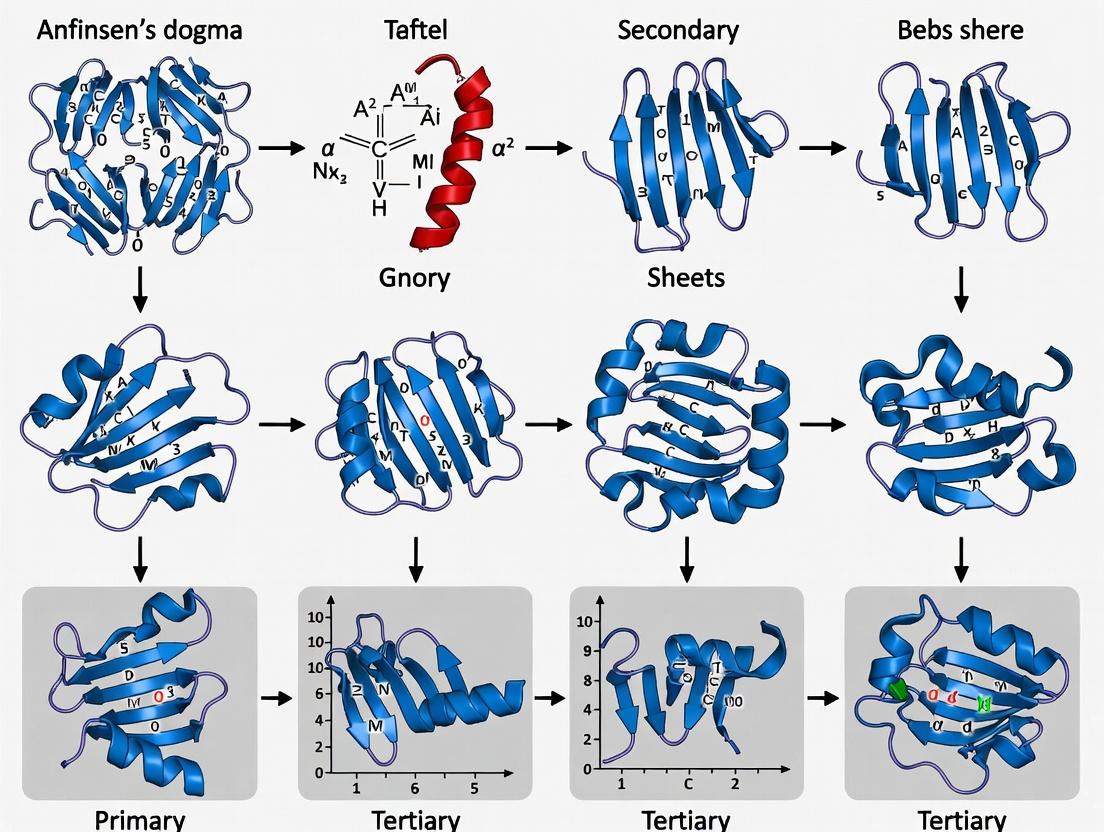
This article provides a comprehensive review of Anfinsen's dogma, the central tenet that a protein's amino acid sequence uniquely determines its native three-dimensional structure.
Anfinsen's Dogma Revisited: The Foundational Principle of Protein Folding and Its Modern Applications in Drug Discovery
Abstract
This article provides a comprehensive review of Anfinsen's dogma, the central tenet that a protein's amino acid sequence uniquely determines its native three-dimensional structure. Aimed at researchers, scientists, and drug development professionals, it explores the dogma's core principles, examines modern methodologies for studying and predicting protein folding, discusses critical limitations and exceptions in complex biological environments, and evaluates how the principle holds up against contemporary challenges like intrinsically disordered proteins. The synthesis offers a practical framework for applying these concepts to structure-based drug design and therapeutic protein engineering.
Decoding Anfinsen's Dogma: The Sequence-Structure Relationship and the Thermodynamic Hypothesis
This whitepaper examines the foundational experiments conducted by Christian Anfinsen on bovine pancreatic ribonuclease A (RNase A), which led to the formulation of the central dogma of protein folding, now known as Anfinsen's dogma. The principle states that a protein's native, functional three-dimensional structure is determined solely by its amino acid sequence under physiological conditions. This work established the thermodynamic hypothesis of protein folding and remains a cornerstone for researchers in structural biology, biophysics, and therapeutic protein design.
Core Experiments and Quantitative Data
Anfinsen's key experiments involved the reversible denaturation and renaturation of RNase A. The quantitative outcomes are summarized below.
Table 1: Summary of Key Experimental Conditions and Outcomes
| Experiment Phase | Chemical Conditions | Key Treatment | Observed Activity Recovery | Conclusion |
|---|---|---|---|---|
| Native State | Buffer, pH 7.0 | None | 100% (Reference) | Enzyme is fully active. |
| Denaturation | 8M Urea, β-Mercaptoethanol | Reduction of disulfides in denaturant. | ~1% or less | Loss of structure and function. |
| Renaturation (Refolding) | Buffer, pH 7.0, Slow reoxidation | Removal of denaturant and reductant by dialysis. | ~95-100% | Spontaneous refolding to active form. |
| Scrambled RNase | 8M Urea, Oxygen | Reoxidation after removal of urea (disulfide scrambling). | ~1% | Incorrect structure formed without folding guidance. |
| Corrected Scramble | 8M Urea, trace β-ME | Re-introduction of reductant followed by reoxidation under native conditions. | ~80% | Misfolded protein can reach native state given proper conditions. |
Table 2: Critical Parameters in Anfinsen's Experiments
| Parameter | Description | Role in Experiment |
|---|---|---|
| Ribonuclease A | 124 amino acids, 4 disulfide bonds (Cys26-Cys84, Cys40-Cys95, Cys58-Cys110, Cys65-Cys72). | Model protein; small, stable, easily assayed. |
| Urea (8M) | Chaotropic denaturant. | Disrupts non-covalent interactions (H-bonds, hydrophobic effect). |
| β-Mercaptoethanol | Reducing agent. | Cleaves native disulfide bonds to yield cysteine thiols. |
| Oxidation | Exposure to atmospheric oxygen or controlled redox buffer. | Allows reformation of disulfide bonds. |
| Enzyme Activity Assay | Hydrolysis of yeast RNA, measured by UV absorbance of soluble products. | Quantitative measure of correct native fold. |
Detailed Experimental Protocols
Protocol 1: Complete Denaturation and Reduction of RNase A
- Preparation: Dissolve purified RNase A at 1-2 mg/mL in 0.1M Tris-HCl buffer, pH 8.0, containing 8M urea.
- Reduction: Add β-mercaptoethanol to a final concentration of 0.1M to reduce all four disulfide bonds.
- Incubation: Flush solution with nitrogen to prevent reoxidation and incubate at room temperature for 4-12 hours.
- Verification: Confirm complete reduction by assays like Ellman's test for free thiols.
Protocol 2: Renaturation and Reoxidation to Native State
- Refolding Initiation: Dilute or dialyze the denatured/reduced RNase solution extensively against a large volume of 0.1M Tris-HCl buffer, pH 7.0, at 4°C. This removes urea and reductant, allowing refolding.
- Controlled Reoxidation: Alternatively, use a redox buffer (e.g., reduced and oxidized glutathione mixture) during dialysis to guide correct disulfide pairing.
- Incubation: Allow renaturation to proceed for 12-24 hours at 4°C.
- Assay: Measure recovered ribonuclease activity spectrophotometrically against a native control.
Protocol 3: Generation of "Scrambled" RNase A
- Denaturation/Reduction: Perform as in Protocol 1.
- Incorrect Reoxidation: First, dialyze against 8M urea at pH 8.0 without reductant but in the presence of air. This allows disulfides to reform randomly while the polypeptide chain remains unfolded.
- Isolation: Subsequently, dialyze away the urea. The resulting protein contains incorrect disulfide pairings and is inactive.
Visualization of Concepts and Workflows
Diagram 1: Anfinsen's RNase A Folding Pathways
Diagram 2: Core Experimental Workflow Comparison
The Scientist's Toolkit: Research Reagent Solutions
Table 3: Essential Materials for Protein Folding Studies (RNase A Model)
| Reagent/Material | Function | Technical Note |
|---|---|---|
| Bovine Pancreatic Ribonuclease A (RNase A) | Model substrate for folding studies. | High purity (>95%) is essential for interpretable results. |
| Urea (Ultra-Pure) | Chaotropic denaturant. Disrupts H-bonds & hydrophobic packing. | Must be freshly prepared or purified to avoid cyanate ions, which can carbamylate proteins. |
| β-Mercaptoethanol (BME) / Dithiothreitol (DTT) | Reducing agent. Cleaves disulfide bonds to free thiols. | DTT is often preferred due to its stronger reducing power and lower odor. |
| Redox Buffers (GSH/GSSG) | Glutathione system (reduced/oxidized). Provides controlled redox potential for disulfide formation. | Mimics the oxidizing environment of the endoplasmic reticulum. Crucial for efficient in vitro refolding of disulfide-rich proteins. |
| Spectrophotometer with UV/VIS | For enzyme activity assays (RNA hydrolysis at 260nm) and protein concentration measurement (A280). | The primary tool for quantitative analysis of folding yield. |
| Dialysis Tubing/Cassettes or Size-Exclusion Columns | For buffer exchange to remove denaturants/reductants. | Enables controlled change of solution conditions to initiate refolding. |
| Ellman's Reagent (DTNB) | Quantifies free sulfhydryl (thiol) groups in solution. | Used to confirm complete reduction of disulfides before refolding experiments. |
Within the canonical framework of Anfinsen's dogma, the primary amino acid sequence of a protein contains the necessary information to dictate its three-dimensional native conformation under physiological conditions. This whitepaper provides a technical examination of this principle, detailing the biophysical forces, experimental validations, and modern computational challenges that define the field of protein folding research. It is intended to inform researchers and drug development professionals on the foundational concepts and current methodologies.
The classical experiments of Christian B. Anfinsen on ribonuclease A established the paradigm that the native, biologically active structure of a protein is the thermodynamically most stable state under a given set of conditions, determined solely by its amino acid sequence. This "thermodynamic hypothesis" remains the central tenet of structural biology, though it is now understood to be nuanced by kinetic traps, chaperone assistance, and potential functional conformations.
Biophysical Principles Linking Sequence to Structure
The folding process is driven by the interplay of covalent and non-covalent interactions, encoded in the sequence.
| Force/Interaction | Energy Range (kcal/mol) | Role in Folding | Dependence on Sequence |
|---|---|---|---|
| Covalent Bonds (Disulfide) | ~50 | Stabilizes tertiary structure; not always present. | Cysteine placement. |
| Hydrophobic Effect | 1-3/residue | Major driving force; sequestration of nonpolar residues. | Hydrophobic residue pattern. |
| Hydrogen Bonds | 1-5 | Stabilizes secondary (α-helices, β-sheets) & tertiary structure. | Donor/acceptor residue placement. |
| Van der Waals | 0.1-1 | Efficient packing of the core. | Side-chain shape & volume. |
| Electrostatic (Salt Bridges) | 1-3 | Can provide specific stabilization; context-dependent. | Charged residue (Arg, Asp, etc.) positioning. |
Key Experimental Protocols & Validations
Classic Anfinsen Experiment: Reversible Denaturation of RNase A
- Objective: To demonstrate that sequence alone dictates native conformation.
- Reagents: Purified bovine pancreatic RNase A, Urea (8M), β-mercaptoethanol, Oxidizing buffer.
- Protocol:
- Denature and reduce RNase A using 8M urea and β-mercaptoethanol, breaking all non-covalent interactions and four disulfide bonds.
- Confirm loss of enzymatic activity.
- Remove denaturant and reductant via dialysis.
- Allow re-oxidation and refolding in an aerobic buffer.
- Measure the recovery of enzymatic activity (>95%) and confirm the correct reformation of disulfide bonds.
- Interpretation: The protein spontaneously refolds to its active form, proving the sequence encodes the fold. Control experiments where re-oxidation occurred in 8M urea yielded scrambled, inactive disulfides, highlighting the role of native non-covalent interactions in guiding correct covalent bond formation.
Modern Validation: Deep Mutational Scanning
- Objective: To quantitatively assess the contribution of each residue to stability and folding.
- Reagents: Mutant gene library, Next-Generation Sequencing (NGS) platform, Stability probe (e.g., thermal shift dye, protease, or cellular function readout).
- Protocol:
- Create a comprehensive single-site mutant library of the target protein gene.
- Express the library in a suitable system (e.g., yeast, phage display).
- Apply a selection pressure based on stability (e.g., heat shock, protease challenge, ligand binding).
- Use NGS to quantify the enrichment or depletion of each mutant before and after selection.
- Calculate a fitness or stability score (φ-value) for every mutation.
- Interpretation: Generates a high-resolution map of "foldability" across the sequence, identifying critical core residues and tolerant surface positions.
Visualization of Concepts
Diagram 1: The Anfinsen Folding Landscape
Diagram 2: From Sequence to Structure via Physical Forces
The Scientist's Toolkit: Essential Reagents & Materials
| Item | Function in Folding Research |
|---|---|
| Chaotropes (Urea, Guanidine HCl) | Disrupt non-covalent interactions to denature/unfold proteins for folding/unfolding studies. |
| Reducing Agents (DTT, TCEP) | Reduce disulfide bonds to study unfolded state or prevent incorrect cross-linking. |
| Oxidizing/Redox Buffers (GSH/GSSG) | Provide controlled environments for disulfide bond formation during refolding. |
| Intrinsic Fluorescent Probes (Trp, Tyr) | Monitor changes in local environment during folding via fluorescence spectroscopy. |
| Extrinsic Dyes (SYPRO Orange, ANS) | Bind hydrophobic patches; used in thermal shift assays to measure stability (Tm). |
| Fast Kinetics Instruments (Stopped-Flow) | Mix reactants in milliseconds to observe early folding events (e.g., helix formation). |
| Site-Directed Mutagenesis Kits | Systematically alter the primary sequence to test the role of specific residues. |
| Chaperone Proteins (GroEL/ES, DnaK) | Used in in vitro refolding assays to study assisted folding mechanisms. |
| Hydrogen-Deuterium Exchange (HDX) Mass Spec | Probes protein dynamics and folding intermediates by measuring solvent accessibility. |
Contemporary Challenges and Implications for Drug Discovery
While Anfinsen's dogma holds for many small, single-domain proteins, the "protein folding problem" is not fully solved. Predicting structure from sequence (de novo folding) remains a grand challenge, though advances like AlphaFold2 represent a paradigm shift. Understanding misfolding and aggregation, relevant in neurodegenerative diseases, requires moving beyond the single native state paradigm. In drug discovery, the concept underpins structure-based drug design and the development of stabilizers (e.g., for tumor suppressor p53) or correctors for misfolded proteins (e.g., in cystic fibrosis). The core tenet that sequence is the blueprint remains the indispensable foundation for all these endeavors.
The "Thermodynamic Hypothesis," a cornerstone of Anfinsen's dogma, posits that the native, functional three-dimensional structure of a protein is determined solely by its amino acid sequence, as this conformation corresponds to the global minimum of the Gibbs free energy under physiological conditions. This principle, derived from Anfinsen's seminal ribonuclease A refolding experiments, establishes protein folding as a spontaneous, thermodynamically driven process. This whitepaper provides a technical dissection of the hypothesis, its modern validation, quantitative challenges, and experimental methodologies central to current research in structural biology and drug development.
Core Principles & Quantitative Landscape
The native state (N) is favored over the unfolded ensemble (U) when the change in Gibbs free energy (ΔGfolding) is negative: ΔGfolding = GN - GU < 0. This stability arises from a delicate balance of enthalpic and entropic contributions.
Table 1: Key Energetic Contributions to Protein Folding Stability
| Contribution | Typical Magnitude (kJ/mol) | Favors Native State? | Description |
|---|---|---|---|
| Favorable (Negative ΔH) | |||
| Hydrophobic Effect | -5 to -20 per buried methylene | Yes | Major driver; release of ordered water upon burial of nonpolar groups. |
| Hydrogen Bonds | -5 to -25 (intra-protein) | ~Yes | Net favorable; strength similar in protein and to water, but gain in stability from cooperativity. |
| Van der Waals | -1 to -5 per contact | Yes | Close packing in native state maximizes numerous weak interactions. |
| Salt Bridges | -0.5 to -5 | Context-dependent | Can be stabilizing or destabilizing depending on desolvation penalty. |
| Unfavorable (Positive ΔS) | |||
| Conformational Entropy | +20 to +80 | No | Largest opposing force; loss of backbone and side-chain flexibility upon folding. |
| Net Stability (ΔG_folding) | -20 to -60 | Yes | Small difference between large, opposing forces. |
The "folding funnel" metaphor illustrates the energy landscape: a broad, high-energy unfolded ensemble narrows toward a single, low-energy native state. The global minimum is kinetically accessible due to a minimally rugged landscape.
Diagram Title: The Protein Folding Funnel Energy Landscape
Experimental Protocols for Validating the Hypothesis
Equilibrium Denaturation (Thermal/Chemical)
Purpose: To measure ΔG_folding and confirm a two-state (U N) transition. Protocol:
- Sample Prep: Purified protein in physiological buffer (e.g., 20 mM phosphate, 150 mM NaCl, pH 7.4).
- Denaturant Titration: Prepare samples with varying [denaturant] (e.g., 0-8 M urea or GdmCl). Incubate to reach equilibrium.
- Signal Measurement: Use circular dichroism (CD) at 222 nm (secondary structure) or fluorescence (Trp emission shift, ~350 nm → ~330 nm) to monitor folding state.
- Data Analysis: Fit sigmoidal unfolding curve to derive ΔGfolding in water (ΔGH2O) and the m-value (cooperativity of unfolding).
Hydrogen-Deuterium Exchange Mass Spectrometry (HDX-MS)
Purpose: To probe local stability and identify protected core regions. Protocol:
- Labeling: Dilute protein into D2O-based buffer. Allow exchange for defined times (10s to hours).
- Quench: Lower pH to ~2.5 and temperature to 0°C to minimize back-exchange.
- Digestion & Analysis: Rapidly digest with pepsin, inject onto LC-MS. Measure mass increase of peptides due to H/D exchange.
- Mapping: Protection factors are calculated, identifying stable, low free energy regions mapped onto the 3D structure.
Deep Mutational Scanning (DMS) for Stability
Purpose: To assess the contribution of every residue to stability. Protocol:
- Library Creation: Generate a comprehensive mutant library via site-saturation mutagenesis.
- Selection/Sorting: Apply a stability-dependent screen (e.g., thermal challenge followed by binding to a folded-state-specific antibody or enzyme activity assay).
- Sequencing: Use next-generation sequencing (NGS) to quantify variant abundance pre- and post-selection.
- ΔΔG Calculation: Enrichment scores are converted to estimates of ΔΔG_folding for each mutation, creating a stability map.
The Scientist's Toolkit: Research Reagent Solutions
Table 2: Essential Materials for Protein Folding Stability Studies
| Item | Function & Application |
|---|---|
| Ultra-Pure Urea/GdmCl | Chemical denaturants for equilibrium unfolding studies. Must be freshly prepared to avoid cyanate formation (urea). |
| Differential Scanning Calorimetry (DSC) Cell | For direct measurement of heat capacity changes during thermal unfolding, providing ΔH, ΔS, and Tm. |
| Intrinsic Fluorescence Dyes (e.g., ANS) | Binds to exposed hydrophobic patches, used to characterize molten globule intermediates. |
| Fast-Kinetics Stopped-Flow Device | Mixes protein and denaturant in <1 ms, allowing observation of early folding events via CD/fluorescence. |
| Site-Directed Mutagenesis Kit | For creating point mutations to test the energetic contribution of specific residues (ΔΔG analysis). |
| Size-Exclusion Chromatography (SEC) Columns | To separate monomeric native protein from aggregates or misfolded states during folding/refolding assays. |
| HDX-MS Software Suite (e.g., HDExaminer) | For automated processing, visualization, and protection factor calculation from complex HDX-MS data. |
Diagram Title: Experimental Workflow for Free Energy Analysis
Challenges & Modern Refinements
The hypothesis faces challenges from metastable folding intermediates, kinetic traps, and the role of chaperones. Furthermore, some proteins (e.g., intrinsically disordered proteins) defy a single global minimum. Computational energy functions (force fields) and AI-based structure prediction tools like AlphaFold2 have revolutionized the field by providing highly accurate predictions of the native state, implicitly supporting the hypothesis while highlighting the complexity of the energy landscape.
Table 3: Quantitative Challenges to the "Global Minimum" Concept
| Phenomenon | Impact on Free Energy Landscape | Experimental/Computational Probe |
|---|---|---|
| Metastable Intermediates | Creates local minima; kinetic partitioning. | Stopped-flow kinetics, φ-value analysis. |
| Proline Isomerization | Creates slow-folding phases; non-native isomers are local minima. | Double-jump kinetics. |
| Chaperone Assistance | Alters effective landscape by preventing off-pathway aggregation. | Folding assays in presence of GroEL/TRiC. |
| Co-Translational Folding | Nascent chain effects alter accessible conformations. | Ribosome-Nascent Chain Complex studies. |
| Functional Dynamics | Native state is an ensemble of closely related conformations (conformational entropy). | NMR relaxation, molecular dynamics simulations. |
The Thermodynamic Hypothesis remains a foundational framework. Its validation through modern high-throughput mutagenesis and HDX-MS confirms that stability is distributed and mutable. In drug discovery, this underpins efforts to:
- Design Stabilizing Drugs: Small molecules that bind the native state and lower its free energy (positive allosteric modulators, pharmacological chaperones).
- Target Misfolding Diseases: Understand how mutations (ΔΔG < 0) destabilize the native state, leading to aggregation (e.g., in amyloidosis).
- Engineer Therapeutic Proteins: Optimize stability (increase ΔG_folding) for biologics by incorporating stabilizing mutations informed by DMS data.
The native state as the global free energy minimum is not a static picture but a dynamic, quantifiable principle guiding the interrogation of protein function and the rational design of interventions.
Thesis Context: This whitepaper examines the foundational assumptions underpinning Anfinsen's dogma—that a protein's amino acid sequence uniquely determines its native conformation—within the modern context of cellular complexity. While Anfinsen's experiments demonstrated reversible folding in vitro, the "Defined Cellular Environment" introduces factors that modulate this process, challenging a strictly deterministic view and informing therapeutic strategies in protein misfolding diseases.
Reversibility of FoldingIn Vitro: Quantitative Foundations
The core evidence for reversible folding originates from denaturation-renaturation experiments. Quantitative data from classic and modern studies are summarized below.
Table 1: Key Quantitative Data from Reversible Folding Studies
| Protein / System | Denaturant/Stress | Renaturation Yield (%) | Method | Key Finding / Keq | Ref (Year) |
|---|---|---|---|---|---|
| Ribonuclease A (RNase A) | 8M Urea, β-ME | >95% | Enzyme activity assay | Demonstrated thermodynamic hypothesis; folding is reversible. | Anfinsen (1973) |
| Lysozyme | Guanidine HCl, Heat | 80-90% | CD spectroscopy, activity | Re-folding rate constant (kf) ~ 0.05 s-1 at 25°C. | Dobson et al. (1994) |
| Green Fluorescent Protein (GFP) | Acid pH (pH 4) | ~70% | Fluorescence recovery | Re-folding is pH-dependent; chromophore formation is rate-limiting. | Tsien (1998) |
| Single-domain SH3 | Force (AFM) | N/A | Single-molecule force spectroscopy | Folding/unfolding forces ~50-150 pN; direct measurement of ΔG. | Fernandez & Li (2004) |
| Modern Data: Luciferase in Cell Lysate | Heat (42°C) | <40% (vs. >90% in buffer) | Luminescence recovery | Chaperone dependence illustrates environmental impact. | Rothlauf et al. (2022) |
Defining the Cellular Environment: Key Modulating Factors
The cell is not a test tube. A "defined" environment must account for specific physicochemical and macromolecular factors that alter the folding landscape.
Table 2: Key Components of the Cellular Environment Impacting Folding
| Environmental Factor | Typical Concentration / Range | Impact on Folding (vs. Dilute Buffer) |
|---|---|---|
| Macromolecular Crowding | 80-400 g/L of solutes | Alters folding kinetics & stability; can promote aggregation. |
| Molecular Chaperones | e.g., Hsp70: ~1-5 μM | Prevent aggregation, assist in folding; consume ATP. |
| Proteostasis Network | Complex regulation | Integrated system of chaperones, degradation, and stress response. |
| Redox Potential (Glutathione) | GSH:GSSG ratio ~30:1 to 100:1 | Governs disulfide bond formation (ER vs. cytoplasm). |
| Ionic Composition & pH | [K+] > [Na+]; pH varies by compartment | Affects charge interactions and protein stability. |
| ATP:ADP Ratio | ~10:1 (energy charge) | Powers chaperone cycles and degradation machinery. |
Experimental Protocols for Validating Assumptions
Protocol:In VitroReversible Folding (Classic RNase A Refolding)
Objective: To demonstrate that all information for native structure is contained in the amino acid sequence under defined buffer conditions.
- Denaturation: Dissolve 1 mg/mL purified RNase A in 0.1M Tris-HCl, pH 8.0, containing 8M urea and 10mM β-mercaptoethanol (β-ME). Incubate at 25°C for 24 hours.
- Renaturation: Rapidly dilute the denatured solution 100-fold into refolding buffer (0.1M Tris-HCl, pH 8.0, 10mM oxidized glutathione). This reduces denaturant concentration and allows reformation of disulfides.
- Control: Prepare a native sample (no denaturant) and a denatured-unoxidized sample (diluted into buffer with β-ME).
- Assay: Measure enzymatic activity using cCMP as a substrate (increase in A296). Compare initial velocities of renatured vs. native protein.
- Analysis: A recovery of >90% activity confirms reversible folding under these defined (redox-controlled) conditions.
Protocol: Assessing Folding in a Defined Cytomimetic Environment
Objective: To test the reversibility of folding under controlled conditions that mimic cellular crowding.
- Preparation of Crowding Agent: Prepare a 200 g/L solution of Ficoll PM-70 or dextran in standard refolding buffer. Filter sterilize.
- Protein Denaturation: Denature a model protein (e.g., citrate synthase) at 1 mg/mL in 6M Guanidine HCl for 2 hours.
- Refolding Initiation: Rapidly dilute the denatured protein 50-fold into two buffers: (A) Standard buffer, (B) Crowded buffer (containing 150 g/L Ficoll).
- Aggregation Monitoring: Immediately measure light scattering at 360 nm (A360) every 30 seconds for 30 minutes. Increased scattering indicates aggregation.
- Activity Recovery: After 2 hours, assay for enzymatic activity. Compare yields in crowded vs. dilute conditions.
- Interpretation: Lower activity recovery and higher light scattering in the crowded condition demonstrate environmental impact on reversibility.
The Scientist's Toolkit: Research Reagent Solutions
Table 3: Essential Materials for Folding Assay Research
| Reagent / Material | Function & Rationale |
|---|---|
| Urea & Guanidine HCl (Ultra Pure) | Chemical denaturants for unfolding proteins; high purity prevents modification artifacts. |
| DTT & β-Mercaptoethanol | Reducing agents to break disulfide bonds and study unfolded state. |
| Oxidized/Reduced Glutathione | Redox buffers to control disulfide bond formation during refolding. |
| Ficoll PM-70, Dextran | Inert crowding agents to mimic macromolecular crowding in vitro. |
| Purified Molecular Chaperones (e.g., GroEL/ES, DnaK) | To study assisted folding pathways and mechanisms. |
| Thioflavin T (ThT) | Fluorescent dye that binds amyloid fibrils; monitors aggregation kinetics. |
| Differential Scanning Calorimetry (DSC) Capillaries | For direct measurement of protein thermal stability and folding thermodynamics. |
| Single-Molecule FRET (smFRET) Labeling Kits | Site-specific dye labeling kits to study folding intermediates and dynamics. |
| Microfluidic Rapid Mixing Devices | For initiating folding/unfolding on sub-millisecond timescales. |
Visualizing Concepts and Workflows
Diagram 1: Anfinsen's Dogma Assumptions and Cellular Modifiers
Diagram 2: Reversible Folding Experimental Workflow
Implications for Drug Development
The interplay between reversible folding and the cellular environment is critical in disease. Protein misfolding diseases (e.g., Alzheimer's, ALS, cystic fibrosis) often involve environmental disruptions to proteostasis. Therapeutic strategies emerging from this research include:
- Pharmacological Chaperones: Small molecules that stabilize native states, enhancing reversibility.
- Proteostasis Regulators: Compounds that upregulate chaperone networks or degrade misfolded proteins.
- Crowding-Mimetic Excipients: Formulation additives for biologics that mimic stabilizing cellular conditions.
Understanding Anfinsen's assumptions within a defined cellular context provides the quantitative and conceptual framework necessary to develop these targeted interventions.
Anfinsen's dogma, articulated in the 1970s, posits that a protein's native, functional three-dimensional structure is uniquely determined by its amino acid sequence under physiological conditions. This principle implies that the folding process is thermodynamically controlled, with the native state representing the global minimum of free energy. However, Cyrus Levinthal's 1968 paradox highlighted a profound kinetic contradiction: if a protein were to randomly sample all possible conformations in its conformational space to find the native state, it would require a time longer than the age of the universe. Yet, proteins fold on timescales of milliseconds to seconds. This paradox frames the central question of modern protein folding research: what are the specific, guided pathways that enable proteins to navigate this vast landscape efficiently? This whitepaper delves into the modern resolution of the paradox, focusing on the principles of funneled energy landscapes and the experimental evidence that elucidates them.
The Quantitative Scope of the Paradox
The astronomical number of possible conformations arises from the rotational degrees of freedom around each peptide bond. A simple estimate for a small protein illustrates the scale of the problem.
Table 1: Conformational Search Space for a 100-Residue Protein
| Parameter | Value | Calculation Basis |
|---|---|---|
| Approx. torsional angles per residue | 3 (φ, ψ, ω) | Backbone conformational freedom |
| Assumed discrete states per angle | 3 | Simplification for estimation |
| Total possible conformations | 3^(300) ≈ 10^143 | (States per angle)^(angles) |
| Time per conformation attempt | ~10^(-13) seconds | Picosecond bond vibration timescale |
| Random search time | ~10^130 seconds | (Conformations * time per attempt) |
| Age of the universe | ~4.3 x 10^17 seconds | For comparison |
Resolution: The Funneled Energy Landscape Theory
The resolution to Levinthal's paradox is provided by the theory of funneled energy landscapes, which moves from a random search on a flat, rugged landscape to a directed search down a biased, funnel-shaped topography. The native state is not found by exhaustive enumeration but through coordinated, cooperative transitions along preferential pathways.
Diagram 1: Energy Landscape Funnel
Key Experimental Methodologies and Protocols
Fast Kinetics: Stopped-Flow Fluorescence
- Objective: Measure folding/unfolding rates on millisecond to second timescales.
- Protocol:
- Sample Preparation: Purified protein is denatured in a high concentration of chemical denaturant (e.g., 6M Guanidine HCl).
- Rapid Mixing: Using a stopped-flow instrument, the denatured protein solution is rapidly mixed (dead time ~1 ms) with a large volume of folding buffer (low/no denaturant), initiating refolding.
- Detection: Intrinsic fluorescence (often of Tryptophan residues) is monitored in real-time. The emission spectrum/shift reports on the burial of aromatic residues as the hydrophobic core forms.
- Data Analysis: Fluorescence traces are fit to exponential equations to extract observed rate constants (kobs) at various final denaturant concentrations. A "chevron plot" (kobs vs. [denaturant]) is constructed to characterize the folding transition state.
Single-Molecule FRET (smFRET)
- Objective: Observe heterogeneous folding pathways and transient intermediates without ensemble averaging.
- Protocol:
- Labeling: Site-specific labeling of the protein with a donor (e.g., Cy3) and an acceptor (Cy5) fluorophore at two defined positions.
- Immobilization or Confinement: Proteins are immobilized on a passivated surface via a biotin-streptavidin linkage or confined in lipid vesicles or microfluidic channels.
- Excitation & Measurement: A laser excites the donor fluorophore. The efficiency of energy transfer (FRET) to the acceptor is inversely related to the sixth power of the distance between the two dyes.
- Analysis: Time trajectories of FRET efficiency are recorded for individual molecules, revealing transitions between high-FRET (folded/docked) and low-FRET (unfolded/separated) states, allowing the construction of energy landscapes and identification of multiple pathways.
Hydrogen-Deuterium Exchange Mass Spectrometry (HDX-MS)
- Objective: Probe structural dynamics, stability, and folding intermediates by measuring the exchange rate of backbone amide hydrogens.
- Protocol:
- Pulse-Labeling: At specific time points during folding (e.g., after stopped-flow initiation), the sample is exposed to deuterated buffer (D₂O) for a short, defined pulse (e.g., 10 ms - 10 s).
- Quenching: Exchange is quenched by lowering pH and temperature (to ~0°C, pH 2.5).
- Digestion & Analysis: The protein is rapidly digested with pepsin, and the resulting peptides are analyzed by liquid chromatography-mass spectrometry (LC-MS).
- Data Interpretation: Regions of the protein that are structured or become protected early in folding show slower deuterium incorporation. This provides residue-level insight into the sequence of structure formation.
Table 2: Key Experimental Observations Supporting a Funneled Landscape
| Experimental Technique | Key Observable | Implication for Levinthal's Paradox |
|---|---|---|
| Stopped-Flow Kinetics | Exponential kinetics; Chevron plots with V-shaped limbs. | Existence of a cooperative, barrier-limited process, not random search. |
| smFRET | Multiple transition pathways observed for some proteins; heterogeneity in intermediate states. | Landscape is funneled but can contain parallel routes and local minima. |
| HDX-MS & NMR | Specific secondary structures (e.g., helices, hydrophobic clusters) form early ("foldons"). | Folding follows defined, hierarchical pathways with early stabilization of key elements. |
| Phi-Value Analysis | Measurement of how point mutations affect folding kinetics vs. stability. | Maps the structure of the folding transition state, revealing a polarized, native-like nucleus. |
The Scientist's Toolkit: Essential Research Reagents & Materials
Table 3: Key Research Reagent Solutions for Protein Folding Studies
| Item | Function & Relevance |
|---|---|
| Urea & Guanidine HCl | Chemical denaturants used to unfold proteins and map folding stability (m-value, ΔG°). Essential for creating chevron plots. |
| ANS (1-Anilinonaphthalene-8-sulfonate) | Hydrophobic dye whose fluorescence increases upon binding to exposed hydrophobic patches. Used to detect molten globule intermediates. |
| D₂O (Deuterium Oxide) | Solvent for HDX experiments. The exchange of H for D in backbone amides reports on solvent accessibility and hydrogen bonding. |
| TCEP (Tris(2-carboxyethyl)phosphine) | A reducing agent that breaks disulfide bonds. Critical for studying oxidative folding or for maintaining cysteine residues in a reduced state. |
| Site-Directed Mutagenesis Kits | Allows for the creation of specific point mutations (e.g., Ala, Gly, or Phi-value mutations) to probe the contribution of individual residues to folding kinetics and stability. |
| Monodisperse Intrinsically Disordered Proteins (IDPs) | Model systems (e.g., α-synuclein, tau) for studying the extreme of a shallow, rugged landscape and its link to aggregation diseases. |
| Molecular Chaperones (GroEL/ES, Hsp70) | ATP-dependent protein complexes that assist in vivo folding by preventing aggregation and providing a controlled environment, illustrating biological solutions to landscape navigation. |
Levinthal's paradox was not an error but a fruitful thought experiment that shifted the paradigm from a thermodynamic endpoint to a kinetic process. The resolution lies in recognizing that evolution has selected sequences whose energy landscapes are not flat but are correlated, funneled, and minimally frustrated. The native fold is not found by chance but is reached through a series of coordinated, local decisions driven by the cooperative formation of stabilizing interactions. This framework, grounded in Anfinsen's thermodynamic principle, unifies experimental observations: fast kinetics arise from a narrowing of the search as the protein descends the funnel, while misfolding and aggregation represent off-pathway traps in the landscape's residual ruggedness. For drug development, understanding these landscapes is critical for targeting folding intermediates in disease (e.g., amyloidosis) or stabilizing native folds of therapeutic proteins.
From Principle to Practice: Methodologies for Studying Folding and Applications in Biopharma
The study of protein folding, governed by Anfinsen's dogma which posits that a protein's native structure is determined solely by its amino acid sequence, demands a robust experimental toolkit. Validating and probing this principle requires techniques capable of resolving atomic structures, capturing dynamic intermediates, and quantifying folding pathways. This whitepaper details the four cornerstone techniques—X-ray Crystallography, Cryo-Electron Microscopy (Cryo-EM), Nuclear Magnetic Resonance (NMR) spectroscopy, and Spectroscopic Probes—that enable researchers to test the limits of Anfinsen's dogma by providing static snapshots, dynamic ensembles, and kinetic data of proteins from unfolded states to native conformations.
Core Techniques: Principles and Applications
X-ray Crystallography
Principle: A high-energy X-ray beam is diffracted by electrons in a protein crystal. The resulting diffraction pattern is used to calculate an electron density map, into which an atomic model is built. Role in Folding Studies: Provides ultra-high-resolution (often <1.5 Å) structures of the folded native state, serving as the definitive endpoint for folding studies. Used to study engineered mutants to understand sequence-structure relationships.
Cryo-Electron Microscopy (Cryo-EM)
Principle: Protein samples are flash-frozen in vitreous ice and imaged with a transmission electron microscope. Thousands of 2D particle images are computationally combined to generate a 3D reconstruction. Role in Folding Studies: Can capture large, flexible, or heterogeneous systems (like folding chaperones or misfolded aggregates) without the need for crystallization. Ideal for studying folding intermediates bound to chaperonins.
Nuclear Magnetic Resonance (NMR) Spectroscopy
Principle: Atomic nuclei with spin (e.g., ¹H, ¹⁵N, ¹³C) in a magnetic field absorb and re-emit radiofrequency radiation. Chemical shifts and couplings provide information on atomic environment, distance, and dihedral angles. Role in Folding Studies: The premier solution-state technique for studying protein dynamics, folding pathways, and unfolded states at atomic resolution. Allows real-time tracking of folding kinetics and identification of transient intermediates.
Spectroscopic Probes
Principle: Utilizes the interaction of light with matter. Key methods include:
- Circular Dichroism (CD): Measures differential absorption of left- and right-handed circularly polarized light, reporting on secondary structure.
- Fluorescence Spectroscopy: Exploits intrinsic (tryptophan) or extrinsic dyes to monitor changes in local environment, distance (FRET), and folding/unfolding transitions.
- Mass Spectrometry (MS): Coupled with HDX (Hydrogen-Deuterium Exchange), measures solvent accessibility and dynamics by tracking deuterium incorporation.
Quantitative Comparison of Techniques
Table 1: Key Parameters of Structural Biology Techniques
| Parameter | X-ray Crystallography | Cryo-EM (Single Particle) | Solution NMR | Spectroscopic Probes (e.g., CD/FRET) |
|---|---|---|---|---|
| Typical Resolution | 1.0 – 3.0 Å | 2.0 – 4.0 Å (for well-behaved samples) | 2.0 – 5.0 Å (for structure); Atomic for restraints | N/A (Non-structural) |
| Sample State | Crystal | Vitrified solution (frozen-hydrated) | Solution (native conditions) | Solution (native/denaturing) |
| Molecular Weight Range | No strict upper limit | Ideal for >50 kDa, now feasible for smaller | Typically <50 kDa for full structure | No limit |
| Information on Dynamics | Limited (B-factors) | Limited (flexibility analysis) | Excellent (timescales ps-s) | Excellent (folding kinetics ms-s) |
| Key Requirement | High-quality crystals | Sample homogeneity, particle orientation | Isotopic labeling, solubility | Suitable chromophore |
| Time to Data Collection | Days-months (crystal growth) | Hours-days (grid prep) | Hours-days (sample prep) | Minutes-hours |
| Primary Folding Insight | Atomic native structure | Structure of large complexes/aggregates | Atomic dynamics & folding intermediates | Kinetics, stability, secondary structure |
Table 2: Application to Anfinsen's Dogma Research Questions
| Research Question | Optimal Technique(s) | Measurable Output |
|---|---|---|
| Atomic structure of the native fold | X-ray Crystallography, Cryo-EM | Atomic coordinates (PDB file) |
| Populations of folded/unfolded states | NMR, Fluorescence, CD | Chemical shift perturbations, FRET efficiency, ellipticity |
| Folding kinetics & intermediates | Stopped-flow CD/Fluorescence, NMR relaxation | Rate constants (k), m-values, burst-phase amplitudes |
| Residue-specific folding pathways | HDX-MS, NMR hydrogen exchange | Protection factors, deuterium incorporation plots |
| Chaperone-substrate interactions | Cryo-EM, NMR | 3D reconstruction, chemical shift mapping |
Detailed Experimental Protocols
Protocol: X-ray Crystallography for a Folded Protein
- Protein Purification: Express and purify target protein to >95% homogeneity via affinity and size-exclusion chromatography.
- Crystallization: Use vapor diffusion (hanging/sitting drop) screens. Mix 0.1-1 µL protein (5-20 mg/mL) with equal volume reservoir solution. Incubate at controlled temperature.
- Crystal Harvesting: Flash-cool crystal in liquid N₂ using a cryoprotectant (e.g., 25% glycerol).
- Data Collection: At synchrotron source, collect 360° of diffraction data with small oscillation angles.
- Data Processing: Index, integrate, and scale diffraction images (HKL-2000, XDS). Solve phase problem by molecular replacement (using homologous structure) or experimental phasing.
- Model Building & Refinement: Build model into electron density map (Coot), refine iteratively (PHENIX, Refmac).
Protocol: HDX-MS for Folding Dynamics
- Labeling: Dilute protein into D₂O-based folding buffer. Incubate for varying timepoints (10s – hours).
- Quenching: Lower pH to 2.5 and temperature to 0°C to minimize back-exchange.
- Digestion & Separation: Pass sample over immobilized pepsin column for rapid digestion. Desalt peptides online.
- Mass Analysis: Use LC-ESI-MS to measure mass increase of peptides due to deuterium incorporation.
- Data Analysis: Process spectra (HDExaminer). Plot deuterium uptake vs. time per peptide to map regions of stability/dynamics.
Protocol: Stopped-Flow Fluorescence for Folding Kinetics
- Sample Preparation: Prepare syringes with unfolded protein (in high denaturant) and refolding buffer.
- Rapid Mixing: Use stopped-flow apparatus to mix solutions 1:10, initiating refolding (dead time ~1 ms).
- Detection: Monitor intrinsic tryptophan fluorescence or extrinsic dye (e.g., ANS) emission at 90° to excitation beam.
- Data Fitting: Fit fluorescence trace over time to single or multi-exponential functions to derive apparent rate constants (k).
Visualization of Workflows and Relationships
Diagram 1: Technique Workflows Converging on Anfinsen's Dogma
Diagram 2: Folding Pathway with Probe Measurement Points
The Scientist's Toolkit: Key Research Reagent Solutions
Table 3: Essential Reagents for Protein Folding Studies
| Reagent / Material | Primary Function in Folding Research | Example Use Case |
|---|---|---|
| Urea / Guanidine HCl | Chemical denaturant. | Create unfolded starting state; perform equilibrium unfolding titrations to measure stability (ΔG). |
| Isotopically Labeled Media (¹⁵N-NH₄Cl, ¹³C-glucose) | Enables specific detection in NMR. | Produce ¹⁵N/¹³C-labeled protein for multidimensional NMR experiments. |
| Size-Exclusion Chromatography (SEC) Columns | Assess oligomeric state & purity. | Verify monodispersity of folded protein or separate folding intermediates. |
| Cryo-EM Grids (e.g., Quantifoil Au R1.2/1.3) | Support for vitrified sample. | Apply protein sample for plunge-freezing in ethane/propane. |
| Fluorescent Dyes (e.g., ANS, Thioflavin T) | Report on hydrophobic exposure or amyloid formation. | Detect molten globule intermediates (ANS) or misfolded aggregates (ThT). |
| Chaperone Proteins (e.g., GroEL/ES) | Assist folding in vitro. | Study assisted folding pathways and mechanisms deviating from spontaneous folding. |
| Proteases (e.g., Pepsin for HDX) | Rapid digestion under quench conditions. | Fragment labeled protein for HDX-MS to obtain regional resolution. |
| Crystallization Screens (e.g., Hampton Research) | Systematic search of crystallization conditions. | Identify conditions promoting crystal formation for X-ray studies. |
The seminal work of Christian Anfinsen established the thermodynamic hypothesis of protein folding: the native three-dimensional structure of a protein is determined solely by its amino acid sequence, under physiological conditions. This principle, known as Anfinsen's dogma, has been the foundational thesis driving computational structural biology for decades. The central challenge has been to computationally predict this native conformation from sequence—a problem of astronomical complexity. This whitepaper examines the revolutionary convergence of two distinct computational paradigms—physical simulation exemplified by Rosetta and deep learning epitomized by AlphaFold2—in solving the protein structure prediction problem, thereby providing a profound validation and practical realization of Anfinsen's dogma.
Core Methodologies & Experimental Protocols
Rosetta: A Physics-Based and Knowledge-Based Approach
Methodology Overview: Rosetta employs a fragment-assembly Monte Carlo method guided by a sophisticated energy function. It simulates the folding landscape by searching for the lowest free energy conformation.
Detailed Protocol for de novo Folding:
- Input Preparation: The target amino acid sequence is provided in FASTA format.
- Fragment Library Generation: For each 3-residue and 9-residue window in the sequence, a database of known protein structures (e.g., PDB) is searched to find structurally homologous fragments using sequence profile-profile matching.
- Conformational Sampling (Monte Carlo):
- A random extended backbone conformation is initialized.
- In each iteration, a random move is proposed: insertion of a fragment from the library, a small torsion angle adjustment, or a rigid-body shift for domains.
- The energy of the new conformation is calculated using the Rosetta energy function (
ref2015orbeta_nov16). - The move is accepted or rejected based on the Metropolis criterion (Boltzmann probability based on energy change).
- Energy Function Evaluation: The all-atom energy function combines terms for van der Waals interactions (Lennard-Jones), implicit solvation (Lazaridis-Karplus), hydrogen bonding, electrostatics, torsional potentials, and knowledge-based terms for rotamer preferences and backbone dihedrals.
- Output & Refinement: Thousands of independent Monte Carlo trajectories are run, generating a large ensemble of decoy structures. Low-energy decoys are clustered, and the centroid of the largest cluster is subjected to further all-atom refinement via gradient-based minimization.
AlphaFold2: An End-to-End Deep Learning Architecture
Methodology Overview: AlphaFold2 frames structure prediction as a geometric deep learning problem. It directly maps multiple sequence alignments (MSAs) and other inputs to atomic coordinates using an attention-based neural network, bypassing explicit physical simulation.
Detailed Protocol for Inference:
- Input Feature Generation:
- Sequence Databases: Query the target sequence against large genomic databases (UniRef90, MGnify, BFD) using MMseqs2 to build a Multiple Sequence Alignment (MSA).
- Template Search: Search the PDB using HMM-HMM alignment (HHblits) to identify potential structural templates.
- Feature Processing: The MSA and template information are embedded into pairwise and single representations (tensors).
- Evoformer Processing (Core Model): A novel neural network module with axial attention operates on the MSA and pairwise representations. It iteratively refines these representations, allowing information to flow between residues in the sequence (rows) and across sequences in the alignment (columns), thereby inferring evolutionary coupling and spatial relationships.
- Structure Module: The refined pairwise representation (now a implicit "distance map") is passed to a structure module. This module, inspired by residual networks and invariant point attention, directly predicts the 3D coordinates of all heavy atoms for each residue. It represents the structure as a frame (rotation and translation) for each residue and iteratively refines it.
- Recycling: The entire pipeline (Evoformer + Structure Module) is run iteratively (3-4 times), with the outputs from one cycle fed back as additional inputs to the next, enabling self-consistency.
- Output: The final output is a predicted atomic coordinate file (PDB format) with a per-residue confidence metric (pLDDT) and predicted aligned error (PAE) for residue-pair distances.
Comparative Performance Analysis: Quantitative Data
Table 1: Key Performance Metrics at CASP14 (2020)
| Metric | AlphaFold2 (Team 427) | Best Rosetta-based Method (Baker Group) | Threshold for High Accuracy |
|---|---|---|---|
| Global Distance Test (GDT_TS) | 92.4 (median on free-modelling targets) | ~60-70 (median) | >90 = Comparable to Exp. |
| Median RMSD (Å) | ~1.2 (for high-confidence predictions) | ~3.5 - 5.0 | <2.0 Å = High Accuracy |
| Success Rate (GDT_TS > 80) | ~90% of targets | ~20-30% of targets | N/A |
Table 2: Computational Resource & Speed Comparison
| Aspect | AlphaFold2 (Inference) | Rosetta (de novo Folding) |
|---|---|---|
| Typical Runtime (per target) | Minutes to Hours (GPU) | Days to Weeks (CPU Cluster) |
| Primary Hardware | GPU (e.g., NVIDIA V100/A100) | Large CPU Cluster |
| Energy Evaluations | ~0 (Forward pass through network) | ~10^9 - 10^12 Monte Carlo steps |
| Key Limiting Factor | MSA Depth / GPU Memory | Sampling Completeness / Energy Function |
Table 3: Outputs and Confidence Metrics
| Output | AlphaFold2 | Rosetta |
|---|---|---|
| Primary Output | Single deterministic model with confidence scores. | Ensemble of decoy structures. |
| Confidence Metric | pLDDT (per-residue), Predicted Aligned Error (pairwise). | Energy score (REU), cluster density. |
| Uncertainty Quantification | Implicit in pLDDT & PAE; models from different random seeds. | Explicit via decoy ensemble variance. |
The Scientist's Toolkit: Essential Research Reagents & Materials
Table 4: Key Research Reagent Solutions for Computational Structure Prediction
| Item | Function in Workflow | Example/Specification |
|---|---|---|
| Multiple Sequence Alignment (MSA) Database | Provides evolutionary constraints for deep learning (AlphaFold2) and informs fragment selection (Rosetta). | UniRef90, MGnify, BFD (Big Fantastic Database). |
| Protein Structure Database | Source of fragment libraries (Rosetta) and structural templates (both). | RCSB Protein Data Bank (PDB). |
| Homology Search Tool | Generates the MSA from the sequence database. | MMseqs2 (fast), HHblits/HMMER (sensitive). |
| Template Search Tool | Identifies potential homologous structures for template-based modeling. | HHSearch, HHblits. |
| Force Field / Energy Function | Scores and ranks candidate structural models (Rosetta). | ref2015, beta_nov16 (all-atom, implicit solvent). |
| Deep Learning Framework | Platform for developing and running models like AlphaFold2. | JAX, PyTorch, TensorFlow. |
| Pre-trained Model Weights | Enable inference without training from scratch. | AlphaFold2 parameters (v2.0, v2.1, v2.3). |
| Structure Visualization & Analysis Software | Visualizes, validates, and analyzes predicted models. | PyMOL, ChimeraX, UCSF Chimera. |
Visualization of Workflows and Relationships
Diagram Title: AlphaFold2 vs Rosetta Workflow Comparison
Diagram Title: Anfinsen's Dogma and the Folding Landscape
Anfinsen’s dogma posits that a protein’s native three-dimensional structure is determined solely by its amino acid sequence. This principle forms the foundational hypothesis for in silico folding simulations: given a sequence, can we compute its native fold? Molecular Dynamics (MD) and Monte Carlo (MC) simulations are the two primary computational approaches used to test this hypothesis by simulating the physical forces and conformational sampling that guide folding. These methods bridge the gap between thermodynamic postulate (the native state is at the global free energy minimum) and kinetic reality (the folding pathway).
Core Methodologies
Molecular Dynamics (MD)
MD simulations numerically solve Newton’s equations of motion for all atoms in a system. The forces are derived from a molecular mechanics force field.
Detailed Protocol: All-Atom Explicit Solvent MD Folding Simulation
System Preparation:
- Obtain or generate an extended polypeptide chain from the target sequence.
- Place the chain in a simulation box (e.g., cubic, dodecahedral) filled with explicit water molecules (e.g., TIP3P, TIP4P).
- Add ions (e.g., Na⁺, Cl⁻) to neutralize system charge and achieve physiological concentration (~150 mM).
Energy Minimization:
- Perform 5,000-10,000 steps of steepest descent or conjugate gradient minimization to remove steric clashes and bad contacts.
Equilibration:
- NVT Ensemble: Run a short simulation (50-100 ps) with position restraints on protein heavy atoms, gradually heating the system to the target temperature (e.g., 300 K) using a thermostat (e.g., velocity rescale, Nosé-Hoover).
- NPT Ensemble: Run a subsequent simulation (100-200 ps) with weaker or no position restraints, allowing the system density to adjust using a barostat (e.g., Parrinello-Rahman, Berendsen) to reach target pressure (1 bar).
Production Run:
- Run an unrestrained simulation for the desired length (nanoseconds to milliseconds). Use a time step of 2 fs, with bonds involving hydrogen constrained (e.g., LINCS algorithm).
- Save atomic coordinates (trajectory) at regular intervals (e.g., every 10-100 ps).
Analysis:
- Calculate Root Mean Square Deviation (RMSD) of the protein backbone relative to a known native structure (if available).
- Monitor secondary structure evolution (e.g., via DSSP).
- Compute radius of gyration (Rg) as a measure of compactness.
- Identify folding events via native contact analysis (Q fraction).
Monte Carlo (MC)
MC simulations use stochastic moves to sample conformational space based on the Metropolis criterion, which accepts or rejects moves based on the change in energy (ΔE).
Detailed Protocol: Coarse-Grained MC Folding Simulation
Model Selection:
- Choose a coarse-grained representation (e.g., Cα-only, backbone+sidechain centroid models like MARTINI, or lattice models).
- Define the energy function (force field), e.g., Go-like model (favors native contacts) or physics-based potential.
Initialization:
- Generate a random or extended starting conformation.
- Set simulation parameters: temperature (kBT), number of steps.
Monte Carlo Cycle:
- For each step (1-10 million steps typical):
- Perturbation: Propose a conformational change (move). Common moves include:
- Local: Single residue pivot, crankshaft, or side-chain rotation.
- Global: Chain translation/rotation (in off-lattice models) or slithering-snake moves (in lattice models).
- Energy Evaluation: Calculate the potential energy of the new conformation, Enew, and the current one, Eold.
- Metropolis Criterion: Calculate ΔE = Enew - Eold.
- If ΔE ≤ 0, accept the move.
- If ΔE > 0, accept the move with probability P = exp(-ΔE / kBT).
- Sample: If the move is accepted, update the conformation. Periodically save the conformation for analysis.
- Perturbation: Propose a conformational change (move). Common moves include:
- For each step (1-10 million steps typical):
Analysis:
- Similar to MD: compute end-to-end distance, native contact fraction (Q), and energy time series.
- Estimate folding temperature from heat capacity (Cv) peaks derived from energy fluctuations.
Quantitative Comparison of MD vs. MC Approaches
Table 1: Comparative Analysis of MD and MC Simulation Approaches for Protein Folding
| Feature | Molecular Dynamics (MD) | Monte Carlo (MC) |
|---|---|---|
| Theoretical Basis | Newtonian mechanics; integrates equations of motion. | Stochastic sampling; Metropolis-Hastings algorithm. |
| Timescale Access | Picoseconds to milliseconds (with enhanced sampling). | Effectively unlimited, as steps are not physical time. |
| Atomic Detail | All-atom or united-atom resolution is standard. | Often coarse-grained (Cα, lattice, or knowledge-based). |
| Solvent Treatment | Explicit or implicit. | Almost always implicit or modeled via potentials. |
| Primary Output | Time-series trajectory with physical kinetics. | Ensemble of thermodynamically weighted conformations. |
| Computational Cost | Extremely high per step, but efficient parallelization. | Very low per step, enabling vast conformational sampling. |
| Key Strength | Provides realistic folding pathways & kinetics. | Efficient sampling of thermodynamic equilibrium states. |
| Major Limitation | Computationally expensive; limited by time-step size. | Lack of explicit kinetics; move sets may be non-physical. |
| Typical Use Case | Folding of small, fast-folding proteins (≤ 100 aa); pathway analysis. | Folding thermodynamics, landscape mapping, and large protein studies. |
Visualization of Methodologies
Title: Workflow of MD and MC Folding Simulations
Title: Folding Landscape Sampling by MD and MC
The Scientist's Toolkit: Research Reagent Solutions
Table 2: Essential Software and Computational Resources for In Silico Folding
| Tool/Resource | Category | Primary Function | Typical Use Case |
|---|---|---|---|
| GROMACS | MD Software | High-performance MD engine for all-atom simulations. | Running large-scale, explicit solvent folding simulations on HPC clusters. |
| AMBER | MD Software/Force Field | Suite for biomolecular simulation with specialized force fields (ff14SB, ff19SB). | Detailed folding studies with advanced lipid & nucleic acid parameters. |
| CHARMM | MD Software/Force Field | Comprehensive simulation package with the CHARMM force field. | Studying protein folding with specific focus on electrostatic interactions. |
| OpenMM | MD Library | GPU-accelerated toolkit for custom MD simulation scripts. | Rapid prototyping of new integrators or force fields for folding. |
| PLUMED | Analysis/Enhanced Sampling | Plugin for free-energy calculations and path collective variables. | Performing umbrella sampling or metadynamics to study folding barriers. |
| MARTINI | Coarse-Grained Force Field | Particle-based CG model for proteins, lipids, and solvents. | Simulating folding of large proteins or protein-membrane systems. |
| Rosetta | MC Software Suite | Knowledge-based scoring functions & Monte Carlo fragment assembly. | Ab initio protein structure prediction and folding design. |
| Folding@home | Distributed Computing | Citizen science project for massively parallel MD simulations. | Accessing millisecond-timescale folding events via crowd-sourced computing. |
| AlphaFold2 DB | Reference Database | Repository of predicted protein structures from DeepMind's AI. | Providing predicted native states for validation of simulation results. |
| VMD / PyMOL | Visualization | Molecular graphics for trajectory analysis and rendering. | Visualizing folding pathways, intermediate states, and contact maps. |
Within the framework of Anfinsen's dogma—which posits that a protein's native, folded structure is determined solely by its amino acid sequence—drug discovery strategies have traditionally focused on targeting the thermodynamically stable, folded state. However, the dynamic process of protein folding, including transiently populated intermediates and transition states, presents a rich, underexplored landscape for therapeutic intervention. This whitepaper examines modern strategies for targeting both the folded native state and the higher-energy transition states along the folding pathway, with applications in diseases of protein misfolding and aggregation, such as neurodegenerative disorders, and in oncology where oncogenic proteins may be stabilized or destabilized.
Targeting the Folded Native State
The classical approach involves designing high-affinity ligands that bind to well-defined pockets in the fully folded, functional protein. This remains the mainstay for enzymes, receptors, and signaling proteins.
Key Methodologies and Data
Structure-Based Drug Design (SBDD): Utilizes high-resolution structures (X-ray crystallography, cryo-EM) of the target protein to guide virtual screening and rational design of small molecules. Fragment-Based Lead Discovery (FBLD): Screens low molecular weight fragments that bind weakly to the folded target, which are then optimized and linked to form high-affinity leads.
Table 1: Representative Drugs Developed via Folded-State Targeting
| Drug Name | Target (Folded State) | Indication | Binding Affinity (Kd/Ki) | Key Technique Used |
|---|---|---|---|---|
| Imatinib | BCR-Abl kinase (inactive conformation) | Chronic Myeloid Leukemia | Kd ≈ 85 pM | X-ray crystallography, SBDD |
| Venurafenib | BRAF V600E kinase | Melanoma | Ki ≈ 31 nM | High-throughput screening, co-crystallization |
| Sotorasib | KRAS G12C (GDP-bound state) | NSCLC | Kd < 10 nM | Covalent FBLD, mass spectrometry |
Experimental Protocol: Surface Plasmon Resonance (SPR) for Binding Kinetics
Objective: To quantitatively measure the association ((k{on})) and dissociation ((k{off})) rates, and equilibrium binding affinity ((K_D)) of a ligand to its folded protein target.
Protocol:
- Immobilization: The purified, folded target protein is covalently immobilized on a carboxymethylated dextran sensor chip (e.g., Series S CM5) using standard amine-coupling chemistry (EDC/NHS).
- Ligand Injection: A series of ligand solutions (analyte) at concentrations spanning 0.1x to 10x expected (K_D) are flowed over the chip surface in HBS-EP buffer (10 mM HEPES, 150 mM NaCl, 3 mM EDTA, 0.05% v/v Surfactant P20, pH 7.4) at a constant flow rate (e.g., 30 µL/min).
- Data Collection: The SPR signal (Response Units, RU) is monitored in real-time during association (injection) and dissociation (buffer flow) phases.
- Regeneration: The surface is regenerated between cycles using a mild condition (e.g., 10 mM glycine pH 2.0) to remove bound analyte without damaging the immobilized protein.
- Analysis: Sensorgrams are globally fitted to a 1:1 Langmuir binding model using evaluation software (e.g., Biacore Evaluation Software) to extract (k{on}), (k{off}), and calculate (KD = k{off}/k_{on}).
Targeting Folding Transition States and Intermediates
This emerging paradigm aims to stabilize or destabilize specific meta-stable states along the folding pathway. It is particularly relevant for "undruggable" proteins that lack stable, folded pockets or for preventing pathogenic aggregation.
Pharmacological Chaperones and Kinetic Stabilizers
These small molecules bind selectively to folding intermediates or the native state with high kinetic stability, altering the folding energy landscape. They are applied in lysosomal storage disorders (e.g., stabilizing mutant glucocerebrosidase) and transthyretin amyloidosis.
Table 2: Drugs Targeting Folding Pathways and Transition States
| Drug/Compound | Target | Mechanism | Clinical Stage/Use | Key Experimental Evidence |
|---|---|---|---|---|
| Tafamidis | Transthyretin (TTR) | Kinetic stabilizer of native tetramer, slows dissociation (rate-limiting step in aggregation) | Approved for TTR amyloidosis | Stabilization assay ((EC_{50} \approx 2 \, \text{nM})), X-ray of binding site |
| Migalastat | Alpha-galactosidase A (mutants) | Pharmacological chaperone; binds active site of folding intermediate, promotes correct trafficking | Approved for Fabry disease | Thermal shift assay ((\Delta T_m +2^\circ C)), increased lysosomal activity in cells |
| BIIB121 (an example) | Alpha-synuclein | Aims to stabilize a non-aggregating conformation | Phase II for Parkinson's | NMR CSP, reduction of oligomers in SEC-MALS |
Experimental Protocol: Hydrogen-Deuterium Exchange Mass Spectrometry (HDX-MS)
Objective: To probe protein dynamics and identify regions stabilized or destabilized by ligands, revealing binding to intermediate or transition states.
Protocol:
- Labeling Reaction: The folded protein (or protein+ligand complex) is diluted into D(_2)O-based labeling buffer (e.g., 20 mM phosphate, 50 mM NaCl, pD 7.0). Incubation proceeds at defined times (e.g., 10s, 1min, 10min, 1hr) at 4°C to minimize back-exchange.
- Quenching: The reaction is quenched by lowering pH and temperature (e.g., 1:1 v/v with quench buffer: 0.1% v/v TFA, 2 M guanidine-HCl, on ice).
- Digestion & Separation: The sample is passed through an immobilized pepsin column (online or offline) at 0°C for rapid digestion (~1 min). Peptides are trapped and desalted on a C18 trap column.
- Mass Spectrometry Analysis: Peptides are separated by UPLC on a C18 column (held at 0°C) and analyzed by a high-resolution mass spectrometer (e.g., Q-TOF).
- Data Processing: Deuterium uptake for each peptide is calculated from the mass shift over time. Differences in uptake between apo and ligand-bound states identify protected/deprotected regions. Software (e.g., HDExaminer, DynamX) is used for automated processing.
Visualizing Pathways and Workflows
Diagram 1: Drug Targeting on the Folding Landscape (Max 760px)
Diagram 2: HDX-MS Experimental Workflow (Max 760px)
The Scientist's Toolkit: Key Research Reagent Solutions
Table 3: Essential Materials for Folding-Targeted Drug Discovery
| Item/Category | Example Product/Specifics | Function/Explanation |
|---|---|---|
| Stabilized Protein Variants | Thermostable mutants (e.g., for crystallography), Isotopically labeled (¹⁵N, ¹³C) for NMR | Provide homogeneous, stable samples for structural studies of folded states and dynamics. |
| Crystallography Screens | JCSG+, Morpheus, MEMSUITE (Molecular Dimensions) | Sparse matrix screens to identify conditions for crystallizing challenging folded proteins and complexes. |
| HDX-MS Buffer System | D₂O Labeling Buffer (Optimized pH/pD), Quench Buffer (TFA/Guanidine) | Enables precise, reproducible hydrogen-deuterium exchange for probing dynamics and ligand effects. |
| SPR Sensor Chips | Series S CM5 (Cytiva), NTA (for His-tagged proteins) | Gold-standard surface for immobilizing folded target proteins to measure real-time binding kinetics. |
| Aggregation/Misfolding Assay Kits | Thioflavin T (ThT) for amyloid, Proteostat for aggregates | Quantify formation of aggregates from misfolded states; used to test kinetic stabilizers. |
| Cellular Thermal Shift Assay (CETSA) | CETSA kits (e.g., from Pelago Biosciences) | Measure target engagement and stabilization of folded protein by ligands in a cellular context. |
| Fast Kinetics Stopped-Flow | Applied Photophysics SX20 or Chirascan with SF module | Monitor ultra-rapid folding/unfolding kinetics (ms timescale) to characterize transition states. |
| Pharmacological Chaperone Libraries | Targeted libraries (e.g., for lysosomal enzymes) | Collections of known active-site binders or structural analogs to screen for folding enhancement. |
The foundation of engineering therapeutic proteins is built upon Anfinsen's dogma, which postulates that a protein's native, functional three-dimensional structure is uniquely determined by its amino acid sequence. This principle implies that by rationally designing or evolving the sequence, we can directly program a protein's stability, folding, and function. Modern therapeutic protein engineering operates within this framework, aiming to overcome the limitations of natural proteins—such as aggregation, immunogenicity, and instability—while enhancing or introducing novel biological functions for clinical application.
Core Principles: From Sequence to Structure
The thermodynamic hypothesis of folding states that the native state resides at the global minimum of the free energy landscape. Engineering efforts focus on stabilizing this minimum.
Table 1: Key Energetic Contributions to Protein Stability
| Interaction Type | Free Energy Contribution (ΔG) Range (kcal/mol) | Engineering Target |
|---|---|---|
| Hydrophobic Effect | -1.0 to -2.0 per buried 100Ų | Core packing, hydrophobicity gradients |
| Hydrogen Bonding | -0.5 to -2.0 (in buried context) | Introducing complementary donor/acceptor pairs |
| Electrostatic (Salt Bridges) | -0.5 to -3.0 (context dependent) | Optimizing charge-charge networks, surface charge for solubility |
| Van der Waals | -0.1 to -0.2 per atom pair | Optimizing shape complementarity (e.g., "knobs-into-holes") |
| Disulfide Bonds | -1.5 to -3.5 per bond | Stabilizing specific domains, locking conformations |
Experimental Protocol 1.1: Computational ΔG Prediction (Alanine Scanning)
- Input: A high-resolution (≤2.0 Å) crystal structure of the target protein (e.g., an antibody Fab fragment).
- Preparation: Use a modeling suite (e.g., Rosetta, FoldX) to protonate, repair missing atoms, and minimize the structure.
- In Silico Mutation: For each residue of interest (e.g., binding interface), computationally mutate it to alanine.
- Energy Calculation: Run the
ddg_monomerapplication in Rosetta or the "BuildModel" function in FoldX to calculate the difference in predicted folding free energy (ΔΔG) between wild-type and mutant. - Interpretation: ΔΔG > 1.0 kcal/mol indicates a destabilizing mutation; ΔΔG < -1.0 kcal/mol indicates a stabilizing mutation (often rare in alanine scanning).
Methodologies for Stability Engineering
Directed Evolution and Library Design
This empirical approach mimics natural selection to identify beneficial sequence variants.
Experimental Protocol 2.1: Yeast Surface Display for Stability Engineering
- Library Construction: Generate a DNA library via error-prone PCR or oligonucleotide-directed mutagenesis targeting specific regions. Clone into a yeast display vector (e.g., pYD1) to fuse the protein to the Aga2p cell wall protein.
- Transformation: Electroporate the library into Saccharomyces cerevisiae strain EBY100. Induce expression with galactose-containing media.
- Selection for Stability: a. Label cells with a fluorescently tagged ligand or antigen to confirm expression. b. Heat Challenge: Incubate induced cells at a denaturing temperature (e.g., 50-70°C) for a defined period (5-15 min). c. Stain the heat-shocked cells with an antibody against the protein's N-terminal tag (e.g., c-myc) to detect properly folded, stable variants that resist denaturation. d. Use Fluorescence-Activated Cell Sorting (FACS) to isolate the double-positive population (ligand-binding and tag-positive).
- Recovery & Analysis: Grow sorted cells, isolate plasmid DNA, sequence, and characterize purified mutants using differential scanning calorimetry (DSC) or thermal shift assays.
Diagram: Directed Evolution Workflow for Stability
Rational Design Based on Biophysical Principles
Leveraging structural knowledge to make targeted, stabilizing mutations.
Experimental Protocol 2.2: Structure-Guided Consensus Design
- Sequence Alignment: Perform a multiple sequence alignment (MSA) of >100 homologs of the target protein from diverse species using tools like Clustal Omega or MAFFT.
- Identify Consensus: At each position, determine the most frequent ("consensus") amino acid. Note positions with high conservation (>80% identity).
- Structural Mapping: Map the consensus sequence onto the target's 3D structure. Focus on positions where the wild-type differs from the consensus, especially in the protein core or at buried polar positions.
- Design Mutations: Prioritize mutations where the consensus residue is predicted to improve packing (e.g., larger hydrophobic side chain) or replace an unsatisfied polar atom (e.g., Asn → Ile to remove a buried polar group). Filter using computational stability predictors (Rosetta ddg, FoldX).
- Construct & Test: Generate single or combination mutants via site-directed mutagenesis. Express in E. coli or HEK293 cells, purify, and measure thermal stability (Tm via DSF or DSC) and aggregation propensity (SEC-MALS).
Engineering for Function: Affinity and Specificity
Enhancing binding affinity often requires fine-tuning the interaction interface without compromising stability.
Table 2: Common Strategies for Affinity Maturation
| Strategy | Typical Library Size | ΔKD Improvement (Fold) | Key Method |
|---|---|---|---|
| CDR Randomization | 10⁷ - 10⁹ | 10 - 1000 | Yeast/phage display, NNK codon saturation |
| Site-Saturation Mutagenesis (Hotspots) | 10² - 10⁴ per position | 2 - 100 | Focused libraries at paratope residues |
| Error-Prone PCR (Whole Gene) | 10⁸ - 10¹⁰ | 2 - 50 | Low-fidelity PCR, display selection |
| DNA Shuffling | 10⁷ - 10¹² | 10 - 1000 | Homologous recombination of related genes |
| Computational Affinity Design | N/A (Targeted) | 5 - 100 | RosettaAntibodyDesign, AbDesign |
Diagram: Affinity Maturation Screening Cascade
Mitigating Immunogenicity: Deimmunization
Humanization and deimmunization are critical to reduce anti-drug antibody (ADA) responses, directly linking sequence to in vivo stability and safety.
Experimental Protocol 4.1: In Silico T-cell Epitope Mapping & Removal
- Predictive Analysis: Input the protein's amino acid sequence into MHC-II epitope prediction tools (e.g., NetMHCIIpan, IEDB tools).
- Identify "Hotspots": Flag 9-15mer peptides predicted to bind promiscuously to multiple common HLA-DR alleles with high affinity (IC50 < 100 nM).
- Design Mutations: For each predicted epitope core, identify solvent-accessible residues amenable to mutation. Use human germline sequences as a guide for "humanizing" substitutions (e.g., murine Lys → human Arg).
- Preserve Function: Cross-reference mutation sites with functional (e.g., paratope) and structural (e.g., disulfide bonds, glycosylation sites) maps. Avoid critical residues.
- Validate: Re-run epitope prediction on the modified sequence to confirm reduction in predicted epitopes. Express the deimmunized variant and test function in vitro. In vivo immunogenicity studies in transgenic mice expressing human MHC-II are the gold standard.
The Scientist's Toolkit: Research Reagent Solutions
Table 3: Essential Reagents for Stability & Function Experiments
| Reagent / Material | Supplier Examples | Function in Experiments |
|---|---|---|
| Sypro Orange dye | Thermo Fisher, Sigma-Aldrich | Fluorescent dye used in Differential Scanning Fluorimetry (DSF) to monitor protein unfolding as a function of temperature. |
| Protein Thermal Shift Buffer Kit | Thermo Fisher | Optimized buffers and standards for thermal shift assays on real-time PCR instruments. |
| Anti-c-Myc Alexa Fluor 488 | Cell Signaling, Abcam | Detection antibody for yeast surface display to quantify surface expression of fusion proteins. |
| HisTrap HP column | Cytiva | Immobilized-metal affinity chromatography (IMAC) column for high-purity purification of His-tagged proteins. |
| Series S Sensor Chip CMS | Cytiva | Gold surface for Surface Plasmon Resonance (SPR) analysis using Biacore systems to measure binding kinetics (ka, kd, KD). |
| PNGase F | New England Biolabs | Enzyme to remove N-linked glycans for mass spectrometry analysis or to assess glycosylation impact on stability. |
| HBS-EP+ Buffer | Cytiva | Standard running buffer for SPR and other biophysical assays, provides low non-specific binding. |
| Strep-Tactin XT resin | IBA Lifesciences | High-affinity resin for purifying Strep-tag II fusion proteins under mild, non-denaturing conditions. |
| Octet RED96e System & Biosensors | Sartorius | Instrument and disposable tips for label-free, real-time analysis of binding kinetics via Bio-Layer Interferometry (BLI). |
| Zeba Spin Desalting Columns | Thermo Fisher | Rapid buffer exchange for protein samples prior to assays, removing salts, reducing agents, or ligands. |
Case Study: Engineering a Stabilized, Deimmunized Interleukin-2 (IL-2) Variant
This integrates principles of stability and immunogenicity engineering.
Experimental Workflow:
- Stability Deficit: Wild-type IL-2 has poor shelf-life and pharmacokinetics.
- Consensus & Computational Design: Generate a consensus IL-2 sequence from mammalian homologs. Perform in silico scanning for predicted destabilizing residues and potential T-cell epitopes.
- Key Mutations:
- Stability: Introduce a disulfide bond (e.g., Cys-125) based on homology to more stable IL-15. Make core-packing substitutions (e.g., V91A) from computational design.
- Deimmunization: Mutate predicted high-affinity MHC-II binding anchor residues (e.g., L80G) on solvent-exposed loops.
- Function: Preserve residues critical for binding IL-2Rβ and γc, while mutating IL-2Rα (CD25) binding site to reduce Treg expansion.
- Validation Cascade: a. Biophysics: DSF shows ΔTm > +10°C. SEC shows monomeric peak. b. Function: Cell proliferation assay with CTLL-2 cells confirms bioactivity. c. Immunogenicity: In vitro human PBMC assay shows reduced IFN-γ release vs. wild-type.
Diagram: Therapeutic Protein Engineering Pipeline
The engineering of therapeutic proteins represents a direct application of Anfinsen's central dogma. By employing an integrated toolkit of computational rational design, high-throughput directed evolution, and immunoinformatics, researchers can systematically rewrite amino acid sequences to optimize the free energy landscape for stability, tailor interaction interfaces for potent and specific function, and eliminate epitopes to enhance safety. This sequence-centric approach transforms proteins from natural biological agents into robust, effective, and tunable human medicines.
Challenges and Exceptions: When Anfinsen's Dogma Meets Biological Complexity
For decades, the central dogma of structural biology was Anfinsen's postulate: a protein's amino acid sequence uniquely determines its stable, three-dimensional native structure, which is essential for its function. This framework has been foundational for understanding enzyme catalysis, ligand binding, and rational drug design. However, the discovery and characterization of Intrinsically Disordered Proteins (IDPs) and Regions (IDRs) have challenged this classical view. A significant portion of the proteome comprises proteins or segments that do not adopt a single, well-defined conformation under physiological conditions but exist as dynamic ensembles of interconverting structures. This whitepaper provides an in-depth technical guide to IDPs, framed as a critical expansion of Anfinsen's dogma, detailing their characterization, functional mechanisms, and implications for biomedical research.
The prevalence of intrinsic disorder across kingdoms of life is well-established. Recent meta-analyses and database updates provide the following quantitative landscape.
Table 1: Prevalence of Intrinsic Disorder Across Proteomes
| Organism/Proteome Category | % Proteins with Long Disordered Regions (>30 residues) | % of Proteome Residues in Disordered Regions | Key Reference (Year) |
|---|---|---|---|
| Human | 44-54% | ~33% | DisProt 2023 Update |
| Eukaryotes (average) | 37-51% | ~28% | MobiDB (2024) |
| Bacteria | 16-24% | ~12% | MobiDB (2024) |
| Archaea | 12-18% | ~10% | MobiDB (2024) |
| Viral (host-specific) | Highly variable (10-70%) | Highly variable | VPIDB (2023) |
Table 2: IDP/IDR Association with Disease and Function
| Category | Association Metric | Experimental/Computational Basis |
|---|---|---|
| Disease Mutations | >70% of cancer-associated mutations occur in IDRs | Analysis of TCGA data & DisProt |
| Signaling Hubs | >80% of scaffold proteins contain long IDRs | PPI network studies |
| Post-Translational Modification Sites | ~40% of PTM sites reside in disordered regions | PhosphoSitePlus, dbPTM |
| Neurodegenerative Disease | Strong link (e.g., Tau, α-synuclein, Aβ) | Pathological aggregation studies |
Core Concepts and Theoretical Framework
IDPs defy the "one sequence = one structure = one function" paradigm. Instead, they operate under a "one sequence = many structures = one/few functions" or "one sequence = many structures = many functions" model. Their conformational ensembles are shaped by sequence composition (low in hydrophobic, high in charged and polar residues), cellular environment (pH, ionic strength, partners), and post-translational modifications.
Key Experimental Protocols for IDP Characterization
Nuclear Magnetic Resonance (NMR) Spectroscopy for Ensemble Description
Protocol Title: Multi-Dimensional NMR for Residual Dipolar Coupling (RDC) and Paramagnetic Relaxation Enhancement (PRE) Measurements.
- Sample Preparation: Express and purify ( ^{15}N ), ( ^{13}C )-labeled IDP. For PRE, introduce a single cysteine residue via site-directed mutagenesis and label with MTSL ((1-oxyl-2,2,5,5-tetramethyl-Δ3-pyrroline-3-methyl) methanethiosulfonate) spin label.
- Data Acquisition:
- Collect ( ^{1}H )-( ^{15}N ) HSQC spectra to assess chemical shift dispersion and backbone assignment.
- For RDCs: Prepare a weakly aligning medium (e.g., Pf1 phage, bicelles). Acquire ( ^1D{NH} ) coupling measurements in aligned and isotropic states using in-phase/anti-phase (IPAP) HSQC or TROSY-based experiments.
- For PRE: Measure ( ^1H ) transverse relaxation rates (( \Gamma2 )) for backbone amides in oxidized (paramagnetic) and reduced (diamagnetic) states.
- Data Analysis:
- Chemical Shifts: Use δ2D or similar for secondary chemical shift analysis to predict transient structure.
- RDCs: Input experimental couplings into ensemble calculation software (e.g., Xplor-NIH, ENSEMBLE) to generate a statistical ensemble that best fits the data.
- PRE: Calculate the PRE rate ( \Gamma2 = R{2}^{para} - R_{2}^{dia} ). Distances >20 Å indicate highly expanded conformations; shorter distances constrain possible ensemble models.
Single-Molecule Förster Resonance Energy Transfer (smFRET)
Protocol Title: smFRET for Monitoring IDP Conformational Dynamics in Real-Time.
- Labeling: Introduce unique cysteine residues at chosen termini/positions via mutagenesis. Label with donor (e.g., Cy3) and acceptor (e.g., Cy5) fluorophores using maleimide chemistry. Remove excess dye via gel filtration.
- Immobilization: For surface-based measurements, use biotin-streptavidin linkage. Incorporate a biotinylation tag (e.g., AviTag) on the IDP and immobilize on PEG-passivated, streptavidin-coated quartz slides.
- Data Collection: Use a total-internal-reflection fluorescence (TIRF) microscope. Excite donor with a 532 nm laser. Collect emission from donor and acceptor channels simultaneously at 10-100 ms time resolution.
- Analysis: Calculate FRET efficiency ( E = IA/(ID + I_A) ) for each molecule over time. Construct histograms of E to show the population distribution. Analyze trajectories for dynamics using transition density plots or hidden Markov modeling.
Analytical Ultracentrifugation (AUC) for Hydrodynamic Analysis
Protocol Title: Sedimentation Velocity AUC for Determining IDP Shape Parameters.
- Sample & Buffer: Prepare IDP in relevant buffer (≥ 200 μL) at appropriate absorbance (OD280 ~0.5-1.0). Use matched buffer for reference.
- Run Conditions: Use an 8- or 12-hole rotor (e.g., An-50 Ti). Set temperature (typically 20°C) and speed (typically 50,000-60,000 rpm for IDPs). Scan absorbance (280 nm) or interference continuously.
- Data Modeling: Fit sedimentation velocity data using the continuous c(s) distribution model in SEDFIT. The apparent sedimentation coefficient distribution indicates conformational heterogeneity. Combine with sequence-based predictions to estimate the scaling parameter (ν) relating molecular weight to hydrodynamic size, indicative of compaction (ν ~0.33 for globular, ~0.5-0.6 for random coil, <0.3 for highly compact).
Visualization of Key Concepts
Diagram 1: Anfinsen's Dogma vs. IDP Paradigm
Diagram 2: Integrative IDP Characterization Workflow
Diagram 3: IDR Phosphorylation-Driven Signaling Switch
The Scientist's Toolkit: Key Research Reagent Solutions
Table 3: Essential Reagents and Materials for IDP Research
| Item | Function/Benefit | Example/Note |
|---|---|---|
| Isotope-Labeled Growth Media | For NMR sample prep ( ( ^{15}N ), ( ^{13}C ), ( ^{2}H ) ). | Celtone (CNLM) or Silantes (SM) media; crucial for backbone assignment. |
| MTSL Spin Label | Site-specific paramagnetic label for PRE NMR. | (1-oxyl-2,2,5,5-tetramethyl-Δ3-pyrroline-3-methyl) methanethiosulfonate; requires single cysteine. |
| Maleimide-Activated Fluorophores | For site-specific labeling for smFRET/fluorescence. | Cy3/Cy5 maleimide; ensure reducing environment to prevent off-target labeling. |
| PEG-Passivated Slides/Coverslips | For smFRET surface immobilization; reduce non-specific binding. | Slides coated with PEG (e.g., mPEG-SVA) + biotin-PEG-SVA for streptavidin capture. |
| Protease Inhibitor Cocktails | Essential during IDP purification due to inherent protease susceptibility. | Broad-spectrum cocktails (e.g., PMSF, leupeptin, pepstatin A). |
| Size Exclusion Columns (SEC) | Critical for isolating monomeric, aggregation-free IDP populations. | Superdex 75 Increase or S200 for most IDPs; use in final purification step. |
| Cryo-EM Grids & Vitrobot | For studying IDP-induced complexes or phase-separated condensates. | UltrAuFoil grids can improve sample distribution for difficult samples. |
| Molecular Crowding Agents | To mimic intracellular crowded environment in vitro (e.g., Ficoll, PEG). | Alters IDP compaction and phase behavior; use physiologically relevant concentrations. |
Implications for Drug Discovery
Targeting IDPs requires a paradigm shift from structure-based design to ensemble-based or "fragment-based" approaches. Strategies include:
- Stabilizing Specific Conformations: Using small molecules to lock an IDP into a particular conformation (e.g., inhibiting a functional interaction).
- Modulating Phase Separation: Developing compounds that selectively dissolve or induce pathogenic condensates (e.g., in neurodegenerative disease).
- Blocking Protein-Protein Interactions: Targeting short linear motifs (SLiMs) within IDRs that mediate transient but crucial interactions, often with biologics or macrocycles.
Intrinsically disordered proteins represent a fundamental expansion of the protein folding universe defined by Anfinsen. They are not exceptions but a ubiquitous and critical component of biological regulation, particularly in higher eukaryotes. Their study demands integrative, multimodal experimental strategies and novel theoretical frameworks. Embracing the "disorder paradigm" opens new frontiers for understanding cellular signaling complexity and developing innovative therapeutic strategies for cancer, neurodegeneration, and other disorders linked to IDP dysregulation.
The Role of Chaperones and the Cellular Machinery in Assisted Folding
The central principle of protein folding, Anfinsen's dogma, posits that a protein's native, functional three-dimensional structure is determined solely by its amino acid sequence, under physiological conditions in vitro. This thermodynamic hypothesis, derived from ribonuclease A denaturation-renaturation experiments, established that folding is a spontaneous, self-assembly process. However, in vivo protein folding occurs in the crowded, complex cellular environment where the risk of misfolding, aggregation, and degradation is high. This discrepancy between the in vitro ideal and the in vivo reality underscores the critical necessity for cellular machinery to assist, oversee, and regulate the folding process. This whitepaper details the molecular chaperones and associated complexes that constitute this essential assisted folding machinery, framing their function as an indispensable in vivo corollary to Anfinsen's foundational principle.
The Chaperone Classes and Their Mechanisms
Cellular chaperones are classified based on their molecular weight, mechanism, and cellular compartment. Their primary role is to prevent inappropriate interactions, provide a conducive environment for folding, and triage irreversibly misfolded proteins for degradation.
ATP-Dependent Foldases: Hsp70 and Hsp90 Systems
The Hsp70 system (DnaK in prokaryotes) is a central hub for nascent chain stabilization and early folding. Hsp40 co-chaperones (DnaJ) recognize and present hydrophobic segments of non-native proteins to Hsp70. ATP hydrolysis in Hsp70's nucleotide-binding domain induces a conformational change in its substrate-binding domain, promoting client folding. Nucleotide exchange factors (e.g., GrpE, BAG-1) then facilitate ADP release, resetting the cycle.
The Hsp90 system acts later, specializing in the maturation and regulation of specific client proteins, often "near-native" metastable kinases and steroid hormone receptors. It operates via a dynamic ATP-driven conformational cycle, involving a cohort of co-chaperones (e.g., Hop, p23, Cdc37) that modulate its function and client specificity.
Table 1: Key ATP-Dependent Chaperone Systems
| System | Core Components | Primary Clients | ATP Cycle Rate (kcat, min⁻¹) | Key Cofactors |
|---|---|---|---|---|
| Hsp70 | Hsp70 (DnaK), Hsp40 (DnaJ), NEF (GrpE) | Nascent chains, unfolded proteins | ~1.0 - 1.5 | ATP, Mg²⁺ |
| Hsp90 | Hsp90, Hop, p23, Cdc37 | Kinases, steroid receptors, transcription factors | ~0.5 - 1.0 | ATP, Mg²⁺ |
| Group II Chaperonins (TRiC/CCT) | 8-membered double-ring complex | Actin, tubulin, other WD40 proteins | ~10 - 15 (per ring) | ATP, Mg²⁺ |
Chaperonins: Anfinsen's "Cage"
Chaperonins are large, barrel-shaped complexes that provide an isolated chamber for folding. Group I (GroEL/GroES in bacteria) and Group II (TRiC/CCT in eukaryotes) chaperonins sequester non-native proteins inside their central cavity, shielding them from the cytosol. Folding occurs in an ATP-dependent manner within this Anfinsen cage, effectively changing the boundary conditions from the crowded cytosol to a dedicated, hydrophilic compartment.
ATP-Independent Holdases: Small HSPs and Trigger Factor
Small Heat Shock Proteins (sHSPs, e.g., Hsp27) act as first responders to cellular stress. They bind to unfolding proteins, preventing aggregation by forming stable, large oligomeric complexes, holding clients in a folding-competent state until ATP-dependent chaperones can process them. Trigger Factor in bacteria associates with the ribosome exit tunnel, providing a first contact for nascent chains.
Integrated Protein Homeostasis Networks
Chaperones do not operate in isolation but are nodes within the Proteostasis Network (PN), which includes the Ubiquitin-Proteasome System (UPS) and Autophagy pathways. The decision between folding attempt and degradation is often mediated by chaperone-adaptor systems. For instance, BAG-1 can function as both an Hsp70 nucleotide exchange factor and a ubiquitin ligase adaptor, channeling clients from folding to degradation pathways.
Diagram Title: Chaperone-Mediated Protein Fate Decision Pathway
Experimental Protocols for Studying Assisted Folding
In Vitro Refolding Assay with GroEL/ES
Objective: To demonstrate the ATP-dependent enhancement of refolding yield for a denatured model substrate (e.g., Malate Dehydrogenase, MDH). Protocol:
- Denaturation: Incubate 2 µM MDH in 6 M GuHCl, 50 mM Tris-HCl (pH 7.5), 10 mM DTT for 2 hours at 25°C.
- Dilution-Refolding: Rapidly dilute the denatured MDH 100-fold into refolding buffer (50 mM Tris-HCl pH 7.5, 50 mM KCl, 10 mM MgCl₂).
- Chaperone Addition: Include experimental conditions:
- A: Refolding buffer only (negative control).
- B: Buffer + 1 µM GroEL.
- C: Buffer + 1 µM GroEL + 2 µM GroES + 2 mM ATP.
- Kinetics Measurement: Monitor recovery of MDH enzymatic activity spectrophotometrically at 340 nm (NADH oxidation) at 25°C for 60 minutes.
- Data Analysis: Calculate final refolding yield relative to native enzyme activity. Condition C typically yields >80% recovery vs. <20% for condition A.
Co-Immunoprecipitation of Hsp90 Client Complexes
Objective: To identify and validate transient interactions between Hsp90 and a client kinase (e.g., CDK4) under specific conditions. Protocol:
- Cell Lysis: Lyse HEK293T cells (expressing tagged CDK4) in mild lysis buffer (40 mM HEPES pH 7.4, 50 mM KCl, 0.5% Triton X-100, 2 mM DTT, 1 mM ATP, protease/phosphatase inhibitors).
- Pre-Clearance: Incubate lysate with control IgG and Protein A/G beads for 1 hour at 4°C.
- Immunoprecipitation: Incubate supernatant with anti-Hsp90 antibody or isotype control overnight at 4°C with rotation.
- Bead Capture: Add Protein A/G beads for 2 hours. Wash beads 4x with wash buffer (lysis buffer with 150 mM KCl).
- Elution & Analysis: Elute proteins with 2X Laemmli buffer. Analyze by SDS-PAGE and western blot, probing for Hsp90, CDK4, and co-chaperones (e.g., Cdc37).
Diagram Title: Co-IP Workflow for Chaperone-Client Interactions
The Scientist's Toolkit: Key Research Reagent Solutions
Table 2: Essential Reagents for Chaperone Research
| Reagent | Supplier Examples | Function in Experimentation |
|---|---|---|
| Recombinant Chaperone Proteins (Hsp70, Hsp90, GroEL/ES, TRiC) | Enzo Life Sciences, Sigma-Aldrich, homemade expression | Essential substrates for in vitro folding, ATPase, and binding assays. |
| ATPγS (Adenosine 5′-[γ-thio]triphosphate) | Jena Bioscience, Sigma-Aldrich | Non-hydrolyzable ATP analog used to trap chaperone-client complexes in a specific state for structural studies. |
| Geldanamycin / 17-AAG (Tanespimycin) | MedChemExpress, Tocris | Specific, well-characterized Hsp90 N-domain inhibitor; used to probe Hsp90 function in vitro and in cellulo. |
| Proteostasis Modulators (Verdinexor, MG-132, Bortezomib) | Selleckchem, Cayman Chemical | Inhibitors of nuclear export, proteasome, etc., used to perturb the proteostasis network and study compensatory chaperone responses. |
| ANTA-FIT Peptide (NRLLLTG) | Genscript, Custom Synthesis | High-affinity, fluorescently tagged model peptide substrate for Hsp70 (DnaK) used in binding and competition assays. |
| Native/Denatured Model Substrates (Citrate Synthase, Luciferase) | Sigma-Aldrich, Promega | Standard proteins for in vitro refolding and aggregation prevention assays; activity provides a direct readout of folding yield. |
| Chaperone-Specific Antibodies (for IP, Western, IF) | Cell Signaling Tech., Abcam, Santa Cruz | Critical for detecting endogenous protein levels, protein-protein interactions, and subcellular localization. |
Quantitative Insights and Clinical Implications
Table 3: Quantitative Parameters of Assisted Folding
| Parameter | Hsp70 System | Group I Chaperonin (GroEL/ES) | Clinical/Drug Development Link |
|---|---|---|---|
| Binding Affinity (Kd) for Model Peptide | 0.1 - 1 µM | ~1 µM (for GroEL cavity) | Informs design of competitive inhibitor peptides. |
| ATP Hydrolyzed per Folding Cycle | 1 ATP/client | 7 ATP/client/ring (x2 rings) | Relates to cellular energy cost of misfolding diseases. |
| Cavity Volume | N/A | ~175,000 ų (GroEL-ES) | Limits size of foldable substrates; relevant for engineered chaperones. |
| Cellular Abundance under Stress | Can increase to 1-5% of total protein | Increases moderately | Biomarker potential for proteotoxic stress in neurodegeneration. |
| Half-life of Client Interaction | Seconds to minutes | ~10 seconds per cycle | Kinetics are a drug target (e.g., prolonging Hsp90-client interaction for client degradation). |
The mechanistic understanding of assisted folding is directly informing drug discovery. Strategies include: 1) Chaperone Inhibition (e.g., Hsp90 inhibitors in cancer to destabilize oncogenic clients), 2) Pharmacological Chaperones (small molecules that stabilize specific mutant proteins in loss-of-function diseases like cystic fibrosis or Gaucher's), and 3) Proteostasis Network Reprogramming (compounds that modulate the integrated stress response to upregulate protective chaperone networks in neurodegenerative diseases).
Anfinsen's dogma correctly defines the thermodynamic endpoint of protein folding. The cellular machinery for assisted folding—chaperones, chaperonins, and degradation systems—does not violate this principle but rather ensures it is achieved with high fidelity and efficiency in vivo. This machinery manages kinetic traps, prevents off-pathway aggregation, and interfaces with quality control, thereby solving the problems posed by the complex cellular environment. Continued research into this machinery, leveraging the quantitative assays and tools outlined, is crucial for understanding proteostasis-linked diseases and developing novel therapeutics that target the folding landscape.
The central axiom of structural biology, Anfinsen's dogma, posits that a protein's native, functional three-dimensional structure is uniquely determined by its amino acid sequence and emerges as the conformation with the lowest Gibbs free energy under physiological conditions. This principle underpins the concept of the "folding funnel," where a polypeptide chain navigates a conformational landscape to reach its thermodynamically stable native state. However, this process is intrinsically error-prone. Kinetic traps, destabilizing mutations, cellular stress, and aging can lead to protein misfolding, where proteins adopt aberrant conformations that often expose hydrophobic regions. These misfolded species are prone to self-association, leading to the formation of soluble oligomers and, ultimately, insoluble aggregates.
This continuum of misfolding and aggregation manifests in two primary pathological contexts: (1) Inclusion Bodies in recombinant protein production, where overexpression in heterologous systems like E. coli overwhelms the host's folding machinery, leading to inert deposits; and (2) Neurodegenerative Diseases, such as Alzheimer's (AD), Parkinson's (PD), and Huntington's (HD), where specific proteins (Aβ, tau, α-synuclein, huntingtin) misfold and aggregate, driving neurotoxicity. This whitepaper provides a technical guide to the mechanisms, experimental analysis, and therapeutic targeting of protein misfolding and aggregation, framed within the ongoing validation and challenge of Anfinsen's foundational principle.
Core Mechanisms: From Soluble Monomers to Pathological Aggregates
The aggregation pathway is typically nucleated polymerization, proceeding through distinct stages:
- Misfolding/Nucleation: A slow, rate-limiting step where monomers undergo conformational change to form aggregation-competent nuclei.
- Elongation: Rapid addition of monomers to the nucleus, forming protofibrils and fibrils.
- Maturation/Secondary Processes: Fibril fragmentation (generating new seeds) and lateral association into higher-order assemblies.
Emerging consensus identifies soluble oligomeric intermediates, rather than mature fibrils, as the primary cytotoxic species in neurodegeneration. These oligomers can disrupt membrane integrity, inhibit proteostasis, and incite inflammatory responses.
Table 1: Key Aggregating Proteins in Disease vs. Biotechnology
| Protein | Disease/Context | Native State | Aggregate Form | Primary Toxic Species |
|---|---|---|---|---|
| Aβ42 | Alzheimer's Disease | Monomeric, unstructured | Amyloid Plaques | Soluble Oligomers, Protofibrils |
| α-Synuclein | Parkinson's Disease | Monomeric, unstructured | Lewy Bodies | Soluble Oligomers, Pore-like Assemblies |
| Huntingtin (polyQ) | Huntington's Disease | Soluble, unclear native fold | Nuclear Inclusions | Oligomers, Fibrils |
| Recombinant IGF-1 | E. coli Inclusion Bodies | Globular, 4-helix bundle | Amyloid-like Aggregates | N/A (Loss-of-function) |
| TDP-43 | ALS/FTD | Soluble nuclear protein | Cytoplasmic Inclusions | Mislocalized Oligomers |
Diagram Title: Nucleated Polymerization Pathway Leading to Cellular Toxicity
Experimental Protocols for Analyzing Misfolding & Aggregation
Protocol: Thioflavin T (ThT) Fluorescence Aggregation Kinetics
Purpose: To monitor the kinetics of amyloid fibril formation in real-time. Principle: ThT binds specifically to cross-β-sheet structure, exhibiting a dramatic increase in fluorescence emission at ~482 nm upon binding. Procedure:
- Sample Preparation: Purified protein (e.g., Aβ42, α-synuclein) is dissolved in aggregation buffer (e.g., PBS, pH 7.4, with 0.02% NaN₃). Monomerization often requires pretreatment with strong denaturant (HFIP) and size-exclusion chromatography.
- Assay Setup: In a black 96- or 384-well plate with clear bottom, mix:
- 100 µL of protein solution (final conc. 5-50 µM).
- ThT from a stock solution to a final concentration of 20 µM.
- Include a control well with ThT and buffer only.
- Kinetic Measurement: Seal plate to prevent evaporation. Load into a plate reader preheated to 37°C. Use settings: Excitation = 440 nm, Emission = 482 nm, bandwidth ~5 nm. Shake plate orbitally for 5-10 seconds before each read cycle. Take measurements every 5-10 minutes for 24-72 hours.
- Data Analysis: Plot fluorescence vs. time. Fit data to a sigmoidal curve using the following equation to derive kinetic parameters:
F(t) = F_i + (F_max - F_i) / (1 + exp(-k*(t - t_50)))Where F_i is initial fluorescence, F_max is maximum fluorescence, k is the apparent elongation rate constant, and t_50 is the half-time of aggregation.
Table 2: Representative ThT Kinetic Parameters for Key Proteins
| Protein | Condition | Lag Time (t₅₀, hours) | Apparent Rate k (h⁻¹) | Reference (2023-2024) |
|---|---|---|---|---|
| Aβ42 | 10 µM, PBS, 37°C, quiescent | 8.2 ± 1.1 | 0.45 ± 0.05 | Nat Chem Biol 20:524 |
| α-Synuclein | 70 µM, PBS, 37°C, shaking | 15.5 ± 2.3 | 0.28 ± 0.03 | Cell 186: 4560 |
| Tau K18 | 20 µM, Hepes, 37°C, heparin | 3.5 ± 0.8 | 1.15 ± 0.12 | Science 382: eadg5423 |
Protocol: Sedimentation Assay for Soluble vs. Insoluble Fractions
Purpose: To quantify the distribution of protein between soluble (monomer/oligomer) and insoluble (fibril/inclusion body) states from cells or in vitro reactions. Procedure:
- Lysis: For cells, lyse in a non-denaturing buffer (e.g., 50 mM Tris pH 7.5, 150 mM NaCl, 1% NP-40, protease inhibitors) on ice for 20 min. For in vitro aggregates, proceed directly.
- Ultracentrifugation: Transfer lysate/reaction to a thick-walled polycarbonate ultracentrifuge tube. Centrifuge at 100,000 x g for 1 hour at 4°C.
- Fractionation:
- Carefully collect the supernatant (Soluble Fraction).
- Discard the remaining liquid. Wash the pellet (insoluble fraction) gently with 500 µL of cold lysis buffer without disturbing it. Centrifuge again at 100,000 x g for 15 min. Discard wash.
- Resuspend the final pellet in a volume of strong denaturing buffer (e.g., 8M urea, 2% SDS, 50 mM Tris pH 8.0) equal to the original supernatant volume. Sonicate or vortex vigorously to fully solubilize. This is the Insoluble Fraction.
- Analysis: Analyze equal volume percentages of both fractions by SDS-PAGE and Western blot or quantitative protein assay.
Protocol: Transmission Electron Microscopy (TEM) of Aggregates
Purpose: To visualize the ultrastructure of amyloid fibrils or inclusion bodies. Procedure:
- Sample Adsorption: Dilute the aggregate sample 1:10 to 1:100 in Milli-Q water or relevant buffer. Apply a 5-10 µL drop to a glow-discharged carbon-coated Formvar grid for 1 minute.
- Negative Staining: Wick away excess liquid with filter paper. Immediately apply a drop of 2% (w/v) uranyl acetate solution for 45-60 seconds. Wick away the stain and allow the grid to air-dry completely.
- Imaging: Insert grid into TEM (e.g., JEOL JEM-1400). Image at an accelerating voltage of 80-120 kV. Capture images at various magnifications (e.g., 10,000x to 50,000x).
The Scientist's Toolkit: Key Research Reagent Solutions
Table 3: Essential Reagents for Misfolding & Aggregation Research
| Reagent/Material | Supplier Examples | Primary Function |
|---|---|---|
| Recombinant Tau (K18/P301L) | rPeptide, SignalChem | Disease-relevant substrate for in vitro aggregation assays. |
| Aβ42 (HFIP-treated) | AnaSpec, Bachem | Pre-monomerized, aggregation-prone peptide for Alzheimer's research. |
| Thioflavin T (ThT) | Sigma-Aldrich, Tocris | Fluorescent dye for detecting amyloid fibrils in kinetic assays. |
| Proteostat Aggresome Detection Kit | Enzo Life Sciences | Fluorescence-based detection of aggregated protein in fixed cells. |
| Size-Exclusion Chromatography Column (Superdex 75) | Cytiva | Isolating monomeric protein from pre-formed oligomers/aggregates. |
| Proteinase K | Thermo Fisher | Differential digestion assay to probe aggregate structure (soluble oligomers vs. fibrils are differentially resistant). |
| Lipid Bilayer (Black Lipid Membrane) Setup | Warner Instruments | Electrophysiology to test oligomer-induced membrane permeability. |
| ATTO-550/ATTO-647N labeled α-Synuclein | ATTO-TEC GmbH | Fluorescently labeled protein for single-molecule imaging and seeding assays. |
| TF-STAT-Huntington Cell Line | Thermo Fisher (CellSensor) | Reporter cell line for monitoring mutant huntingtin aggregation/toxicity. |
Therapeutic Strategies Targeting Aggregation Pathways
Current strategies aim to intervene at specific nodes of the aggregation cascade, informed by Anfinsen's principle that stabilizing the native state or sequestering aggregation-prone intermediates is key.
Table 4: Therapeutic Modalities in Clinical Development (2023-2024)
| Strategy | Target/Mechanism | Example (Clinical Stage) | Challenge |
|---|---|---|---|
| Antibodies (Immunotherapy) | Promote clearance of soluble oligomers & aggregates. | Lecanemab (Aβ protofibrils, FDA approved), Cinpanemab (α-synuclein, Phase II). | Limited blood-brain barrier penetration, ARIA side effects. |
| ASOs / Gene Silencing | Reduce production of aggregation-prone protein. | Tofersen (SOD1 for ALS, FDA approved), ALN-APP (APP for AD, Phase I). | Delivery to CNS, long-term safety, target specificity. |
| Pharmacological Chaperones | Stabilize native protein conformation. | Tafamidis (Transthyretin, FDA approved), BRICHOS domain mimics (Aβ, preclinical). | Identifying binding pockets on natively unstructured proteins. |
| Aggregation Inhibitors | Block nucleation/elongation via direct binding. | NE3107 (anti-inflammatory/ Aβ binder, Phase III), PBT2 (metal protein attenuating compound, Phase II/III). | Achieving specificity over other essential proteins. |
| Autophagy Enhancers | Boost clearance of aggregated proteins. | Rapamycin analogs (mTOR inhibitors, preclinical/Phase I). | Systemic side effects, pleiotropic signaling. |
Diagram Title: Therapeutic Intervention Points on the Aggregation Pathway
The journey from Anfinsen's elegant postulate to the complex reality of cellular proteostasis reveals a critical tension: while the native state is thermodynamically favored in vitro, the crowded, dynamic cellular environment creates kinetic competitions that favor pathological aggregation. The study of inclusion bodies and neurodegenerative diseases represents two faces of the same fundamental process—the failure of the proteostatic network to manage folding intermediates. Modern research, employing the quantitative protocols and tools outlined here, continues to test the limits of Anfinsen's dogma, exploring how chaperones, post-translational modifications, and membrane interactions alter the folding landscape. The ultimate goal is to develop kinetic stabilizers and clearance enhancers that tilt the balance back toward functional proteome integrity, a direct translational application of folding principles first articulated decades ago.
Co-translational Folding and the Impact of the Ribosomal Tunnel
The classical paradigm of protein folding, Anfinsen's dogma, posits that a protein's amino acid sequence uniquely determines its native three-dimensional structure under physiological conditions, following the completion of synthesis. This principle has been foundational for in vitro refolding studies. However, in vivo, the ribosome synthesizes polypeptides in a vectorial manner, from the N- to the C-terminus. This necessitates a re-evaluation of Anfinsen's postulate within the cellular context: folding does not necessarily await the release of the full-length chain but can begin during synthesis. This process, known as co-translational folding, is fundamentally constrained and influenced by the narrow, ~100 Å long ribosomal exit tunnel.
This whitepaper examines the mechanisms of co-translational folding, the structural and biophysical properties of the ribosomal tunnel, and its role as a modulator of folding pathways, with implications for understanding protein misfolding diseases and therapeutic intervention.
The Ribosomal Exit Tunnel: A Constrained Environment
The exit tunnel is not a passive conduit but an interactive compartment with specific dimensions, electrostatic properties, and constriction sites that can influence nascent chain conformation.
Quantitative Dimensions and Key Features
Table 1: Structural and Biophysical Properties of the Bacterial Ribosomal Exit Tunnel
| Feature | Measurement / Description | Functional Implication |
|---|---|---|
| Length | ~80-100 Å (≈ 30-40 amino acids) | Defines the lag between synthesis and emergence. |
| Diameter | 10-20 Å, with constrictions at ~25 Å from PTC | Limits secondary structure formation; α-helices can form, β-sheets are hindered. |
| Primary Constriction | Composed of proteins L4 and L22 (bacterial) / uL4 and uL22 (eukaryotic) | Acts as a potential gate, influencing translocation rates and antibiotic binding. |
| Electrostatic Landscape | Largely negative charge near the constriction, positive near the exit. | Can attract/repel specific nascent chain sequences, altering translation kinetics. |
| Tunnel Protrusions | Ribosomal proteins and rRNA loops (e.g., L23, L24, L29) | Provide potential interaction sites for chaperones and secretion machinery. |
Mechanisms and Experimental Evidence for Co-translational Folding
Folding begins within the tunnel (limited to helices and turns) and accelerates upon exit, often with the assistance of ribosome-associated chaperones like Trigger Factor (prokaryotes) or NAC (eukaryotes).
Key Experimental Protocols
Protocol 1: Cryo-Electron Microscopy (cryo-EM) of Ribosome-Nascent Chain Complexes (RNCs)
- RNC Generation: A stalled RNC is generated by in vitro translation of a gene lacking a stop codon, often using puromycin treatment and sucrose gradient centrifugation for purification.
- Sample Vitrification: The purified RNC is applied to an EM grid and rapidly plunged into liquid ethane to form amorphous ice.
- Data Collection & Processing: Images are collected under cryo-conditions. Single-particle analysis is used to reconstruct 3D density maps, revealing the density of the nascent chain within the tunnel and at the exit site.
Protocol 2: Single-Molecule Force Spectroscopy (Optical Tweezers)
- Tethering: A single ribosome is immobilized on a surface. The nascent polypeptide is attached via its C-terminus (using a fused protein handle) to a microsphere held in an optical trap.
- Translation & Measurement: The ribosome is driven through translation (e.g., using an in vitro system). As the polypeptide folds and exits, the changes in tension and extension on the tether are measured with piconewton and nanometer resolution.
- Data Analysis: Force-extension trajectories reveal precise folding transitions, their timing relative to codon translation, and the energy landscapes of co-translational folding.
Protocol 3: FRET-based Folding Reporters on the Ribosome
- Reporter Design: A nascent chain is engineered with donor (e.g., Cy3) and acceptor (e.g., Cy5) fluorophores at positions that report on a specific folding event.
- RNC Preparation: The labeled RNC is prepared using cell-free translation with charged tRNAs carrying the fluorescent dyes.
- Spectroscopy: SmFRET (single-molecule FRET) or bulk FRET measurements monitor the distance between dyes in real-time during translation or upon arrest, indicating when and where the chain folds.
Diagram: Co-translational Folding Workflow & Analysis
Title: Experimental Workflow for Studying Co-translational Folding
Impact on Folding Pathways and Protein Misfolding
The vectorial, compartmentalized release from the tunnel can prevent premature, non-productive interactions, especially in multi-domain proteins. It enforces a sequential folding trajectory that may differ from the refolding pathway of the full-length, denatured protein. This has direct implications for disease.
Table 2: Ribosomal Tunnel Influence on Protein Misfolding Phenotypes
| Protein / Disease | Co-translational Folding Challenge | Potential Tunnel-Mediated Effect |
|---|---|---|
| CFTR (Cystic Fibrosis) | Misfolding of NBD1 domain leads to ΔF508 degradation. | Altered translation kinetics or early interactions in the tunnel may promote misfolded conformations. |
| Amyloid-β (Alzheimer's) | Aggregation-prone hydrophobic sequences. | Tunnel constraints may transiently stabilize aggregation-prone β-hairpins, seeding later aggregation. |
| Prion Protein (PrP) | Conversion from PrP^C to PrP^Sc. | The tunnel could influence the initial folding nucleus, affecting susceptibility to conversion. |
| Rare Codon Clusters | Can cause ribosomal pausing. | Extended dwell-time in/at the tunnel may allow aberrant intrachain interactions or premature folding. |
Diagram: Ribosomal Tunnel as a Folding Modulator
Title: Folding Pathways Modulated by the Ribosomal Tunnel
The Scientist's Toolkit: Key Research Reagent Solutions
Table 3: Essential Reagents and Materials for Co-translational Folding Research
| Reagent / Material | Function / Application | Example / Notes |
|---|---|---|
| Cell-Free Translation System | In vitro synthesis of proteins under controlled conditions for RNC generation. | PURExpress (E. coli based), Rabbit Reticulocyte Lysate (eukaryotic). |
| Stalling Sequences | DNA/RNA sequences that robustly arrest translation for RNC purification. | SecM (E. coli), MifM (B. subtilis), or rare codon clusters. |
| Crosslinking Agents | Covalently link interacting partners (e.g., nascent chain and tunnel wall) for structural mapping. | Disuccinimidyl suberate (DSS), formaldehyde. Often combined with MS. |
| Biotinylated Puronycin | Affinity handle for purifying stalled RNCs via biotin-streptavidin interaction. | Enables one-step purification of specific nascent chains. |
| Non-hydrolyzable tRNAs | To stall the ribosome at specific positions during in vitro translation. | e.g., tRNA charged with an amino acid but lacking a 3' OH for peptide bond formation. |
| Fluorescent tRNA / Amino Acids | Site-specific labeling of nascent chains for FRET or single-molecule imaging. | tRNAs chemically charged with dyes (Cy3, Cy5) or use of engineered tRNA/RS pairs. |
| Ribosome-Specific Antibodies | Immunoprecipitation of ribosome complexes from cellular extracts. | For pull-down of endogenous RNCs for proteomics (e.g., Ribo-Seq/CLIP). |
| Chaperone Knockout Strains | To study the role of specific ribosome-associated chaperones in vivo. | Δtig (Trigger Factor), ΔribH (NAC) strains in model organisms. |
The ribosomal tunnel is an active participant in protein biogenesis, challenging a purely post-translational interpretation of Anfinsen's dogma. It acts as a "folding gatekeeper," minimizing aggregation risk by controlling the timing and context of nascent chain exposure. Understanding these mechanisms opens novel avenues in drug development:
- Translation-Targeted Therapies: Small molecules or ASOs that modulate translation elongation rates at specific mRNA positions could help proteins avoid misfolding traps (e.g., for CFTR or Huntington's disease).
- Tunnel-Interface Drugs: Compounds that bind to the tunnel constriction or ribosome-associated chaperones could alter the folding landscape of disease-relevant nascent chains.
- Aggregation Inhibitors: Knowledge of early, ribosome-bound folding intermediates provides new targets for compounds designed to block the initial steps of pathogenic aggregation.
Integrating co-translational folding into the protein folding paradigm is therefore essential for a complete mechanistic understanding of proteostasis and for developing next-generation therapeutics for conformational diseases.
The central challenge of heterologous protein expression—producing a protein in a host organism other than its origin—often lies in achieving correct folding. This pursuit is fundamentally anchored in Anfinsen's dogma, which posits that a protein's native, functional three-dimensional structure is encoded solely in its amino acid sequence and is the thermodynamically most stable state under physiological conditions. However, in the bioproduction context, the cellular environment of a non-native host (e.g., E. coli, yeast, or mammalian cells) often fails to replicate the optimal folding conditions, leading to misfolding, aggregation, and low yields of active product. This whitepaper outlines contemporary, evidence-based strategies to optimize folding fidelity during heterologous expression, framing them as applied tests and extensions of Anfinsen's principles.
Key Optimization Strategies and Quantitative Data
Host System Selection and Engineering
The choice of expression host dictates the available folding machinery and environmental conditions. Key performance metrics are summarized below.
Table 1: Comparison of Heterologous Expression Host Systems for Complex Proteins
| Host System | Typical Yield (mg/L) | Key Folding Advantages | Primary Folding Challenges | Best For |
|---|---|---|---|---|
| Escherichia coli | 10 - 5,000 | Rapid growth, high density, low cost. | Lack of eukaryotic PTMs, oxidizing cytoplasm, poor disulfide bond formation, inclusion body formation. | Simple cytosolic proteins, non-glycosylated products. |
| Pichia pastoris | 100 - 10,000 | Strong promoters, eukaryotic secretory pathway, dense cultures. | Hyper-glycosylation, ER stress under high expression. | Secreted proteins, disulfide-rich enzymes. |
| Chinese Hamster Ovary (CHO) Cells | 10 - 5,000 | Full eukaryotic PTMs, accurate folding & assembly, human-like glycosylation. | High cost, slow growth, complex media. | Complex therapeutics (mAbs, multi-subunit proteins). |
| Baculovirus/Insect Cells | 1 - 500 | Eukaryotic PTMs, high expression for large genes. | Viral lifecycle limits scale, glycosylation differs from mammals. | Viral antigens, kinases, multi-domain complexes. |
Experimental Protocol: Screening Hosts for Soluble Expression
- Cloning: Clone the target gene into appropriate, compatible vectors for each host system (e.g., pET for E. coli, pPICZα for Pichia, pcDNA for CHO).
- Transformation/Transfection: Introduce the vector into each host using standard methods (heat shock, electroporation, lipofection).
- Expression Induction: Grow cultures to optimal density and induce with the appropriate agent (IPTG for E. coli, methanol for Pichia).
- Lysis & Fractionation: Harvest cells, lyse, and separate soluble (supernatant) and insoluble (pellet) fractions by centrifugation.
- Analysis: Run both fractions on SDS-PAGE. Quantify soluble yield via densitometry or activity assays. Western blot can confirm identity.
Vector and Sequence Optimization
Codon optimization is a primary strategy. Rare tRNAs in the host can cause translational stalling, leading to misfolding.
Table 2: Impact of Codon Optimization on Soluble Yield
| Target Protein (Host) | Codon Adaptation Index (CAI) Change | Resulting Change in Soluble Yield | Ref. |
|---|---|---|---|
| Human IFN-γ (E. coli) | 0.65 → 0.95 | 15 mg/L → 220 mg/L | [1] |
| Mouse Fab (P. pastoris) | 0.72 → 0.99 | 5% soluble → 85% soluble | [2] |
| Viral Capsid (Baculovirus) | 0.58 → 0.91 | 2-fold increase in VLP assembly | [3] |
Experimental Protocol: Codon Optimization and Testing
- Optimization: Use software (e.g., IDT Codon Optimization Tool, GeneArt) to optimize the gene sequence for the chosen host, maximizing the CAI while avoiding cryptic splice sites or undesirable motifs.
- Gene Synthesis: Order the full-length optimized gene from a synthesis provider.
- Cloning & Expression: Clone into the expression vector as per standard protocols.
- Quantification: Compare the soluble protein yield (via ELISA, activity assay, or purified total protein) to the non-optimized construct under identical expression conditions.
Manipulating the Cellular Folding Environment
Strategies include co-expressing chaperones and folding catalysts, or engineering the host's redox environment.
Table 3: Effect of Chaperone Co-expression on Solubility
| Co-expressed Chaperone (in E. coli) | Target Protein Class | Typical Fold Increase in Soluble Yield |
|---|---|---|
| GroEL-GroES (Hsp60/Hsp10) | Large, multi-domain proteins | 2-8x |
| DnaK-DnaJ-GrpE (Hsp70 system) | Aggregation-prone, nascent chains | 3-10x |
| Trigger Factor (TF) | Rapidly translating polypeptides | 2-5x |
| Disulfide isomerase (DsbC) | Disulfide-bonded proteins (in periplasm) | 5-20x |
Experimental Protocol: Chaperone Co-expression Assay
- Strain/Vector Selection: Use E. coli strains (e.g., BL21(DE3)) with compatible chaperone plasmids (e.g., pGro7 for GroEL/ES, pKJE7 for DnaK/DnaJ/GrpE, pTf16 for TF).
- Co-transformation: Transform the target protein plasmid and the chaperone plasmid together. The chaperone plasmid often carries a chloramphenicol resistance marker.
- Induction: Grow culture to mid-log phase. Add L-arabinose (for pGro7, pKJE7) to induce chaperone expression 1 hour before adding IPTG to induce target protein expression.
- Analysis: Process samples as in the host screening protocol. Compare solubility and activity with and without chaperone induction.
Process Parameter Optimization
Physical parameters like temperature and induction timing critically influence folding kinetics.
Table 4: Influence of Temperature on Folding Outcomes in E. coli
| Expression Temperature | Rate of Protein Synthesis | Dominant Folding Pathway | Typical Outcome for Difficult Proteins |
|---|---|---|---|
| 37°C | High | Overwhelms chaperone capacity, kinetic trapping | Predominantly insoluble inclusion bodies |
| 25-30°C | Moderate | Allows co-translational folding, chaperone assistance | Maximizes soluble, active protein |
| 16-20°C | Low | Very slow, minimizes aggregation | High solubility but lower total yield |
Experimental Protocol: Temperature Shift Study
- Culture Setup: Inoculate multiple cultures of the expression strain.
- Growth: Grow all cultures at 37°C to an OD600 of ~0.6.
- Induction & Temperature Shift: Induce with IPTG. Immediately place culture flasks into shaking incubators pre-set to 16°C, 25°C, 30°C, and 37°C.
- Harvest: Harvest all cultures after a standardized induction period (e.g., 16-20 hours for lower temps, 3-4 hours for 37°C).
- Analysis: Lyse cells, separate soluble/insoluble fractions, and analyze by SDS-PAGE and activity assays.
Visualizations
Figure 1: Heterologous expression as a test of Anfinsen's dogma.
Figure 2: Integrated optimization workflow.
The Scientist's Toolkit: Research Reagent Solutions
Table 5: Essential Reagents for Folding Optimization Experiments
| Reagent / Material | Primary Function in Optimization | Example Product/Catalog |
|---|---|---|
| Chaperone Plasmid Sets | Co-express prokaryotic (e.g., GroEL/ES, DnaK/J) or eukaryotic (e.g., BiP, PDI) folding assistants to improve solubility. | Takara Bio "Chaperone Plasmid Set" (pGro7, pKJE7, pTf16) |
| Disulfide Bond Enhancing Strains | Provide an oxidizing periplasm or cytoplasm suitable for disulfide bond formation in E. coli. | E. coli SHuffle T7 (C3029J, NEB) |
| Protease-Deficient Strains | Minimize degradation of heterologously expressed proteins, especially those that fold slowly. | E. coli BL21(DE3) (C2527I, NEB) |
| Codon-Optimized Gene Synthesis | Provides a gene sequence tailored for high expression and translation fidelity in the chosen host. | Twist Bioscience "Gene Synthesis" or IDT "gBlocks Gene Fragments" |
| Solubility & Affinity Tags | Fusion partners (e.g., MBP, GST, SUMO) enhance solubility and simplify purification of difficult targets. | pMAL (NEB) for MBP, pGEX (Cytiva) for GST. |
| Redox Buffer Systems | Maintain correct redox potential in vitro for refolding or studying disulfide-dependent proteins. | Reduced/Oxidized Glutathione (GSH/GSSG) mixtures. |
| Thermoshock Induction Protocols | Standardized methods for low-temperature expression to favor proper folding over aggregation. | Documented protocols for E. coli at 18-25°C post-IPTG induction. |
| Insoluble Fraction Solubilization Kits | For recovering and refolding proteins from inclusion bodies. | Novagen Protein Refolding Kit (71196-3) |
Anfinsen's Dogma in the Modern Era: Validation, Critiques, and Alternative Models
Anfinsen's dogma posits that a protein's native three-dimensional structure is determined solely by its amino acid sequence. For decades, predicting this structure from sequence represented a grand challenge in biology. Traditional experimental methods like X-ray crystallography and cryo-EM, while accurate, are time-intensive and cannot scale to the vast universe of possible sequences. This bottleneck has profound implications for understanding disease mechanisms and developing novel therapeutics. The field has now been revolutionized by deep learning models, which treat protein structure prediction as a computational problem of "validation through prediction." These models do not perform physical experiments; instead, they validate their understanding of biophysical principles by generating accurate, testable predictions of atomic coordinates.
Evolution of Deep Learning Architectures for Protein Folding
The success of deep learning in this domain stems from the sequential and relational nature of protein data. Key architectural innovations include:
- Residual Neural Networks (ResNets): Enable the training of very deep networks by mitigating the vanishing gradient problem, crucial for modeling long-range interactions in sequences.
- Attention Mechanisms and Transformers: Allow the model to weigh the importance of different amino acid pairs irrespective of their distance in the sequence, directly capturing non-local interactions critical for folding.
- Evoformers & Iterative Refinement: A specialized module (as in AlphaFold2) that processes multiple sequence alignments (MSAs) and pairwise representations, iteratively refining its predictions in a geometrically informed manner.
- Equivariant Neural Networks: Architectures designed to respect the rotational and translational symmetries of 3D space, ensuring predicted structures are physically plausible.
Experimental Protocol: In Silico Validation of a Deep Learning Model
The validation of a model like AlphaFold2 or RoseTTAFold follows a rigorous in silico protocol, benchmarked against experimental data.
Protocol: CASP (Critical Assessment of protein Structure Prediction) Evaluation
- Input Preparation: Gather target protein sequences for which structures have been experimentally solved but not publicly released.
- Multiple Sequence Alignment (MSA) Generation: Use tools like HHblits or JackHMMER to search genomic databases (e.g., Uniclust30, BFD) for homologous sequences. Construct an MSA.
- Template Identification: Search the Protein Data Bank (PDB) for structurally homologous templates using fold recognition tools.
- Model Inference: Input the target sequence, MSA, and templates into the deep learning model. The model outputs predicted atomic coordinates, per-residue confidence scores (pLDDT), and predicted aligned error (PAE) matrices.
- Metrics Calculation:
- Global Distance Test (GDT_TS): Measures the percentage of Cα atoms under a defined distance cutoff (e.g., 1Å, 2Å, 4Å, 8Å) when the predicted structure is superimposed on the experimental ground truth. Scores range from 0-100 (higher is better).
- Local Distance Difference Test (lDDT): A per-residue metric estimating the reliability of the local structure.
- Root-Mean-Square Deviation (RMSD): Measures the average distance between corresponding atoms after optimal alignment (lower is better).
- Analysis: Compare model predictions to the withheld experimental structures. High accuracy across diverse protein folds validates the model's generalizability.
Quantitative Performance Data
Table 1: CASP14 (2020) Performance Summary of Leading Models
| Model | Median GDT_TS (All Domains) | Median GDT_TS (High Difficulty) | Key Architectural Innovation |
|---|---|---|---|
| AlphaFold2 | 92.4 | 87.0 | Evoformer, Structural Module, End-to-End |
| RoseTTAFold | 85.5 | 75.8 | 3-Track Network (Seq, Dist, 3D) |
| Zhang-Server | 73.9 | 58.3 | Deep learning-enhanced template modeling |
| Baseline (Physical) | ~40 | ~20 | Coarse-grained molecular dynamics |
Table 2: Practical Output Metrics from a Typical AlphaFold2 Prediction Run
| Output Metric | Description | Typical Range | Interpretation |
|---|---|---|---|
| pLDDT | Per-residue confidence score | 0-100 | >90: Very high confidence. 70-90: Confident. 50-70: Low confidence. <50: Unreliable. |
| Predicted Aligned Error (PAE) | Expected distance error in Ångströms for any residue pair | 0-30 Å | Informs on domain packing and global topology confidence. |
| Predicted TM-score | Global similarity measure to a possible template | 0-1 | >0.5: Correct fold. >0.8: High accuracy model. |
Visualizing the Prediction and Validation Workflow
Title: Deep Learning Protein Structure Prediction and Validation Pipeline
The Scientist's Toolkit: Essential Research Reagents & Solutions
Table 3: Key Digital & Experimental Reagents for Prediction-Driven Research
| Item Name | Type | Function / Purpose |
|---|---|---|
| AlphaFold2 (ColabFold) | Software | End-to-end deep learning model for protein structure & complex prediction. Accessible via Google Colab. |
| RoseTTAFold | Software | A 3-track neural network for protein structure prediction, often faster than AF2. |
| ChimeraX / PyMOL | Software | Molecular visualization tools for analyzing predicted models, calculating RMSD, and comparing to experimental data. |
| MMseqs2 | Software | Ultra-fast protein sequence searching and clustering for generating MSAs. |
| PDB (Protein Data Bank) | Database | Repository of experimentally determined protein structures, used for training, template search, and final validation. |
| UniRef90 / BFD | Database | Large, clustered sequence databases used for constructing deep MSAs, providing evolutionary constraints. |
| pLDDT & PAE | Data | Model-derived confidence metrics guiding the interpretation of predicted regions and interfaces. |
| Cryo-EM Map | Experimental Reagent | High-resolution electron microscopy density used for validating and/or refining predicted models of large complexes. |
| NMR Chemical Shifts | Experimental Reagent | Solution-state data used to validate the local chemical environment of atoms in predicted models. |
| Site-Directed Mutagenesis Kit | Experimental Reagent | Used to experimentally test functional hypotheses generated from predicted structures (e.g., disrupting a predicted binding interface). |
The validation of deep learning models through accurate prediction has transformed Anfinsen's dogma from a principle into a practical tool. In drug discovery, these models rapidly generate high-quality protein structures for targets lacking experimental data, enabling structure-based drug design (SBDD) against previously "undruggable" targets. They are instrumental in predicting protein-protein interaction interfaces, designing novel enzymes, and understanding pathogenic mutations. The iterative cycle of prediction -> experimental validation -> model refinement is accelerating biomedical research, moving the field from a paradigm of structure determination to one of structure prediction and functional inference. This represents a fundamental shift where computational prediction is no longer just a supportive tool but a primary engine for generating biologically and therapeutically actionable hypotheses.
Anfinsen’s dogma established the foundational principle that a protein’s native, functional three-dimensional structure is determined solely by its amino acid sequence, representing the thermodynamic minimum of free energy. While revolutionary, this principle presents a simplified, two-state view (unfolded vs. folded). The Energy Landscape Theory (ELT) provides a more nuanced and powerful statistical framework, reframing protein folding not as a single pathway but as a biased stochastic search across a multidimensional, funnel-like energy landscape. This whitepaper details the core principles of ELT, its experimental validation, and its critical implications for understanding folding intermediates, misfolding diseases, and rational drug design.
Core Principles of the Energy Landscape Theory
The ELT conceptualizes a protein’s conformational space as a high-dimensional surface—the energy landscape—where the vertical axis represents free energy and the horizontal axes represent all possible conformational coordinates. The key features are:
- The Funnel: The native state resides at the global free energy minimum at the funnel’s bottom. The width represents conformational entropy, which decreases as the protein folds.
- Ruggedness: The funnel surface is not smooth; it contains local minima and barriers representing metastable intermediates, misfolded states, and kinetic traps.
- Folding as a Heterogeneous Process: A protein population does not follow a single pathway but explores many routes down the funnel, guided by the overall bias toward the native state (minimal frustration).
Quantitative Data & Key Metrics
Table 1: Key Quantitative Metrics in Energy Landscape Analysis
| Metric | Description | Typical Experimental Method | Significance in ELT |
|---|---|---|---|
| Φ-value | Fraction of native contacts formed in the transition state (0 to 1). | Protein engineering & kinetics | Maps transition state structure; identifies "nucleation" residues. |
| Folding Rate (kf) | Rate constant for folding (s-1 or ms-1). | Stopped-flow, T-jump | Indicates landscape roughness; faster rates suggest smoother funnels. |
| Cooperativity (m-value) | Dependence of folding free energy on denaturant concentration. | Equilibrium denaturation (CD, Fluorescence) | Measures compactness of transition state; high m-value indicates "all-or-none" folding. |
| Radius of Gyration (Rg) | Measure of overall protein compactness (Å). | Small-Angle X-ray Scattering (SAXS) | Tracks compaction along folding coordinate. |
| Contact Order | Average sequence separation between contacting residues in native state. | Computational analysis | Correlates with folding rate; low contact order proteins fold faster. |
| Frustration | Measure of conflicting interactions in non-native states. | Computational analysis (AWSEM, etc.) | Quantifies landscape ruggedness; minimal frustration is a hallmark of funneled landscapes. |
Table 2: Experimental Signatures of Landscape Features
| Landscape Feature | Experimental Signature | Technique(s) |
|---|---|---|
| Single Smooth Funnel | Two-state kinetics; single exponential phase. | Stopped-flow spectroscopy. |
| Rugged Landscape | Multi-exponential kinetics; deviations from Chevron plot linearity. | Single-molecule FRET, advanced kinetics. |
| Metastable Intermediate | Observable plateau in kinetic trace; distinct spectroscopic state. | Hydrogen-Deuterium Exchange (HDX-MS), NMR. |
| Misfolded/Kinetic Trap | Slow phase in refolding; aggregation propensity. | Light scattering, thioflavin T assay. |
Experimental Protocols for Mapping the Energy Landscape
Protocol 1: Φ-Value Analysis for Transition State Structure
Objective: Determine the structure of the folding transition state ensemble. Methodology:
- Design Mutants: Create a series of point mutations (typically Ala or Gly) at solvent-inaccessible core residues.
- Measure Kinetic Parameters: For wild-type and each mutant, measure:
- Folding rate constant (kf) under native conditions.
- Unfolding rate constant (ku) under denaturing conditions.
- Equilibrium free energy of unfolding (ΔG).
- Calculate Φ: Φ = ΔΔG‡-U / ΔΔGN-U, where ΔΔG‡-U = -RT ln(kf, mut/kf, wt) and ΔΔGN-U is from equilibrium data.
- Interpretation: Φ ≈ 1: residue is native-like in transition state. Φ ≈ 0: residue is unfolded-like. Intermediate values indicate partial structure formation.
Protocol 2: Single-Molecule FRET for Heterogeneous Pathways
Objective: Observe individual protein folding trajectories to characterize pathway heterogeneity. Methodology:
- Labeling: Site-specifically label the protein with a donor (e.g., Cy3) and an acceptor (e.g., Cy5) fluorophore at positions reporting on a specific distance change.
- Imaging/Detection: Use a confocal microscope or TIRF setup to immobilize and observe single protein molecules under folding conditions.
- Data Acquisition: Record donor and acceptor fluorescence intensities over time. Calculate FRET efficiency (E) as a proxy for intramolecular distance.
- Analysis: Construct FRET efficiency histograms (revealing subpopulations) and analyze transition rates between states using hidden Markov modeling. Identify multiple pathways and transient intermediates.
Protocol 3: Hydrogen-Deuterium Exchange coupled with Mass Spectrometry (HDX-MS)
Objective: Measure the stability and dynamics of specific protein regions with residue-level resolution. Methodology:
- Labeling Pulse: Dilute the protein into D2O-based folding buffer for a defined time (ms to hours).
- Quench: Lower pH and temperature to minimize back-exchange.
- Digestion & Analysis: Rapidly digest with pepsin, separate peptides via LC, and analyze by MS.
- Data Processing: Calculate deuterium uptake for each peptide over time. Regions protected from exchange are structured (natively or in intermediates); faster exchange indicates flexibility or unfolding.
Visualizing the Energy Landscape and Experimental Workflows
Title: Multiple Folding Pathways on a Rugged Energy Landscape
Title: Kinetic Workflow for Landscape Mapping
The Scientist's Toolkit: Key Research Reagent Solutions
Table 3: Essential Reagents & Materials for Energy Landscape Studies
| Item | Function/Benefit | Example/Notes |
|---|---|---|
| Ultra-Pure GuHCl/Urea | Chemical denaturant for equilibrium & kinetic folding studies. | Essential for measuring m-values and generating Chevron plots. Must be of high purity to avoid artifacts. |
| Site-Specific Labeling Kits (e.g., maleimide, SNAP-tag) | For introducing fluorophores (FRET pairs, solvatochromic dyes) or spin labels. | Enables single-molecule studies and advanced spectroscopic detection of conformations. |
| Fast-Kinetics Stopped-Flow Instrument | Mixes solutions in <1 ms to initiate folding/unfolding reactions. | Core tool for measuring folding rates (kf & ku) across conditions. |
| HDX-MS Buffer System (D2O, low-pH quench) | Enables probing backbone amide hydrogen exchange with structural resolution. | Requires optimized quench conditions and LC systems to minimize back-exchange. |
| Chaperone Proteins (e.g., GroEL, Hsp70) | Investigate interaction of folding landscape with cellular machinery. | Used to study how in vivo factors mitigate kinetic traps and misfolding. |
| Aggregation Inhibitors (e.g., osmolytes, small molecules) | Modulate landscape to suppress off-pathway aggregation. | Tool for probing landscape ruggedness and potential therapeutic compounds. |
| Intrinsically Disordered Protein (IDP) Constructs | Model systems for studying folding-upon-binding landscapes. | Highlight the continuum between folding and binding energy landscapes. |
The Energy Landscape Theory moves beyond the endpoint-centric view of Anfinsen's dogma to provide a dynamic, statistical, and mechanistic framework for protein folding. For researchers, it explains the existence of intermediates, misfolding diseases like Alzheimer's and Parkinson's (representing deep kinetic traps), and the evolution of folding efficiency. For drug development professionals, ELT informs strategies to:
- Stabilize the Native State: Design drugs that deepen the global minimum.
- Block Misfolding Pathways: Develop compounds that specifically raise the energy of off-pathway intermediates.
- Modulate Chaperone Interactions: Exploit cellular machinery to rescue misfolded proteins. Understanding a disease-relevant protein's specific energy landscape is thus becoming a prerequisite for rational therapeutic intervention in protein conformational disorders.
1. Introduction: Anfinsen's Dogma and the Conformational Challenge Anfinsen's dogma, a central tenet of structural biology, posits that a protein's native, functional three-dimensional structure is uniquely determined by its amino acid sequence and the thermodynamic minimization of free energy in its physiological environment. This principle has guided decades of research in protein folding, misfolding, and design. However, the discovery of prions and other self-templating protein conformations presents a profound exception. Prions are misfolded isoforms of normal cellular proteins (e.g., PrPC to PrPSc) that can catalyze the conformational conversion of their native counterparts, leading to transmissible, pathogenic protein aggregates. This phenomenon of "conformational inheritance" challenges the deterministic view of Anfinsen, introducing a kinetic, self-propagating dimension to protein folding landscapes. This analysis provides a technical comparison of these paradigms, detailing experimental approaches to study them.
2. Core Principles: A Comparative Framework
| Aspect | Anfinsen's Dogma (Classical Folding) | Prion-like Conformational Inheritance |
|---|---|---|
| Primary Determinant | Amino acid sequence & thermodynamics. | Pre-existing protein conformation (template). |
| Final State | Single, globally stable native fold (N). | Multiple, meta-stable aggregate-competent states (e.g., β-sheet-rich oligomers/fibrils). |
| Kinetics | Reversible, cooperative folding/unfolding. | Irreversible or hysteretic seeding & amplification. |
| Information Transfer | Genetic (DNA → RNA → Amino Acid Sequence). | Epigenetic (Protein Conformation → Protein Conformation). |
| Pathway | Funnel-like energy landscape to minimum. | Landscape with high kinetic barriers; seeded nucleation-polymerization. |
| Biological Role | Standard protein function (catalysis, signaling, structure). | Pathogenesis (e.g., CJD, FFI), epigenetic memory in yeast ([PSI+], [URE3]). |
| Free Energy State | Global free energy minimum. | Local, kinetically trapped free energy minimum. |
3. Experimental Methodologies for Comparative Analysis
3.1. Protein Folding/Unfolding (Validating Anfinsen)
- Protocol: Equilibrium Chemical Denaturation with Fluorescence Spectroscopy.
- Sample Prep: Purify recombinant protein of interest (e.g., RNase A, lysozyme) in native buffer.
- Denaturant Series: Prepare samples with increasing concentrations of denaturant (e.g., 0-8 M Guanidine HCl or Urea).
- Measurement: Incubate to equilibrium. Measure intrinsic fluorescence (e.g., Trp emission shift) or circular dichroism (CD) at 222 nm for each sample.
- Analysis: Plot signal vs. [denaturant]. Fit data to a two-state or multi-state unfolding model. Calculate ΔGunfolding (∆GH2O), m-value, and Cm (midpoint of transition). Refolding from high denaturant should retrace the unfolding curve, demonstrating reversibility.
3.2. Seeding and Propagation (Detecting Prion-like Behavior)
- Protocol: Seeded Aggregation via Thioflavin T (ThT) Fluorescence Assay.
- Sample Prep: Purify monomeric protein (e.g., recombinant α-synuclein, Tau, PrP). Generate "seeds" by sonicating pre-formed fibrils.
- Reaction Setup: In a 96-well plate, mix monomeric protein with varying concentrations of pre-formed seeds (0-10% w/w) in assay buffer containing ThT (20 µM).
- Measurement: Monitor fluorescence (Ex ~440 nm, Em ~480 nm) in a plate reader with orbital shaking at 37°C. Include unseeded and seed-only controls.
- Analysis: Plot fluorescence vs. time. Lag time (tlag) is inversely proportional to seeding efficiency. Calculate elongation rates. The dependence of tlag on seed concentration confirms template-driven propagation.
4. The Scientist's Toolkit: Research Reagent Solutions
| Reagent/Material | Function in Analysis |
|---|---|
| Recombinant Prion Protein (PrP 23-231) | Substrate for studying in vitro conversion kinetics and fibril formation. |
| Thioflavin T (ThT) | Fluorescent dye that binds cross-β-sheet structure; core reagent for monitoring aggregation kinetics. |
| Proteinase K | Protease used to distinguish protease-sensitive PrPC from partially protease-resistant PrPSc in cell or tissue lysates. |
| PMCA (Protein Misfolding Cyclic Amplification) Kit | Provides standardized reagents for serial amplification of minute prion quantities using cycles of sonication and incubation. |
| RT-QuIC (Real-Time Quaking-Induced Conversion) Kit | Contains buffers, substrate (recombinant PrP), and standards for highly sensitive, specific detection of prion seeds via seeded aggregation in plate readers. |
| Chaperone Proteins (Hsp104, Hsp70) | Used to study disassembly or stabilization of prion aggregates, particularly in yeast model systems. |
| Stable Cell Lines Expressing Mutant Proteins | For cellular models of conformational inheritance (e.g., inducible aggregation-prone Tau or α-synuclein). |
| FRET-Based Conformational Reporters | Genetically encoded biosensors to monitor conformational changes in living cells. |
5. Visualizing Pathways and Workflows
Title: Anfinsen's Dogma: Deterministic Folding Pathway
Title: Prion Conformational Inheritance Cycle
Title: Comparative Experimental Workflow
6. Quantitative Data Summary: Key Parameters
| Parameter | Anfinsen's Dogma Context | Prion Context | Typical Measurement Technique |
|---|---|---|---|
| ∆Gunfolding | -5 to -15 kcal/mol (stable fold) | N/A for aggregate; seeding reduces ∆G*nucleation | Equilibrium Denaturation. |
| Cm | [Denaturant] at midpoint (e.g., 3-5 M GdnHCl) | N/A | Equilibrium Denaturation. |
| Lag Time (tlag) | Not applicable. | Minutes to days; highly seed-concentration dependent. | ThT Aggregation Kinetics. |
| Elongation Rate (k+) | Not applicable. | 10² - 10⁵ M⁻¹s⁻¹ (for fibril growth) | ThT Kinetics / Single-Molecule Analysis. |
| Protease Resistance | Defined, specific cleavage sites. | Partial resistance (core fragment after PK digest). | Western Blot after PK treatment. |
| Seeding Dose (SD50) | Not applicable. | Infectious units per mg tissue; can be <10³ in RT-QuIC. | Bioassay / Cell Assay / RT-QuIC. |
7. Conclusion and Therapeutic Implications The comparative analysis reveals that Anfinsen's dogma and prion-mediated conformational inheritance represent two ends of a spectrum governing protein structure fate. While Anfinsen's principle explains the fidelity of the folding process for most proteins, prions demonstrate how kinetic traps and self-templating can bypass thermodynamic control, leading to transmissible pathological states. This dichotomy is central to understanding neurodegenerative diseases (Alzheimer's, Parkinson's). Drug development strategies thus bifurcate: for classical misfolding, stabilizers of the native state (chaperone inducers, kinetic stabilizers) are pursued; for prion-like propagation, the focus is on inhibitors of seeding (aggregation blockers, seed-degrading compounds, structure-specific antibodies). Integrating both paradigms is essential for a complete mechanistic understanding of protein homeostasis and its failures.
Anfinsen's dogma established that a protein's native structure is encoded solely in its amino acid sequence, determined by the thermodynamic minimum of the free-energy landscape. This whitepaper examines two deeply interconnected concepts that provide an evolutionary and mechanistic framework for Anfinsen's principle: conserved folding nuclei and the principle of minimal frustration. From an evolutionary perspective, these concepts explain how natural sequences are selected not only for biological function but also for efficient, reliable, and robust folding. This selection minimizes kinetic traps and misfolding, which are implicated in aggregation diseases, thereby offering critical insights for drug development targeting proteostasis.
Core Concepts: Definitions and Evolutionary Rationale
- Conserved Folding Nucleus: A small set of native contacts that form early and cooperatively during the folding reaction. These residues are critical for the rate-limiting step in folding. Evolutionary conservation of these residues, even when they are not part of the active site, signals their crucial role in shaping the folding landscape.
- Minimal Frustration Principle: Proposed by Joseph Bryngelson and Peter Wolynes, it states that naturally evolved proteins have energy landscapes where stabilizing, native-like interactions are overwhelmingly favored over non-native, misfolded ones. The landscape is "smooth" or "funneled" toward the native state, minimizing conflicting ("frustrated") interactions that could trap the folding chain.
The evolutionary perspective posits that sequence evolution is constrained by the need to maintain a funneled, minimally frustrated landscape. Mutations that increase frustration, leading to slow folding or aggregation, are purged by natural selection. Consequently, the folding nucleus often comprises evolutionarily conserved, minimally frustrated contacts.
Quantitative Data & Experimental Evidence
Key experimental approaches have quantified these concepts. Data are summarized in the tables below.
Table 1: Experimental Evidence for Conserved Folding Nuclei
| Experimental Method | Key Measurable | Typical Finding | Interpretation in Context |
|---|---|---|---|
| Phi-value (Φ) Analysis | Φ = ΔΔG‡-folding / ΔΔGequilibrium | Φ ~1 for nucleus residues; Φ ~0 for residues folding late. | High Φ-value residues are structured in the transition state and are often evolutionarily conserved. |
| Computational ΔΔG Prediction | Predicted change in folding stability (ΔΔG) upon mutation. | Large ΔΔG for mutations at conserved, buried, hydrophobic nucleus residues. | Identifies residues critical for stability and folding kinetics. |
| Evolutionary Rate Analysis | Relative evolutionary rate (dN/dS) of residues. | Significantly lower dN/dS for folding nucleus residues compared to surface loops. | Direct evidence of purifying selection on folding nucleus residues independent of functional sites. |
Table 2: Metrics for Assessing Landscape Frustration
| Metric/Tool | Description | Output/Measurement | Implication for Minimal Frustration |
|---|---|---|---|
| Frustratometer | Computes energetic frustration per residue or contact. | Local (minimally frustrated) vs. Global (highly frustrated) contacts. | Native proteins show strong local frustration at functional sites but minimal global frustration in the core. |
| Φ-value Distribution | Histogram of Φ-values across a protein. | Bimodal distribution (values near 0 or 1). | Indicates a polarized, funneled landscape where interactions are either fully formed or not in the transition state. |
| Folding Rate (kf) | Experimental kinetic measurement. | Correlation between kf and contact order or nucleus stability. | Fast folding is enabled by a well-defined, minimally frustrated nucleus. |
Detailed Experimental Protocols
4.1. Protocol: Phi-Value (Φ) Analysis via Protein Engineering Objective: To identify residues participating in the folding nucleus by measuring their contribution to the folding transition state energy.
- Site-Directed Mutagenesis: Generate a series of point mutants, typically destabilizing (e.g., Ile→Val, Leu→Ala), targeting suspected nucleus residues (often conserved, hydrophobic, and buried).
- Equilibrium Unfolding: Use circular dichroism (CD) or fluorescence spectroscopy with a chemical denaturant (e.g., urea, GdmCl) to determine the change in global stability: ΔΔG = ΔG(mutant) - ΔG(wild-type).
- Kinetic Folding/Unfolding: Perform stopped-flow fluorescence or CD to measure folding (kf) and unfolding (ku) rates for wild-type and mutants under identical conditions.
- Data Analysis: Calculate the Φ-value: Φ = RT ln(kf,mutant / kf,wt) / ΔΔG. A Φ ≈ 1 indicates the mutated residue's interactions are fully formed in the transition state (nucleus). A Φ ≈ 0 indicates no formation.
4.2. Protocol: Quantifying Frustration using the Frustratometer Objective: To map local and global energetic frustration in a protein structure.
- Input Preparation: Obtain a high-resolution PDB file of the protein's native structure.
- Energy Function Configuration: Use the native-centric AWSEM (Associative Memory, Water Mediated, Structure and Energy Model) or a similar force field within the Frustratometer server/software.
- Decoy Generation: For each native contact, the algorithm generates thousands of alternative ("decoy") conformations where the interacting residues are replaced by other amino acids while maintaining the backbone geometry.
- Frustration Index Calculation: Compute the energetic difference between the native contact and the average decoy energy. A contact is minimally frustrated if its native energy is significantly lower than decoy energies. It is highly frustrated if the native energy is unfavorable.
- Visualization: Map frustration indices onto the 3D structure, coloring residues or contacts by their frustration level (e.g., blue for minimal, red for high).
Visualizations: Pathways and Workflows
Title: Phi-Value Analysis Links Mutation Effects to Folding Nucleus
Title: Frustratometer Algorithm Workflow for a Single Contact
The Scientist's Toolkit: Research Reagent Solutions
| Reagent / Material | Function in Folding Nuclei/Frustration Research |
|---|---|
| Site-Directed Mutagenesis Kit (e.g., Q5 by NEB) | Enables precise generation of point mutations in the gene of interest to probe the role of specific residues (Phi-value analysis). |
| Urea / Guanidine Hydrochloride (GdmCl) | Chemical denaturants used in equilibrium and kinetic folding experiments to perturb protein stability and measure ΔG and kinetic rates. |
| Stopped-Flow Spectrophotometer | Instrument for rapid mixing (< 1 ms) of denaturant and protein solutions, allowing measurement of fast folding/unfolding kinetics via fluorescence or CD. |
| Circular Dichroism (CD) Spectrophotometer | Measures secondary structure content during equilibrium unfolding (for ΔG) and can monitor kinetic folding events. |
| Frustratometer Web Server / Software | Computational tool for calculating and visualizing local and global energetic frustration in protein structures from PDB files. |
| Rosetta or AlphaFold2 | Advanced protein structure prediction & design suites. Used to model mutant structures, predict ΔΔG, and generate decoy structures for frustration analysis. |
| Evolutionary Analysis Software (e.g., Rate4Site, PAML) | Computes site-specific evolutionary conservation rates (dN/dS) from multiple sequence alignments to identify residues under purifying selection. |
Within the framework of Anfinsen's dogma—which posits that a protein's native structure is determined solely by its amino acid sequence—lies a fundamental dichotomy in protein homeostasis pathology. While Anfinsen's principle elegantly describes the folding of globular proteins, it encounters complexity in two major disease categories: Diseases of Misfolding (e.g., Alzheimer's, Parkinson's, Transthyretin Amyloidosis) where ordered proteins adopt stable, non-native β-sheet-rich aggregates, and Disorders of Intrinsically Disordered Proteins (IDPs) (e.g., Tauopathies, α-Synucleinopathies, TDP-43 proteinopathies) where proteins lack a fixed tertiary structure and form dynamic, toxic assemblies. This whitepaper provides a technical comparison of therapeutic strategies for these distinct yet sometimes overlapping classes, grounded in modern extensions of folding research.
Pathophysiological and Therapeutic Comparison
Table 1: Core Pathophysiological Differences
| Feature | Diseases of Misfolding | Disorders of IDPs |
|---|---|---|
| Exemplar Proteins | Transthyretin (TTR), Lysozyme, Immunoglobulin light chains (AL) | Tau, α-Synuclein, TDP-43, FUS |
| Native State | Defined globular fold (Anfinsen-compliant) | Intrinsically disordered or with large disordered regions |
| Toxic Species | Amyloid fibrils (cross-β), oligomers from folding intermediates | Liquid-liquid phase-separated condensates, oligomers, amyloid fibrils |
| Primary Driver | Stability loss, leading to aggregation-competent monomers | Aberrant interactions, post-translational modifications (PTMs), disrupted phase separation |
| Key Genetic Factors | Destabilizing point mutations (e.g., TTR V30M) | Mutations altering propensity to aggregate or phase separate (e.g., Tau P301L) |
| Cellular Clearance Target | Primarily extracellular or ER-associated aggregates | Primarily cytosolic/nuclear aggregates or condensates |
Table 2: Therapeutic Strategy Landscape (2024)
| Strategy Category | Diseases of Misfolding (Example) | Disorders of IDPs (Example) | Key Quantitative Metrics (Recent Data) |
|---|---|---|---|
| Stabilization of Native/Functional State | TTR Stabilizers (Tafamidis, Diflunisal): Bind tetramer, increase ΔG of folding by 2-4 kcal/mol. | Structure-Promoting Compounds: E.g., CNS drug candidate ANLP-12 shown to induce α-helical structure in α-synuclein, reducing oligomer formation by ~70% in vitro. | Tafamidis: 5-year survival increase of 60% vs. placebo in ATTR-CM. ANLP-12: IC50 for oligomer inhibition = 150 nM in FRET assay. |
| Aggregation Inhibitors | Peptide-based inhibitors targeting β-sheet elongation (e.g., β-breaker peptides for Aβ). | Small molecules targeting NACore of α-synuclein (e.g., NPT100-18A) inhibiting fibril formation by >90% in ThT assays. | NPT100-18A: Reduces pathological α-syn seeding in mice by 80% (PFF model). |
| Enhancing Clearance | Immunotherapy (mAbs) to clear Aβ plaques (Aducanumab, Lecanemab). | Autophagy inducers (e.g., AR-200 series) promoting clearance of Tau condensates. | Lecanemab: 27% slowing of CDR-SB decline over 18 months. AR-200: 40% reduction in pTau in iPSC-derived neurons. |
| Gene Therapy & Editing | siRNA (Patisiran) / ASO knockdown of mutant TTR production (>80% reduction). | ASOs targeting MAPT pre-mRNA to reduce total Tau expression (Phase I/II trials). | Patisiran: Serum TTR reduction sustained at ~88%. IONIS-MAPTRx (BIIB080): ~50% CSF Tau reduction in Phase I. |
| Proteostasis Network Modulators | Pharmacological chaperones in ER (e.g., CFTR correctors for cystic fibrosis). | Hsp90 inhibitors to reduce pathogenic Tau client loading, shifting to Hsp70/TRiC. | Hsp90 inhibitor PU-AD: 55% reduction in oligomeric Tau in rTg4510 mice. |
Detailed Experimental Protocols
Protocol 1: Assessing Protein Stabilization (Surface Plasmon Resonance - SPR)
- Objective: Quantify binding affinity (KD) and kinetics (ka, kd) of a stabilizer compound to a folded target (e.g., TTR).
- Methodology:
- Immobilization: Purified recombinant TTR tetramer is amine-coupled to a CM5 sensor chip to ~5000 Response Units (RU).
- Ligand Preparation: Serial dilutions of compound (e.g., Tafamidis) in running buffer (PBS, pH 7.4 + 2% DMSO) from 0.1 nM to 1 µM.
- Binding Kinetics: Inject compound concentrations over ligand surface for 120s association, followed by 300s dissociation at 25°C, flow rate 30 µL/min.
- Regeneration: Surface regenerated with 10 mM glycine-HCl, pH 2.0.
- Analysis: Double-reference subtracted sensograms are fit globally to a 1:1 Langmuir binding model using Biacore Evaluation Software to derive ka, kd, and KD.
Protocol 2: Monitoring IDP Phase Separation and Inhibition (Microscopy & Turbidity)
- Objective: Measure compound effect on liquid-liquid phase separation (LLPS) of an IDP (e.g., FUS).
- Methodology:
- Sample Preparation: Recombinant, fluorescently labeled FUS (15 µM) in buffer (25 mM HEPES, 150 mM KCl, pH 7.4) is mixed with test compound or vehicle.
- Induction of LLPS: Induce condensation by adding 2.5% w/v PEG-8000 or adjusting salt concentration. Incubate at room temperature for 15 min.
- Quantification:
- Turbidity: Measure optical density at 600 nm (OD600) in a plate reader.
- Imaging: Acquire confocal images (63x objective). Count and measure area of droplets using ImageJ.
- Data Analysis: Calculate % inhibition of droplet formation relative to vehicle control. Determine IC50 via dose-response curve (compound range: 0.01-100 µM).
Visualization: Signaling and Workflow Diagrams
Diagram 1: Misfolding Disease Pathways & Interventions
Diagram 2: IDP Disorder Progression & Therapeutic Nodes
The Scientist's Toolkit: Key Research Reagent Solutions
Table 3: Essential Research Materials and Reagents
| Item | Function/Application | Example Product/Catalog # (2024) |
|---|---|---|
| Recombinant IDP Proteins | Source of pure, tag-cleaved protein for in vitro aggregation/LLPS studies. | rHuman α-Synuclein (monomeric), lyophilized (Abcam, ab218819). |
| Amyloid Dye Kits | Quantitative detection of fibril formation (ThT) or oligomers (pFTAA/ANS). | Proteostat Aggresome Detection Kit (Enzo, ENZ-51035). |
| Phase Separation Buffers | Controlled formulation for consistent induction of biomolecular condensates. | OptiPhase LLPS Buffer Kit (Vector Laboratories, PH-101). |
| Stability Assay Kits | Measure thermal (Tm) or chemical (C50) unfolding for stabilizer screening. | nanoDSF Grade High Sensitivity Capillaries (NanoTemper, PR-C006). |
| Pathological Seed Templates | Pre-formed fibrils (PFFs) for cellular seeding assays. | Recombinant Human Tau PFFs (P301L) (rPeptide, T-101P). |
| Proteostasis Reporter Cell Lines | Stable cell lines with reporters for aggregation (e.g., HttQ103-GFP). | HEK293T Hsp70-BLuc reporter line (InVivo Biosystems, CLC-01). |
| Microfluidic SPR Chips | High-throughput kinetic analysis of compound-protein interactions. | Series S Sensor Chip Protein A (Cytiva, BR100531). |
| Cryo-EM Grids | Prepare samples for high-resolution structure of aggregates/oligomers. | Quantifoil R1.2/1.3 Au 300 mesh grids (Electron Microscopy Sciences, Q350AR13A). |
Conclusion
Anfinsen's dogma remains a profoundly powerful and essentially correct principle that forms the cornerstone of structural biology. It successfully established that sequence dictates structure under defined conditions, enabling the revolutionary progress in computational protein structure prediction. However, modern research reveals its framework as a simplified ideal. The biological reality involves chaperones, co-translational folding, and energy landscapes with kinetic traps. Crucially, the discovery of intrinsically disordered proteins expands the paradigm, showing that functional states are not always uniquely folded. For biomedical research, this integrated view is vital. It validates structure-based drug design for well-folded targets while directing alternative strategies for IDPs and aggregation-prone proteins. Future directions lie in simulating folding within the cellular milieu, predicting misfolding propensities for drug safety, and designing de novo proteins and peptide therapeutics that leverage or circumvent the dogma's rules. The enduring legacy of Anfinsen's insight is a dynamic, evolving framework that continues to guide the quest to understand and harness the protein universe for therapeutic breakthroughs.