A Comprehensive Protocol for FACS-Based Screening of Yeast Display Libraries: From Basics to High-Throughput Discovery
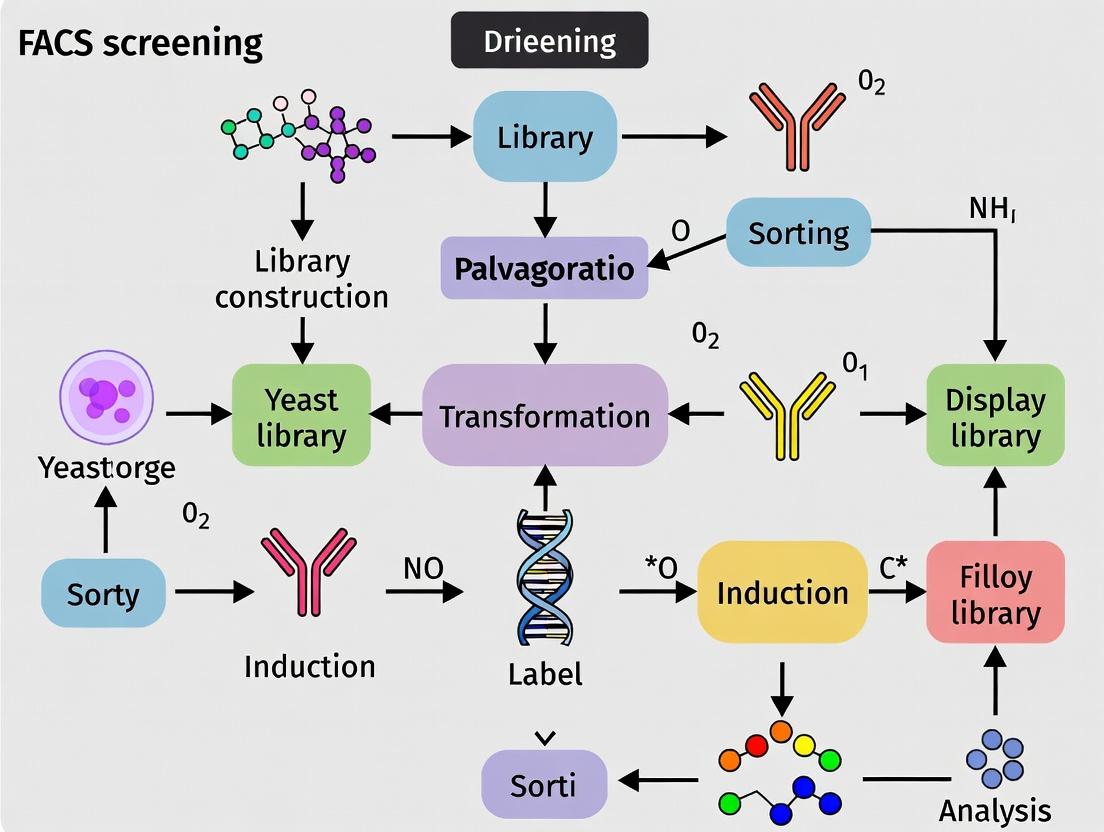
This article provides a detailed, step-by-step guide for researchers and drug discovery professionals to effectively screen yeast display libraries using Fluorescence-Activated Cell Sorting (FACS).
A Comprehensive Protocol for FACS-Based Screening of Yeast Display Libraries: From Basics to High-Throughput Discovery
Abstract
This article provides a detailed, step-by-step guide for researchers and drug discovery professionals to effectively screen yeast display libraries using Fluorescence-Activated Cell Sorting (FACS). We cover foundational principles of yeast display technology and FACS mechanics, present a complete optimized protocol from library preparation to sorting and recovery, address common troubleshooting and optimization strategies for signal and yield, and validate the approach through comparative analysis with other screening methods. This guide synthesizes current best practices to enable the successful isolation of high-affinity binders for therapeutic and diagnostic applications.
Understanding the Synergy: Yeast Display and FACS Screening Fundamentals
Yeast surface display (YSD) is a robust eukaryotic platform for presenting recombinant proteins on the surface of Saccharomyces cerevisiae cells. This technology is fundamental for high-throughput screening of protein libraries using techniques like Fluorescence-Activated Cell Sorting (FACS). Within the broader thesis on FACS screening of YSD libraries, understanding the core presentation mechanism is critical for experimental design and data interpretation.
The system exploits the yeast's innate secretory pathway and cell surface assembly machinery. A protein of interest (POI) is genetically fused to an anchoring domain, typically the Aga2p subunit of the α-agglutinin adhesion receptor. The fusion protein is expressed under a controllable promoter, secreted via the ER and Golgi, and covalently attached via disulfide bonds to Aga1p, which is itself covalently anchored to the β-glucan of the yeast cell wall. This positions the POI on the extracellular surface, accessible for binding studies.
Table 1: Key Advantages of Yeast Surface Display for FACS Screening
| Advantage | Quantitative Impact / Rationale |
|---|---|
| Eukaryotic Processing | Enables proper folding, disulfide bond formation, and glycosylation for complex mammalian proteins. |
| Direct Phenotype-Genotype Linkage | The displaying yeast cell contains the plasmid encoding the displayed protein, allowing recovery of genetic material after sorting. |
| Quantitative Analysis | Allows for measurement of binding affinity (KD) via titration and FACS, with typical detection ranges from nM to μM. |
| Library Capacity | Practical library sizes of 107 – 109 individual clones, balancing diversity with transformation efficiency. |
| Multicolor FACS Compatibility | Simultaneous use of 2-3 fluorescent labels (e.g., for expression detection and antigen binding) enables sophisticated gating strategies. |
Detailed Experimental Protocol: Yeast Display and Staining for FACS Analysis
This protocol details the induction of protein expression on the yeast surface and the labeling for subsequent FACS screening, a central methodology within the thesis research.
Materials & Reagents
- Yeast Strain: EBY100 (S. cerevisiae) or similar, containing the display plasmid (pCTcon2 or derivative).
- Media:
- SD-CAA: 20 g/L glucose, 6.7 g/L Yeast Nitrogen Base, 5 g/L Casamino acids, 10.19 g/L Na2HPO4·7H2O, 8.56 g/L NaH2PO4·H2O. pH 6.0. For plates, add 15 g/L agar.
- SG-CAA: Identical to SD-CAA but with 20 g/L galactose instead of glucose (for induction).
- Buffers: PBS (pH 7.4), PBSA (PBS + 0.1% BSA).
- Primary Label: Biotinylated target antigen at varying concentrations (for affinity titration).
- Detection Labels:
- Mouse anti-c-myc monoclonal antibody (Clone 9E10) for detection of the N-terminal c-myc tag (expression control).
- Streptavidin-conjugated fluorophore (e.g., SA-PE, SA-APC) for detecting bound biotinylated antigen.
- Fluorophore-conjugated anti-mouse IgG antibody (e.g., Alexa Fluor 488) for detecting the anti-c-myc antibody.
- Equipment: Shaking incubator (30°C), centrifuge, flow cytometer (e.g., BD FACS Aria, Sony SH800).
Protocol Steps
A. Yeast Culture and Induction
- Inoculate a single colony from an SD-CAA agar plate into 2 mL of SD-CAA media. Grow overnight (16-24 hrs) at 30°C with shaking (250 rpm).
- Dilute the overnight culture to an OD600 of ~0.5 in fresh SD-CAA. Grow for another 4-6 hours until OD600 reaches 2-4.
- Harvest cells by centrifugation (3,000 x g, 2 min). Wash cells once with an equal volume of sterile SG-CAA media.
- Resuspend cells to an OD600 of 1.0 in SG-CAA to induce protein expression. Incubate at 20°C with shaking (250 rpm) for 18-24 hours. Note: Lower temperature (20°C) often improves display of complex proteins.
B. Cell Staining for FACS Analysis
- Harvest 5 x 10⁶ induced yeast cells (typically ~1 mL of OD600=1 culture) per staining condition by centrifugation (5,000 x g, 1 min). Wash once with 1 mL of ice-cold PBSA.
- Primary Labeling: Resuspend cell pellet in 50 µL of PBSA containing the biotinylated antigen at the desired concentration (e.g., from 1 nM to 1 µM for a titration). Incubate on ice or at room temperature for 30-60 minutes.
- Wash cells twice with 1 mL of ice-cold PBSA.
- Secondary/Detection Labeling: Resuspend cell pellet in 50 µL of PBSA containing two detection reagents:
- Fluorophore-conjugated anti-mouse IgG antibody (1:100 dilution) to label the anti-c-myc primary antibody.
- A different fluorophore-conjugated Streptavidin (1:100 dilution) to label the bound biotinylated antigen. Incubate on ice in the dark for 20-30 minutes.
- Wash cells twice with 1 mL of ice-cold PBSA.
- Resuspend final pellet in 200-500 µL of PBSA for FACS analysis. Keep on ice and protected from light.
- FACS Analysis: Analyze cells using a flow cytometer equipped with appropriate lasers and filters. Gate on yeast population based on FSC/SSC, then analyze fluorescence in the relevant channels (e.g., FITC for expression, PE for antigen binding).
Visualization of the Yeast Display and Screening Workflow
Diagram 1: YSD-FACS Screening Cycle
Diagram 2: Molecular Architecture of Yeast Surface Display
The Scientist's Toolkit: Essential Reagent Solutions
Table 2: Key Research Reagents for Yeast Surface Display Screening
| Reagent / Material | Function & Role in Screening |
|---|---|
| EBY100 Yeast Strain | Engineered S. cerevisiae with chromosomal integration of AGA1 under control of the GAL1 promoter. Essential host for the display system. |
| pCTcon2 Vector | Primary display plasmid. Contains galactose-inducible (GAL1) promoter, Aga2p fusion site, c-myc/HA epitope tags, and bacterial/yeast selection markers. |
| SD-CAA / SG-CAA Media | Selective growth (glucose) and induction (galactose) media. Defined composition ensures reproducible protein expression and library maintenance. |
| Biotinylated Antigen | The target molecule for binding screens. Biotin enables strong, specific detection with streptavidin-fluorophore conjugates in FACS. |
| Anti-c-myc Antibody (9E10) | Primary antibody for detecting the N-terminal epitope tag. Serves as a universal expression reporter, independent of POI function. |
| Fluorophore-Conjugated Streptavidin | Critical detection reagent for bound biotinylated antigen. Available in multiple colors (PE, APC, etc.) for multiplexing. |
| Fluorophore-Conjugated Anti-Mouse IgG | Secondary antibody for detecting the anti-c-myc antibody, completing the expression reporting channel. |
| Magnetic Beads (Streptavidin) | Used for pre-enrichment of binders before FACS to reduce library size and remove non-binders, saving sort time. |
| Zymoprep Yeast Plasmid Kit | For rapid recovery of display plasmids from sorted yeast populations, enabling sequence analysis and plasmid shuttling to E. coli. |
Within the context of a broader thesis on Fluorescence-Activated Cell Sorting (FACS) screening of yeast display libraries, this application note details the core advantages of FACS for quantitative, multiparameter interrogation of protein or peptide variant libraries. Yeast display, which presents recombinant proteins on the surface of Saccharomyces cerevisiae, coupled with FACS screening, represents a cornerstone technology for high-throughput protein engineering, antibody discovery, and epitope mapping. FACS transcends traditional bulk selection methods by enabling the quantitative measurement and physical isolation of individual clones based on multiple, simultaneously measured fluorescence parameters.
Core Advantages of FACS for Library Interrogation
The power of FACS in library screening stems from several interconnected advantages, summarized quantitatively below.
Table 1: Quantitative Advantages of FACS in Yeast Display Library Screening
| Advantage | Quantitative/Technical Metric | Implication for Library Screening |
|---|---|---|
| Multiparameter Analysis | Simultaneous measurement of 2-18+ fluorescence channels (e.g., FITC, PE, APC, Alexa Fluor conjugates). | Enables concurrent assessment of target binding (via fluor-labeled antigen), expression level (via epitope tag detection), and viability (via scatter or viability dye). Allows for complex gating strategies to identify clones with optimal properties. |
| Quantitative Resolution | Measurement of fluorescence intensity on a linear or logarithmic scale (10⁴–10⁵ dynamic range). | Provides a precise, numerical affinity ranking (mean fluorescence intensity, MFI) of displayed clones. Distinguishes subtle differences in binding strength that bulk methods cannot. |
| High-Throughput Screening | Analysis and sorting speeds of 10,000–100,000 events per second. | Enables the screening of library sizes exceeding 10⁹–10¹⁰ clones in a practical timeframe, sampling deep into sequence diversity. |
| Single-Cell Isolation | Direct deposition of single cells into multi-well plates with >95% purity and viability. | Directly links a desired phenotype (binding signal) with its genotype (the yeast cell). Isolates rare clones of interest from a vast background for subsequent expansion and validation. |
| Real-Time Gating & Decision Making | On-the-fly analysis and sorting based on user-defined, complex multidimensional gates. | Permits iterative, enrichment-based screening strategies. Researchers can adjust sorting gates between rounds based on population shifts to stringently select for improved clones. |
Application Note: Multiparameter Enrichment of High-Affinity Binders
This protocol outlines a standard workflow for enriching high-affinity binders from a yeast display library using multiparameter FACS.
Objective: To isolate clones from a yeast-displayed scFv library that bind to a target antigen with high affinity and good expression.
Detailed Protocol:
Library Induction & Harvest:
- Induce yeast library expression in SG-CAA medium at 20–25°C for 16-24 hours.
- Harvest 1x10⁸ – 1x10⁹ cells by centrifugation (3,000 x g, 5 min). Wash cells twice with cold PBSA (PBS + 0.1% BSA, pH 7.4).
Staining for Multiparameter Analysis:
- Primary Labeling: Resuspend cells in PBSA containing a titrated, biotinylated target antigen. Incubate on ice or at 4°C for 60-90 minutes with gentle rotation.
- Wash: Wash cells twice with cold PBSA to remove unbound antigen.
- Secondary Labeling: Resuspend cells in PBSA containing two fluorescent probes:
- Streptavidin conjugated to Phycoerythrin (SA-PE, e.g., 1:100 dilution) to detect antigen binding.
- Anti-c-Myc antibody conjugated to Fluorescein (FITC, e.g., 1:100 dilution) to detect surface expression of the scFv fusion.
- Incubate on ice for 30 minutes in the dark.
- Wash & Resuspend: Wash cells twice with cold PBSA. Finally, resuspend in PBSA at a density of ~1x10⁷ cells/mL. Keep samples at 4°C and protected from light until sorting.
FACS Gating Strategy & Sorting:
- Use a high-speed cell sorter equipped with 488 nm (for FITC) and 561 nm (for PE) lasers.
- Apply the following sequential gating logic, visualized in the diagram below:
- Gate on forward scatter (FSC-A) vs. side scatter (SSC-A) to select single yeast cells.
- Gate on FSC-H vs. FSC-A to exclude doublets.
- Gate on the FITC (expression) channel to select cells expressing the scFv construct.
- Apply a sorting gate on the PE (binding) channel to collect the top 0.1–5% of cells with the highest PE signal (high binders) within the expression-positive population.
Post-Sort Processing:
- Sort cells directly into sterile SD-CAA medium in a 96-well plate or a bulk culture tube.
- Allow sorted cells to recover and expand for 24-48 hours before inducing for the next round of screening or for monoclonal analysis.
Visualization of Workflow and Logic
Diagram 1: Multiparameter FACS Gating Logic for Yeast Display
Diagram 2: Iterative Library Screening Workflow
The Scientist's Toolkit: Essential Research Reagents & Materials
Table 2: Key Reagent Solutions for FACS-Based Yeast Display Screening
| Item | Function in Protocol | Critical Notes |
|---|---|---|
| SG-CAA Medium | Selective induction medium for galactose-driven expression of the displayed protein. | Contains galactose as carbon source and lacks tryptophan to maintain plasmid selection. |
| PBSA Buffer (PBS + 0.1% BSA) | Standard wash and staining buffer. BSA reduces non-specific binding of probes. | Must be sterile-filtered (0.22 µm) and ice-cold for all staining steps. |
| Biotinylated Target Antigen | The primary target for binding by displayed library variants. Biotin enables sensitive fluorescent detection. | Biotin:protein ratio must be optimized to avoid avidity effects. Concentration is titrated per round. |
| Fluorescent Conjugates:• SA-PE/APC• Anti-c-Myc-FITC | SA-PE/APC: Detects bound biotinylated antigen.Anti-c-Myc-FITC: Detects surface expression level via a C-terminal epitope tag. | Use secondary reagents pre-adsorbed against yeast to minimize background. Protect from light. |
| Propidium Iodide (PI) or DAPI | Viability dye to exclude dead/damaged cells. Stains nucleic acids of permeabilized cells. | Add immediately before sorting. Gate out PI+/DAPI+ events. |
| SD-CAA Medium | Recovery and expansion medium for yeast post-sort. Contains dextrose as carbon source. | Used for outgrowth of sorted cells to prepare for the next round or monoclonal plating. |
| 96-Well Plate (Tissue Culture Treated) | Receiver plate for single-cell deposition during sorting. | Typically filled with 100-200 µL of sterile SD-CAA medium per well. |
Within the framework of FACS-based screening of yeast display libraries for drug discovery, the precise selection and application of antigens, detection reagents, and fluorescent probes are fundamental. This workflow enables the isolation of high-affinity antibody fragments or other binding proteins by tagging yeast cells based on target binding strength and specificity. The quantitative nature of FACS relies on the fluorescent signal intensity, which is directly contingent on the quality and performance of these essential components.
Key Components and Research Reagent Solutions
The successful execution of a FACS screen requires a carefully curated toolkit. Below is a table detailing essential materials and their functions.
Table 1: Research Reagent Solutions for FACS Screening of Yeast Display Libraries
| Component | Function & Critical Notes |
|---|---|
| Purified Target Antigen | The molecule of interest (e.g., protein, peptide, receptor ectodomain). Must be highly pure, properly folded, and conjugated to a tag (e.g., biotin, AviTag) for downstream detection. |
| Primary Detection Reagent | A tag-specific reagent (e.g., streptavidin, anti-epitope tag antibody) that bridges the antigen to the fluorescent probe. High purity and low non-specific binding are essential. |
| Fluorescent Probe (Conjugate) | The fluorophore (e.g., Alexa Fluor 647, PE) conjugated to the detection reagent. Choice depends on laser lines, filter sets, and spectral overlap with other probes. Photostability is key. |
| Yeast Display Library | Saccharomyces cerevisiae library expressing the protein of interest (e.g., scFv) fused to Aga2p on the cell surface. Diversity and quality are paramount. |
| Induction Media (SGCAA) | Synthetic media with galactose and raffinose to induce protein expression on the yeast surface. |
| Wash/Staining Buffer (PBSA) | Phosphate-Buffered Saline (PBS) pH 7.4 with 0.1% Bovine Serum Albumin (BSA). BSA reduces non-specific binding during staining steps. |
| Propidium Iodide (PI) or DAPI | Viability dye to exclude dead or compromised cells during FACS analysis/sorting. |
| Magnetic Separation Beads | Optional for pre-enrichment. Streptavidin-coated magnetic beads can be used to capture antigen-binding yeast cells prior to FACS. |
Protocols for Key Experiments
Protocol 3.1: Yeast Library Induction and Antigen Staining for FACS Analysis
Objective: To prepare and label a yeast display library for analysis or sorting based on antigen binding affinity. Materials: Induced yeast library culture, Purified biotinylated antigen, Streptavidin-fluorophore conjugate, PBSA buffer, PI viability dye. Procedure:
- Induction: Grow yeast library in selective media to mid-log phase. Induce protein expression by transferring cells to SGCAA media. Incubate at 20-30°C with shaking for 18-24 hours.
- Harvest & Wash: Pellet 1-5 x 10^7 cells by centrifugation (3,000 x g, 2 min). Wash cells twice with 1 mL ice-cold PBSA.
- Primary Labeling: Resuspend cells in 100 µL PBSA containing the biotinylated antigen at a predetermined concentration (e.g., ranging from 100 nM for equilibrium sorting to low nM/pM for off-rate selections). Incubate on ice or at room temperature for 30-60 minutes with gentle agitation.
- Wash: Pellet cells and wash twice with 1 mL ice-cold PBSA to remove unbound antigen.
- Secondary Labeling: Resuspend cells in 100 µL PBSA containing a titrated, optimal concentration of streptavidin-fluorophore conjugate (e.g., Streptavidin-Alexa Fluor 647). Incubate on ice for 20-30 minutes in the dark.
- Wash & Viability Stain: Wash cells twice with 1 mL ice-cold PBSA. Resuspend in 500 µL PBSA containing a 1:200 dilution of PI. Keep on ice and protected from light until FACS.
- FACS Setup: Use a high-speed sorter equipped with appropriate lasers and filters. Gate on single, PI-negative (viable) cells. Sort the top 0.5-2% of cells based on fluorescent signal intensity for high-affinity binders.
Protocol 3.2: Titration and Validation of Detection Reagents
Objective: To determine the optimal working concentration of fluorescent detection reagents to minimize background and maximize signal-to-noise. Materials: Antigen-positive control yeast strain (displaying a known binder), Antigen-negative control yeast strain, Serial dilutions of detection reagent. Procedure:
- Induce and harvest control yeast strains as in Protocol 3.1.
- Stain both strains with a saturating concentration of antigen, followed by a series of 2-fold dilutions of the streptavidin-fluorophore conjugate (e.g., from 1 µg/mL to 0.015 µg/mL).
- Process samples as per steps 6-7 in Protocol 3.1, analyzing by flow cytometry.
- Plot Median Fluorescence Intensity (MFI) vs. reagent concentration for both strains. The optimal concentration is typically at the plateau of the positive curve, where the ratio (Positive MFI / Negative MFI) is maximal.
Table 2: Example Fluorophore Properties for FACS Screening
| Fluorophore | Excitation Laser (nm) | Emission Peak (nm) | Relative Brightness | Photostability | Common Application in Yeast Display |
|---|---|---|---|---|---|
| Alexa Fluor 488 | 488 | 519 | High | High | Secondary label, expression tag. |
| Phycoerythrin (PE) | 488, 561 | 575 | Very High | Moderate | High-sensitivity antigen detection. |
| Alexa Fluor 647 | 633, 640 | 668 | High | Very High | Primary antigen detection (low autofluorescence). |
| Propidium Iodide (PI) | 488, 532 | 617 | N/A | N/A | Viability dye (dead cell stain). |
Table 3: Typical Staining Conditions for Affinity-Based Selections
| Selection Type | Antigen Concentration | Incubation Time & Temperature | Purpose |
|---|---|---|---|
| Equilibrium Sorting | 100-500 nM | 60 min, RT or 4°C | Isolate binders based on overall affinity (K_D). |
| Off-Rate Sorting | Saturating, then dilute | Label at saturation, then add excess unbiotinylated antigen for competitive dissociation (e.g., 1-24 hrs). | Isolate binders with slow dissociation kinetics (k_off). |
Diagrams
FACS Screening Workflow for Yeast Display
Detection Complex Assembly on Yeast
Application Notes and Protocols
Within FACS-based yeast display library screening for therapeutic antibody or protein discovery, the initial library's diversity and quality are the primary determinants of success. A high-quality library ensures that rare, high-affinity binders are present and can be efficiently enriched over multiple sorting rounds. These protocols are framed within a thesis investigating advanced FACS stringency gates and pre-sort normalization to improve the recovery of picomolar-affinity clones from combinatorial libraries.
Quantitative Assessment of Library Diversity
Prior to sorting, rigorous quantification of library size and diversity is essential. The following table summarizes key metrics and their assessment methods.
Table 1: Key Metrics for Yeast Display Library Assessment
| Metric | Target Value | Measurement Method | Protocol Reference |
|---|---|---|---|
| Transformation Efficiency | >1 x 10⁷ CFU for naïve libraries | Colony counting on selective media (SDCAA) | Protocol 1.1 |
| Sequence Diversity | >90% unique sequences (by NGS) | Next-Generation Sequencing (Illumina MiSeq) | Protocol 1.2 |
| Display Efficiency | >95% of population | Flow cytometry (anti-c-myc FITC staining) | Protocol 1.3 |
| Functional Library Size | ≥100x intended sorted pool size | Calculated from (Diversity * Display Efficiency) | N/A |
Protocol 1.1: Library Transformation & Titration
- Objective: Generate a sufficiently large and clonally distinct yeast display library.
- Materials: Electrocompetent EBY100 yeast, purified library plasmid DNA, electroporator, SDCAA agar plates.
- Method:
- Perform electroporation according to standard protocols (e.g., 1.8 kV, 5 ms pulse).
- Immediately recover cells in 1 mL room temperature SOC medium for 30 min, then add 9 mL SDCAA.
- Incubate at 30°C with shaking (250 rpm) for 48 hours.
- Make serial dilutions (10⁻¹ to 10⁻⁶) in PBSA and plate 100 µL on SDCAA plates. Incubate at 30°C for 72 hours.
- Count colonies to calculate total library size (CFU = colonies * dilution factor * 10).
Protocol 1.2: NGS-Based Diversity Analysis
- Objective: Quantify the percentage of unique clones and identify potential sequence biases.
- Materials: Library plasmid DNA, PCR primers with Illumina adapters, NEBNext Ultra II Q5 Master Mix, MiSeq Reagent Kit v3.
- Method:
- Amplify the variable region (e.g., scFv or VHH) from the pooled plasmid library using barcoded primers.
- Purify amplicons and quantify via Qubit. Pool equimolar amounts of samples.
- Sequence on an Illumina MiSeq platform (2x300 bp).
- Analyze data using dedicated software (e.g., MiGEC or custom Python scripts) to cluster unique sequences and calculate diversity metrics.
Protocol 1.3: Flow Cytometric Display Check
- Objective: Confirm surface expression of the fusion protein on the yeast population.
- Materials: Induced yeast library, mouse anti-c-myc antibody (primary), FITC-anti-mouse antibody (secondary), PBSA buffer.
- Method:
- Induce library expression in SGCAA medium at 20°C for 20-24 hours.
- Aliquot 1 x 10⁶ yeast cells, wash twice with PBSA.
- Resuspend in 100 µL PBSA containing 1:100 dilution of anti-c-myc antibody. Incubate on ice for 30 min.
- Wash twice with PBSA, resuspend in 100 µL PBSA containing 1:200 FITC-anti-mouse. Incubate on ice for 30 min in the dark.
- Wash, resuspend in PBSA, and analyze on a flow cytometer. The percentage of FITC-positive cells indicates display efficiency.
Pre-Sort Normalization Protocol for Enrichment Bias Mitigation
Protocol 2.1: Magnetic Bead-Based Depletion of High-Abundance Clones
- Objective: Reduce the frequency of fast-growing or dominant clones to level the playing field for rare, high-quality binders prior to FACS.
- Materials: Induced yeast library, biotinylated non-target antigen (e.g., bovine serum albumin), streptavidin magnetic beads, magnetic rack.
- Method:
- Incubate 5 x 10⁸ induced yeast cells with 100 nM biotinylated non-target antigen in PBSA for 1 hour on ice.
- Wash cells twice to remove unbound antigen.
- Incubate cells with pre-washed streptavidin magnetic beads for 20 minutes at 4°C with gentle rotation.
- Place tube on a magnetic rack for 2 minutes. Carefully transfer the supernatant (depleted library) to a new tube.
- Wash the bead-bound cells twice, combining all supernatants. This "flow-through" library is enriched for clones that do not bind the non-target antigen and is used for the subsequent FACS sort against the target.
Visualizations
Diagram Title: Yeast Display FACS Screening Workflow with QC
Diagram Title: Pre-Sort Library Normalization via Depletion
The Scientist's Toolkit: Key Research Reagent Solutions
Table 2: Essential Materials for Library Construction and FACS Screening
| Item | Function | Critical Notes |
|---|---|---|
| EBY100 Yeast Strain (S. cerevisiae) | Display host. Contains Aga1p integrated and Aga2p expressed from plasmid for surface fusion. | Genotype must be verified for proper auxotrophic selection (Trp-). |
| pYD1 Vector (or similar) | Yeast display plasmid. Contains GAL1 promoter for inducible expression, c-myc and HA epitope tags for detection. | Multiple cloning sites vary; choose based on insert (scFv, VHH, etc.). |
| SDCAA / SGCAA Media | Selective growth (SDCAA) and induction (SGCAA) media. Galactose in SGCAA switches on expression. | pH must be adjusted to 6.0 for optimal Aga protein stability. |
| Anti-c-myc Antibody (FITC) | Primary detection antibody for quantifying surface display efficiency. | Mouse monoclonal 9E10 is standard. Conjugate choice (FITC, PE) depends on FACS laser setup. |
| Biotinylated Antigens | Target and non-target antigens for binding detection and pre-sort depletion. | Biotin:Protein ratio must be optimized to ensure monovalent binding and avoid avidity effects. |
| Streptavidin Magnetic Beads | For pre-sort depletion protocols to remove non-specific or high-abundance binders. | Size (e.g., 1 µm) impacts depletion efficiency and yeast cell loss. |
| Streptavidin-PE (SA-PE) | Crucial secondary reagent for detecting biotinylated target binding during FACS. | Provides bright, quantifiable signal. Must be titrated to avoid receptor saturation. |
| Propidium Iodide (PI) | Viability dye. Used to gate out dead/damaged cells during FACS to reduce noise. | Add immediately before sorting. Requires a laser line compatible with PE (e.g., 561 nm). |
Key FACS Parameters and Instrument Setup for Yeast Sorting
This document provides detailed application notes and protocols for Fluorescence-Activated Cell Sorting (FACS) of yeast display libraries. It is framed within the context of a broader thesis research project aimed at screening combinatorial yeast surface display libraries to identify high-affinity binders for therapeutic targets. The guidelines herein are essential for ensuring high sorting efficiency, maintaining library diversity, and achieving successful enrichment of rare clones during iterative selection rounds.
Core FACS Parameters for Yeast Display Sorting
Optimizing these parameters is critical for discriminating between yeast displaying high-affinity binders (bright fluorescence) and those with weak or no binding.
Table 1: Key FACS Sorting Parameters and Typical Values
| Parameter | Recommended Setting/Range | Purpose & Rationale |
|---|---|---|
| Primary Laser & Detector | 488 nm blue laser; FITC/GFP channel (530/30 nm bandpass filter) | Standard for detecting Fluorescein (FITC)-conjugated targets or GFP-fusion reporters. |
| Secondary Laser | 561 nm yellow-green or 633 nm red laser | Enables multiplexing (e.g., detection of c-myc or HA epitope tags with Alexa Fluor 647). |
| Threshold/FSC-H | 10,000 - 50,000 (linear scale) | Gates out small debris. Setting is instrument-specific; must capture all yeast cells. |
| Nozzle Size | 70 µm or 100 µm | Larger nozzle reduces shear stress and cell clogs. 100 µm is standard for yeast (4-6 µm cells). |
| Sheath Pressure | 20 - 25 psi (for 100 µm nozzle) | Balances sorting speed and cell viability. Lower pressure favors viability. |
| Sort Rate | ≤ 5,000 events/sec | Prevents coincidence (swapping) and maintains sort purity. Slower rates (~2,000/sec) enhance purity. |
| Sort Mode | "Purity" or "Single Cell" (1-drop envelope) | For stringent enrichment. "Yield" mode can be used for early, diverse rounds. |
| Sorting Buffer | PBS + 0.5 - 1% BSA or FBS, 1 mM EDTA, sterile filtered | Maintains cell viability, reduces clumping, and prevents nozzle blockages. |
| Collection Tube | Sterile microcentrifuge tube with 500 µL recovery media (SDCAA) | Provides nutrients immediately post-sort to maximize outgrowth of sorted cells. |
| Gating Strategy | FSC-A vs SSC-A → Single Cells (FSC-H vs FSC-W) → Fluorescence+ | Eliminates doublets and aggregates; isolates the target fluorescent population. |
Pre-Sort Experimental Protocol: Yeast Staining for FACS
Aim: To label the yeast surface display library with fluorescent ligand for sorting.
Reagents & Solutions:
- Induced yeast library culture (in SGCAA, OD600 ~5-10).
- Biotinylated target antigen.
- Primary detection reagent: Streptavidin, Alexa Fluor 488 conjugate (SA-AF488).
- Secondary detection/viability stain: Mouse anti-c-myc primary antibody, followed by Goat anti-mouse IgG-Alexa Fluor 647 conjugate.
- Wash/Buffer: PBSA (PBS pH 7.4 + 1 mg/mL BSA), kept ice-cold.
- Sorting Buffer: PBS + 1% BSA + 1 mM EDTA, sterile filtered and degassed.
Procedure:
- Harvest & Wash: Pellet 1-5 x 10^7 yeast cells from the induced culture. Wash twice with 1 mL ice-cold PBSA.
- Primary Labeling: Resuspend cells in 100 µL PBSA containing biotinylated antigen at a desired concentration (e.g., 10-100 nM for affinity selections). Incubate on ice or at room temperature for 30-60 min with gentle rotation.
- Wash: Wash cells twice with 1 mL ice-cold PBSA to remove unbound antigen.
- Secondary Labeling: Resuspend cells in 100 µL PBSA containing SA-AF488 (e.g., 1:200 dilution) and, if desired, anti-c-myc antibody (1:100) for expression check. Incubate on ice for 30 min protected from light.
- Tertiary Labeling (if needed): If using anti-c-myc, wash once and resuspend in 100 µL PBSA with anti-mouse IgG-AF647 (1:100). Incubate on ice for 30 min, protected from light.
- Final Wash & Resuspension: Wash cells twice with 1 mL ice-cold PBSA. Resuspend the final pellet in 1-2 mL of sterile, degassed Sorting Buffer. Pass through a 35 µm cell strainer cap into a sterile FACS tube.
- Keep on Ice: Process for sorting immediately. Maintain sample at 4°C during sort using the sorter's sample cooler if available.
Instrument Setup & Calibration Protocol
Daily Startup & QC:
- Startup & Fluidics Prime: Follow manufacturer's procedures. Run decontamination and prime lines with sheath fluid.
- Performance Check: Run standardized alignment beads (e.g., 2 µm beads for 488/530/30) to optimize laser delay and CVs. Aim for CV < 3%.
- Sorting Setup: Install a 100 µm sterile nozzle. Perform drop delay determination using Accudrop or similar beads. Verify side stream stability.
- Sterilization: For aseptic sorting, run 70% ethanol through the sample line and collection chamber for 10-15 minutes, followed by sterile PBS or sheath flush.
Setting Gates for Yeast:
- Trigger on FSC-H: Set threshold to exclude small particles.
- Create FSC-A vs SSC-A plot: Draw a polygon gate (P1) around the yeast population, excluding extreme debris.
- Create FSC-H vs FSC-W plot: From P1, gate on the diagonal population (P2) to select single cells, excluding doublets and clumps.
- Create Fluorescence Plot: From P2, display AF488 (FITC) vs AF647 (PerCP-Cy5.5) fluorescence. Set sort gate (P3) on the desired double-positive or high-AF488 population. Use negative control (unstained/ no antigen) to set the boundary.
Executing the Sort:
- Set collection tube with 500 µL SDCAA media.
- Choose "Single Cell" or "Purity" sort mode with a 1-drop envelope.
- Adjust sample pressure to achieve a event rate of 2,000-5,000 events/sec in P2.
- Begin sorting. Periodically check sort efficiency and stream stability.
- Post-sort, recover collection tube and incubate at 30°C with shaking to allow outgrowth.
Visualization of the Sorting Workflow and Key Signaling
Diagram 1: Yeast Display FACS Sorting and Staining Workflow (85 chars)
Diagram 2: Yeast Surface Display and Detection Strategy (81 chars)
The Scientist's Toolkit: Essential Reagents & Materials
Table 2: Key Research Reagent Solutions for Yeast Display FACS
| Item | Function & Purpose in Protocol | Example/Notes |
|---|---|---|
| SGCAA Induction Media | Induces expression of the displayed protein under the GAL1 promoter. Contains galactose as carbon source. | Critical for library expression pre-sort. |
| PBSA (PBS + BSA) | Standard wash and labeling buffer. BSA blocks non-specific binding. | Use high-purity, low-fluorescent BSA. Keep ice-cold. |
| Biotinylated Target Antigen | The "bait" molecule that binds to yeast-displayed libraries. Biotin enables fluorescent detection. | Must be monomeric, pure, and have a low biotin:protein ratio (≤2). |
| Streptavidin-AF488 Conjugate | High-affinity detection reagent for biotin. AF488 is excited by the 488 nm laser. | Titrate to find optimal concentration; avoid over-saturation. |
| Anti-c-myc Antibody (mouse) | Detects the C-terminal epitope tag, reporting surface expression level. | Allows gating on "expressers". Use monoclonal clone 9E10. |
| Anti-mouse IgG-AF647 | Secondary antibody for c-myc detection, enables multiplexing. | Use pre-adsorbed to reduce non-specific yeast binding. |
| Degassed Sorting Buffer | Final resuspension buffer for FACS. Degassing prevents bubble formation in the sorter fluidics. | PBS + 1% BSA + 1 mM EDTA, filter (0.22 µm), degas 15 min. |
| SDCAA Recovery Media | Rich, dextrose-based media in collection tube. Represses display expression, promotes cell division. | Essential for high viability and outgrowth post-sort. |
| 35 µm Cell Strainer Caps | Attaches to FACS tubes to remove cell clumps before sorting, preventing nozzle clogs. | Use immediately before loading sample on sorter. |
Step-by-Step Protocol: From Library Induction to Clone Recovery
Within the broader thesis investigating optimized FACS screening protocols for yeast display libraries, the initial stage of controlled induction and robust surface expression is fundamental. This stage dictates library quality, ensuring the target protein or peptide is displayed in sufficient copy number for downstream sorting and analysis. Efficient induction maximizes the fraction of cells displaying the fusion protein while maintaining cell viability, setting the stage for high-resolution screening.
Key Quantitative Parameters for Induction
Optimal induction balances surface expression density with host cell health. Key metrics are summarized below.
Table 1: Quantitative Parameters for Yeast Library Induction
| Parameter | Typical Target Range | Optimal Value (for scFv display) | Measurement Method |
|---|---|---|---|
| Induction Temperature | 18°C - 30°C | 20°C - 25°C | Incubator setting |
| Induction Duration | 12 - 48 hours | 18 - 24 hours | Time from inducer addition |
| Final Galactose Concentration | 0.1% - 2% (w/v) | 0.5% - 1% (w/v) | Prepared in induction medium |
| Initial Cell Density (OD600) | 0.5 - 5.0 | 1.0 - 2.0 | Spectrophotometry |
| Post-Induction Viability | > 70% | > 90% | Flow cytometry (PI/FSC) |
| Display Efficiency* | 30% - 100% | > 70% | Flow cytometry (anti-tag stain) |
*Percentage of cells in culture displaying detectable levels of the surface fusion protein.
Detailed Protocol: Yeast Library Induction for Surface Expression
Materials and Reagents
The Scientist's Toolkit: Key Research Reagent Solutions
| Item | Function in Protocol |
|---|---|
| EBY100 or equivalent yeast strain | S. cerevisiae engineered for inducible surface display (e.g., contains pCTcon2 plasmid). |
| SD/-Trp/-Ura Medium | Selective dextrose medium for plasmid maintenance and pre-culture growth. |
| SG/-Trp/-Ura or SGR/-Trp/-Ura Medium | Selective galactose (SG) or galactose+raffinose (SGR) medium for induction of the GAL1 promoter. |
| 20% (w/v) Galactose Solution | Sterile stock solution for precise induction concentration. |
| 1x PBSA (PBS + BSA) | Phosphate-buffered saline with 1% BSA, used for cell washing and immunostaining. |
| Anti-c-myc FITC (9E10) Antibody | Primary detection antibody for the common c-myc epitope tag on displayed fusions. |
| Shaking Incubator with Temperature Control | For precise control of growth and induction temperature (20°C-30°C). |
Step-by-Step Methodology
Day 1: Inoculation and Pre-culture
- Retrieve the frozen yeast display library glycerol stock from -80°C.
- Briefly thaw and inoculate 2-5 mL of SD/-Trp/-Ura medium with a small scrape of cells. The volume should be scaled to yield an OD600 of ~1.0 after overnight growth.
- Incubate the culture at 30°C with shaking (250-300 rpm) for 12-16 hours.
Day 2: Induction of Surface Expression
- Measure the OD600 of the overnight culture.
- Calculate the volume needed to inoculate fresh SG/-Trp/-Ura induction medium at an OD600 of 1.0 in a total volume sufficient for your experiment (typically 2-5 mL per sample). Formula: Volume of culture (mL) = (Target OD * Final Volume) / OD600 of overnight culture
- Pellet the required volume of cells by centrifugation at 3,000 x g for 5 minutes at room temperature.
- Critical Wash Step: Gently resuspend the cell pellet in an equal volume of pre-warmed SG/-Trp medium to remove all glucose. Centrifuge again and discard supernatant.
- Resuspend the washed pellet in the pre-calculated volume of pre-warmed SG/-Trp/-Ura induction medium containing the target galactose concentration (typically 0.5-1% final).
- Transfer the induced culture to an appropriately sized flask (≥5x culture volume for aeration).
- Induce at the desired temperature (typically 20°C or 25°C) with shaking (250 rpm) for 18-24 hours.
Day 3: Harvest and Validation
- Check the OD600 of the induced culture. It should typically increase 2-5 fold.
- Harvest 1-2 x 10^7 cells (∼1 mL of OD600=1.0) for expression analysis by centrifugation at 3,000 x g for 5 minutes.
- Wash cells once with 1 mL of ice-cold 1x PBSA.
- Proceed to immunostaining (Step 4) to confirm surface expression before FACS screening.
Confirmation of Surface Display via Immunostaining
This protocol is run in parallel to the main induction to validate success.
- Resuspend the washed cell pellet from Day 3, Step 4 in 1 mL of PBSA containing a 1:100 dilution of anti-c-myc FITC antibody.
- Incubate on ice or at 4°C for 30-60 minutes, protected from light.
- Wash cells twice with 1 mL of ice-cold PBSA.
- Resuspend in 0.5-1 mL PBSA for analysis.
- Analyze via flow cytometry. A successful induction will show a clear rightward shift in fluorescence compared to an uninduced or negative control.
Visualizing the Induction and Expression Workflow
Diagram Title: Yeast Library Induction and Validation Workflow
Diagram Title: GAL1 Induction Pathway for Yeast Surface Display
Following the initial sorting of a yeast display library to enrich potential binders, Stage 2 involves labeling the yeast surface with the target antigen and employing a detection strategy to isolate clones with specific binding characteristics. This step is critical for confirming affinity, specificity, and epitope diversity within the context of a broader FACS-based screening thesis.
Key Principles and Strategies
The core objective is to fluorescently label yeast cells based on their interaction with the target antigen. A common strategy employs a biotinylated target antigen, detected via a streptavidin-conjugated fluorophore. Alternatively, direct fluorophore conjugation to the antigen or the use of primary and fluorescent secondary antibodies is applicable. The choice hinges on antigen availability, labeling efficiency, and the need to minimize non-specific background.
Quantitative Labeling Parameters:
| Parameter | Typical Range | Purpose/Notes |
|---|---|---|
| Yeast Cell Density | 1–5 x 10^7 cells/mL | Optimal for staining and washing. |
| Biotinylated Antigen Concentration | 1–500 nM | Varies with expected affinity; use in excess for saturation. |
| Incubation Temperature | 4°C (on ice) or RT | 4°C minimizes antigen internalization. |
| Incubation Time | 15–30 min (primary), 15 min (detection) | Sufficient for equilibrium binding. |
| Wash Steps | 2–3x with PBSA (PBS + 0.1% BSA) | Reduces non-specific binding. |
| SA-fluorophore Concentration | 1:50 – 1:200 dilution (from stock) | Must be titrated to optimize S/N. |
| Detection Fluorophore | e.g., SA-PE, SA-APC, SA-Alexa Fluor 647 | Must be distinct from epitope tag detection fluor (e.g., FITC). |
Detailed Protocol: Labeling with Biotinylated Antigen
Materials & Reagents:
- Induced yeast display library culture from Stage 1.
- PBSA: Phosphate-buffered saline (PBS), pH 7.4, with 0.1% (w/v) bovine serum albumin (BSA).
- Biotinylated target antigen.
- Detection reagent: Streptavidin conjugated to a fluorophore (e.g., SA-PE).
- Mouse anti-c-myc antibody (for expression detection).
- Fluorescently labeled anti-mouse antibody (e.g., FITC conjugate) if not using direct fusion tag.
- Ice and 4°C centrifuge.
- Microcentrifuge tubes or 96-well V-bottom plates.
Procedure:
- Harvest & Wash: Pellet 1–5 x 10^7 yeast cells from the induced culture by centrifugation at 13,000 rpm for 30 sec. Aspirate supernatant and resuspend cells in 1 mL of cold PBSA. Repeat wash once.
- Primary Labeling (Antigen): Resuspend the cell pellet in 100 µL of PBSA containing the biotinylated antigen at a predetermined concentration (e.g., 100 nM). Incubate on a rotator for 30 minutes at 4°C (or room temperature as required).
- Wash: Add 1 mL of cold PBSA, pellet cells, and aspirate supernatant. Repeat for a total of two washes to remove unbound antigen.
- Detection Labeling (Streptavidin-fluorophore): Resuspend cells in 100 µL of PBSA containing the SA-fluorophore at the optimal dilution. Incubate on a rotator in the dark for 15 minutes at 4°C.
- Epitope Tag Labeling (Control): Concurrently or in a separate tube, label an aliquot of cells with mouse anti-c-myc antibody (1:100 dilution) followed by a FITC-conjugated anti-mouse antibody (1:50 dilution) to monitor surface expression levels. This is often done in parallel or as a two-color stain.
- Final Wash: Wash cells twice with 1 mL cold PBSA as before.
- Resuspension & Analysis: Resuspend the final pellet in 0.5–1 mL of cold PBSA. Keep on ice and protected from light until analysis by flow cytometry.
Detection Strategy and FACS Gating Logic
Successful clones are identified by dual positivity: high fluorescence from the antigen detection channel (e.g., PE for affinity) and high fluorescence from the epitope tag channel (e.g., FITC for expression). The ratio or normalized signal (Antigen signal / Epitope tag signal) can correlate with relative affinity.
FACS Gating Strategy for Clone Isolation
The Scientist's Toolkit: Key Reagent Solutions
| Item | Function in Stage 2 | Key Considerations |
|---|---|---|
| Biotinylated Antigen | The primary bait molecule; binds to displayed antibody fragments on yeast. | Biotin:protein ratio critical; must retain native conformation; carrier protein-free is ideal. |
| Streptavidin-Fluorophore Conjugates | Amplifies signal from biotinylated antigen for detection. | High purity; minimal lot-to-lot variation; choice of fluorophore (PE, APC, Alexa Fluor) depends on laser/filter setup. |
| Anti-c-myc Antibody (Mouse) | Detects the C-terminal c-myc epitope tag, quantifying surface expression. | Monoclonal (clone 9E10) is standard; validates proper protein folding and display. |
| Fluorescent Anti-Mouse IgG (e.g., FITC) | Detects bound anti-c-myc antibody for expression measurement. | Must be highly cross-adsorbed to minimize non-specific yeast binding. |
| PBSA (PBS + 0.1% BSA) | Standard wash and dilution buffer. | BSA blocks non-specific binding; must be sterile and protease-free for consistent results. |
| Fluorescence-Activated Cell Sorter (FACS) | Analyzes and physically isolates dual-positive yeast cells. | Requires configuration for appropriate lasers and filters (e.g., 488nm for FITC, 561nm for PE). |
Within the broader thesis on optimizing FACS-based yeast display library screening, Stage 3 is critical for ensuring the efficiency and specificity of the subsequent sorting event. This stage involves the analytical characterization of the pre-sort library to assess expression quality, antigen binding distribution, and background signals. A rigorously designed gate strategy, based on this analysis, is essential for isolating target-specific clones with high fidelity during fluorescence-activated cell sorting (FACS).
Key Analytical Parameters & Data Presentation
Pre-sort analysis quantifies several parameters to inform gate placement. The following table summarizes typical metrics from a model library screening for a fluorescently labeled antigen (Ag):
Table 1: Quantitative Summary of Pre-Sort Sample Analysis Metrics
| Parameter | Description | Typical Target Range/Value | Measurement Purpose |
|---|---|---|---|
| Display Efficiency | % of yeast displaying surface protein (via epitope tag staining). | >80% | Assess library health and surface expression integrity. |
| MFI of Display | Median Fluorescence Intensity (MFI) of epitope tag stain. | >10³ au (instrument dependent) | Gauge expression level homogeneity. |
| MFI of Ag-Binding (Pos) | MFI of antigen-binding signal for the stained population. | Varies by target; used for gate thresholding. | Determine binding signal strength and dynamic range. |
| % Antigen-High (Putative Binders) | Percentage of library exhibiting Ag signal above background threshold. | 0.01% - 0.5% (naïve library) | Estimate library diversity and enrichment challenge. |
| Signal-to-Background Ratio | Ratio of Ag-binding MFI to negative control MFI. | >5:1 is desirable for clear separation. | Evaluate specificity and feasibility of gating. |
| Non-Specific Binding (NSB) | MFI of library stained with irrelevant protein or secondary reagent only. | Minimize; dictates negative gate boundary. | Set lower limit for positive selection gates. |
Detailed Experimental Protocols
Protocol 1: Staining for Pre-Sort Analysis
This protocol details the staining procedure to generate data for gate strategy design.
Materials:
- Induced yeast display library culture.
- Labeled antigen (Ag) in selection buffer (e.g., PBSA: PBS + 1 mg/mL BSA).
- Negative control: Selection buffer only or irrelevant labeled protein.
- Primary detection reagent: Mouse anti-c-Myc antibody (for Aga2p-displayed scFv detection).
- Secondary detection reagents:
- Anti-mouse IgG-Alexa Fluor 488 (for display detection).
- (If Ag is biotinylated): Streptavidin-PE (for binding detection).
- Wash buffer: PBSA.
- Ice and 4°C centrifuge.
Method:
- Harvest Cells: Aliquot 1-2 x 10⁷ yeast cells from induced library culture. Pellet at 13,000 rpm for 15 seconds, aspirate supernatant.
- Primary Stain (Binding): Resuspend cells in 50 µL of labeled Ag solution at desired concentration (e.g., 100 nM). For the negative control tube, resuspend in selection buffer only. Incubate on ice for 30-60 minutes with gentle agitation.
- Wash: Add 1 mL of cold PBSA, pellet cells, and aspirate supernatant. Repeat once.
- Secondary Stains (if needed): For biotinylated Ag, resuspend cells in 50 µL of Streptavidin-PE (1:100 dilution in PBSA). Incubate on ice for 20 min, protected from light. Wash twice with 1 mL PBSA.
- Display Stain: Resuspend all tubes in 50 µL of anti-c-Myc antibody (1:100 dilution in PBSA). Incubate on ice for 30 min. Wash twice with 1 mL PBSA.
- Secondary Display Stain: Resuspend cells in 50 µL of Anti-mouse IgG-Alexa Fluor 488 (1:200 dilution in PBSA). Incubate on ice for 20 min, protected from light. Wash twice with 1 mL PBSA.
- Resuspension & Analysis: Resuspend final cell pellet in 0.5-1 mL of cold PBSA. Filter through a 35-40 µm cell strainer cap into FACS tube. Keep on ice and analyze immediately or at 4°C.
Protocol 2: Flow Cytometry Data Acquisition for Gate Design
Method:
- Instrument Setup: Calibrate the flow cytometer (e.g., BD FACSAria, Beckman Coulter MoFlo) using calibration beads. Adjust photomultiplier tube (PMT) voltages so that the negative control population is centered in the first decade of the log-scale histogram.
- Compensation: Set fluorescence compensation using single-stain controls (yeast stained for display only, and yeast stained with Ag only) to correct for spectral overlap between Alexa Fluor 488 and PE/PECy5 channels.
- Data Collection: Acquire a minimum of 100,000 events for the negative control sample first. Then, acquire at least 500,000 to 1,000,000 events for the Ag-stained library sample to adequately capture rare putative binders.
- Analysis: Use flow cytometry analysis software (e.g., FlowJo, FACS Diva) to create plots for visualization.
Visualization of Workflow and Gate Logic
Title: Stage 3 Workflow: From Stained Library to Gate Strategy
Title: Hierarchical Gating Strategy for Yeast Display FACS
The Scientist's Toolkit: Research Reagent Solutions
Table 2: Essential Materials for Pre-Sort Analysis
| Item | Function & Rationale |
|---|---|
| Fluorescently Labeled Antigen | Target molecule conjugated to PE, Alexa Fluor 647, or biotin. Directly reports binding events. Concentration must be optimized for screening. |
| Anti-c-Myc Monoclonal Antibody (9E10) | Primary antibody targeting the c-Myc epitope tag on the Aga2p-subunit. Universal for detecting displayed proteins in most yeast display systems. |
| Fluorophore-Conjugated Secondary Antibodies (e.g., Anti-Mouse AF488) | Enables detection of the primary anti-epitope tag antibody. Provides the "display" signal critical for quality control gating. |
| Streptavidin-PE/Cy5 | High-affinity reagent for detecting biotinylated antigens. Essential for indirect staining when direct labeling of Ag is not feasible. |
| PBSA Buffer (PBS + 1 mg/mL BSA) | Standard washing and staining buffer. BSA reduces non-specific binding of proteins to yeast cells. |
| 35 µm Cell Strainer Caps | Filters out cell clumps before FACS analysis, preventing instrument clogging and ensuring accurate single-cell analysis. |
| Flow Cytometry Compensation Beads | Used with single-stain controls to calculate spectral overlap compensation matrix, ensuring fluorescence signal purity in each channel. |
| Analysis Software (e.g., FlowJo) | Enables detailed visualization of multi-parameter data, population statistics calculation, and precise, reproducible gate drawing for template creation. |
Application Notes
In the high-throughput screening of yeast display libraries for drug discovery, the final high-speed Fluorescence-Activated Cell Sorting (FACS) stage is critical for isolating rare, high-affinity binders. The operator must strategically choose between Purity Mode and Recovery Mode, a decision that directly impacts screening outcomes. Purity Mode prioritizes the exclusion of unwanted cells, ensuring a highly enriched population but at the potential cost of losing some target cells. Recovery Mode maximizes the capture of all target cells, accepting a higher degree of contaminant co-isolation. The choice is governed by the screening objective: early-stage de novo discovery often favors Recovery to avoid losing rare clones, while later-stage enrichment for characterization requires Purity.
Key quantitative performance metrics for a modern high-speed sorter (e.g., 100 µm nozzle, 40-50 psi) are summarized below:
Table 1: Performance Metrics for High-Speed FACS Modes
| Parameter | Purity Mode | Recovery Mode | Notes |
|---|---|---|---|
| Sort Rate | 20,000 - 30,000 events/sec | 15,000 - 25,000 events/sec | Limited by decision logic complexity. |
| Target Purity | >98% | 85-95% | Post-sort analysis typically via re-analysis. |
| Target Yield/Recovery | 80-90% | >95% | Percentage of desired population collected. |
| Dead Time/Abort Rate | Higher | Lower | Purity mode has stricter coincidence rejection. |
| Typical Nozzle Size | 70-100 µm | 100-130 µm | Larger nozzle can improve recovery of fragile cells. |
| Sheath Pressure | 45-55 psi | 35-45 psi | Lower pressure can enhance yeast viability. |
Table 2: Decision Matrix for Mode Selection in Yeast Display Screening
| Screening Phase | Primary Goal | Recommended Mode | Rationale |
|---|---|---|---|
| Primary Library Panning | Capture maximum diversity | Recovery | Avoid loss of rare, low-abundance binders. |
| Secondary Enrichment | Increase binder frequency | Purity | Remove non-specific binders efficiently. |
| Tertiary Stringency Sort | Isolate highest affinity clones | Purity | Achieve >99% purity for characterization. |
| Final Clone Isolation | Single-cell deposition | Purity (Single-Cell) | Ensure one cell per well with high confidence. |
Experimental Protocols
Protocol 1: Instrument Setup for High-Speed Yeast Sorting
- Preparation: Sterilize fluidic lines with 10% bleach for 30 minutes, followed by copious sterile DI water and sheath fluid (e.g., PBS). Use a 100 µm ceramic nozzle.
- Alignment: Align the system using alignment beads (e.g., 2 µm fluorescent beads). Optimize laser delays and drop drive frequency for stable break-off.
- Sample Preparation: Induce yeast display library expression. Label with fluorescently conjugated target antigen (e.g., biotinylated antigen + streptavidin-PE) and a viability dye (e.g., propidium iodide). Resuspend in sterile sort buffer (PBS + 0.5% BSA + 1 mM EDTA) at a density of 50-100 million cells/mL.
- Gating Strategy: Create a sequential gating hierarchy on the sorter software:
- FSC-A vs. SSC-A: Gate on yeast population.
- FSC-H vs. FSC-A: Gate on single cells.
- Viability dye vs. SSC: Gate on live (dye-negative) cells.
- Fluorescence (Antigen signal) vs. SSC: Define the positive population (top 0.1-5%).
- Mode Configuration:
- For Purity Mode: Set sort mode to "4-Way Purity." Use a tight "Single-Cell" or "1.0 Drop Pure" mask. Increase abort rate for coincidence rejection.
- For Recovery Mode: Set sort mode to "4-Way Yield" or "Enrich." Use a "1.5 Drop" or "2.0 Drop" envelope. Relax abort rate settings.
- Collection: Sort into collection tubes containing 500 µL of rich recovery medium (e.g., SDCAA + penicillin/streptomycin). Keep samples on ice or at 4°C during sort.
- Post-Sort Analysis: Run a small aliquot of the sorted sample through the analyzer to assess purity and viability. Plate sorted cells for outgrowth.
Protocol 2: Quantitative Assessment of Sort Performance
- Purity Assay: Immediately after sorting, take a 10 µL aliquot from the collection tube. Analyze on the sorter (using analyzer settings) or a benchtop flow cytometer. The percentage of the gated target cells within the live, single-cell gate defines the Actual Purity.
- Recovery/Yield Calculation:
- Pre-Sort Count: Note the total number of events processed and the absolute count of the target (gated) population pre-sort.
- Post-Sort Count: After outgrowth (18-24 hours), take a 1 mL sample of the culture. Use a hemocytometer or automated cell counter to determine the total cell count. Determine the frequency of target cells (e.g., by plasmid retention or re-staining) via flow analysis.
- Calculation: Recovery (%) = (Post-sort target cell count / Pre-sort target cell count) * 100.
- Viability Check: Plate serial dilutions of the pre-sort and post-sort cultures on selective agar plates. Compare colony-forming units (CFUs) to flow counts to assess sorting-induced stress.
Visualizations
Title: Decision Flow for Purity vs. Recovery Mode Selection
Title: High-Speed Yeast Display FACS Sorting Protocol Workflow
The Scientist's Toolkit
Table 3: Essential Research Reagent Solutions for High-Speed FACS of Yeast
| Item | Function/Benefit | Example/Note |
|---|---|---|
| Sterile Sheath Fluid | Particle-free fluid for stable stream; prevents contamination. | 1x PBS, 0.22 µm filtered. For yeast, 1 mM EDTA can prevent clumping. |
| Sort Collection Buffer | Maintains cell viability and prevents overgrowth post-sort. | SDCAA medium + 1% Pen/Strep. Keep on ice. |
| Fluorescent Conjugates | Label target antigen for detection. High brightness is key. | Biotinylated antigen + Streptavidin-PE/APC. Use monomeric Avidin for elution. |
| Viability Dye | Distinguish live from dead cells; critical for purity. | Propidium Iodide (PI) or DAPI for dead cells. Must be excluded from sort gate. |
| Alignment Beads | Optimize instrument performance before sorting critical samples. | 2-3 µm rainbow fluorescent particles. |
| Nozzle Cleaner | Maintain and sterilize nozzle between sorts. | 10% bleach, 70% ethanol, Contrad 70 detergent. |
| Cloning Medium | For direct plating of single cells after sort. | Selective agar plates (e.g., SDCAA agar). |
Application Notes
Following Fluorescence-Activated Cell Sorting (FACS) of a yeast display library, the Post-Sort Recovery, Expansion, and Analysis phase is critical for validating sort success, ensuring clonal integrity, and characterizing selected binders. This stage transitions from a pooled population to discrete clones for downstream applications in drug discovery.
Key Objectives:
- Recovery: Maintain viability of the sorted yeast population, which has undergone significant stress.
- Expansion: Generate sufficient biomass for sequence analysis and functional validation.
- Analysis: Quantitatively assess the enrichment of target-binding clones, determine sequence diversity, and confirm binding characteristics at a clonal level.
Critical Considerations:
- Bottlenecking: Inadequate recovery can lead to loss of rare, high-affinity clones.
- Growth Rate Bias: During expansion, faster-growing clones may outcompete slower-growing high-affinity binders, skewing population representation.
- Validation Rigor: Mono-clonality must be confirmed; a single sorted event can deposit multiple cells.
Protocols
Protocol: Immediate Post-Sort Recovery and Primary Expansion
Objective: To resuscitate sorted yeast cells and initiate culture for biomass generation.
Materials:
- Sorted yeast pool in collection tube (typically containing SDCAA media).
- Fresh SDCAA media (20 g/L dextrose, 6.7 g/L YNB, 5 g/L casamino acids, 8.56 g/L Na2HPO4•7H2O, 8.2 g/L NaH2PO4•H2O, pH 6.0).
- Sterile 15 mL or 50 mL conical tubes.
- 30°C shaking incubator.
Method:
- Immediately following sort completion, pellet the collected yeast cells by centrifugation at 3,000 × g for 5 minutes.
- Gently resuspend the cell pellet in 5-10 mL of fresh, pre-warmed SDCAA media. The volume should be scaled based on the estimated number of sorted cells (aim for an initial density of <1x10^6 cells/mL to allow immediate growth).
- Transfer the suspension to a sterile culture flask or tube. The culture volume should not exceed 20% of the container's capacity for adequate aeration.
- Incubate at 30°C with shaking at 220-250 rpm for 48-72 hours. Monitor growth by OD600.
Protocol: Secondary Expansion and Glycerol Stock Generation
Objective: To amplify the culture for analysis and create archival stocks.
Method:
- After primary expansion, measure the OD600 of the culture.
- Dilute the culture into fresh SDCAA media to an OD600 of ~0.1-0.2 in a total volume sufficient for planned analyses (typically 10-50 mL).
- Incubate at 30°C with shaking until the culture reaches mid-log phase (OD600 ~1.0-2.0). This typically takes 12-18 hours.
- For glycerol stocks: Aseptically mix 0.5 mL of the dense yeast culture with 0.5 mL of sterile 50% glycerol in a cryovial. Mix thoroughly. Immediately freeze at -80°C for long-term storage.
Protocol: Analysis of Enrichment and Diversity
Objective: To evaluate the success of the sort by comparing binding of the pre-sort and post-sort pools.
Materials:
- Pre-sort library aliquot (from Stage 1).
- Post-sort expanded culture.
- Antigen of interest, fluorescently labeled.
- Flow cytometry buffer (PBSA: PBS pH 7.4, 0.1% BSA).
- Anti-c-Myc primary antibody (e.g., mouse anti-c-Myc) and fluorescent secondary antibody (e.g., Alexa Fluor 488-goat anti-mouse) for expression check.
- Flow cytometer.
Method:
- Induce expression of the displayed protein in both pre-sort and post-sort cultures by inoculating them into SGCAA media (identical to SDCAA but with galactose replacing dextrose) and incubating for 18-24 hours at 20°C.
- For each sample (pre-sort and post-sort), aliquot 1-2 x 10^6 cells into separate microcentrifuge tubes. Pellet cells at 3,000 × g for 2 minutes.
- Labeling: Resuspend cells in 100 µL flow cytometry buffer containing a predetermined, saturating concentration of labeled antigen. Include controls: no antigen (background), and secondary antibody only for post-sort.
- Incubate on ice or at room temperature (per antigen stability) for 30-60 minutes, protected from light.
- Wash cells twice with 1 mL ice-cold flow cytometry buffer.
- Resuspend in 300-500 µL flow cytometry buffer for analysis.
- Acquire data on a flow cytometer, analyzing 10,000-50,000 events per sample. Gate on yeast population based on scatter.
- Compare the percentage of antigen-positive cells and the median fluorescence intensity (MFI) between pre-sort and post-sort populations.
Protocol: Plating for Monoclonal Isolation and Sequence Analysis
Objective: To isolate single clones for sequence determination and individual validation.
Method:
- From the induced post-sort culture, perform serial dilutions in PBSA or SDCAA.
- Spread 100 µL of appropriate dilutions (e.g., 10^-3, 10^-4) onto SDCAA agar plates to obtain ~100-200 colonies per plate.
- Incubate plates at 30°C for 48-72 hours until colonies are visible.
- Pick 48-96 individual colonies into 96-well deep-well plates containing 1 mL of SDCAA media per well. Grow for 48 hours at 30°C, shaking.
- Use a part of each culture for plasmid extraction (yeast plasmid mini-prep kit) followed by sequencing of the insert region using a plasmid-specific primer.
- Analyze sequences to determine the diversity of enriched clones and identify consensus motifs.
Data Presentation
Table 1: Quantitative Enrichment Analysis from a Representative FACS Sort
| Sample | % Antigen-Positive Cells | MFI (Antigen) | MFI (Expression) | Fold-Enrichment (% Pos) |
|---|---|---|---|---|
| Pre-Sort Library | 0.15 | 520 | 18,500 | 1.0 |
| Post-Sort Pool (Round 1) | 12.7 | 8,150 | 21,200 | 84.7 |
| Post-Sort Pool (Round 2) | 89.4 | 45,300 | 19,800 | 596.0 |
Table 2: Sequence Analysis of 96 Randomly Picked Post-Sort Clones
| Sequence Cluster | Number of Clones | Frequency (%) | Representative KD (nM)* |
|---|---|---|---|
| Clone Family A | 78 | 81.3 | 2.1 |
| Clone Family B | 12 | 12.5 | 5.7 |
| Clone Family C | 4 | 4.2 | 0.8 |
| Unique Singletons | 2 | 2.1 | Varies |
*KD values from subsequent surface plasmon resonance (SPR) analysis.
Diagrams
Title: Post-Sort Workflow: Recovery to Analysis
Title: Iterative FACS Screening Cycle with Stage 5
The Scientist's Toolkit
Table 3: Essential Research Reagents for Post-Sort Analysis
| Item | Function & Rationale |
|---|---|
| SDCAA Media | Selective growth medium for yeast displaying the plasmid. Maintains plasmid pressure and supports recovery. |
| SGCAA Media | Induction medium (galactose). Switches expression of the displayed protein from glucose-repressed to ON state for analysis. |
| Fluorescently-Labeled Antigen | The target molecule conjugated to a fluorophore (e.g., Alexa Fluor 647). Used to re-stain the pool to quantify sort enrichment. |
| Anti-c-Myc Antibody & Secondary | Antibodies for detecting the C-terminal c-Myc epitope tag. Critical control for surface expression level of the displayed protein. |
| Flow Cytometry Buffer (PBS/BSA) | Wash and staining buffer. BSA reduces non-specific binding of antigens and antibodies to yeast cells. |
| SDCAA Agar Plates | Solid medium for the isolation of single yeast colonies to ensure monoclonality after sorting. |
| Yeast Plasmid Miniprep Kit | For efficient extraction of plasmid DNA from yeast cultures for subsequent sequencing of the variant insert. |
| Cryogenic Vials & 50% Glycerol | For generating long-term archival stocks of sorted pools and individual clones at -80°C. |
Solving Common Pitfalls and Enhancing Screening Performance
The success of Fluorescence-Activated Cell Sorting (FACS) in screening yeast display libraries for high-affinity binders hinges on achieving a high signal-to-noise ratio (SNR). A low SNR, characterized by poor discrimination between displayed clones and background fluorescence, leads to inefficient sorting and potential loss of rare, high-quality binders. This application note, framed within a broader thesis on optimizing FACS-based biopanning, details protocols for two critical parameters: optimal antigen concentration for labeling and the strategic use of labeling reagents to maximize specificity and detection sensitivity.
Table 1: Impact of Antigen Concentration on FACS Sorting Metrics
| Antigen Concentration (nM) | Mean Fluorescence Intensity (MFI) | Signal-to-Noise Ratio (SNR) | % Positive Population | Recommended Use Case |
|---|---|---|---|---|
| 1 | 1,250 | 3.5 | 15% | Enrichment of ultra-high affinity clones (Kd < 1 nM) |
| 10 | 8,750 | 12.0 | 65% | Primary library sorts and standard affinity maturation rounds |
| 50 | 15,000 | 15.5 | 85% | Staining for off-rate sorting (with chase) |
| 100 | 16,200 | 15.8 | 88% | Saturation staining for accurate clone characterization |
| 500 | 16,500 | 15.0 | 87% | May increase non-specific binding; not recommended for sorting |
Table 2: Comparison of Labeling Strategies for Yeast Display FACS
| Labeling Strategy | Key Reagent(s) | Primary Advantage | Primary Disadvantage | Best for SNR Optimization When: |
|---|---|---|---|---|
| Direct Primary | Biotinylated antigen + Streptavidin-fluorophore | Fast, single step | Potential for increased non-specific SAv binding | Using ultra-pure, monovalent SAv conjugates at low concentrations (e.g., 1-5 µg/mL). |
| Indirect Primary | Antigen with His-tag + Anti-His-Antibody-fluorophore | Amplifies signal | Additional incubation and wash step required | Antigen purity is low; antibody quality is high and pre-blocked against yeast. |
| Pre-Complexing | Biotinylated antigen pre-incubated with Streptavidin-fluorophore at 4:1 molar ratio | Ensures monovalent labeling, reduces off-target SAv binding | More complex reagent preparation | Sorting for affinity, as it prevents avidity effects and lowers background. |
| Tandem Labeling | Antigen with two distinct tags (e.g., AviTag + His-tag) with orthogonal detection | Extremely high specificity | Costly and complex reagent setup | Screening very diverse libraries with high background, requiring stringent gating. |
Detailed Experimental Protocols
Protocol 3.1: Titration of Antigen Concentration for Labeling Objective: To determine the antigen concentration that yields the optimal SNR for a given yeast display library. Materials:
- Yeast cells displaying the library (induced per standard protocol).
- Purified, labeled antigen (e.g., biotinylated).
- Wash Buffer (PBS + 1% BSA, pH 7.4).
- Streptavidin-fluorophore conjugate (e.g., SAv-PE).
- Ice and rotator. Method:
- Induce & Harvest: Induce yeast culture for surface display. Harvest 1 x 10^7 cells per titration point. Wash cells 2x with cold Wash Buffer.
- Prepare Antigen Dilutions: Prepare 2X serial dilutions of biotinylated antigen in Wash Buffer across a range (e.g., 0.5 nM to 500 nM) in separate microcentrifuge tubes.
- Primary Labeling: Aliquot 50 µL of washed yeast cells (2 x 10^7 cells/mL) into each tube containing 50 µL of antigen dilution. Incubate on a rotator at 4°C for 60 minutes.
- Wash: Wash cells 2x with 1 mL cold Wash Buffer to remove unbound antigen.
- Secondary Detection: Resuspend cell pellets in 100 µL of a fixed, low concentration of SAv-fluorophore (e.g., 2 µg/mL). Incubate on ice for 30 minutes in the dark.
- Final Wash & Analysis: Wash cells 2x, resuspend in Wash Buffer, and analyze by flow cytometry. Plot MFI and % positive against antigen concentration to identify the knee of the curve (typically 10-50 nM for initial sorts).
Protocol 3.2: Pre-complexed Antigen Labeling for Enhanced Specificity Objective: To generate monovalent antigen-fluorophore complexes that minimize non-specific streptavidin binding to yeast. Materials:
- Biotinylated antigen.
- Monovalent Streptavidin-fluorophore (e.g., SAv-PE).
- Zeba Spin Desalting Columns (7K MWCO). Method:
- Calculate Stoichiometry: Determine the molar concentration of biotinylated antigen and SAv-PE. Aim for a 4:1 molar ratio (antigen:SAv) to ensure all biotin binding sites on SAv are occupied.
- Mix & Incubate: Combine the calculated amounts in a low-protein-binding tube. Incubate at room temperature for 30 minutes in the dark.
- Remove Free Biotin: Pass the mixture through a desalting column pre-equilibrated with Wash Buffer to remove any unincorporated biotinylated antigen. Collect the eluate (the pre-complexed reagent).
- Labeling: Use the pre-complexed reagent directly in Step 5 of Protocol 3.1, replacing the sequential antigen-then-SAv steps. Use an equivalent final SAv-fluorophore concentration.
- Analysis: Compare the SNR and background fluorescence to the standard sequential labeling method.
Visualizations
Diagram 1: Workflow for Antigen Optimization & Labeling
Diagram 2: Labeling Strategy Decision Logic
The Scientist's Toolkit: Research Reagent Solutions
Table 3: Essential Materials for Optimized FACS Labeling
| Item | Function & Critical Feature | Example/Catalog Consideration |
|---|---|---|
| High-Purity Biotinylated Antigen | The primary probe; low non-specific binding and controlled biotin:protein ratio (aim for 1-2) are essential. | Labeling done via site-specific conjugation (e.g., AviTag) or controlled chemical (e.g., NHS-PEG4-Biotin) reaction. |
| Monovalent Streptavidin Conjugates | Secondary detection reagent; monovalent mutants (e.g., mSAv) prevent cross-linking and reduce background binding to yeast. | Vector Laboratories (Monomeric Avidin), Thermo Fisher (NeutrAvidin). |
| Fluorophore-Conjugated Anti-His Antibodies | For indirect/His-tag detection; must be pre-adsorbed against yeast to minimize background. | BioLegend, Qiagen (Anti-His antibodies). |
| Flow Cytometry Grade BSA | Blocking agent in wash buffers; reduces non-specific protein adsorption. Must be protease-free. | Jackson ImmunoResearch, Sigma-Aldrich (IgG-Free, Protease-Free). |
| Zeba Spin Desalting Columns | For rapid buffer exchange and removal of free biotin during pre-complexing protocol. | Thermo Fisher Scientific (7K or 40K MWCO). |
| Anti-c-Myc FITC Antibody | Detection of surface expression control; validates display efficiency independent of antigen binding. | Clone 9E10 from various suppliers. |
| Low-Protein-Binding Microcentrifuge Tubes | Minimizes loss of precious antigen and library samples during incubations and washes. | Eppendorf Protein LoBind Tubes. |
Within a broader thesis focused on optimizing FACS-based screening of yeast display libraries, a critical bottleneck was identified: poor yeast cell viability following fluorescence-activated cell sorting (FACS). This application note details the systematic investigation and optimization of sorting buffer composition and post-sort collection media to maximize the recovery of viable clones. We present comparative data and detailed protocols to enable researchers to significantly improve the efficiency of their yeast display library screening workflows, ensuring the faithful representation of library diversity after sorting.
Yeast surface display coupled with FACS is a powerful platform for the discovery and engineering of high-affinity binders. However, the physical and physiological stress imposed by hydrodynamic focusing, droplet charging, deflection, and high-speed collection often results in significant loss of cell viability, directly compromising screening fidelity. This work, conducted as part of a comprehensive thesis on protocol robustness, addresses this by methodically evaluating components that mitigate osmotic, nutritional, and shear stresses during and immediately after sorting.
Comparative Analysis of Buffer & Media Formulations
The following tables summarize quantitative viability and recovery data from our optimization experiments. Viability was assessed via propidium iodide exclusion measured by flow cytometry 2 hours post-sort. Colony Forming Units (CFU) were counted 48 hours post-sort on selective media.
Table 1: Impact of Sorting Buffer Additives on Post-Sort Viability
| Buffer Formulation | Basal Buffer | Key Additives | Avg. Viability (%) | CFU Recovery (%) |
|---|---|---|---|---|
| Standard PBS | PBS | None | 35.2 ± 4.1 | 22.5 ± 5.3 |
| Osmotic Support | PBS | 1% (w/v) BSA | 58.7 ± 3.8 | 45.1 ± 6.7 |
| Shear Protection | PBS | 0.1% Pluronic F-68 | 52.4 ± 5.2 | 40.3 ± 4.9 |
| Combined Formulation | PBS | 1% BSA, 0.1% F-68 | 72.5 ± 2.9 | 65.8 ± 5.1 |
| Rich Medium Sort | SDCAA | None | 68.1 ± 4.5 | 60.2 ± 7.0 |
Table 2: Post-Sort Collection Media Optimization
| Collection Media | Key Components | Function | Viability at 24h (%) | Doubling Time (h) |
|---|---|---|---|---|
| Standard PBS | Phosphate Buffered Saline | Inert Holding | 31.5 ± 6.1 | N/A |
| SDCAA (Std. Growth) | Dextrose, Casamino Acids | Nutrition | 75.3 ± 3.2 | 2.1 ± 0.3 |
| SDCAA + Supplements | SDCAA + 10mM HEPES, 5mM Adenine | Buffering & Metabolism | 88.6 ± 2.1 | 1.9 ± 0.2 |
| Recovery Broth | SDCAA, 1M Sorbitol, 5mM MgCl₂ | Osmotic & Membrane Support | 84.2 ± 3.7 | 2.3 ± 0.4 |
Detailed Experimental Protocols
Protocol 3.1: Preparation of Optimized Sorting Buffer
Objective: To prepare a sterile sorting buffer that maximizes yeast viability during FACS. Materials: Sterile PBS (pH 7.4), Bovine Serum Albumin (BSA, Fraction V), Pluronic F-68 (10% stock solution), 0.22 µm vacuum filter unit. Procedure:
- Under sterile conditions, pour 90 mL of sterile PBS into a sterile glass bottle.
- While stirring gently, add 1.0 gram of BSA. Allow it to dissolve completely (~15-20 mins).
- Add 1.0 mL of 10% (w/v) sterile-filtered Pluronic F-68 stock solution to achieve a final concentration of 0.1%.
- Bring the final volume to 100 mL with sterile PBS. Mix gently to avoid foaming.
- Sterile-filter the complete buffer through a 0.22 µm filter unit. Store at 4°C for up to 2 weeks. Note: For yeast displaying proteins, BSA may bind non-specifically. Include a no-BSA control in initial experiments.
Protocol 3.2: FACS Sorting with Viability-Preserving Parameters
Objective: To sort a yeast display library using parameters that minimize cell stress. Pre-sort Preparation:
- Induce protein expression as per your standard protocol (e.g., in SGCAA media).
- Label yeast with fluorescent ligands/antibodies in ice-cold sorting buffer (Protocol 3.1) containing 1% BSA to reduce non-specific binding.
- Filter cells through a 35-40 µm cell strainer cap into a sterile FACS tube to remove aggregates. FACS Instrument Settings:
- Nozzle: Use a 100 µm or larger nozzle diameter.
- Sheath Pressure: Keep ≤ 20 psi.
- Sort Mode: Purity or single-cell mode is acceptable, but avoid "enrichment" modes that may increase abort rates.
- Collection Tube: Pre-fill 15mL collection tube with 2 mL of pre-warmed SDCAA + Supplements collection media (Table 2).
- Sample Cooling: Keep the sample chamber at 4°C during the sort.
Protocol 3.3: Post-Sort Recovery and Viability Assessment
Objective: To effectively recover sorted cells and quantify viability. Materials: Optimized collection media (SDCAA + 10mM HEPES, 5mM Adenine, pH 6.0), YPD Agar plates, SDCAA Agar plates, Propidium Iodide (PI) stock solution (1 mg/mL). Procedure:
- Immediately after sorting, cap the collection tube and invert gently to mix.
- Remove a 100 µL aliquot for viability assessment (Step 3). Pellet the remainder (3000 x g, 2 min), resuspend in 5 mL fresh SDCAA+Supplements media, and incubate at 30°C with shaking (250 rpm) for recovery.
- Viability Staining: To the 100 µL aliquot, add 1 µL of PI stock (10 µg/mL final). Incubate in the dark for 10 mins at room temperature.
- Analyze on a flow cytometer (or the sorter in analysis mode). Use a 488 nm laser and collect fluorescence with a 610/20 nm (or equivalent) filter for PI.
- Viability Calculation: % Viability = [(Total Events - PI-Positive Events) / Total Events] * 100.
- Plating for CFU: Perform serial dilutions in PBS of the recovered culture at T=0h and T=24h. Plate on SDCAA agar. Count colonies after 48h incubation at 30°C to calculate CFU recovery.
Visualizations
Diagram 1: Stress Pathways in FACS & Protective Additives
Diagram 2: Optimized Post-Sort Workflow
The Scientist's Toolkit: Essential Research Reagents
| Reagent/Material | Function/Role in Optimization | Key Benefit |
|---|---|---|
| Pluronic F-68 | Non-ionic surfactant added to sorting buffer. | Reduces shear-induced membrane damage by coating cells and preventing adhesion. |
| Bovine Serum Albumin (BSA), Fraction V | Osmotic stabilizer and carrier protein in sorting buffer. | Provides colloidal osmotic support and reduces non-specific binding of displayed proteins. |
| Sorbitol (1M Stock) | Osmotic stabilizer for post-sort recovery media. | Creates a hypertonic environment to prevent lysis in stressed cells. |
| HEPES Buffer (1M, pH 6.0) | Biological buffer added to post-sort collection media. | Maintains optimal extracellular pH during recovery, independent of CO₂. |
| Adenine Hemisulfate | Nutritional supplement for auxotrophic yeast strains. | Supports immediate metabolic recovery of common lab yeast strains (e.g., EBY100). |
| Propidium Iodide (PI) | Membrane-impermeable DNA intercalating dye. | Allows rapid, quantitative assessment of cell viability via flow cytometry post-sort. |
| 100 µm Nozzle Tip | Larger diameter nozzle for FACS sorter. | Reduces shear stress on cells compared to standard 70 µm nozzles. |
| 35 µm Cell Strainer Caps | Pre-sort filtration device for FACS tubes. | Removes cell aggregates to prevent instrument clogs and abort errors. |
Application Notes
Within yeast display FACS screening for therapeutic antibody discovery, insufficient enrichment between sorting rounds is a critical bottleneck. It often stems from poor signal-to-noise ratios, non-optimal library diversity, or suboptimal FACS gate placement. Iterative sorting strategies coupled with dynamic gate tuning are essential to overcome this, progressively isolating rare, high-affinity binders from a complex library. This protocol details a systematic approach to diagnose and correct insufficient enrichment, framed within a thesis focused on optimizing FACS-based yeast display screening pipelines.
Key Principles:
- Diagnosis: Quantitative assessment of enrichment factors (EF) after each sort is mandatory. An EF < 10-fold per round typically indicates a problem.
- Iterative Strategy: Sorting gates must be adaptive, not static. They should be refined based on the population distribution of the previous round's output.
- Gate Tuning: Involves balancing stringency (to eliminate background) against recovery (to maintain library diversity and prevent loss of rare clones).
Table 1: Enrichment Factor (EF) Diagnosis and Action Guide
| Enrichment Factor (Round N+1 vs N) | Interpretation | Recommended Action |
|---|---|---|
| > 100-fold | Excellent Enrichment | Continue current strategy; consider increasing stringency. |
| 10 - 100-fold | Acceptable Enrichment | Maintain or slightly tune gates for better recovery. |
| 2 - 10-fold | Insufficient Enrichment | Implement gate tuning (see Protocol). Re-evaluate antigen concentration/quality. |
| < 2-fold | Failed Enrichment | Halt sorting. Troubleshoot binding assay, staining, or FACS setup. |
Table 2: Impact of Gate Tuning Parameters on Sort Outcome
| Tuning Parameter | Effect on Stringency | Effect on Recovery | When to Apply |
|---|---|---|---|
| Increase Fluorescence Threshold | Increases | Decreases | High background binding. |
| Tighten Polygon Gate on FITC/AF488 | Increases | Decreases | Population shows clear high-binder shoulder. |
| Widen Gate on FSC/SSC for Singlets | Maintains | Increases | Debris or clumps are excluding target cells. |
| Introduce "Dump Channel" (e.g., anti-c-Myc) | Increases | Varies | To exclude aggregates or false positives. |
| Iterative "Top X%" Gating | Dynamically Increases | Controlled | Primary strategy for insufficient enrichment. |
Experimental Protocols
Protocol 1: Diagnostic Analysis for Insufficient Enrichment
Objective: Quantify enrichment and assess population distribution to inform gate tuning. Materials: Sorted yeast populations from consecutive rounds (Rnd N, Rnd N+1), staining reagents (antigen, detection Ab). Steps:
- Culture: Induce equivalent expression of all populations (Rnd N, Rnd N+1, naive library control).
- Stain: Label 1e6 cells from each with identical concentrations of biotinylated antigen and streptavidin-AF488. Include a no-antigen control.
- Acquire: Analyze samples on flow cytometer, recording median fluorescence intensity (MFI) and event counts for the positive population.
- Calculate: Enrichment Factor (EF) = (% Positive in Rnd N+1) / (% Positive in Rnd N).
- Plot: Overlay histograms (AF488 fluorescence) of all populations. Note shift in MFI and shape of distribution.
Protocol 2: Iterative Sorting with Top X% Gating & Gate Tuning
Objective: To progressively enrich a library by dynamically adjusting sort gates based on the previous round's output. Materials: Yeast display library, magnetic sorting tools for pre-clearance, FACS sorter. Steps:
- Round 1 – Liberal Gate:
- Perform a negative selection (if possible) to remove sticky clones.
- Stain with antigen at a concentration near the expected Kd of weak binders (e.g., 100-500 nM).
- Set initial sort gate to capture the top 5-10% of fluorescent cells based on the naive library stain. This ensures diversity recovery.
- Sort 10-20 million cells (or 5-10x library diversity) into recovery media.
- Round 2+ – Iterative Tuning:
- Grow and induce cells from the previous sort.
- Critical Step: Stain a sample under identical conditions to the previous round.
- Analyze the new population. Set the sort gate to capture the top X% of this new population, where X is determined by the enrichment:
- If EF was low (2-10x), use a more liberal gate (e.g., top 20-30%) to maximize recovery of potential binders.
- If EF was acceptable, increase stringency (e.g., top 5-10%).
- Reduce the number of cells sorted (e.g., 1-5 million for Round 2). For subsequent rounds, sort enough events to maintain >100x coverage of the estimated binder frequency.
- Final Round – High Stringency:
- Use a low antigen concentration (e.g., < 10 nM) to select for high-affinity clones.
- Set a tight gate on the brightest population (often top 1-2%).
- Sort single cells into 96-well plates for monoclonal expansion and validation.
Diagrams
Title: Iterative Gate Tuning Decision Workflow
Title: Four-Round Iterative Sorting Strategy
The Scientist's Toolkit
Table 3: Research Reagent Solutions for Yeast FACS Enrichment
| Item | Function in Protocol | Key Consideration |
|---|---|---|
| Induction Media (e.g., SGCAA) | Induces expression of the scFv/peptide on the yeast surface. | Maintain consistent pH and glucose depletion for reproducible expression levels. |
| Biotinylated Antigen | The primary selection target. Conjugated via biotin for flexible detection. | Confirm biotin:protein ratio; ensure activity is retained. Aliquot to avoid freeze-thaw. |
| Streptavidin-fluorophore (e.g., SA-AF488) | High-affinity detection of biotinylated antigen on yeast surface. | Titrate to find saturation point; use fresh aliquots to prevent aggregates. |
| Anti-c-myc Antibody (FITC conjugate) | Detection of surface expression (Aga2p fusion tag). | Used to gate for "expressers" and normalize for display level. |
| Magnetic Anti-Biotin Beads | For negative selection or pre-clearance of sticky clones. | Reduces background before FACS, improving sort efficiency. |
| FACS Collection Media | (e.g., SDCAA + Pen/Strep). Supports yeast viability during and after sorting. | Use rich media to minimize stress; include antibiotics if sorting into plates. |
| Propidium Iodide (PI) or DAPI | Viability dye. Excluded from live cells. | Add just before sorting to gate out dead/damaged cells (use separate channel). |
Within the broader research on optimizing FACS screening for yeast display library protocols, minimizing non-specific binding (NSB) is paramount. NSB leads to high background noise, inefficient sorting, and the enrichment of false-positive clones, compromising the discovery of high-affinity binders against therapeutic targets. This application note details current strategies for blocking and counter-selection, providing protocols to enhance the signal-to-noise ratio in yeast display FACS experiments.
NSB in yeast display primarily arises from interactions between the target molecule (or detection reagents) and the yeast cell wall, mediated by electrostatic, hydrophobic, or lectin-like interactions. Common culprits include:
- Cell Wall Mannoproteins: Binding via lectin domains (e.g., in streptavidin or antibodies).
- Hydrophobic Patches: Interactions with Fc regions or aggregated proteins.
- Charge-Based Interactions: Between charged residues on the target and the negatively charged yeast wall.
Blocking Strategies: Reagents and Formulations
Effective blocking saturates non-specific sites without interfering with the displayed protein-target interaction.
Table 1: Common Blocking Agents and Their Applications
| Blocking Agent | Typical Concentration | Primary Mechanism | Best For | Considerations |
|---|---|---|---|---|
| BSA or Casein | 1-5% (w/v) | Passive occupancy of hydrophobic & charged sites. | General purpose; most target types. | May contain bovine Ig; purity is critical. |
| Skim Milk | 2-5% (w/v) | Complex mixture of proteins and carbohydrates. | Low-cost, high-capacity blocking. | Can harbor biotin/phosphatases; not for biotinylated targets. |
| Yeast tRNA | 0.1-1 mg/mL | Blocks electrostatic interactions via phosphate backbone. | Targets with strong positive charge (e.g., DNA-binding proteins). | Used in combination with protein blockers. |
| Carrier Proteins (Gelatin, OVA) | 1-3% (w/v) | Similar to BSA. | Alternative if BSA shows interference. | Gelatin can be viscous; OVA may have sugars. |
| Polysorbate 20 (Tween 20) | 0.05-0.1% (v/v) | Reduces hydrophobic interactions, disrupts aggregation. | Essential additive to all wash/incubation buffers. | Higher concentrations can destabilize some displayed proteins. |
| Engineered Blockers (e.g., Blocker YES) | As per mfr. | Proprietary, yeast-optimized protein mixtures. | Challenging targets (high isoelectric point, sticky). | Costly but highly effective for difficult screens. |
Protocol 2.1: Standard Yeast Display Blocking and Staining Procedure Objective: To label a yeast display library for FACS with minimal NSB. Materials: Induced yeast library, target antigen, selection buffer (PBSA: PBS pH 7.4, 0.1% BSA, 0.05% Tween 20), blocking agents, fluorescently conjugated secondary reagents (e.g., anti-epitope tag antibody, streptavidin). Procedure:
- Harvest & Wash: Pellet 1 x 10⁸ yeast cells from induction culture. Wash twice with 1 mL ice-cold PBSA.
- Primary Block: Resuspend cells in 1 mL PBSA containing an optimized blocker (e.g., 1% BSA + 0.1 mg/mL yeast tRNA). Incubate on a rotator at 4°C for 30-60 minutes.
- Primary Labeling: Add biotinylated target antigen at desired concentration directly to the block mixture. Incubate on a rotator at 4°C for 1-2 hours.
- Wash: Pellet cells and wash three times with 1 mL ice-cold PBSA.
- Secondary Block: Resuspend pellet in 1 mL PBSA with blocker (as in step 2) for 10 minutes.
- Secondary Labeling: Add fluorescent detection reagent (e.g., streptavidin-PE, anti-tag-AF647). Incubate on a rotator at 4°C for 30 minutes in the dark.
- Final Wash & Resuspension: Wash cells three times with ice-cold PBSA. Resuspend final pellet in 1 mL PBSA for FACS analysis/sorting. Keep on ice and protected from light.
Counter-Selection Strategies
Counter-selection actively removes clones that bind to non-desired components (e.g., detection reagents, blocking proteins, or related off-targets).
Protocol 3.1: Pre-Sorting Counter-Selection with Depletion Objective: To deplete a yeast library of clones that bind to secondary detection reagents or common off-targets prior to positive selection. Materials: Induced yeast library, non-target molecule (e.g., bare streptavidin, irrelevant protein in the same formulation as target), magnetic separation kit for yeast. Procedure:
- Block & Label for Depletion: Follow Protocol 2.1, steps 1-6, but substitute the target antigen with the non-target molecule (e.g., streptavidin alone if screening for biotinylated-antigen binders).
- Magnetic Depletion: Use magnetic beads conjugated to an antibody against the fluorescent tag (e.g., anti-PE microbeads) to negatively select and magnetically remove labeled cells.
- Collect Flow-Through: The unbound, magnetically negative cell population is collected. This population is enriched for clones that do not bind the counter-selection reagent.
- Wash & Proceed: Wash these cells and proceed to the primary positive selection screen (Protocol 2.1).
The Scientist's Toolkit: Key Research Reagent Solutions
Table 2: Essential Materials for NSB Reduction in Yeast Display
| Item | Function | Example Product/Catalog |
|---|---|---|
| Ultra-Pure BSA | High-purity blocking agent free of contaminants like Ig or biotin. | New England Biolabs BSA (B9000S) |
| Yeast tRNA | Blocks polycationic and electrostatic NSB to the cell wall. | Invitrogen AM7119 |
| ChromPure Proteins | Non-reactive carrier proteins (e.g., Human, Mouse IgG) for competitive blocking. | Jackson ImmunoResearch 009-000-003 |
| Protease-Free Biotinylation Kits | Produces clean, site-specifically biotinylated target with minimal aggregation. | Thermo Fisher 90407 |
| Fluorophore-Conjugated Streptavidin | High-quality, pre-adsorbed detection reagents minimize NSB. | BioLegend 405237 (SA-PE) |
| Magnetic Cell Separation Kit | Enables efficient counter-selection via depletion. | Miltenyi Biotec 130-090-889 (Anti-PE) |
| Engineered Blocking Solutions | Optimized for yeast surface display. | G-blocker (Genscript) or similar |
Visualizing Strategies and Workflows
Diagram 1: NSB Troubleshooting Workflow for Yeast Display
Diagram 2: Specific vs. Non-Specific Binding on Yeast Surface
1. Introduction and Context Within the broader thesis on advancing FACS-based yeast surface display (YSD) library screening protocols, the imperative to increase throughput is paramount. Traditional iterative screening cycles are bottlenecked by manual handling, limited sample processing, and single-target focus, which prolongs the discovery timeline for therapeutic antibodies and engineered proteins. This document details application notes and protocols for integrating automation and multi-target parallel screening to dramatically enhance throughput, robustness, and the probability of identifying cross-reactive or target-specific clones.
2. Key Strategies for Throughput Enhancement
2.1. Automation Integration Automation addresses critical bottlenecks in cell handling, staining, and sorting.
- Table 1: Automated Platform Comparison for YSD Screening
Platform/Module Function Throughput Gain Key Consideration Liquid Handler (e.g., Biomek, Hamilton) Automated library expansion, induction, staining reagent dispensing. 4-8x (vs. manual pipetting) Tip compatibility with yeast cells; cross-contamination prevention. Plate-Based Washer High-efficiency cell washing and buffer exchange in 96-/384-well format. 6-10x (vs. manual centrifugation) Optimization of wash pressure to avoid cell loss. Automated Sampler for FACS High-speed injection of samples from multi-well plates into the sorter. Enables continuous, unattended sorting of 100s of samples. Sample homogeneity and pre-filtration to prevent clogging. Microfluidic Pre-Sorter (e.g., Chip-based) High-speed, label-free enrichment based on size/morphology before FACS. Can reduce input to FACS by 60-80%, saving sort time. Integration complexity with existing workflow.
2.2. Multi-Target and Parallel Screening Screening against multiple antigens simultaneously or in parallel cohorts de-risks campaigns and enriches for clones with desired specificity profiles.
- Strategy A: Sequential Multiplexed Sorting: Uses distinct fluorescent conjugates for multiple targets to sort populations binding to one, several, or all targets in sequential gates.
Strategy B: Parallelized Screening: Multiple target-specific screening campaigns run simultaneously using automated, plate-based workflows.
Table 2: Multi-Target Screening Strategy Comparison
Strategy Fluorescent Conjugation Primary Advantage Primary Challenge Competitive/Sandwich One label, target competition. Identifies high-affinity clones; simple labeling. Requires careful stoichiometry and timing. Sequential Multiplex Unique label per target (e.g., AF488, PE, APC). Directly reveals cross-reactivity profile at single-cell level. Spectral overlap compensation; increased cost. Parallelized Cohorts Same label, separate wells/plates. Simpler fluorescence setup; isolates target-specific clones. Requires more cells and sort time initially.
3. Detailed Experimental Protocols
3.1. Protocol: Automated Yeast Library Staining for 96-Well Format Objective: To perform consistent, high-throughput labeling of induced yeast display libraries against multiple targets using a liquid handler. Materials: Induced yeast library (in 96-well U-bottom plate), automated liquid handler, plate washer, staining buffer (PBSA), primary reagents (antigens conjugated to biotin or fluorophores), secondary reagents (Streptavidin-fluorophore if needed), foil seal. Procedure:
- Setup: Program liquid handler for aspirate/dispense cycles. Prime lines with staining buffer.
- Primary Labeling: Transfer 100 µL of yeast cells (∼1e7 cells/mL) to a new assay plate. Aspirate supernatant. Dispense 50 µL of primary staining mix (antigen in PBSA) to appropriate wells. Seal, mix (500 rpm, 5 min), incubate (4°C, 30 min).
- Automated Wash: Using a plate washer, add 150 µL PBSA, mix, aspirate carefully. Repeat for two additional washes.
- Secondary Labeling (if needed): Dispense 50 µL of appropriate fluorophore-conjugated secondary reagent (e.g., 1 µg/mL SA-PE). Seal, mix, incubate (4°C, 20 min, protected from light).
- Final Wash: Perform three automated washes as in step 3. Resuspend cells in 120 µL PBSA for analysis/sorting.
- Validation: Manually run a control plate in parallel to confirm automated staining efficiency.
3.2. Protocol: Parallel Multi-Target FACS Screening Objective: To screen a single YSD library against three separate target antigens in parallel, enriching distinct populations. Materials: Pre-stained yeast library plates (from Protocol 3.1) for Target A (AF488), Target B (PE), Target C (APC), high-speed cell sorter with automated sampler, collection plates with SDCAA media. Procedure:
- Instrument Setup: Configure sorter with 100 µm nozzle. Set up lasers and filters for AF488 (530/30), PE (585/42), APC (670/30). Adjust compensation using single-stained controls.
- Gating Strategy:
- Gate P1: Yeast population on FSC-A/SSC-A.
- Gate P2: Single cells on FSC-H/FSC-W.
- Gate P3: HA-epitope (expression control) positive cells (use anti-HA-fluorophore).
- Set three separate sort gates: P4: Target A+ (AF488+), P5: Target B+ (PE+), P6: Target C+ (APC+). Set gates to collect top 0.5-2% of binders.
- Automated Sorting: Load collection plates and sample plate onto autosampler. Program sort to deposit ~5000 events per target into separate wells containing 200 µL SDCAA.
- Recovery & Expansion: Incubate sorted plates at 30°C with shaking (700 rpm) for 48-72 hours. Proceed to subsequent rounds of induction and sorting, potentially incorporating counter-selection or stringency increases.
4. Visualizations
Diagram 1: Parallel Multi-Target Screening Workflow (76 chars)
Diagram 2: Automation Replaces Manual Bottlenecks (53 chars)
5. The Scientist's Toolkit: Key Research Reagent Solutions
- Table 3: Essential Materials for High-Throughput YSD Screening
Item Function & Specification Rationale for Throughput Bioinylated Antigens High-purity (>95%), site-specific biotinylation preferred. Enables flexible use with streptavidin-fluorophore conjugates across multiple targets. Streptavidin-Conjugated Fluorophores (e.g., SA-AF488, SA-PE, SA-APC) Multiple brightness levels for compensation. Core detection reagent for biotinylated targets; essential for multiplexing. Anti-c-myc or Anti-HA Antibody, Fluorophore-conjugated Mouse monoclonal, high affinity. Consistent detection of surface expression (display level) for normalization. 96-/384-Well U-Bottom Plates Cell culture-treated, black/clear walls. Compatible with automated liquid handling, washing, and imaging. Magnetic Bead-Based Selection Kits (e.g., Streptavidin beads) For pre-enrichment before FACS. Reduces library size for sort, increasing effective throughput of rare clones. Yeast Growth Media (SDCAA/SGCAA) Prepared in bulk, sterile-filtered. Consistent induction and recovery, critical for parallel culture.
Benchmarking FACS Screening Against Alternative Methods
Within the context of a thesis focused on FACS screening of yeast display libraries for antibody discovery, selecting the appropriate cell sorting technology is critical. Fluorescence-Activated Cell Sorting (FACS) and Magnetic-Activated Cell Sorting (MACS) represent two cornerstone technologies with distinct operational principles, performance metrics, and applications. This application note provides a quantitative comparison and detailed protocols to inform their use in high-throughput library screening and hit isolation workflows.
Quantitative Comparison Table
Table 1: Core Performance and Application Comparison
| Parameter | FACS (e.g., BD FACSAria, Sony SH800) | MACS (e.g., Miltenyi Biotec AutoMACS) |
|---|---|---|
| Sorting Principle | Electrostatic droplet deflection based on multi-parametric fluorescence and light scatter. | Column-based retention of magnetically labeled cells in a high-gradient magnetic field. |
| Maximum Throughput | ~50,000 events/second (high-speed sorters). | ~10^9 cells total in ~30-45 minutes (bulk separation). |
| Purity | High (typically >95-99%, depending on gating and coincidence). | High (typically >90-95% for positive selection). |
| Recovery Yield | Variable (70-95%), influenced by sorting stringency and nozzle size. | High (typically >85-90% for positive selection). |
| Cell Viability Post-Sort | Good (can be impacted by shear stress, pressure). | Excellent (minimal shear stress). |
| Multi-Parameter Capability | Very High (10+ colors plus scatter). | Low (typically 1-2 parameters via sequential sorting). |
| Rare Cell Detection | Excellent (capable of isolating populations at <0.01% frequency). | Moderate (best for >0.1% frequency without pre-enrichment). |
| Single-Cell Dispensing | Yes (into plates). | No (bulk separation only). |
| Approximate Cost per Sample | High (instrument cost, sheath fluid, maintenance). | Low to Moderate (reagent and column costs). |
| Typical Use Case in Yeast Display | High-throughput library screening, isolation of rare clones based on affinity/kinetics, multiparameter phenotyping. | Rapid depletion of non-binding population, bulk enrichment of binding clones, pre-sorting enrichment to reduce library size for FACS. |
Table 2: Throughput and Resolution Data in Yeast Display Context
| Metric | FACS | MACS |
|---|---|---|
| Event Rate for Optimal Sort | 5,000-15,000 events/sec | N/A (bulk process) |
| Typical Sort Duration for 10^8 Events | ~2-3 hours (including setup, sorting, cleanup) | ~30 minutes (hands-on time) |
| Affinity Discrimination Resolution | High (can gate on fluorescence intensity differentials). | Low (binary separation of binders vs. non-binders). |
| Compatible Library Size (Diversity) | >10^9 (with pre-enrichment) | >10^10 (for initial enrichment) |
Detailed Protocols
Protocol 1: FACS Enrichment of High-Affinity Binders from a Yeast Display Library
Objective: To isolate yeast clones expressing scFv antibodies with high antigen-binding affinity from a sorted library.
Materials (Research Reagent Solutions):
- Induction Media (SGDCAA): Contains galactose to induce surface expression of the scFv-Aga2p fusion protein on yeast.
- Biotinylated Antigen: The target molecule for binding. Biotin allows for detection with fluorescent streptavidin.
- Fluorescent Streptavidin Conjugates (e.g., SA-PE, SA-APC): Secondary detection reagent that binds biotin. Different fluorophores enable multiplexing or signal amplification.
- MACS Streptavidin MicroBeads (for pre-enrichment): Magnetic beads for bulk removal of non-binding yeast, reducing library size prior to FACS.
- Propidium Iodide (PI) or DAPI: Viability dye to exclude dead cells during sorting.
- FACS Sheath Fluid & Collection Media (SDCAA): Sterile fluid for the sorter and rich media to collect sorted yeast for outgrowth.
- 96-well or 384-well Plates: For single-cell deposition if sorting individual clones.
Method:
- Yeast Induction: Grow the yeast display library in 5 mL of SGDCAA media at 30°C for 20-24 hours with shaking to induce scFv expression.
- Labeling: Harvest ~1x10^8 cells by centrifugation. Wash twice with PBSA (PBS + 0.1% BSA). Resuspend cells in 100 µL PBSA containing a limiting concentration (e.g., 1-10 nM) of biotinylated antigen. Incubate on ice or at room temperature for 1 hour with gentle rotation.
- Detection: Wash cells twice with ice-cold PBSA to remove unbound antigen. Resuspend in 100 µL PBSA containing a pre-titrated, optimal concentration of fluorescent streptavidin (e.g., 1:100 dilution of SA-PE). Incubate on ice for 30 minutes in the dark.
- Viability Staining (Optional): Wash cells once and resuspend in PBSA containing a viability dye (e.g., 1 µg/mL PI). Keep on ice and protected from light.
- FACS Setup: Use a cell sorter equipped with a 488 nm (for PE) and 561 nm (for PI) laser. Set gates based on forward/side scatter to exclude debris. Create a fluorescence gate to isolate the top 0.1-1% of brightest cells (high binders), excluding PI-positive (dead) cells.
- Sorting: Sort the gated population under sterile conditions into a tube containing 1 mL of SDCAA media for bulk population recovery, or directly into 96-well plates containing 150 µL SDCAA per well for single-cell clones.
- Recovery & Expansion: Grow sorted yeast at 30°C for 48-72 hours before the next round of sorting or analysis.
Protocol 2: MACS Pre-Enrichment Prior to FACS Screening
Objective: To rapidly reduce library complexity by depleting non-binding yeast, enriching for antigen-binders before high-resolution FACS.
Materials (Research Reagent Solutions):
- MACS Streptavidin MicroBeads: Superparamagnetic beads coated with streptavidin for labeling biotinylated cells.
- LS Columns & Magnetic Separator: Specialized columns that create a high-gradient magnetic field to retain labeled cells.
- Biotinylated Antigen: As in Protocol 1.
- Buffer (PBS, pH 7.2, 0.5% BSA, 2 mM EDTA): Degassed buffer to prevent bubble formation in the column.
Method:
- Induction & Antigen Labeling: Perform Steps 1 and 2 from Protocol 1 (Induction and labeling with biotinylated antigen).
- Magnetic Labeling: Wash cells once after antigen labeling. Resuspend the cell pellet in 80 µL of cold, degassed buffer. Add 20 µL of MACS Streptavidin MicroBeads. Mix well and incubate for 15 minutes at 4°C.
- Column Preparation: Place an LS column in the magnetic field of the separator. Prepare the column by rinsing with 3 mL of buffer.
- Magnetic Separation: Apply the cell-bead suspension onto the column. Allow the unlabeled, non-binding cells to flow through. Collect the flow-through as the "negative fraction."
- Washing: Wash the column 3 times with 3 mL of buffer, each time allowing the wash to pass through completely.
- Elution of Positive Cells: Remove the column from the magnetic field. Place it over a fresh collection tube. Pipette 5 mL of buffer onto the column and immediately flush out the magnetically retained cells (positive binders) using the plunger supplied.
- Expansion: Grow the eluted positive fraction in SDCAA media at 30°C. This enriched population is now suitable for high-resolution analysis and sorting via FACS as described in Protocol 1.
Visualizations
Diagram 1: Integrated Yeast Display Library Screening Workflow
Diagram 2: Technology Selection Decision Tree
Within the broader thesis on FACS screening of yeast surface display libraries for therapeutic antibody discovery, the capability to discriminate between clones based on binding affinity is paramount. Sensitivity refers to the minimum difference in affinity that can be reliably detected, while resolution defines the system's ability to rank-order clones based on this parameter. This Application Note details protocols for quantitatively assessing and optimizing this discrimination capability, a critical factor in isolating lead candidates from large, diverse libraries.
Key Principles of Affinity Discrimination via FACS
FACS-based screening uses fluorescent labeling to quantify antigen binding. The effective dissociation constant (KD) of displayed antibodies correlates with mean fluorescence intensity (MFI) at a given antigen concentration. Discrimination relies on creating a separation in MFI between clones of differing affinities. The key variables are antigen concentration ([Ag]), staining temperature/duration, and the use of competitive or sequential labeling strategies.
Table 1: Impact of Experimental Parameters on Discrimination
| Parameter | High Sensitivity Condition (For Tight Binders) | High Resolution Condition (For Broad Ranking) | Rationale |
|---|---|---|---|
| Antigen Concentration | ~0.1 x KD of target binder | 1-10 x KD of median library clone | Low [Ag] maximizes fraction of bound antibody differences. High [Ag] saturates most clones, highlighting off-rate differences. |
| Staining Temperature | 4°C (Equilibrium) | 25-37°C (Kinetic) | Lower temp favors equilibrium measurement. Higher temp increases off-rates, enabling kinetic discrimination. |
| Staining Duration | Long (>30 min) for equilibrium | Short (<10 min) or chase step | Equilibrium binding vs. kinetic, off-rate probing. |
| Labeling Strategy | Direct, monovalent stain | Competitive stain with unlabeled antigen | Direct stain measures occupancy. Competitive stain highlights off-rate differences. |
Core Experimental Protocols
Protocol 3.1: Titration-Based Affinity Resolution Assessment
Objective: Determine the optimal antigen concentration for discriminating between two clones of known, distinct affinities. Materials:
- Yeast cells displaying control clones (e.g., with known KD of 1 nM and 10 nM).
- Purified antigen, conjugated to fluorophore (e.g., Alexa Fluor 647).
- PBSA (PBS + 1 mg/mL BSA).
- FACS tubes or 96-well plates.
- Flow cytometer.
Procedure:
- Induce antibody expression in yeast cultures for the two control clones.
- Prepare a serial dilution of labeled antigen in PBSA across a range spanning 0.1 nM to 100 nM (or relevant range).
- Aliquot 1 x 10⁶ yeast cells per staining condition into tubes/wells.
- Wash cells once with PBSA.
- Resuspend cells in 100 µL of each antigen dilution. Include a no-antigen control.
- Incubate on ice for 90 minutes (equilibrium binding) with gentle agitation.
- Wash cells twice with 1 mL cold PBSA.
- Resuspend in 200-300 µL cold PBSA for flow cytometry analysis.
- Acquire MFI for each clone at each concentration.
- Analysis: Plot MFI vs. [Ag] on a semi-log scale. The concentration that maximizes the MFI fold-difference between clones is the optimal concentration for screening.
Protocol 3.2: Kinetic Discrimination via Off-Rate Screening
Objective: Exploit differential dissociation rates (koff) for high-resolution separation of high-affinity clones. Materials:
- Yeast library or control clones.
- Labeled antigen (Ag*).
- Large excess (e.g., 100-1000x) of unlabeled identical antigen.
- PBSA.
- Timer.
Procedure:
- Stain induced yeast cells with a saturating concentration of Ag* (e.g., 10-50 nM) on ice for 60 min. Use 1 x 10⁷ cells per sample.
- Wash cells twice with cold PBSA to remove unbound Ag*.
- Time Point 0 (T0): Resuspend one aliquot in cold PBSA. Keep on ice.
- Chase Samples: Resuspend remaining cells in PBSA containing a vast molar excess of unlabeled antigen (e.g., 1-10 µM). This blocks rebinding of dissociated Ag*.
- Immediately place chase samples in a 37°C water bath.
- At defined time points (e.g., T=10, 30, 60, 120 min), remove an aliquot and quench by adding 10x volume of ice-cold PBSA. Pellet immediately.
- Wash all samples (including T0) once more with cold PBSA.
- Analyze all samples by flow cytometry.
- Analysis: Plot MFI (normalized to T0 MFI) vs. chase time. Clones with slower off-rates retain higher MFI longer. Sorting on the dimmest population after an appropriate chase time enriches for the slowest off-rate clones.
Protocol 3.3: Multiparameter Gating for Enhanced Specificity
Objective: Use multiple fluorescent parameters to discriminate specific, high-affinity binding from non-specific or avidity-driven binding. Procedure:
- Perform a standard labeling with antigen conjugated to Fluorophore A (e.g., AF647).
- Simultaneously, label with an anti-c-Myc antibody (or another epitope tag on the displayed scaffold) conjugated to Fluorophore B (e.g., FITC). This controls for expression level.
- Analyze by flow cytometry using a two-dimensional plot: Fluorophore B (Expression) vs. Fluorophore A (Binding).
- Set a diagonal gate that selects for cells with high binding signal relative to their expression level (high Binding/Expression ratio). This normalizes for variability in antibody display and isolates clones with superior affinity.
Data Presentation
Table 2: Representative Discrimination Data for Model Clones
| Clone ID | Reported KD (nM) | MFI at 1 nM [Ag] | MFI at 10 nM [Ag] | % MFI Retained after 60 min Chase |
|---|---|---|---|---|
| High-Affinity Ctrl | 0.5 | 8,250 | 45,600 | 85% |
| Low-Affinity Ctrl | 15.0 | 950 | 22,100 | 12% |
| Fold-Difference | 30.0x | 8.7x | 2.1x | 7.1x |
Interpretation: Low [Ag] (1 nM) provides better fold-separation for affinity-based discrimination, while the chase assay provides strong kinetic discrimination.
The Scientist's Toolkit: Research Reagent Solutions
Table 3: Essential Materials for Affinity Discrimination Assays
| Item | Function & Rationale |
|---|---|
| Fluorophore-Conjugated Antigen | Primary probe for binding detection. Site-specific labeling is preferred to avoid epitope masking. Common fluorophores: Alexa Fluor 647, PE. |
| Anti-epitope Tag Antibody (e.g., anti-c-Myc-FITC) | For display level normalization. Enables gating on binding/expression ratio. |
| Ultra-Pure BSA | Used in PBSA buffer to reduce non-specific binding of yeast cells. |
| Excess Unlabeled ("Cold") Antigen | Critical for competitive chase experiments to prevent rebinding and measure true koff. |
| Precision Temperature Water Bath | For accurate kinetic off-rate chase experiments at 25°C or 37°C. |
| High-Sensitivity Flow Cytometer/Cell Sorter | Instrument with low background noise and high signal-to-noise detection is essential for resolving small MFI differences. |
Visualizations
Title: FACS Affinity Discrimination Workflow
Title: Yeast Display Binding & Detection Schema
1. Introduction Within the broader framework of developing a robust FACS-based screening protocol for yeast display libraries, the validation of isolated clones is the critical endpoint that confirms target binding specificity and defines clone identity. Following sorting rounds, putative hits must be rigorously characterized to eliminate false positives and to obtain sequence information for downstream applications. This protocol details the integrated use of flow cytometry for phenotypic validation and Sanger sequencing for genotypic validation, forming the cornerstone of credible clone isolation for drug discovery research.
2. Quantitative Validation via Flow Cytometry Post-sort clones are individually cultured and induced for surface expression. Binding is quantified by flow cytometry using target antigen probes. Key metrics differentiate specific binders from non-specific or autofluorescent clones.
Table 1: Flow Cytometry Validation Metrics for Isolated Clones
| Metric | Definition | Interpretation (Positive Clone) | Typical Threshold |
|---|---|---|---|
| Median Fluorescence Intensity (MFI) | Median signal from the fluorescent probe channel. | High signal relative to controls. | >10x negative control MFI. |
| % Positive Cells | Percentage of induced yeast population with fluorescence above a defined threshold. | High, homogeneous population. | >90% positive. |
| Binding Signal-to-Noise Ratio | (MFI of Sample) / (MFI of Negative Control). | Ratio significantly greater than 1. | >10. |
| Specificity Index | (MFI with Target Antigen) / (MFI with Non-Target Protein). | Demonstrates selective binding. | >5. |
Protocol 2.1: Flow Cytometric Analysis of Individual Clones
- Materials: Induced clone culture, labeling buffer (PBS + 1% BSA), primary target antigen (biotinylated or fluorescently conjugated), isotype control, detection reagent (e.g., streptavidin-PE if using biotinylated antigen), anti-c-myc FITC antibody (for expression check).
- Procedure:
- For each clone and controls, pellet 1x10^6 induced yeast cells in a microcentrifuge tube.
- Wash twice with 1 mL of ice-cold labeling buffer.
- Resuspend cells in 100 µL labeling buffer containing the appropriate probe mixture:
- Test: Target antigen at predetermined concentration (e.g., 100 nM).
- Expression Control: Anti-c-myc antibody (1:100 dilution).
- Negative Control: Labeling buffer only or non-target protein.
- Incubate on ice for 30-60 minutes, protected from light.
- Wash cells twice with 1 mL ice-cold labeling buffer.
- If using a biotinylated antigen, resuspend in 100 µL labeling buffer containing a suitable dilution of streptavidin-PE and incubate on ice for 20 minutes. Wash twice.
- Resuspend final pellet in 400 µL ice-cold PBS. Analyze immediately on a flow cytometer, collecting at least 10,000 events per sample.
- Data Analysis: Gate on yeast population based on FSC/SSC. Plot fluorescence histograms. Calculate MFI and % positive for target binding and surface expression. Clones with high % positivity and MFI for both target and c-myc are considered valid binders.
3. Genotypic Validation via Sequencing Confirmed binding clones must be sequenced to identify the encoded variable region. Plasmid DNA is isolated from yeast and the insert region is amplified by PCR for sequencing.
Protocol 3.1: Plasmid Recovery & Sequencing from S. cerevisiae
- Materials: Yeast plasmid miniprep kit, E. coli subcloning efficiency competent cells, LB-Ampicillin plates, bacterial plasmid miniprep kit, PCR reagents, insert-specific primers (e.g., pYD-F: 5'-TGTGCGGCCGCAGATCT-3', pYD-R: 5'-CTATTGCATATGCAGCT-3'), Sanger sequencing service primers.
- Procedure:
- Yeast Plasmid Prep: Harvest 3-5 mL of clone culture. Perform a yeast plasmid miniprep according to kit instructions, often involving enzymatic lysis (lyticase) and column purification.
- Bacterial Transformation: Electroporate or heat-shock 2-5 µL of the yeast plasmid prep into high-efficiency E. coli competent cells. Plate on LB-Ampicillin. Incubate overnight at 37°C.
- Bacterial Colony PCR/Purification: Pick 2-3 colonies. Screen by colony PCR using insert-specific primers or perform a bacterial plasmid miniprep.
- Sequencing Preparation: Submit purified plasmid DNA (miniprep quality) or purified PCR product to a sequencing facility. Use primers that flank the variable region (e.g., pYD-F or gene-specific primers).
- Data Analysis: Assemble forward and reverse sequence reads. Translate the nucleotide sequence to amino acids. Align to germline sequences to identify framework and complementarity-determining regions (CDRs).
The Scientist's Toolkit: Key Reagent Solutions
| Item | Function in Validation |
|---|---|
| Biotinylated Target Antigen | Enables specific detection via high-affinity streptavidin-fluorophore conjugates, amplifying signal. |
| Fluorophore-Conjugated Anti-c-myc Antibody | Monitors surface expression of the yeast display construct, confirming proper folding and display. |
| Streptavidin-Phycoerythrin (SA-PE) | High-stokes shift fluorophore conjugate for sensitive detection of biotinylated probes. |
| Yeast Plasmid Miniprep Kit | Isolate shuttle plasmid from yeast for bacterial transformation and high-quality DNA preparation. |
| High-Efficiency E. coli Competent Cells (>10^9 cfu/µg) | Critical for rescuing the often low-yield yeast plasmid prep for reliable sequencing. |
| Insert-Flanking Sequencing Primers | Provide binding sites for Sanger sequencing to read the variable insert region. |
Diagram 1: Validation Workflow for Isolated Clones
Diagram 2: Plasmid Rescue Path for Sequencing
Application Notes
Within the broader context of optimizing FACS-based yeast display library screening protocols for therapeutic antibody discovery, the validation of candidate hits is a critical step. Fluorescence-Activated Cell Sorting (FACS) efficiently isolates yeast clones expressing surface-displayed antibodies or fragments with desired binding characteristics. However, FACS signal intensity is influenced by multiple factors beyond intrinsic monovalent affinity, including avidity (due to multiple copies per yeast cell), expression level, and fluorophore labeling efficiency. Therefore, cross-platform validation using label-free, solution-phase biophysical techniques is essential to confirm true binding affinity and kinetics. Surface Plasmon Resonance (SPR) and Bio-Layer Interferometry (BLI) are the industry-standard methods for this validation phase, providing quantitative kinetic ((k{on}), (k{off})) and equilibrium ((K_D)) parameters.
This document details the application notes and protocols for utilizing SPR and BLI to characterize the affinity of antibodies isolated from yeast display FACS campaigns. The parallel use of both platforms mitigates technical limitations inherent to any single method and increases confidence in the resulting data before committing to downstream preclinical development.
Key Advantages of Cross-Platform Validation:
- SPR: Provides high-resolution, real-time kinetic data in a continuous flow system, minimizing analyte depletion. Ideal for detailed kinetic profiling.
- BLI: Offers a dip-and-read, semi-quantitative format with lower sample consumption and faster setup times, suitable for higher-throughput screening of FACS hits.
- Convergent Data: Agreement between SPR-derived and BLI-derived (K_D) values provides strong confirmation of binding affinity, de-risking candidate selection.
Table 1: Comparative Overview of SPR and BLI for FACS-Hit Validation
| Parameter | Surface Plasmon Resonance (SPR) | Bio-Layer Interferometry (BLI) |
|---|---|---|
| Core Principle | Optical measurement of refractive index change on a sensor chip surface. | Optical measurement of interference pattern shift on a biosensor tip. |
| Assay Format | Continuous flow; analyte injected over immobilized ligand. | Dip-and-read, static incubation; analyte in solution. |
| Throughput | Medium (serial analysis, multi-channel systems). | High (parallel analysis in 96- or 384-well format). |
| Sample Consumption | Moderate (requires continuous flow). | Low (minimal volume for analyte incubation). |
| Kinetic Resolution | Excellent (precise (k{on}) and (k{off}) determination). | Good (reliable (K_D), kinetic data possible with optimization). |
| Typical Assay Time | 15-30 minutes per cycle. | 5-15 minutes per sensor. |
| Primary Role in Workflow | Definitive, high-resolution kinetic characterization of top-tier leads. | Rapid affinity ranking and validation of mid-to-high throughput FACS hit lists. |
Experimental Protocols
Protocol 1: SPR Affinity Kinetic Analysis of Yeast-Display Derived scFv/Fab
Objective: To determine the kinetic rate constants ((ka), (kd)) and equilibrium dissociation constant ((K_D)) for a purified antibody fragment binding to its immobilized antigen using a Biacore-series SPR instrument.
Key Research Reagent Solutions:
- CM5 Sensor Chip: Gold surface with a carboxymethylated dextran matrix for covalent ligand immobilization.
- Running Buffer: HBS-EP+ (10 mM HEPES, 150 mM NaCl, 3 mM EDTA, 0.05% v/v Surfactant P20), pH 7.4, filtered and degassed.
- Amine Coupling Kit: Contains 1-ethyl-3-(3-dimethylaminopropyl)carbodiimide (EDC), N-hydroxysuccinimide (NHS), and ethanolamine-HCl for covalent immobilization.
- Antigen Solution: Recombinant protein antigen, ≥90% purity, in low-salt buffer (e.g., 10 mM sodium acetate, pH 4.0-5.5) for optimal surface immobilization.
- Analyte Dilution Series: Purified scFv or Fab at a minimum of 5 concentrations spanning a range from ~0.1x to 10x expected (K_D). Prepare in running buffer.
- Regeneration Solution: Glycine-HCl, pH 2.0-3.0, or other solution that fully dissociates the complex without damaging the immobilized ligand.
Procedure:
- System Preparation: Prime the SPR instrument with filtered and degassed running buffer.
- Ligand Immobilization (Ami ne Coupling):
- Dock a new CM5 sensor chip.
- Activate the dextran matrix on the target flow cell with a 1:1 mixture of EDC and NHS (typically 7-minute injection).
- Inject the antigen solution (10-50 µg/mL in suitable acidic buffer) over the activated surface for 5-7 minutes to achieve a target immobilization level of 50-100 Response Units (RU) for kinetic analysis.
- Deactivate remaining reactive groups with a 7-minute injection of 1M ethanolamine-HCl-NaOH, pH 8.5.
- A reference flow cell is subjected to activation and deactivation without antigen injection.
- Kinetic Data Acquisition:
- Set a multi-cycle kinetic method.
- Dilute the purified scFv/Fab analyte in running buffer to create a 2-fold or 3-fold dilution series (e.g., 100 nM, 50 nM, 25 nM, 12.5 nM, 6.25 nM).
- Program analyte injections over both the antigen and reference flow cells for 2-3 minutes (association phase), followed by a dissociation phase of 5-10 minutes with running buffer.
- Include a 30-60 second pulse of regeneration solution between cycles to restore the baseline.
- Data Analysis:
- Subtract the reference flow cell sensorgram from the antigen flow cell sensorgram.
- Further subtract the average response from a buffer-only injection.
- Fit the processed, concentration-series data globally to a 1:1 Langmuir binding model using the instrument's evaluation software (e.g., Biacore Evaluation Software) to extract (ka) (association rate constant, (M^{-1}s^{-1})), (kd) (dissociation rate constant, (s^{-1})), and (KD) ((kd/k_a), M).
Protocol 2: BLI Affinity Measurement for FACS-Hit Ranking
Objective: To rapidly determine the binding affinity ((K_D)) of multiple purified antibody candidates from yeast display using an Octet BLI system for validation and ranking.
Key Research Reagent Solutions:
- Anti-Human Fab-CH1 (AHQ) Biosensors: Tips coated with anti-Fab antibody to capture human IgG or Fab fragments. Ideal for standardizing analyte capture level.
- Kinetics Buffer: 1X PBS, pH 7.4, supplemented with 0.1% BSA and 0.02% Tween-20 to minimize non-specific binding.
- Analyte (Antibody) Solution: Purified antibody at a standardized concentration (e.g., 5 µg/mL) for consistent loading onto capture sensors.
- Antigen Dilution Series: Recombinant antigen at a minimum of 4 concentrations (e.g., 200 nM, 100 nM, 50 nM, 25 nM, 0 nM) prepared in kinetics buffer.
- Black 96-Well Plate: Low-volume, flat-bottom plate for assay steps.
Procedure:
- System Preparation: Hydrate AHQ biosensors in kinetics buffer for at least 10 minutes before the assay. Fill the black 96-well plate with the required solutions.
- Assay Setup (Step-wise in plate):
- Baseline (60 sec): Column 1, kinetics buffer.
- Loading (300 sec): Column 2, antibody solution (5 µg/mL). Capture to a target level of 1-1.5 nm wavelength shift.
- Baseline 2 (60 sec): Column 3, kinetics buffer.
- Association (180 sec): Columns 4-8, antigen solutions (varying concentrations and a 0 nM blank).
- Dissociation (300 sec): Column 9, kinetics buffer.
- Data Acquisition: Run the assay on the Octet instrument according to the programmed steps. Each biosensor tip moves sequentially through the wells.
- Data Analysis:
- Align sensorgrams to the start of the association phase.
- Subtract the sensorgram from the 0 nM antigen (blank) control.
- Fit the processed association and dissociation data globally to a 1:1 binding model using the system software to obtain (K_D).
Visualizations
Diagram 1: Integrated Workflow from Yeast Display to Affinity Validation
Diagram 2: Comparative Principle of SPR vs. BLI Measurement
The Scientist's Toolkit: Essential Reagents for SPR/BLI Validation
| Item | Function | Typical Example(s) |
|---|---|---|
| Biosensor Chips/Tips | Solid support for immobilizing the ligand (antigen or capture antibody). Functionalized surface defines assay format. | SPR: CM5 (dextran), SA (streptavidin). BLI: AHQ (Anti-Human Fab-CH1), SA (Streptavidin). |
| High-Purity Antigen | The target molecule for binding studies. Requires high purity and stability for reproducible surface immobilization. | Recombinant proteins with >90% purity, biotinylated for capture-based formats. |
| Purified Antibody Fragments | The analyte derived from yeast display hits (e.g., scFv, Fab). Must be purified to homogeneity from yeast or a recombinant system (e.g., E. coli). | His-tagged or untagged scFv/Fab in PBS or HEPES buffer. |
| Optimal Running Buffer | Provides consistent pH, ionic strength, and includes additives to minimize non-specific binding across both platforms. | HBS-EP+ (for SPR) or PBS + 0.1% BSA + 0.02% Tween-20 (for BLI). |
| Immobilization/Capture Kit | Enables stable attachment of the ligand to the biosensor surface. | SPR: Amine Coupling Kit (EDC/NHS/EtNH2). BLI: Pre-coated tips (e.g., AHQ) eliminate need for separate immobilization. |
| Regeneration Solution | Gently dissociates the bound analyte without damaging the immobilized ligand, allowing sensor surface re-use. | Low pH buffer (e.g., Glycine-HCl, pH 2.0) or high salt/mild detergent solutions. |
Application Notes
Yeast surface display, coupled with Fluorescence-Activated Cell Sorting (FACS), has emerged as a powerful platform for the discovery and engineering of high-affinity therapeutic antibodies. Within the broader thesis on optimizing FACS screening protocols for yeast display libraries, these case studies illustrate the platform's robustness in isolating antibodies against challenging targets, including G-protein-coupled receptors (GPCRs) and viral antigens.
Case Study 1: Discovery of Antagonistic Antibodies against a GPCR Target A primary challenge in antibody discovery is targeting complex membrane proteins like GPCRs in their native conformation. Researchers successfully isolated fully human antagonistic antibodies against the β2-Adrenergic Receptor (β2AR). A synthetic human single-chain variable fragment (scFv) library (>10⁹ diversity) was displayed on yeast. Key to success was the use of a purified, detergent-solubilized β2AR stabilized in an active conformation (constitutively active mutant). FACS screening was performed using fluorescently labeled receptor and a competitive elution with a small-molecule antagonist to prioritize clones that bound the orthosteric pocket. After four rounds of sorting with increasing stringency (reduced antigen concentration, increased competitor concentration), several clones were isolated with sub-nanomolar affinity (KD: 0.1-0.5 nM). These antibodies demonstrated potent inhibition of receptor signaling in cell-based assays.
Case Study 2: Rapid Isolation of Neutralizing Antibodies against a Viral Spike Protein During the COVID-19 pandemic, yeast display facilitated the rapid development of neutralizing antibodies against the SARS-CoV-2 Spike protein. A naive human scFv library was panned against the recombinant Spike Receptor-Binding Domain (RBD). FACS was employed with dual-color labeling: one fluorophore for RBD binding and another for a c-myc epitope tag to monitor display level. This allowed for the normalization of binding signal to expression, enabling the selection of clones based on high antigen-binding density (a proxy for affinity). Three rounds of sorting yielded antibodies with KD values in the low nanomolar range (2-10 nM). Affinity maturation was subsequently performed by introducing random mutagenesis into the lead scFv heavy chain complementarity-determining region 3 (CDRH3) and conducting additional FACS sorts under stringent conditions (low antigen concentration, brief incubation), resulting in a 50-fold affinity improvement to ~100 pM. The matured antibody showed potent viral neutralization in vitro.
Table 1: Summary of Case Study Data
| Parameter | Case Study 1: GPCR Antagonist | Case Study 2: Viral Neutralizer |
|---|---|---|
| Target | β2-Adrenergic Receptor (active state) | SARS-CoV-2 Spike RBD |
| Library Size | >1 x 10⁹ clones | ~1 x 10⁹ clones |
| Sorting Rounds | 4 | 3 (Primary), 3 (Maturation) |
| Key FACS Strategy | Competitive elution with small molecule | Binding/Display normalization |
| Final Affinity (KD) | 0.1 - 0.5 nM | ~100 pM (after maturation) |
| Functional Outcome | Inhibition of cAMP signaling | Potent viral neutralization |
Experimental Protocols
Protocol 1: FACS Screening of a Yeast scFv Library for Antigen-Binding Clones Materials: Induced yeast display library, biotinylated antigen, anti-c-myc antibody (FITC conjugate), streptavidin-phycoerythrin (SA-PE), FACS buffer (PBS pH 7.4, 0.1% BSA).
- Labeling: Harvest 1x10⁸ induced yeast cells by centrifugation. Resuspend in 100 µL FACS buffer containing 100 nM biotinylated antigen and a 1:50 dilution of anti-c-myc-FITC. Incubate on ice for 60 minutes.
- Wash: Wash cells twice with 1 mL ice-cold FACS buffer to remove unbound antigen.
- Secondary Label: Resuspend cell pellet in 100 µL FACS buffer containing a 1:50 dilution of SA-PE. Incubate on ice for 30 minutes in the dark.
- Wash & Resuspend: Wash cells twice and resuspend in 1 mL ice-cold FACS buffer. Pass through a 35 µm cell strainer.
- FACS Sorting: Use a high-speed cell sorter. Gate on the yeast population based on forward/side scatter. Set a sorting gate for dual-positive cells (FITC+/PE+) with a high PE/FITC ratio (indicating strong binding relative to display). Sort 0.1-1% of the population into sterile growth medium.
- Recovery & Expansion: Incubate sorted cells at 30°C with shaking for 48 hours in SD-CAA medium to expand the population.
- Repeat: Use expanded cells as input for subsequent rounds of sorting, progressively decreasing the antigen concentration (e.g., 100 nM -> 10 nM -> 1 nM) to increase stringency.
Protocol 2: Affinity Maturation via Error-Prone PCR and FACS Materials: Plasmid DNA of lead scFv, error-prone PCR kit, yeast strain for gap-repair cloning.
- Diversify CDR: Perform error-prone PCR on the scFv gene fragment, targeting a mutation rate of 1-2 amino acid substitutions per gene.
- Library Construction: Co-transform the mutated PCR product and a linearized display vector into yeast via homologous recombination (gap-repair). Achieve a library diversity of >10⁷ transformants.
- Induction: Induce scFv display in SG-CAA medium at 20°C for 36-48 hours.
- Off-Rate Selection (FACS):
- Label 1x10⁸ cells with 100 nM biotinylated antigen and anti-c-myc-FITC as in Protocol 1.
- Wash and resuspend in 1 mL FACS buffer.
- Add a 1000-fold molar excess (100 µM) of unlabeled antigen to compete for binding.
- Incubate at room temperature for a defined period (e.g., 1 hour, 4 hours) to allow dissociation.
- Immediately place on ice, wash once, and apply SA-PE secondary label.
- Perform FACS, gating for cells that retain high PE signal (FITC+/PE+) after the competition period. These cells express scFvs with slow off-rates.
- Sort & Analyze: Perform 2-3 rounds of off-rate sorting. Isolate single clones for monovalent affinity measurement via flow cytometry or surface plasmon resonance (SPR).
Visualization
Title: FACS Sort for GPCR Antagonists
Title: Affinity Maturation Workflow
The Scientist's Toolkit: Key Reagent Solutions
| Reagent/Material | Function in FACS-Yeast Display |
|---|---|
| Yeast Display Vector (e.g., pYD1) | Episomal plasmid for inducible surface expression of scFv or Fab fused to Aga2p. |
| S. cerevisiae Strain (e.g., EBY100) | Engineered Saccharomyces cerevisiae with stable, inducible display characteristics. |
| SD-CAA / SG-CAA Media | Selective growth (SD) and induction (SG) media for yeast culture and scFv expression. |
| Biotinylated Antigen | Critical for detection with streptavidin-fluorophore conjugates; enables precise control of valency and concentration. |
| Anti-Epitope Tag Antibodies (FITC) | (e.g., anti-c-myc, anti-HA). Conjugated to FITC, they quantify surface display level for normalization. |
| Streptavidin-Phycoerythrin (SA-PE) | High-intensity fluorophore conjugate for detecting biotinylated antigen binding. |
| Fluorescent Cell Sorting Buffer | PBS with BSA or FBS to block non-specific binding and maintain cell viability during sorting. |
| MACS or FACS Sorting System | Magnetic or fluorescence-activated cell sorter for high-throughput, quantitative library screening. |
Conclusion
FACS screening of yeast display libraries represents a powerful and versatile platform for high-throughput discovery of protein binders. This protocol, integrating foundational knowledge, a robust methodological pipeline, troubleshooting insights, and rigorous validation, provides a comprehensive roadmap for researchers. The ability to perform quantitative, multiparameter sorting based on binding affinity and expression levels offers a distinct advantage for isolating lead candidates. Future directions include integration with next-generation sequencing for deeper analysis of enriched populations, automation for ultra-high-throughput campaigns, and the direct screening of more complex libraries like single-chain variable fragments (scFvs) and non-antibody scaffolds. Mastering this technique accelerates the pipeline from library to validated hit, with profound implications for accelerating therapeutic antibody and protein engineering in biomedical research.