The Tiny Messenger Bags in Our Blood
A New Way to Read Them One-by-One
How scientists are using tunable micropattern-array assays to isolate and analyze single extracellular vesicles, revolutionizing early disease detection
Explore the DiscoveryImagine your body's cells are like a bustling city. They don't just live in isolation; they communicate, sending out tiny, sealed packages of information to coordinate everything from healing a wound to fighting an infection. For decades, scientists have known about these packages—called extracellular vesicles and particles (EVs/EPs)—but reading their messages has been like trying to listen to a single conversation in a roaring stadium. Now, a groundbreaking new technology is changing the game, allowing us to isolate and read these messages with unprecedented clarity, heralding a new era for early disease detection.
Cracking the Code of Cellular Communication
To understand why this is a big deal, let's first get to know these microscopic messengers.
What are EVs and EPs?
Almost every cell in your body constantly sheds tiny, bubble-like structures. Think of them as biological messenger bags or drones. They are packed with a cargo of proteins and RNA from their parent cell.
The Medical Goldmine
A cancer cell sheds vesicles that are different from a healthy cell. So do neurons affected by Alzheimer's, or heart cells under stress. This means that our blood is teeming with real-time information about our health.
The Old Way vs. The New Way
Traditional methods analyze billions of EVs at once, giving an "average" reading that masks critical differences. The new approach allows scientists to finally pick out and study individual vesicles.
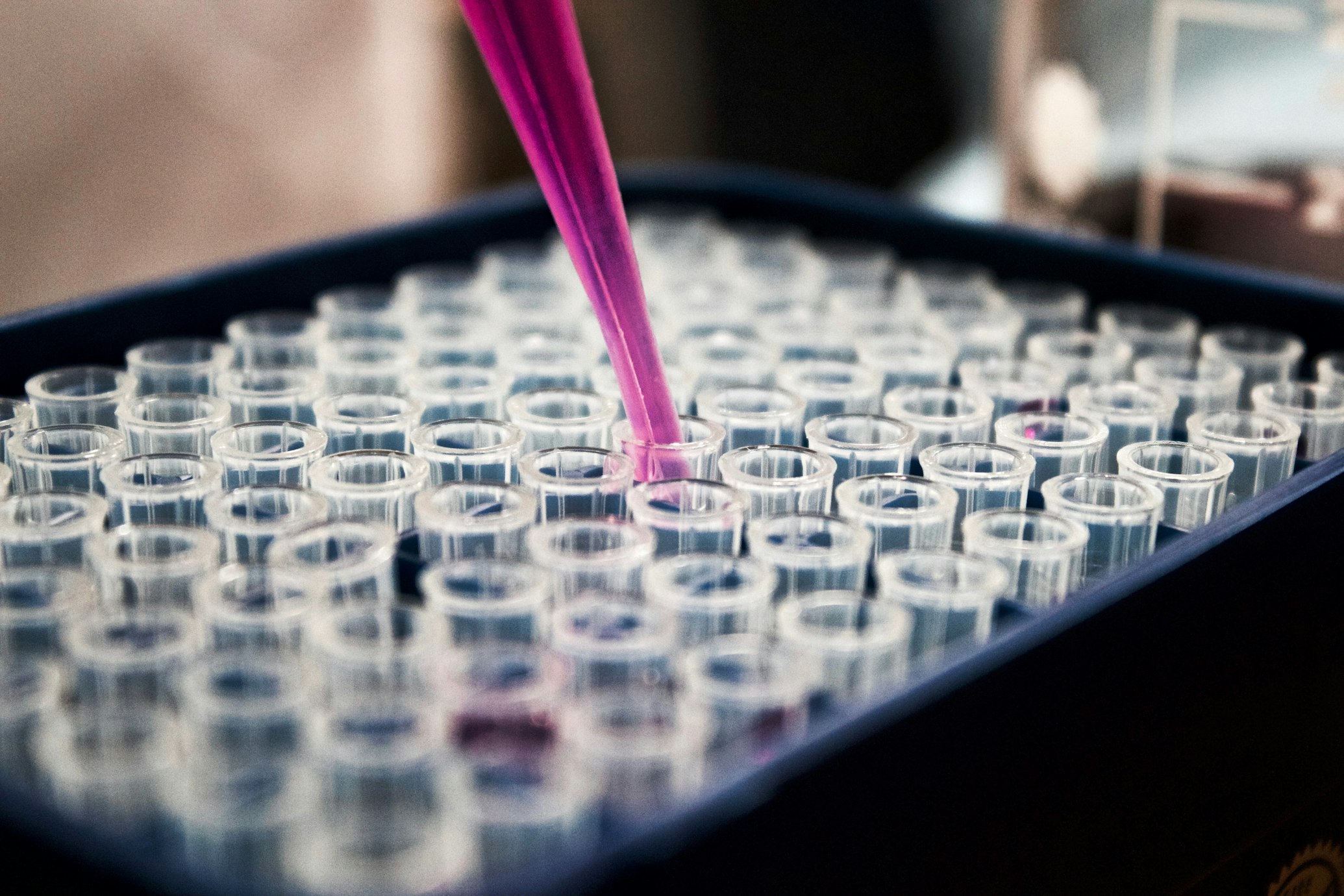
A Deep Dive: The Single-Vesicle Sorting Experiment
The pivotal experiment that demonstrated this power was designed to prove a simple but profound point: can we reliably capture single EVs and then detect both their protein markers and their RNA cargo from the same individual vesicle?
The Step-by-Step Methodology
The process is a marvel of micro-engineering, broken down into four key steps:
Creating the "Parking Spots"
Scientists use a technique called photolithography (similar to how computer chips are made) to create a slide covered in millions of microscopic "dots" or wells. Each well is tiny enough to hold only a single EV. These wells are the micropattern array.
"Tuning" the Assay with Antibody Barcodes
This is the "tunable" part. The bottom of each well is pre-coated with a capture agent—often an antibody that acts like a molecular magnet for a specific protein on the surface of EVs. For this experiment, they used an antibody for CD63, a common protein on many EVs.
Loading the EVs and Washing
A fluid sample containing the EVs (like blood plasma from a healthy donor and a patient with pancreatic cancer) is flowed over the slide. EVs with the CD63 protein stick to their designated wells. A gentle wash then clears away everything else.
In-Situ Analysis (The Double Check)
Now for the magic. The scientists perform two crucial tests on the same captured EVs right there on the slide using protein confirmation and RNA detection techniques.
By using two different colored fluorescent tags, they can see, for a single EV, both its surface protein (what it is) and its internal RNA message (what it says).


Results and Analysis: A Clear Signal Emerges
The results were striking. Under a super-resolution microscope, the slide lit up like a starfield, with each dot representing a single EV. By analyzing the color of the light from each dot, the team could make powerful conclusions.
The core finding: They successfully detected both protein and RNA from the same individual extracellular vesicle. This had never been done so cleanly before.
Data Tables: Quantifying the Breakthrough
| Sample Type | Total Wells Analyzed | Wells with 1 EV | Wells with 0 EVs | Wells with 2+ EVs | Single-EV Capture Efficiency |
|---|---|---|---|---|---|
| Healthy Donor | 1,000,000 | 850,000 | 145,000 | 5,000 | 85% |
| Cancer Patient | 1,000,000 | 820,000 | 150,000 | 30,000 | 82% |
Demonstrates the high efficiency of the micropattern array in capturing individual EVs, a critical prerequisite for accurate single-particle analysis.
| EV Source | EVs Positive for Surface Protein (CD63) | EVs Positive for KRAS RNA | EVs Positive for BOTH CD63 & KRAS RNA |
|---|---|---|---|
| Healthy Donor (n=50,000 EVs) | 48,000 (96%) | 500 (1%) | 450 (0.9%) |
| Pancreatic Cancer Patient (n=50,000 EVs) | 47,000 (94%) | 9,000 (18%) | 8,200 (16.4%) |
A clear contrast between healthy and cancer samples. The low "double-positive" rate in the healthy sample versus the high rate in the cancer sample identifies a powerful disease signature.
The cancer patient's EVs showed a significantly higher presence of the mutant KRAS RNA, a key driver of pancreatic cancer.
This proved the assay's ability to find the "needle in a haystack"—the rare, disease-causing EVs among a crowd of normal ones.
The Scientist's Toolkit
Essential tools that made this experiment possible
| Research Reagent / Tool | Function in the Experiment |
|---|---|
| Micropatterned Slide | The core platform. A glass slide etched with a grid of millions of microscopic wells, each designed to capture a single EV. |
| Capture Antibodies (e.g., anti-CD63) | The "bait." These are immobilized on the wells to specifically grab onto EVs with a matching surface protein. |
| Fluorescent Antibodies | The "protein tag." These glow under specific light, allowing scientists to visualize and confirm which EVs have the protein of interest. |
| smFISH Probes | The "RNA tag." Short, fluorescent DNA sequences that seek out and bind to a specific target RNA molecule inside the EV, making it visible. |
| Biological Sample (e.g., Blood Plasma) | The "soup" of information. The complex fluid from which EVs are isolated, containing the biological signatures of health or disease. |
A New Window into Our Health
The ability to sort and analyze single extracellular vesicles is more than a technical triumph; it's a paradigm shift in medical diagnostics.
Diagnostic Potential
By moving from the blended "fruit puree" to inspecting each piece of fruit individually, we are unlocking a deeper, more precise understanding of human biology and disease.
Technological Innovation
This tunable micropattern-array assay is like giving scientists a super-powered microscope and a set of ultra-fine tweezers, opening a new window into the secret world of cellular communication.
This technology brings us closer to a future where a deadly disease can be caught and stopped by a simple blood test, with a message in a bottle we've finally learned to read.

References
References will be added here manually.